Barley on my mind
(day 1, Monday)
TL; DR: First day of the Springbank Whisky School, so exciting! We spent most of the day in the malting floor – shovelling, grubbing and turning barley while understanding all the steps before milling. We were also treated to a walking tour to discover the sites of the many lost distilleries in Campbeltown!
(missed Part 1?)
On the Monday morning, we woke up early but excited: it was the first day of the Springbank Whisky School! A shower, then breakfast in the dining room: a full Scottish fried up by the lovely Marie, but also some fruits, yogurt, and toasted bread. It was a big plate, and as per usual Gianluigi helped Teresa clean it up! At 8am sharp Donald walked us from the Still Guesthouse to the distillery (only 5 minutes or so away).
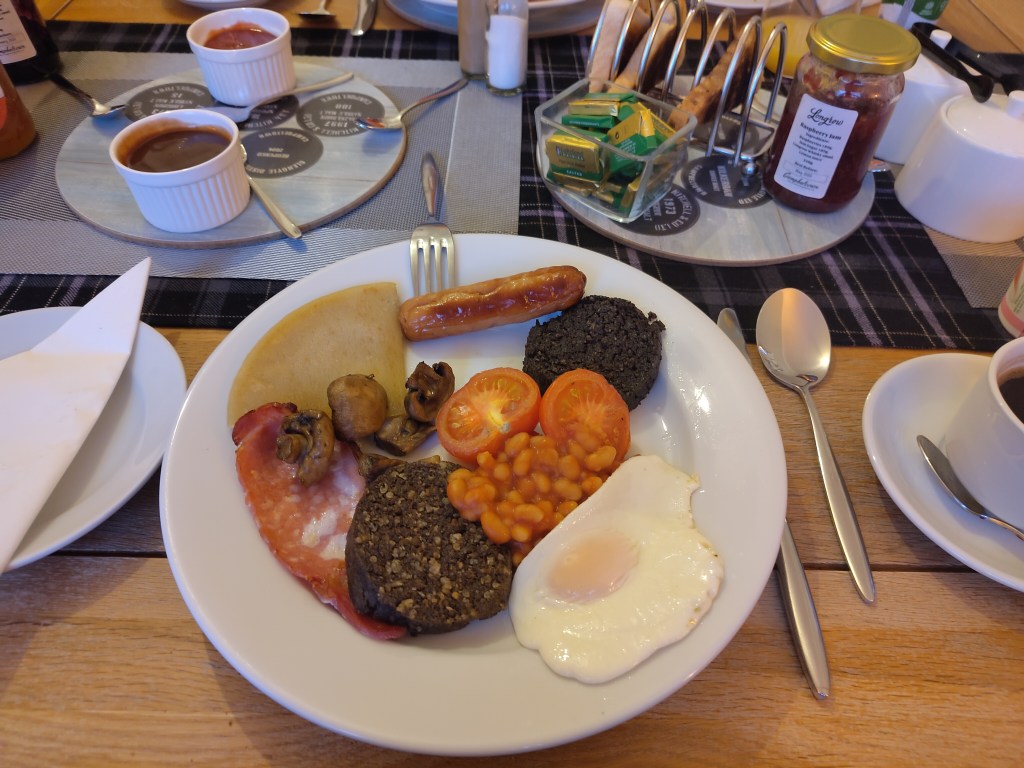
Big breakfast for a big day ahead.
While arriving we saw (and smelled) grey peat smoke coming from the distillery kiln chimney: maybe no pope were made on that day, but still a very good sign! We met the distillery manager Gavin introduced himself and the school, gave us some study material, and briefly showed us around: first our lockers in the staff room, then a brief distillery tour.
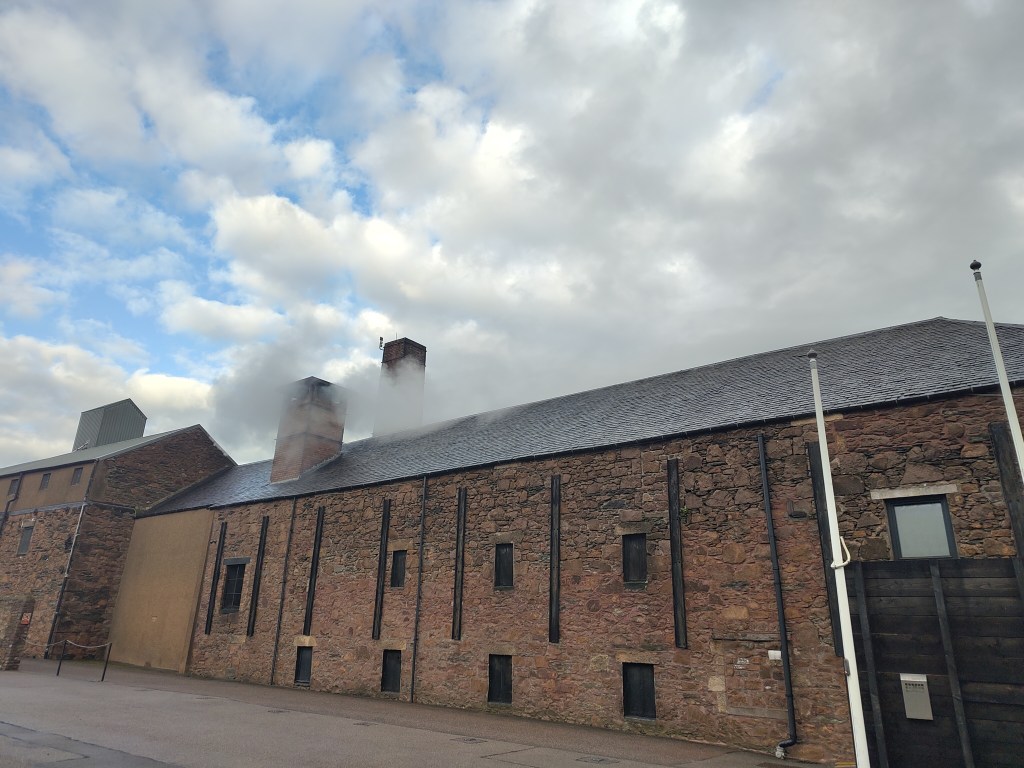
Kiln in action!
But soon after, it was time for us to get “serious” and…Shovel barley! (We’ll spare you the jingle that Gianluigi came up with, but yes, there was a jingle about shovelling barley.) A little premise here: malting is a key part of Springbank’s production: for a long time, they were the only distillery where every step was done on site, from malting to bottling. Now Dunphail distillery (in Speyside) is also malting 100% of the barley on site, while other distilleries are at 10%-30% (Kilchoman, Laphroaig, and Bowmore on Islay, Benriach and Balvenie in Speyside, Glen Garioch in the East Highlands – we might have missed some). Most of the Scottish distilleries source malt from maltsters (or send theirs to be malted elsewhere, like Ballindalloch, Bruichladdich or Daftmill). For Springbank, the decision to keep malting in-house was not by accident, as for a period between 1960 and 1992 they also sourced it outside. It was Hadley G. Wright, the former chairman of J&A Mitchell (sadly passed away in 2023), who decided to bring it back to create more jobs for the Campbeltown community.
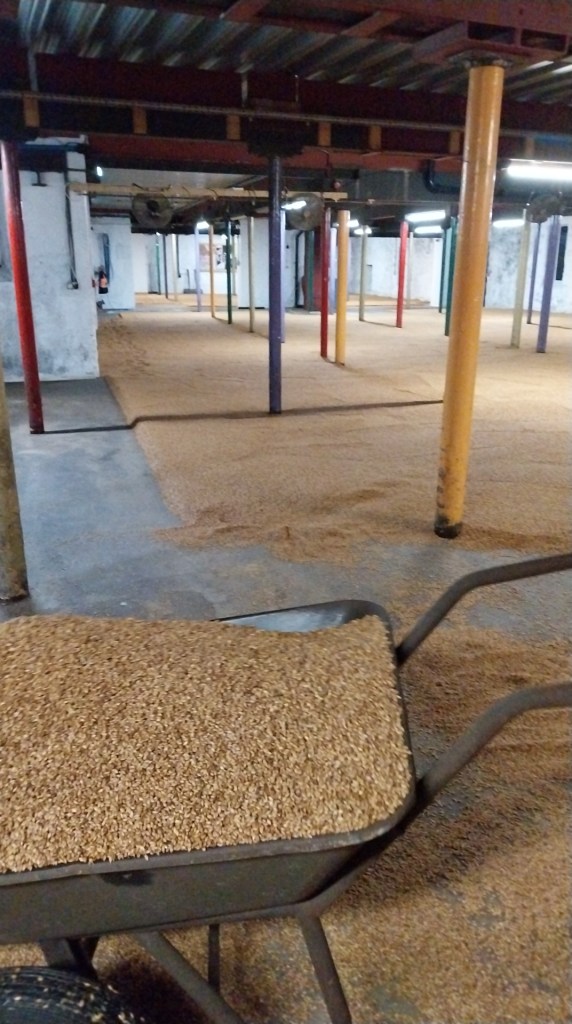
Malting starts by taking the green barley from the bins where the lorries unload it. When ready, it is transported with a conveyer belt through three hatches into the steep tank (13 tons if it goes to the slightly larger lower malting floor, 10 tons if it goes to the upper malting floor), where it is soaked with water for 14 hours. Water is then drained, and after 12 hours the barley is soaked again for another 14 hours. After draining, it is shovelled through another hatch if it goes to the lower malting floor, or shovelled outside the steep if it stays on the upper floor. That day we were on the lower malting floor, and a pile of wet barley was waiting for us, ready to be spread. So, for about 30-40 minutes, we shovelled barley on to wheelbarrows, that we then used to spread it on the floor, under the supervision of Joey and John, who levelled out the most uneven bits. Being five (plus the staff) doing it, it went quickly, and it was already time for the 10am break, when we gathered at the washback bar for a hot drink and some sweet treats.
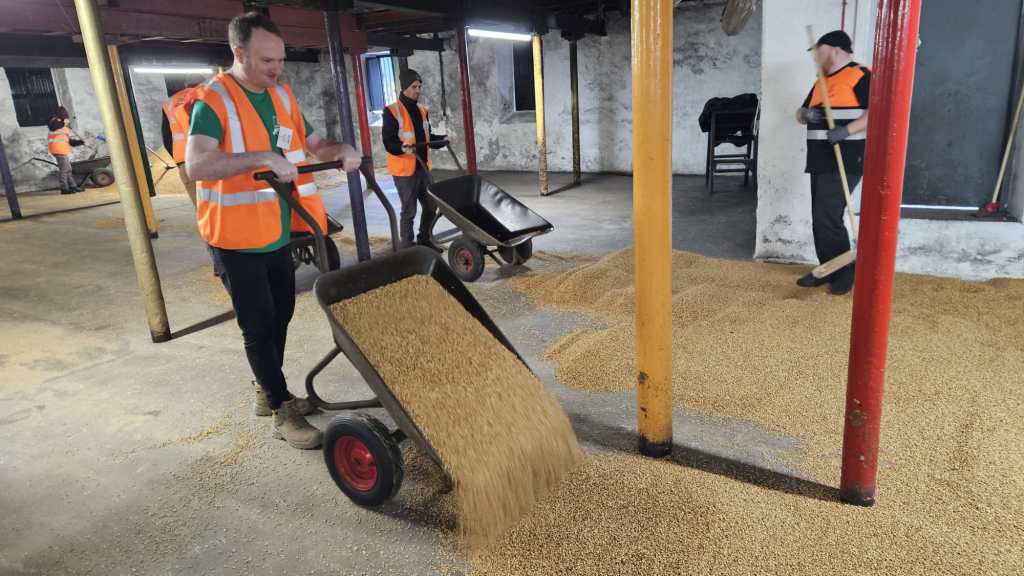
Working hard. Were we doing a good job? Oh well.
The second activity of the day was a walking tour with Findlay, hunting down the sites of lost distilleries. Having read David Stirk’s Whiskypolis book recently, Gianluigi was already acquainted with the story of the 30-odd distilleries that used to be in town. Only two survived all the shocks of the late 19th and early 20th centuries, that led to many closures in the 1920s and 1930s. The two are obviously Glen Scotia (formerly only Scotia) and Springbank, while Glengyle was resurrected in 2004 by J&A Mitchell in order for Campbeltown to retain its official whisky region status. And we’re happy for that, as Kilkerran (the brand name under which they sell Glengyle’s whisky, as the name is owned by another company) is a tremendous dram! Two other old distillery names live on as Springbank variants: Longrow, heavily peated and double distilled), and Hazelburn, unpeated and triple distilled. Some of the spots gave it away that there used to be a distillery – for example, Benmore is a now the name of the street, but you can still see half of its pagoda roof and the name on the old gate.
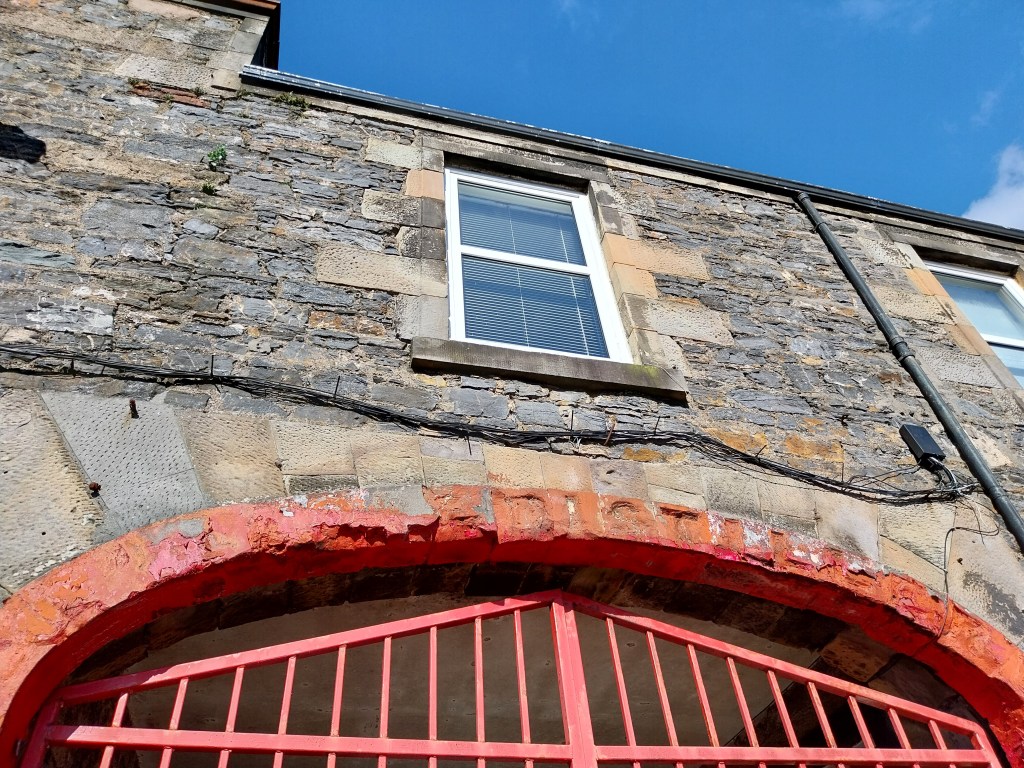
What remains of a glorious past.
Some others were less straightforward to spot, like the site of Lochead distillery, which is now home to…a Tesco. Apparently, when they had their application approved by the Argyll and Bute Council, they were supposed to include in the architecture something that hinted at the fact that there used to be a distillery, so they came up with “pagodas” on the roof. Pardon our French, but they look a bit shite. The old Hazelburn distillery is, instead, one of the best-preserved buildings. Some warehouses of Glen Nevis also survived. Nice touch, during the tour we also popped into Glen Scotia, where we said “hi” to Greg, who gave us the excellent Warehouse Tasting back in December.
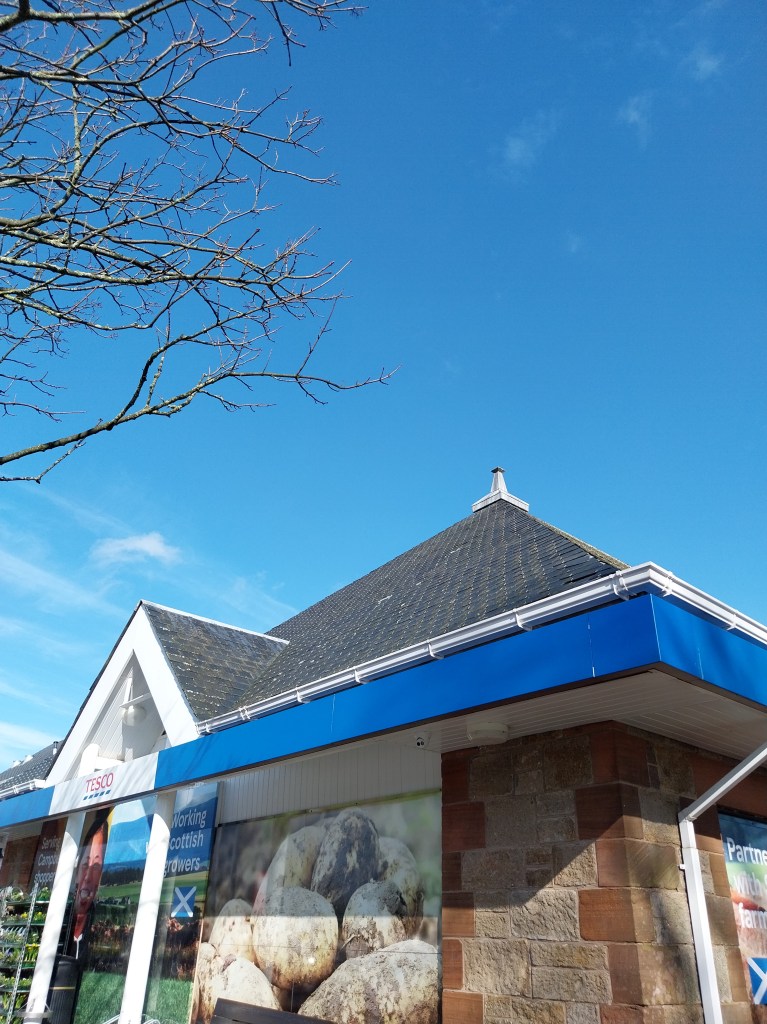
The oddest rendition of a pagoda.
After the tour, it was time for lunch back at the Still Guesthouse: scotch pie, keeping it traditional. Common theme for the whole week: the food was delicious, we were (happily) spoiled! Anyway, after the one-hour lunch break, we were split in two groups, Graham and the two of us in one, and Robert and Stephen in the other. While Robert and Stephen went on to look at mashing, fermenting and distilling, we went back to the maltings, where the staff showed us all the nitty and gritty of what is done there. First, we watched the steep tank being filled in with barley, and how it gets evened out. To see how the steep tank gets filled with water, we had to wait for the next morning.
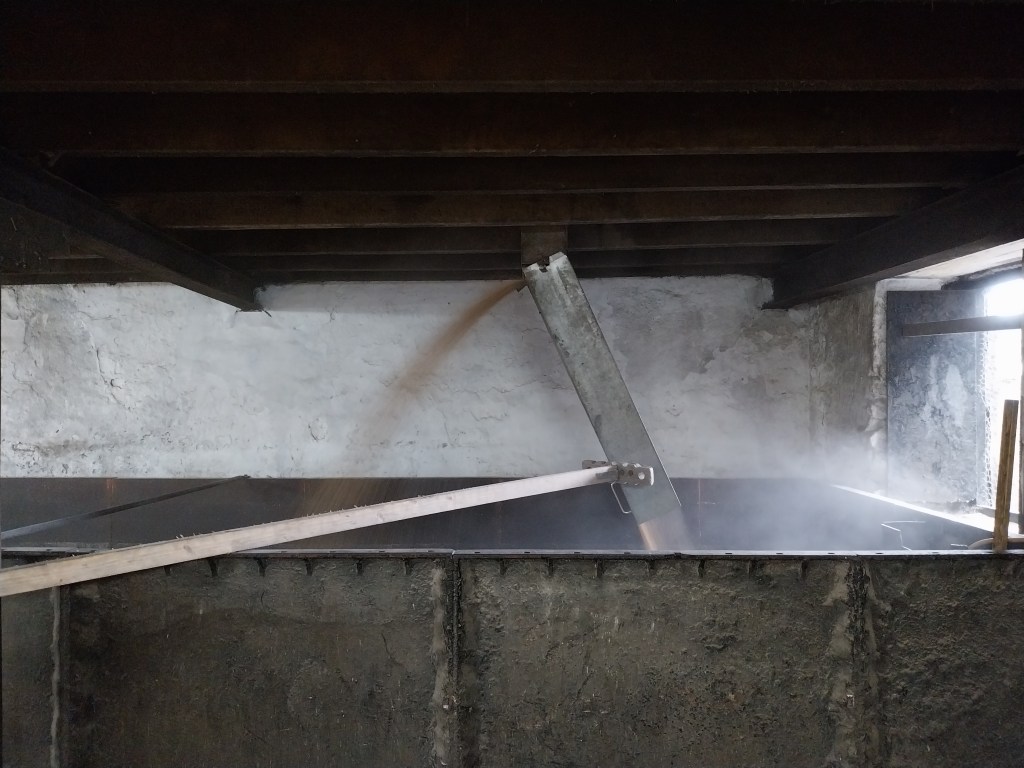
Step 1, filling the steep tank with barley.
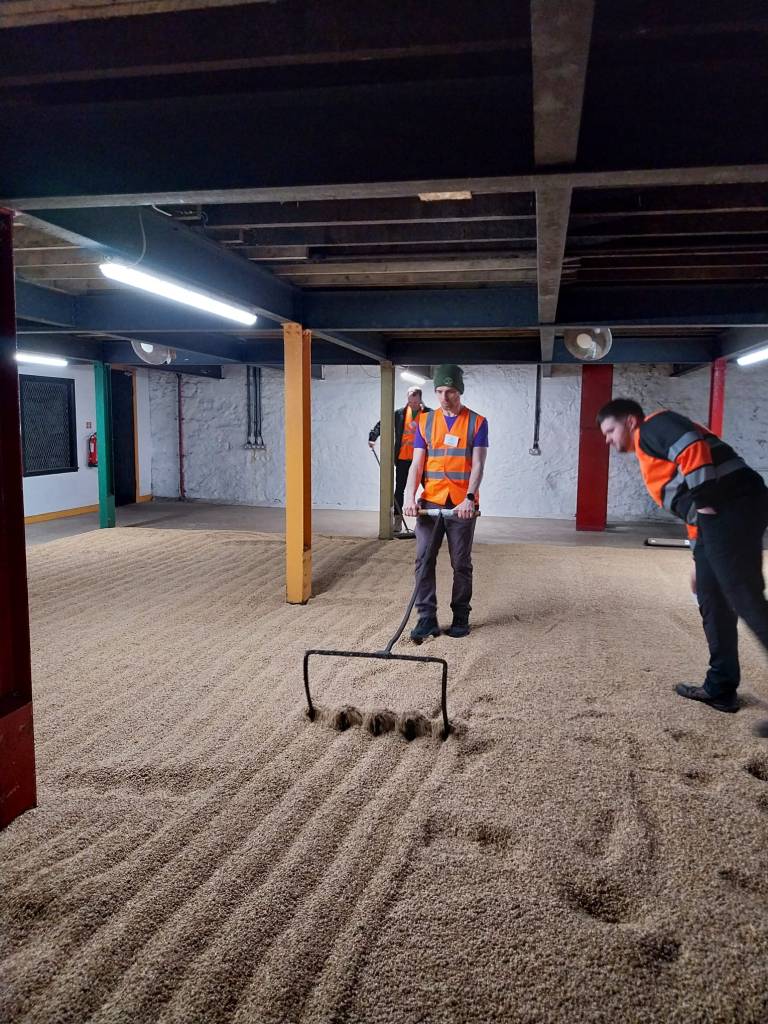
Anyway, once spread on the floor, the barley is turned every four hours to keep it aerated and break up rootlets. The three of us got to turn a few rows of barley with both the grubber (manual) and the turner (electric). Every step and relevant information is noted down on paper registers, things like when the barley is turned, temperature, humidity, etc. It was quite exciting to see some old registers going back many years!
Quality control.
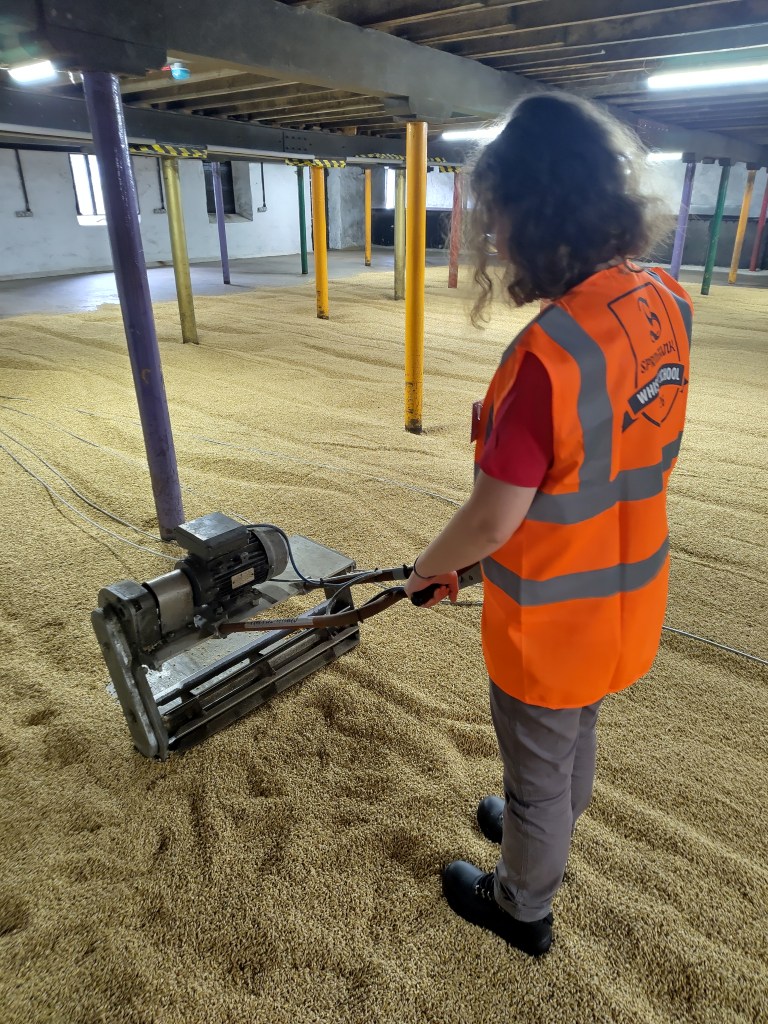
Turning…Less easy than we thought!
The team then took us outside in the internal courtyard, where they keep both wet and dry (under a shed) peat, and where the old oil tanker still lays, which was used before they switched to natural gas. Back inside, we went up to the last floor, which is not used to spread malt, but to store the barley from two local farms (wink, wink) waiting to be processed. It’s also where we could see the top of the malt bins (and a conveyer belt!).
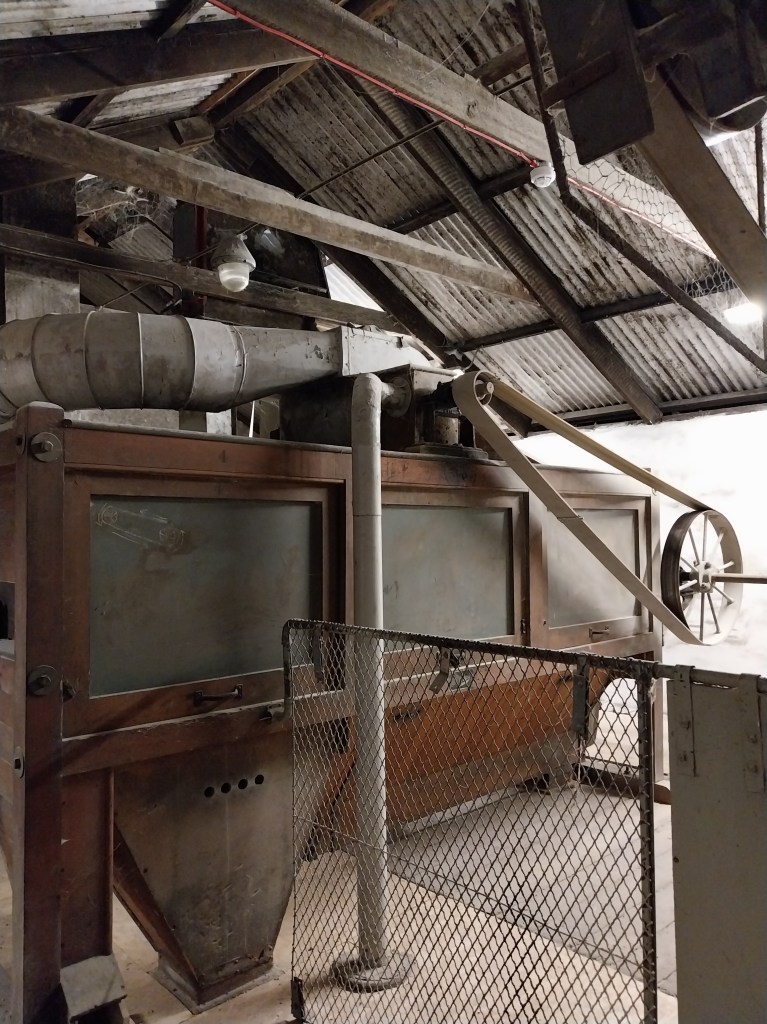
The oldest destoner we ever saw.
We then checked out the destoner above the Porteus mill, a very old piece of equipment in a wooden box, which weighs the malt to send to the mill in 25kg “coups”. All very nerdy details, and of course we loved it!
With that, our first day was over. While the afternoon was a bit slow, it was a solid start of the school, and we were looking forward to the second day! We went back to the guesthouse, where Sandra had cooked us a delicious dinner, chicken Balmoral with fava beans and mashes, followed by a trifle: we still dream about it! We then had a couple of drams with Stephen and Robert in the sitting room, before retiring to our rooms.
Stay tuned to know more about our second day! Until then, slàinte!
Springbank Whisky School
Link: https://www.springbank.scot/whisky-school/


