#36 The Stirling Distillery

Distilling underneath the castle


TL; DR: Very gloomy Sunday afternoon, we decided for a last-minute distillery visit not far from Edinburgh: the Stirling Distillery. Very close to the Stirling Castle, they distilled only gin until very recently, when they added malt whisky (well, newmake spirit for now) to their portfolio. 

Most of our trips (in particularly whisky trips) are carefully planned in advance, mainly because of the popularity of distillery visits nowadays. Of course, we donโ€™t want to risk travelling to a distillery and being told theyโ€™re fully booked, it happened once during a non-whisky trip and it was disappointing. Careful planning also helps because Scotland is not the easiest country to travel, with ferries, single track roads, etcโ€ฆAnd before we got Mr Vantastic, finding reasonably priced last-minute accommodation was always a challenge.

Sometimes though, we can still sneak in a last-minute whisky trip, and this was the case of todayโ€™s story. On a Sunday at the end of October weโ€™d planned to take the van and go somewhere for a walk. However, as usual when we plan outdoor activities, the weather was dire: dark, gloomy, rainy (we should probably just buy waterproof walking gear at this pointโ€ฆ). So, instead, we went to a new whisky distillery: the Stirling Distillery!

This is one of the newest whisky distilleries in Scotland, and as the name reveals, itโ€™s in Stirling, on the same hill that leads to the magnificent Stirling Castle (one of the most interesting to visit, and where Kings of Scotland stayed until the end of 1500s). Unlike many others, the distillery has not been talked much about in the whisky world, itโ€™s not even mentioned in the very comprehensive Malt Whisky Yearbook 2024, despite the notable feature of starting distilling whisky in the town of Stirling for the first time after more than 170 years. We can think of two possible reasons for this: first, itโ€™s tiny, definitely a craft operation (see later for more details). Second, and more importantly, owners June and Cameron conceived it as a gin distillery in the first place, all the way back in 2015, with the aim to โ€œreflect the Stirlingshire countrysideโ€ in their gin, and only very recently they moved to new make spirit.

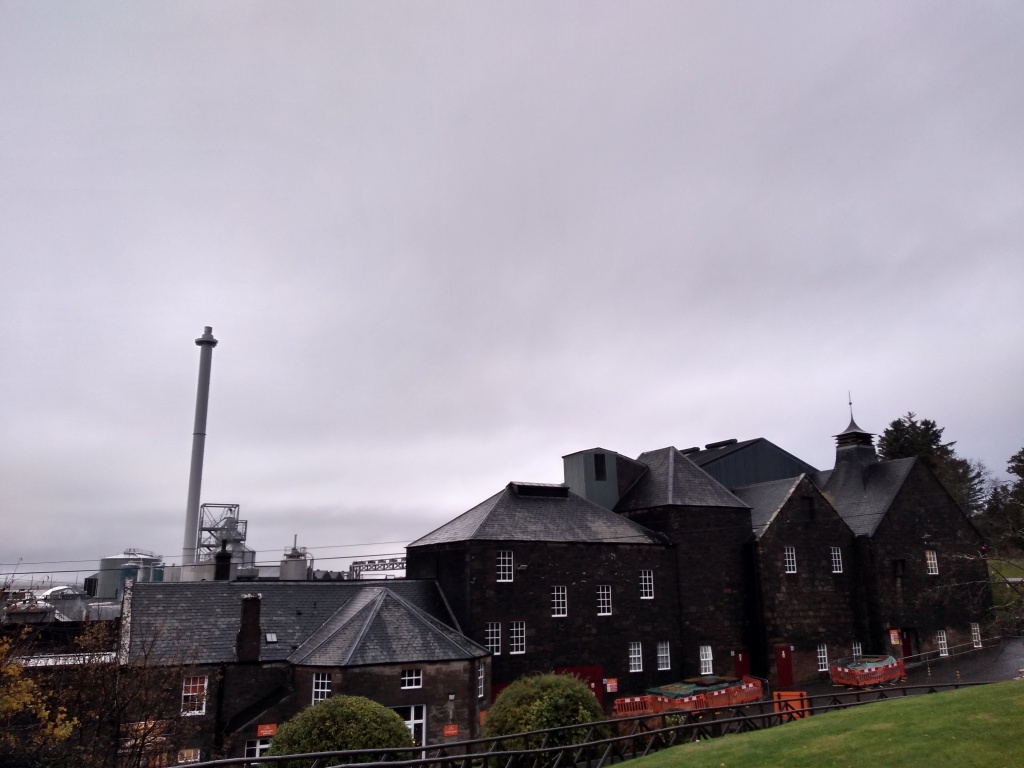
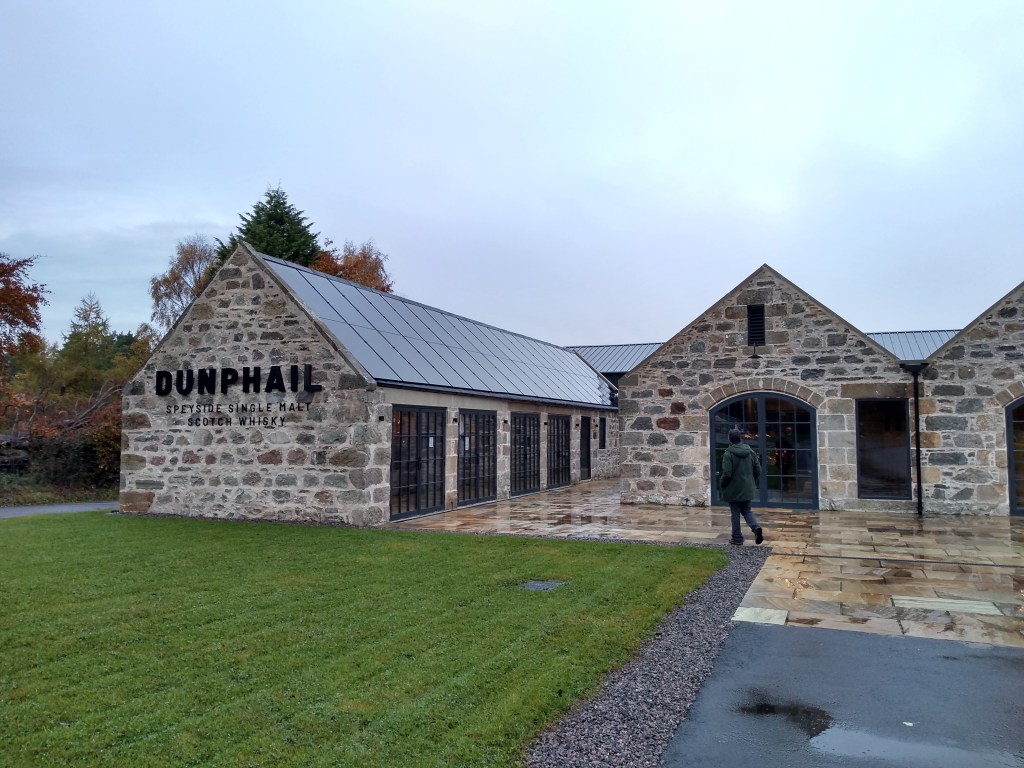
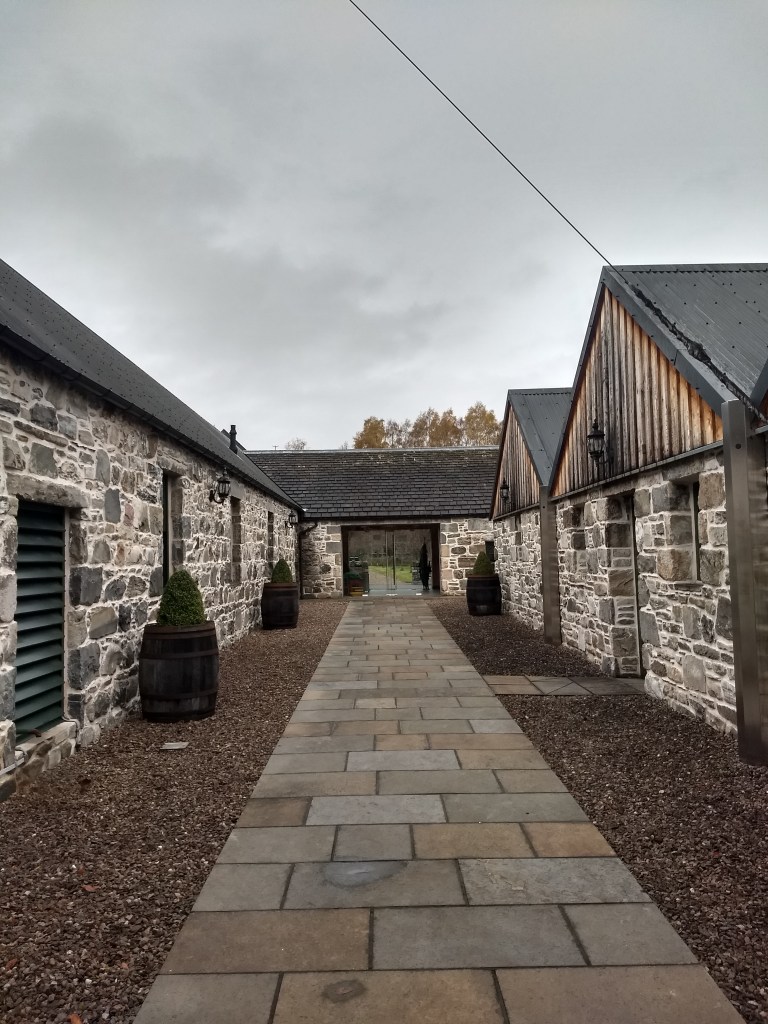
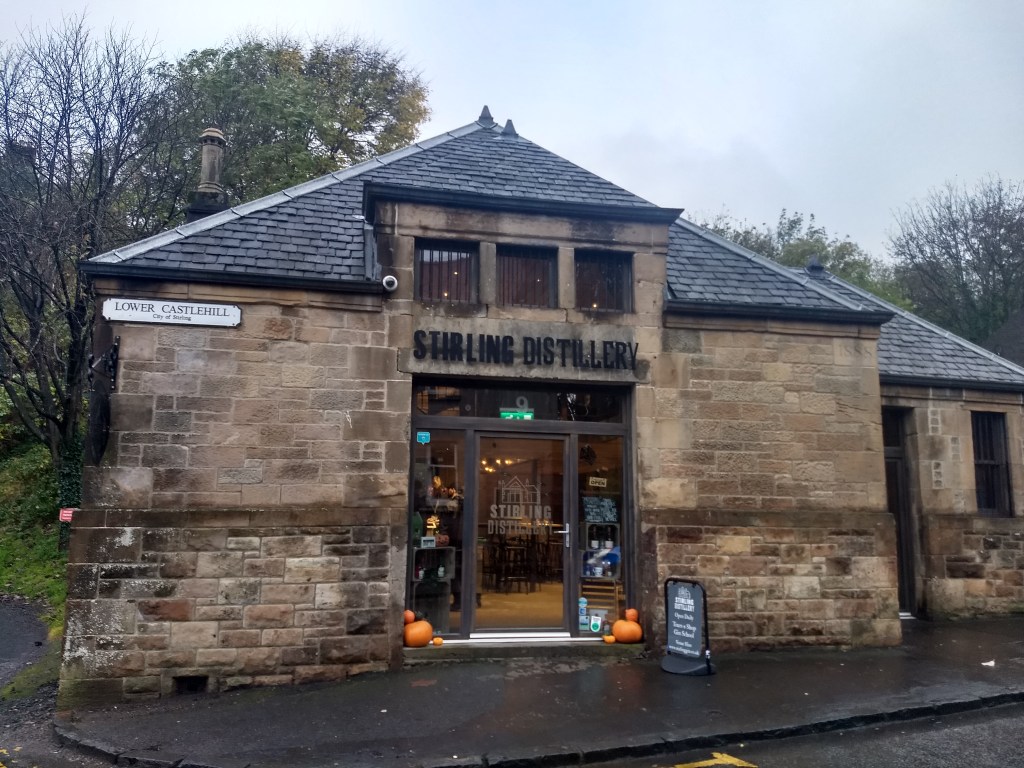
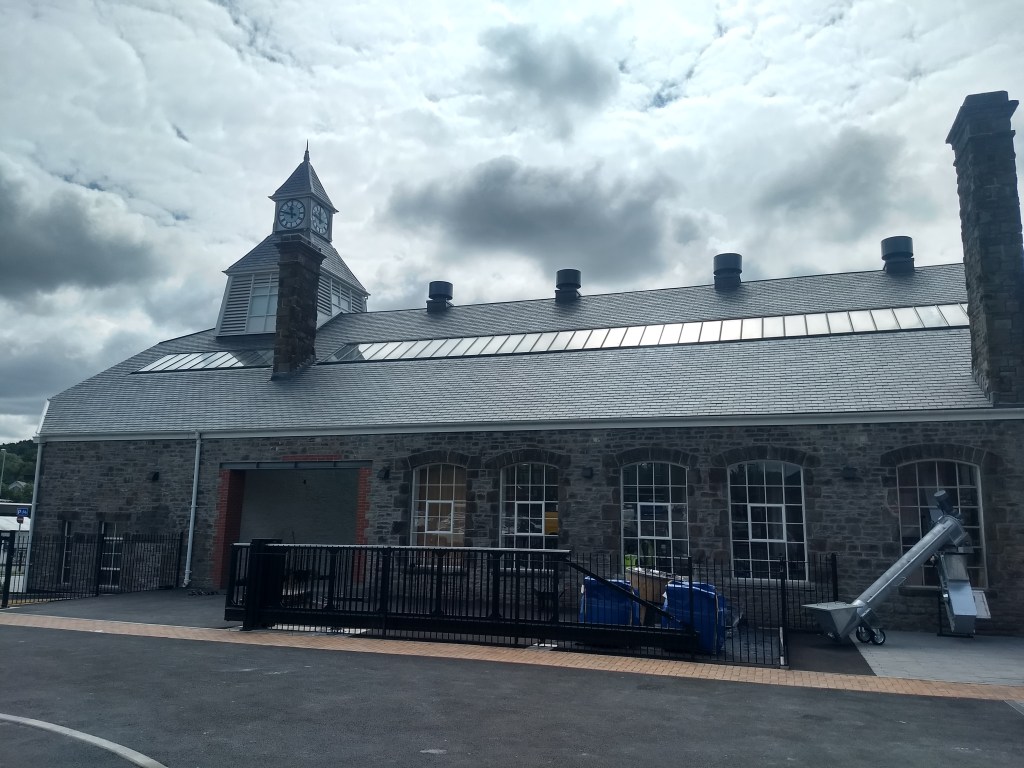
So there we are, under a dire weather, after an almost-hour drive from Leith. The stone building is very beautiful, we will soon find out that it was called โ€œthe Old Smiddyโ€. Built in 1888, funnily enough it used to be a church temperance hall and a blacksmith. The distillery moved there in 2018, although they also have a warehouse and gin production in the Stirling outskirts. They have two experiences, one dedicated to gin and one to whisky, with the latter being very new as whisky production had only started 2-3 weeks before our visit. They also offer a gin school for ยฃ90 (or for ยฃ140 for the couple, quite unusual to find such discounts in the Scottish whisky landscape).

…and inside!

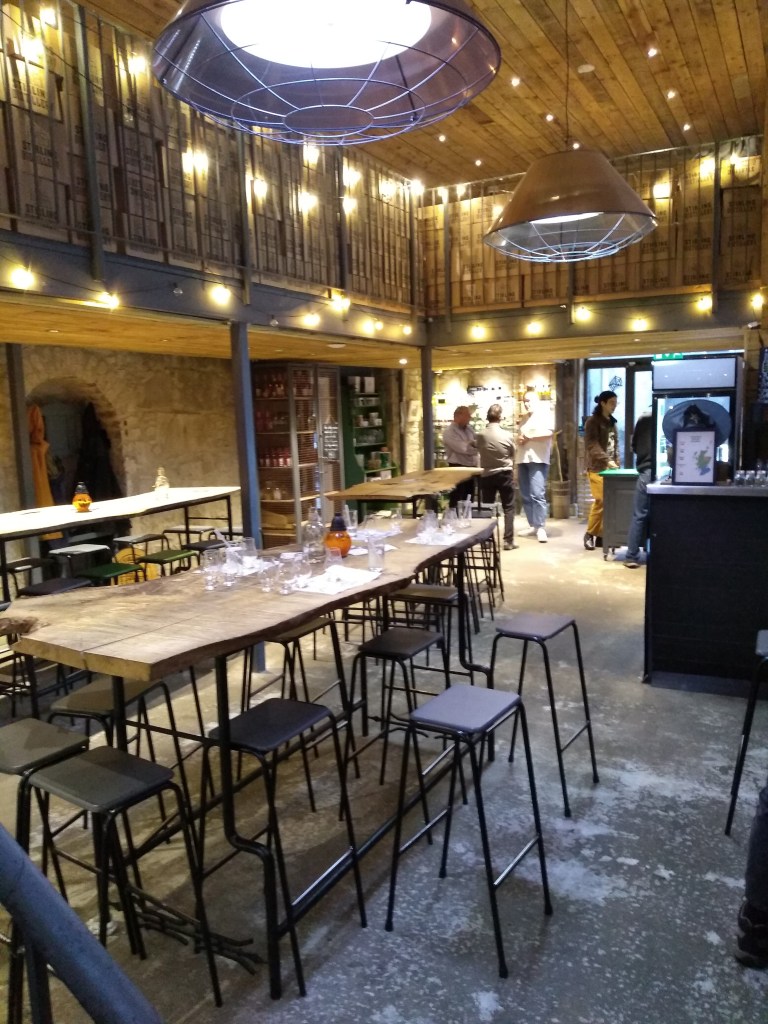
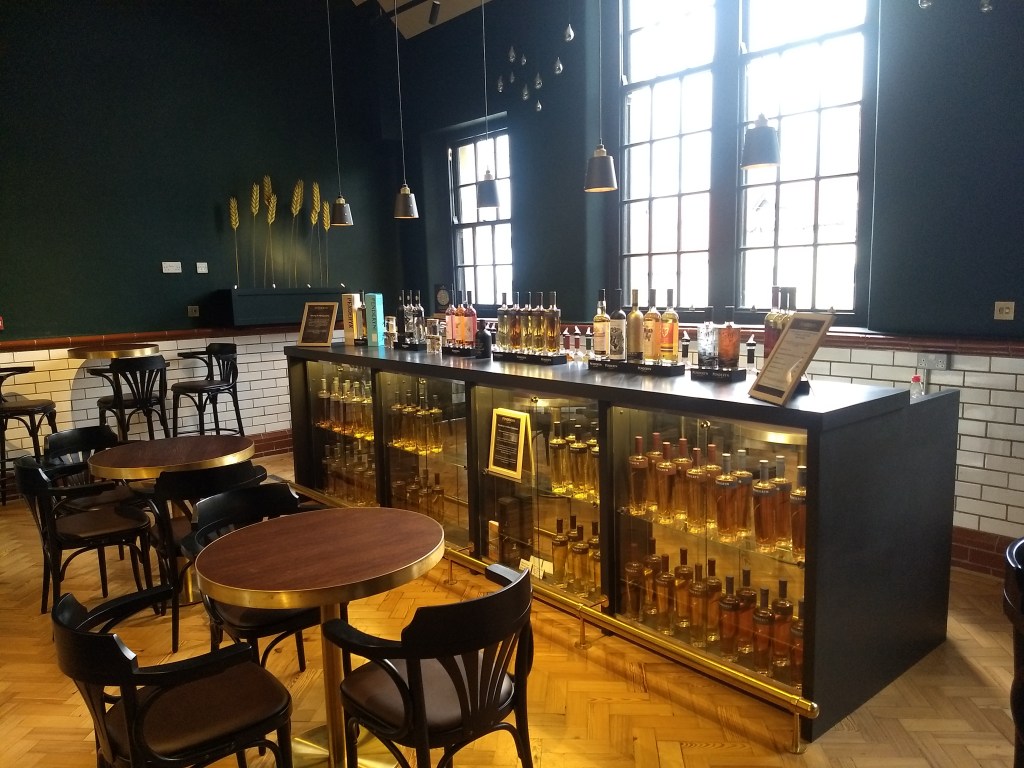
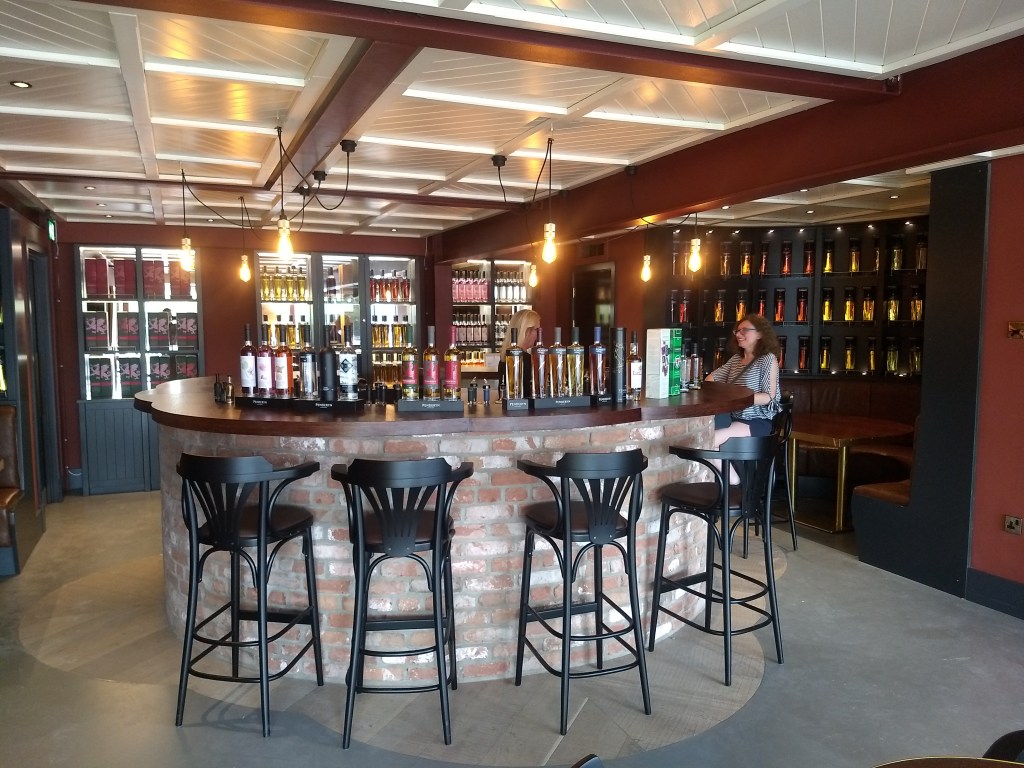
The building is very beautiful inside too, with low lights creating a very peaceful atmosphere. On the right side there is the shop, and on the left the bar, offering a variety of beverages (including soft drinks). There is also a mezzanine where we didnโ€™t go, it looked like an office/warehouse space. The guide for the day, Kiran, told us he was mostly into gin and cocktails, and that was one of his first whisky tastings. When all visitors had checked in, we started the tasting, which included four single malts from their independently bottled range called Sons of Scotland (all non-chill filtered, not artificially coloured and bottled at 50%).

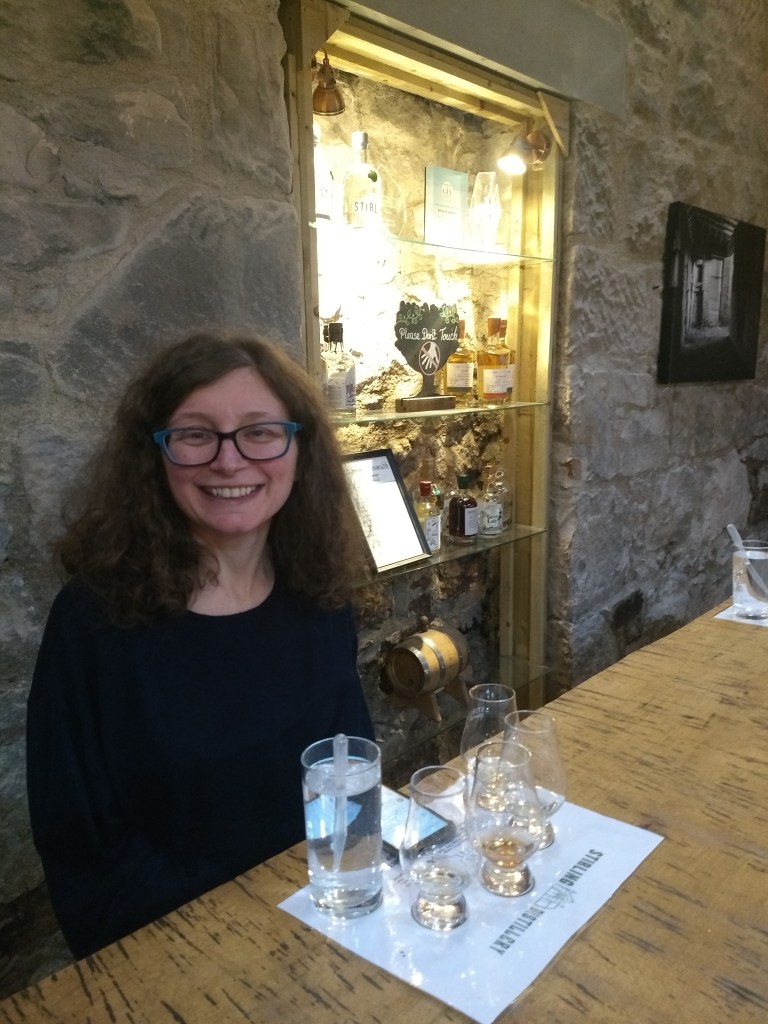
Guess who’s not driving today.

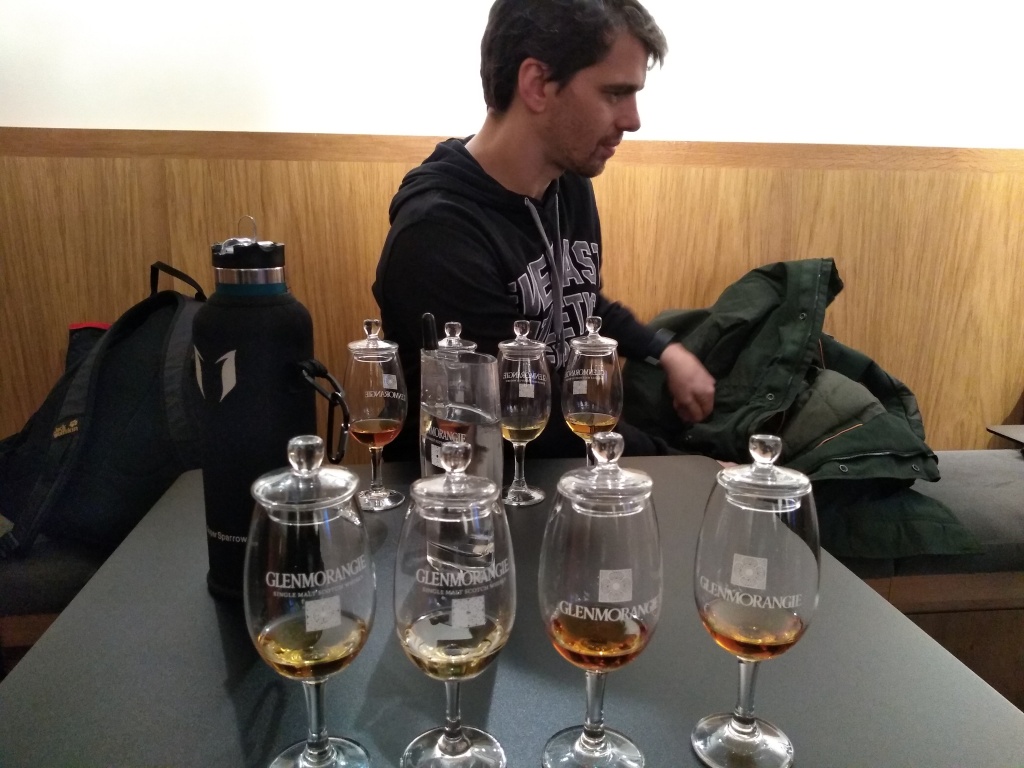
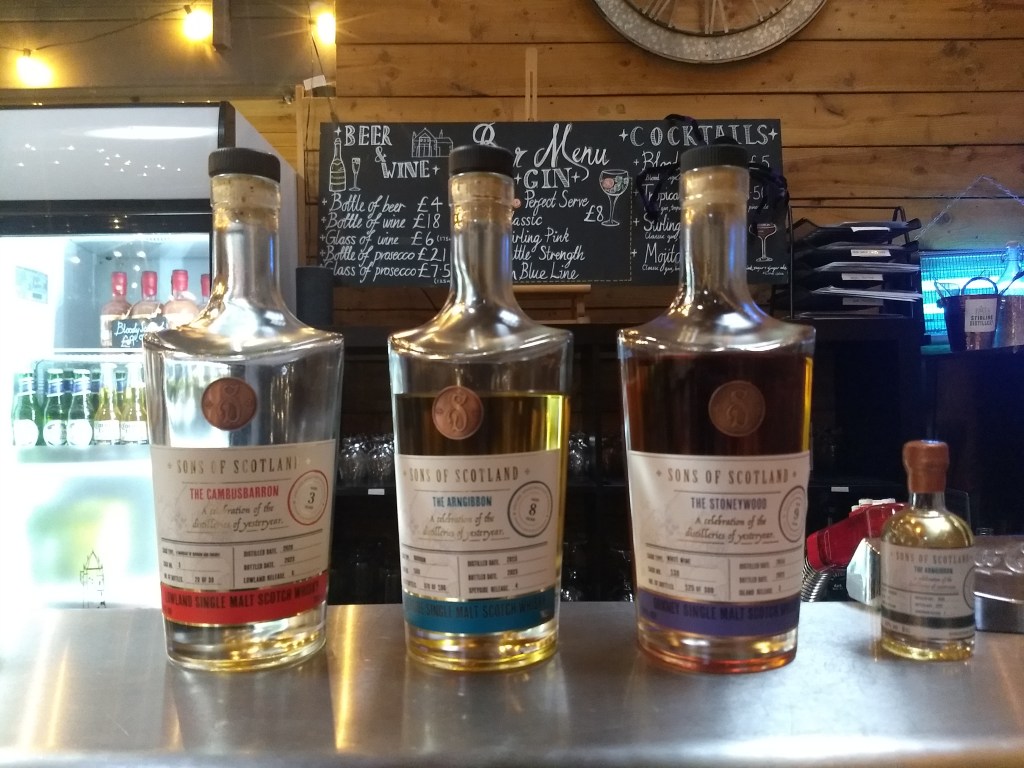
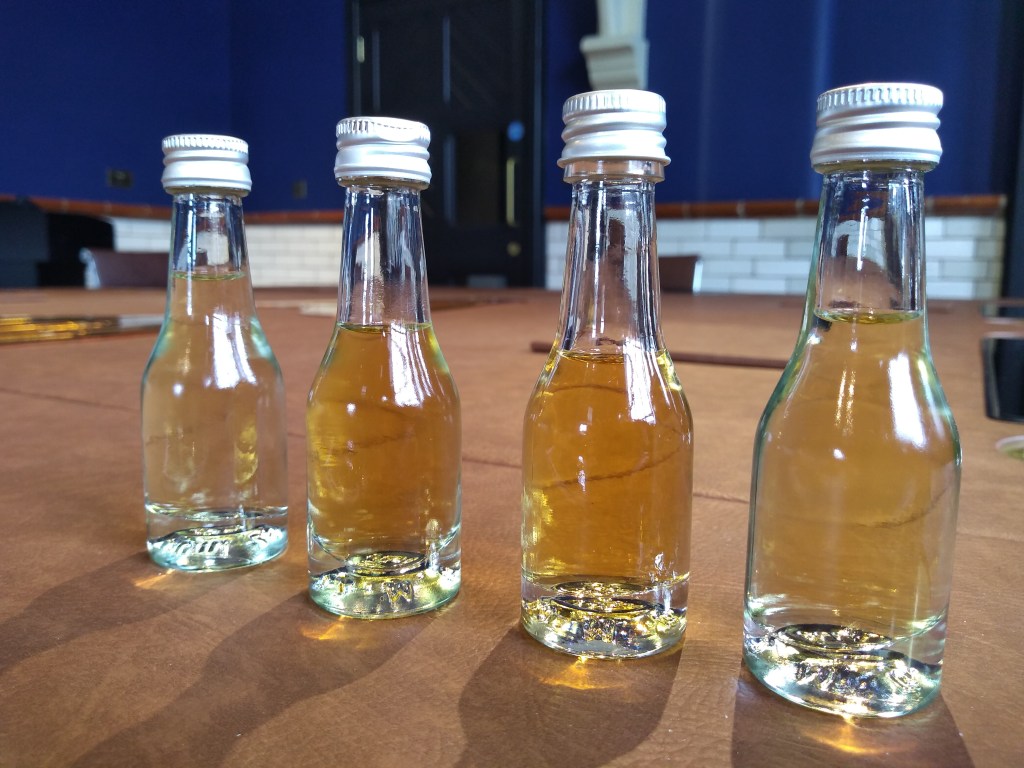
The expressions we (well, Teresa) tried are named after historical distilleries near Stirling. The first (*) was the Cambusbarron (batch 3), a 3y Lowlands whisky (vintage 2020) matured in a combination of ex-bourbon and ex-sherry casks. The second dram was the Arngibbon (batch 4), an 8y Speysider (vintage 2015) matured in ex-bourbon casks. Then we tried the Stoneywood 9y, an Orkney whisky (vintage 2014, we still wonder which distillery this was from), finished or fully matured (we didnโ€™t get it) in ex-white wine casks (batch 3). Finally, we tried a previous batch of the Arngibbon (batch 3), a 14y Speysider matured in ex-bourbon and ex-sherry hogsheads (vintage 2008). Overall a nice string of drams, with the Orkney one being definitely the most interesting.

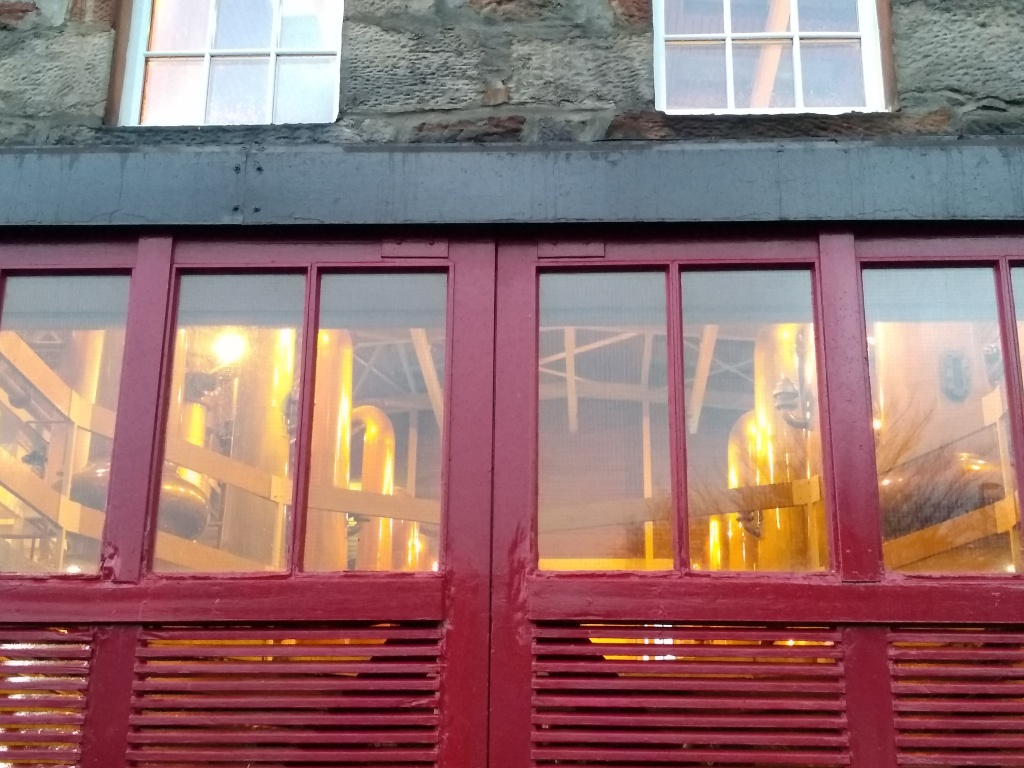
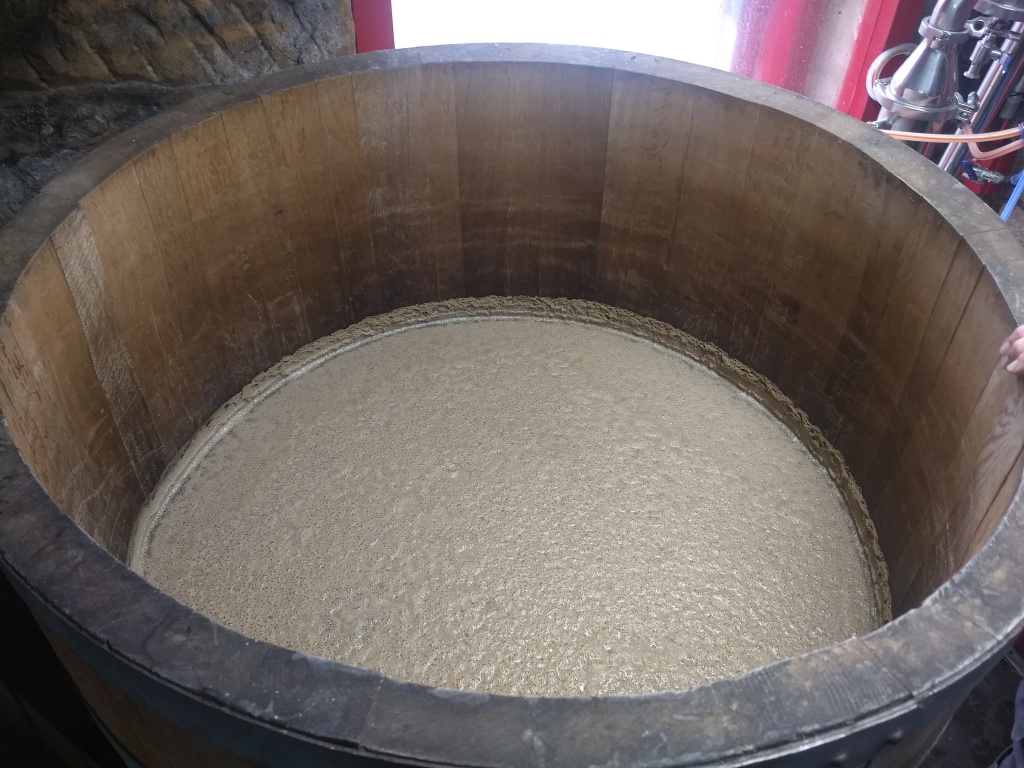
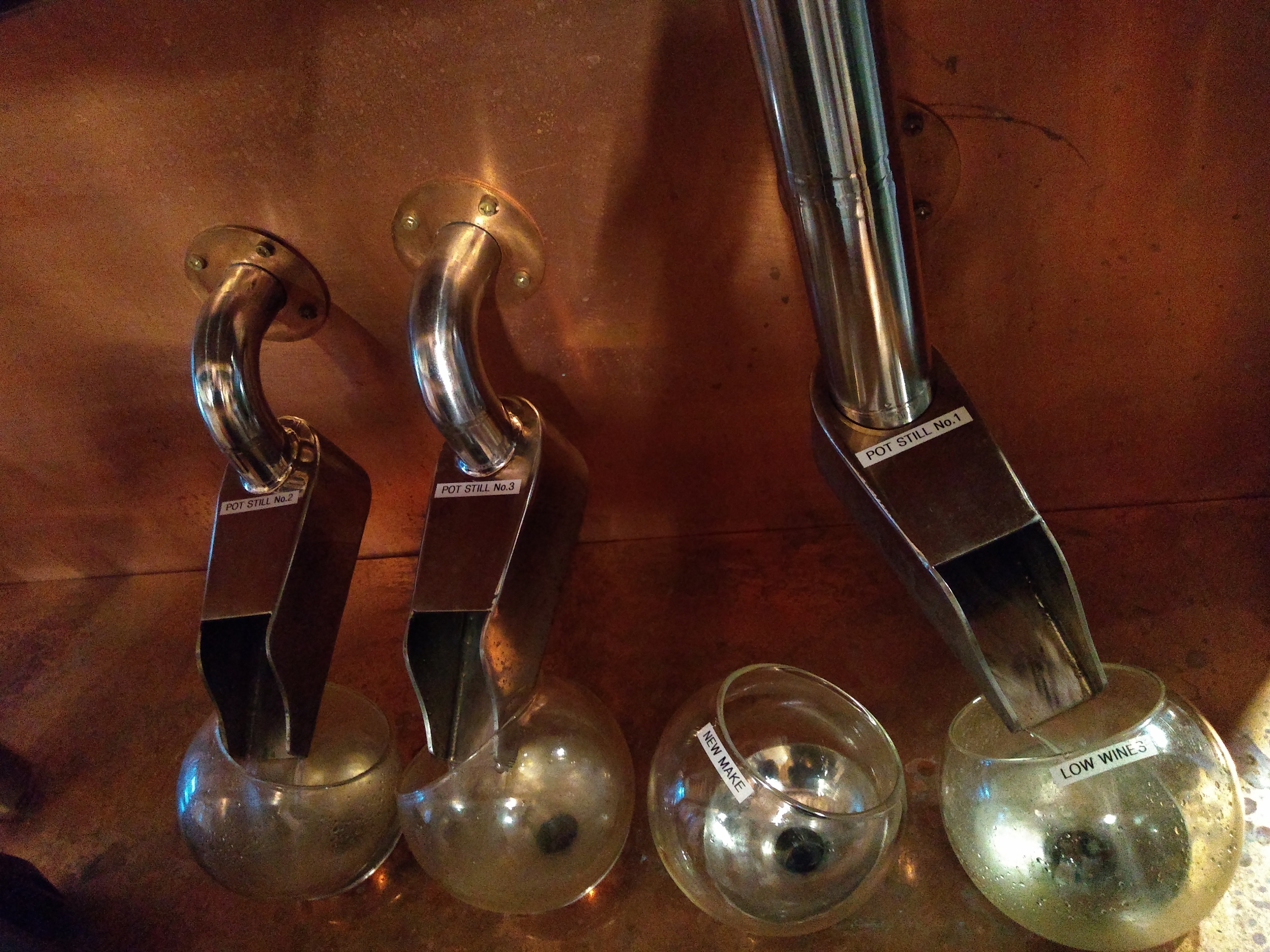
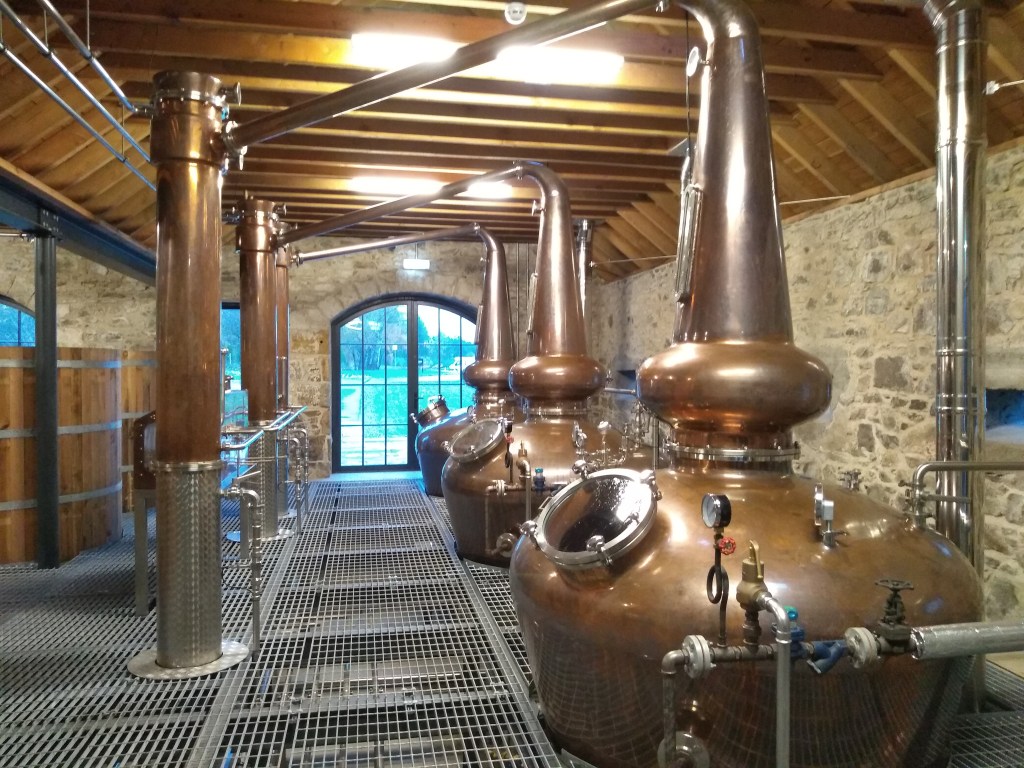
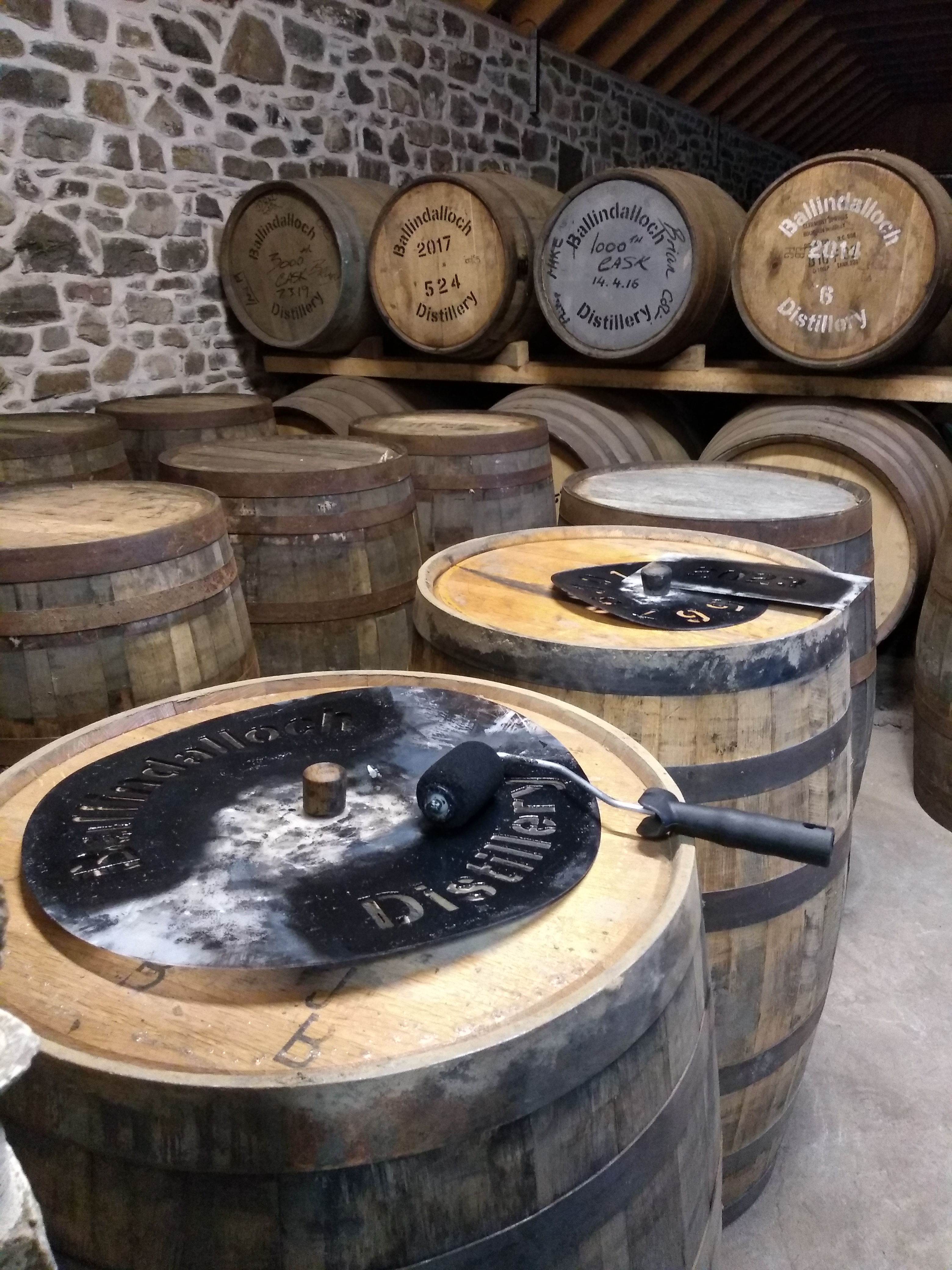
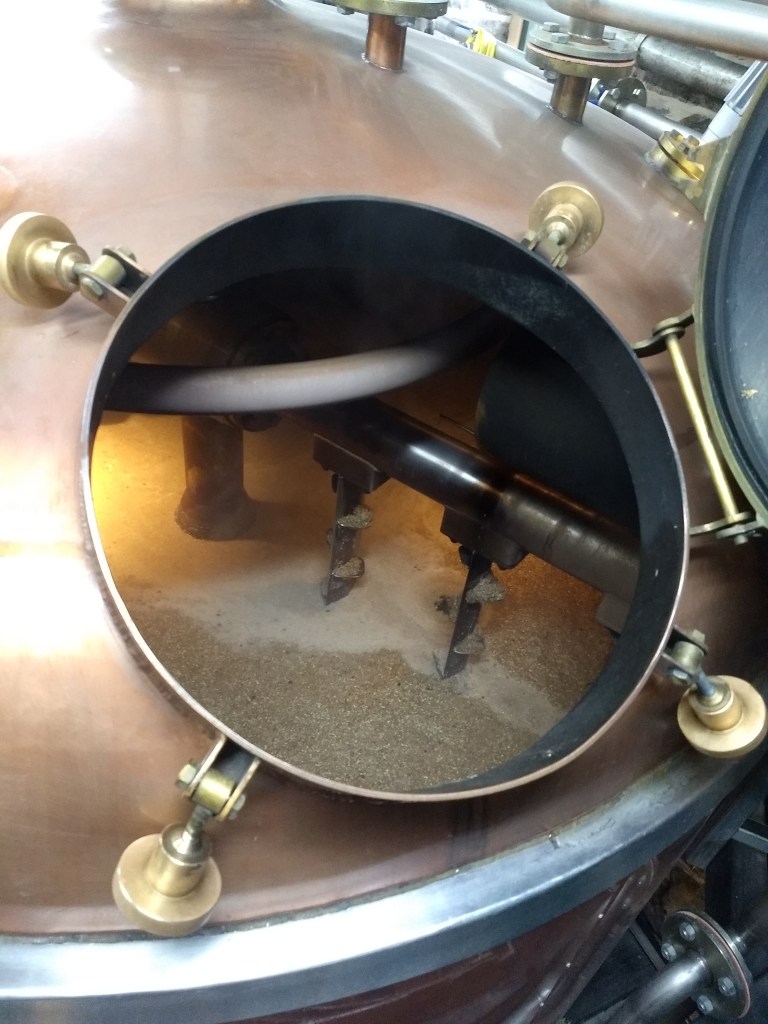
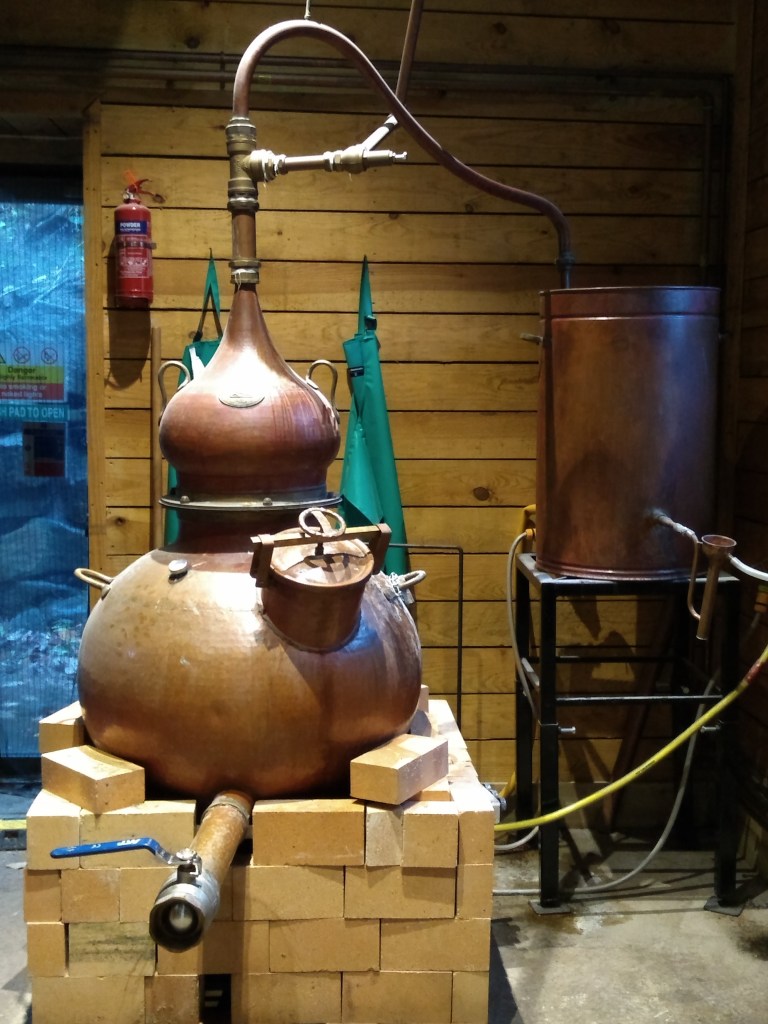
After the tasting, Kiran showed us the whisky production, which is entirely happening in a separate part of the building, all in the same relatively small room! They buy malted barley grist (pre-milled), which they mash on site stirring by hand. Then they move it into two fermentation vessels, where it ferments for 4 days (96 hours approximately, they use distillerโ€™s yeast). They finally distill it twice in the same 170-litre copper pot still, a very beautiful Portuguese still, named Flora after Juneโ€™s mother. The spirit comes out at 70%abv, and it is first put into plastic jugs, only later transferred in casks at the warehouse for maturing. Edit (April 2024): they later installed a second still, to fully comply with the SWA regulations.

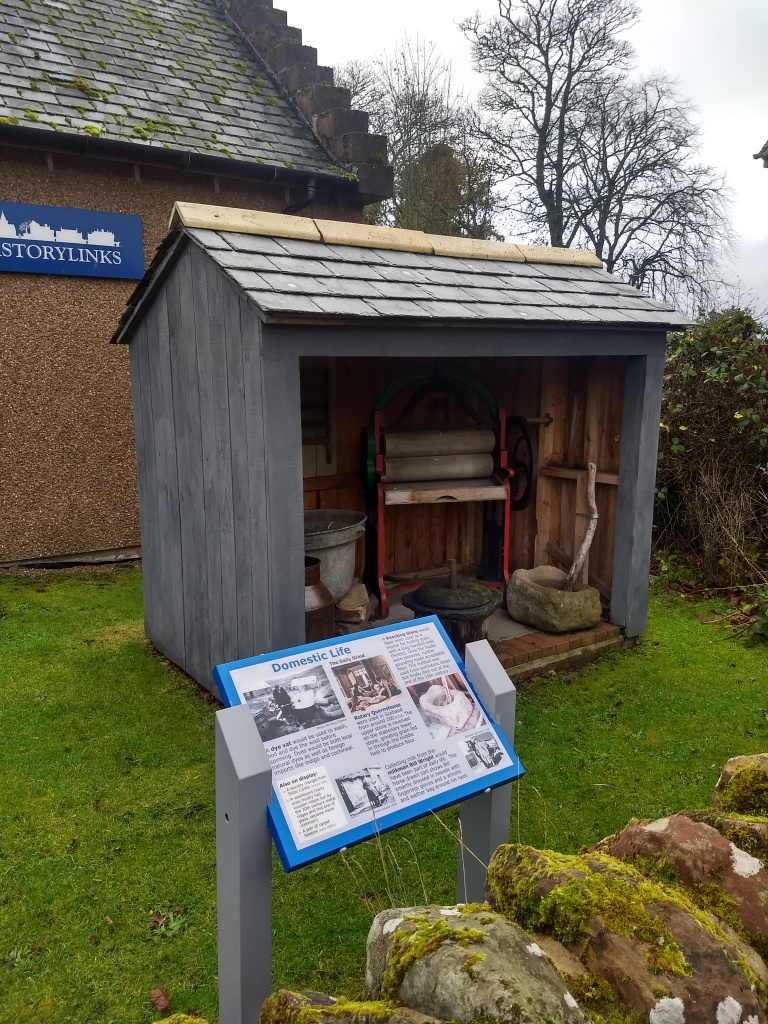
The wee distillery shed.

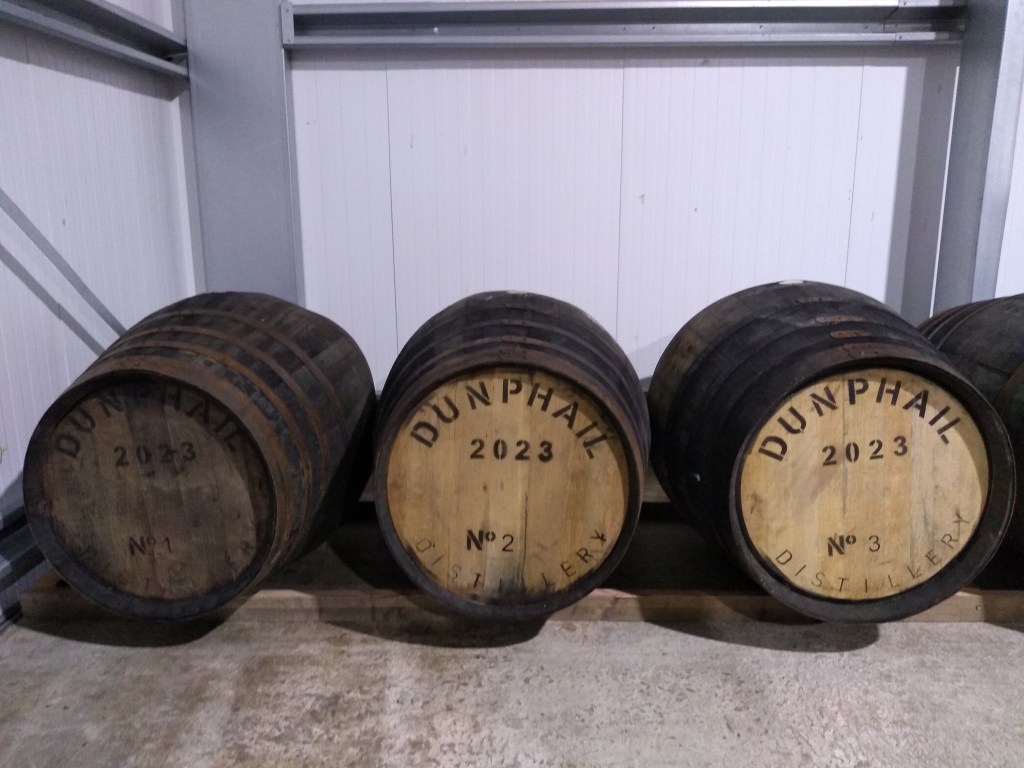
At the time they were producing the newmake to fill the casks for their King James Collection: six casks of different type (bourbon, sherry, rum, etc.) which will be released biannually starting in 2027. They also have a cask sale programme, from 55-litre Firkin to 250-litre hogsheads. They aim for a production of 10,000 litres of alcohol per year, which would put them as the smallest distillery in Scotland (currently the smallest are Dornoch and Moffat, with 12,000 litres each).

And here is Flora.

Some distilleries we visited started gin production as a way to get quick cash (for example Borders, Cotswolds and Holyrood), but they knew from the beginning they mainly wanted to do whisky. Stirling (and others like In the Welsh Wind or Deerness) on the other hand, started with gin, and decided to add whisky along the way. This is definitely reflected in Stirling distilleryโ€™s size and equipment, which makes them a truly craft operation. As we couldnโ€™t try their newmake spirit, we cannot really say much more at this stage, but this left us very curious for the future. Hopefully weโ€™ll come back to try it, or try their single malt too.

Until next time, slainte!


Stirling Distillery Whisky Experience

Price: ยฃ25.00 pp (October 2023, ยฃ12.00 for drivers + ยฃ1.85 fee)

Duration: 1hr

Tasting: four drams from their Sons of Scotland independent bottler range, depending on availability (see * for description)

Target: everyone

Value for money: ok

Highlights: the bar and the distilling “shed”

Recommended: if youโ€™re visiting Stirling and have some spare time, definitely, otherwise we’d suggest waiting for their single malt

Link: https://stirlingdistillery.com/


#33.4 The Welsh Whisky Trail (not TM)

Nosing whisky in the north of Wales: Penderyn Llanduno


TL; DR: After the lovely Aberystwyth, a long drive north in the rain and the mist through industrial relics and castles to get to Llanduno, where we visited the third (and last) Penderyn distillery and enjoyed an interesting, full-on whisky masterclass.  

(missed Part 3/Part 2/Part 1?)

We woke up in a misty Aberystwyth. Unfortunately, weather forecasts were right: a day of rain. Thus, a change of plan was needed: we were supposed to take the Cliff Railway to admire the Afon Rheidol valley, of which weโ€™d had some glimpse the day before, but with fog and rain what was the point? Instead, we had breakfast and afterwards we visited the National Library of Wales, which had very interesting exhibitions (and a cosy cafeteria).

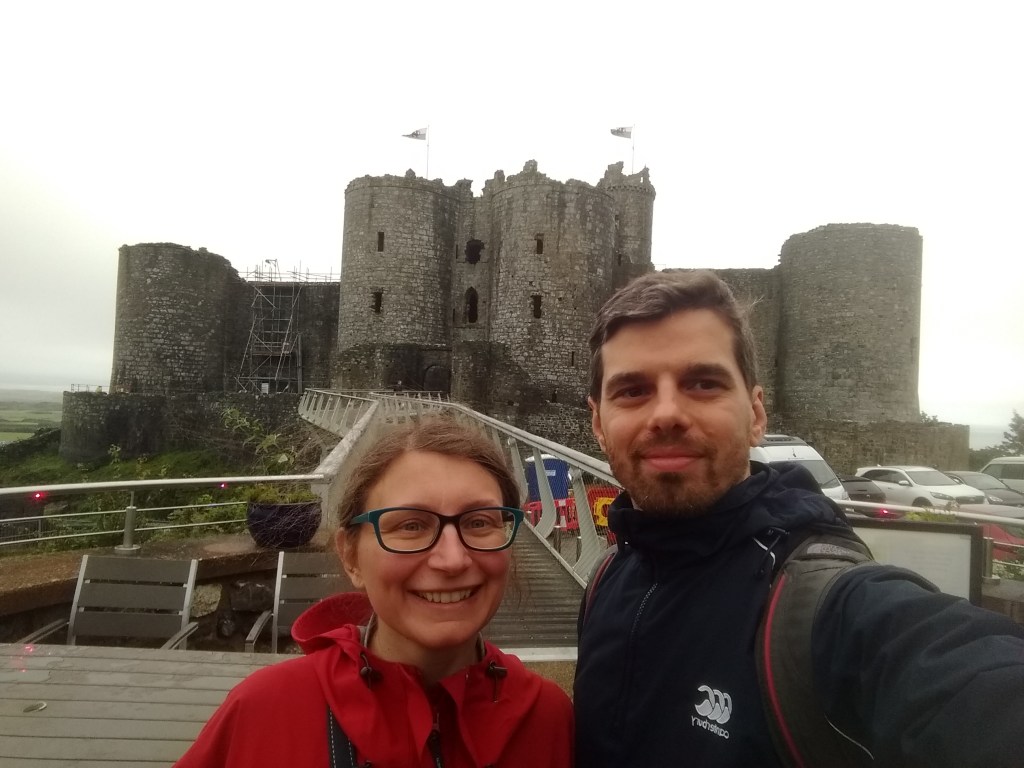
We soon left the nice wee town driving north, towards the camping for the night, in Blaenau Ffestiniog. We tried to drive โ€œthe long wayโ€, so first we stopped at the Dyfi Furnace, a well-preserved industrial relic. We kept driving north, to Machynlleth and past the Dyfi Bridge, until Llanelltyd. Here, we took a detour to drive on the coast, and we stopped at Harlech Castle, in a very picturesque little village. This was our last stop before the camping (named Quarry Viewโ€ฆ and indeed it is surrounded by quarries), where we arrived still under the rain: a shame, as the camping looked it could have been very enjoyable with nice weather.

The morning after it was not raining but still misty. We had a quick breakfast and then we were on the road, as we needed to get to Abergwyngregyn in time for the bus to Llanduno. The road across Eryri (Snowdonia) National Park was quite spectacular even in the mist, and we passed many groups of hikers getting ready to climb the sharp mountains. That day we had two distilleries booked, Penderyn Llanduno and Aber Falls. We parked the van walking distance to the latter, but with a convenient bus we could reach Llanduno so we could both fully enjoy the Masterclass at Penderyn. The trip on the North Wales Expressway was quiet and smooth.

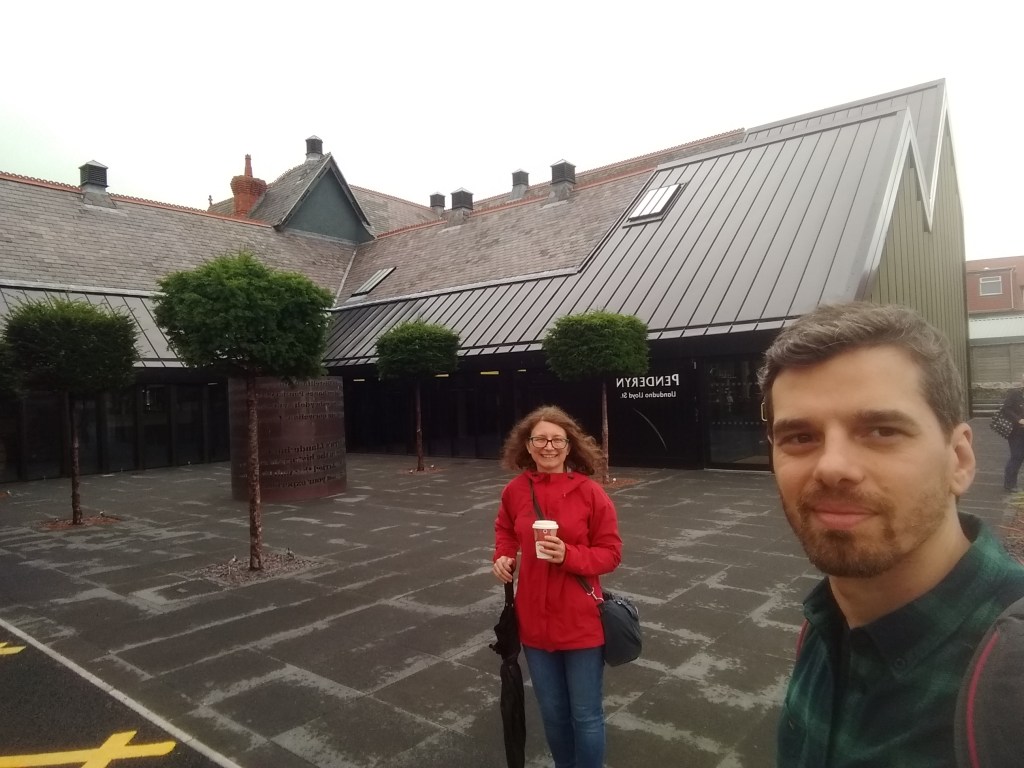
As we got off the bus, we got a hint on why the distillery is located in this town: itโ€™s a very touristy place, dating back to Victorian times. We had just enough time to get a coffee and walk to the distillery, which contrary to many others, is located in the town centre. The building, in fact, is one of a former school. There, we were welcomed by Angharad, which collected us and other two people to start the Masterclass. She walked us into a big room and played a video about the history of Welsh whisky and Penderyn. She also served us coffee and a Welsh cake, a nice and appreciated touch. This was accompanied by a first dram, a Penderyn Myth, from the reduced strength range (41%), initially developed for the French market and finished in shaved-toasted-recharred (STR) casks.

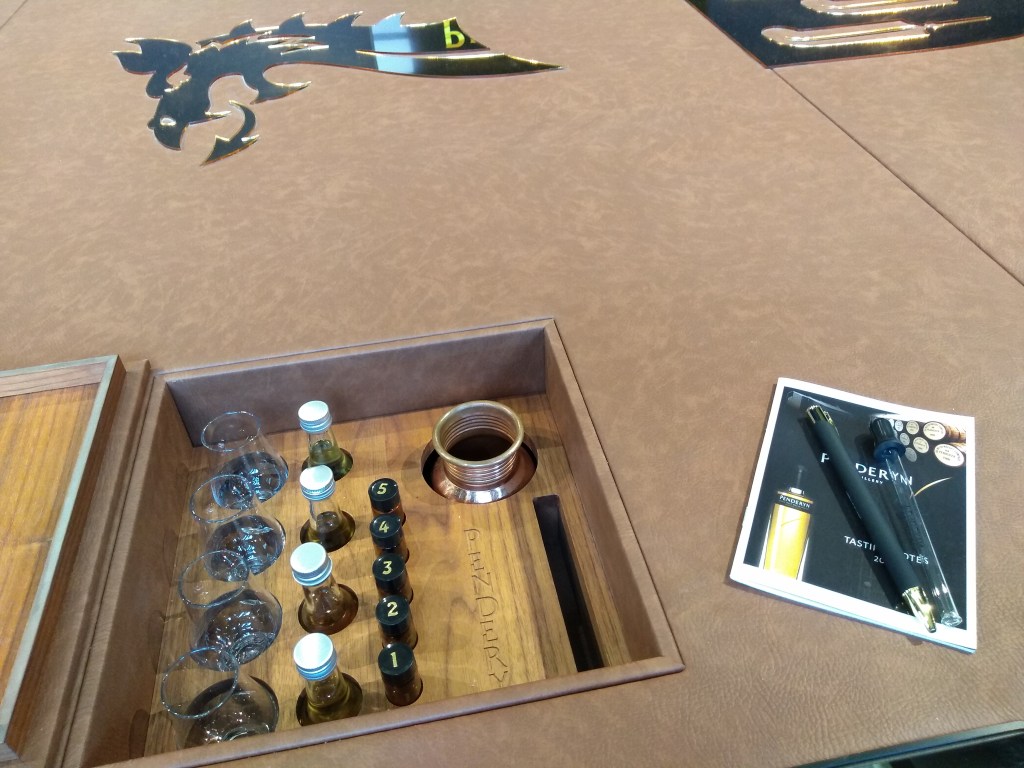
After the introductory video and history, we did a nosing challenge: 10 fragrancies to recognise. Teresa was the best in the class, with 8/10, while โ€œslow noserโ€ Gianluigi had to be asked to finish twice, and only got 4โ€ฆOuch! In spite of her modesty, that confirmed what we knew already, that she has a great nose! For the next dram, we were asked to guess among Johnnie Walker Black Label, Monkey Shoulder, Haig Club single grain, and the Penderyn Madeira. Clearly it wasnโ€™t the latter two, and it took a moment but we recognised the JW Black Label (due to the presence of a whiff of smoke).

Now it was the time for the tour of production (where we couldnโ€™t take pictures): it is very similar to what weโ€™d seen in Brecon Beacons and Swansea, but on a smaller scale. They have only one Faraday still (and no copper pot stills), with which they produce only peated spirit. Of course, being in a town centre, they donโ€™t have a warehouse on site, and the tour finished in a hallway with the types of casks they use on display for us to nose, like we did in the other two sites. This was accompanied by a dram of Buffalo Trace bourbon (their standard at 40%), because they mainly fill ex-bourbon barrels from this distillery, and a wee glass of Madeira wine, the finishing cask for their main expression.

After this, we followed Angharad first in an exhibition room, then in the bar, where we could choose a dram: for us, it had to be the Icons of Wales #7 Rhiannon (finished in ex-sherry casks, 46%) and the Penderyn club exclusive (an ex-Madeira cask exclusive, whose purchase for ยฃ95 allows to be in the Club for 3 years, with some benefits like discounts, etc.). We headed back to the โ€œboardroomโ€, for yet another test: we had four Penderyn from the Gold range (Madeira, Peated, Sherrywood, Portwood and Rich Pak/STR) and we had to recognise which one was which (one missing). We both did the same: got the Sherrywood and Peated right, correctly guessed the Portwood was the missing one, but mixed up the Rich Oak and Madeira. Nosing is a tricky thing! Finally, we headed down to the shop, where we collected some memorabilia included in the tour.

The masterclass was supposed to be 2-2.5 hours, but it ran for over 3.5! So, as we walked out, we raced to the bus stop and barely had time to get a couple of hot rolls and beefy bakes to eat on the bus. Overall, we liked the experience, even if it was more challenging than expected. We were hoping for some drams from the cask, like some sort of warehouse tasting. It wasnโ€™t the case, but the offer was very generous nonetheless, and we could appreciate the variety of the Penderyn offer. After visiting all three distilleries, we are left wondering how different the whisky from the three sites will be, in particular the peated one. In our understanding, the way they’ve made peated whisky before opening the site in Llanduno is by using ex-Laphroaig casks). Anyway, definitely a trio of distilleries to keep an eye on and revisit at some point. Slainte!


Penderyn Llanduno Masterclass

Price: ยฃ60.00 pp (July 2023)

Duration: 2hr 30min

Tasting: 8 drams (Penderyn Myh, JW Black Label, Buffalo Trace, one from the bar, 4 from the Gold Range) and a sip of Madeira wine

Target: whisky novices and nerds

Value for money: good

Highlights: the sensory experience

Distillery exclusive: mostly the same as Swansea and Brecon Beacon distilleries

Recommended: for craft distilling enthusiasts in particular

Link: https://www.penderyn.wales/

#33.2 The Welsh Whisky Trail (not TM)

From Cardiff to Pembroke: Penderyn Swansea and Coles


TL;DR: After visiting Cardiff, we spent the next couple of days again on the road in South Wales for a mix of whisky and non-whisky activities: Penderyn Swansea distillery, Gower peninsula and Rhossili, followed by Coles distillery and Pembroke Castle. 

(missed Part 1?)

That morning in Cardiff the sky was a bit moody, but this didnโ€™t stop us going for a morning run (to Teresaโ€™s disappointment). Near the camping there is a huge park, the Bute Park River Side, which continues along the river Taff, with plenty of pedestrian and cycling paths. We took advantage of it – always nicer to run in green areas. We spent the rest of the day in Cardiff, visiting the castle first, buying rugby-related gifts for Gianluigiโ€™s brothers and father, and looking out for some local beers to try: we found a pub we quite liked right in front of the stadium, but we found out soon it wasnโ€™t Welsh: Tiny Rebels, from Bristol (delicious beers!). We liked Cardiff as a city, small but cosy, and seemed very liveable. Definitely a place to go back to!

The following day we left early in the morning, directed to Swansea. No matter how we liked Cardiff, we have to say that the landscape along the road between the two cities was not nice at all, very industrial and a bit decadent. Even Swansea didnโ€™t look that good to be honest, not to their fault: it was quite flattened by the Germans during WWII. We soon managed to find the distillery (although Google Maps pointed us somewhere else): the newest of the Penderyn.

We did the regular tour here as well (pricier, see summary below), as it was the only experience available in July. In fact, the distillery was so new that they hadnโ€™t even started distilling yet (all the equipment was there however). Being built inside a former copperworks, in the first part of the tour they showed us some videos and the reproduction of a little copper mine, showcasing the importance of this material for electricity (and distilling). Very interesting indeed!

We then visited the soon-to-be active production (again, no pictures allowed), and we realised it is a replica of their Brecon Beacons site. We couldnโ€™t quite get why they made two almost identical distilleries, but our guesses are for tourism (see later) and because it was not possible to increase the size of the original production site. They have a warehouse, however, which we got to after walking on the remains of the copperworks building (covered by glass, hence why we could walk on them). Finally, in the very beautiful tasting bar, we could try two of their expressions each. We picked another two drams from the Icons of Wales series, the #6 Royal Welsh Whisky (43%, peated Portwood finish, to commemorate the original Welsh Whisky distillery at Frongoch) and the #10 YMA O HYD (43%, matured in ex-Rye casks), plus a couple from the core range, the peated ex-Islay cask and the Rich Oak. Despite the fairly basic tour, overall we enjoyed the experience, especially thanks to the very friendly staff.

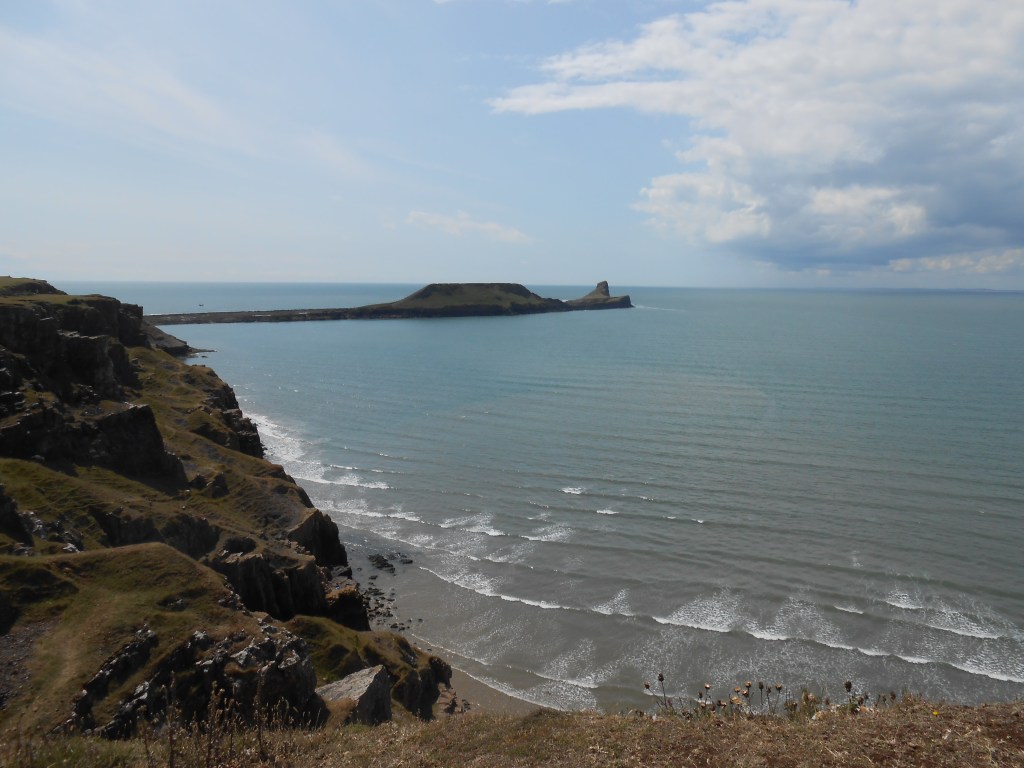
While Swansea didnโ€™t look very beautiful itself, just past it we found a very touristy seaside location, Mumbles, where we stopped for a coffee and a bite. Further ahead, the Gower peninsula. In spite of the narrow and busy roads, we really loved it, in particular Rhossili. We spent the afternoon there, walking to the Ynys Weryn and the Wormโ€™s head before the tide would make it an island again.

For the night we didnโ€™t park much far away, just past Crofty, so we had time for a walk. The spot is popular for dramatic sunsets on the river Loughor estuary.

In the morning we drove towards Llanelli, but only after checking out a nice cafรฉ inside a gym (!!) to get a coffee and a morning roll. One of the peculiarities of this holiday was that the offer of morning rolls in Wales seemed to be less rich than in Scotland (lacking black pudding and haggis, for example), so we always ended up with baconโ€ฆbacon and sausage in this case (delicious!). Anyway, we soon got to the next stop, Coles Distillery, at the historical White Hart Inn pub, in Llandarrog, which dates back to 1371.

As we parked behind the inn, our guide for the day, Tom, approached us. He is a young and enthusiastic fella, who works in both the brewery and the distillery. The Coles family (who took over the pub in 1994) started brewing their own beer in 1999, cider in 2011 and since the craft stills legalisation, they have been making whisky, vodka, gin, brandy and the first ever welsh rum (as you can imagine, all in small batches). Except for the rum, for which they import molasses, they are a proper grain-to-glass distillery (or fruit-to-glass), as even the gin and the vodka are made from scratch using wheat.

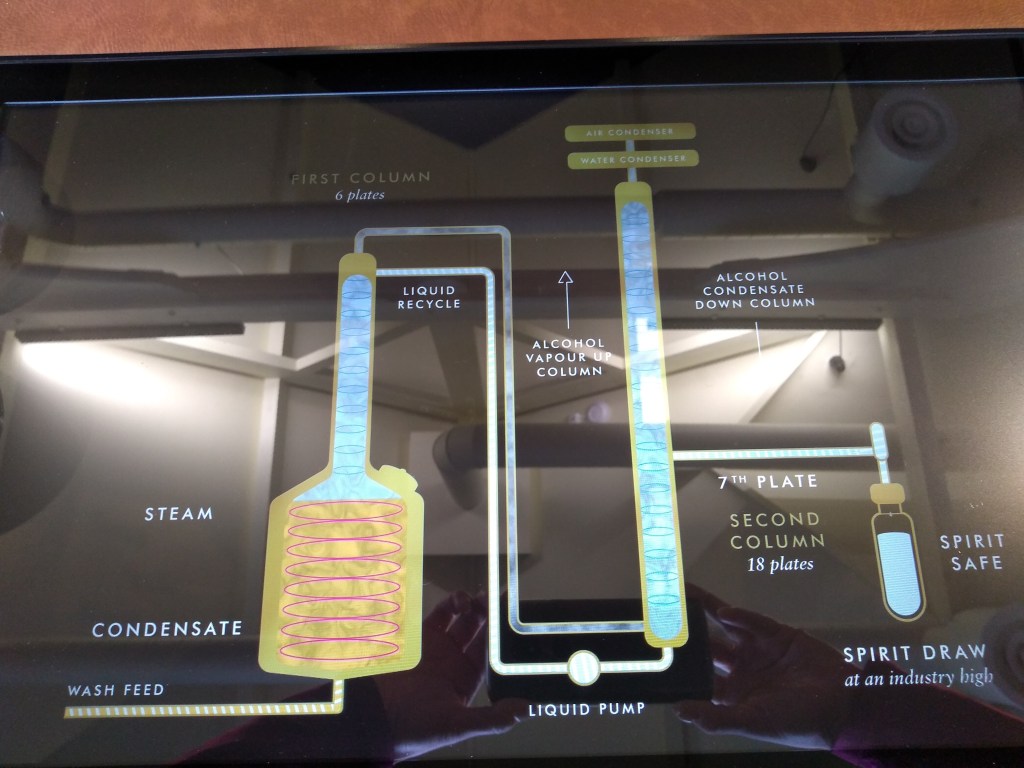
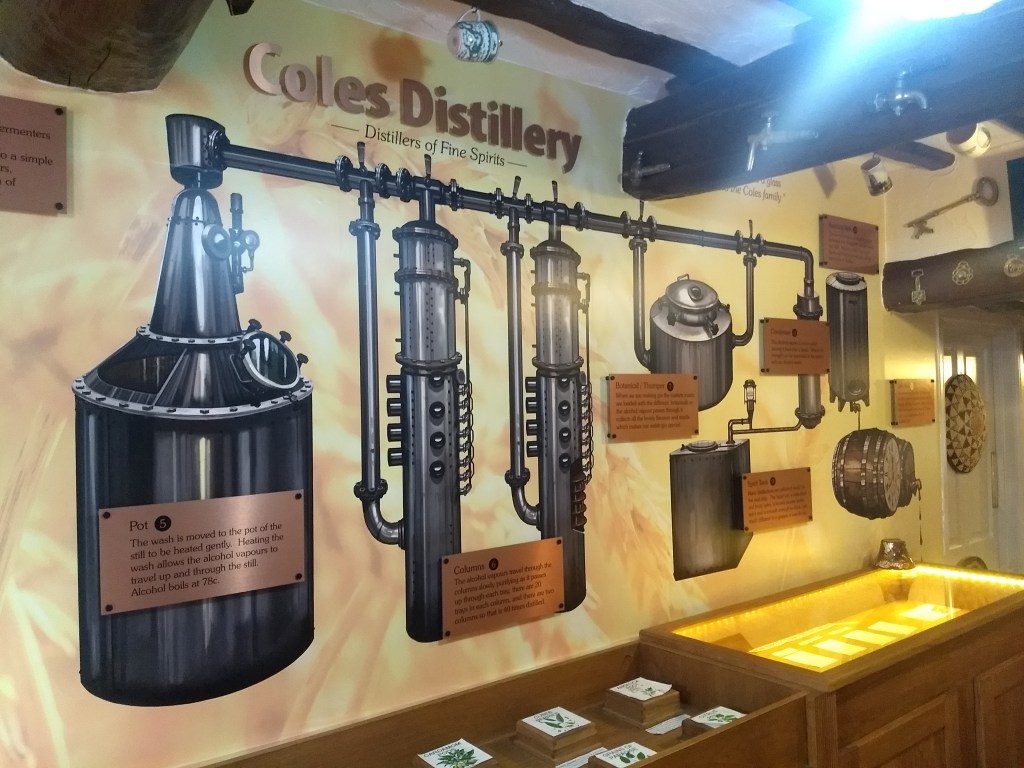
The first part of the tour took place in a hallway, in the pub building, where there is a panel displaying how their distilling operation works, including the botanicals for the gin. They take the water from a well about 90 meters deep, and mashing and fermentation take place in stainless steel tanks (the latter are 6, and fermentation lasts 70 hours). The actual distillation is the interesting part: they have one stainless-steel pot still which takes 3000l wash, and of which only a joint before the lyne arm is made of copper. Then, they have two column stills, each one with 20 copper plates. This setup, all using a steam boiler, gives them lot of flexibility, thanks to which they are able to make different products.

After this very thorough explanation, we moved inside the distillery, just a few steps away from the pub. Because of the craft size of the operation, everything is under one shed, including some maturing casks of whisky and rum. There we could revisit all the steps of their process under Tomโ€™s careful guide, which explained that they mostly use American oak ex-bourbon barrels, in particular for their main whisky.

Back to the pub, we sit at the bar to try a few of their spirits. Sips were very tiny, but they also sell almost everything they produce in 5cl miniatures, so we took a few with us for a more in depth tasting in the evening.

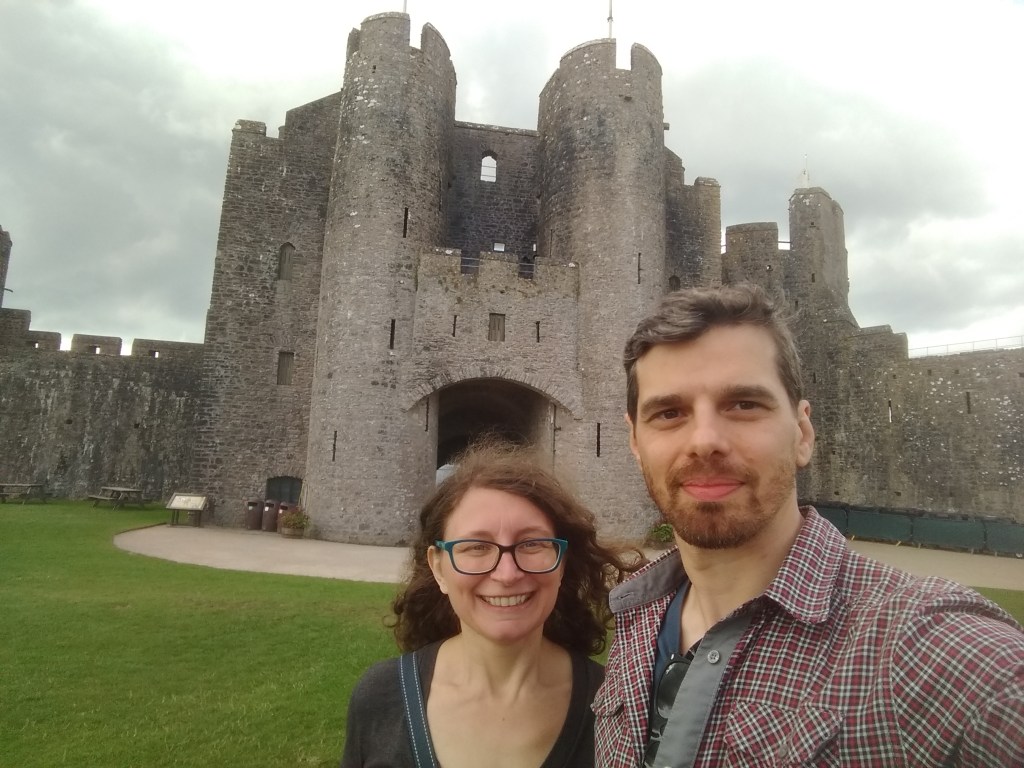
Back on the road, we started driving towards Pembrokeshire, to visit the Pembroke Castle, probably our favourite of the holiday. We were able to catch a guided tour, and what an amazing tour that was! The history of the castle is very fascinating too, definitely a must-do if youโ€™re ever in the area. Our camping for the night was still in Pembrokeshire, near St David.

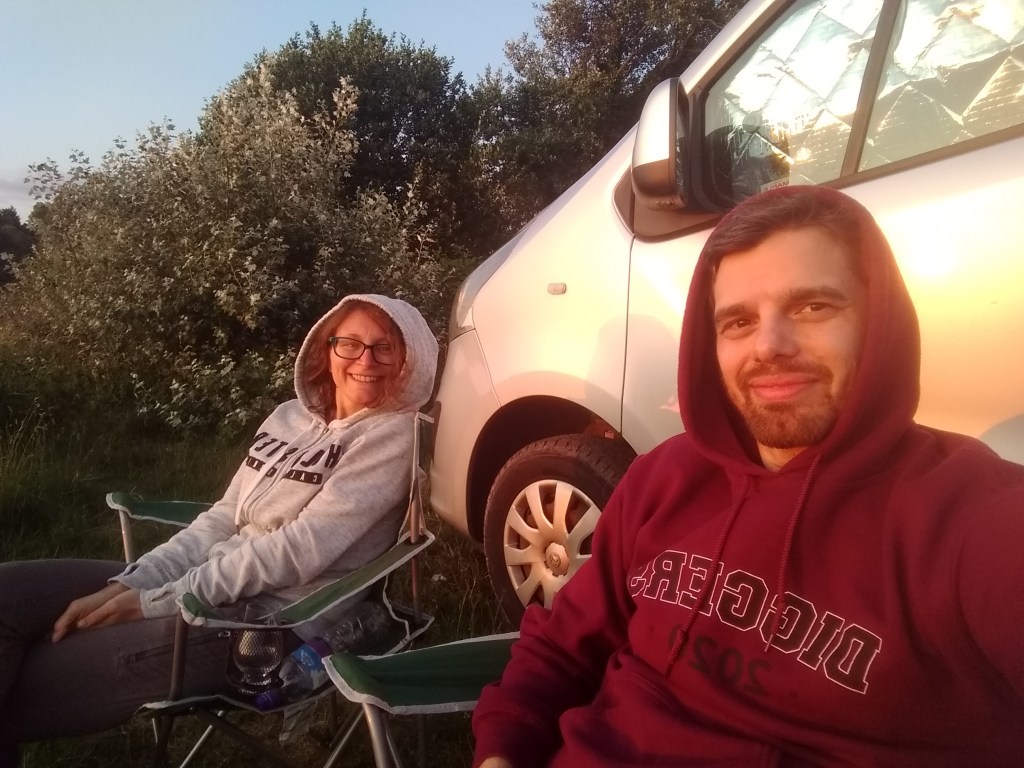
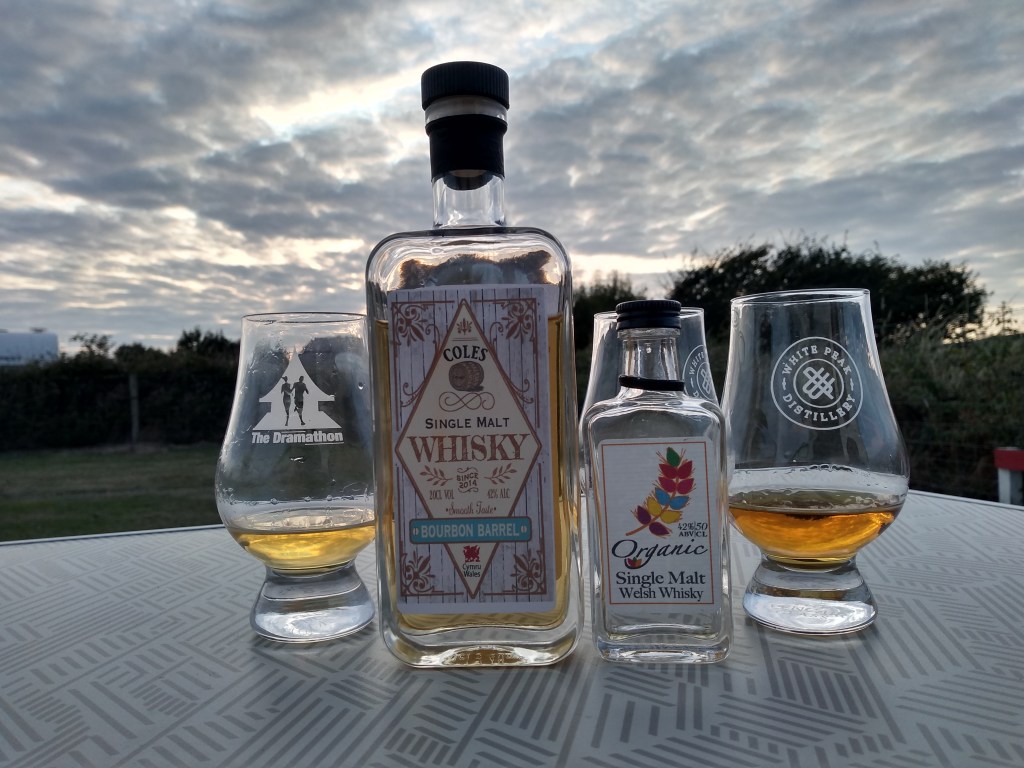
It was on a farm, and because the weather was nice, after dinner (we went โ€œtrue Italianโ€ and made pasta) we could relax and watch the sunset while sipping the Coles distilleryโ€™s miniatures: Welsh single malt (5y, 42%, ex-borubon), Organic single malt (42%), dark rum (oak aged, 40%) and the Plum brandy (40%). The latter was the winner for us, delicious!

See you next week, slainte!


Penderyn Swansea Copperworks Tour

Price: ยฃ19.50 pp (July 2023)

Duration: 1hr

Tasting: 2 drams of choice

Target: everyone

Value for money: less good than Penderyn Brecon Beacons

Highlights: the copperworks history of Swansea

Distillery Exclusive: same as Penderyn Brecon Beacons (except the Fino cask)

Recommended: if you are curious about the copperwork history and/or if you havenโ€™t visited the Brecon Beacons site

Link: https://www.penderyn.wales/tours-swansea-copperworks/


Coles Distillery Tour

Price: ยฃ12.50 pp (July 2023)

Duration: 1hr

Tasting: a nip of anything they produce

Target: everyone

Value for money: good

Highlights: the range of spirits

Recommended: for craft-distilling enthusiasts in particular

Link: https://www.coles.wales/

#27.3 Speycation

From Glenallachie to the
blend of Doom


TL;DR: Saturday morning we visited a distillery that is special to us, Glenallachie. After an amazing tour and a few drams, we spent the rest of the day walking around Dufftown, enjoying the sun. We finished the day with a sip of the infamous Blend of Doom and a pizza at the Craigellachie Lodge.

(missed Part 2/Part 1?)

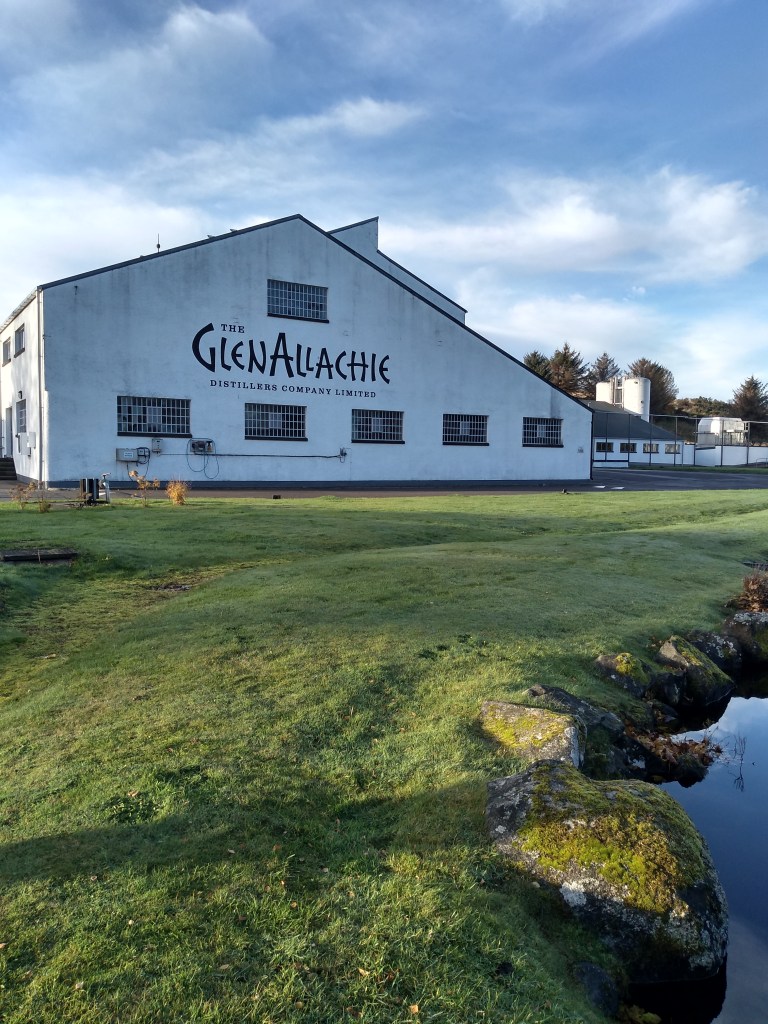
That Saturday morning was a very nice one, warm and shinyโ€ฆWeโ€™re told thatโ€™s unusual for Speyside in October, but itโ€™s not the first time we got one. After breakfast, we jumped on the bus towards Aberlour (the village, not the distillery again) to reach our next destination: GlenAllachie distillery!

Such a beautiful day for a distillery visit!

We were super excited about that. When we visited it in August 2021, on a much colder and wet day (so much that we couldnโ€™t light up our BBQ in the evening!), it wasnโ€™t possible to tour the facility because of Covid, so we only had a tasting while the guide played us an interesting video. It wasnโ€™t one of those โ€˜letโ€™s celebrate Scotlandโ€™ videos with deer, waterfalls, glens, mist, etcโ€ฆ, but literally a worker filming and explaining production with their phone, so much more interesting in our opinion. This time, we could finally visit production. And mostly, we really like their stuff. We know some whisky geeks are put off by the big use of secondary maturation and finishes, but we love their bottlings anyway and we regard the whisky as top notch, so far it never disappointed.

That morning the distillery was (almost) all for us. Sue, Brenda and Karen warmly welcomed us with a dram, a special one to start with, one we hadnโ€™t tried before: a 15y GlenAllachie finished in Virgin Scottish Oak wood (48%, non-chill filtered, NCF, and not artificially coloured NC). Then, they split us into two groups, to have a bit more space while wondering around: our group started with the tour. We had a look at the usual Porteus Mill, and the huge stainless steel closed mashtun.

Milling, safely.

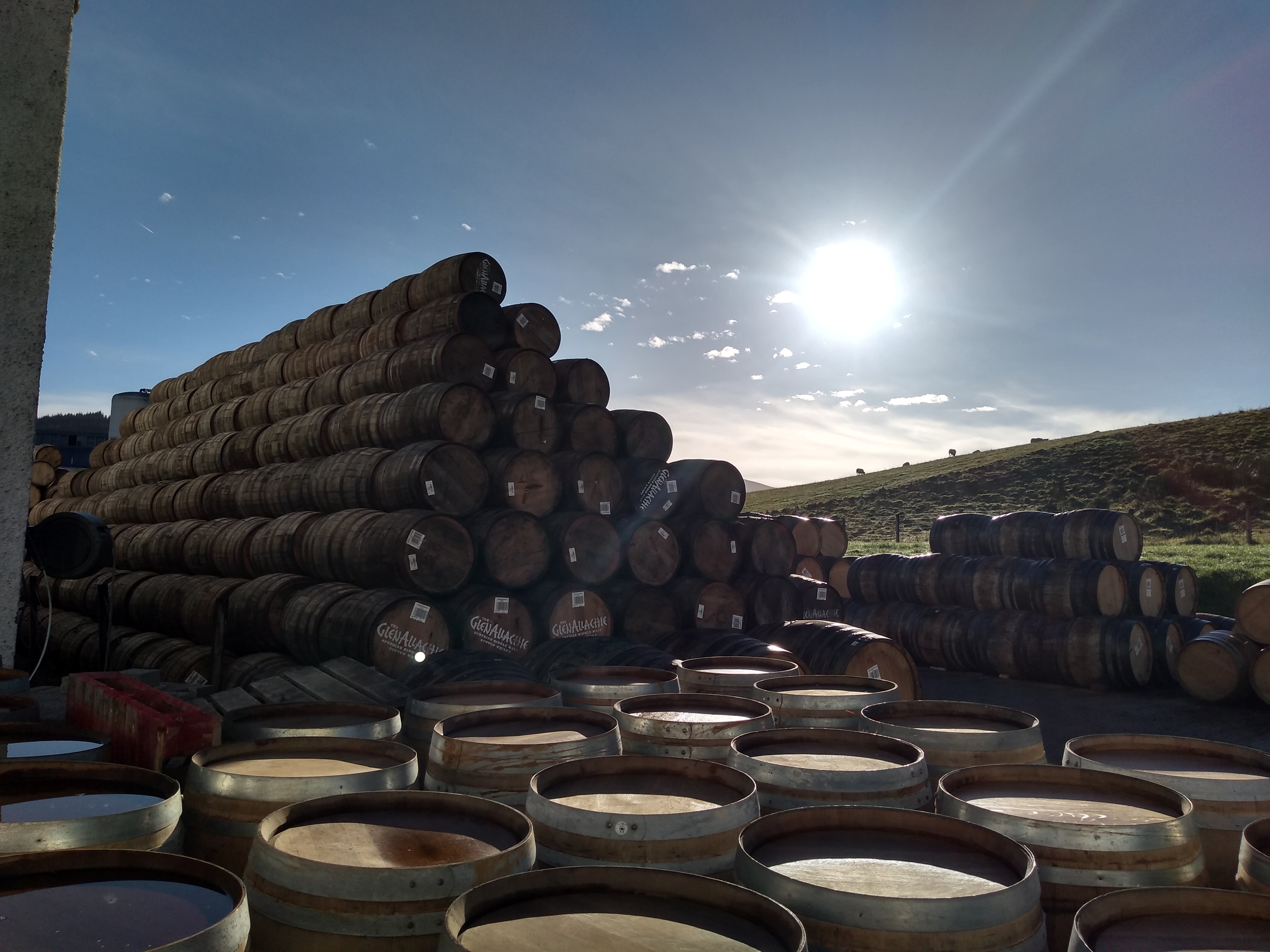
The washbacks are made of steel as well, and there are 6 of them. Currently the distillery is running way below capacity, a bit less than a half in our understanding. This started when Billy Walker bought the distillery in 2017, to improve the produced spirit. In particular, fermentation is now about a week long, and they donโ€™t work during weekends. In the still room, two wash stills and two spirit stills were off for the weekendโ€ฆso we could take a sneak peek inside (just another occasion for a silly photo). Finally, we went to the warehouse to admire the maturing stock and the huge variety of casks (wine, various size of sherry and bourbon, etc.); they laid out not a typical dunnage warehouse, but a racked one.

Fun or creepy? You decide.

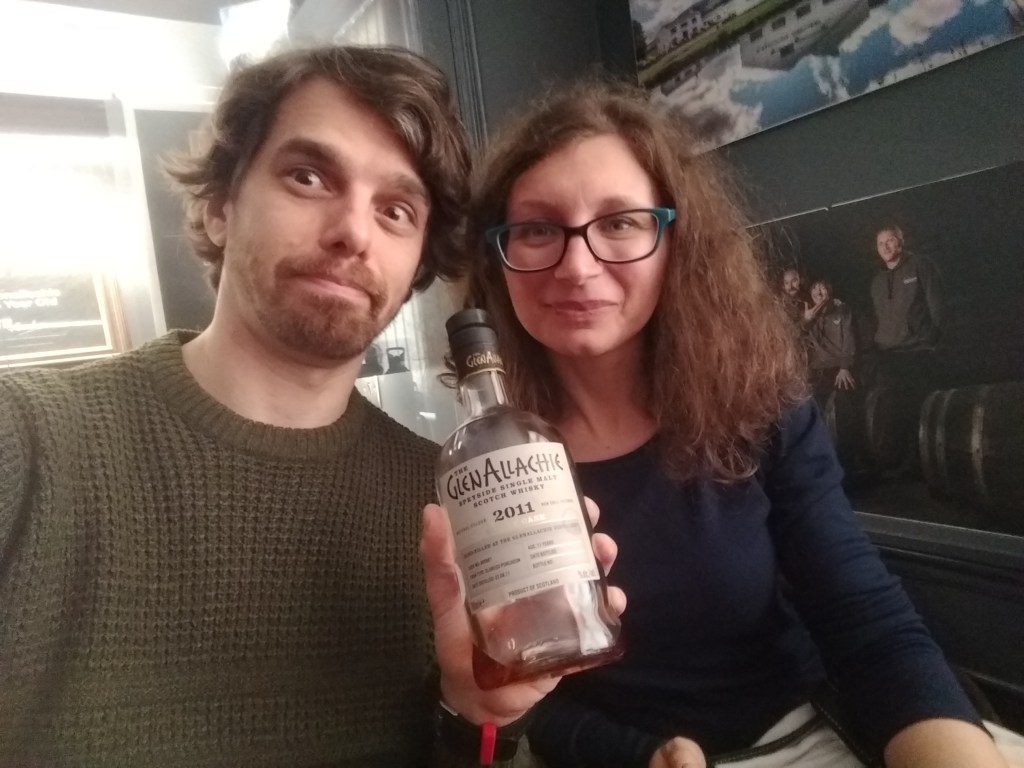
Back at the visitor centre, we had another two delicious drams in the tasting room: the 16y Present Edition (48%, NCF, NC, Mizunara and Virgin oak) released in celebration of Billy Walker 50 years in the business, and the Glenallachie 21y Batch 2 (51.1%, NCF, NC). Well, it looked like that was it. Instead, we moved upstairs to join the other group, to have two last drams all together. Such a nice touch! The two drams were the bottle-your-own (or distillery casks) on sale at the shop at the time: an 11y ex-oloroso puncheon (60.5%, NCF, NC) and a 16y finished in refill ex-bourbon barrel which held peated whisky before (59.5%, NCF, NC), both amazing (and of course, we came back home with one)!

Overall, this was one of our best distillery tours ever: Sue, Brenda and Karen were all very funny and knowledgeable, and we could see how they love their job. Karen even told us that she followed Billy Walker after he acquired the distillery, after Glenglassaugh was sold to Brown Foreman (together with GlenDronach and Benriach).

So delicious!

Here, we have to make a little digression. Speyside is by far the biggest whisky region, not by size but by number of distilleries and production quantity. Therefore, in the planning phase of the trip, at first it looked like we had a plethora of possibilities that we wouldnโ€™t know where to start, like for a kid going to Disneyworld or Legoland. Unfortunately, it didnโ€™t go down like that, and according to Justine filling the schedule was much harder than prevented. In some cases, she was told that there was personnel shortage. Others still have to come back to her (6 months afterโ€ฆahahah). This felt really weird and very much in contrast with our first EWG trip to Campbeltown – the smallest whisky region, and by far the smallest production (according to the 2023 Malt Whisky Yearbook the 3 distilleries combined donโ€™t get to 2.5 million litres per annum of alcohol), so with a limited number of available activities. Still, despite this and Covid restrictions at the time, we managed to have a very full schedule fairly quickly (Cadenheadโ€™s warehouse tasting, Springbank, Glengyle, and tastings with Mark Watt from Watt Whisky, Ian McAllister from Glen Scotia and Kyntire gin).

Things you see if you take a walk in Dufftown.

We discussed a few times about this โ€˜Speyside struggleโ€™ in the group, and probably the main cause was the lack of personnel indeed (thanks Brexit, โ€œthe gift that keeps givingโ€โ€ฆ), but we suspect that some of them just couldnโ€™t be arsed to organise an open day for 22 thirsty whisky enthusiasts. A bit unexpected, but in the end we managed to have a great holiday anyway, as Justine came up with some great surprises for us.

Anyway, all this to say that, as a matter of fact, the Saturday afternoon was free from whisky activities, and we decided to spend it in Dufftown. After a brief lunch in a cafรฉ near the clock tower (characterised by some quite rude staff), the day was still so nice that a group of us decided to walk around, and we basically repeated Michelleโ€™s walking tour we did in 2019: from the clock tower to Dufftown distillery, then Mortlach, Glendullan and we finished off at Glenfiddich. This time, however, we checked out Balvenieโ€™s castle, which unfortunately was still closed (together with a worrying number of Historic Scotland sites, we later found out). Here our pal Joe opened a Glen Scotia Double Cask rum finish, a novelty of that period, and shared it with us.

Balvenie castle, not the distillery.

Back to the bus, we moved to Craigellachie, and as we had some time to kill before dinner at the Craigellachie Lodge, we went down to the Speyโ€™s bridge where Justine had something โ€œvery specialโ€ ready for us: THE BLEND OF DOOM!!!

That’s the Blend of Doom for you.

This is a bottle she filled throughout the years with all the whisky samples she tried but didnโ€™t (or couldnโ€™t) finish. It was very funny to see people faces – to Gianluigi it tasted like old bathroom cleaning products, but most people went directly to โ€œpissโ€. It was truly dire, and almost felt like an initiation ceremony for the Edinburgh Whisky Group. Fortunately, the pizza together with a pint and a dram, bingo and music set things right again in our mouth, so we could go to bed happy again.  


GlenAllachie Connoisseurs Tour*
*ours was a bespoke tour, but from the description and price it looks very similar to this one

Price: ยฃ50.00 (Oct 2022, now ยฃ60)

Duration: 2h

Tasting: 5 drams, 15y Scottish Oak (48%), 16y Mizunara Billy Walker 50th year anniversary (48%), 21y Batch Two (51.1%), Vintage 2011 11y distillery cask ex-oloroso puncheon (60.5%), Vintage 2006 16y distillery cask ex-peated bourbon barrel (59.5%)

Value for money: very good

Highlights: the guide team was superb, knowledgeable and very funny!

Target: whisky enthusiasts and geeks

Distillery exclusives: there are always two distillery cask bottle-your-own available

Recommended: absolutely!

Link: https://theglenallachie.com/


#24.1 Dramming in Dublin

A whiskey weekend before the storm: Teeling & Roe & Co.


TL;DR: In January 2020, we visited friends in Dublin, so why not check out a couple of distilleries in the meanwhile? We chose two among the many newbies, Teeling, in the Liberties neighbourhood, and Roe & Co, a new Diageo distillery close to the iconic Guinness brewery! 

In our blog, so far, we talked about our whisk(e)y adventures in Kentucky, England, Canada and, of course, Scotland. You might have noticed an important gap, which is the object of this and the next blog post: Ireland!

Gianluigi had actually visited Ireland, mostly Dublin, a few times way before his whisky journey started, while for Teresa the first time came when we went there to celebrate 2019  New Year with two friends from the US. At that point, we were already into whiskey (and whisky), but in our heads Dublin = Jameson, so thatโ€™s what we went for: the Jameson Experience in Bow Street, where the old distillery was. It was a nice experience for newbies, and it was very interesting to compare scotch (Johnnie Walker), American (Jack Danielsโ€ฆ) and Irish whiskey (Jameson, of course). For sure, at the time we were not aware of the troubled history of Irish whiskey: after the trade block with the Commonwealth countries as a consequence of the Irish Independence war, and prohibition in the USA, Irish whiskey saw a decline which led the biggest producers (Powers, Cork Distillers and Jameson) to join forces and form the Irish Distillers company, while moving production to the New Middleton distillery, in Cork, in 1971. For many years, only two distilleries were active in Ireland: the aforementioned Middleton and Bushmills, in Ulster.

Recent years saw a renaissance of Irish whiskey, however. First, in 1987, John Teeling acquired and converted an old potato processing plant into the third Irish working distillery: Cooley. More recently, a number of distilleries throughout the island popped up, including a handful in Dublin.

It is in this context that we started to sniff around. The occasion was a weekend at the end of January 2020, when Covid was already a thing but hopes were that, like the SARS-CoV-1 in 2003, it would have been a limited outbreakโ€ฆso naรฏve! We went back to Dublin to visit a friend of Gianluigi who was working at the UCD, and a former Teresa’s advisor from New Zealand. When we looked at the available tours we spotted four distilleries: the Liberties, Pearse Lyons, Roe & Co. and Teeling. Being unfamiliar with all of these brands, we chose the latter two, almost randomly.

First Irish whiskey distillery visit: Teeling.

It was a sunny Saturday morning, when we arrived in the Liberties, a former industrial neighbourhood. This is home to both the Liberties (more on this next week) and Teeling distilleries. The latter was founded in 2015 by Jack and Stephen Teeling, the sons of the founder of Cooley, now owner of the Great Northern Distillery, in County Louth, the former Harp beer brewery converted into a distillery in 2015. In hindsight, visiting Teeling first made sense as it is the first new whiskey distillery in Dublin in over 100 years, and the first operating since Jameson and Powers moved to Cork.

The three stills (made in Italy!)

The building is quite modern, and itโ€™s obvious that they built the distillery with tourists in mind: everything is spacious and feels ready to accommodate big groups. They are quite a sizeable distillery too, with half-million litres of alcohol per annum. They produce many different styles of whiskey: single grain, single malt, single pot still and the typical Irish unaged spirits (Poitin), all bottled at 46%, except the latter which goes up to around 50-52%. Their main expression Is the Small Batch, made with malt and grain whisky. The tour was nice, nothing particular to note, except that the three stills (most Irish whiskeys are tripled distilled) come from an Italian firm, Frilli, and they are named after the ownersโ€™ daughters (which now we cannot recallโ€ฆit was 3 years ago!). The tour ended with a visit to the on-site warehouse, where some of the first casks filled are stored.

After the tour, we got a 4-dram tasting: the Small Batch, the Single Malt, the Single Pot-still and a distillery exclusive. It was very interesting to try them all together, a comparison between very different styles of whiskey! At the bar, we also tried one of their special releases of the time, the Brabazon vol. 2, a sourced whiskey finished in ex-Port cask and bottled at 49.5% abv, very different from the others!

Caged casks.

The following day, much cloudier, was Roe & Coโ€™s turn, very close to the Guinness St James Gate Brewery. The name is inspired by George Roe & Co, the owner of the old Thomas Street Distillery. This used to be a massive distillery around the late 1800s, just a stone throw away from the brewery, with over 2 million gallons of single pot still whiskey produced per year. It was closed in 1926, following the aforementioned crisis of Irish whiskey. The new Roe & Co distillery was built by Diageo in the old brewery powerhouse, and started producing in 2019. It is a very beautiful old industrial brick building, with big windows that make it possible to see the still room from outside. Next to the building, there is a tower with a green dome and a pear tree (which inspired the distilleryโ€™s logo).

Second day, second distillery: Roe & Co.

Production is characterised by a closed mash-tun with a copper lid, a few (we cannot remember how many) wooden washbacks, and three stills of different shapes. Again, this distillery too has been clearly built with visitors in mind, so the spaces are quite open, and the bar is near the still room. After visiting the production, the guide brought us to a fancy showroom with a big table, where there was a wooden box for each of us. Inside the box, a few aromas and other stuff for a sort of sensorial experience (honestly, the least favourite part of the tour).

Beautiful still room!

Afterwards, we went to a blending room, where the guide gave us a brief but informative introduction to mixology before we mixed our own cocktails. While we are far from being whisk(e)y purists (once in a while we like a good whisk(e)y-based cocktail), weโ€™re not big fans of this โ€œwhisk(e)y as a mixerโ€ thing that has been pushed so much by big companies like Diageo. However, we have to say that this experience was really interesting, definitely a plus of this tour.

Mixology newbies.

Finally, at the bar we had a sip of the Roe & Co whiskey, a blend made with malt and grain whiskeys from undisclosed Irish distilleries: a nice dram (45%, not-chill filtered, NAS). We also tried an ex-Port cask finished Roe & Co, another blend (if we recall correctly), a bit more robust, but we couldnโ€™t get it because we had no checked luggage. Oh well.

We felt this trip to Dublin was just a first, tiny taste of the Irish whiskey wolrd, and indeed we were left more curious than when we had arrived. Since then, we have tried some very interesting expressions, and itโ€™s nice to see the Irish whiskey scene being revamped. For more about this, stay tuned until next week, Slรกinte!


Jameson Bow St. Whiskey Experience
Link: https://www.jamesonwhiskey.com/en-gb/visit-our-distilleries/jameson-bow-street-distillery-tour/

Teeling Distillery
Link: https://www.teelingwhiskey.com/

Roe & Co. Distillery
Link: https://www.roeandcowhiskey.com/

#19.2 Dramming Around Orkney

The other side of Kirkwall


TL; DR: The second day on Orkney was dedicated to visiting historical sites like the Ring of Brodgar and the incredible village of Skara Brae. On the third day, we finally managed to visit Highland Park distillery. It was a very interesting and in-depth tour (mostly thanks to the outstanding guide, James), however followed by a disappointing tasting, which made the overall experience mostly a tourist trap. 

(missed Part 1?)

On the second day on Orkney, we decided to put on hold our whisky curiosity and focus on the history of the island instead. After a brief run to the foot of Wideford hill, shower and breakfast, we left the camping westward. First, we visited the quite spectacular standing stones of Stenness and the Ring of Brodgar. Fortunately, it was a sunny day, albeit very windy, we even spotted a sunbathing seal!

Wind and stones at Stenness.

Around lunch, we moved on to Skara Brae. This is one of the sites we liked the most in Scotland, so far. Reading about the discovery of this 5,000-year old village was very interesting, as well as finding out about all the insights on the life of our ancestors. Being a nice day, we also took advantage of the splendid view on the beach just behind the site. After our visit, we drove first to the nearby Orkney brewery, not in time to enjoy a beer there but still in time to buy some for dinner. This was after a stop at Birsay beach, where the splendid landscape was saddened by the presence of a half-dozen dead seabirds: avian flu striking again. Back at the camping, it was grilling time! The only thing we did not account for was the number of midges assaulting us: the food intake was barely enough to compensate for the blood loss (sorry, we like to be dramaticโ€ฆ)!

The magnificent Skara Brae.
Romantic view of the Brough of Birsay.

On the third day, it was finally Highland Park time. Our friends Roberto and Cecilia are not whisky nerds, but they enjoy a dram once in a while, so they were very keen to visit the distillery. Because kids below a certain age are not allowed, we had to do the tour in two shifts so that there’d always be someone with the wee one: first, Teresa and Gianluigi, later Roberto and Cecilia. Our friends opted for the basic (but not cheap) one: Honour and Pride (and prejudice?) experience (30 quid, 3 drams). After excluding the two high-end offers (eye-watering price of 125 and 325 quid), we chose the upgraded Wild Harmony Experience, 75 quid with 5 drams, placing it as one of the most expensive tours we ever didโ€ฆ actually THE most expensive (unfortunately, the price jumped from 60 to 75 around May). Because of this, and of the history of the distillery, we had great expectations.

Two happy kids in front of a candy shop.

They picked us up at the St. Magnus cathedral, in Kirkwall centre, saving us the 15-20 mins walk to the distilleryโ€™s gate. Our tour guide was James, a true whisky geek and expert, who didnโ€™t limit himself to answering all the questions, but went above and beyond to provide more context and deeper explanations. The tour started with a short video, during which we tasted their most basic expression, the HP 10y (40%, chill filtered, but according to them not artificially coloured, available in supermarkets). After that, we moved on to the distillery, starting with the malting floor: similar to other distilleries we visited (so far Laphroaig, Kilchoman, Glen Garioch, Benriach and Balvenie), they malt some of their barley in house (about 20%), using peat from Orkney, resulting in a quite distinctive flavour compared to Islay or Highland peat.

The malting floor.

The distillery has a very interesting history, and a curious layout, almost like a tiny village. It was founded in 1798 and now it belongs to the Edrington group, with a production of 2.5 millions litre per annum. They used to fill almost exclusively ex-sherry cask, although now they have several ex-bourbon cask expressions (the 10y, 15y and the Full Volume).

The excellent tour guide James explaining us Highland Park distillation.

The tasting took place in the Eunson room, named after the founder, above the visitor centre. To our surprise, the line-up was actually the core range: the widely available 12y (40% abv), the new 15y in the ceramic bottle (44% abv), the 18y (43% abv), and the 21y (2019 bottling, 46% abv). Except for the 21y, which was really good (but unfortunately overpriced at 240 pound), the others were OK drams: not dislikeable, but quite inoffensive as well. At the end, they gave us a bunch of (quite unnecessary) gifts: other than the usual glass, a booklet about the distillery (OK as well we guessโ€ฆbut what are we going to do with two of these?), the (n-th) tote bag and a postcard-size frame with a tour attendance certificate (probably more of a gullibility certificate for having spent 75 quid each on this tour).

The core range tasting.

We were hopeful until the end, but nope: no distillery exclusive or limited bottling in the tasting. Back to the shop, we spotted a couple of interesting expressions that we thought could be a good buy: a 10y bottled at 46% (ambassador choice) and a cask strength bottled to raise money for a local rowing club, both around the ยฃ60 mark. We didnโ€™t even bother to ask for the distillery exclusive: 170 quid for a 14y cask strength seemed a bit ridiculous (at the SMWS you can them for less than half of this), while the Full Volume at ยฃ80 was definitely overpriced for a non-age statement whisky (probably you pay for the Marshall amplifier shaped boxโ€ฆGianlugi always preferred Orange and Fender). We asked if we could purchase a dram of the two. We were told it was not allowed because they are an off-sale only (soโ€ฆwhat about the 5 drams they had just given us? Mystery), but we could try them at the shop in Kirkwall. Once down at the shop, they said the same, but that we could try at the Kirkwall Hotelโ€™s bar. At the hotel, of course, they did not have those 2 drams. We went back to the shop, asking them again, but no chance we could try.

Outside the distillery.

(rant mode: on)

We like to be positive in our posts, but seriously: how detached from reality do you have to be to think that whisky enthusiasts would prefer the bag of cra…ehm, unnecessary gifts to, for example, some more limited/special drams?

We usually like vertical tastings, but in this case it was very poor value for money. We were OK with getting the 12y, as it is their flagship, but the inclusion of the 10y as well was not great, as it is a mostly supermarket release (please donโ€™t misinterpret us: the single malt selection in most supermarkets in Scotland is far better than some liquor shops in other countries, we just found strange to get that after travelling all the way to distillery). Not only the tour was super-expensive for no apparent reason (no samples from the cask, or distillery bottling, or some limited-edition release) but the fact that you couldnโ€™t try try any other drams at the distillery nor at the shop was almost ridiculous. We believe that the only reason they can get away with it is the hordes of tourists from the cruise ships, which guarantee them some cash flow no-matter-what.

Highland’s Park bunch of (mostly) “unnecessary” gifts…definitely not worth 75 quid!

Ironically, the more basic tour was definitely better value for money: our friends did a very similar tour (albeit, not with James), and they still got to try the 12y and 18y, but instead of the 10y they got the Full Volume release. So, if you want to tick off Highland Park from the distillery list, the Honour and Pride tour is the one to go for.  

As for the whisky itself, thanks to the SMWS, Cadenheadโ€™s, Watt Whisky and other independent bottlers, we know how good Highland Park can be, so the offer at the distillery was a bit disappointing. This is a shame for all the nice people working there, first and foremost the guide James, which was one of the best ones we ever had.

(rant mode: off)

Dramatic cliff at the Gloup!

Anyway, not being able to buy a bottle at Highland Park left us with a problem: no Orcadian whisky for the rest of the trip! Gianluigi solved the situation by getting a Douglas Laing blended malt Rock Island form the local CoOp: not only very tasty (and not-chill filtered and bottled at 46%), but also with some Highland Park in it, so 2 birds with one stone and a great value for money!

The day after we explored the east: a wee coffee break at the Deerness gin distillery (soon to produce single malt), a stroll in the Gloup reserve, and a stop at the J Gow rum distillery, on our way to the Italian Chapel. We went to the shop, and guess what: they let us try their (quite delicious) rums before buying!

Oooops, we bought some rum!

We really liked Orkney: we expected a quieter and eerie place, more similar to some areas in the north of the Highlands with mosses and peat bogs. Instead, it turned out to be a lovely, very rural landscape. Next time weโ€™ll definitely try to cross to the other islands as well, but for a first taste it was a great visit!

Until next time, slainte!


Highland Park: A Wild Harmony Experience

Price: ยฃ75.00 pp (August 2022)

Duration: 2h

Tasting: 5 drams from the core range, 10y (40% abv) 12y (40% abv), 15y (44% abv), 18y (43% abv), and 21y (2019 bottling, 46% abv), probably all chill-filtered (but according to our guide, no artificial colour added)

Target: Gullible whisky enthusiasts

Value for money: Quite bad

Highlights: our guide James was outstanding, chapeu!

Things we did not like: see rant above

Distillery exclusive: 14y single cask (ยฃ170)

Recommended: NO!

Link: https://www.highlandparkwhisky.com/en

Bonus: Highland Park Honour and Pride Experience (thanks to Roberto and Cecilia)

Price: ยฃ30 (August 2022)

Duration: 1h 15m

Tasting: 3 drams, Full Volume (48% abv NAS), 12y (40% abv) and 18y (43% abv)

Value for money: Acceptable

Target:
Everyone

Recommended: Only if you want to visit the distillery really badly


#19.1 Dramming around Orkney

A visit to Scapa distillery


TL; DR: We were finally able to visit Orkney and its malt distilleries. First off, Scapa, home of quite a โ€œmysteriousโ€ single malt, that we learned to appreciate during an in-depth distillery tour and a great tasting of mostly single cask expressions. Definitely a must-go for whisky fans visiting Orkney! 

In summer 2021, we had carefully planned a trip to the North of Scotland, including a few days on Orkney, which we were very eager to visit. For various reasons (actually, one reason, guess which one!) we had to cancel it. The occasion to catch up presented itself this year thanks to a couple of friends from Parma, Roberto and Cecilia (and their wee one, Flora). They wanted to visit the Highlands since their first visit in 2019, but things happened in between. This year they finally made it, and halfway into their holiday we joined them in Inverness and continued together: direction, Orkney!

We travelled in a campervan, which was meant to be an adventure. It was indeed, although with way more midges than expected: that was our first unfortunate discovery of the holiday: the Northeast coast is full of midges, almost as much as in the West, at least around Thurso where we spent the first night.

On the way to Thurso, where midges were waiting for us!

We woke up early however, and not for the midges, our ferry from Thurso to Stromness was around 8am. The cafe on the boat had a very Scottish menu, which meant a roll-based second breakfast. The view was quite spectacular, in particular we could admire the Old Man of Hoy during the cross.

The (misty) Old Man of Hoy.

Once on the island, we explored the village of Stromness. It looked like a very peaceful place, and not overwhelmingly touristy. After the stroll we had a quick lunch in a cafe and drove towards East, direction Orphir, where we stopped for a walk to the beach, taking advantage of the nice weather. On the beach we found half a jaw of some animalโ€ฆcow? Sheep? Seal? And, more worrying, some dead birds, likely because of avian influenza. This wasnโ€™t the only time during the holiday, it happened later at the Brough of Birsay and at Dingyshowe beaches.

Peaceful Stromness.

Moving on, it was finally time for our first visit to an Orcadian distillery, Scapa, right outside the “capital”, Kirkwall! Before the tour, Scapa was quite a โ€œmysteriousโ€ single malt to us: until then, we were only aware of two official bottlings, the Skiren and the Glansa, the latter finished in ex-peated casks (since the distillery belongs to Chivas Brothers, we guess Allt-A Bhainne). We also never came across an expression from independent bottlers (the SMWS has a code for Scapa, #17, but as far as we know no recent bottlings).

Gianluigi exploring Orphir beach…
…Look what we found!

Our friends dropped us at the visitor centre, where the tour guide Maria Letizia warmly welcomed us. Because she is Italian, she gave us a personalised tour in Italian, the very first time for us! The distillery is going through some renovations. They’re building a new tasting room, making sure it’s not pointing towards a certain buoy in the Scapa Flow. Maria Letizia explained that this is a sign of respect, because that’s the place where the Royal Oak, a ship with about 800 novices in training, mostly teenagers, was sunk by a German submarine during WW2, which was lucky enough to get to the Flow avoiding all old ships positioned as hurdles.

Scapa distillery, here we are!

After this quite sad historical anecdote, the tour moved on as usual: we got told the history of the distillery, which was founded in 1885, and partially destroyed in 1919 by a fire. More recently, in 1994, it was mothballed and for a few years, personnel from the neighbouring Highland Park were turning it on for a few weeks every year to make sure that everything was still working. They get all the malted barley from the mainland, totally unpeated, and that was from the foundation in our understanding, which is very uncommon for an Island distillery. Unfortunately, we couldnโ€™t take any photos in the production area, so we cannot show you a very peculiar detail: their wash still is a Lomond still, similar to the Ugly Betty at Bruichladdich (which is used for gin, however). They also donโ€™t have any filling station, so the newmake spirit is stored into tankers and transported to Glasgow to be put in casks, at 63.5% if first-fill casks, while at a higher strength, 68.8%, if refills. Some of these return back to the island, together with casks from other Chivasโ€™ distilleries, to mature on site. We could take a sneak peek at the warehouses, but photos from the outside only.

The warehouse.

Back to the visitor centre, everything was ready for the tasting. When we booked the tour (which alone was 5 quids only!!!), we could choose three tastings: the Land (a core range expression and 3 from the 10-16y range, ยฃ30), the Sea (four drams from the 15-19y range, ยฃ35) and the Air (four drams from the above 20y range, ยฃ45). These tastings were not bookable from the website, which only offers 3 unspecified drams forยฃ25, we had learned about them by contacting the distillery via email. Except for the two core range expressions, all the other ones are available as 50cl bottles, as is typical of Chivas Brothersโ€™ distilleries. Like the ones we saw in the other distilleries, they are a bit pricey too – company policy.

The delicious Air tasting.

We chose the fancier ones, Sea and Air, although in the first one we decided to include two drams below 15y (more approachable price-wise). All very tasty drams, in particular a couple of sherry cask matured ones (very cask forward, though). In general, we found the distillery character very citrusy, oily, crispy and honey/vanilla forward. They were all single casks, except an 18y, a marriage of 5 ex-bourbon barrels from the small production of 2000, when the distillery was run for a few days by Highland Park operators.

Sooo curious about this tasting!

We were very happy to finally get to know this distillery and its character. After dinner, we tried the two core range expressions, Skiren and Glansa, which we had tasted a long time before. Quite inoffensive sweet drams, definitely not comparable with the juicy and tasty ones we had had earlier at the distillery. Just a shame Chivas donโ€™t bottle more geek-forward expressions at a reasonable price (donโ€™t have to be all single casks, btw).

The night ended at the Kirkwall camping, trying to avoid the midges. Stay tuned for the second and last part of this trip!


Scapa Tour and Tasting

Price: ยฃ5 tour (August 2022) + tasting (ยฃ25 3 drams, bookable online in the summer season; ยฃ30 Land 1 dram from the core range and 3 distillery bottlings 10-16y; ยฃ35 Sea 4 distillery bottlings 15-19y; ยฃ45 Air 4 distillery bottlings 20+y)

Duration: 1-1.5 hours

Tasting: depending on tasting choice and available expressions

Target: anyone really, the experience can be easily customised

Value for money: very good

Highlights: the still room and the Lomond still

Recommended: YES!

Link: https://www.scapawhisky.com/


#18 Two festivals adventures

Festival!


TL;DR: With the relaxation of Covid restrictions (thanks vaccines!), public events started coming back, including whisky festivals! In 2022 we attended a couple of wee ones, the Fife Whisky Festival in March and the Whisky Fringe in August. In both cases, we are already looking forward to the next editions!

Until a few years ago, the word โ€œfestivalโ€ meant a very specific situation to us: (mostly) summer, a few thousand people around, and music blasting your ears. Northern Italy wasnโ€™t short of these events, so during our teenage and 20s we indulged in what the national and international rock scene offered. Fast forward a few years, we are still going to concerts, even to international festivals, despite the older age making it more difficult: sleeping in a tent in our mid-20s was feasible, doing it in our mid-30s, it just wonโ€™t happen again (thanks a lot, Bluetooth speakers!).

Us going to festivals before getting into whisky!

In the meantime, we collected a new hobby: whisky! As you probably know if you read this blog, we started by visiting distilleries around US and Scotland. We have been enjoying the usually remote location of many distilleries, and the often intimate type of experience. Thatโ€™s why, when first heard about whisky festivals, we weren’t too convinced. This changed in 2019, when we learned about a couple of them that seemed a great opportunity to know more about our beloved amber liquid.

After missing out on a couple of events in 2019 (Whisky Fringe was already sold-out when we learned about it) and 2020 (we only managed to attend a Fife Whisky Festival side-event at Kingsbarns distillery), the time of our first whisky festival finally arrived, in March 2022: the Fife Whisky Festival, for real! Because of our friendship with one of the organizers (Kask Whisky Justine), we were recruited as volunteers to help out during the day. The festival actually started the evening before, with a dinner at the Lindores Abbey distillery.

Welcome cocktails on the way at Lindores Abbey…
…followed by a welcome dram.

A very tasty 3-course dinner, entertained by the radio host Vic Galloway (to note, heโ€™s curating a very interesting podcast for the Scotch Malt Whisky Society, tasting drams with guests from the Scottish artist scene and pairing them with music). The dinner was accompanied by four tasty drams: a wine-matured Lindores, the Glen Scotia Victoriana, a 25y Glenfarclas, and finally a peated Kilchoman, UK exclusive batch 3, each one presented by one of the respective distillery ambassadors.

Archived the dinner, the day of the festival arrived, at the Corn Exchange in Cupar. We were given aprons and instructions: we were going to be at the door, Gianluigi scanning tickets (with Kath, a friend from the Edinburgh Whisky Group) and Teresa putting bracelets and giving away scratch cards (with Kathโ€™s partner, Craig) to get the chance to buy one of the festival bottles, a single cask Lindores Abbey and a highly sought-after single cask Daftmill. The scratch card was actually a very smart move by the organisers, because it avoided tons of chancers going straight to the shop and buying a limited edition bottle to be put on auctions. Of course, someone complained, but there is no remedy against self-entitlement and selfishnessโ€ฆor is there?

Hard life volunteering ๐Ÿ˜›

After the entrance operation, our task was to set up the room for the two masterclasses, Mackmyra and Loch Lomond. During these, we could do little breaks, which we exploited to taste a couple of drams each. We spent the rest of the session walking around the stands assisting brand ambassadors and chatting with friends.

All set for the master class!

At the end of the first session, we and the other volunteers quickly cleaned everything up, and had a little lunch break. This is when Justine brought in the mystical fudge donuts: a beast of a dessert, probably hundreds of Kcal per bite. After checking that everyone had one, Gianluigi decided to show his true animal nature and ate a second one.

Happy two-fudge-donut guy.

The second session went almost as smoothly as the first one: a few more drunken fellas, but fortunately no one outrageously pished. Overall we loved the atmosphere, so relaxed and friendly, it was a great day that we are looking forward to repeating.


A few months went by, until we got to the middle of August. Gianluigi had just come back from a conference in Canada (and a distillery trip he managed to sneak in, wink wink), just in time to attend the Whisky Fringe. โ€œJustโ€: his flight from Toronto landed in Edinburgh around 9am. Fortunately, the festival location, the beautiful Mansfield Traquair, is only about 30 minutes walking from Leith, and the festival was starting at 2pm. After an abundant brunch and a bit of unpacking, we were on our way to the festival.

Ready to taste whisky!

The number of participants for each session was limited to 500, which seems a lot, but because of the festival layout on different floors, and the space around, never really felt very crowded. The first stand we hit was the Uncle Nearest one. We were already aware of their fascinating history (Green Nearest was the person, at the time enslaved, who taught Jack Daniels how to distill). We tried two of their Tennessee whiskies, both quite delicious. We then went to say hi to our friends at Ardnamurchan (Gianluigi is part of their AD/Ventures club), and to taste one of their fabulous drams. We met several friends, some from the Edinburgh Whisky Group, some from past tastings, some just friends. Feature of the festival, a half-time dram: at 4pm, each person could choose a special dram from one of the stands. Gianluigi went for a 16y Port Charlotte from Thompson Brothers, Teresa for an old Glen Moray, both very tasty!

Blurred picture (ooops) of Uncle Nearest whiskeys.

Choosing what to buy with our 10-quid voucher was hard, of course you canโ€™t get all the delicious Thompson Brothers’, Glenallachie’s, Springbank’s/Kilkerran’s, Ardnamurchan’s at once. We finally opted for a bottle of White Heather 15, a stunning blended scotch from the Glenallachie company, very different from most whiskies we tried, and which we had been after for a while. The night ended with a meal with some friends at the Leith Depot, and a last dram at Nauticus.

Both experiences challenged our prejudice of whisky festivals being messy and noisy. They were both quite relaxed, lively experiences, where we could enjoy some delicious drams (well, not so many at the Fife Whisky Festival, as we were helping out) without spending lot of time queuing. We already signed up to help at the 2023 Fife Whisky Festival, and we will keep an eye on the Whisky Fringe tickets. Are we ready for bigger events? Not really sure, but who knows. 

Until next time, slainte!


Whisky Festivals Links

https://www.fifewhiskyfestival.com/
https://www.royalmilewhiskies.com/whisky-fringe/


#16 A Canadian single malt with a Scottish soul

Visiting Glenora Distillery


TL;DR: Gianluigi went on a work trip to Nova Scotia, Canada, and sneaked in a visit to the first single malt distillery in North America: Glenora! Although a bit expensive (compared to Scotland prices) the visit was definitely worth it and the whisky had its own very fruity character. If you find yourself in the area, itโ€™s strongly suggested. 

(This post is written in first person by Gianluigi, since he was the only one on this trip)

In the academic world, one of the last things to come back after Covid were in-person international conferences, of course. Hundreds of researchers coming from all over the world and staying together in closed spaces for a week, what could go wrong?!? In my field of study, infectious diseases epidemiology, people have been particular cautiousโ€ฆguess why. So after 2020 and 2021 without meetings, in August 2022 I finally went to my first in-person conference in Halifax, a quite touristy city in Nova Scotia, on the Atlantic coast of Canada.

Once flight and accommodation were booked, I looked for activities to do in the couple of days before the conference. And what I really mean, is โ€œwhisky activitiesโ€, or even better โ€œwhisky distilleries to visitโ€. I found out that Nova Scotia has some relative recent ones (Caldera, Authentic Seacoast, among others), but the one that grabbed my attention was Glenora Distillery, located in Cape Breton Island, the north of Nova Scotia province. The mighty David taking down the Scotch Whisky Association (SWA) Goliath.

Slowly getting there…

For those who donโ€™t know the story: Glenora Distillery was founded by Bruce Jardine, a local entrepreneur, and it was the first North-American single malt distillery, during a time when distilleries in Scotland were still shutting down following the whisky loch. He decided to go back to his Scottish roots, and start producing the most iconic Scottish product in a province literally called โ€œNew Scotlandโ€. He moved for over a year in Scotland to learn the nitty and gritty about distilling, in particular at Bowmore, and after coming back to Nova Scotia he acquired the land and built the distillery. After an unfortunate start which saw the distillery change owner twice, in 2000 they released their first single malt (an 8-year old), the Glen Breton Rare. Proudly advertising it as the โ€œonly/first single malt in Canada/North Americaโ€ didnโ€™t prevent the SWA to sue them over the use of the world โ€œGlenโ€. But well, they are literally located in a โ€œglenโ€, and the village is called Glenville. After 9 years of trials and appeals, they had the last word and could keep the โ€œGlenโ€.

Almost there…

So, you could understand my excitement to visit them! However, the visit almost didnโ€™t happen, because of the shortage of cars for rental in the whole region. That meant zero cars available at the airport, despite looking 4 months ahead. After bothering a number of people through emails (taxi/shuttle companies, Nova Scotia tourist service, hotels, etc.), I was about to give up the trip, but then I decided to try Turo. This is a company that hires private car, like Goboony does for campervan, but they arenโ€™t a scam like the latter. So, I booked a car, not cheap but what the hell, when will I be in the area again?

Unfortunately, another challenge was behind the corner: the disastrous situation of Toronto International airport, where I had my layover, which I learned a mere 10 days before the trip. And in fact, my first flight was almost 2 hours late, but the second was 75 minutes late as well, so I didnโ€™t lose the coincidence. This meant to change the time of the rented car pick up though, and when I called the owner to ask him to come later, he blathered some excuse and said he wasnโ€™t allowed to hire cars anymore. I called Turo, which very professionally (unlike Goboony, sorry if I stress this but they are really terrible) provided me a different car and covered most of the price difference. So, finally, at 9.20pm local time, I was on a car directed to a B&B not too far from the airport.

Finally there!

Because of the jet lag, I woke up quite early, and after a good breakfast I was already on my way to Cape Breton Island. I arrived at the site around 2.30pm, ready to check in for the night: I didnโ€™t tell you already, but at Glenora they have a hotel on site and a lodge just up the road, where I stayed. They also run a pub and a fine dining restaurant on site, so I was all sorted. The distillery offers two tours, the regular (CAD 7.00 + taxes, one dram) and the VIP, which I signed up for.

The tour started at 3pm, and it was conducted by Donnie, the manager of the hospitality side of the business. He is a huge malt whisky fan, so the tour was extremely entertaining and all the information really in depth. We started outside the shop building near the stream where they source their water from (first time I am bothered by bugs during a distillery tour).

The source wee stream.

The shop is topped by a pagoda roof, but it is just for aesthetic purposes and was never meant to be a kiln. In fact they source their malted barley from Sasquetwchan, but until the early 2000s they were buying it inScotland (some peated as well). My visit happened in their silent season, which goes from the late spring to the Fall, and during which they mostly run the hospitality side. For this reason their production is currently about 50,000 mlpa, although Donnie later told me that they could easily crank it up. All their equipment came from Scotland, including the two Forsyths stills. Differently to many distilleries, the wash and spirit still are of the same size, approximately 5,600 litres. A particular difference is that they fill their barrels with 70% newmake spirit, unlike the greatest majority of distilleries we visited which fill at the standard 63.5%.

Scottish equipment on Canadian soil.
The still I’m hiding looks the same as the other one, I promise!

We moved to the dunnage warehouse, one of their three, and for the first time the air was warm and humid instead of cold and humid: what a difference! Donnie explained us their maturation process: they source the barrels from Kentucky (we could see many Buffalo Traceโ€™s ones) and they rarely mature for less than 10 years. Apparently they donโ€™t re-use them, so all their barrels are first fill ex-bourbon. They had used sherry and other casks in the past, but for very specific releases. We tried one sample from the cask of a 26y/o, which was very creamy and quite fruity, in particular after adding water (collected from the stream!): after 26 years it was still 64%! Donnie said their angelsโ€™ share (the % lost to evaporation) is still 2%, similar to Scotland, although with huge seasonal variation. They bottle everything on site, without adding artificial colouring nor chill filtering.

The dunnage warehouse.

We moved the tasting room, near the restaurant, where 5 drams were ready in front of us: we started with the newmake spirit (at 70%!), which after the 64% in the warehouse wasnโ€™t too hard to drink, followed by the Battle of the Glen, a very sweet and balanced 15y (43%) celebrative of the victory of the trial vs. the SWA. We moved on to the 12y Ice (43%), finished for a short time (average 3 months) in ice wine casks. I was totally unaware about ice wine before this tasting: it is wine made with grapes harvested in February, and the frozen water allows the sugar to be retained to make a very sweet dessert wine (I bought a 5cl at the airport, Iโ€™m very curious to try it!). They also have 10y and 15y cask strength versions of the Ice in 25cl bottles (the latter available at the Halifax Airport). The final two drams were distillery casks: a peated 18y old, still made with Scottish barley, and an unpeated 12y, both cask strength. These two were the standout of the line-up, in particular the peated one.

Happy kid with the tasting.

As I was by myself, Donnie joined me over dinner for a nice chat, where I bought another couple of their drams (they were selling by the half-ounce, 15 ml): their main expression (the Glen Breton Rare 10y, 43%), and the 14y, which was truly delicious (still 43%). Not too late, we called it a day and a driver took me to the lodge.

I was very satisfied with the visit to Glenora, it was a very different experience to our usual trips around Scotland. Being a very touristy area, and isolated from other whisky distilleries, I could see how this makes them more of a tourist attraction, almost a โ€œboutique distilleryโ€, if you want. I could fully appreciate how good their single malt can be though, starting from one of the best newmake spirits I tried so far. The hot/cold maturation process definitely influences the whisky compared to most Scottish malts, but probably other factors are important too, like filling the barrels at 70%. I am really having a hard time comparing their prices with other tours or other whiskies, as during the whole time I spent in Nova Scotia, I felt that the cost of living is just much higher. Nonetheless, if you are travelling to the area or nearby, as I did, it is a must-do experience for any whisky lover.

Until next time, slainte!


Glenora VIP Tour and Tasting

Price: CAD 125.00 pp + taxes (total CAD 143.75, August 2022)

Duration: 2-3 hours

Tasting: in the warehouse, sample from the cask (26y, ex-bourbon barrel); in the tasting room, new make spirit (70%), the Battle of the Glen (15y, 43%, *NC, NCF), ICE 12y (43%, NC, NCF), Barrel #67 2010 (12y, 59%, NC, NCF), Barrel #132 2004 (12y, 59.0%, NC, NCF)

Target: whisky lovers and geeks

Value for money: Good+

Highlights: everything

Distillery Exclusive: Barrel #67 2010, Barrel #132 2004 (see above, CAD 125/375 for 25/75cl), Barrel #129 1995 (27y, 65.4%, NC, NCF, CAD 250/750 for 25/75cl)

Link: https://www.glenoradistillery.com/

*NC: not artificially coloured, NCF: non chill-filtered
+at the time of the visit 1 GBP = 1.55 CAD. If compared to Scottish distilleries tours it was pricey, but after a few days in Nova Scotia and on Cape Breton Island I think that it reflects the high prices in the province.


#12.5 From Islay with love

Back to mainland… Au revoir, Islay (Epilogue)


A straight return to Leith and some reflections about our first trip to Islay. 

(missed Day 3, Day 2, Day 1 or the Prologue?)

We woke up a bit sad: we werenโ€™t on Islay anymore. The night before we had made good use of the disposable grill (in the parking lotโ€ฆ) and, exhausted, went straight to bed. After breakfast we called AA right away, still puzzled about what to do with the campervan. Another guy came, again from the super helpful Stag Garage, and helped us turn the van on. One objective now: drive straight to Edinburgh, without turning it off! It looked like one of those challenges in the old ads of Amaro Montenegro (at least the ones on Italian TV), but we could do it, fuel was enough. And yes, we made it: four hours later we successfully drove it to a garage in Leith previously agreed with the owner, stopping only once for a leak and once for Teresa to unload our stuff (Gianluigi stayed in the vanโ€ฆ we donโ€™t feel comfortable enough to leave a running vehicle around Leith yet)! After a celebratory coffee and pint, we finally went home.

So that was it, our very first trip to Islay, and hopefully, the first of many! It didnโ€™t go as we planned it out, and we definitely didnโ€™t like being moved from one distillery to another like cattle. We like doing things our way, and itโ€™s not just about the whisky: taking our time, exploring the roads and the places, enjoying the changing landscape and feeling the community. But setbacks happen, so we feel lucky that we still managed to somehow visit the island, at least! Anyway, visiting six distilleries in three days made us reflect on a popular topic in the whisky community: what makes a good distillery tour?

First, the tour guide, definitely. An experienced, engaging and enthusiastic guide always makes the difference, even when the distillery doesnโ€™t have much to offer (for example, because whisky is not ready yet or because the site is not the most beautiful one). We always admired the ability of a guide to set the tone of the tour depending on whether the crowd is knowledgeable or not, and to answer questions at a depth which felt just right for the audience. Most of the guides we found on the island were great, and were a big component of our experience.

This was outstanding!

Second, the type of visit matters too. We always have fun visiting production, but warehouse tastings are becoming more and more our favourite whisky experience. The trip on Islay only confirmed it: the feeling, the smell, the dampnessโ€ฆthere is really no other place like a distillery warehouse! We already did some excellent warehouse tastings before coming to Islay (Deanston, Cadenheadโ€™s twiceโ€ฆ). Among the ones we did so far, Bunnahabhain Warehouse 9 was definitely one of the best ever. Next time weโ€™d like to do the distillery tour, but weโ€™ll likely do the warehouse tasting too (yes, again!). Similarly for Lagavulin, with a slight difference: Bunnaโ€™s drams were clearly chosen as outstanding ones, all very rich and showcasing the influence of both cask and spirit; Lagavulinโ€™s drams were cleaner and spirit-forward, and this gave to the tasting a very valuable educational angle, it was like following the spirit in its maturation journey. We loved both!

Happier and more knowledgeable after the Lagavulin warehouse tasting.

We know they have warehouse tastings at Laphroaig and Bruichladdich too, but while we couldnโ€™t fit them in this trip, weโ€™ll definitely check them out next time. In both distilleries we did the โ€œregularโ€ tour, although we were pleasantly surprised because in both cases the tour was definitely whisky geek oriented, and nothing like the quite dull regular tours you can find sometimes on the mainland. Probably being in a distillery on Islay is definitely a sign of whisky-geekery, you cannot stumble there on your way to Loch Ness we guessโ€ฆ

Laphroaig malting floor.

Having a good experience definitely makes you connect deeper with a whisky, but in these two cases we already liked them both. Laphroaig was one of the drams that got Gianluigi into whisky in a first place, although now we moved away from the main range (the Select and the 10y), trying solid drams like the Lore and the Cairdeas was a pleasant discovery. The basic Bruichladdich range (Classic Laddie and Port Charlotte 10y) is very solid already, but unfortunately getting special releases or and single casks can be a bit priceyโ€ฆin particular the whole Octomore range.

Bruichladdich still.

Finally, every distillery has its own features, and even just this makes the visit worthwhile (ok ok, we accept this might only apply to enthusiasts like us). While some of the distilleries might seem similar at a first glance, ultimately they are very different in their philosophy, style and, more importantly, their malt. For example, we were very curious about Kilchoman, being one of the youngest distilleries on the island, but still built in a moment when the whisky frenzy wasnโ€™t as high as it is now. The fact that this tour was supposed to happen over two years ago only made us more eager. It did not disappoint, and we both really liked everything about the distillery, from its mix of modern and traditional features, to their philosophy. A truly farm distillery, something we hadnโ€™t seen many times.

Kilchoman warehouse…Oh the smell!

Ardnahoe tour was the only one we found a bit basic, in particular compared to the others on the island, but we have to consider that itโ€™s much harder when you are such a young operation (from 2019โ€ฆand with 2 years of pandemic in between) and donโ€™t have well aged stock to showcase. Still, it was very interesting to see a perfect example of how new distilleries are clearly built with visitors in mind. Also, their new make is very promising, so weโ€™ll look to go back after their single malt releases.

At least this time we have bad weather as an excuse for our bad Ardnahoe pictures…

The only thing a bit off was some of the crowd we encountered in a few distilleries. Itโ€™s understandable being enthusiastic, but when that becomes rudeness itโ€™s not ok: touching things youโ€™re not supposed to touch, making the party wait for you, not respecting personal space, bothering the guide with questions about other distilleries (โ€ฆwhy?), talking over the guide and reply to question directed to themโ€ฆPlease donโ€™t be that guy! We had already witnessed some of these previously, but not all at once like on Islayโ€ฆWe were a bit shocked, so shocked that we thought the whole thing was worth a bingo card! Big shout out to the guides that, kindly but firmly, kept the undisciplined visitors straight!

Here a bingo card for your leasure!

Well, we will need to go back to Islay, hopefully sooner rather than later: first to visit the other distilleries (Bowmore, Caol Ila and Ardbeg, plus the close-enough Juraโ€ฆand of course one day Port Ellen and Portintruan), and probably to revisit some. Hopefully next time things will be much smoother (not that it would take much, to be honestโ€ฆ), so weโ€™ll have a chance to have a more fulfilling experience!

As you might imagine, we are already starting to planning it out!