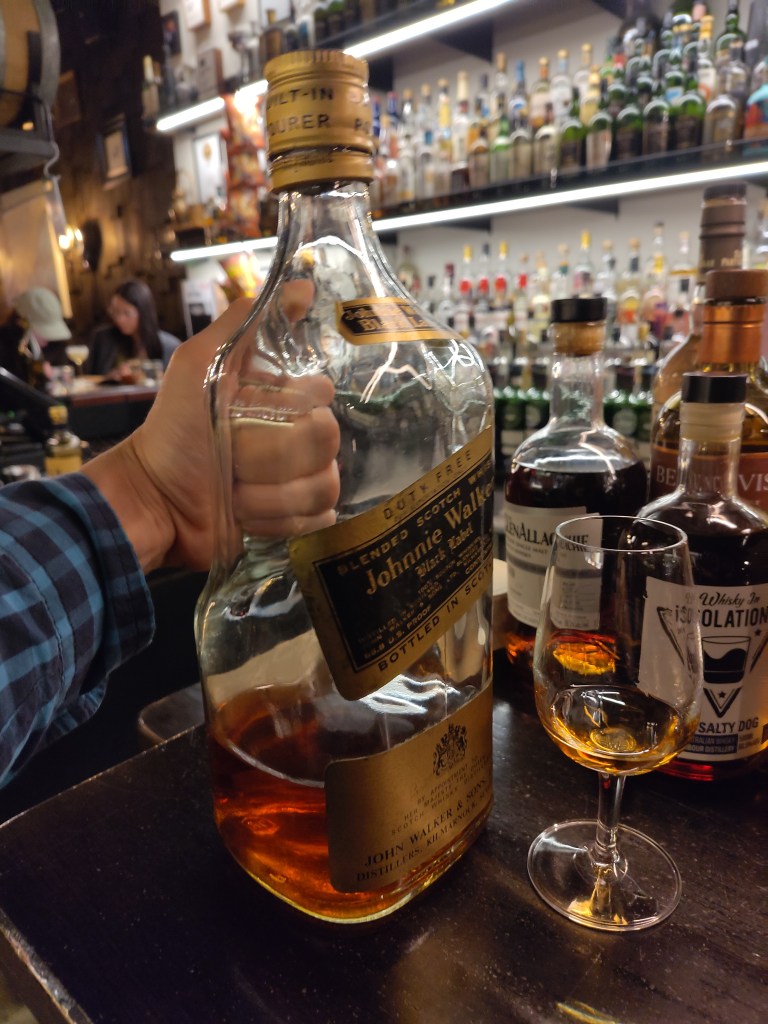
#56.2 Dramming Down Under

The hidden still in Melbourne


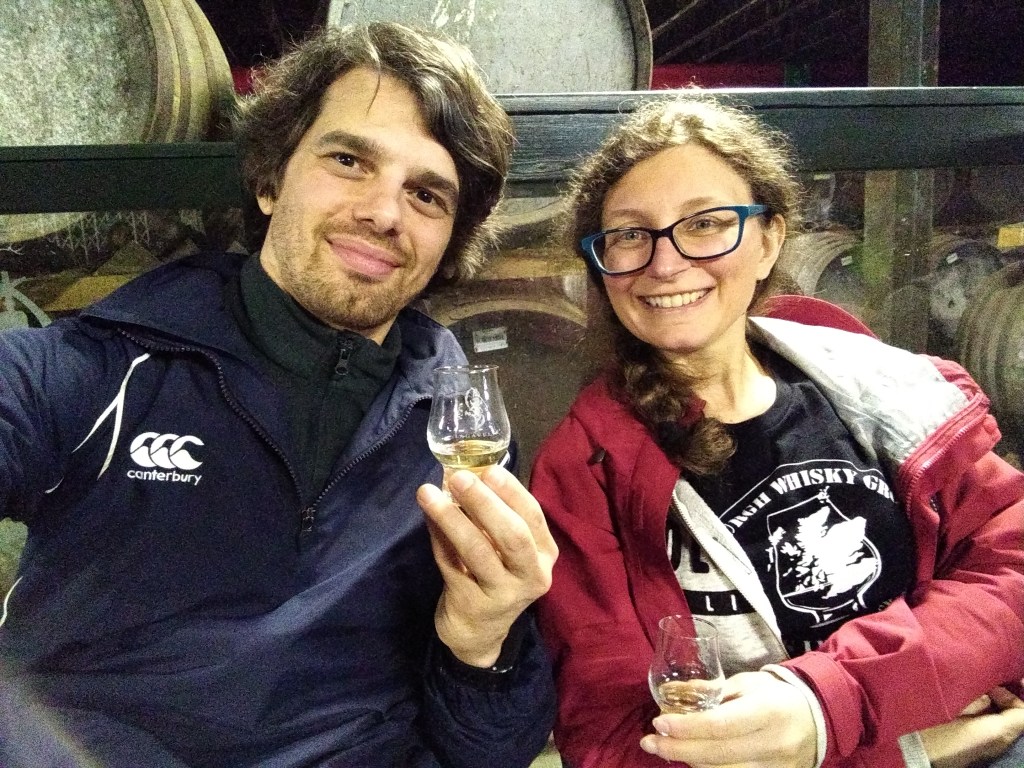
TL; DR: From Sydney, we soon flew into Melbourne, where we were pleasantly surprised by the lively and interesting whisky scene. We checked out some bars, as well as local distilleries. We found out about one, Bakery Hill, at the last minute. The very welcoming staff gave us an in-depth tour of this very urban-style distillery. And they produce delicious whisky! 

(missed Part 1?)

After the visit to Archie Rose, we paused our whisky activities for a couple of days. After the distillery tour, we went straight to Manly (north of the city) to check out the famous beach and relax. The day after, together with one of Gianluigiโ€™s colleagues and his cousin, we went to visit the spectacular Blue Mountains, about an hour outside the city – definitely worth it. Finally, on a sunny Tuesday morning, we flew to Melbourne. Once arrived, we headed towards the rental car place where, after a long wait, we got our car and drove straight to a car park near the hotel in the CBD. While we wouldnโ€™t use the car for the first day or two, having it would pay off a few days later. In the evening, we met with a Teresaโ€™s former colleague and then explored the cityโ€™s whisky scene, starting with the Whisky Den – an incredible choice of whisky, including many Australian, in a super cozy venue: thumbs up from us!
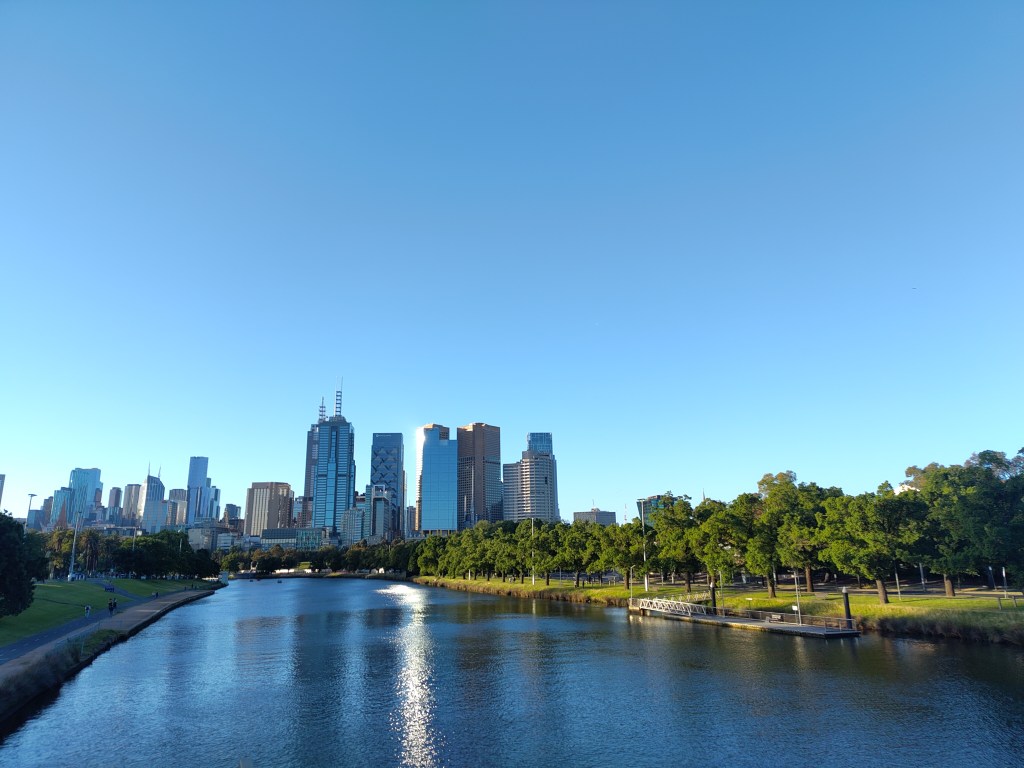
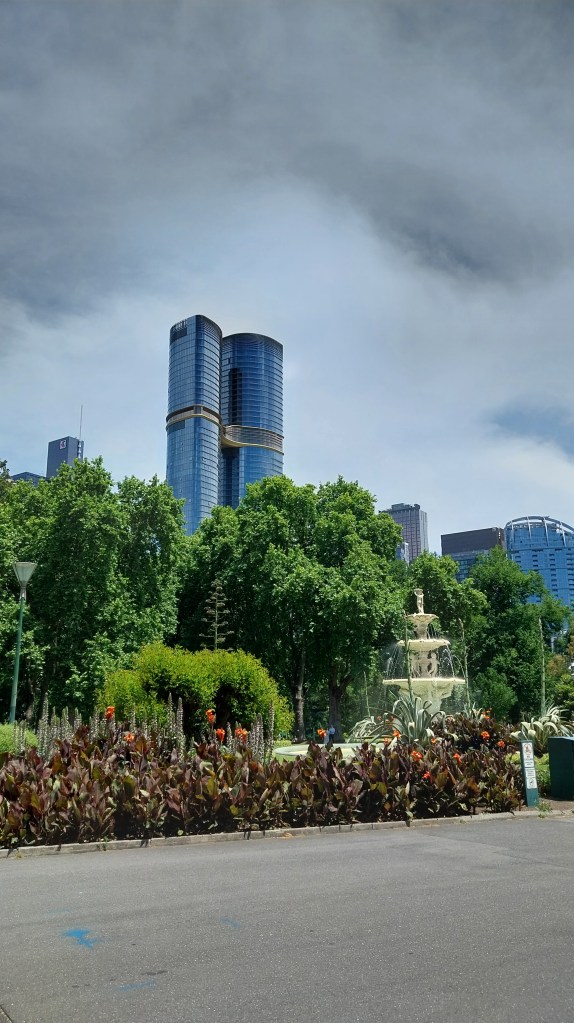
We didn’t take pictures at the Whisky Den, so you get Melbourne skyline instead.

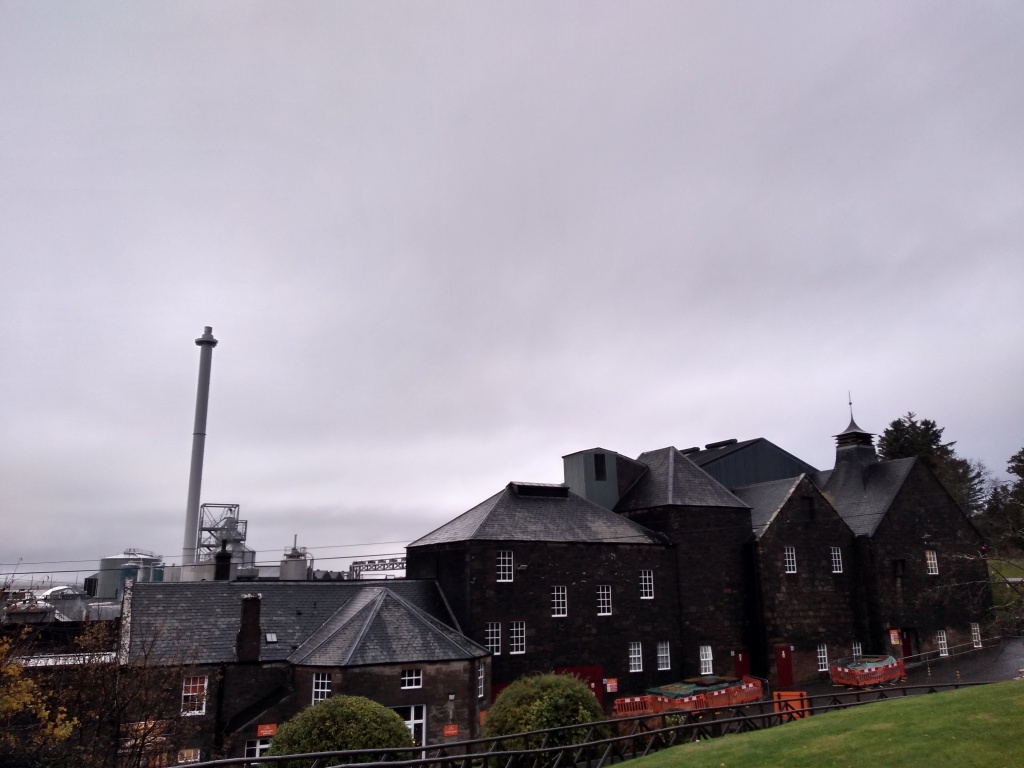
Right before taking off from Sydney, our pal Joe (from the Edinburgh Whisky Group) had given us some advice about distilleries and whisky bars to check out in the city. A suggestion was a distillery called Bakery Hill. Armed with hope but not expecting much, we sent them an email straight away to ask if we could visit the day after, the only option we had to accommodate a tour while in Melbourne. To our surprise, they replied confirming their availability for a tour, fantastic! So, the next morning we took a train from the Southern Cross station towards Kensington, North-west from the CBD. The building is a small warehouse, very well hidden in the urban context, so much so that, at first, we cluelessly walked almost a block past it.
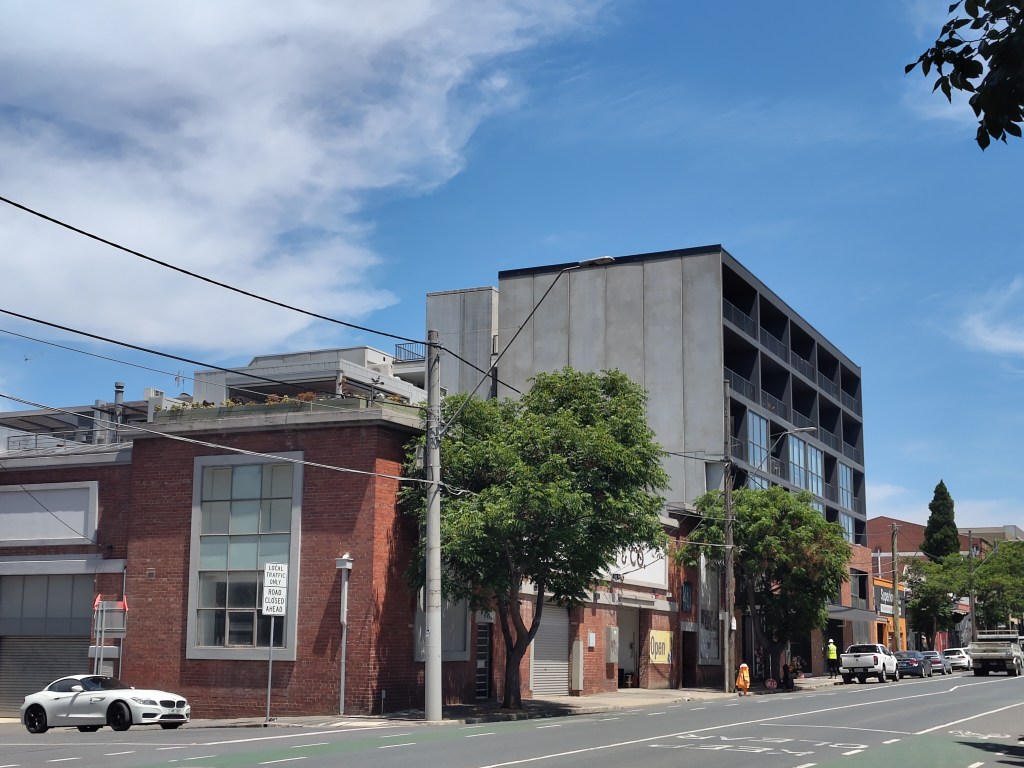
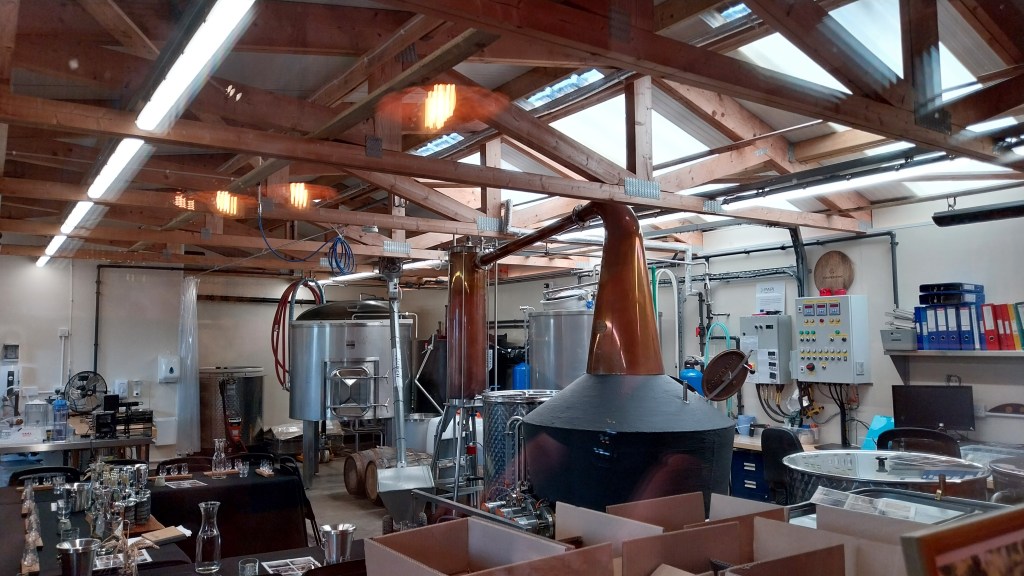
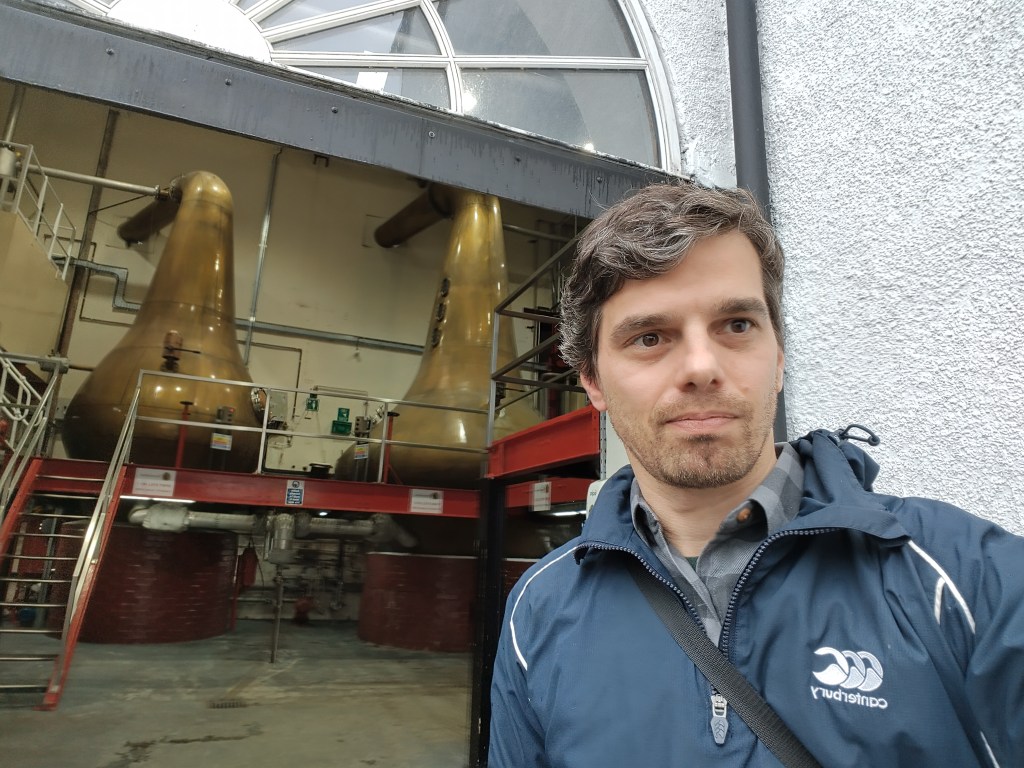
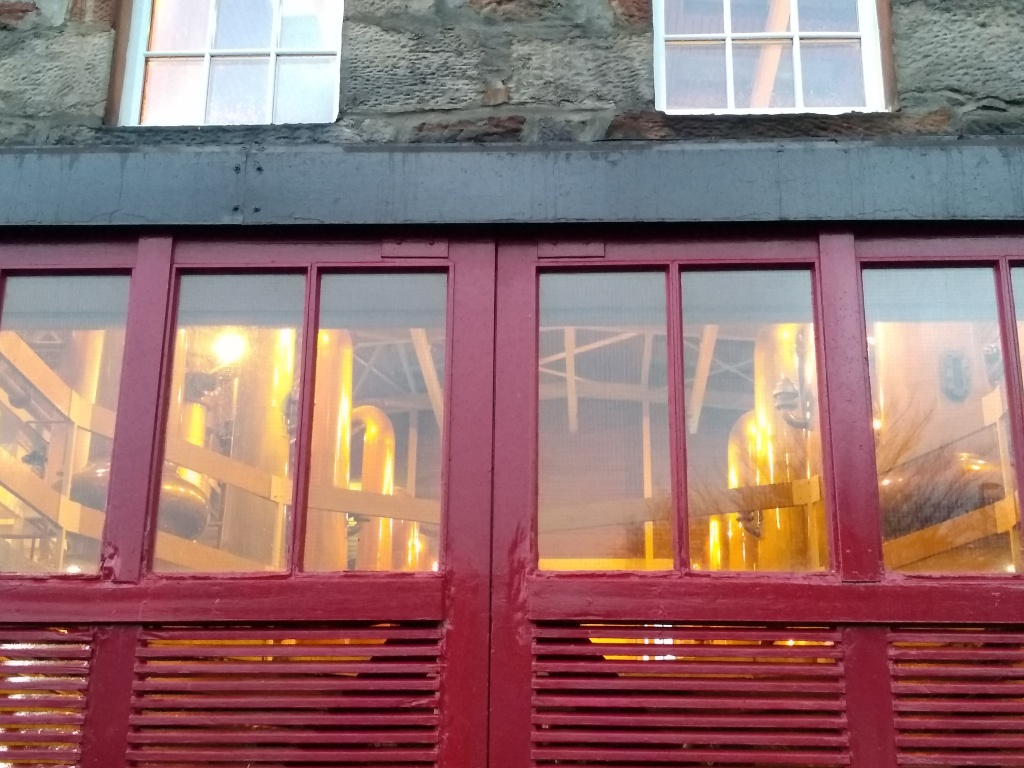
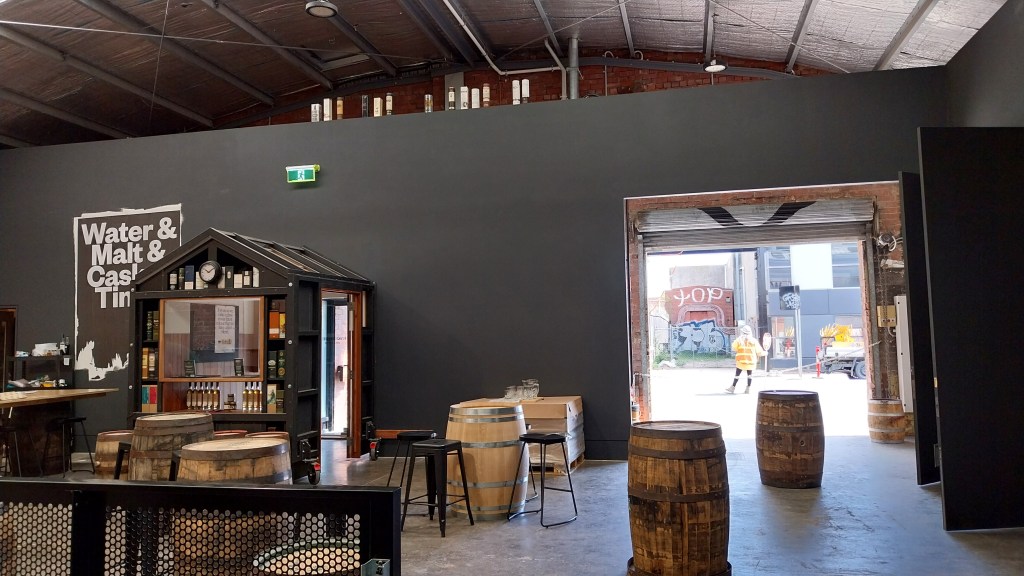
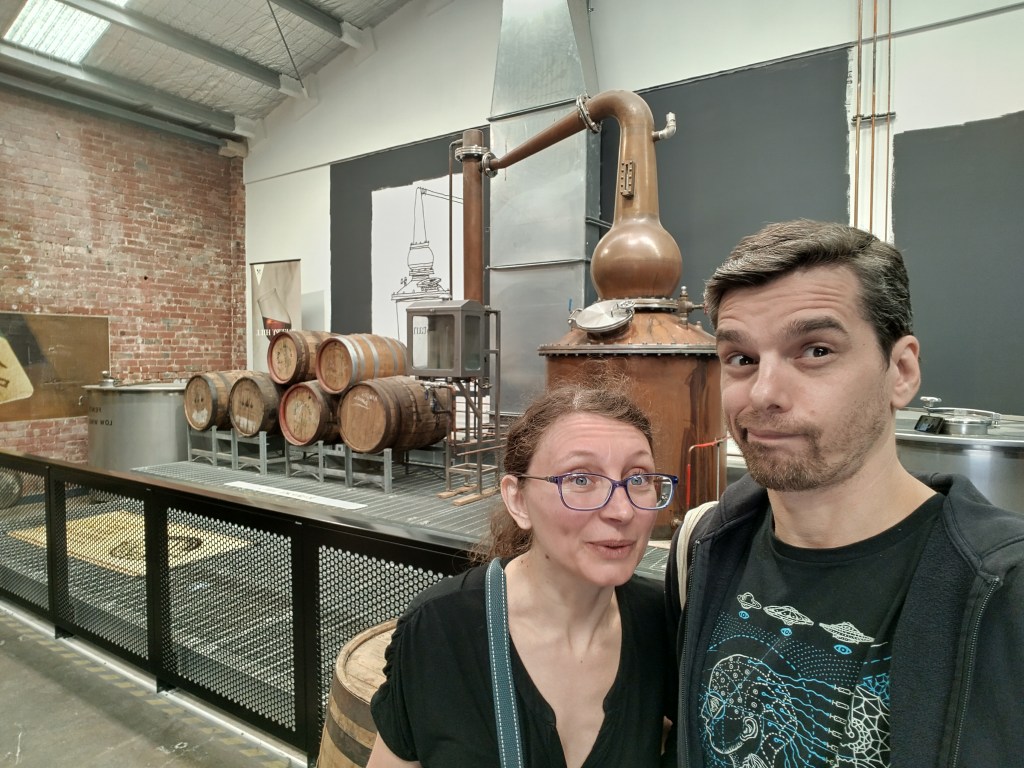
We were welcomed by Pete, one of the distillers and ownerโ€™s son. In fact, the distillery was set up in 1999 by David Baker, a former chemistry teacher, who wanted to prove that it is possible to make a good whisky in places other than Scotland. The distillery was originally outside the city, and they first released whisky in 2003. They then moved to within the city boundaries, only a year before our visit, in 2023. Now the distillery is mostly run by Davidโ€™s sons, Andrew and Pete. Except for a small space they carved out for a shop and a small office, the distillery has two main large areas, divided by a wall. The first one is occupied by the still, a space for tastings and events, and racked casks on the side. The space is also used for other activities, for example while we were there Andrew was preparing their upcoming first blended whisky release (their single malt vatted with Australian grain whisky from ex-bourbon casks, 46%). The rest of production is located in the adjacent area, again with casks racked on all sides.
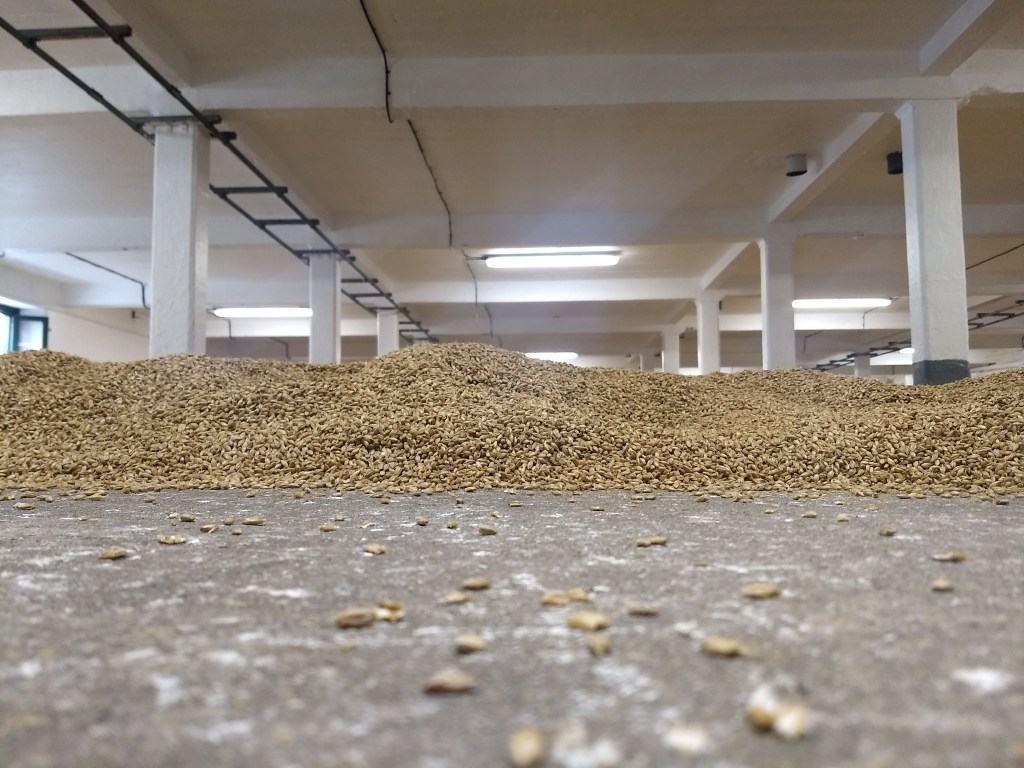
About production, the unpeated malt they use is sourced from New South Wales. The peated malt is currently sourced from New Zealand, while until a few years ago they were getting it from Scotland. They use 320kg of malted barley per mash, which is processed manually in a very โ€œtraditionalโ€ way. Fermentation is kickstarted with brewerโ€™s yeast and is quite long, 5 days. Funnily, the two washbacks are named after a children TV show called Bananas in Pyjamas, thus Banana 1 and Banana 2.

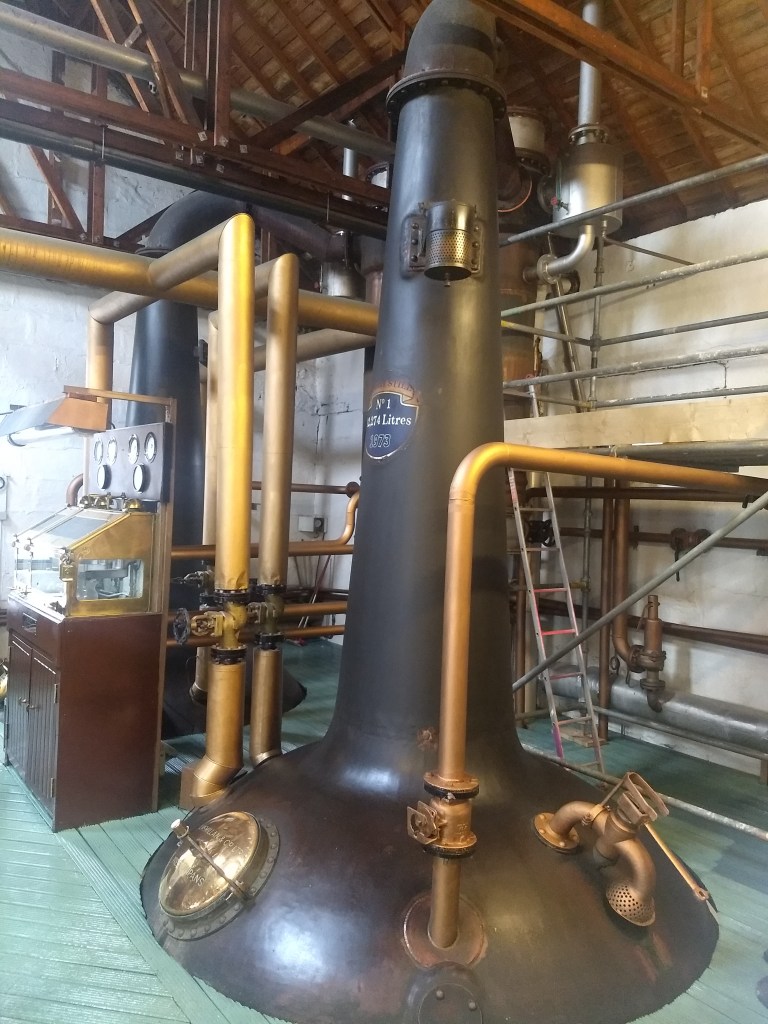
They currently have one 1,000-litre still where they run both distillations. However, a new 3,000 litre wash still was due to arrive soon (at the time of visiting). As for maturation, they use mainly American oak ex-bourbon casks, in particular from Brown Foreman, including Jack Daniel’s. They mostly bottle single cask whiskies (in 50cl bottles), and everything every whisky nerd wants to know is handwritten on the back label: distillation and bottling dates, cask number. The whisky is usually older than other local producers, the ones we tried were between the 5 and 8 years old.
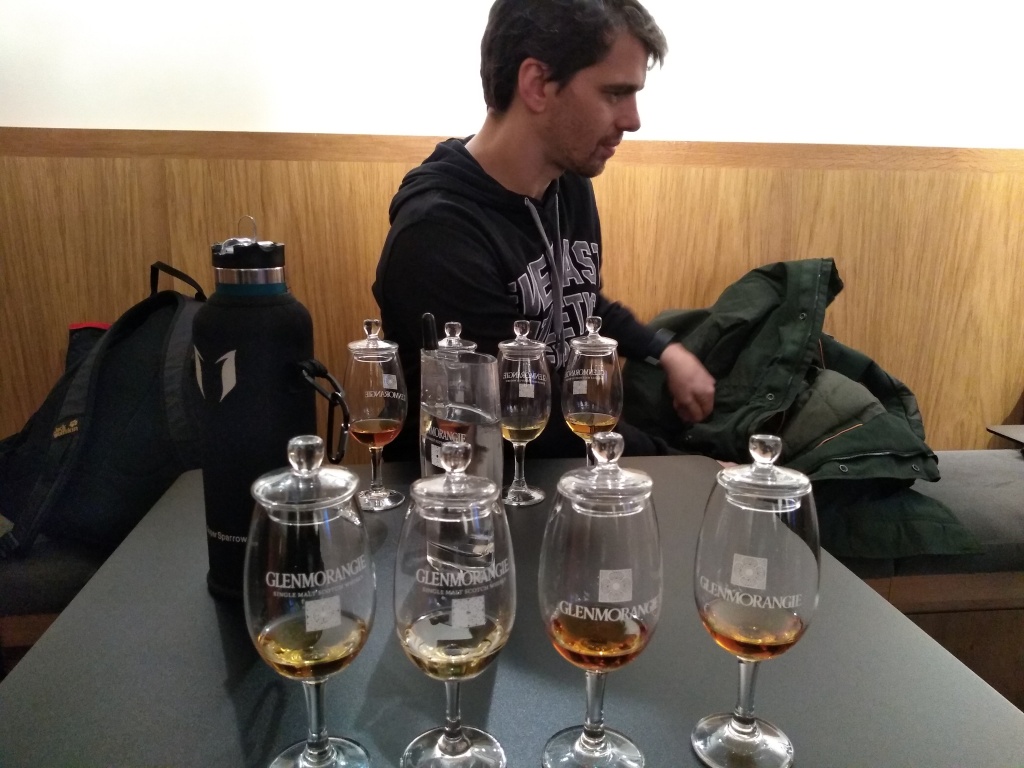
Their current Signature range includes five single malts: Classic (unpeated, 46%, ex-bourbon), Double Wood (unpeated, 46%, finished in 1st fill French oak ex-red wine cask), Peated (46%, ex-bourbon), Classic Cask Strength (unpeated, 60%, ex-bourbon), and Peated Cask Strength (60%, ex-bourbon). In our tasting, we tried four of them in this order, except for the Classic Cask Strength. They were all very good, but the two peated expressions โ€œknocked it out of the parkโ€ for us. They also do limited and seasonal releases, among the latter the Blunderbuss (after 5y in ex-bourbon, finished for 2y in Kalash Imperial Stout barrels) and the El Dorado (matured for 1.5y in Apera, i.e. โ€œAustralian sherryโ€, casks and finished for 3y in ex-bourbon). To note, they produce a gin too, the Oxford Traditional Gin (40%). Pete also told us that they started to work with some UK based independent bottlers to try get some of their whisky over here: Atom Brands already released one expression from them under That Boutique-y Whisky Company brand (the hilarious label was inspired by Breaking Bad series, given David Baker’s past as chemistry teacher).
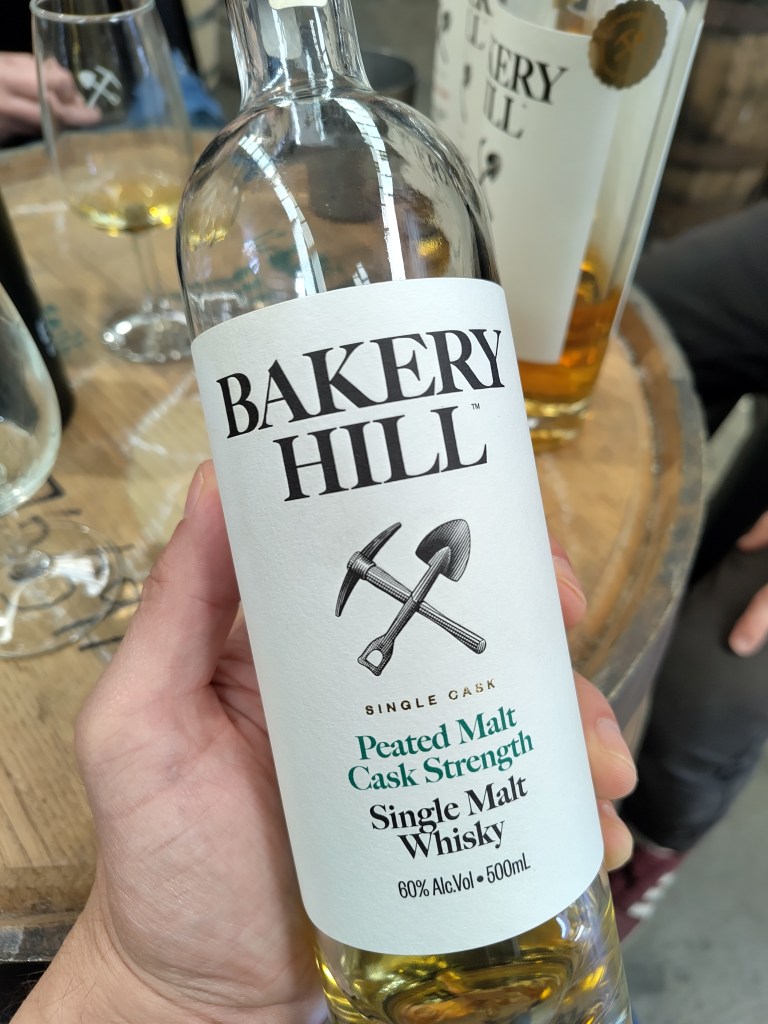
We loved the concept of this distillery: self-contained, doing things properly, and this ethos totally transpires in the quality of their drams. Bottles are pricey to be fully honest, even compared to some of their peers, but given the production size and the fact that they bottle one cask at the time, we can see why. Overall, one distillery we are super happy to have visited, and weโ€™d definitely go back (in the unlikely case weโ€™ll find ourselves in Melbourne, again)!

After the distillery we had a quick bite in a very nice cafรฉ across the road, before getting on a bus towards Fitzroy and other areas in the north of Melbourne. In Fitzroy, we also paid a visit to the Elysian Whisky bar, on Brunswick Road: what a bar! We had a lovely chat with the owners (we were there kind of early, so the only ones), who suggested drams to try and guided us through them. One great thing of Australian whisky bars is that it is possible to order half-size drams (15ml, versus the 30ml full dram), which are a bit easier on the liver (and on the wallet), in particular for whisky curious people like us who always wants to try a few.
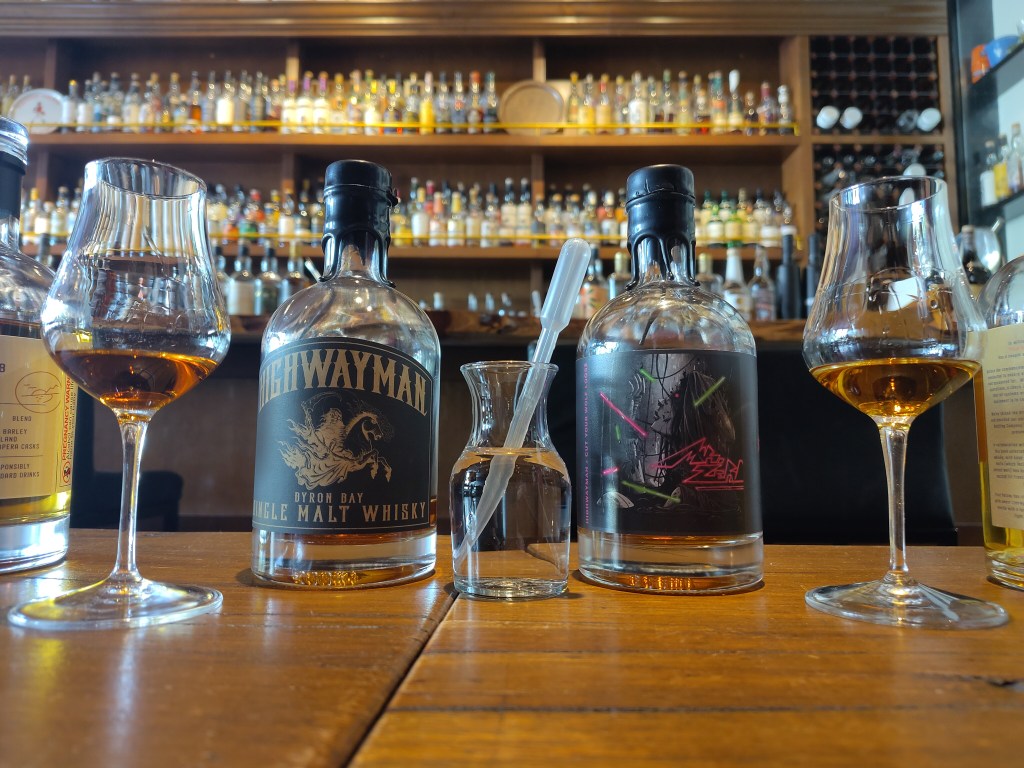
After dinner we visited another fantastic whisky bar, Whisky and Alement, where we had another great time chatting with the super knowledgeable staff, who ended up gifting us a pin for their 10y anniversaryโ€ฆwhich was four years before, ahah!

A great distillery tour and two great whisky bars, what a whisky day that was. We did other stuff (including getting the worst coffee of the entire holiday, and finding an awesome record in a second-hand music store, Travels by the American band Defeater if youโ€™re curious), but the three above were definitely the highlights of the day.

Stay tuned for the rest of our Melbourne (and surroundings) action! Until the next time, slainte!


Bakery Hill Distillery Tour

Price: AUD 35.00 pp (November 2024)

Duration: 1hr 30min

Tasting: Classic single malt (46%), Double Wood single malt (46%), Peated single malt (46%), Peated cask strength single malt (60%)

Target: whisky enthusiasts

Value for money: good

Highlights: the history of the distillery and its urban style

Recommended: absolutely yes!

Link: https://bakeryhill.com/

#55.3 All drams great and small

An English malt with a Tasmanian twist and an eye for sustainability


TL; DR: From Ellers Farm, we went directly to another distillery: Cooper King. Inspired by Tasmanian craft distilleries, they produce other spirits other than single malt, with a very interesting set up. And, everything is done in the most sustainable way possible, kudos! After the visit, we went to Brew York, for a tour, dinner, and a quiz! 

(missed Part 2/Part 1?)

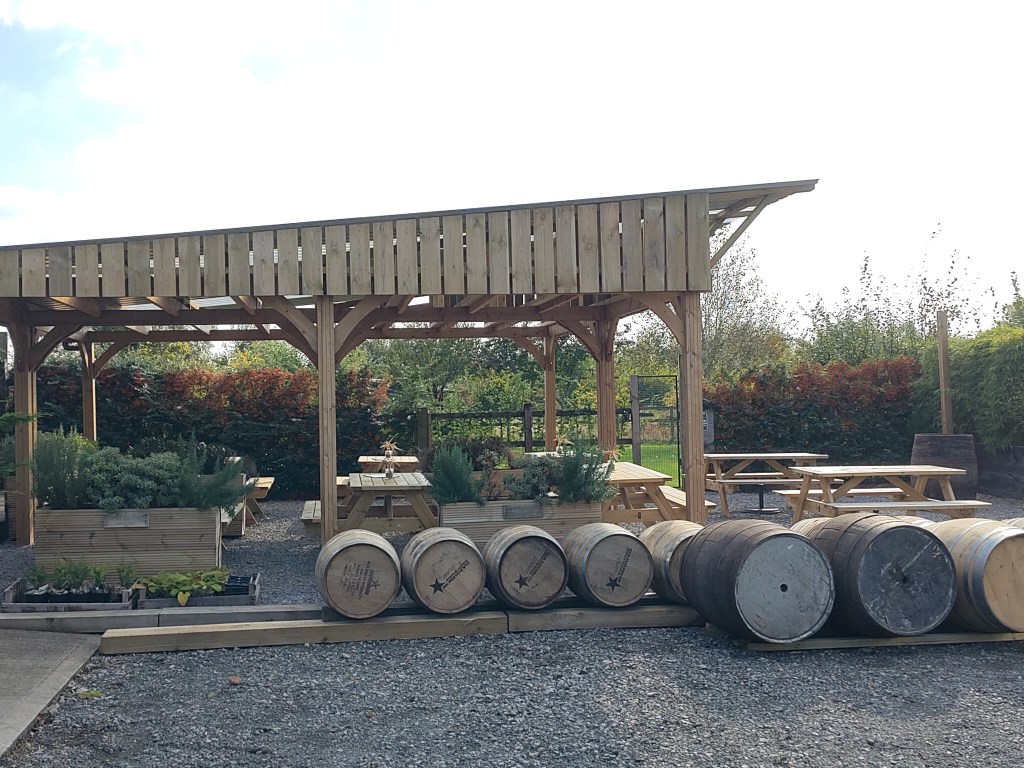
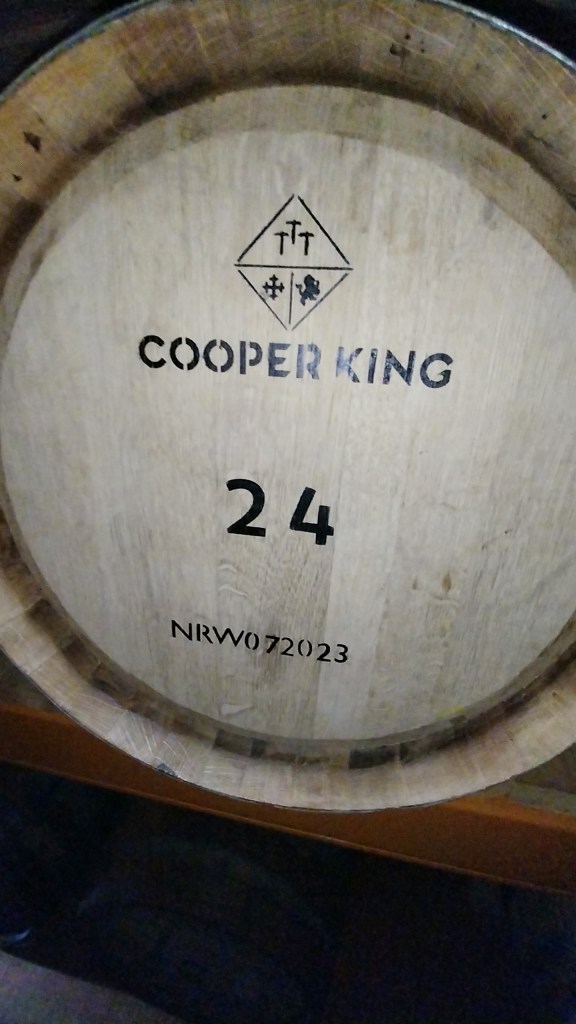
After the visit at Ellers Farm, we jumped back on the minibus. Our next destination was only about half hour away driving north-west, approximately 13 km north from the city of York, in the village of Sutton-on-Forest. The distillery is called Cooper King, just outside the village. It was founded by Abbie and Chris, a couple who got the inspiration while travelling in Australia and visiting local distilleries. The distillery is named after Charles Cooper King, Chrisโ€™ great-great-grandfather. The main building is just a few meters from the gravel parking lot, and it harbours a bar/shop and production. There is also a nice wee garden outside, with wooden tables and benches, which we took advantage of after the tour. It was a nice sunny day!

We were welcomed by Mark, tour guide and assistant distiller. Like others, he came on board as a crowdfunder. At some point (in our understanding) the two founders Abbie and Chris asked who among the crowdfunders wanted to be more involved, and Mark answered the call. We could clearly see his passion for the project. He explained that, in 2014, Abbie and Chris, once a biochemist and an architect, moved to Australia to travel, and started working as fruit pickers. Then, they went to Tasmania, and after getting in contact with Sullivanโ€™s Cove and Lark, they decided to go back to England and produce a Tasmanian-style whisky. Back in Yorkshire, they bought the land thanks to a crowdfunding, as well as a 900-litre pot still (Neilson) straight from Australia.

Another principle they had in mind when setting up the distillery was sustainability. The electricity comes from renewable sources, of which 60% is produced on site with solar panels: this contributed to make them the first net-zero distillery in England. They also have a programme for planting trees and restoring woodland and wildflowers habitat for each bottle they sell. Moreover, they chose lighter bottles, and offer refills at the distillery, for a few quid less.

Production-wise, they use Maris Otter barley malted in middle England. They pre-heat the small mashtun before mashing the malt. After that, the remaining draff goes out to local farmers to feed cows. Fermentation takes place in a 1750-litre plastic vessel (usually only half full to avoid foam accidents) and lasts seven days. Both distillations happen in the same still, which is different to what we saw in all the Scottish distilleries we visited so far. At first, Neilson the still was heated externally, but to make the process more efficient it was sent to Scotland for modifications and is now internally heated and insulated.

The wash gets distilled to 25% abv, while the heart of the second distillation comes out on average at 75%, before getting diluted by filtered tap-water. Needless to say, everything in the distillery is very manual, except for the gin and vodka very modern cold-distillation machines (which take only about 10% of energy compared to a classic copper pot distillation).

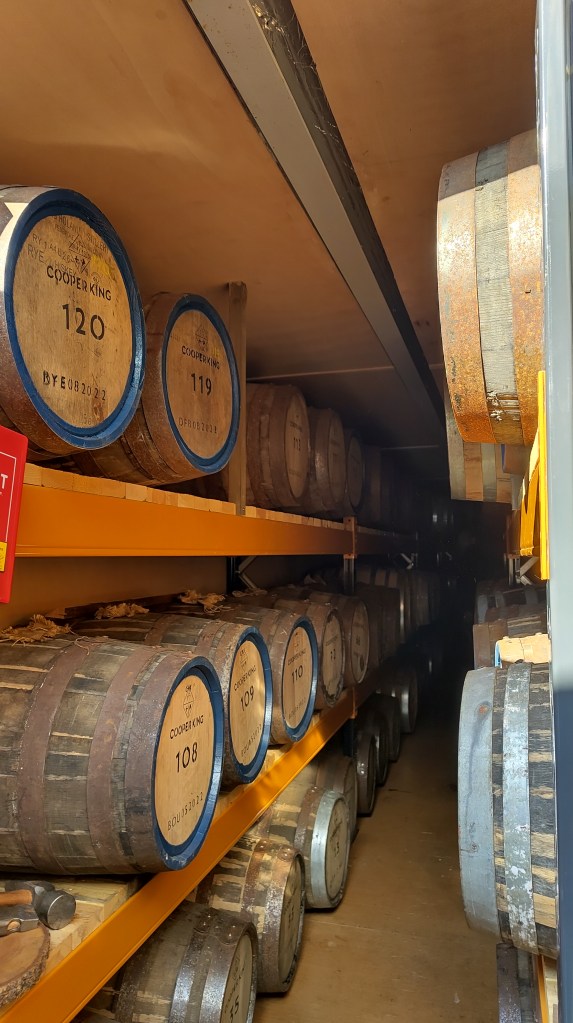
They use a variety of casks from all over the world, and their main American cask supplier is the Garrison Brothers distillery, in Texas. Casks are kept in a safe container behind the distillery, while waiting to get a proper warehouse. They started distilling newmake spirit in 2018, and their first whisky was released in October 2023, about a year before our visit.

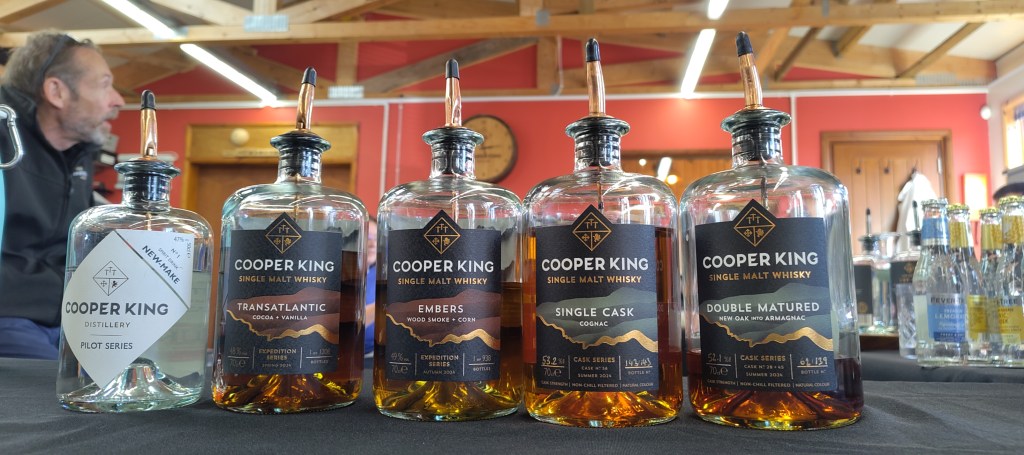
While we were outside checking out the casks, another member of staff set up the tasting in the main production room, which also serves as a tasting location. First, we went through five liquors and gins (see below), but as itโ€™s not really our focus, we wonโ€™t spend many words on it. We were really interested in their whiskies. The first one was not exactly that: a newmake spirit, from the โ€œPilot Seriesโ€ and bottled at 47%. It was followed by two single malts from their โ€œExpedition Seriesโ€, Transatlantic (ex-bourbon and ex-wine casks, 48%), and Embers (charred ex-bourbon casks, 49%). Then, two single casks: first, an ex-Cognac matured single malt, bottled at the 53.2% natural cask strength; second, a dram first matured in virgin oak casks, then re-racked into an ex-Armagnac cask, again cask strength at 52.1%. The evaporation (or โ€œangel shareโ€) is higher compared to Scotland, about 4%, which combined with other specific conditions, might cause the abv to be lower for such young whisky. Overall, we could tell the degree of experimentation at this distillery is high.

After the tasting we had a few minutes to spend in the sunny patio, sipping on our leftover drinks, before getting back on the mini-bus. We headed towards York, precisely the Brew York Brewery. Despite the city location is not their main production facility anymore (that one is in Yorkโ€™s outskirts), itโ€™s still a massive place. We did a production tour (ยฃ15, including four tastes) and then had dinner there (they do a range of Asian-inspired dishes, which were delicious, albeit heavy on spring onion). Unfortunately, the place was too noisy for the next scheduled activity, a whisky-based quiz, so we had to move to a quieter pub nearby. The quiz, organised by our whisky veteran pal Charlie, was great fun, and we went back to base all very happy.

What a great afternoon and evening we had! At that time, we had tried very few craft Australian whiskies (and even less Tasmanian ones), so the link between them and Cooper King was not evident to us. At the time of writing however (after a serendipitous trip to Australiaโ€ฆStay tuned in the coming weeks for more), the connection is quite obvious: we spotted a very typical herbaceous note in Cooper King drams, the same we found in most whiskies down under. Overall, itโ€™s a very interesting project, which we are very glad we got to know more of.

Next up, another Yorkshire whisky day, but not a distillery! Until next time, slainte!


Cooper King Distillery Bespoke Tour

Price: ยฃ20.00 pp (October 2024)

Duration: 1hr 30min

Tasting: 5 spirits (Dry Gin, 42%; Herb Gin, 40%; Smoked+Spice Dry Gin, 41%; Black Cardamom Vodka, 40%; Berry+Basil liqueur, 25%) and 4 drams: Transatlantic (48%, ex-bourbon and ex-wine, 1208 bottles), Embers (ex-bourbon, 49%, 938 bottles), ex-Cognac matured single cask (53.2%), virgin oak/ex-Armagnac cask (52.1%)

Target: whisky and spirit enthusiasts

Value for money: very good

Highlights: the distillery set up

Recommended: yes

Link: https://www.cooperkingdistillery.co.uk/


#48.1 Islagain


Nice drams with a sour aftertaste: Bunnahabhain


TL; DR: And weโ€™re back to Islay for the second time this summer! After a quiet Friday afternoon, the next morning we had our first tasting, followed by a tour at one of our favourite distilleries: Bunnahabhain. The tasting was great as usual, but what happened afterwards was a major let down for us.ย 

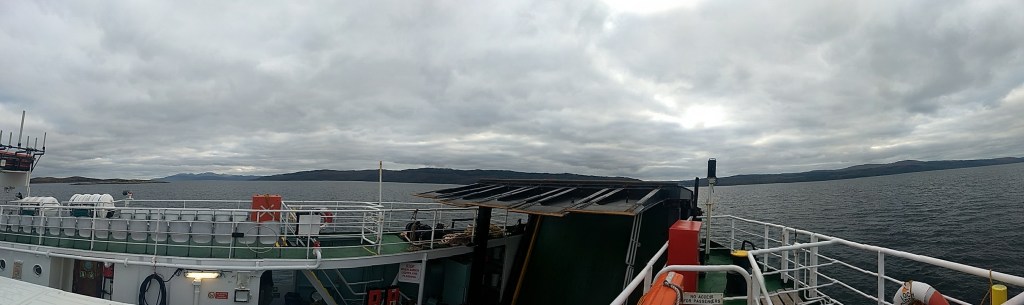
Driving to Islay is always a big trip: it takes about four hours to drive from Leith to the Kennacraig ferry terminal, and then the ferry trip is another couple of hours. However, once youโ€™re on the island, you forget about all of this as the atmosphere in which youโ€™re immersed is something else. Everything slows down and there is a sense of quiet and tranquillity. Itโ€™s a strange mix between feeling energised and relaxed, with the mind finally off the million thoughts of everyday life. Maybe this a feature of all remote places.

The excuse for this trip came when our friends Glaire and Clay asked us to join them on their trip to celebrate their friendโ€™s birthday. That was a proposition too good to be true, so we happily accepted. On a Friday morning, we picked them up and started driving westward, first to Glasgow and then up along Loch Lomond, past Arrochar south-west, and along the Argyllโ€™s lochs (as we write, we can almost visualise the trip). We had a wee stop for a coffee (well, and a wee) in Inveraray, at the George Hotel. We also enjoyed their morning rolls, unbelievably tasty. A pity we didnโ€™t manage to meet our friend Ivan. The rest of the drive was uneventful, everything was on time, and we got safely to Bowmore where our friends had booked a small apartment. We parked our van not too far away and hanged out with them. In the evening, after dinner at the Lochside, we met their friends for a drink at the Duffieโ€™s, just next door. It was a nice evening but we were very tired, so after a while we just went back to sleep.

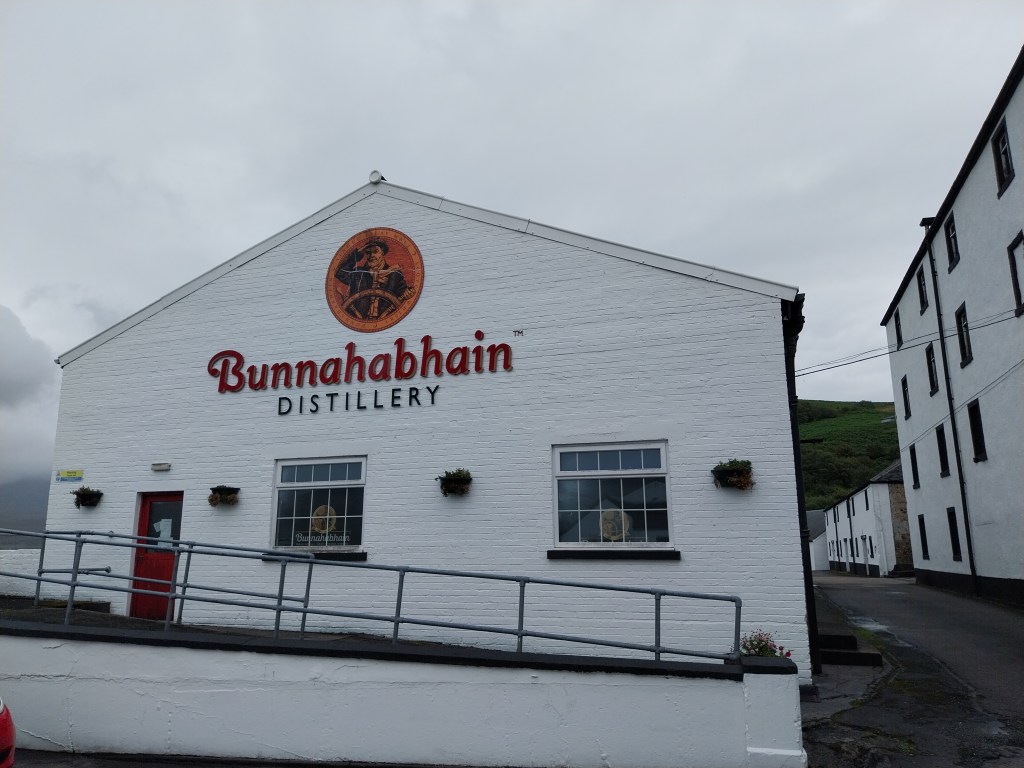
The day after we were very excited: our first time back to Bunnahabhain, after our visit in spring 2022. Bunna is one of our favourite whiskies, and it rarely disappoints us: we both love the unpeated sherried stuff, and the peated one too (itโ€™s actually one of the best peated malts in our opinion). So, the jolly party of three (Glaire skipped this one) left Bowmore on Mr Vantastic, and after a quick stop to check out the Ardnahoe shop, we got to our destination. The day was cloudy, a tad windy but not enough to keep the midges away, which in the minute we spent outside the visitor centre destroyed us!

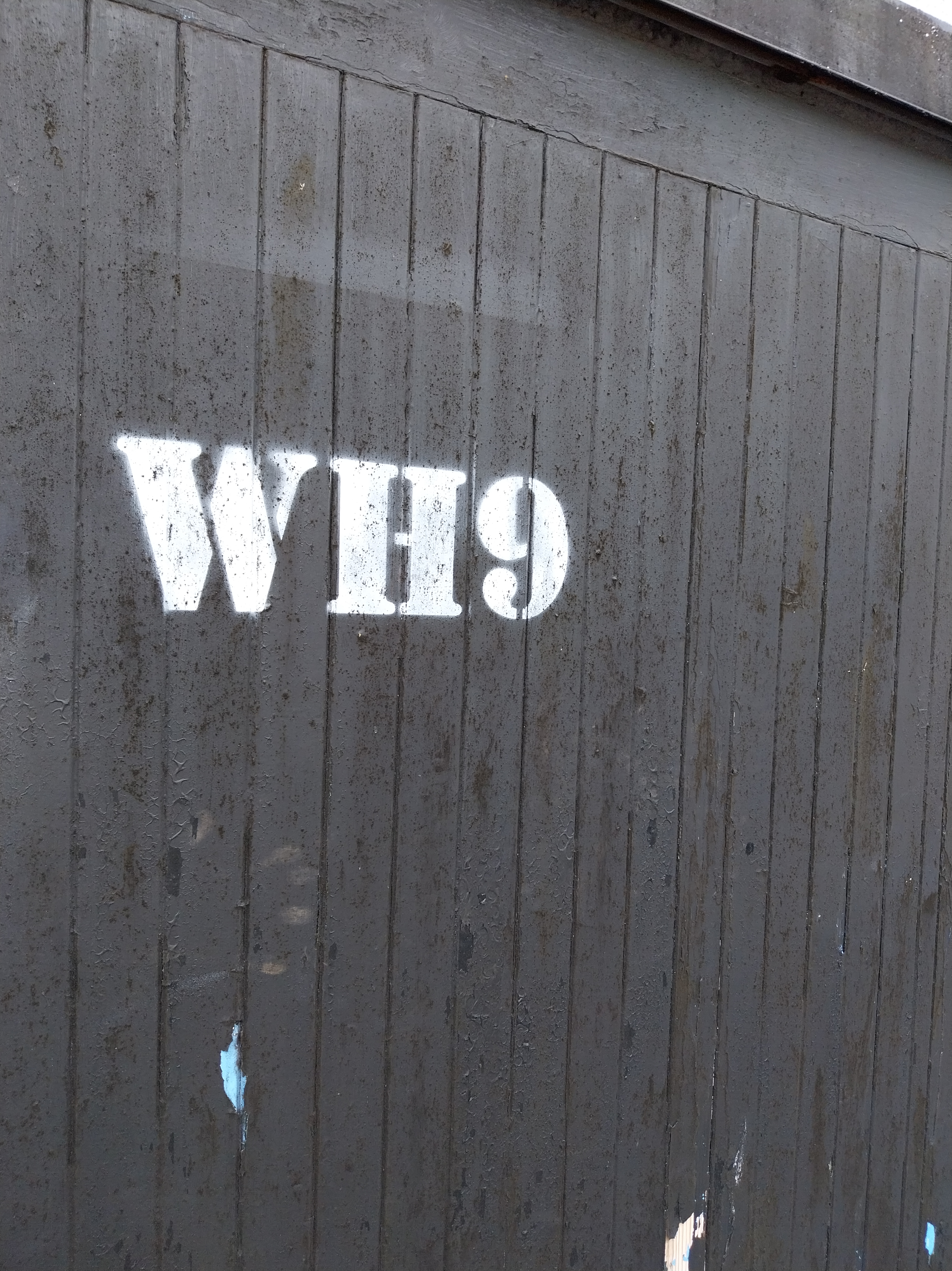
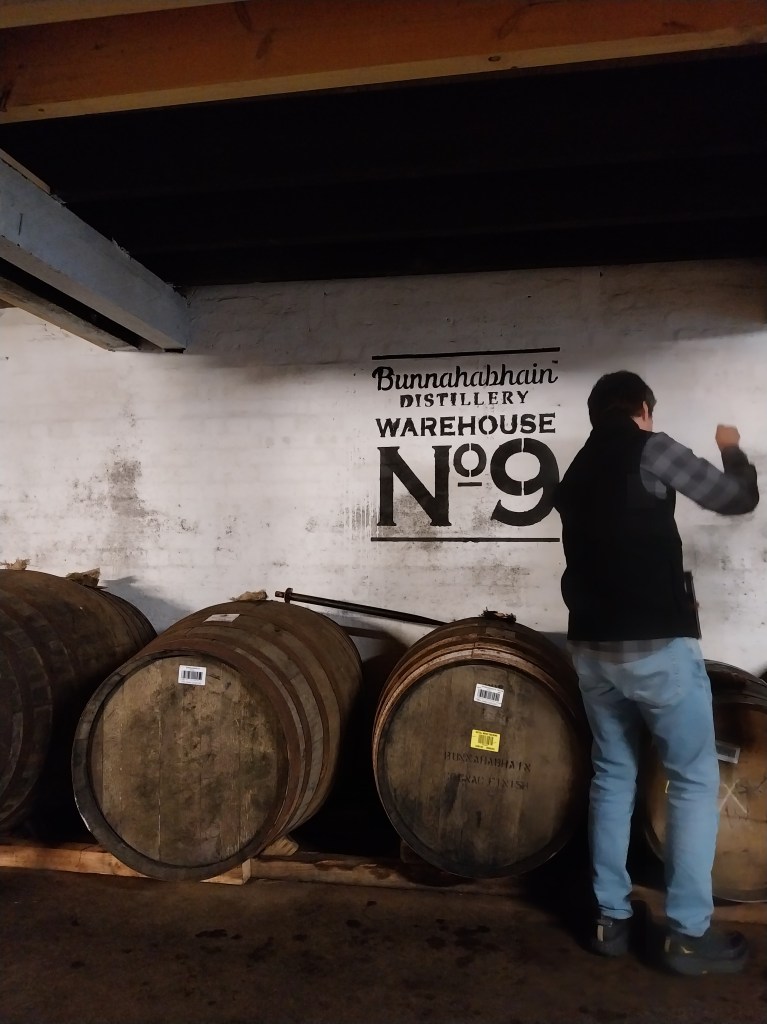
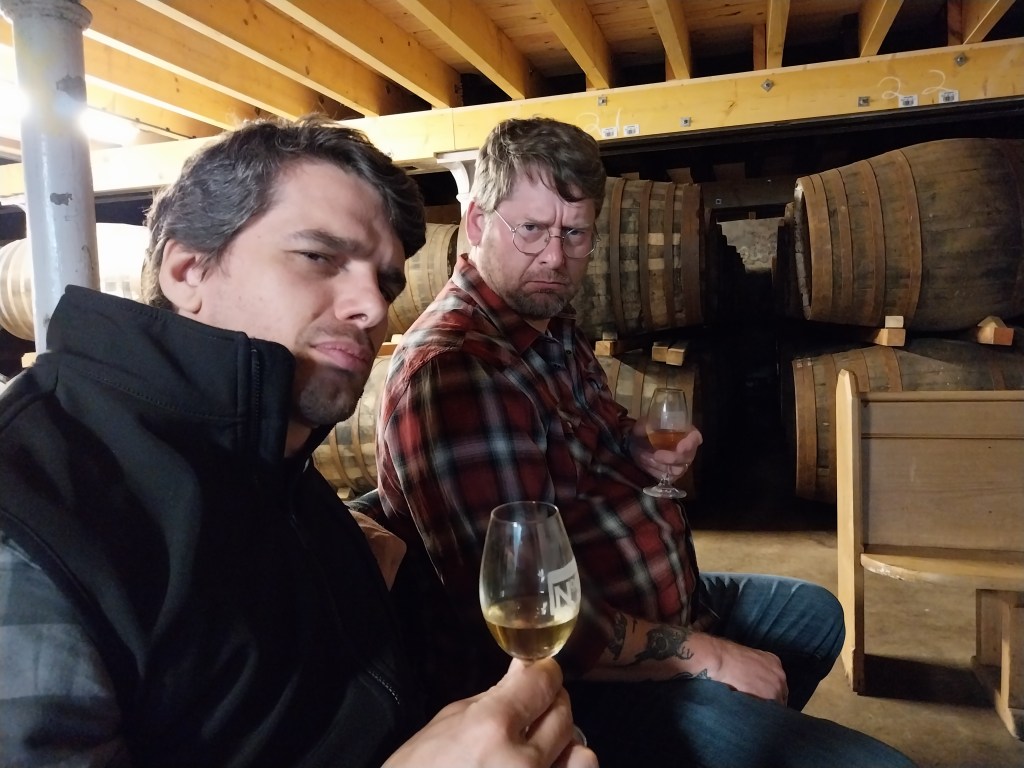
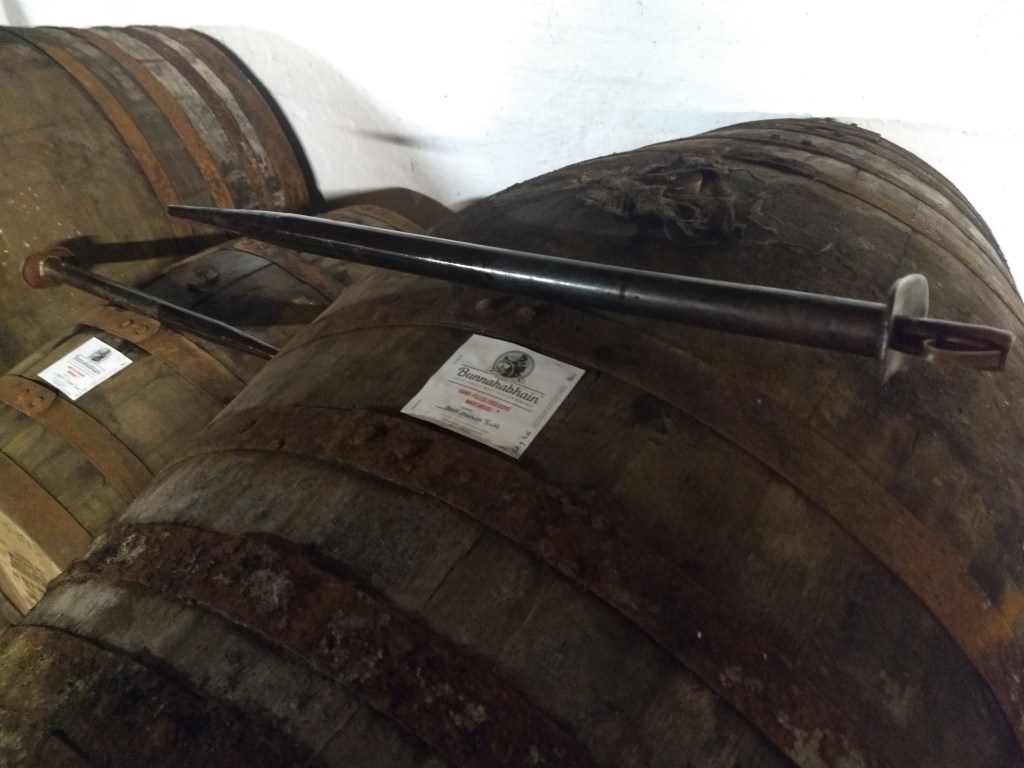
Once safely inside, we met the guide for the tasting: Matthew, which after a brief introduction walked us to Warehouse 9, the former malting floor. We were 5 people in total, so quite an intimate tour – the first time it was 13 people and felt like a crowd in comparison. The tasting was fun, as usual, Matthew was a good entertainer and very knowledgeable, and let people draw the whisky from the cask (Gianluigi tried too).

The first dram was an unpeated one, a 2007 ex-Muscat cask (16y), bottled at 53.7%. A very sweet and delicious dram. It was followed by a 2014 (9y) ex-Canasta sherry cask: this is a brand of cream sherry, which is a mix of Oloroso and PX. This dram was bottled at 58.4%, stronger at the palate as well. We moved on to the peated drams, first a 2011 vintage fully matured in a refill ex-Cognac cask (58.9%); the cask was used for a finish first, so the Cognac influence wasnโ€™t too strong. It was followed by a 2013 (10y) ex-Bordeaux red wine cask (57.9%), re-casked into this only after two years, in 2015. The last one was truly stunning, a real dirty belter of a dram.

However, here is where things went wrong. Back at the visitor centre, we were told that we could participate in the tour because weโ€™d drunk before at the tasting, and they could allow inebriated people in production. While we could see where this rule comes from (after all, we both did the 2-hour Scottish Training for Alcohol Retailers and Servers training, so we can see the logic), we really didnโ€™t expect this to happen: it wasnโ€™t written anywhere and in other distilleries (including Deanston, of the same company) we’d visited production after a tasting. There, they mentioned the T&C, which is always an โ€œout-of-jailโ€ card, but later that day we verified and that was not true (at the time, more on this later). We asked if we could have a refund, and here is the annoying part: they told us they couldnโ€™t issue any! Thus, to avoid losing ยฃ40 we decided for Teresa to go on the tour on her own (she was the driver that day, so sheโ€™d not drunk at the tasting), while Gianluigi would come back on the Monday to catch up, just before the ferry back to the mainland. The following tour description is a summary of both our tours, which were given by the same guide. They were probably in training, as both tours only covered the basics, but as we said in other occasions, you need to start somewhere.

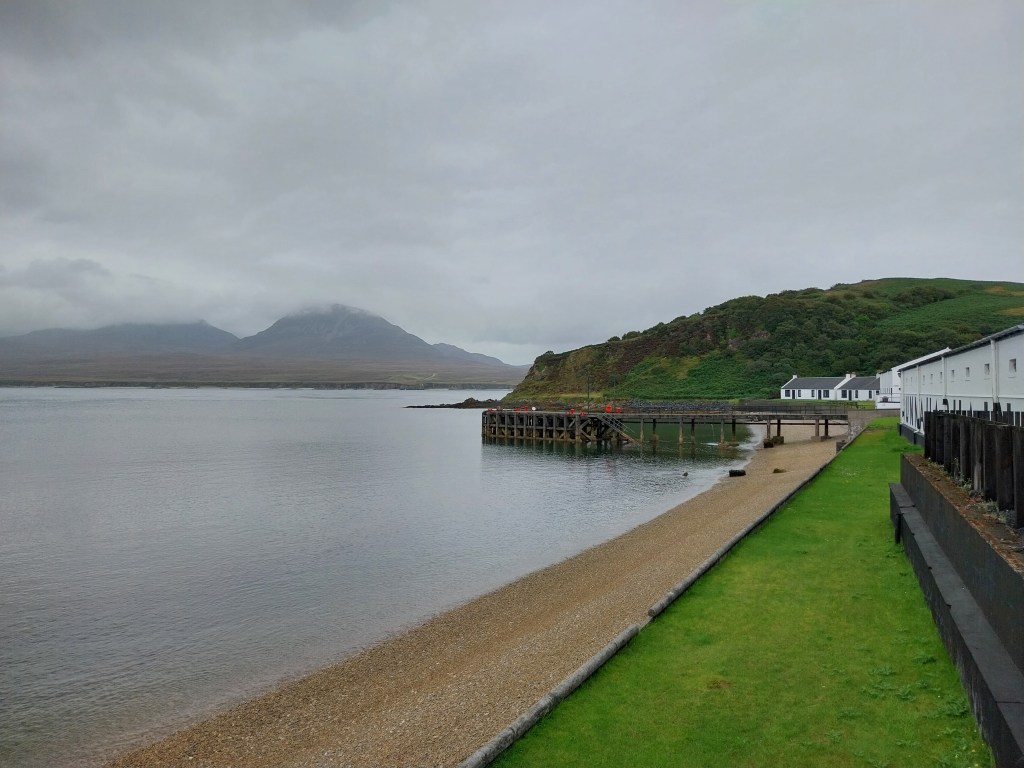
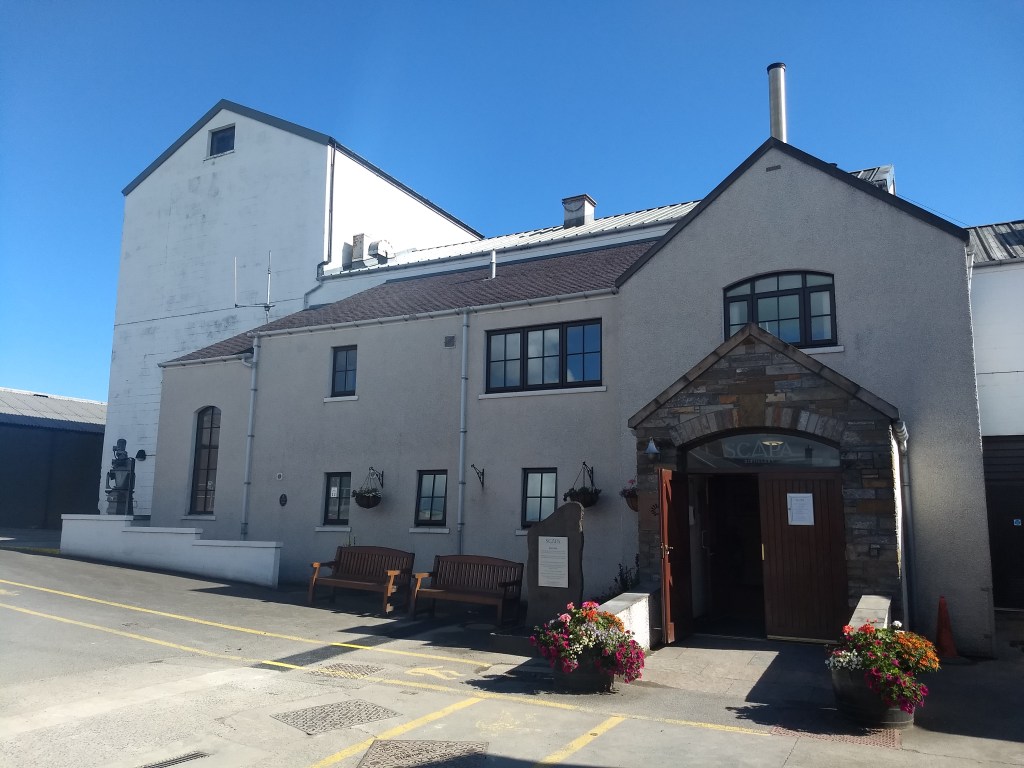
The distillery, whose name means the Mouth of the River, was founded in 1881, originally doing peated malt, but turned to unpeated later: nowadays they do both. Their flagship malt, the Bunnahabhain 12, was first released in 1979, almost a hundred years after founding. What is really hard to wrap our head around, is that until the 60s there was no road to the distillery, so everything that went there and back was by boat, quite incredible! They have one of the iconic Porteus mills since 1964, which grinds the barley usually sourced from Simpson, on the mainland. In the resulting grist, the husk/grit/flour split is 20/70/10, as usual. It is then sent to a big mashtun (full leuter and covered by a copper lid), 8.6 tonnes at the time, where it is mashed with the usual three waters at increasing temperatures, to maximise the sugar extraction in their cloudy wort. The draff, discard from mashing, is used for their biomass plant, as opposed to many distilleries that sell or give it to farmers to feed cows.

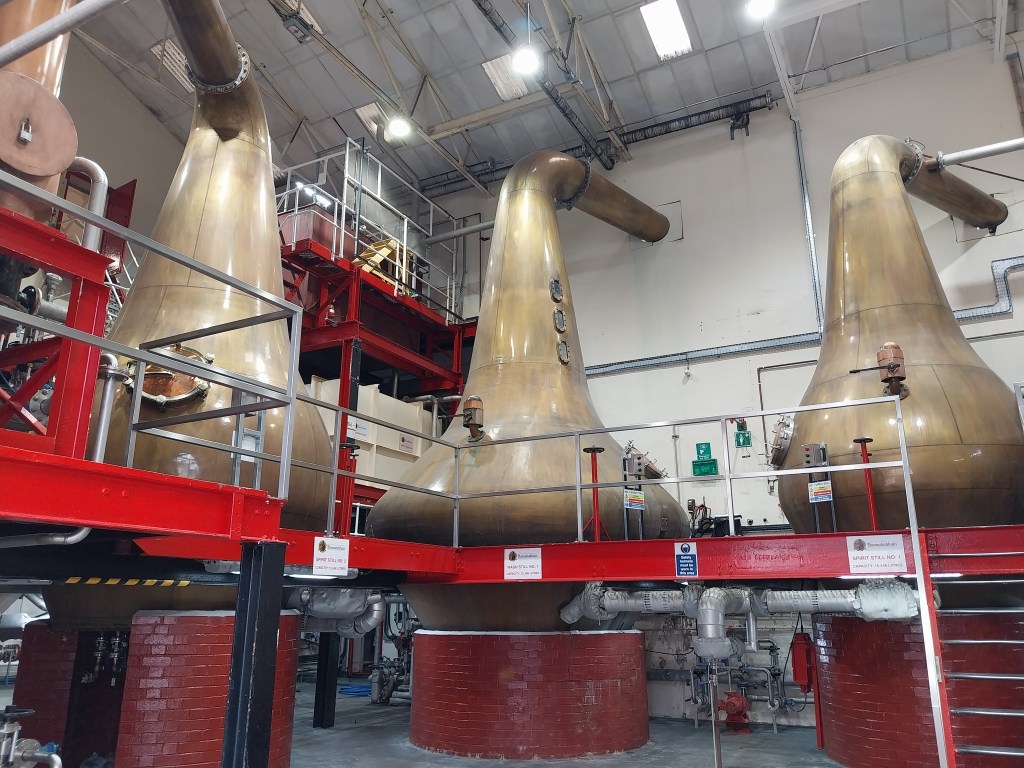
Currently, they do 23 mashes per week, which are then moved to ferment into one of the six Oregon pine washbacks for 52 hours to reach about 8%abv. They have only one pair of stills, and during the second distillation they take a cut from 74% to 64%, discarding and redistilling the head (above the first cut point) and the tails (after the second one). After a quick nip to the warehouse and a look at the pier, we walked back to the visitor centre for the two-dram tasting. Surprisingly, there wasnโ€™t their flagship 12-year old, but a dram each of the two non-age statement expressions: Stiuireadair (unpeated), and Toiteach A Dhร  (peated). Meh.

A bit deflated, we left the distillery and drove back to Bowmore, where we had a quick meal before driving to the birthday party. There, we met some very nice people and had lot of fun, playing garden games and having delicious food. In the evening, we had a final couple of drams at our friendsโ€™ flat, before retiring in the campervan.

Honestly, this was one of the most disappointing distillery visits we had recently, which made us sad as Bunnahabhain is one of our favourite whiskies. We excused the increase in ยฃ10 for the Warehouse 9 tasting compared to 2022, although for four drams it is has became quite steep. Someone could argue that they are expensive drams, they are indeed, but the reason is that they are almost insanely priced: the 20cl bottle of the whiskies we tried ranged between ยฃ45 and ยฃ60, which is ยฃ145 to ยฃ195 for a full 70cl bottle, out of touch. Also, the choice to replace the Bunnahabhain 12 with the Stiuireadair (maybe the only bad Bunna we ever tried) in the tasting after the tour is quite a strange and cheap move. Would you imagine going to Lagavulin/Caol Ila/Ardbeg/Bruichladdich, paying for the basic tour and not getting a dram of their flagship 16/12/10/Classic Laddie? Yep, not even the Evil Empire does that.

But of course, what we really did not like was the way we were treated, and the lack of flexibility or willingness to try to fix a problem that wasn’t our fault in the first place. It’s true the staff gave Gianluigi and Clay “reparation” drams while Teresa was doing the tour, but at the same time we felt we were treated like we had done something wrong, which wasn’t true at all. At that time, it wasnโ€™t written anywhere that we couldnโ€™t do the tour after the warehouse tasting. Fortunately they recently changed the website (we wonder whether it wasn’t just us having this problem). Since the reservations were made under the same name/email, it would have costed the staff 5 minutes to touch base via email before. But what really made them unprofessional was that someone could have just told us before the tasting, when we checked in (and said weโ€™d booked both tasting and tour). We would have both got drivers drams. We later complained via email, and they promised a refund for the tours (refund still not received, at the time of writing over a month later).

To wrap up this rant: will we still drink Bunnahabhain? Definitely, itโ€™s too delicious to let go. Will we still buy from the distillery? Maybe, there are many indies out there with great Bunnas. Will we go back for another tasting or visit? Probably not for a very long time.

Stay tuned for some happier action the next day, a visit to the only Islay distillery we hadnโ€™t visited yetโ€ฆCan you guess which one? Until then, slainte!

Bunnahabhain Warehouse Tour

Price: ยฃ50.00 pp (August 2024)

Duration: 1hr 30min

Tasting: 4 drams (25ml, all natural colour and unchillfiltered), 2007, 16y, ex-Muscat cask, 53.7% (70/20cl bottles for ยฃ195/ยฃ60); 2014, 9y, ex-Canasta sherry cask, 58.4% (ยฃ145/ยฃ45); 2011 Moine (peated) fully matured in a refill ex-Cognac cask, 58.9% (ยฃ155/ยฃ55); 2013, 10y, Moine ex-Bordeaux red wine cask, 57.9% (ยฃ145/ยฃ50), and a copita to take home

Distillery Exclusive: see above

Target: whisky nerds

Value for money: a tad pricey

Highlights: Warehouse 9 is always special

Recommended: yes

Link: https://bunnahabhain.com/

Bunnahabhain Production Tour

Price: ยฃ20.00 pp (August 2024)

Duration: 1hr (almost)

Tasting: 2 drams (20ml), Bunnahabhain Stiuireadair (46.3%), Toiteach A Dhร  (46.3%)

Distillery Exclusive: see box above

Target: casual drinkers and tourists

Value for money: ok

Highlights: the still room

Recommended: if youโ€™re looking for a basic distillery tour, there are better options on the island

Link: https://bunnahabhain.com/
#39.3 The Highlander Trip

Down the neck of the giraffe


TL; DR: Third and final distillery of the day (not of the trip), Glenmorangie. The behemoth of the north, producing one of the best-selling malts, a visit weโ€™d postponed for some time. A visit weโ€™ll remember as one of the funniest we had in a while.

(missed Part 2/Part 1?)

The tour and tasting at Balblair ended under a heavy rain. We were quick in jumping back on the bus, which drove us to the next distillery: Glenmorangie! The distillery is located next to the A9 just passed Tain (you canโ€™t see it from the highway), a mere 10 minutes away from Balblair. Weโ€™d never had the chance to visit it before, despite driving past it more than a few times. 

Despite its popularity, we havenโ€™t tried many Glenmorangie expressions. Probably one of the reasons is that it doesnโ€™t appear often at independent bottlers, and when it does it usually carries a high price premium (unless itโ€™s marked as โ€œsecret Highlandsโ€, of course). Other than the omnipresent 10y โ€œthe Originalโ€, we tried the 12y Lasanta (sherry cask finished) and 14y Quinta Ruban (Port cask finished) in a tasting back in 2020, both solid. About other popular expressions, we recently tried the 18y – delicious and very drinkable (the 43% ABV helped), while because of our lack of enthusiasm for Sauternes finishes in general, we never gave a chance to โ€œthe Nectarโ€, the expression formerly known as Nectar Dโ€™Or. We also tasted the โ€œA Tale of Cakeโ€ (Tokaj wine finish) in a tasting, sweet but truly delicious, but until our distillery visit that was the only one in the โ€œA Tale ofโ€ฆโ€ range weโ€™d tried. To note, not long ago, Glenmorangie have also brought up a โ€œBarrel Selectโ€ range, including expressions finished in Malaga, Cognac, Palo Cortado, Amontillado, and more recently Calvados (and similar to the โ€œA Tale ofโ€ฆโ€ range, originally priced around ยฃ75-80).

Anyway, back to the trip! The driver left us in the parking lot, from which the 7-mlpa size of the distillery can be fully appreciated. We took a few pics, and then we started walking down a short path to the visitor centre, which is in front of the main distillery building, on the other side of a small lane. There is also an orange giraffe statue on the path: it is associated to the brand because of the height of Glenmorangie pot stills, the tallest in Scotland. These are considered to contribute to the lightness of this spirit by allowing only light molecules to climb up the tall stillsโ€™ necks and leap over to the lyne arms and the condensers. 

Contrary to Balblair, the visitor centre is very brightly lighted, almost like an airport duty free and, in general, it felt very โ€œcorporateโ€. On display, other than the usual merchandise, there were most of their recent bottlings, but also some older expressions: we spotted some bottles of the โ€œA Tales of Cakeโ€, priced at ยฃ350 (the RRP in 2020 was ยฃ75!). Needless to say, they stayed on the shelf. 

The charm of old buildings.

We were given a few minutes to check the shop and for a neep in the loo, after which our guide Lewis walked us outside the visitor centre and into the distillery building to start the tour. We gathered in a small room (which we filled quite quickly), where a very expensive Renovo bike made with some leftover wood from old casks was displayed, for a short introduction. We immediately realised Lewis was a great character, definitely one of the most entertaining guides we had in recent years. He quickly picked up that we were whisky nerds, so instead of describing all the phases of production (which all of us knewโ€ฆprobably too well) he sat back and replied to all our gazillion questions with a very dry humour. When he was asked โ€œwhat about the 12 men of Tain?โ€ (in front of a picture of them on the wall) he answered โ€œwell, they were 12โ€ฆand they came from Tainโ€. 

Because of this, and because pictures were not allowed inside the distillery, we donโ€™t have many notes about Glenmorangie. The tour inside was quite standard – milling, mashing, and fermenting – but we could try the wort, a nice touch. The still room is really huge, almost looking like a cathedral. After that, we went back to the courtyard, where we could look at (but unfortunately not go inside) the Lighthouse: a new small fully equipped distillery next to the old one, where Dr Bill Lumsden, the Head of Distillation for both Glenmorangie and Ardbeg (one of the great innovators in current times) can run small batches and experiments. The building in itself is very beautiful, and somehow fits nicely next to the old buildings. 

We can see why they called it the Lighthouse.

After wee look at a warehouse, it was finally time for the tasting, prepared in a room just behind the visitor centre. It was a bespoke tasting, so to minimise the chances that someone already had some of the drams, our friend Justine (who organised the trip) chose one recent expression and 3 distillery exclusives. We started with the last of the โ€œA Tale ofโ€ releases, โ€œA Tale of Tokyoโ€ (46%), finished in Mizunara oak. It was good but not memorable: all the whiskies finished in Mizunara oak that we tried (3 or 4) were interesting but thatโ€™s it, not something weโ€™d go for. The other three drams were sublime: two single casks, one matured in a custom oak barrel and one in red wine, and the last a vatting of two ex-Pedro Ximenex sherry casks. Really great drams, just a shame that the price tag was a bit too high for us. 

Lewis humour (well, and these last three whiskies) made our tour at Glenmorangie quite unique, and it didnโ€™t feel corporate at all (which some of us were worried about). Experiences like this are the ones that really stay in our memory, and we are so grateful for.  

We left the distillery empty-handed, but very happy nonetheless, and after a brief bus drive to Dornoch, it was time for dinner, after which we went back to the van for a good sleep (spoiler: it was not!).

Stay tuned to hear about it, and until next week, Slainte!


Glenmorangie Tour & Bespoke Tasting

Price: ยฃ65.00 pp (November 2023)

Duration: 1hr 30min

Tasting: 4 drams, Tales of Tokyo (46%, NAS), Distillery Managerโ€™s Selection (2nd fill custom cask, 56.1%), Distillery Exclusive Release Cask 12835 (12y, vintage 2006, bottled 2019, ex-red wine cask, 55.1%), Distillery Exclusive Release Cask 1784 (16y, vintage 2003, bottled 2019, PX sherry, 55%)

Distillery Exclusives: see above

Target: everyone

Value for money: pricey, but at least we tried something new

Highlights: Lewis really made this tour memorable

Recommended: yes

Link: https://www.glenmorangie.com/

#19.1 Dramming around Orkney

A visit to Scapa distillery


TL; DR: We were finally able to visit Orkney and its malt distilleries. First off, Scapa, home of quite a โ€œmysteriousโ€ single malt, that we learned to appreciate during an in-depth distillery tour and a great tasting of mostly single cask expressions. Definitely a must-go for whisky fans visiting Orkney! 

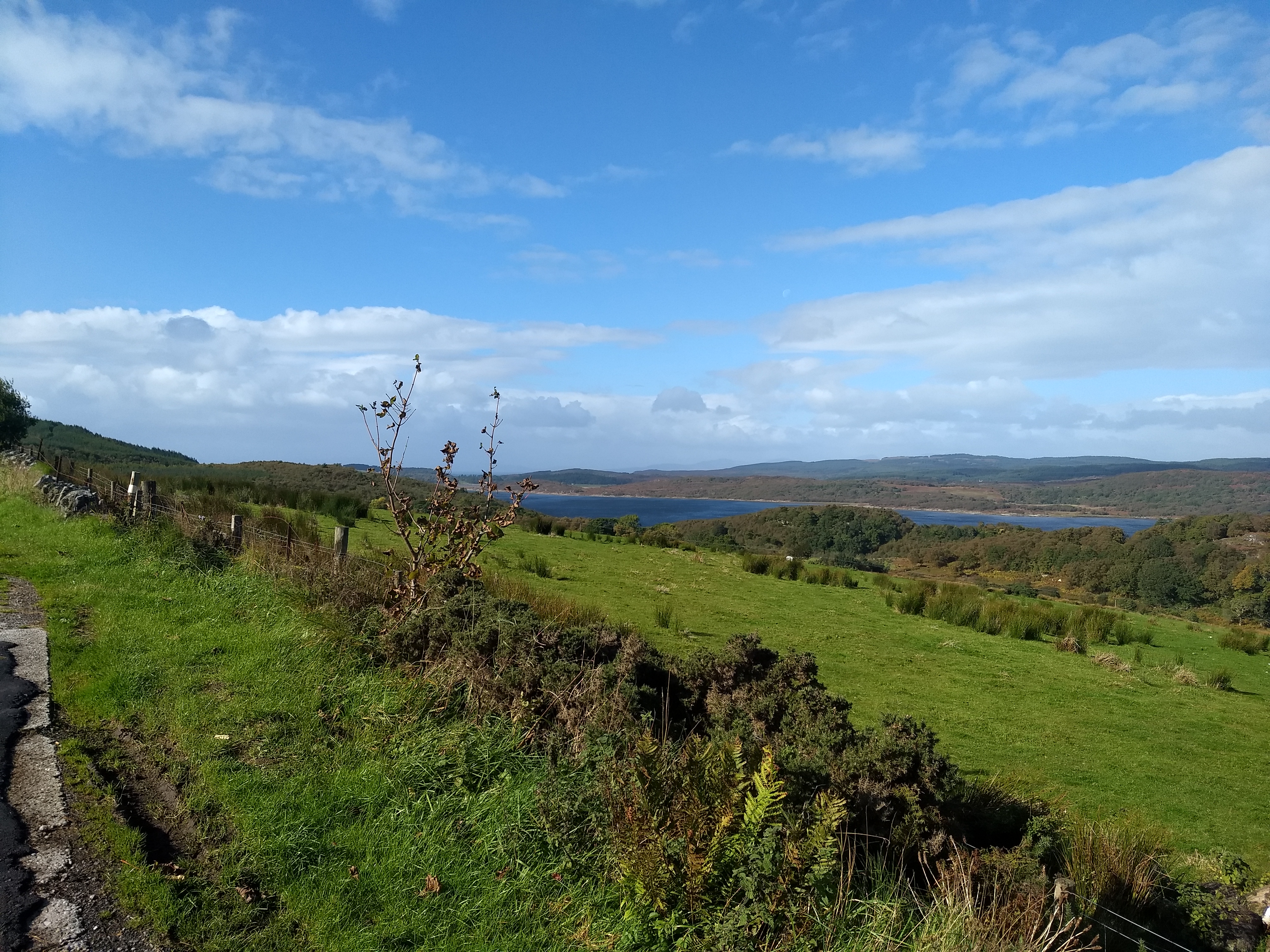
In summer 2021, we had carefully planned a trip to the North of Scotland, including a few days on Orkney, which we were very eager to visit. For various reasons (actually, one reason, guess which one!) we had to cancel it. The occasion to catch up presented itself this year thanks to a couple of friends from Parma, Roberto and Cecilia (and their wee one, Flora). They wanted to visit the Highlands since their first visit in 2019, but things happened in between. This year they finally made it, and halfway into their holiday we joined them in Inverness and continued together: direction, Orkney!

We travelled in a campervan, which was meant to be an adventure. It was indeed, although with way more midges than expected: that was our first unfortunate discovery of the holiday: the Northeast coast is full of midges, almost as much as in the West, at least around Thurso where we spent the first night.

On the way to Thurso, where midges were waiting for us!

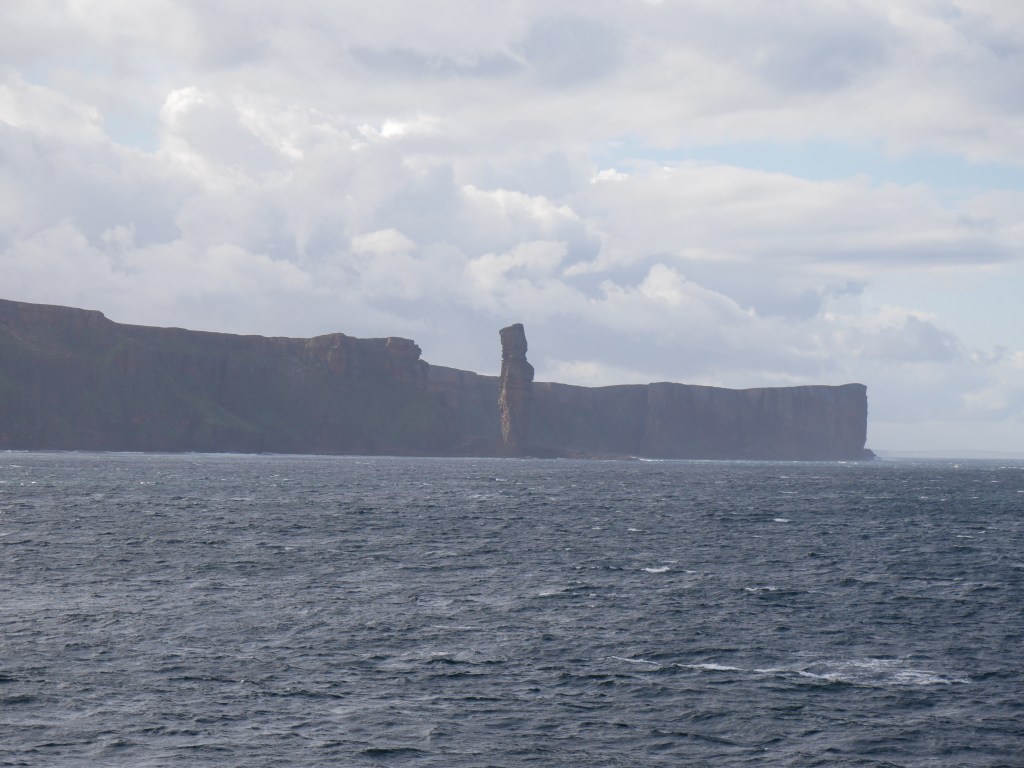
We woke up early however, and not for the midges, our ferry from Thurso to Stromness was around 8am. The cafe on the boat had a very Scottish menu, which meant a roll-based second breakfast. The view was quite spectacular, in particular we could admire the Old Man of Hoy during the cross.

The (misty) Old Man of Hoy.

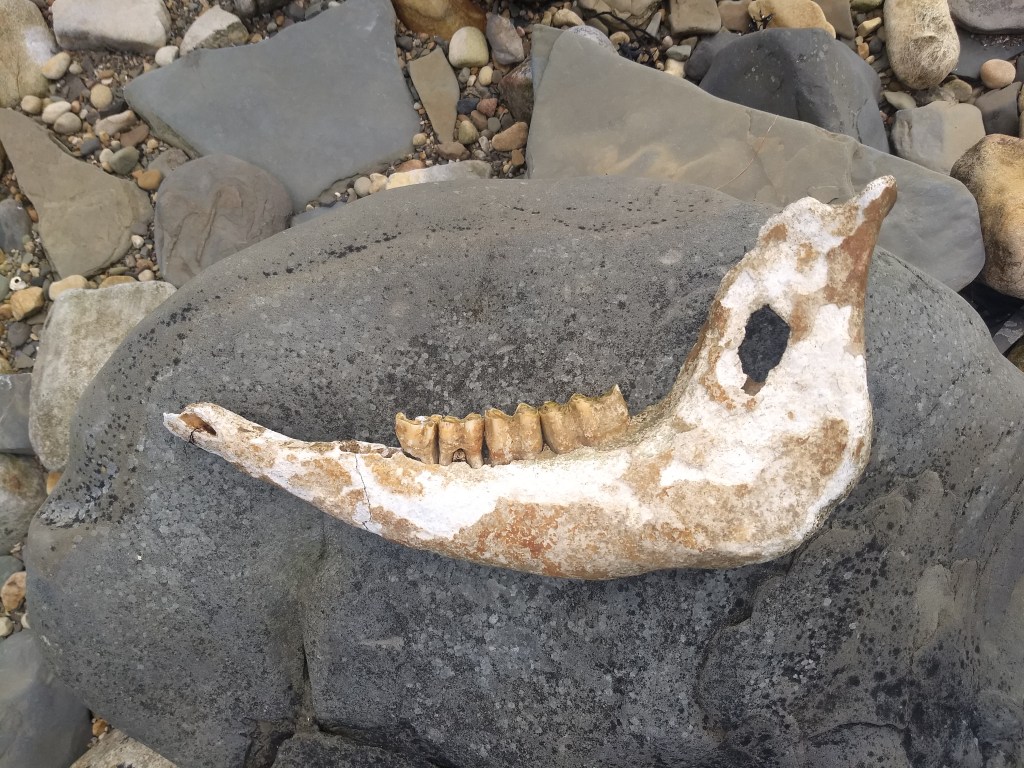
Once on the island, we explored the village of Stromness. It looked like a very peaceful place, and not overwhelmingly touristy. After the stroll we had a quick lunch in a cafe and drove towards East, direction Orphir, where we stopped for a walk to the beach, taking advantage of the nice weather. On the beach we found half a jaw of some animalโ€ฆcow? Sheep? Seal? And, more worrying, some dead birds, likely because of avian influenza. This wasnโ€™t the only time during the holiday, it happened later at the Brough of Birsay and at Dingyshowe beaches.

Peaceful Stromness.

Moving on, it was finally time for our first visit to an Orcadian distillery, Scapa, right outside the “capital”, Kirkwall! Before the tour, Scapa was quite a โ€œmysteriousโ€ single malt to us: until then, we were only aware of two official bottlings, the Skiren and the Glansa, the latter finished in ex-peated casks (since the distillery belongs to Chivas Brothers, we guess Allt-A Bhainne). We also never came across an expression from independent bottlers (the SMWS has a code for Scapa, #17, but as far as we know no recent bottlings).

Gianluigi exploring Orphir beach…
…Look what we found!

Our friends dropped us at the visitor centre, where the tour guide Maria Letizia warmly welcomed us. Because she is Italian, she gave us a personalised tour in Italian, the very first time for us! The distillery is going through some renovations. They’re building a new tasting room, making sure it’s not pointing towards a certain buoy in the Scapa Flow. Maria Letizia explained that this is a sign of respect, because that’s the place where the Royal Oak, a ship with about 800 novices in training, mostly teenagers, was sunk by a German submarine during WW2, which was lucky enough to get to the Flow avoiding all old ships positioned as hurdles.

Scapa distillery, here we are!

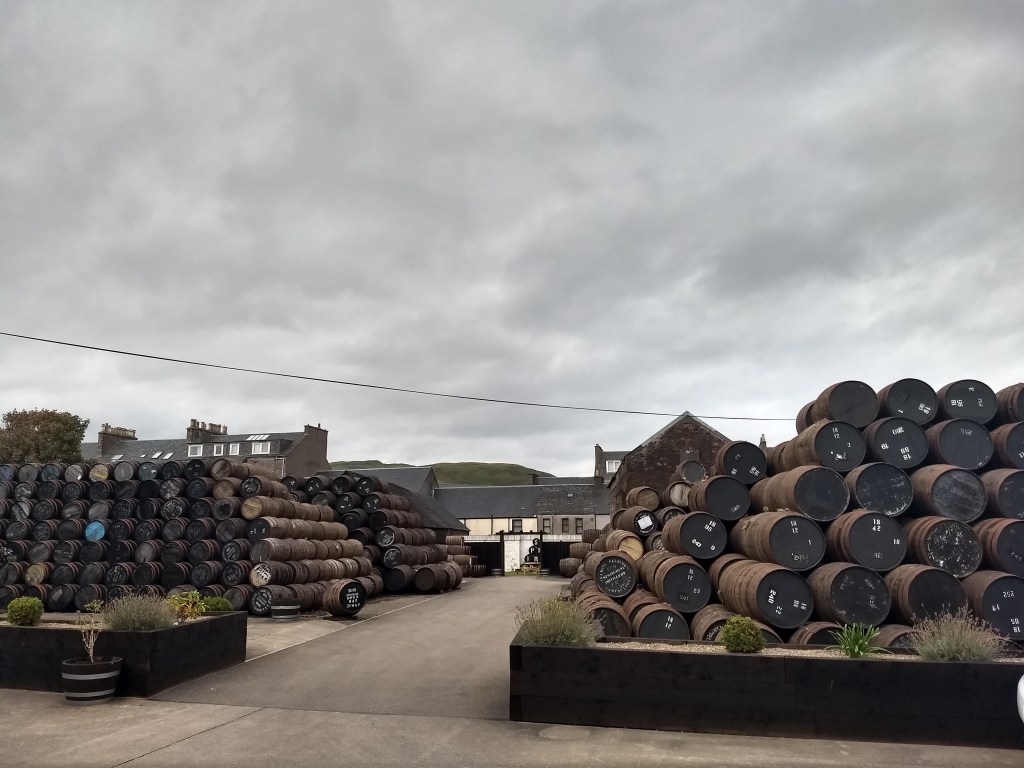
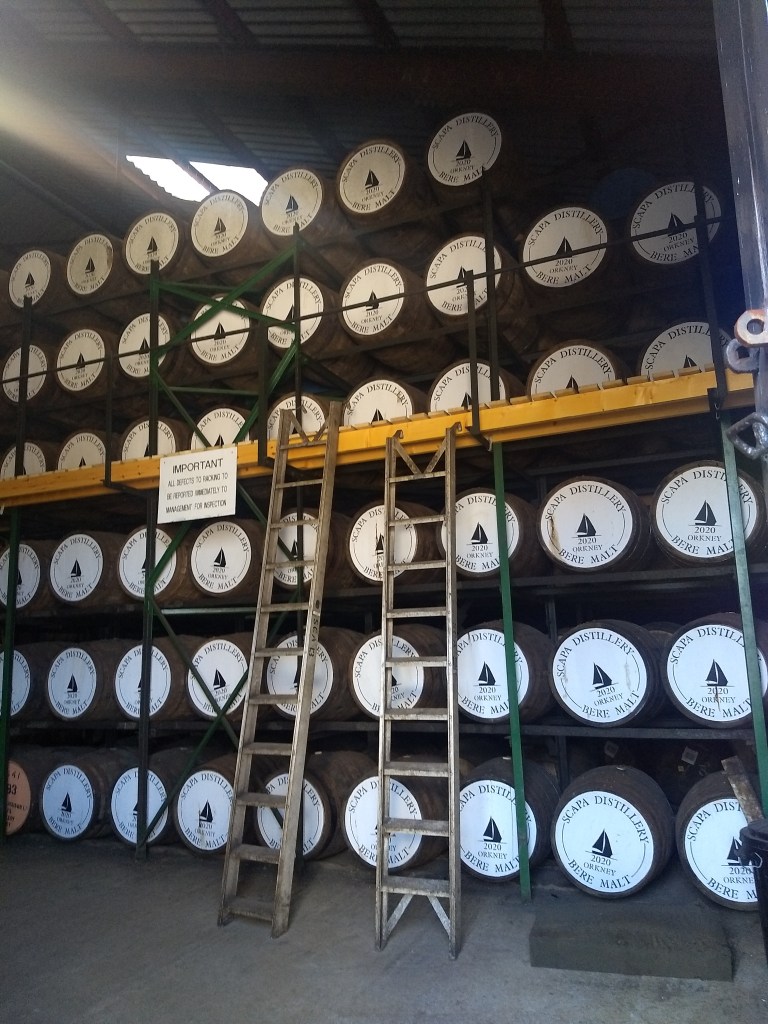
After this quite sad historical anecdote, the tour moved on as usual: we got told the history of the distillery, which was founded in 1885, and partially destroyed in 1919 by a fire. More recently, in 1994, it was mothballed and for a few years, personnel from the neighbouring Highland Park were turning it on for a few weeks every year to make sure that everything was still working. They get all the malted barley from the mainland, totally unpeated, and that was from the foundation in our understanding, which is very uncommon for an Island distillery. Unfortunately, we couldnโ€™t take any photos in the production area, so we cannot show you a very peculiar detail: their wash still is a Lomond still, similar to the Ugly Betty at Bruichladdich (which is used for gin, however). They also donโ€™t have any filling station, so the newmake spirit is stored into tankers and transported to Glasgow to be put in casks, at 63.5% if first-fill casks, while at a higher strength, 68.8%, if refills. Some of these return back to the island, together with casks from other Chivasโ€™ distilleries, to mature on site. We could take a sneak peek at the warehouses, but photos from the outside only.

The warehouse.

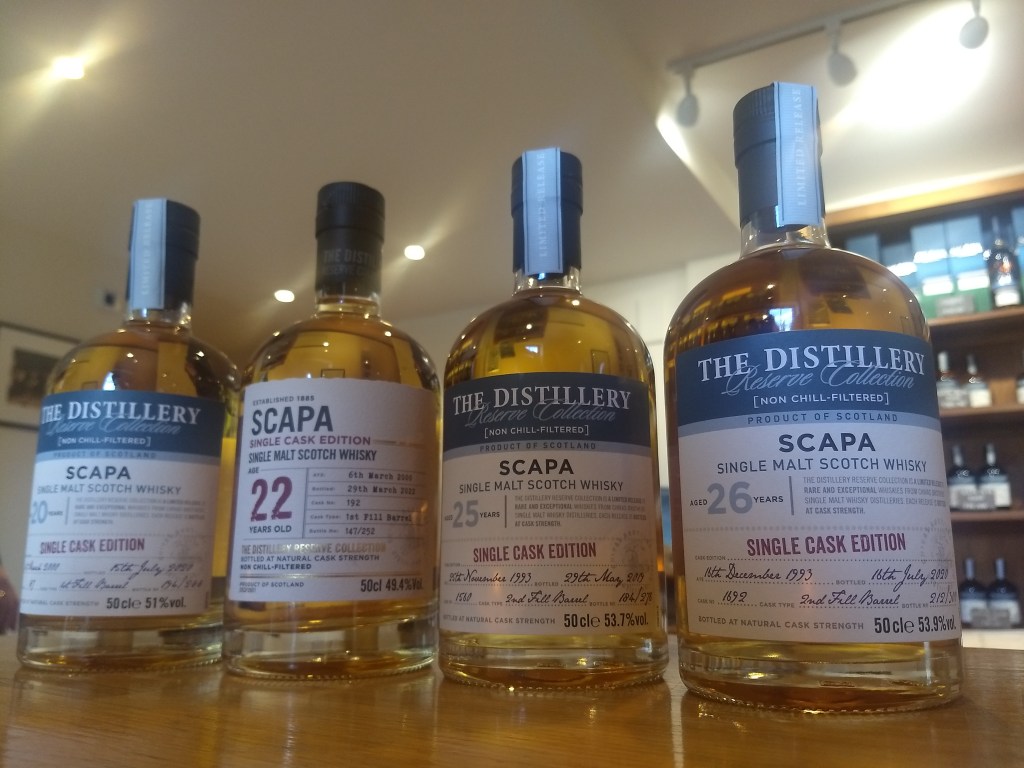
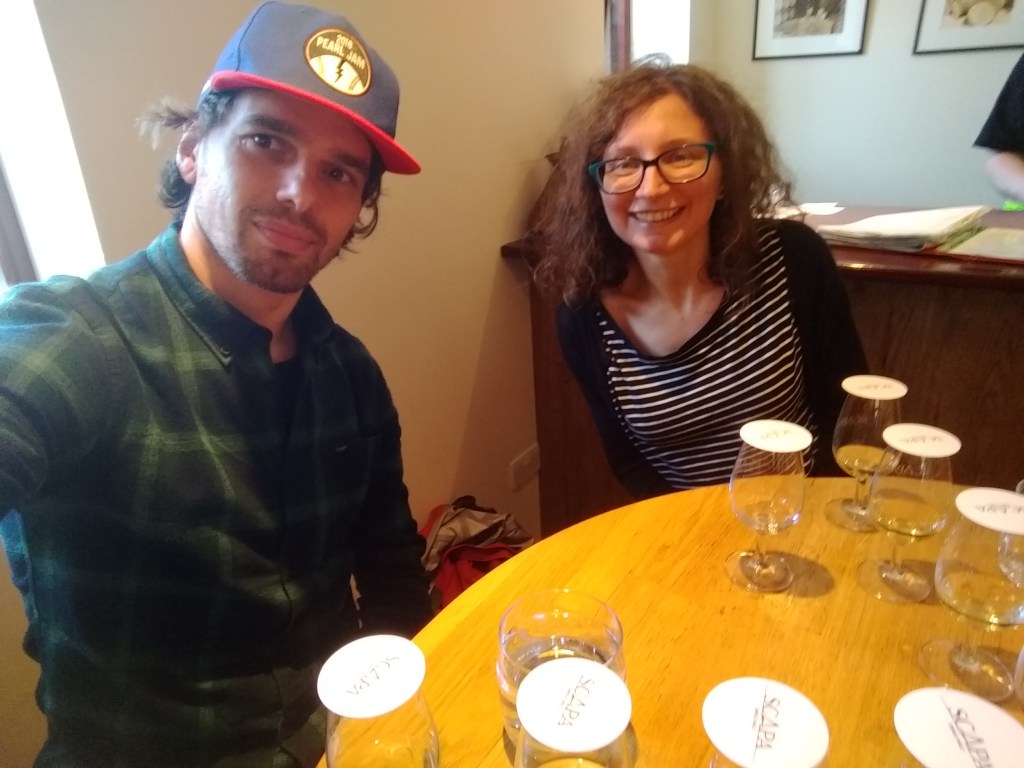
Back to the visitor centre, everything was ready for the tasting. When we booked the tour (which alone was 5 quids only!!!), we could choose three tastings: the Land (a core range expression and 3 from the 10-16y range, ยฃ30), the Sea (four drams from the 15-19y range, ยฃ35) and the Air (four drams from the above 20y range, ยฃ45). These tastings were not bookable from the website, which only offers 3 unspecified drams forยฃ25, we had learned about them by contacting the distillery via email. Except for the two core range expressions, all the other ones are available as 50cl bottles, as is typical of Chivas Brothersโ€™ distilleries. Like the ones we saw in the other distilleries, they are a bit pricey too – company policy.

The delicious Air tasting.

We chose the fancier ones, Sea and Air, although in the first one we decided to include two drams below 15y (more approachable price-wise). All very tasty drams, in particular a couple of sherry cask matured ones (very cask forward, though). In general, we found the distillery character very citrusy, oily, crispy and honey/vanilla forward. They were all single casks, except an 18y, a marriage of 5 ex-bourbon barrels from the small production of 2000, when the distillery was run for a few days by Highland Park operators.

Sooo curious about this tasting!

We were very happy to finally get to know this distillery and its character. After dinner, we tried the two core range expressions, Skiren and Glansa, which we had tasted a long time before. Quite inoffensive sweet drams, definitely not comparable with the juicy and tasty ones we had had earlier at the distillery. Just a shame Chivas donโ€™t bottle more geek-forward expressions at a reasonable price (donโ€™t have to be all single casks, btw).

The night ended at the Kirkwall camping, trying to avoid the midges. Stay tuned for the second and last part of this trip!


Scapa Tour and Tasting

Price: ยฃ5 tour (August 2022) + tasting (ยฃ25 3 drams, bookable online in the summer season; ยฃ30 Land 1 dram from the core range and 3 distillery bottlings 10-16y; ยฃ35 Sea 4 distillery bottlings 15-19y; ยฃ45 Air 4 distillery bottlings 20+y)

Duration: 1-1.5 hours

Tasting: depending on tasting choice and available expressions

Target: anyone really, the experience can be easily customised

Value for money: very good

Highlights: the still room and the Lomond still

Recommended: YES!

Link: https://www.scapawhisky.com/

#14 A taste of Campbeltown

Dramming Around moves to Scotland

Our first whisky trip in Scotland: couldnโ€™t have been anywhere else!ย 

(For a more in depth Campbeltown experience go here: Cadenheadโ€™s Warehouse tasting, Kintyre Gin and Watt Whisky tastings, Springbank/Glengyle visits and Glen Scotia tasting)

September 2018, still the beginning of our life in Scotland: Gianluigi had moved about a year earlier, Teresa not even 4 months. We were coming out our first Fringe as Edinburghers (although someone would use another term), festival that we appreciated but despised at the same time, as the city can become very hard to live in August.

We wanted to have a weekend break somewhere, but for a few weeks we were stuck exploring options, undecided. Then a thought crossed our minds: why donโ€™t we go to that placeโ€ฆthe one that is a whisky region by itselfโ€ฆwhatโ€™s its nameโ€ฆCampbeltown!

As we used to do for our weekends away back in Illinois, we rented a car, and booked a random accommodation on Booking.com (at the time we were not aware of the Ardshiel Hotel), and the holiday was set! The program was very easy: travelling on Friday, Saturday in Campbeltown, and on Sunday weโ€™d visit Oban and travel back to Edinburgh. We had no idea what was expecting us! At the time we hadnโ€™t visited any distillery in Scotlandโ€ฆtogether: Gianluigi had visited Glengoyne as a side event of a conference he had attended a couple of months before in Glasgow. Unfortunately, the experience was far from great: too many people and one tiny dram.

So, when the day came, Teresa went to work in Glasgow as usual, while Gianluigi picked up the rental car and picked her up for lunch. We followed Teresaโ€™s colleagues suggestions and drove westward instead of north. So, we crossed the sea on ferries twice: first from Gourock to Dunoon, and after crossing the Argyll, from Portavadie to Tarbert, to finally drive down the Kintyre peninsula.

On our way to Campbeltown.

Even if this is not the most popular part of the West Coast, we found most landscapes truly beautiful, and particularly peaceful. We arrived at our hotel quite late, and Gianluigi had to finish off a bit of work. We hadnโ€™t realised how early restaurants were closing in Campbeltown, so we almost missed dinner time. Fortunately, a nearby restaurant allowed us in, at the condition we ordered quickly, which we did, as we were super-hungry (unfortunately, when we were back in 2021 we saw that itโ€™s closed). The night ended with a pint at the hotelโ€™s bar.

After a generous breakfast, we left the hotel to check out Campbeltown. The day wasnโ€™t great (overcast but not rainy), and we just walked around. Someone would describe the town as a bit run down, but to us the atmosphere was relaxing and cosy, almost intimate and melancholic, one that you can only find in far-away villages like this.

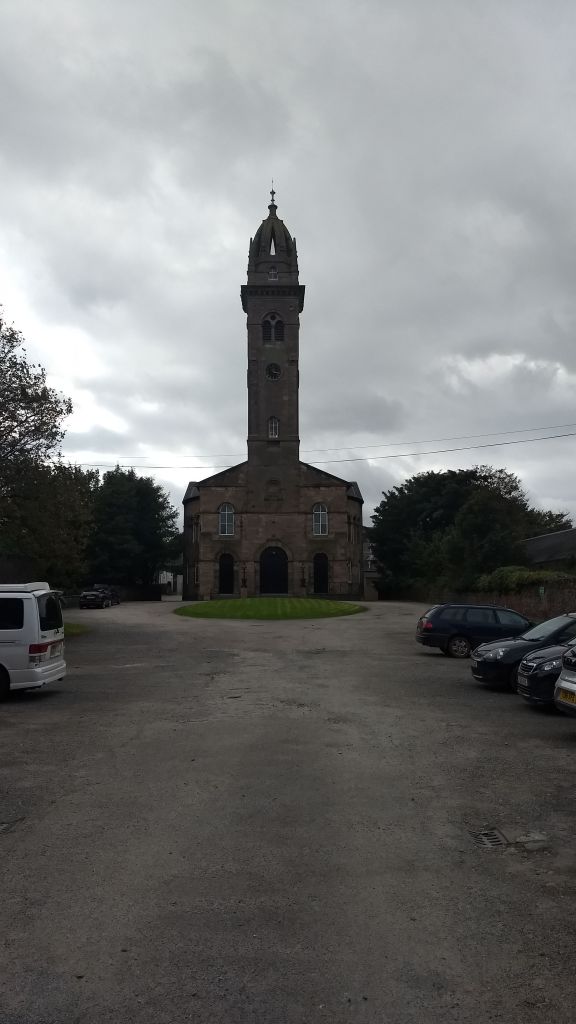
That tower bell looks familiar…

The first appointment of the morning was at Glen Scotia Distillery, but when we arrived, everything was closed. We waited a bit puzzled, checking emails and times meanwhile. Suddenly, a man came out of the production gate, asking if one of us was Gianluigi. He was one of the distillers, Archie, who told us that the designed guide was sick and couldnโ€™t give us the tour. However, if that was OK with us, Archie would be the guide for the two of us, although sometimes he would have needed to go check the stills. Moreover, the tour was free as an apology for the inconvenient. We couldnโ€™t believe our ears, of course it was OK with us!!! The tour was really in depth, and the fact that a distiller was our guide made it really invaluable. Even the tasting was very generous: a wee taste of the new-make spirit, then the Double Cask, the 15y, the Campbeltown Festival 2018 (finished in Ruby Port casks), and the Victoriana. Unfortunately, the shop was closed as well (the sick tour guide was running the shop too), so we bought something later at Cadenheadโ€™s.

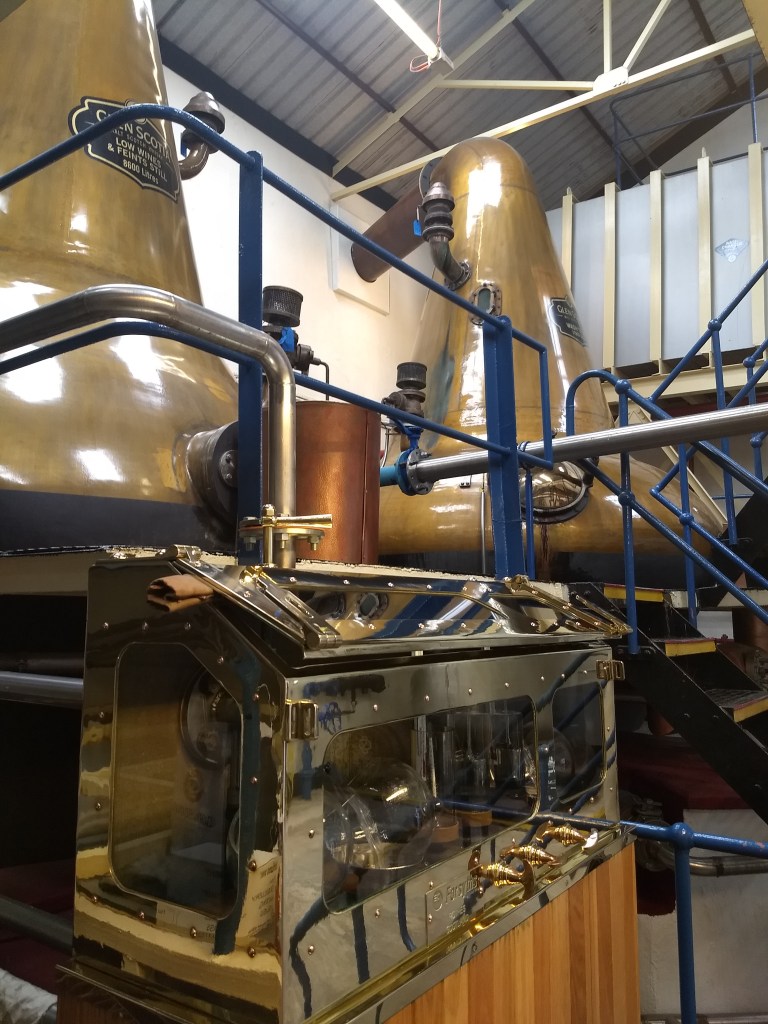
The beauty of Glen Scotia still room.

After the tour, we had a quick but tasty bite at Cafรฉ Bluebell, and we then proceeded to the afternoon activity: the Cadenheadโ€™s Warehouse Tasting. At the time we werenโ€™t as nerdy as we are today, so we decided to skip the Springbank or Glengyle distillery tours in favour of a tasting: we werenโ€™t even aware of all the frenzy around Springbank yet. Moreover, at first, the concept of an independent bottler was not the easiest to grasp: why should a distillery sell its product to an intermediary? Now it is so obvious, and we are grateful for that: the variety of whisky that some independent bottlers can offer is truly astonishing, and without them we wouldnโ€™t be able to get our Miltonduffโ€™s, Glen Elginโ€™s, Glentauchersโ€™, Glen Speyโ€™s, Mannochmoreโ€™s, and all the other ones that are rarely bottled by their owners.

A relaxing landscape…

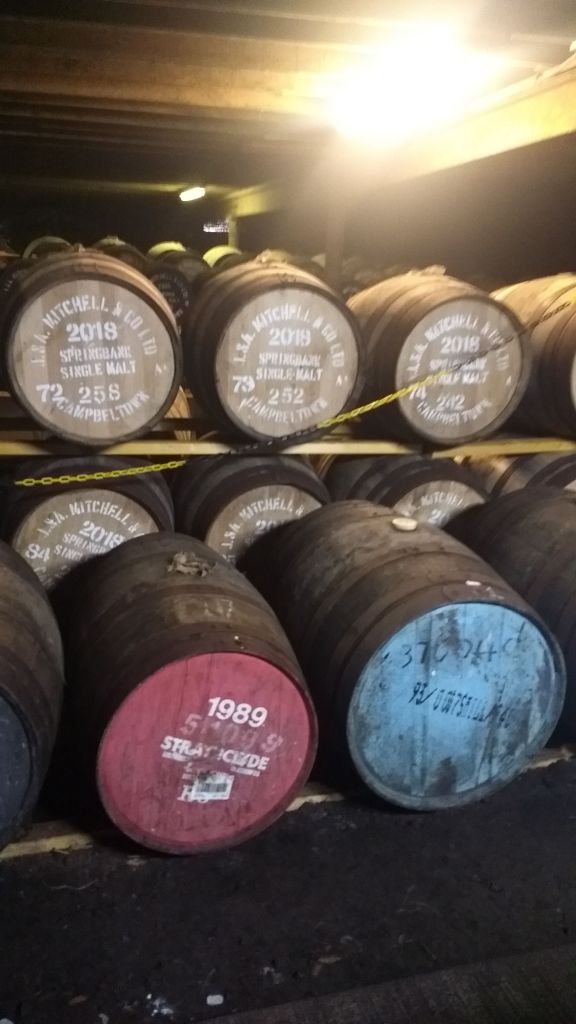
As a matter of fact, it didnโ€™t take long to appreciate the great work that Cadenheadโ€™s do. In the warehouse, a sizeable line-up of casks was waiting for us. We donโ€™t remember much, but in the bunch there were a Strathclyde grain (there are pictures), a Longrow 11y, a Paul John, definitely a speysider, someone said a Lagavulin (probably a Caol Ila) and a 10y rum from Darsa distillery, in Guatemala. We ended up taking the rum and the Longrow, but all the drams were truly delicious. Not surprisingly, weโ€™re in the Cadenheadโ€™s club now!

Old and new delicious stuff!

At the end of the tasting we were kind of tipsy (ehmโ€ฆ), so we decided to leave the bottles at the hotel and have dinner in the most far-away restaurant we could reach walking, on the other side of the harbour (which is now closed tooโ€ฆare we bringing bad luck??). We went back to the hotel, not before having an extra dram, the last one in Campbeltownโ€ฆfor now.


The Sunday morning was again overcast turning to rain, so we checked out and started driving south, towards the Mull of Kintyre (โ€œOh mist rolling in from the sea, my desire is always to be hereโ€โ€ฆ), to finish our exploration of the peninsula.

Slightly better weather on the way from Campbeltown to Oban!

Then we drove north, towards Oban, the last stop in our trip. Although the sun came out while driving, it started pouring rain as soon as we parked in Oban (experiencing the 4-season in day). Oban is a nice village but looked a bit too touristy for us (and indeed we havenโ€™t been back yet, unlike Campbeltown). The tour at the distillery was nice but a bit dull, probably it suffered in comparison to the previous day experiences. Still, it was interesting to see how this distillery, unlike many others, is nestled in the village, with no space for potential expansions. At the end of the tour we were given a dram of the flagship, the Oban 14y, and one of the Oban Little Bay. We ended up not buying anything, as even then we were aware that distillery prices sometimes are not competitive. We would have bought a bottle a few months later.

Oban right in the middle of the flavour map.

As a baptism into scotch distillery visiting, we couldnโ€™t ask for more: a magic place, and magic whisky. With the pandemic and all we werenโ€™t able to go back to Campbeltown for a while, so when we managed to do it in 2021, it was a very welcome return, with more whisky knowledge and experience in the pocket! Now it’s time to plan our third tripโ€ฆ 2023?


Links

Glen Scotia Distillery: https://www.glenscotia.com/
Cadenheadโ€™s: https://experience.cadenhead.scot/
Oban Distillery: https://www.malts.com/en-gb/distilleries/oban


#12.5 From Islay with love

Back to mainland… Au revoir, Islay (Epilogue)


A straight return to Leith and some reflections about our first trip to Islay. 

(missed Day 3, Day 2, Day 1 or the Prologue?)

We woke up a bit sad: we werenโ€™t on Islay anymore. The night before we had made good use of the disposable grill (in the parking lotโ€ฆ) and, exhausted, went straight to bed. After breakfast we called AA right away, still puzzled about what to do with the campervan. Another guy came, again from the super helpful Stag Garage, and helped us turn the van on. One objective now: drive straight to Edinburgh, without turning it off! It looked like one of those challenges in the old ads of Amaro Montenegro (at least the ones on Italian TV), but we could do it, fuel was enough. And yes, we made it: four hours later we successfully drove it to a garage in Leith previously agreed with the owner, stopping only once for a leak and once for Teresa to unload our stuff (Gianluigi stayed in the vanโ€ฆ we donโ€™t feel comfortable enough to leave a running vehicle around Leith yet)! After a celebratory coffee and pint, we finally went home.

So that was it, our very first trip to Islay, and hopefully, the first of many! It didnโ€™t go as we planned it out, and we definitely didnโ€™t like being moved from one distillery to another like cattle. We like doing things our way, and itโ€™s not just about the whisky: taking our time, exploring the roads and the places, enjoying the changing landscape and feeling the community. But setbacks happen, so we feel lucky that we still managed to somehow visit the island, at least! Anyway, visiting six distilleries in three days made us reflect on a popular topic in the whisky community: what makes a good distillery tour?

First, the tour guide, definitely. An experienced, engaging and enthusiastic guide always makes the difference, even when the distillery doesnโ€™t have much to offer (for example, because whisky is not ready yet or because the site is not the most beautiful one). We always admired the ability of a guide to set the tone of the tour depending on whether the crowd is knowledgeable or not, and to answer questions at a depth which felt just right for the audience. Most of the guides we found on the island were great, and were a big component of our experience.

This was outstanding!

Second, the type of visit matters too. We always have fun visiting production, but warehouse tastings are becoming more and more our favourite whisky experience. The trip on Islay only confirmed it: the feeling, the smell, the dampnessโ€ฆthere is really no other place like a distillery warehouse! We already did some excellent warehouse tastings before coming to Islay (Deanston, Cadenheadโ€™s twiceโ€ฆ). Among the ones we did so far, Bunnahabhain Warehouse 9 was definitely one of the best ever. Next time weโ€™d like to do the distillery tour, but weโ€™ll likely do the warehouse tasting too (yes, again!). Similarly for Lagavulin, with a slight difference: Bunnaโ€™s drams were clearly chosen as outstanding ones, all very rich and showcasing the influence of both cask and spirit; Lagavulinโ€™s drams were cleaner and spirit-forward, and this gave to the tasting a very valuable educational angle, it was like following the spirit in its maturation journey. We loved both!

Happier and more knowledgeable after the Lagavulin warehouse tasting.

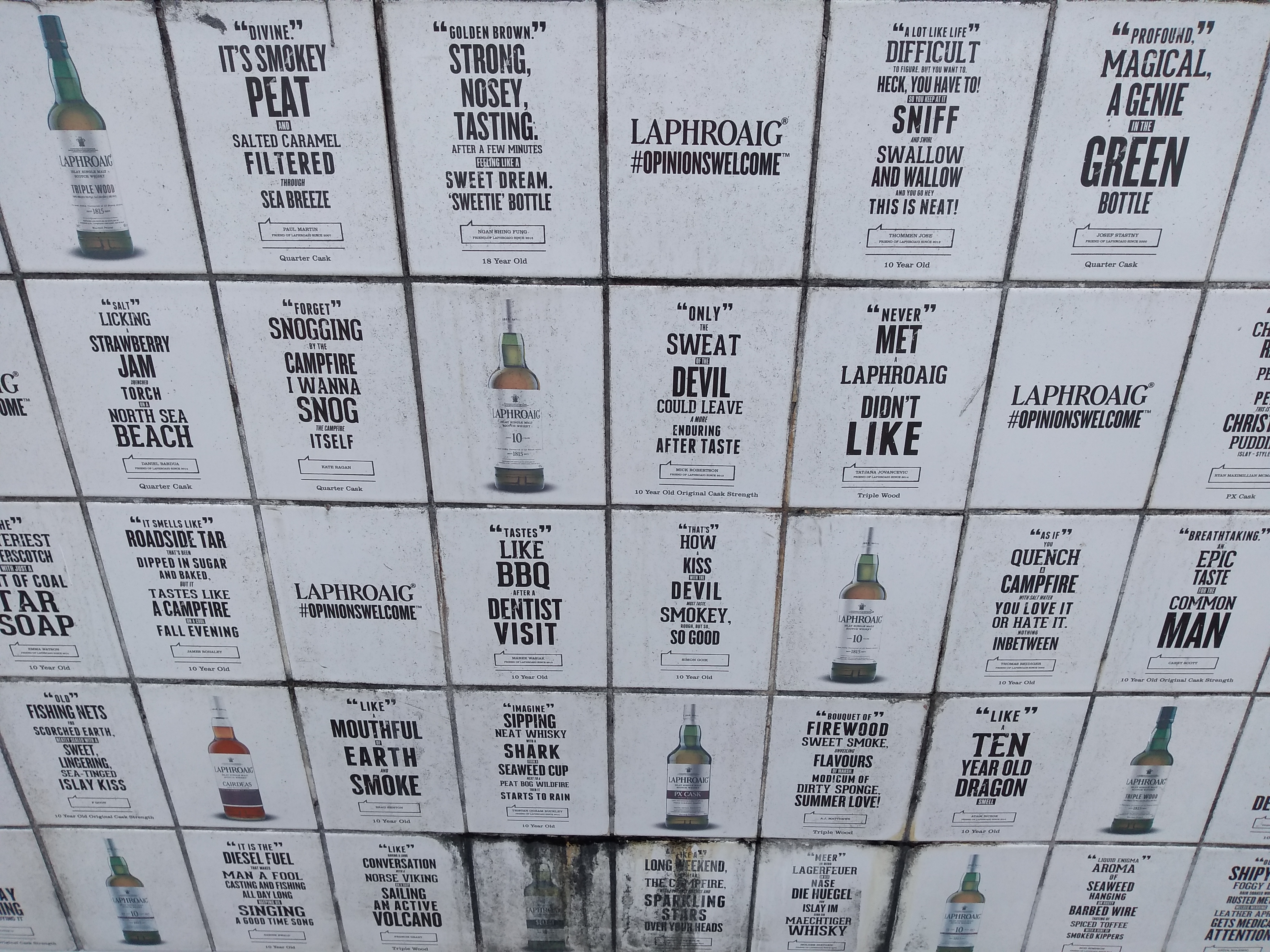
We know they have warehouse tastings at Laphroaig and Bruichladdich too, but while we couldnโ€™t fit them in this trip, weโ€™ll definitely check them out next time. In both distilleries we did the โ€œregularโ€ tour, although we were pleasantly surprised because in both cases the tour was definitely whisky geek oriented, and nothing like the quite dull regular tours you can find sometimes on the mainland. Probably being in a distillery on Islay is definitely a sign of whisky-geekery, you cannot stumble there on your way to Loch Ness we guessโ€ฆ

Laphroaig malting floor.

Having a good experience definitely makes you connect deeper with a whisky, but in these two cases we already liked them both. Laphroaig was one of the drams that got Gianluigi into whisky in a first place, although now we moved away from the main range (the Select and the 10y), trying solid drams like the Lore and the Cairdeas was a pleasant discovery. The basic Bruichladdich range (Classic Laddie and Port Charlotte 10y) is very solid already, but unfortunately getting special releases or and single casks can be a bit priceyโ€ฆin particular the whole Octomore range.

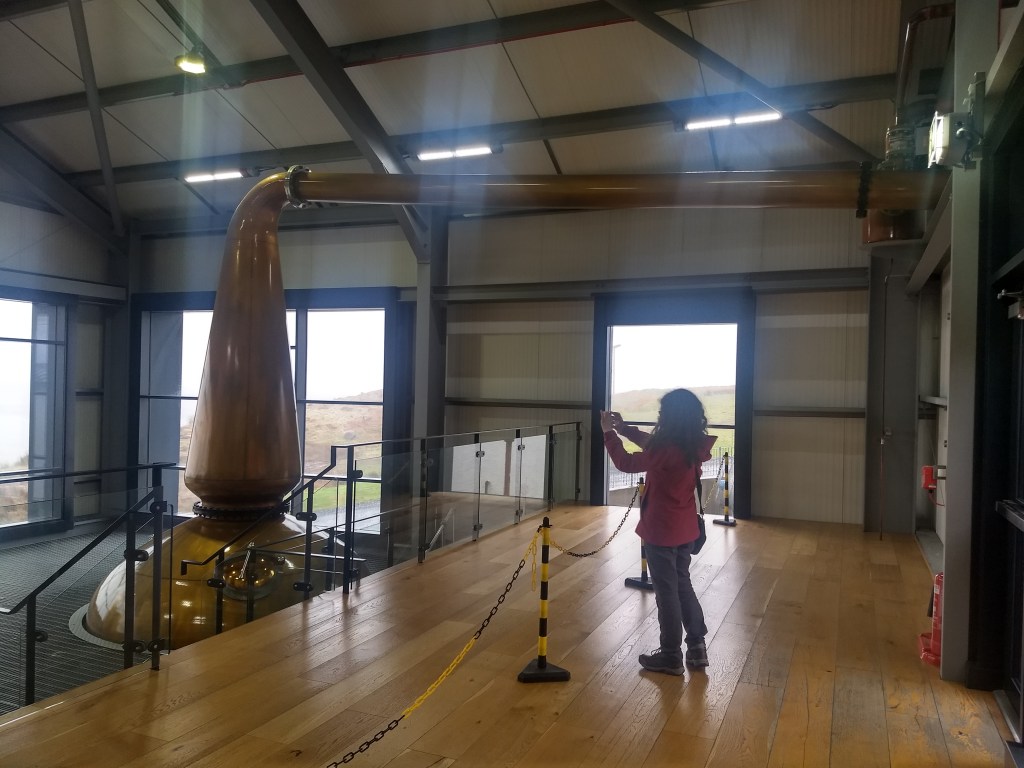
Bruichladdich still.

Finally, every distillery has its own features, and even just this makes the visit worthwhile (ok ok, we accept this might only apply to enthusiasts like us). While some of the distilleries might seem similar at a first glance, ultimately they are very different in their philosophy, style and, more importantly, their malt. For example, we were very curious about Kilchoman, being one of the youngest distilleries on the island, but still built in a moment when the whisky frenzy wasnโ€™t as high as it is now. The fact that this tour was supposed to happen over two years ago only made us more eager. It did not disappoint, and we both really liked everything about the distillery, from its mix of modern and traditional features, to their philosophy. A truly farm distillery, something we hadnโ€™t seen many times.

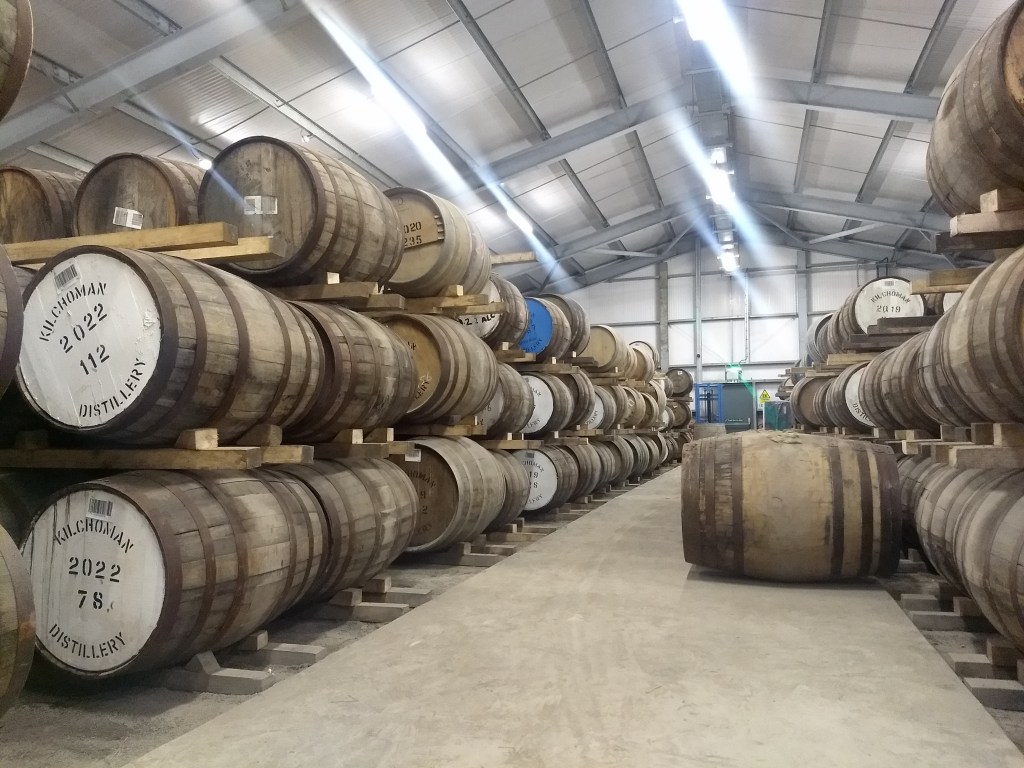
Kilchoman warehouse…Oh the smell!

Ardnahoe tour was the only one we found a bit basic, in particular compared to the others on the island, but we have to consider that itโ€™s much harder when you are such a young operation (from 2019โ€ฆand with 2 years of pandemic in between) and donโ€™t have well aged stock to showcase. Still, it was very interesting to see a perfect example of how new distilleries are clearly built with visitors in mind. Also, their new make is very promising, so weโ€™ll look to go back after their single malt releases.

At least this time we have bad weather as an excuse for our bad Ardnahoe pictures…

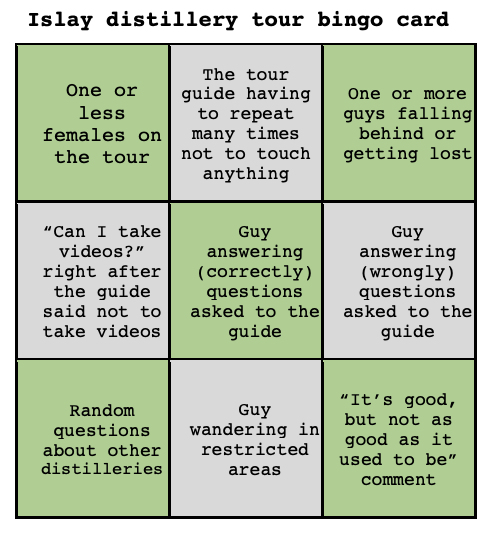
The only thing a bit off was some of the crowd we encountered in a few distilleries. Itโ€™s understandable being enthusiastic, but when that becomes rudeness itโ€™s not ok: touching things youโ€™re not supposed to touch, making the party wait for you, not respecting personal space, bothering the guide with questions about other distilleries (โ€ฆwhy?), talking over the guide and reply to question directed to themโ€ฆPlease donโ€™t be that guy! We had already witnessed some of these previously, but not all at once like on Islayโ€ฆWe were a bit shocked, so shocked that we thought the whole thing was worth a bingo card! Big shout out to the guides that, kindly but firmly, kept the undisciplined visitors straight!

Here a bingo card for your leasure!

Well, we will need to go back to Islay, hopefully sooner rather than later: first to visit the other distilleries (Bowmore, Caol Ila and Ardbeg, plus the close-enough Juraโ€ฆand of course one day Port Ellen and Portintruan), and probably to revisit some. Hopefully next time things will be much smoother (not that it would take much, to be honestโ€ฆ), so weโ€™ll have a chance to have a more fulfilling experience!

As you might imagine, we are already starting to planning it out!