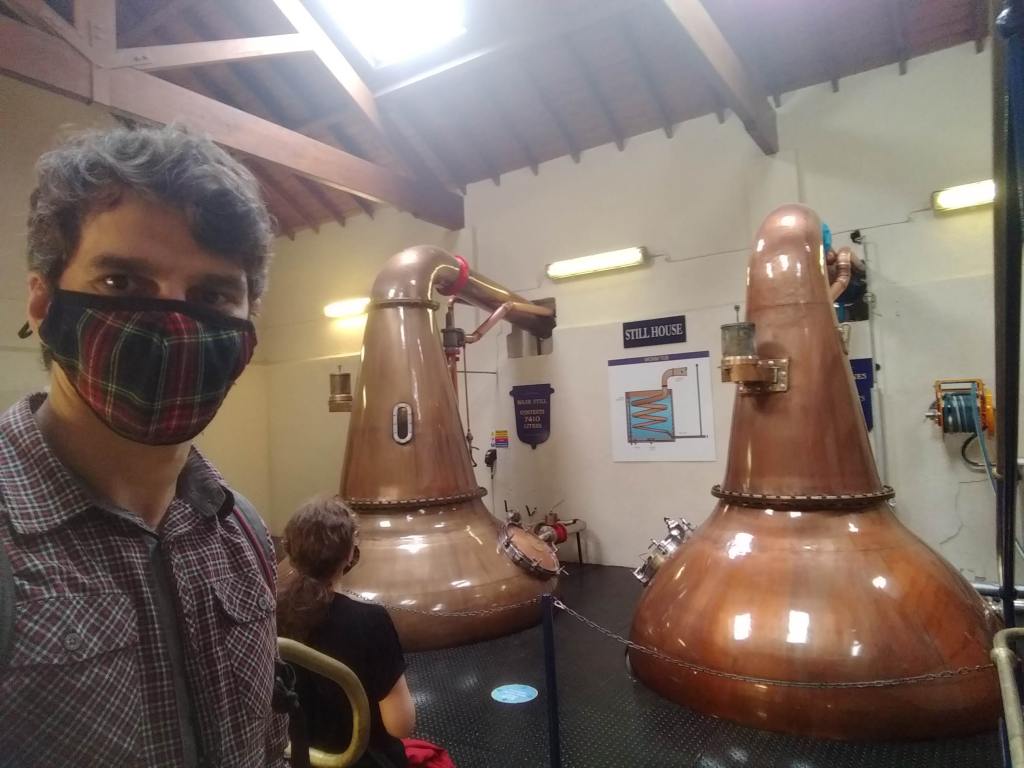
#31.2 Spirit of Speyside 2023

Shut it, badger!


TL;DR: Second distillery visit during the Spirit of Speyside: another workhorse, owned by Diageo this time, Dailuaine! Contrary to Tamnavulin, we know their malt mostly thanks to independent bottlers, as most of the production goes into blends. The tour was great, although it felt like visiting a distillery after a zombie apocalypse.

(missed Part 1?)

After the visit at Tamnavulin, we had only 45 minutes before our second visit of the day at another distillery usually closed to public: Dailuaine. Fortunately, the drive was only 25-ish minutes, and because we knew we were tight with time, in the morning we had prepared sandwiches, so we could have a quick lunch. Everything went fine, we drove from Tamnavulin to Ballindalloch, and before Aberlour we turned left, with the distillery being mid-way between the main road and the village of Carron. We had run through this village during the Dramathon, admiring the recently built Dalmunach distillery (on the site where Imperial used to be), but despite being the n-th time in Speyside, we had never driven there, so we didnโ€™t quite know what to expect. As we drove downhill form the A95, we found Dailuaine distillery on the left, spotting their big warehouses, almost terraced to cope with the slope. 
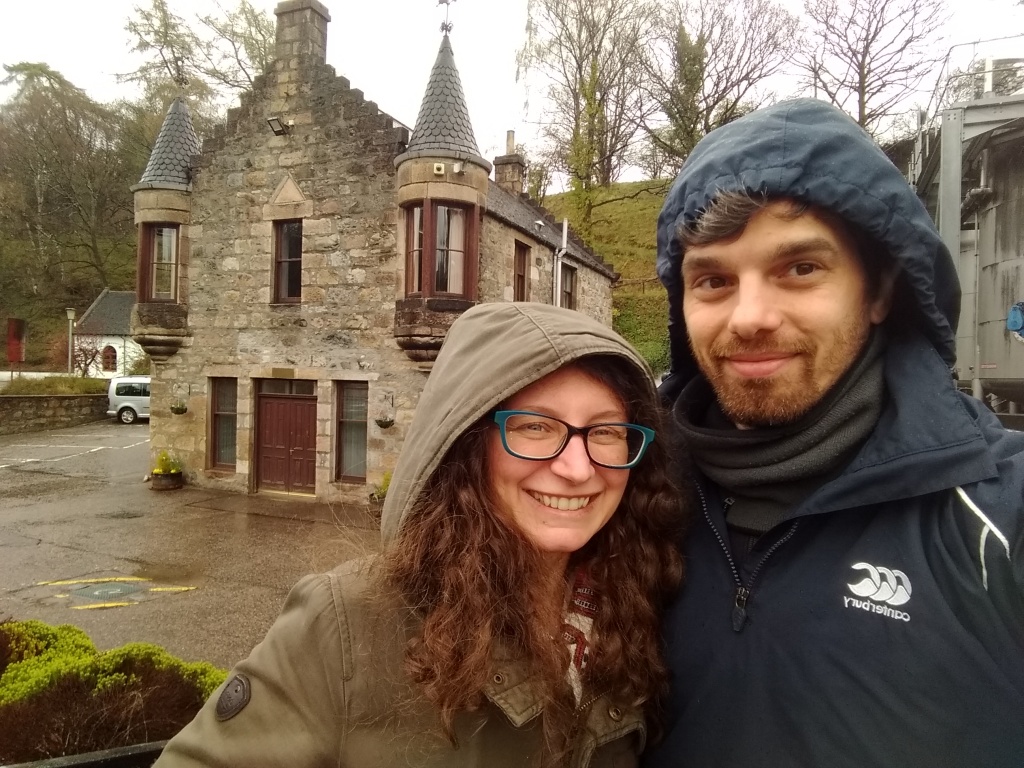
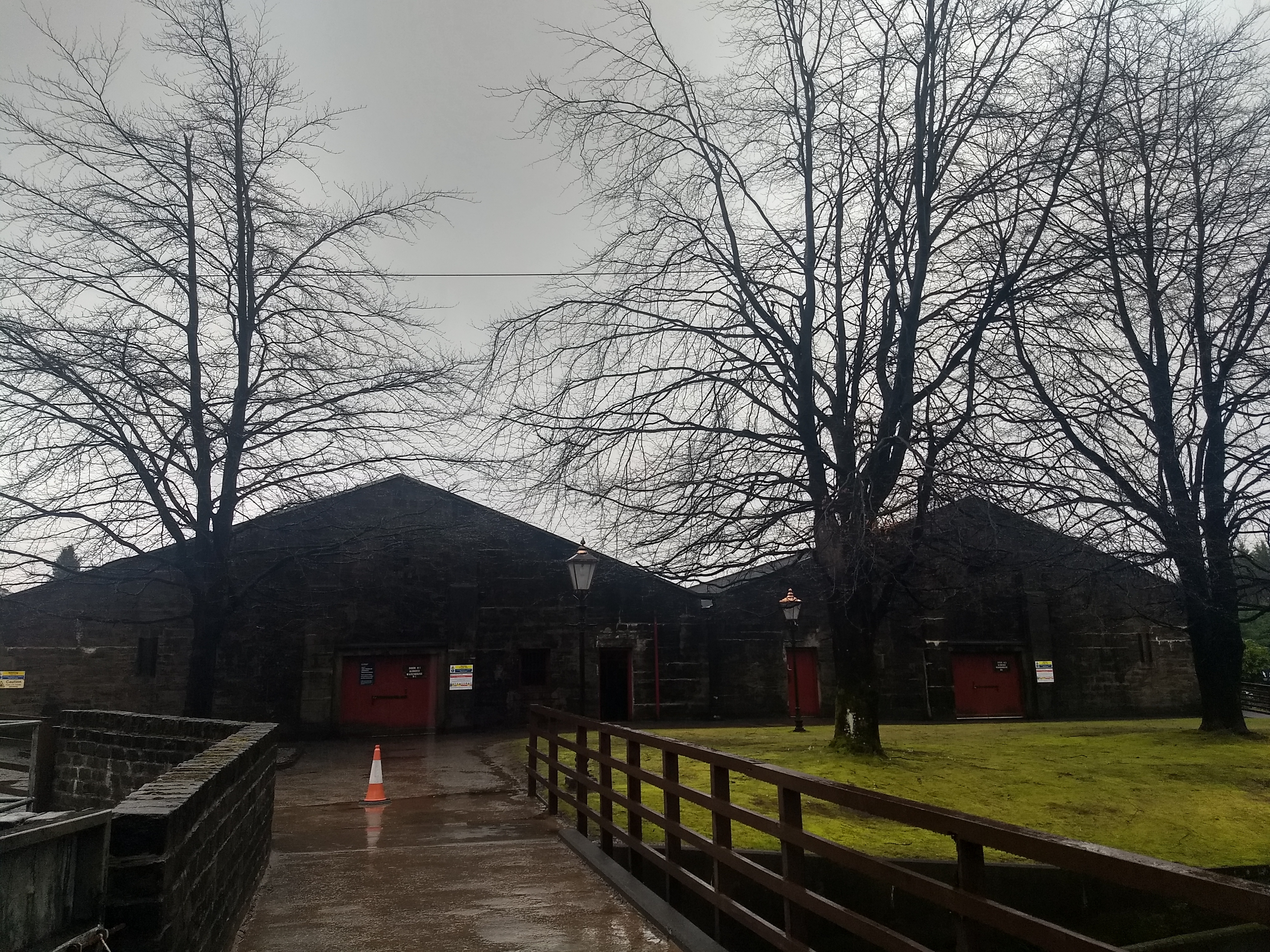
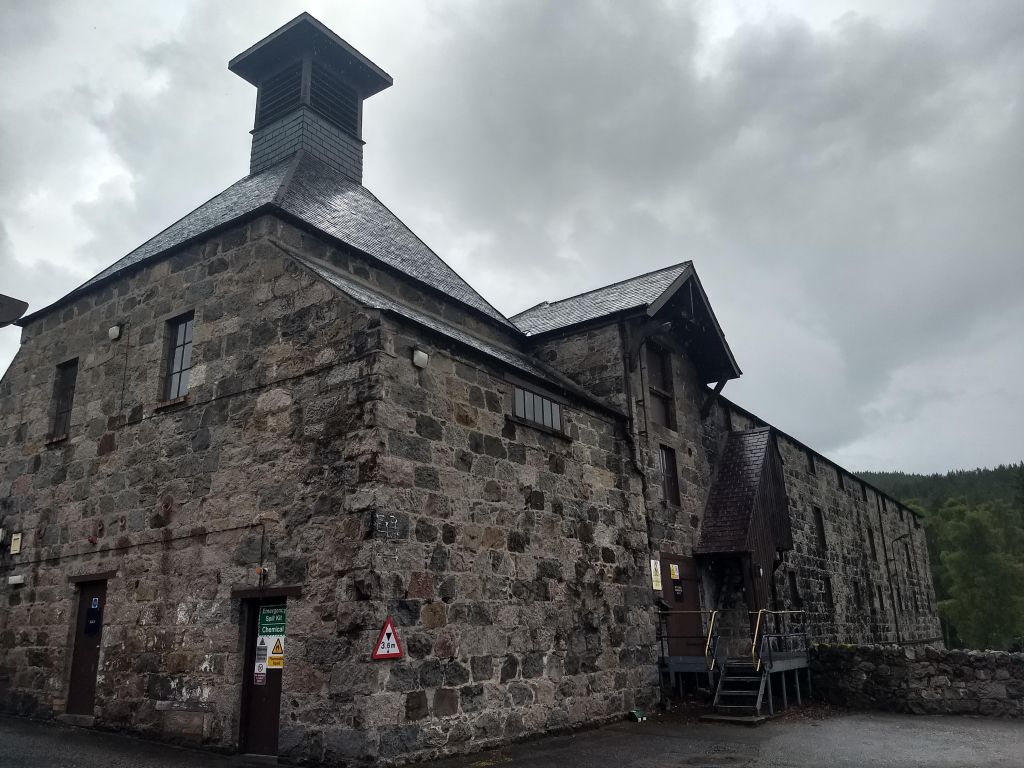
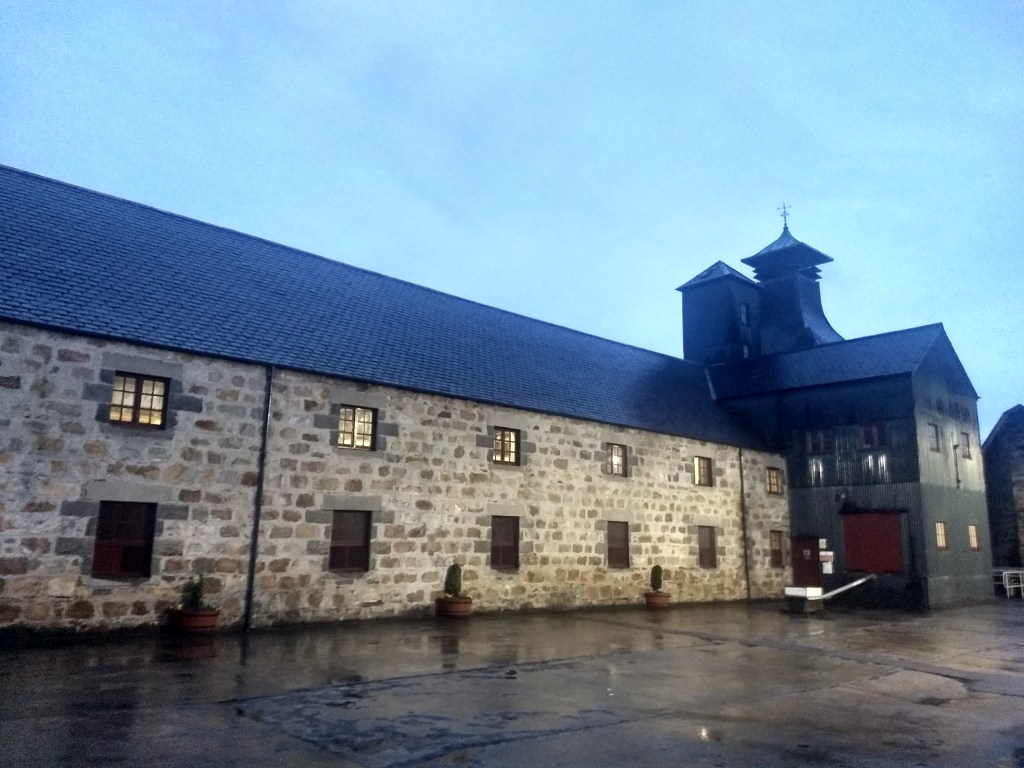
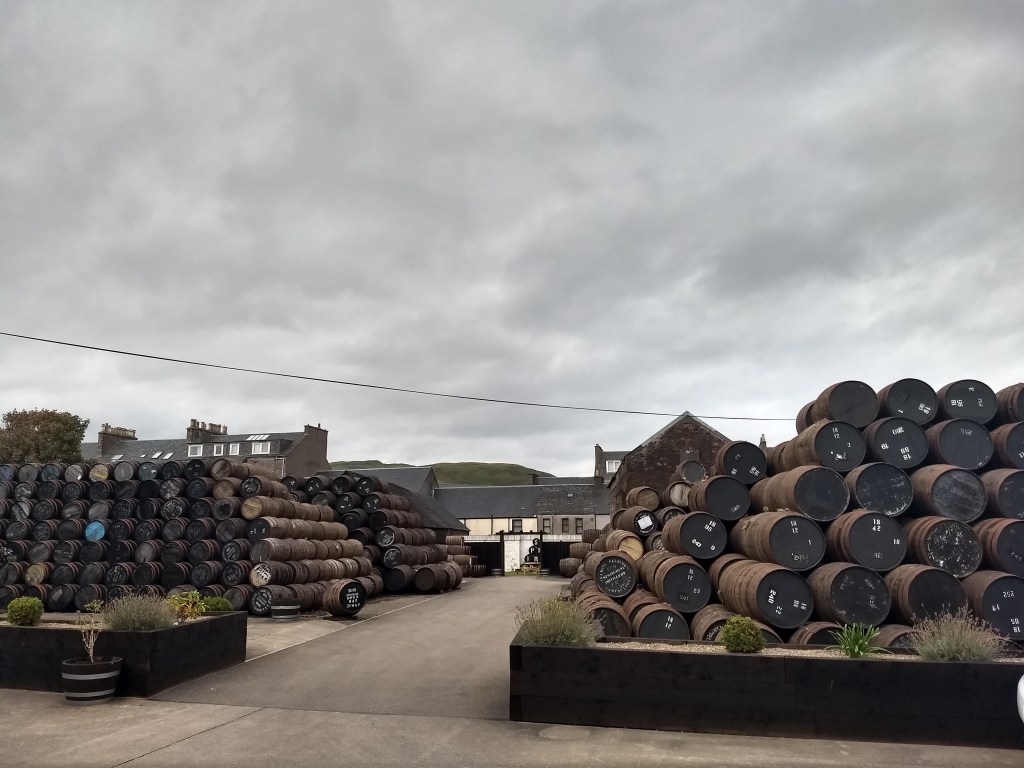
In the courtyard, we noted how massive is the site: the warehouses on the left, a small house (will turn out to be offices) on the right, and behind it the huge production building. As soon as we parked, a guy asked us if we were there for the tour, and because it was starting to rain, he told us to go inside and wait for him. He turned out to be Archie, the distillery manager, quite a character who made our visit unique! In the office, all visitors could sit around a table, and as we started, Archie poured some filter coffee and gave us some brownie squares – a very nice touch. He told us about his career before landing on this job, a few years before, and explained the history of the distillery. It was founded in 1852, and in 1925 it was acquired by Distillery Company Limited (or DCL, one of Diageo previous incarnations). He showed old pictures of the distillery, which testified how the staff numbers decreased over time, to the current handful of operators (2.5). Sad but understandable. He also told us that the warehouses on site are empty, quite a surprise to us given their size. 
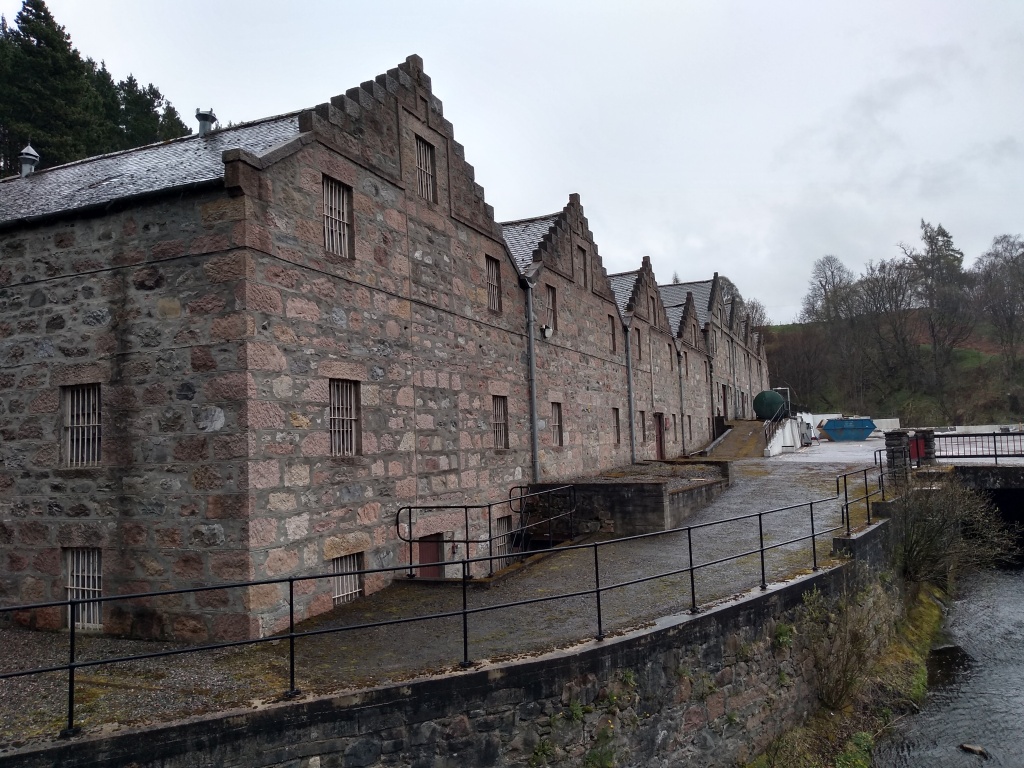
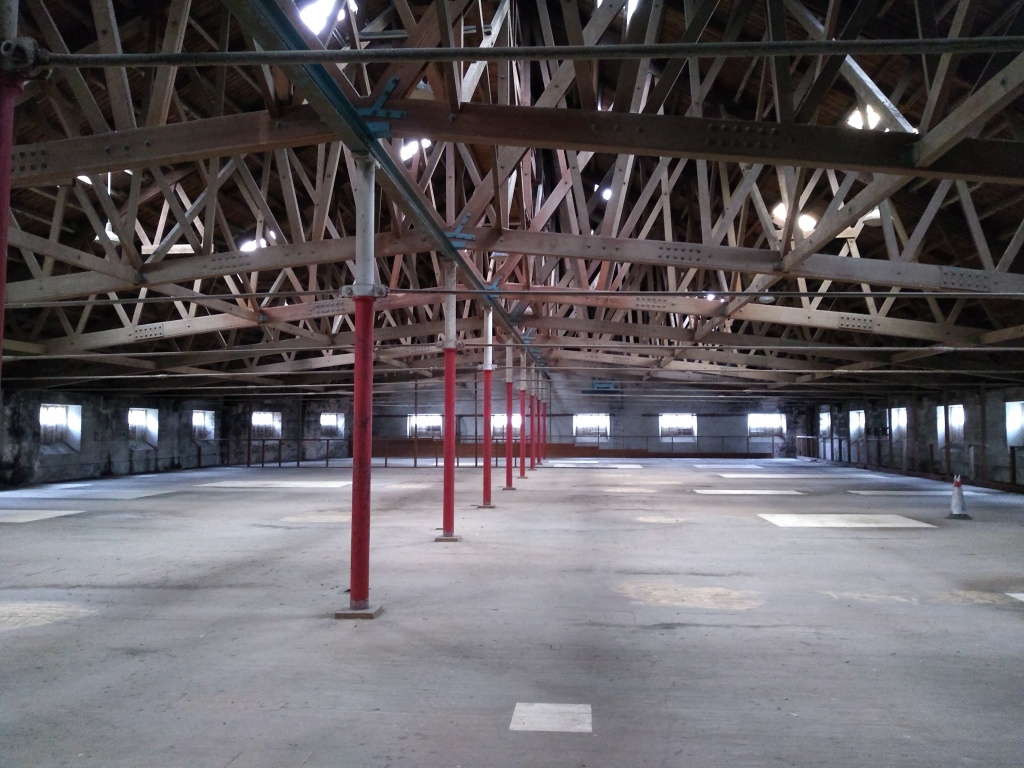
Soon after we went back outside and started the tour. On site, there is still a dark grain plant, which until 2018, when it was closed, used to process draff and pot ale (leftovers from mashing and distilling) to make cattle feed. As we moved inside the production building, we couldnโ€™t help but notice how big the spaces are, and how empty they look too! As technology advanced, less and less space was required for the production. Also, part of it moved away, in particular malting and cask filling, as currently all the newmake spirit is put in tankers and shipped to Diageoโ€™s sites in the central belt. As a matter of fact, one of the most surprising parts was the huge malting floor, so big you could use it for a sizeable concert! They used to have Saladin boxes, a short-lived mid-20th century innovation replacing the need of hand-shovel the barley while malting, which was soon replaced by maltings drums. These big empty spaces gave us almost an eerie feeling, maybe we were influenced by The Last of Us TV series, but this really looked like a distillery in the post zombie apocalypse era. Decadent, but fascinating. 
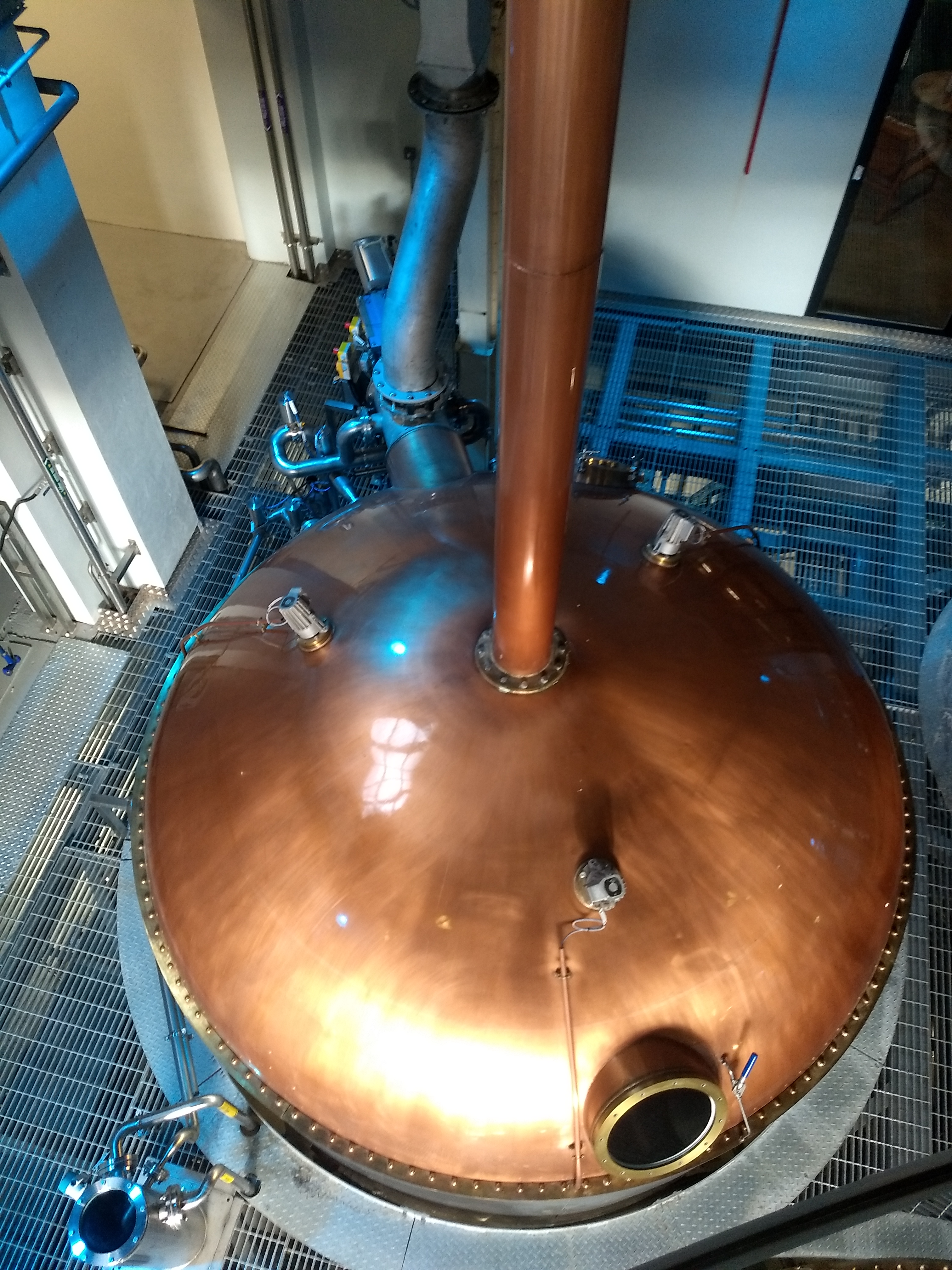
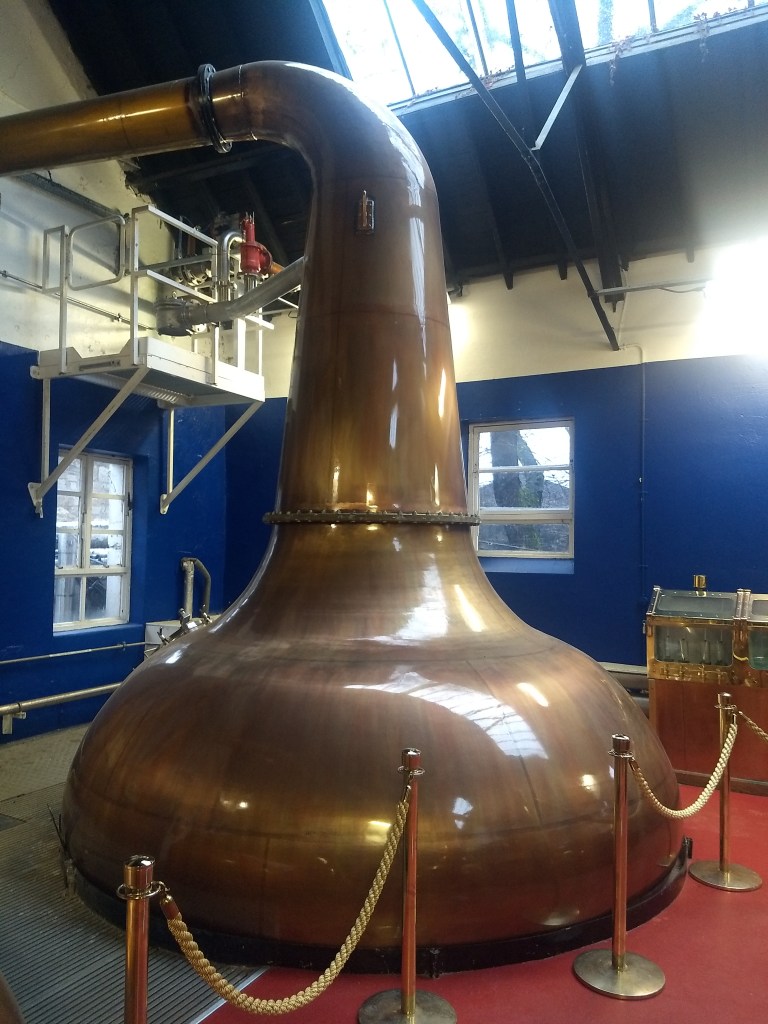
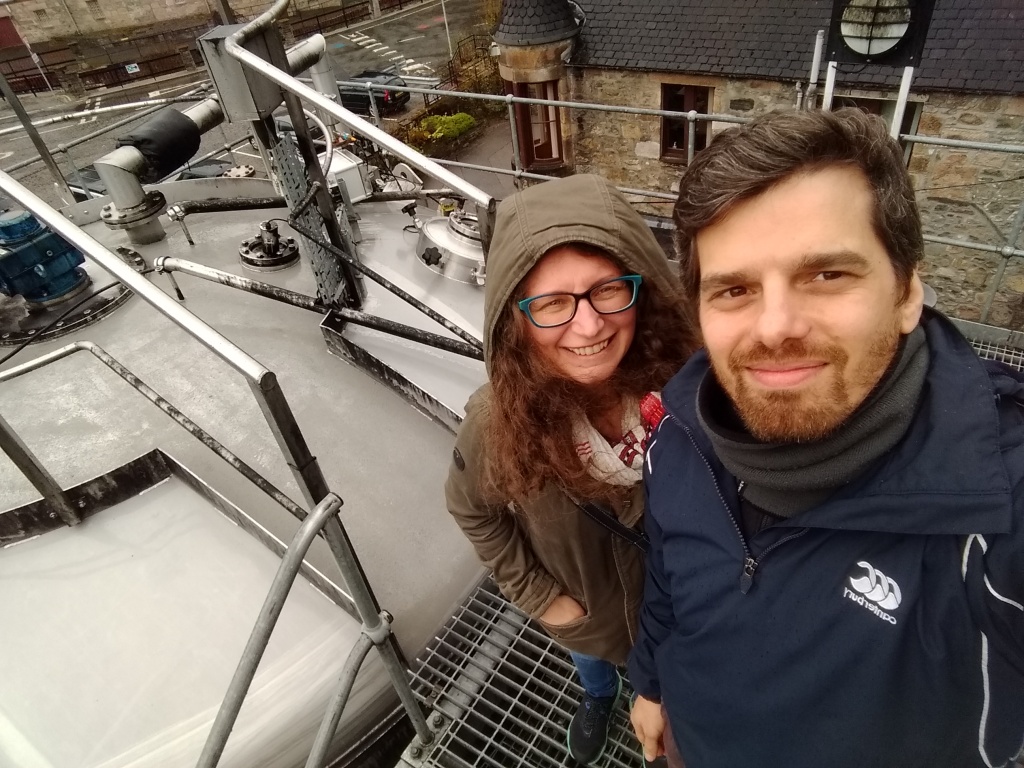
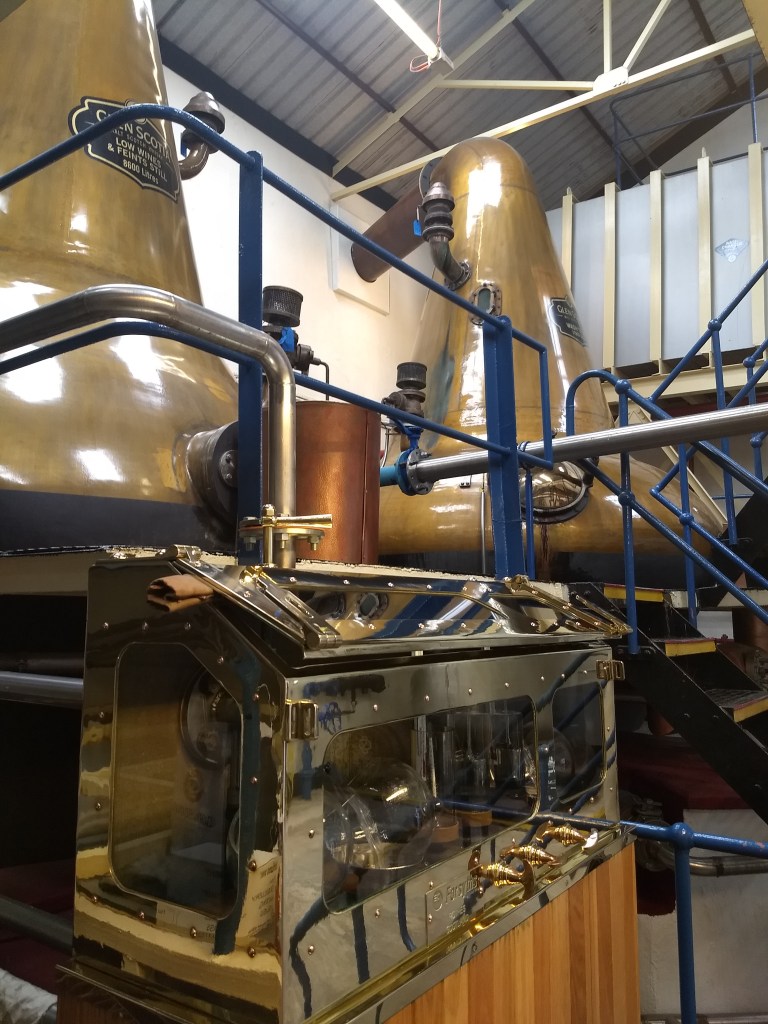
Empty spaces apart, the production is very modern and all controlled by computers (although they still carry out manual checks). They have a closed mash-tun, 8 wooden and 2 steel washbacks (the latter outside the building), and 3 pair of pot stills (with copper shell-and-tube condensers). The distillery produces over 3 million litres of alcohol per year, placing it among the medium-big ones.
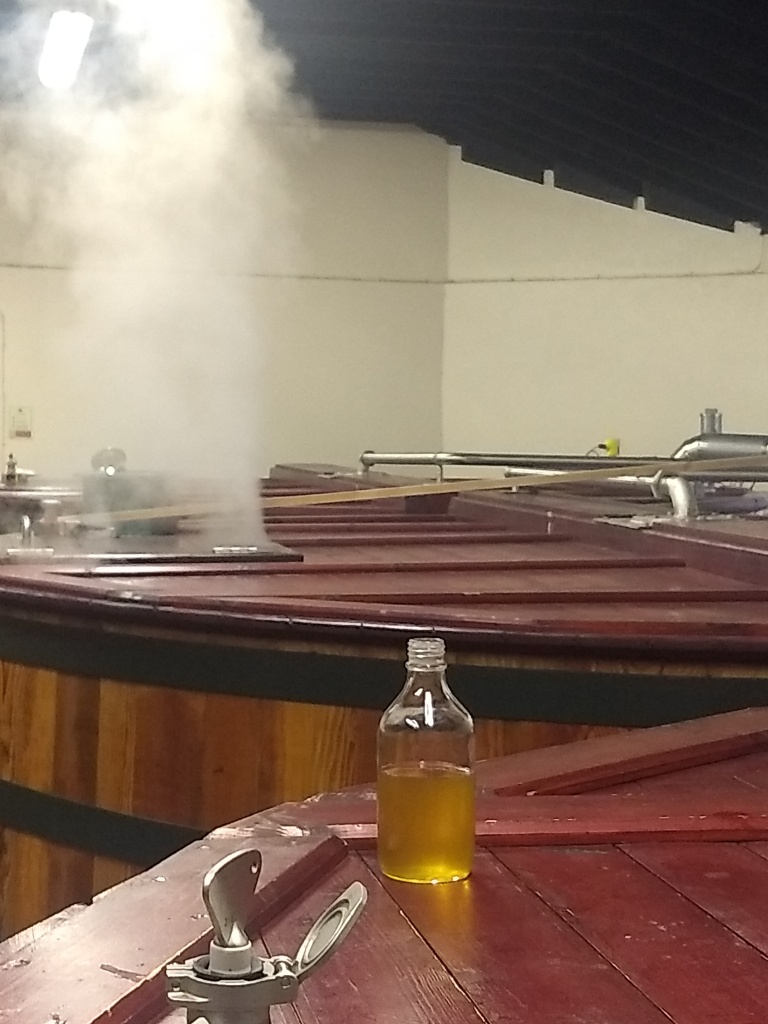
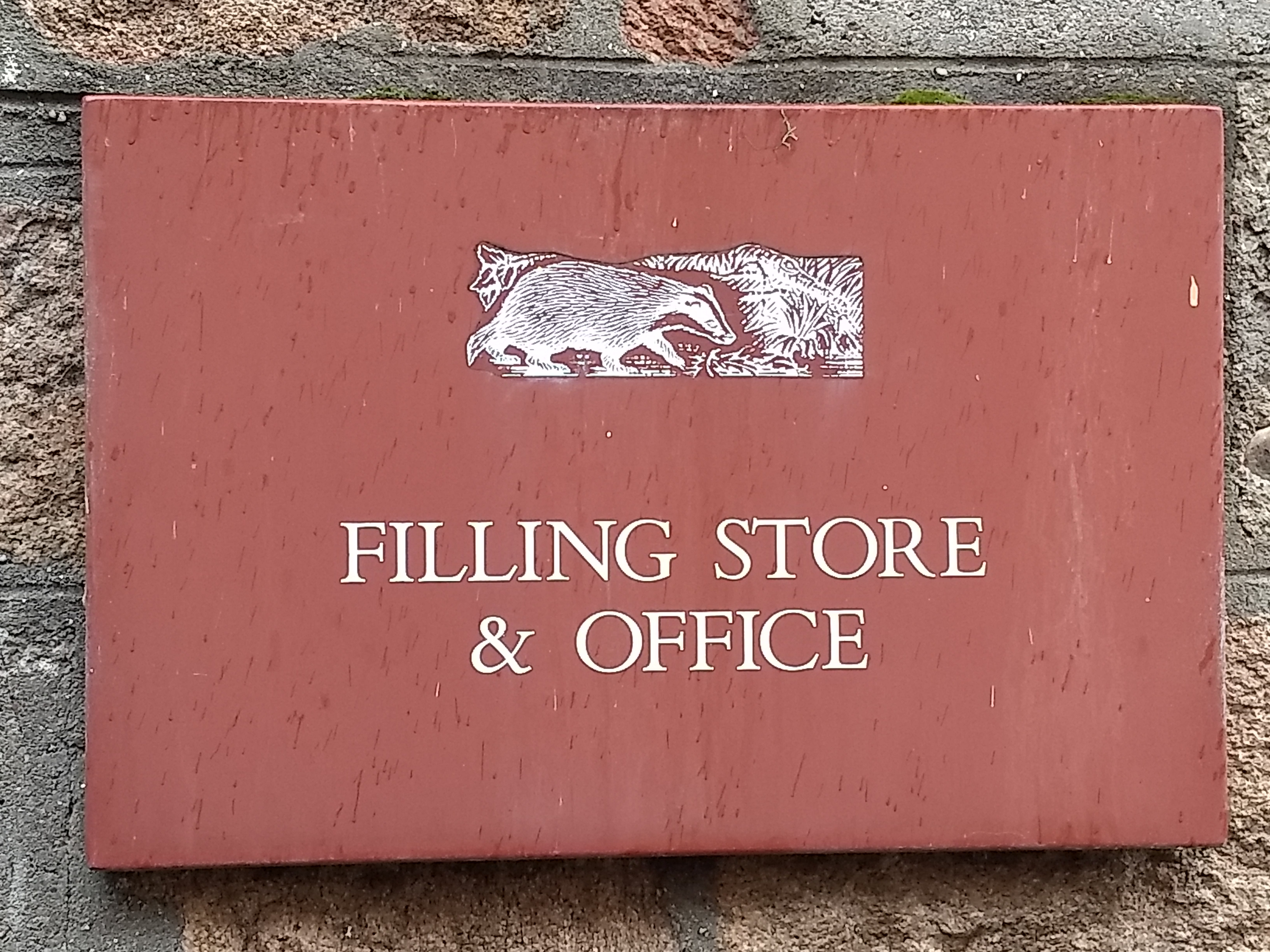
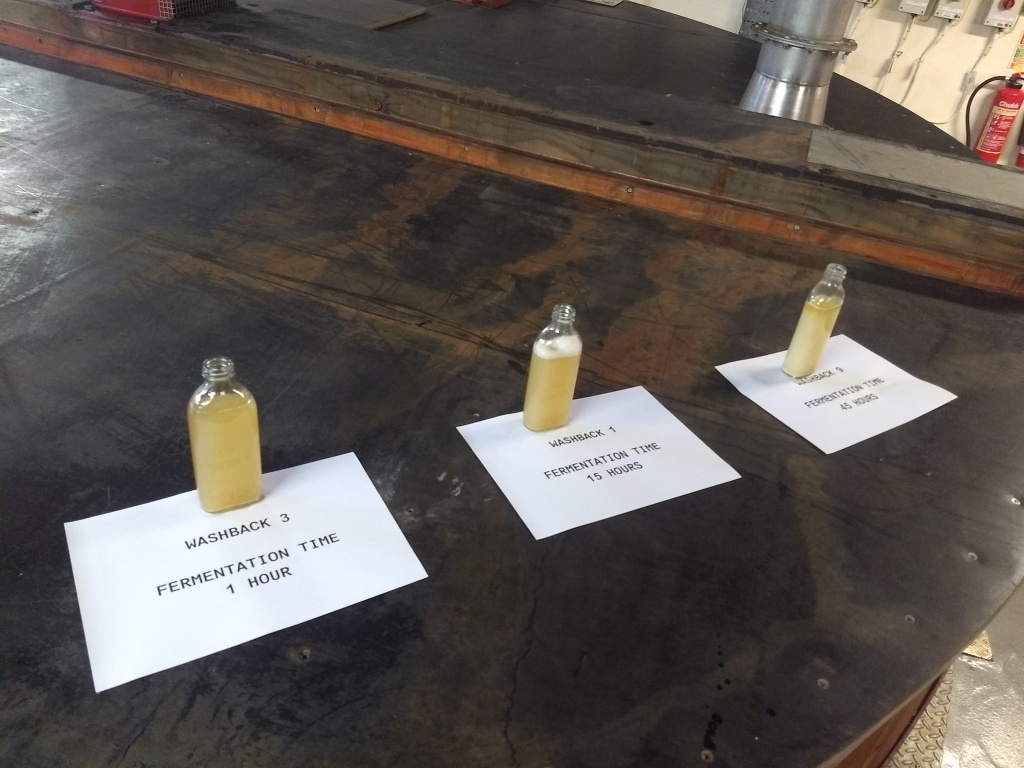
As we visited the fermentation room, Archie made us find three samples of wash for us to smell (not to drink!!), collected at different times: 1, 15 and 45 hours after fermentation started (overall fermentation is about 46 hours for a nutty style). Very nerdy and interesting. There, he was helped by Kyle, a distillery operator from Knockando distillery, deployed at Dailuaine as Knockando is currently closed. He also explained us how the system works in the stills room, answering all our (many) questions. We finally visited the โ€œfilling storeโ€, basically a tank with newmake spirit waiting for tanker truck to take it away. 
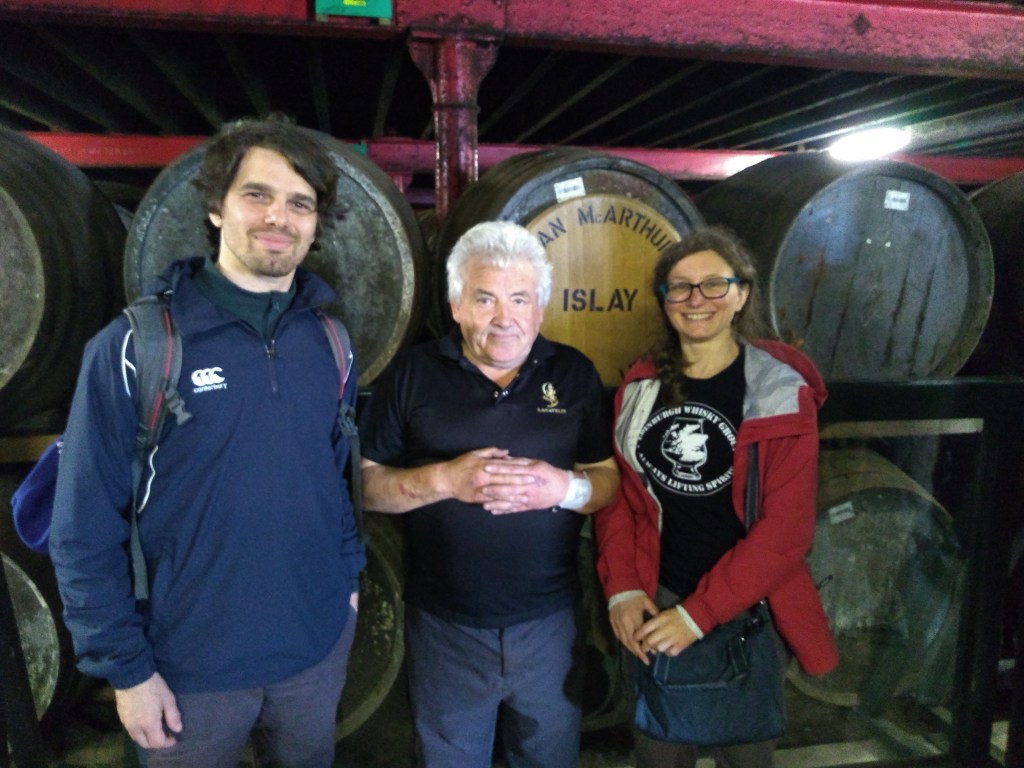
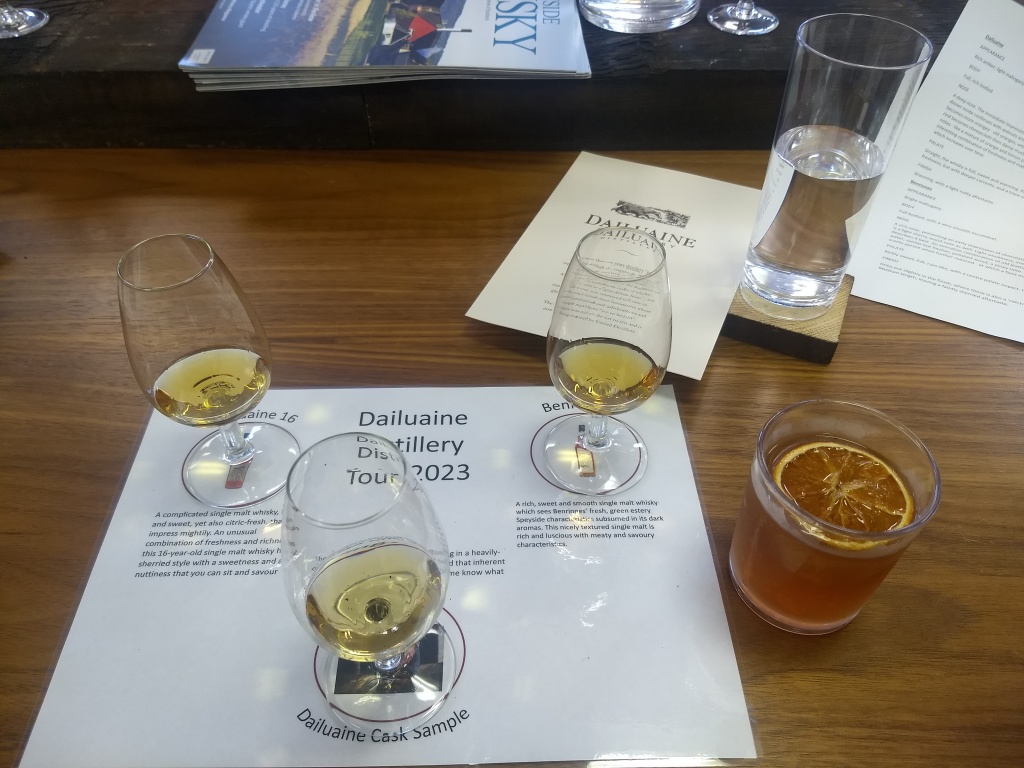
After the tour, it was time for the tasting! One of the offices was set up as a tasting room with a pop-up shop too (which turned out to be common to all Diageo distilleries we visited during the festival). As we got in, we were offered a cocktail: a variation of the Old-fashioned, made with Dailuaine 16 (of course) and orange bitters (instead of Angostura): very tasty! The drams at the tasting were three (four including the cocktail), a bit stingy for an 80-quid tour. We started with the Dailuaine 16 (43%), the Flora and Fauna bottle with the badger on the label. Second dram, another Dailuaine, a cask sample vintage 2010 usually offered in tastings at Cardhu distillery: a truly delicious dram, one of the best we tried during the festival. Finally, for some reason there was a Benrinnes 15, again from the Flora and Fauna range. 
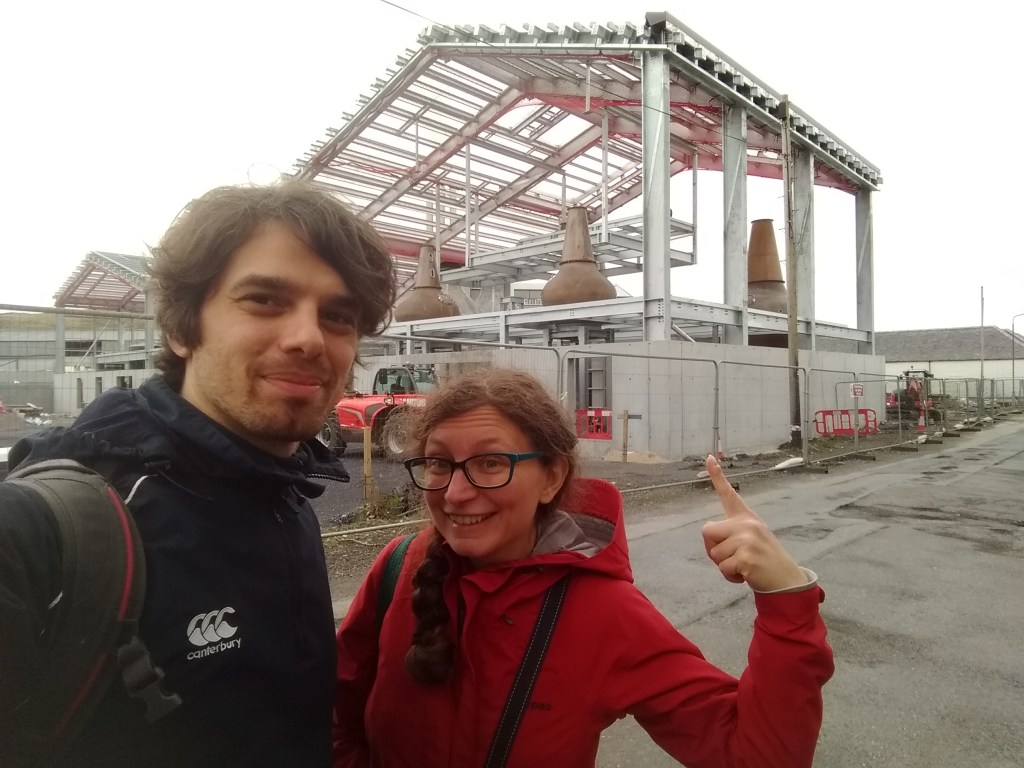
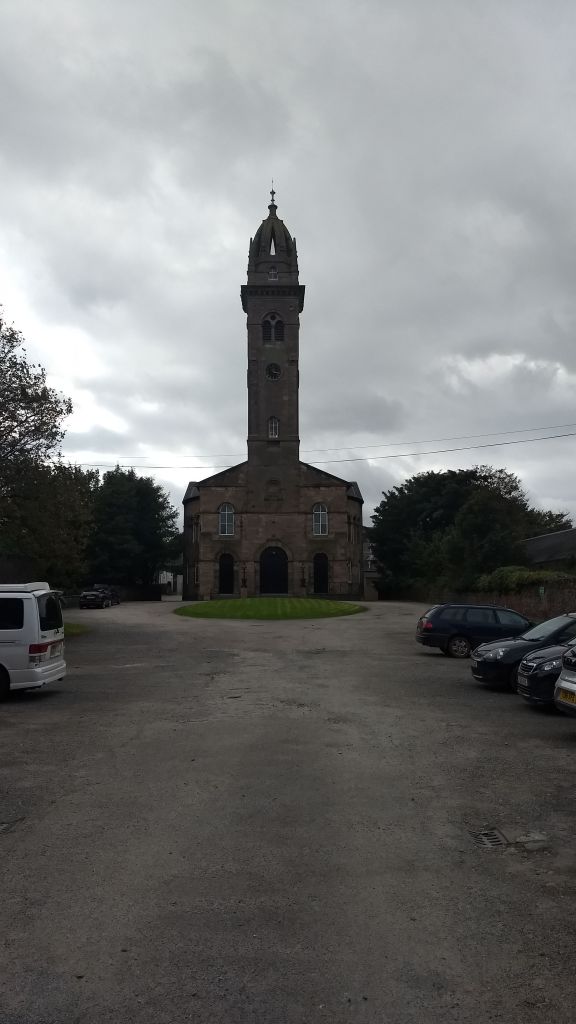
As we came out from the distillery we drove to another, Dalmunach, just to take a couple of pictures: we already knew from the glimpse while running the Dramathon, but that is a stunning one! After paying a visit to the GlenAllachie shop (we didnโ€™t have any event booked there, soโ€ฆ.), we found a spot for the night, a small parking lot near a church. The weather was a bit crappy, so we cooked something in the campervan and caught up with the drivers drams collected during the day: both the Tamnavulin and Dailuaine cask samples were quite great. 
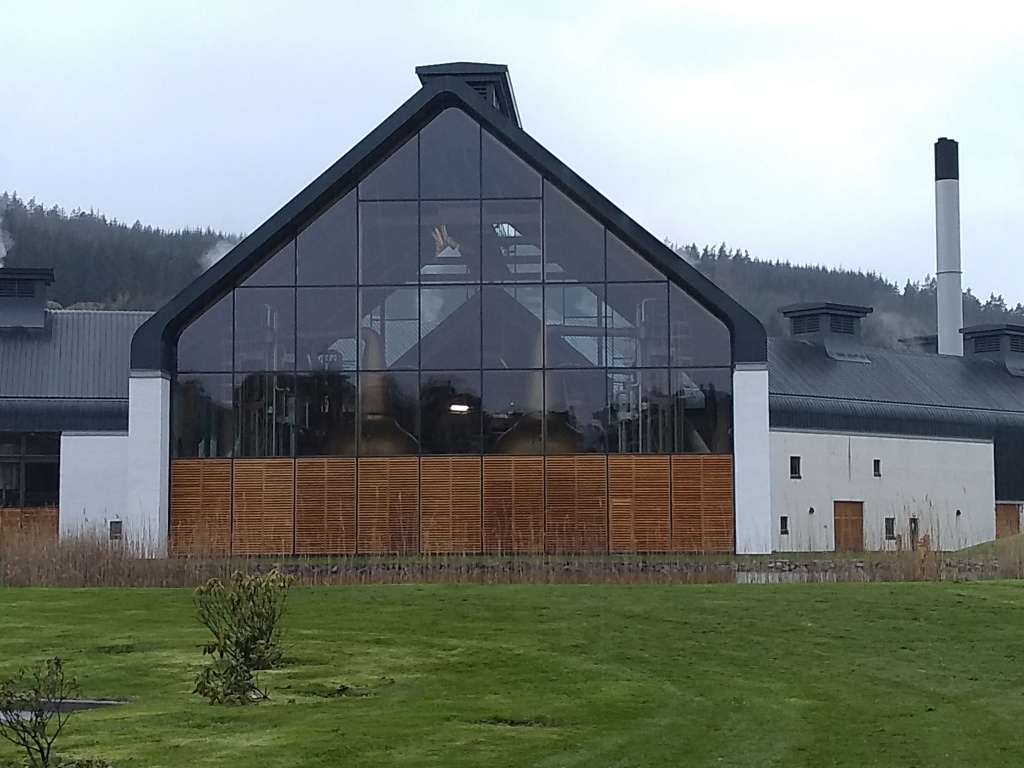
Dailuaine distillery really impressed us, it was like experiencing tradition and progress at the same time, and Archie was truly a great host! Throughout the festival, we also noted that, there is something different about distilleries normally closed to the public compared to the others: they are not โ€œsweetenedโ€ to look like tourist attractions. The ultimate whisky nerd paradise!


Dailuaine Tour (Spirit of Speyside)

Price: ยฃ80.00 pp (April 2023)

Duration: 2hr

Tasting:  a cocktail and 3 drams, Dailuaine 16 (43%), cask sample and Benrinnes 15 (43%)

Target: whisky enthusiasts

Value for money: too pricey

Highlights: Archie was a great host!

Recommended: if you are really really keen to visit

Link: https://www.spiritofspeyside.com/
https://en.wikipedia.org/wiki/Dailuaine_distillery

#25.3 Highlands trip bonanza!

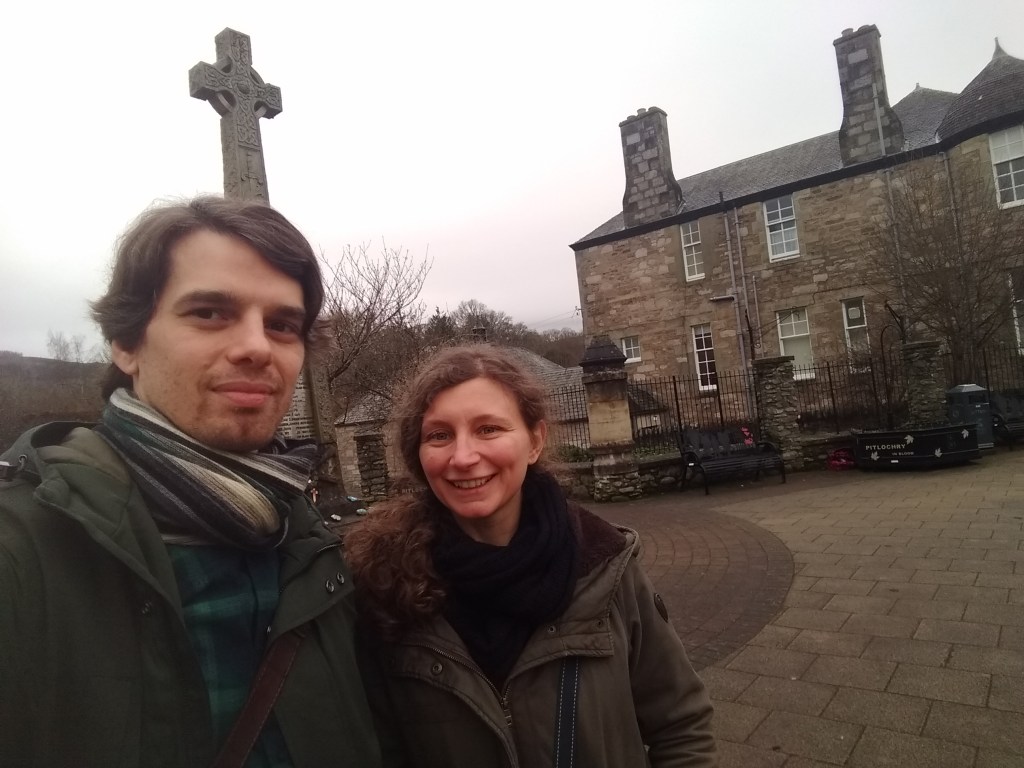
Back to Edinburgh through Aberfeldy and Pitlochry


TL;DR: The final day of the trip was dedicated to slowly driving back to Edinburgh. Still, we were able to fill the day with a few distillery visits: Aberfeldy first, followed by Edradour and Blair Athol! Phew
(missed Part 2/Part 1?)

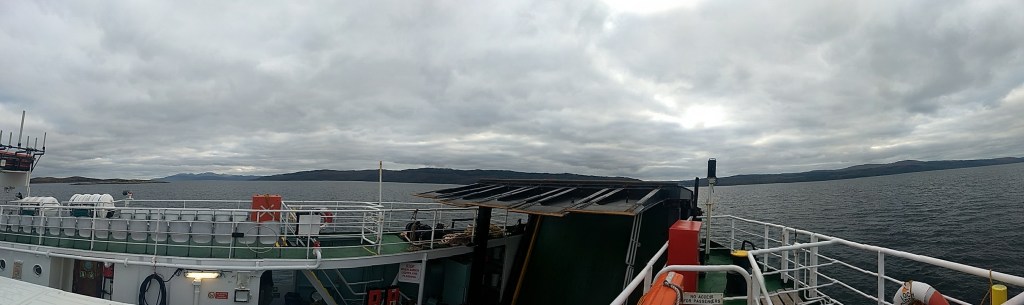
We woke up early that day, skipped breakfast, and drove straight to the ferry terminal at Fishnish, on the Isle of Mull, to catch the ferry back to the mainland under the morning sun. After a quick ferry trip (we believe itโ€™s the quickest Mull route), we arrived in Lochaline, on the Morvern peninsula (home to another distillery, Ncโ€™Nean, which at that time we didn’t even know existed). We had breakfast, finally, at the Lochaline Snack Bar, which serves delicious sandwiches, rolls, and other goodies at very reasonable prices. We enjoyed our breakfast in the good company of a nice English couple, who told us how they decided to spend their retirement on Mullโ€ฆnot a bad idea at all!

Not a bad morning!

Back in the car, we soon arrived in Corran for another quick ferry (this time just to save us over an hour drive), and then drove for the first time through Glencoe: what an incredible place! It felt like being in the middle of American canyons, but green.

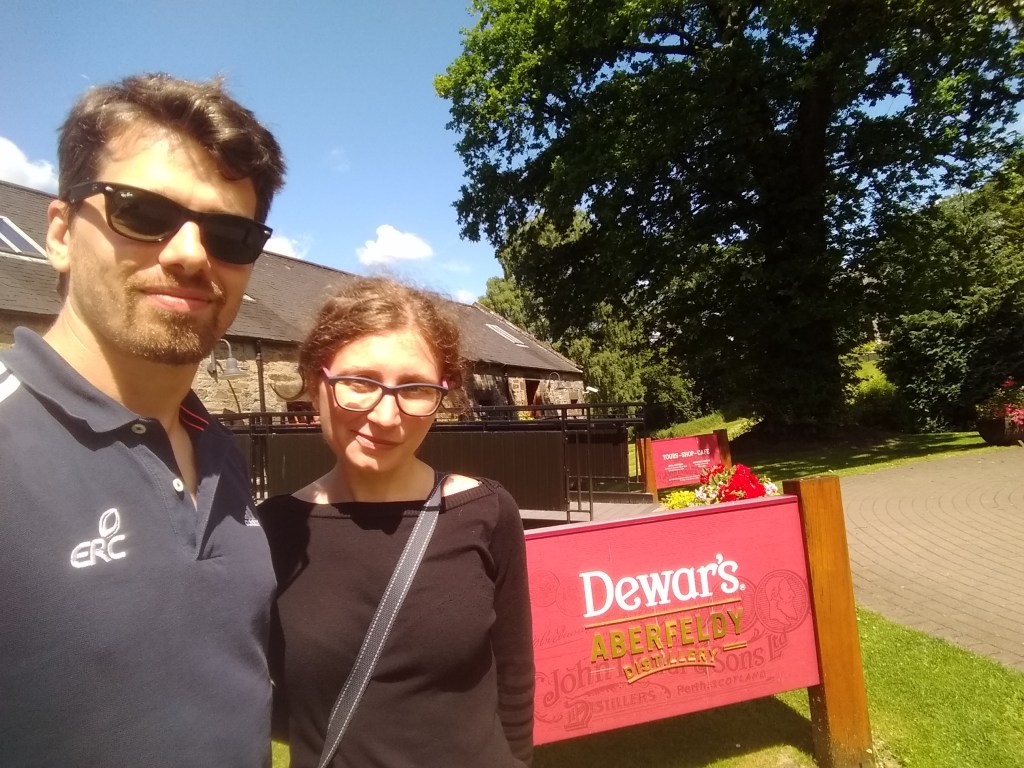
We followed the road to Bridge of Orchy and Tyndrum, then we turned left (eastward) and drove almost straight towards the first distillery of the day: Aberfeldy! It was not a new name for us, we had seen it in supermarkets and at the airport, but we had never tried it before, so we were quite curious. The distillery is in the village ofโ€ฆ.yep, you guessed it: Aberfeldy! Lovely place, the landscape was not as dramatic as the ones we had crossed earlier in the morning, but hilly and cosy. The distillery itself sits in quite a beautiful spot, almost like a postcard, with a small walking bridge to cross before entering the visitor centre.
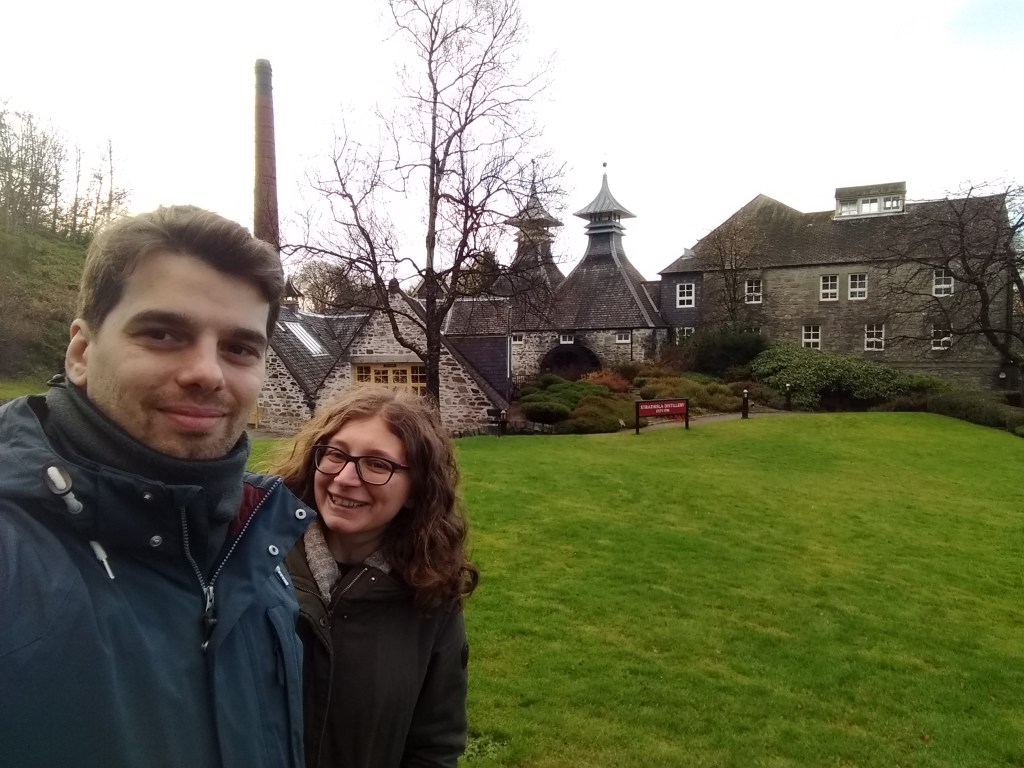
Teresa wasn’t ready for the picture.

The distillery is owned by Bacardi, together with Dewarโ€™s, one of the most prominent blended scotch whiskies, and a few other single malt distilleries (Craigellachie, Royal Brackla, Aultmore and Macduff). Before the tour, we could take a look at the museum on site, with lots of memorabilia and documents about the history of John Dewar and related brands.
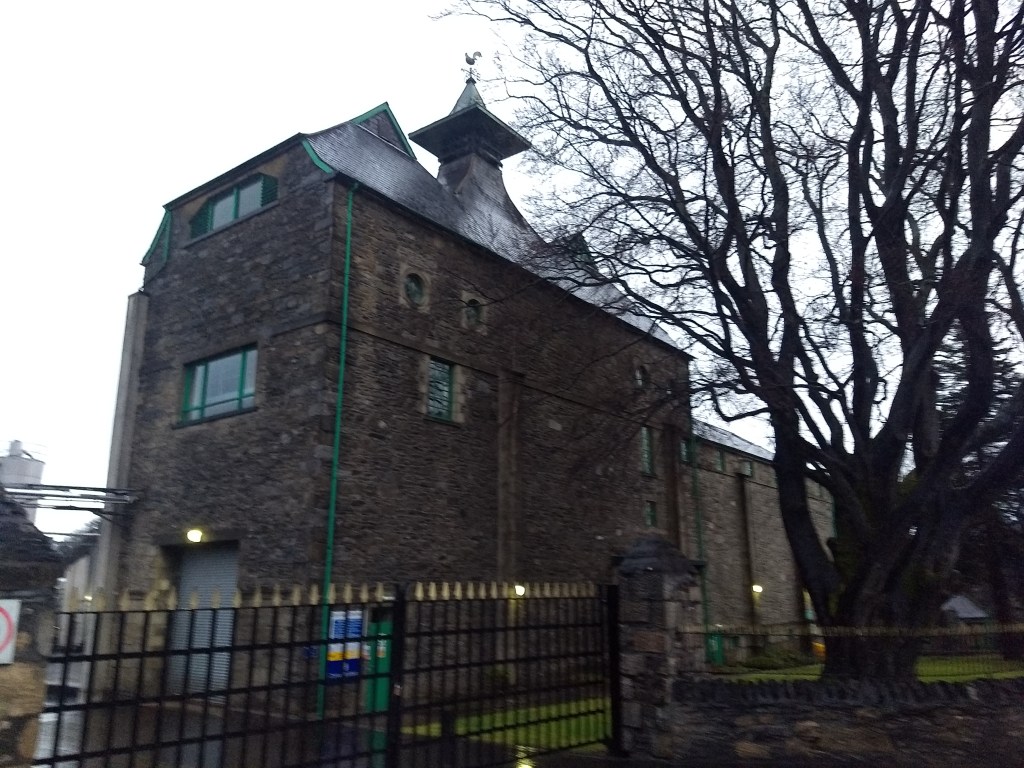
Then, we started the tour of this very pretty distillery. Around production, the signals of being owned by a big corporation were obvious, with a lot of signs that reminded Gianluigi of his environmental consulting days (not a bad thing, on the contrary: emphasis on environment and safety are a must!). It is on this tour that we realised that we could remember all the stages of productionโ€ฆafter all, that was the 5th distillery in 4 days.
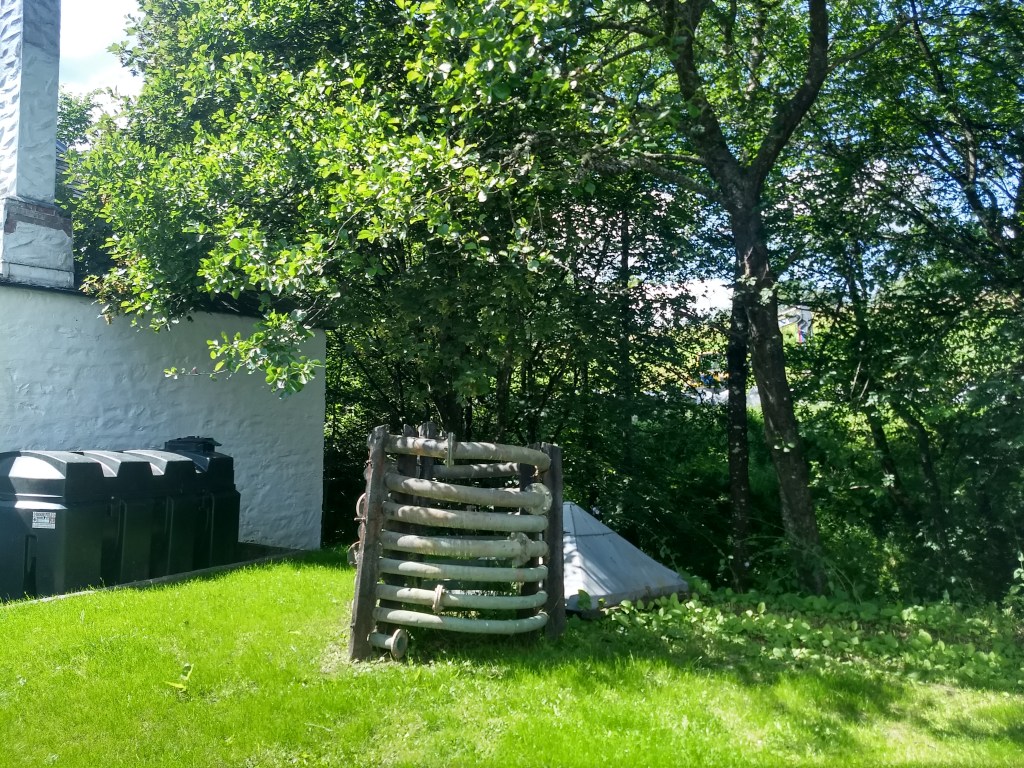
At the time we didn’t really know what it was…

Then, we moved on to the warehouse, where a dram taken from a cask was served, but only to those with a more expensive ticket (3-4 people on the tour, including Teresa). It was a 1999 (so almost 20y old) Aberfeldy ex-sherry cask, and it was truly delicious. The fact that it was served with people with the regular ticket just waiting and watching was not the best however, a bit awkward. Anyway, back at the visitor centre, we could try a dram each: we chose the Aberfeldy 12 and the Dewar’s White Label. Not very memorable the first one, more memorable (but not in a good way) the second one.

We had lunch at the cafรฉ in the visitor centre, but we soon left to get to the next distillery of the day: Edradour! It is a very small distillery, located near the village of Pitlochry. It used to be one of the smallest, if not the smallest in Scotland (called โ€˜the little gemโ€™), but then they lost the record because a few smaller distilleries opened and because they built a second production line in a separate building on site, increasing the stills from 2 to 4. Edradour is owned by Signatory Vintage, an independent bottler, and indeed the shop stocks quite some of their range.
Ready for the second tour of the day.
This time, drams were served at the beginning of the tour (so Gianluigi could sip a tiny bit of it): we picked the flagship Edradour 10 (40%) and the peated version Ballechin 10y (46%), and decided not to go for the whisky cream liqueur. We started the tour with a big German group, but after a while, we and another 3-4 people branched off to get the tour in English. As usual, the tour guide went through the story of the distillery, which was founded in 1825, although their first single malt was only released in 1982! We visited the new distillery first, while the old production plant was showed to us from the courtyard as we walked back to the visitor centre. It is on this tour that we discovered what the โ€˜monkey shoulderโ€™ is. At the shop, we found out that for a few extra quid, we could get the Signatory Vintage version of Edradour, still 10y old and vintage 2019, bottled at 46%, non-coloured and not chill-filtered: a very delicious treat to ourselves! We also got the whisky cream liqueur for a friend, who gave absolutely positive feedback!

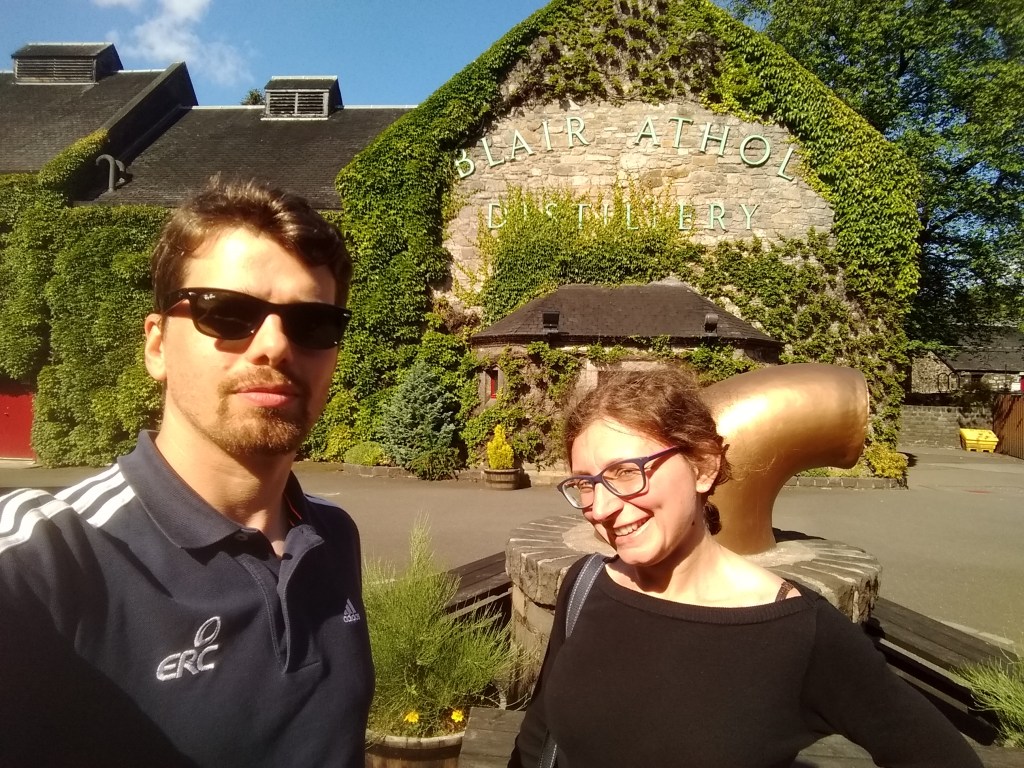
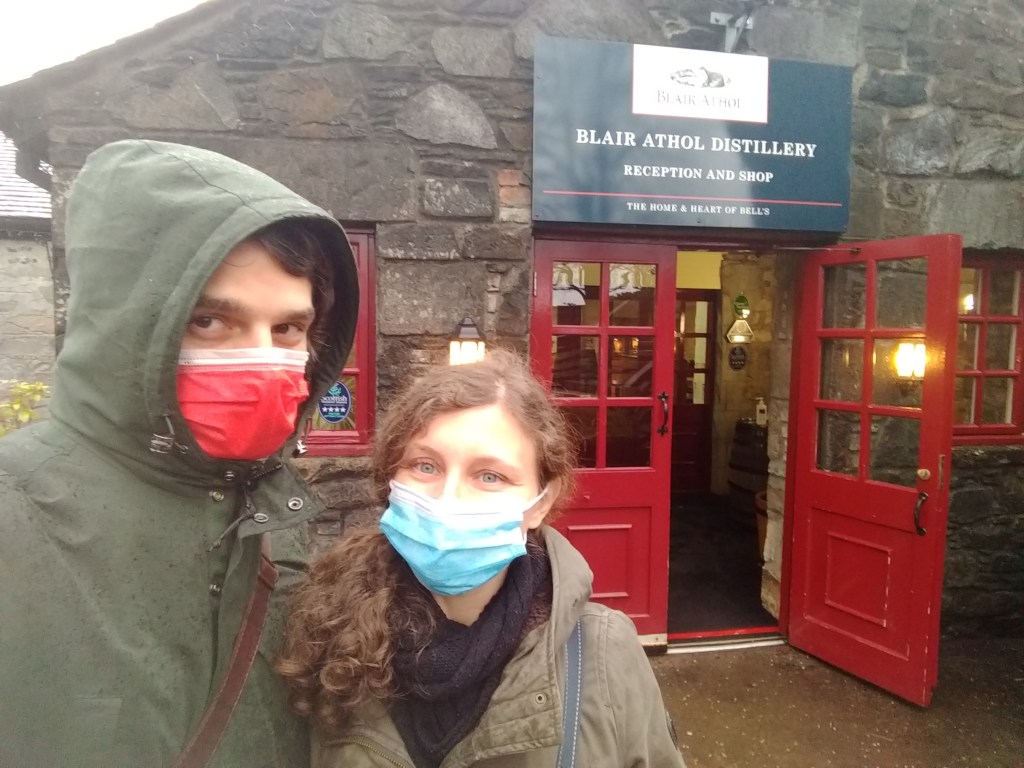
Back in the car, we drove towards the final stop of the trip, the neighbouring Blair Athol distillery, in Pitlochry. We went first for a coffee in the village (the early start was catching up on us), and then checked in at the distillery. After a bit, our host for the day, the very knowledgeable Calum, took us to the table for the tasting (after two tours in a day, we didnโ€™t feel like going for the third oneโ€ฆWell, we would catch up later on).

We can’t remember whether this was before or after the tasting…

We hadnโ€™t had any Blair Athol before, and actually rarely heard anything about it, so we werenโ€™t surprised when Calum explained to us that the majority of the whisky produced there goes into blends. Now that we are a bit more experienced, we can say that Blair Athol drams can be fantastic, but mostly the independently bottled ones. There, we were given Blair Athol 12y and Distillers edition 2019, followed by a range of Diageo products: Cragganmore, Caol Ila and Lagavulin Distiller Editions, and a wee tiny sip of Johnnie Walker Blue Label – the first and only time we tried it, not impressed (instead, we determined that the much cheaper Green Label we had at home was more enjoyable). After collecting โ€œourโ€ driverโ€™s drams and a quick stop at the shop, we finally drove home.

It was a cracking weekend, one of the most memorable ones, and we took so much in from all these distillery visits. Itโ€™s when we switched from being whisky curious to whisky enthusiasts! Some of the experiences were quite touristy, which was OK with us at the time, but would not suit us well today after n more distilleries tours and tastingsโ€ฆWe really appreciated Ardnamurchan for their environmental forward thinking (well, now we appreciate them ALSO for the stunning quality of their whiskies), while the range we tried at Tobermory was incredible. Edradour and Ben Nevis were unknown to us previously but revealed themselves as little gems in the scotch whisky landscape. Overall, a fantastic trip!

Until next time, slainte!


Distillery Links

Aberfeldy: https://www.dewars.com/gl/en/aberfeldydistillery/
Edradour: https://www.edradour.com/
Blair Athol: https://www.malts.com/en-gb/distilleries/blair-athol

#25.1 Highlands trip bonanza!

From Edinburgh to the West Highlands, via Dalwhinnie and Ben Nevis


TL;DR: During our first big whisky road trip on the Highlands in mid-July 2019, we bagged seven distilleries in four days. First off, Dalwhinnie (OK, albeit a bit touristy) and Ben Nevis (if only we knewโ€ฆ). And amazing Scottish landscapes, of course. 

For this story, we go back to 2019, early Summer. We were fresh members of the SMWS, and definitely eager to learn more about whisky, in particular eager to visit more distilleries. The perfect occasion was a mid-July weekend, when Teresa could enjoy a Glasgow bank holiday. Prompted by all the people telling us how beautiful Mull is (true story), we aimed towards that direction, central and west Highlands. From this, we started defining our route while poking distilleries.

A thing to note, it is unbelievable how in only three and a half years the whisky tourism landscape has changed. Many of the distilleries didnโ€™t have an online booking system at the time, so we had to contact them via email or phone. That made us (well, Gianluigi mostly) a bit uneasy: will everything go as scheduled or will our bookings be lost in translation? Weโ€™ll see how mostly everything worked out fine, in the end, except for one.

This is the only picture we took at the distillery.

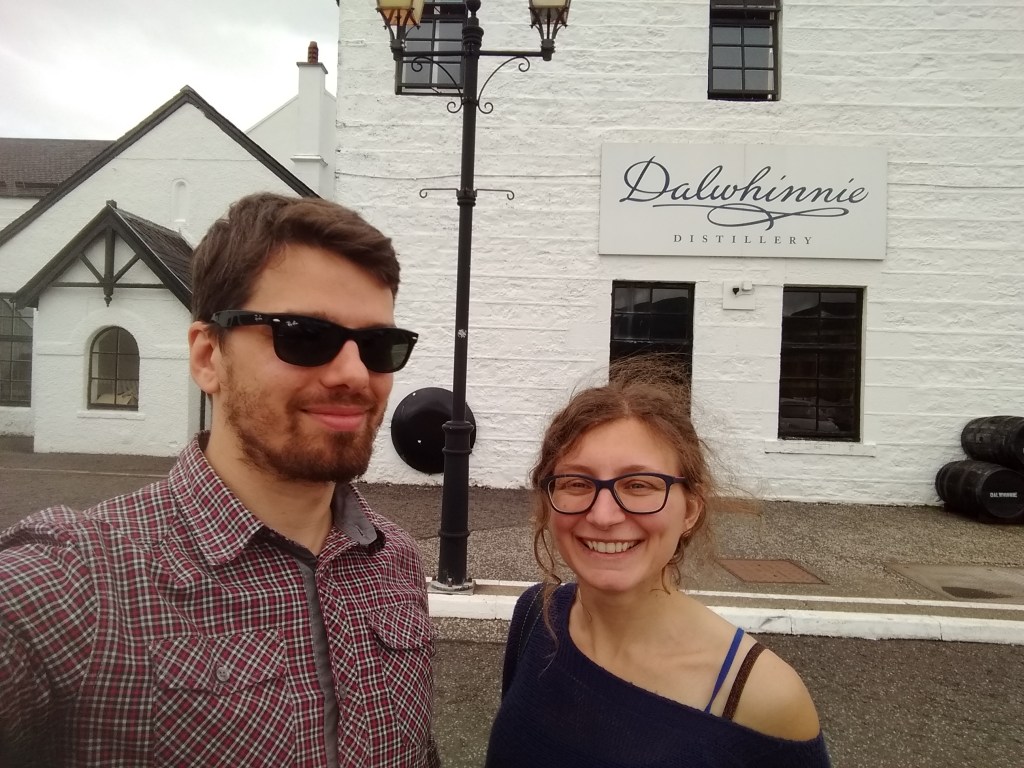
On Friday morning, we drove up north from Edinburgh, as the first visit was at Dalwhinnie. Built in 1825, the distillery is actually visible from the A9, the main highway from Edinburgh to Inverness, past Pitlochry but before Aviemore. The village giving the name to the distillery is one of the coldest in Scotland, as it is very far away from the sea and one of the highest as well. As a matter of fact, the distillery is often referred to as the highest in Scotland, although the highest is actually Braeval (by 2m, Wikipedia says). The buildings are very beautiful and somehow symmetric, including two pagoda roofs above the former malting floor. Being very close to the river Spey, it falls within the area where distilleries can pick their region between Highlands or Speyside, albeit Dalwhinnie usually goes for the former. It is owned by Diageo, and its two main expressions (Dalwhinnie 15y and Winterโ€™s Gold) are very prevalent. The whisky is considered to be light and floral, and it is very hard to find expressions released by independent bottlers.

We checked in quickly for one of the standard tours, with a very nice lady who, however, was keen to clarify that she didnโ€™t like whisky (which sounded a bit weird). Honestly speaking, we donโ€™t remember it as a memorable tour, although we do remember the relaxed atmosphere created by the very friendly staff. It looked like a nice work environment. Probably, being in a such visible spot, the distillery suffers from being excessively geared towards mass tourism. The drams (the aforementioned two, plus a sip of the Game of Thrones House Stark release, suspiciously similar to the Winterโ€™s Goldโ€ฆ) were OK but they didnโ€™t prompt us to purchase. So, after a homemade lamb-chop sandwich eaten in the parking lot, we hit the road towards our next stop.

Fewer distillery pictures, more landscapes.

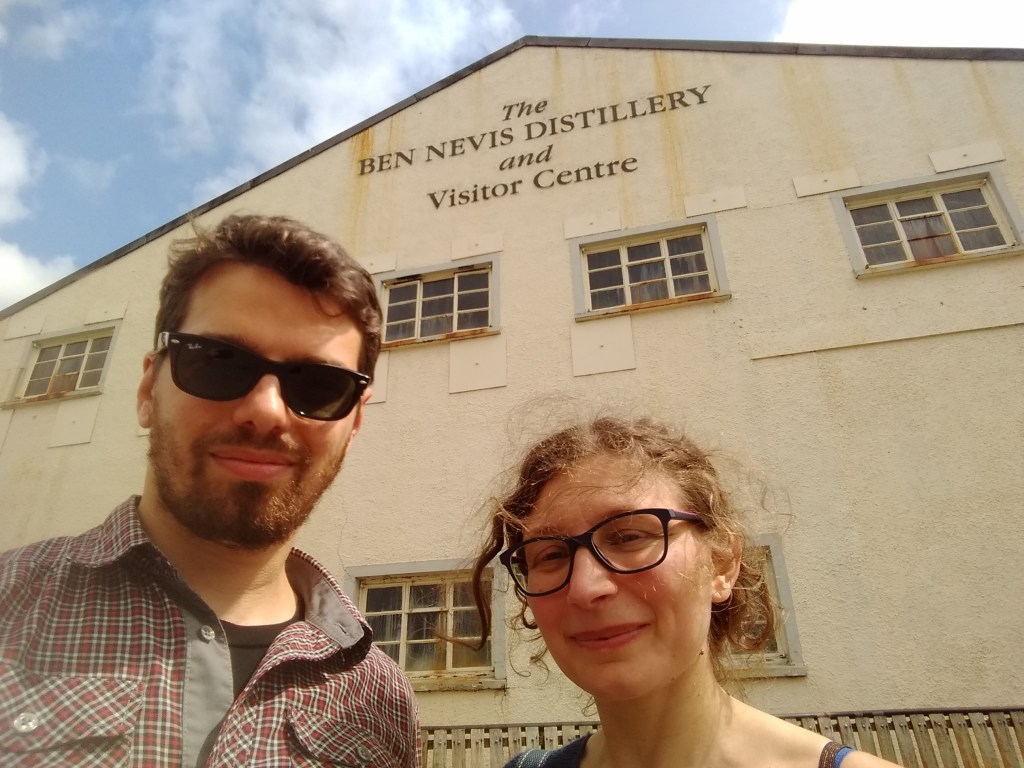
From Dalwhinnie, instead of going back to the A9, we drove westward following Loch Laggan and passing by the village of Spean Bridge: the landscape is truly amazing over there (wellโ€ฆas in most parts of Scotland). We arrived at our destination in the afternoon, just in time for the tour: Ben Nevis distillery, in Fort William. After the nice tour, Gianluigi had only one dram and Teresa four (well, she saved some for the evening). The distillery looked a bit decadent: the decor in the visitor centre reminded us of an early 90s ski resort, giving us almost a nostalgic feeling. At the time we didnโ€™t know that the distillery is owned by the Japanese Nikka, who use Ben Nevis in some of their popular blends (did someone say โ€œNikka from the Barrelโ€?? We didnโ€™tโ€ฆ).

And this is the only picture we took here.

For us, this was a totally new experience as, unlike Dalwhinnie, we had never heard about Ben Nevis before booking the visit. The whisky was a great surprise too. While we werenโ€™t too fond of the Nevis Dew Special reserve blend (the one with the red label), we loved both the blended malt Glencoe 8y (cask strength, now long gone unfortunately) and the single malt Ben Nevis 10y. In our understanding, we missed the cask strength version for just a few weeks, and the Mac Donald Traditional Ben Nevis wasnโ€™t available. Being naรฏve in the whisky world, we bought the slightly cheaper Glencoe (at the time around 25-28 quid) instead of the Ben Nevis 10y (at the time 35-38 quid), but in hindsight, we should have got bothโ€ฆand a couple of bottles of each too: back at the distillery in 2021, we found out that the release of Ben Nevis 10y would cost us 50 quid, and that the Glencoe was discontinued!

Highlands encounters.

After Ben Nevis, our trip continued towards one of the most westerly points of mainland Scotland: the never enough celebrated Ardnamurchan peninsula! And with that, we also discovered a very typical Highlands feature: single-track roads! Unavoidable, we guess, and now we are kind of used to themโ€ฆbut letโ€™s say that the first time we werenโ€™t so happy about it. We stayed in a self-catering accommodation very close to the Ardnamurchan distillery, and after dinner, thanks to still very long days, we managed to visit the lighthouse: such an amazing spot!

We guess by now you know about our plans for the day after, so stay with us until next week, Slainte!


Distillery Links

Dalwhinnie: https://www.malts.com/en-gb/distilleries/dalwhinnie
Ben Nevis: https://www.bennevisdistillery.com/


#24.1 Dramming in Dublin

A whiskey weekend before the storm: Teeling & Roe & Co.


TL;DR: In January 2020, we visited friends in Dublin, so why not check out a couple of distilleries in the meanwhile? We chose two among the many newbies, Teeling, in the Liberties neighbourhood, and Roe & Co, a new Diageo distillery close to the iconic Guinness brewery! 

In our blog, so far, we talked about our whisk(e)y adventures in Kentucky, England, Canada and, of course, Scotland. You might have noticed an important gap, which is the object of this and the next blog post: Ireland!

Gianluigi had actually visited Ireland, mostly Dublin, a few times way before his whisky journey started, while for Teresa the first time came when we went there to celebrate 2019  New Year with two friends from the US. At that point, we were already into whiskey (and whisky), but in our heads Dublin = Jameson, so thatโ€™s what we went for: the Jameson Experience in Bow Street, where the old distillery was. It was a nice experience for newbies, and it was very interesting to compare scotch (Johnnie Walker), American (Jack Danielsโ€ฆ) and Irish whiskey (Jameson, of course). For sure, at the time we were not aware of the troubled history of Irish whiskey: after the trade block with the Commonwealth countries as a consequence of the Irish Independence war, and prohibition in the USA, Irish whiskey saw a decline which led the biggest producers (Powers, Cork Distillers and Jameson) to join forces and form the Irish Distillers company, while moving production to the New Middleton distillery, in Cork, in 1971. For many years, only two distilleries were active in Ireland: the aforementioned Middleton and Bushmills, in Ulster.

Recent years saw a renaissance of Irish whiskey, however. First, in 1987, John Teeling acquired and converted an old potato processing plant into the third Irish working distillery: Cooley. More recently, a number of distilleries throughout the island popped up, including a handful in Dublin.

It is in this context that we started to sniff around. The occasion was a weekend at the end of January 2020, when Covid was already a thing but hopes were that, like the SARS-CoV-1 in 2003, it would have been a limited outbreakโ€ฆso naรฏve! We went back to Dublin to visit a friend of Gianluigi who was working at the UCD, and a former Teresa’s advisor from New Zealand. When we looked at the available tours we spotted four distilleries: the Liberties, Pearse Lyons, Roe & Co. and Teeling. Being unfamiliar with all of these brands, we chose the latter two, almost randomly.

First Irish whiskey distillery visit: Teeling.

It was a sunny Saturday morning, when we arrived in the Liberties, a former industrial neighbourhood. This is home to both the Liberties (more on this next week) and Teeling distilleries. The latter was founded in 2015 by Jack and Stephen Teeling, the sons of the founder of Cooley, now owner of the Great Northern Distillery, in County Louth, the former Harp beer brewery converted into a distillery in 2015. In hindsight, visiting Teeling first made sense as it is the first new whiskey distillery in Dublin in over 100 years, and the first operating since Jameson and Powers moved to Cork.

The three stills (made in Italy!)

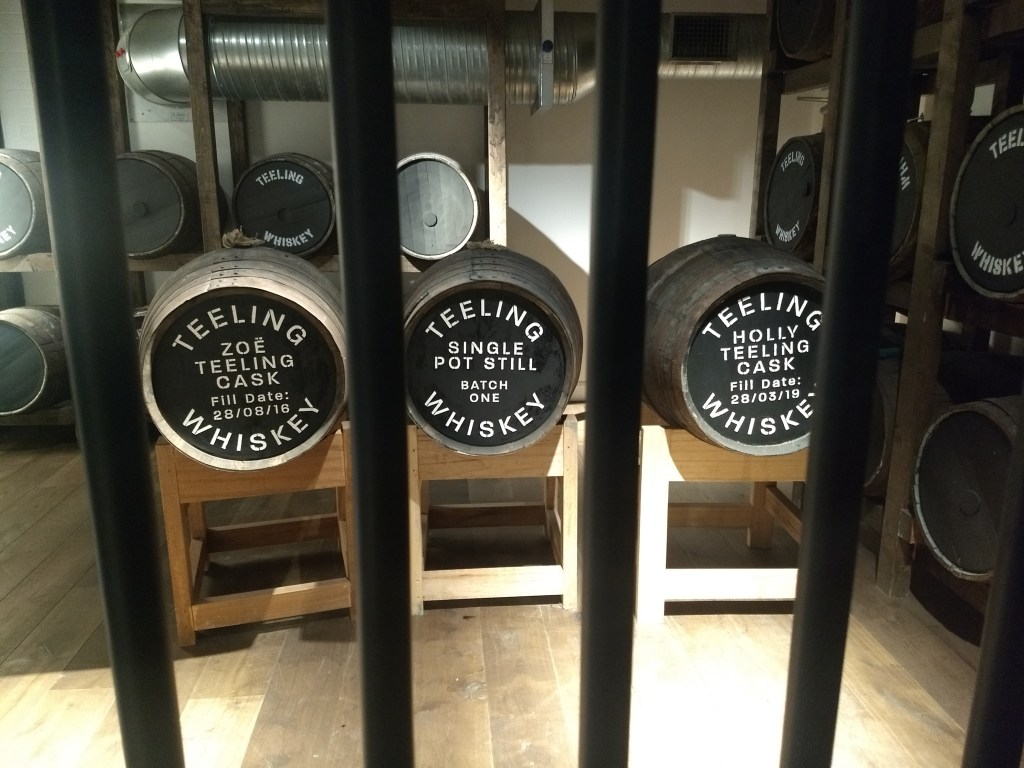
The building is quite modern, and itโ€™s obvious that they built the distillery with tourists in mind: everything is spacious and feels ready to accommodate big groups. They are quite a sizeable distillery too, with half-million litres of alcohol per annum. They produce many different styles of whiskey: single grain, single malt, single pot still and the typical Irish unaged spirits (Poitin), all bottled at 46%, except the latter which goes up to around 50-52%. Their main expression Is the Small Batch, made with malt and grain whisky. The tour was nice, nothing particular to note, except that the three stills (most Irish whiskeys are tripled distilled) come from an Italian firm, Frilli, and they are named after the ownersโ€™ daughters (which now we cannot recallโ€ฆit was 3 years ago!). The tour ended with a visit to the on-site warehouse, where some of the first casks filled are stored.

After the tour, we got a 4-dram tasting: the Small Batch, the Single Malt, the Single Pot-still and a distillery exclusive. It was very interesting to try them all together, a comparison between very different styles of whiskey! At the bar, we also tried one of their special releases of the time, the Brabazon vol. 2, a sourced whiskey finished in ex-Port cask and bottled at 49.5% abv, very different from the others!

Caged casks.

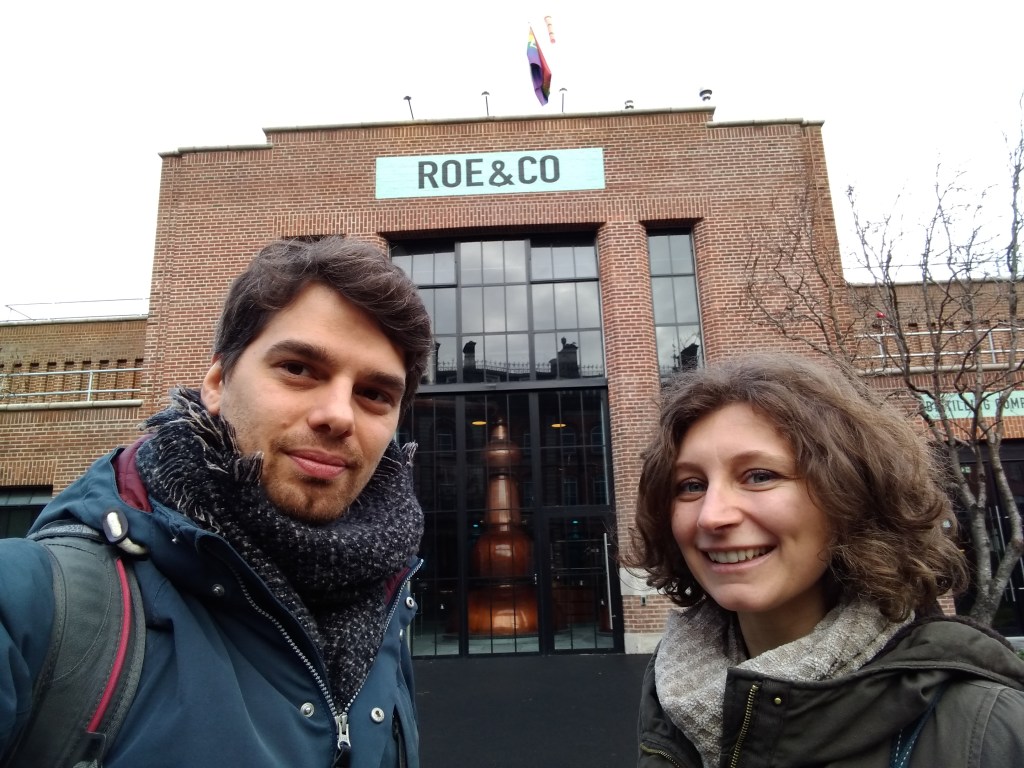
The following day, much cloudier, was Roe & Coโ€™s turn, very close to the Guinness St James Gate Brewery. The name is inspired by George Roe & Co, the owner of the old Thomas Street Distillery. This used to be a massive distillery around the late 1800s, just a stone throw away from the brewery, with over 2 million gallons of single pot still whiskey produced per year. It was closed in 1926, following the aforementioned crisis of Irish whiskey. The new Roe & Co distillery was built by Diageo in the old brewery powerhouse, and started producing in 2019. It is a very beautiful old industrial brick building, with big windows that make it possible to see the still room from outside. Next to the building, there is a tower with a green dome and a pear tree (which inspired the distilleryโ€™s logo).

Second day, second distillery: Roe & Co.

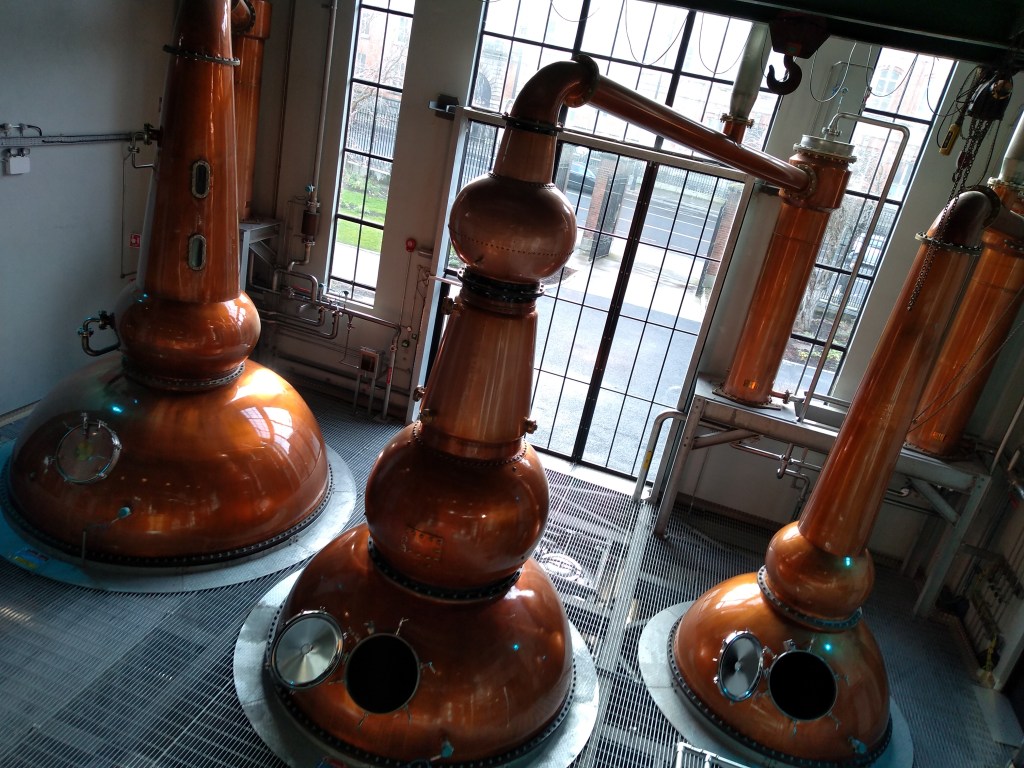
Production is characterised by a closed mash-tun with a copper lid, a few (we cannot remember how many) wooden washbacks, and three stills of different shapes. Again, this distillery too has been clearly built with visitors in mind, so the spaces are quite open, and the bar is near the still room. After visiting the production, the guide brought us to a fancy showroom with a big table, where there was a wooden box for each of us. Inside the box, a few aromas and other stuff for a sort of sensorial experience (honestly, the least favourite part of the tour).

Beautiful still room!

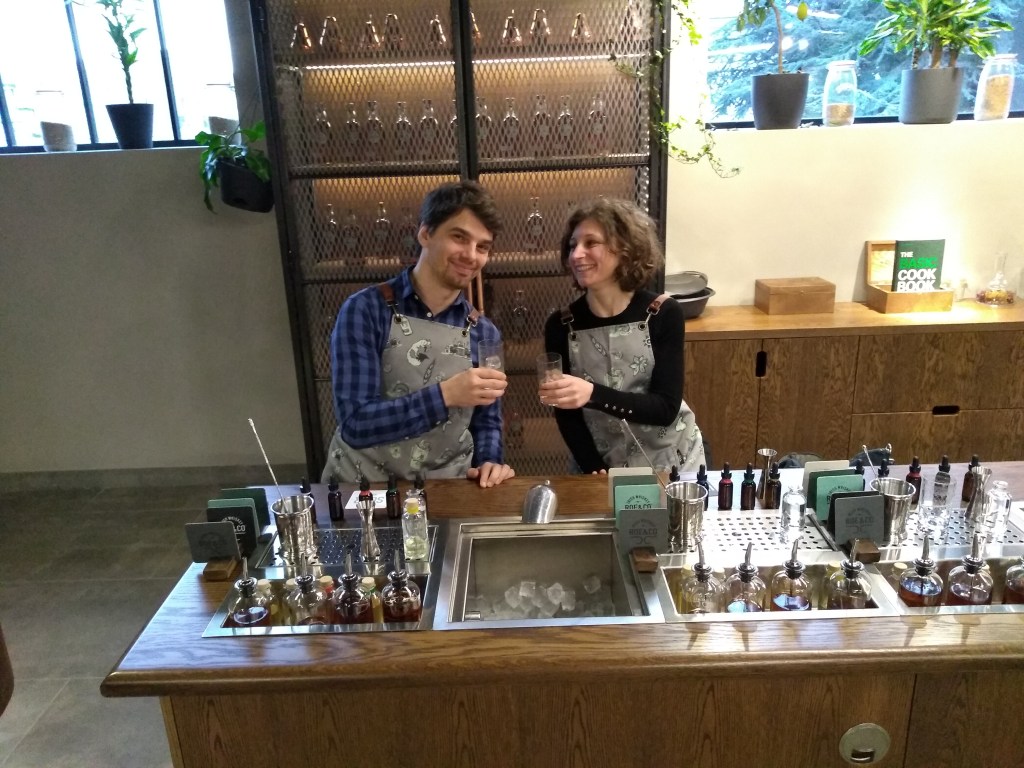
Afterwards, we went to a blending room, where the guide gave us a brief but informative introduction to mixology before we mixed our own cocktails. While we are far from being whisk(e)y purists (once in a while we like a good whisk(e)y-based cocktail), weโ€™re not big fans of this โ€œwhisk(e)y as a mixerโ€ thing that has been pushed so much by big companies like Diageo. However, we have to say that this experience was really interesting, definitely a plus of this tour.

Mixology newbies.

Finally, at the bar we had a sip of the Roe & Co whiskey, a blend made with malt and grain whiskeys from undisclosed Irish distilleries: a nice dram (45%, not-chill filtered, NAS). We also tried an ex-Port cask finished Roe & Co, another blend (if we recall correctly), a bit more robust, but we couldnโ€™t get it because we had no checked luggage. Oh well.

We felt this trip to Dublin was just a first, tiny taste of the Irish whiskey wolrd, and indeed we were left more curious than when we had arrived. Since then, we have tried some very interesting expressions, and itโ€™s nice to see the Irish whiskey scene being revamped. For more about this, stay tuned until next week, Slรกinte!


Jameson Bow St. Whiskey Experience
Link: https://www.jamesonwhiskey.com/en-gb/visit-our-distilleries/jameson-bow-street-distillery-tour/

Teeling Distillery
Link: https://www.teelingwhiskey.com/

Roe & Co. Distillery
Link: https://www.roeandcowhiskey.com/


#20.3 Feast on the East


Back to a traditional experience: Cragganmore


TL;DR: The last distillery in this trip was Cragganmore, producing a malt we were not too familiar with. It was the most traditional whisky experience of the weekend, of course in a good way. We just wish theyโ€™d improve the whisky presentation and move away from the 40% and chill-filtering, to allow this good dram to fully express! 

(missed Part 1/Part 2?)

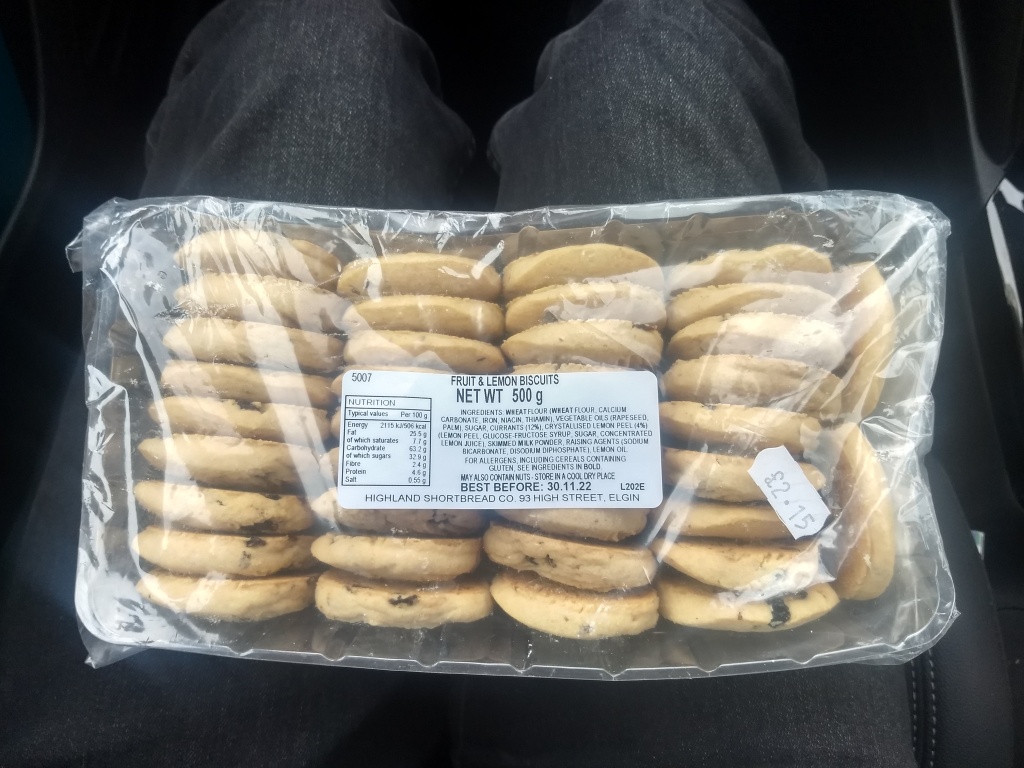
After the visit to Macallan, we were almost bamboozled by being back in the daylight. We drove to Aberlour and had a soup and a coffee at the Gatherโ€™n Cafe, officially our go-to place when we are in the area. We also sneaked in the Walkerโ€™s cookies shop a few meters down the road, another one of our must-go in the village.

These didn’t last long!

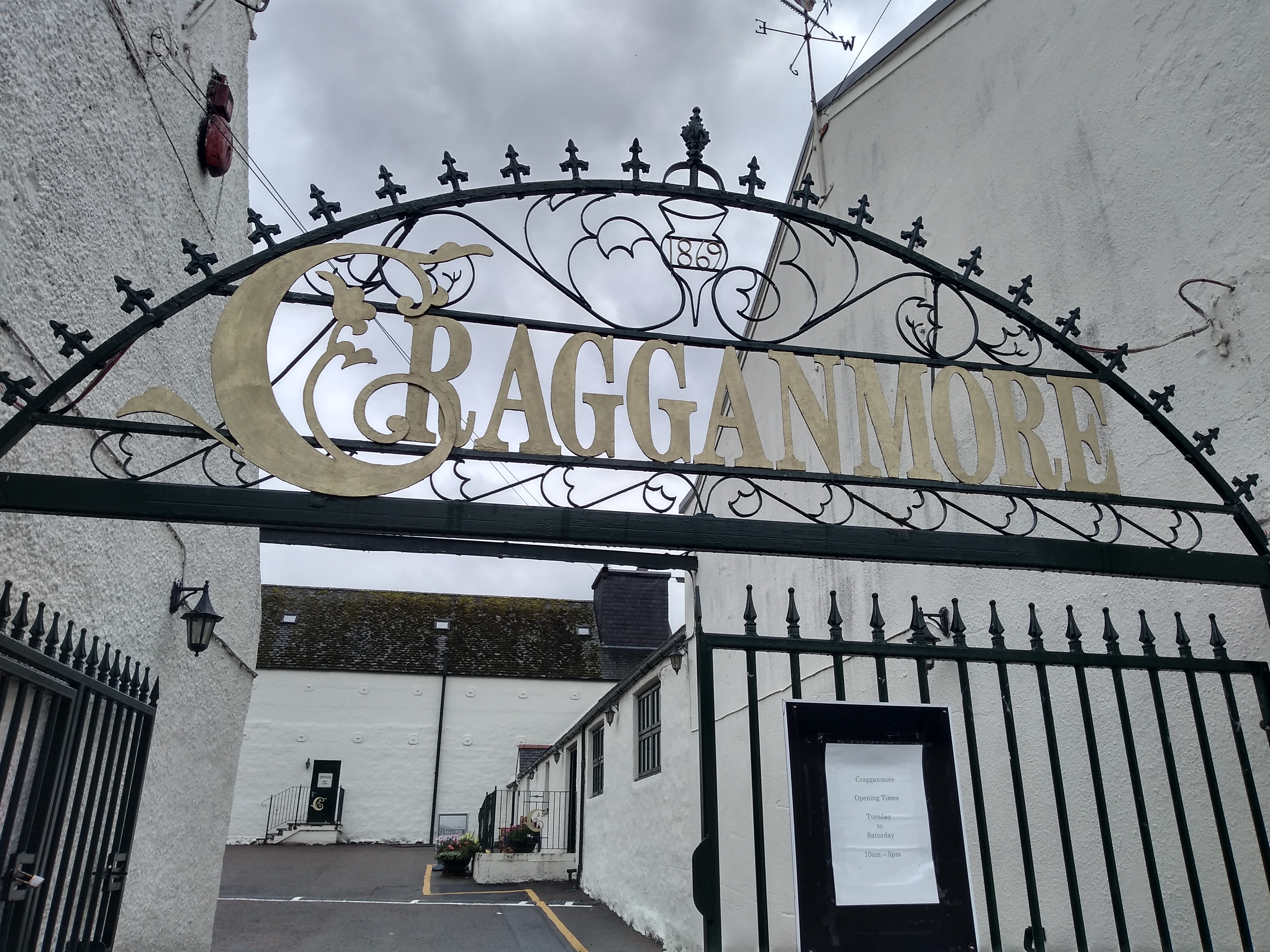
Back to the car, we drove directly to Cragganmore distillery, in Ballindalloch. Unlike Tormore, or the new Cairns (which we spotted several times just driving around Speyside), Cragganmore is quite hidden in a narrow valleyโ€ฆyou really want to be there to see it (well, not as much as Ncโ€™Nean!). It does make sense, however, that so many distilleries in Speyside popped up in such hidden places, given the history of distilling in the region, in particular pre-1823 (date of the Excise Act, for more info check out the dedicated episode of the Liquid Antiquarian on YouTube).

Second distillery of the day, of course we’re happy!

We didnโ€™t know what to expect: Cragganmore is one of those many drams we came in contact with after the beginning of our whisk(e)y journey, when we were already members of the SMWS and had already visited a few distilleries. Because of this, and because of its 40% presentation (and itโ€™s probably artificially coloured and chill-filtered) we never got into it, we had just tried it once or maybe twice in bars. Well, itโ€™s kind of nice to discover a new whisky, isnโ€™t it?

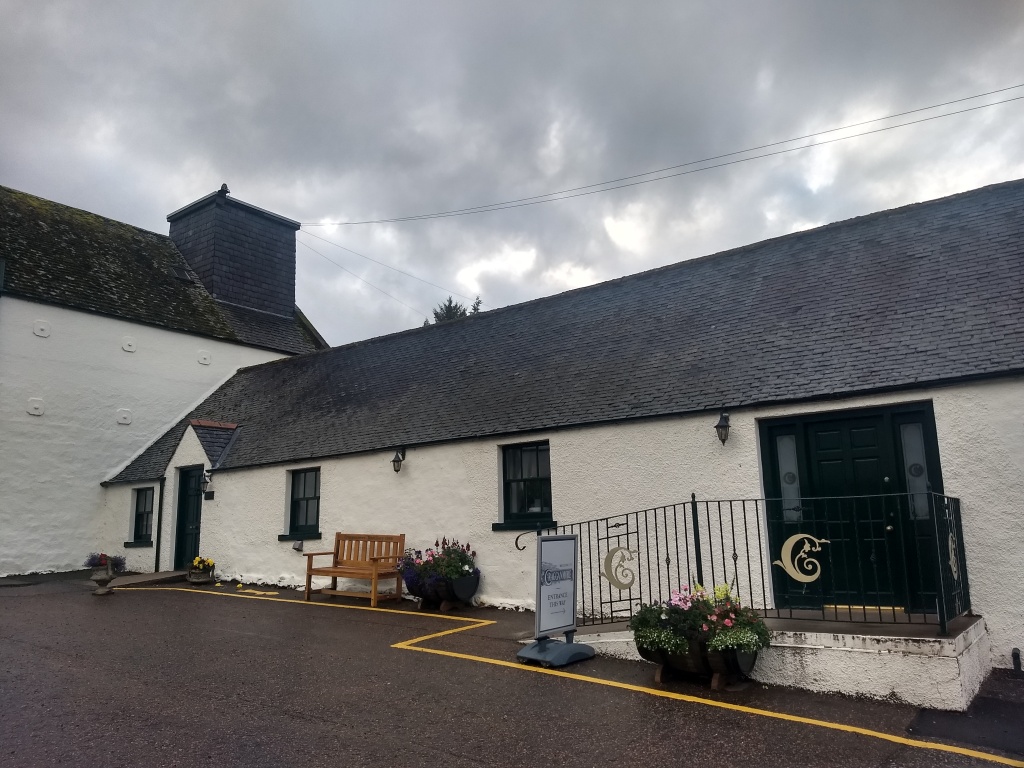
We arrived at the distillery 10 minutes before the tour start, so we took a look around to admire old-style buildings. The visitor centre didnโ€™t go through much renovation (unlike other Diageoโ€™s distilleries, like this and these two), just enough to make it pretty.

The wee visitor centre.

Albeit much smaller, it reminded us a bit of Lagavulinโ€™s one, as it mainly consists of a shop and a very cozy tasting room, with a fireplace, sofas and chairs. The tour we had booked is โ€œA Taste of Speysideโ€, and it is still the only available one (for the very reasonable price of ยฃ16, still at the time of writing). Our guide for the day was Gary, a former firefighter which instead of dully retiring, decided to work part-time at the visitor centre (something we observed a few times around distilleries). Anyway, we started the tour by gathering at the centre of the courtyard, and after the usual health and safety instructions, we moved to the production area.

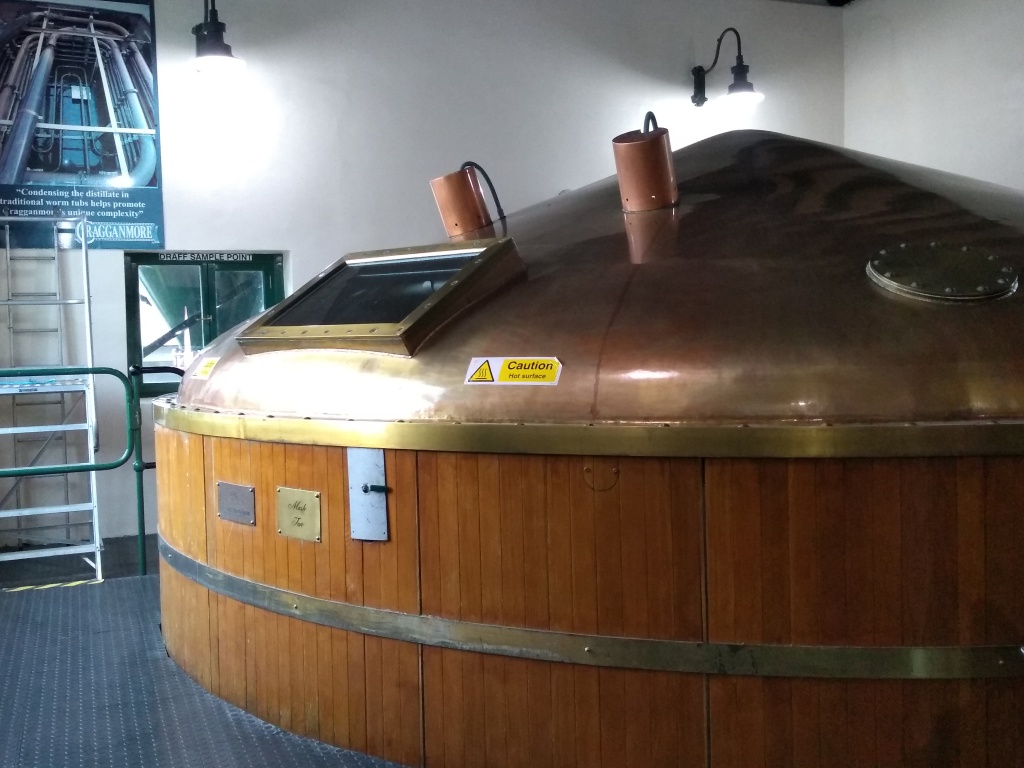
The mashtun.

As usual, we started from the milling room with its red Porteus mill (and as usual, we got told the story of Porteus company running out of business because their machines were too robust and never brokeโ€ฆ maybe at the time the evil programmed obsolescence was not a thing). We rapidly moved on to the copper-lidded mashtun and the washbacks, where the distiller on shift โ€œfishedโ€ a sample of fermented wash for us to see and smell (not drink, fortunately).

Too scared to drink it!

Before moving to the stillroom we could spot from the window the box containing the worm-tub condenser, one of the features of the distillery. The distiller came with us to the whisky safe, where the spirit from the 4 stills goes through and gets checked. There, he gave us a very detailed explanation of the distillation process. Although it is computerised now, the lever to start collecting the second distillation heart (from 68% to 62%, much lower than Macallan!) is still manualโ€ฆInteresting! We then moved outside to check the warehouse, only from the outside, unfortunately.

Partial (very partial) view of the still room.

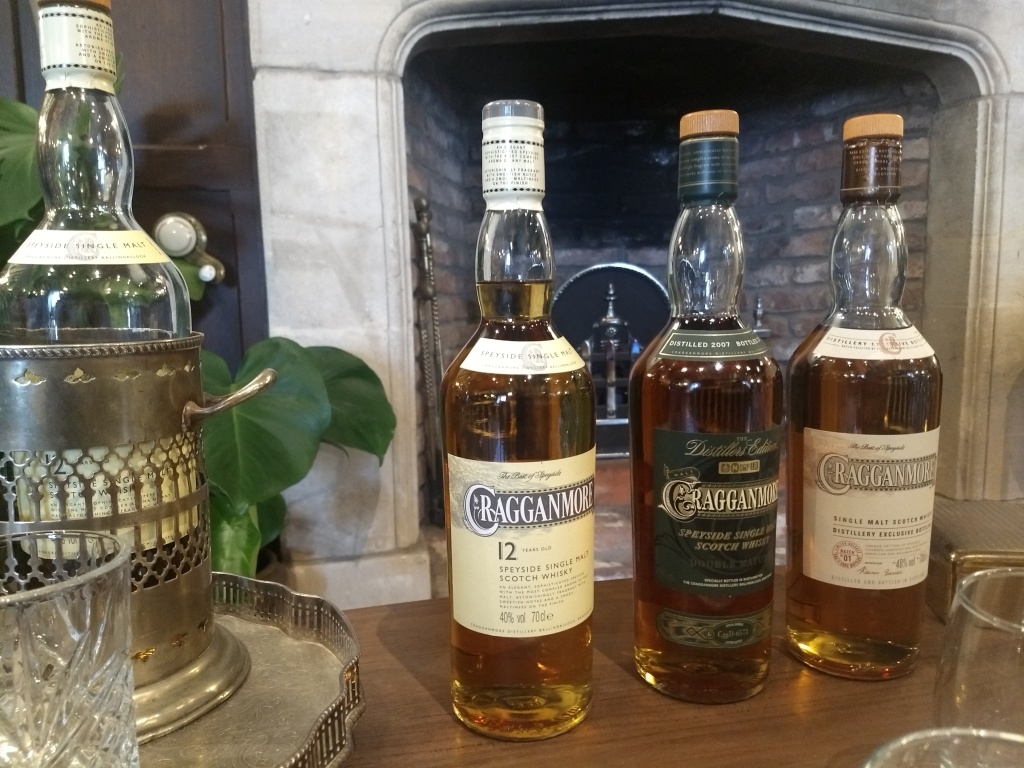
In the tasting room, three drams were already waiting for us, poured in tiny glasses: their flagship, Cragganmore 12, the Distillers Edition (commonly across Diageoโ€™s distillery, this is the same age of the main core release but finished in a different cask, ex-Port cask for Cragganmore), and the Distillery Edition (a more recent release quite common across all Diageo distilleries, usually a batch of few-thousand bottles non-age stated, bottled at 48% and priced between 85 and 100 quid, a bit pricey, but apparently casks are selected by the distillery personnel). The drams were quite nice, despite the watery presentations (in our opinion): a shame for such a potentially robust and rich of flavour malt. We even got something to include in a future tastingโ€ฆwe wonโ€™t say anything else, but stay tuned in 2023 for more!

Tasting by the fireplace.

Overall, it was a pleasant visit, and Gary was super nice as a tour guide, and of course him involving the distiller on shift was the cherry on top. Compared to the other distilleries we visited during the same trip this was the most traditional one, what probably youโ€™d expect when thinking of Scottish single malt distilleries. It was a very interesting comparison though, with Fettercairn being still old-style at core, but with a more modern visitor centre, and Arbikie and Macallan being definitely among the most modern we visited. We believe that this is reflected in the philosophy of the whisky production, and indeed Cragganmore feels very traditional, in every sense.

Until the next time, Slainte!


Cragganmore: A Taste of Speyside

Price: ยฃ16.00 pp (September 2022)

Duration: 1h

Tasting: 3 drams, Cragganmore 12y (40%), Distillers Edition (40%), Distillery Exclusive (NAS, 48%)

Value for money: good (10% off on anything in the shop if you attended the tour)

Highlights: the old-style distillery atmosphere

Target: anyone

Recommended: yes

Things we did not like: samples are super tiny (10ml? Definitely no more than 15)

Distillery only expressions: Distillery Exclusive (NAS, 48%), ยฃ85

Link: https://www.malts.com/en-gb/distilleries/cragganmore


#17.2 A first taste of Speyside

Walking and blending


TL;DR: The last two days of the trip were dedicated to less standard whisky experiences. First off, a walk through the village of Dufftown and its distilleries. On the last day, we did a blending experience at Strathisla, learning the hard way how difficult it is. Overall, definitely a great trip! 

(missed Part 1?)

The morning of the third day was quite open, so we went back to Aberlour, officially for a walk to the Linn waterfalls, behind the Aberlour distillery, but we sneaked in a second visit toโ€ฆno, not the distillery, to the Walkerโ€™s cookies shop! Just to pick up Christmas gifts for family and friends, and because Gianluigi loves cookies indeed! We had some take-away food from a local shop, before our afternoon activity: a walking tour of the 9 distilleries of Dufftown! If youโ€™re asking yourself why 9, just stick with usโ€ฆ

A cute meeting point for the walking tour.

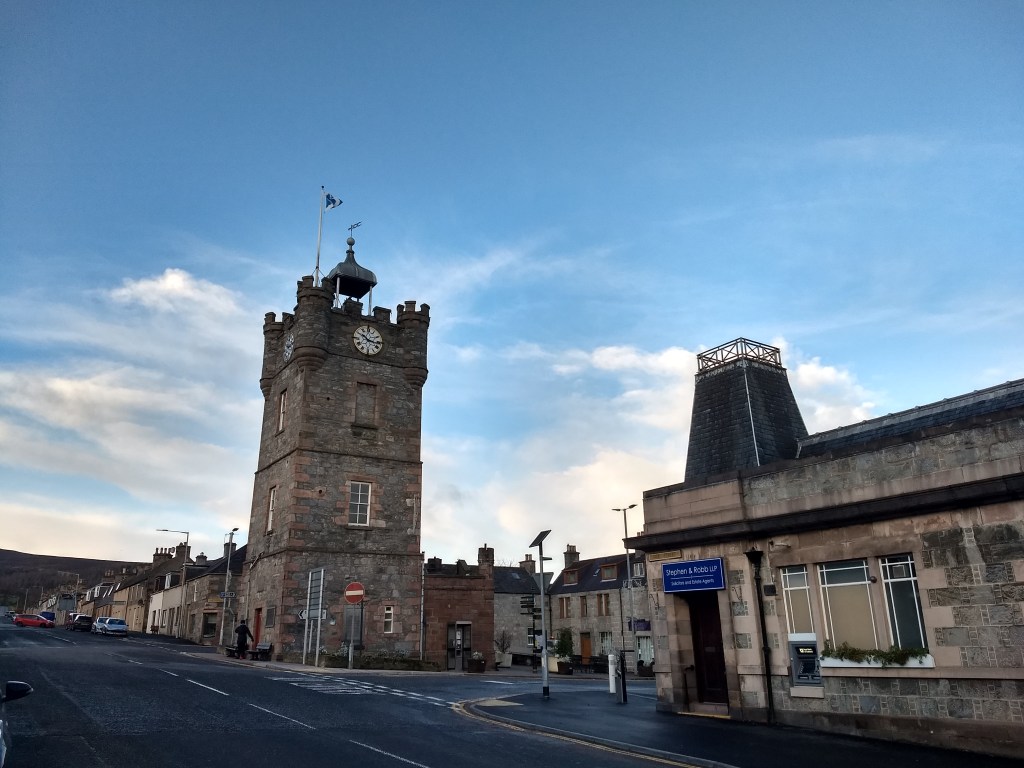
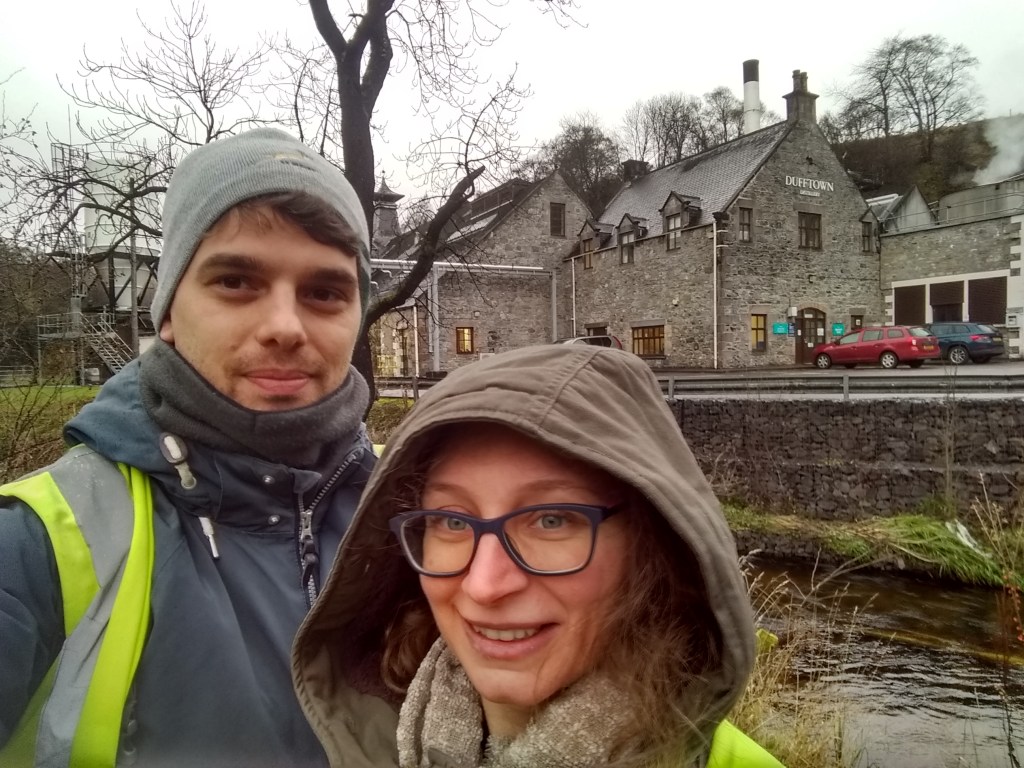
The tour was organized by Michelle, a local guide living in the village. We and another young couple met her at the clock tower. First, we walked towards her house, where she very professionally gave us a glencairn and a yellow vest: at the end of the day we were about to walk through a few whisky producing plants, most of them not open to visitors. To start with, we walked towards the site where the now demolished Pittyvaich distillery used to be (close to the Mortlach Parish Church). While looking at some of the old warehouses, Michelle poured a taste of a 25y Pittyvaich from a Diageo release. A bit down the road, we then stopped at Dufftown distillery, owned by Diageo.

Best shot at Dufftown distillery.

Thisย is one of the three distilleries making the Singleton (Singleton of Dufftown), sold mostly in the UK and Europe. Moving on with our tour, walking along the Dullan Water, we found the third distillery: Glendullan, another one from the Singleton series (this one distributed in North America, while the third one is from Glen Ord and is distributed in the Asian market). One exception was the House of Tully Singleton, part of the Game of Thrones range, which we had a taste of after a wee look at the still room. Next stop was a popular one, Mortlach, which we were very curious about for their quite complicated 2.71 distillation process. We saw their third still (from the outside), called the Wee Witchie, where the last 0.71 of the distillation happens (in our understanding, but not so sureโ€ฆ).

The beast of Dufftown and us.

In this case, the dram was a Gordon & MacPhail 25y from the distillery label range, paired with homemade shortbreads, which were fantastic! It took a bit to get to the next stop, this time walking along the Foiddich. During the walk Michelle showed us the building where another silent distillery was, Parkmore, closed too long ago to get a sip. We were already acquainted with the next working one, Glenfiddich, but not the next ones: Kininvie and Balvenie.

Balvenie, the beautiful.

Unfortunately, during this trip we hadnโ€™t managed to book the latter (although we caught up almost a couple of years later), so we were very curious to see it. As we walked past the malting floor, we saw smoke coming out of it, meaning it was working! Michelle was very excited as well, she had seen it only a dozen of times. We walked past Kininvie still room (the mashtun and washbacks are at Balvenie). The final distillery was another silent one, Convalmore, now used as warehouses. This is where Michelleโ€™s husband was waiting for us in a van to bring us back (it was quite dark at that stage). It was a great experience, a bit different from a regular distillery visit, definitely worth it! We ended up having dinner at the Commercial Hotel and, again, a couple of drams at the Seven Stills.


Sunday was the last day of our wee holiday. We had a very nice conversation with Linda and her partner, who drove us to Keith for the last whisky activity of the long weekend: Strathisla. The distillery looks very pretty, in particular as you walk in from the parking through the courtyard. Like Aberlour, it is owned by Chivas Brothers (a subsidiary of Pernod Ricard), and it is the core malt of one of their most popular brands, Chivas Regal. The 12 year old expression is present in almost all auntiesโ€™ and grandmothersโ€™ houses back in Italy too.

Iconic Strathisla.

For this tour, Teresa picked something different: the blending experience. So, after the tour of the distillery and the warehouses (where we had a dram of Chivas straight from the cask), we were guided to the blending room. It looked like a fancy version of a high school chemistry lab, with all the glass equipment, but instead of burners there were bottles of whisky. Our task was to create a blend of 5 whiskies: fruity (Strathisla), citrusy (Glen Keith), smoky (Allt Aโ€™Bhaine), creamy (Longmorn) and floral (Strathclyde, a grain whisky distilled in Glasgow). Of course, as we were making it, it was like: โ€œitโ€™s going to be super tastyโ€, but when a few months later we opened our 20cl souvenir bottle of our very own blends, it clearly was kind of crappy. Well, blending is more of an art, and the blenders job is definitely one of the hardest in the sector! Definitely a fun activity though, although we both agreed that one time was plenty.

As we came out, we had over an hour to wait at the Keith โ€œstationโ€ (a porch) for the train to Aberdeen. We couldnโ€™t really walk around because of the backpacks and the heavy rain, so we just sneaked in a walk to Glen Keith distillery, right in front of Strathisla.

Glen Keith distillery under the rain.

On the train back we came up with the idea of a whisky blog. It would have taken over a year to kickstart it, but this trip is the culprit! It substantially improved our knowledge and made us even more enthusiastic about scotch whisky. Speyside is one of those places where every time we visit, we say to each other: โ€œwe should get a house here”. This was the first trip to this magical region, with many more just about to come!

Until the next story, slainte!


Strathisla Distillery Tours
https://www.maltwhiskydistilleries.com/strathisla/

Michelle’s Dufftown Distilleries Walk
https://www.dufftown.co.uk/prov_attr_detail.php?id=153

(Because this trip happened almost 3 years ago, we are not compiling the distillery visit evaluation box.)


#14 A taste of Campbeltown

Dramming Around moves to Scotland

Our first whisky trip in Scotland: couldnโ€™t have been anywhere else!ย 

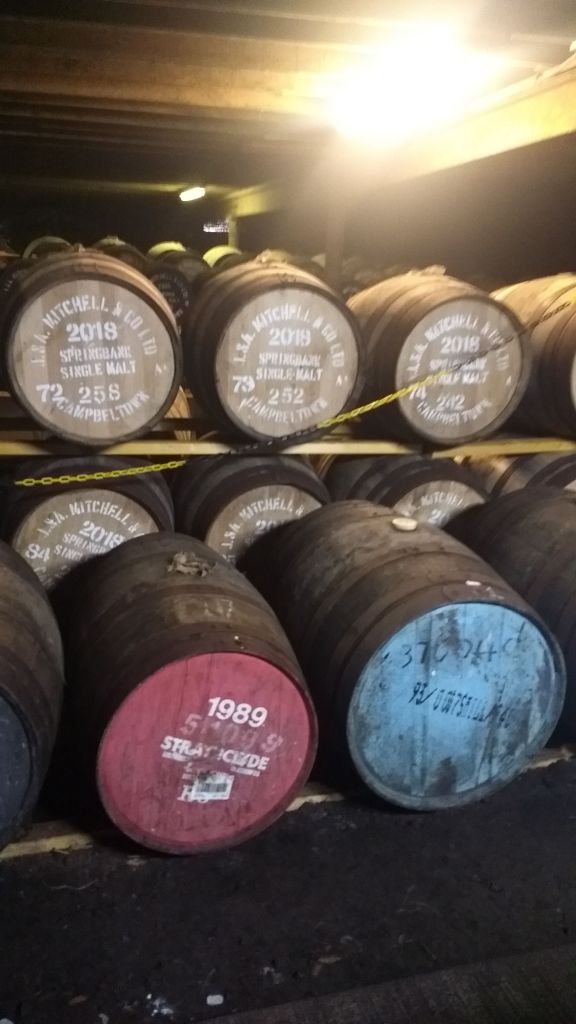
(For a more in depth Campbeltown experience go here: Cadenheadโ€™s Warehouse tasting, Kintyre Gin and Watt Whisky tastings, Springbank/Glengyle visits and Glen Scotia tasting)

September 2018, still the beginning of our life in Scotland: Gianluigi had moved about a year earlier, Teresa not even 4 months. We were coming out our first Fringe as Edinburghers (although someone would use another term), festival that we appreciated but despised at the same time, as the city can become very hard to live in August.

We wanted to have a weekend break somewhere, but for a few weeks we were stuck exploring options, undecided. Then a thought crossed our minds: why donโ€™t we go to that placeโ€ฆthe one that is a whisky region by itselfโ€ฆwhatโ€™s its nameโ€ฆCampbeltown!

As we used to do for our weekends away back in Illinois, we rented a car, and booked a random accommodation on Booking.com (at the time we were not aware of the Ardshiel Hotel), and the holiday was set! The program was very easy: travelling on Friday, Saturday in Campbeltown, and on Sunday weโ€™d visit Oban and travel back to Edinburgh. We had no idea what was expecting us! At the time we hadnโ€™t visited any distillery in Scotlandโ€ฆtogether: Gianluigi had visited Glengoyne as a side event of a conference he had attended a couple of months before in Glasgow. Unfortunately, the experience was far from great: too many people and one tiny dram.

So, when the day came, Teresa went to work in Glasgow as usual, while Gianluigi picked up the rental car and picked her up for lunch. We followed Teresaโ€™s colleagues suggestions and drove westward instead of north. So, we crossed the sea on ferries twice: first from Gourock to Dunoon, and after crossing the Argyll, from Portavadie to Tarbert, to finally drive down the Kintyre peninsula.

On our way to Campbeltown.

Even if this is not the most popular part of the West Coast, we found most landscapes truly beautiful, and particularly peaceful. We arrived at our hotel quite late, and Gianluigi had to finish off a bit of work. We hadnโ€™t realised how early restaurants were closing in Campbeltown, so we almost missed dinner time. Fortunately, a nearby restaurant allowed us in, at the condition we ordered quickly, which we did, as we were super-hungry (unfortunately, when we were back in 2021 we saw that itโ€™s closed). The night ended with a pint at the hotelโ€™s bar.

After a generous breakfast, we left the hotel to check out Campbeltown. The day wasnโ€™t great (overcast but not rainy), and we just walked around. Someone would describe the town as a bit run down, but to us the atmosphere was relaxing and cosy, almost intimate and melancholic, one that you can only find in far-away villages like this.

That tower bell looks familiar…

The first appointment of the morning was at Glen Scotia Distillery, but when we arrived, everything was closed. We waited a bit puzzled, checking emails and times meanwhile. Suddenly, a man came out of the production gate, asking if one of us was Gianluigi. He was one of the distillers, Archie, who told us that the designed guide was sick and couldnโ€™t give us the tour. However, if that was OK with us, Archie would be the guide for the two of us, although sometimes he would have needed to go check the stills. Moreover, the tour was free as an apology for the inconvenient. We couldnโ€™t believe our ears, of course it was OK with us!!! The tour was really in depth, and the fact that a distiller was our guide made it really invaluable. Even the tasting was very generous: a wee taste of the new-make spirit, then the Double Cask, the 15y, the Campbeltown Festival 2018 (finished in Ruby Port casks), and the Victoriana. Unfortunately, the shop was closed as well (the sick tour guide was running the shop too), so we bought something later at Cadenheadโ€™s.

The beauty of Glen Scotia still room.

After the tour, we had a quick but tasty bite at Cafรฉ Bluebell, and we then proceeded to the afternoon activity: the Cadenheadโ€™s Warehouse Tasting. At the time we werenโ€™t as nerdy as we are today, so we decided to skip the Springbank or Glengyle distillery tours in favour of a tasting: we werenโ€™t even aware of all the frenzy around Springbank yet. Moreover, at first, the concept of an independent bottler was not the easiest to grasp: why should a distillery sell its product to an intermediary? Now it is so obvious, and we are grateful for that: the variety of whisky that some independent bottlers can offer is truly astonishing, and without them we wouldnโ€™t be able to get our Miltonduffโ€™s, Glen Elginโ€™s, Glentauchersโ€™, Glen Speyโ€™s, Mannochmoreโ€™s, and all the other ones that are rarely bottled by their owners.

A relaxing landscape…

As a matter of fact, it didnโ€™t take long to appreciate the great work that Cadenheadโ€™s do. In the warehouse, a sizeable line-up of casks was waiting for us. We donโ€™t remember much, but in the bunch there were a Strathclyde grain (there are pictures), a Longrow 11y, a Paul John, definitely a speysider, someone said a Lagavulin (probably a Caol Ila) and a 10y rum from Darsa distillery, in Guatemala. We ended up taking the rum and the Longrow, but all the drams were truly delicious. Not surprisingly, weโ€™re in the Cadenheadโ€™s club now!

Old and new delicious stuff!

At the end of the tasting we were kind of tipsy (ehmโ€ฆ), so we decided to leave the bottles at the hotel and have dinner in the most far-away restaurant we could reach walking, on the other side of the harbour (which is now closed tooโ€ฆare we bringing bad luck??). We went back to the hotel, not before having an extra dram, the last one in Campbeltownโ€ฆfor now.


The Sunday morning was again overcast turning to rain, so we checked out and started driving south, towards the Mull of Kintyre (โ€œOh mist rolling in from the sea, my desire is always to be hereโ€โ€ฆ), to finish our exploration of the peninsula.

Slightly better weather on the way from Campbeltown to Oban!

Then we drove north, towards Oban, the last stop in our trip. Although the sun came out while driving, it started pouring rain as soon as we parked in Oban (experiencing the 4-season in day). Oban is a nice village but looked a bit too touristy for us (and indeed we havenโ€™t been back yet, unlike Campbeltown). The tour at the distillery was nice but a bit dull, probably it suffered in comparison to the previous day experiences. Still, it was interesting to see how this distillery, unlike many others, is nestled in the village, with no space for potential expansions. At the end of the tour we were given a dram of the flagship, the Oban 14y, and one of the Oban Little Bay. We ended up not buying anything, as even then we were aware that distillery prices sometimes are not competitive. We would have bought a bottle a few months later.

Oban right in the middle of the flavour map.

As a baptism into scotch distillery visiting, we couldnโ€™t ask for more: a magic place, and magic whisky. With the pandemic and all we werenโ€™t able to go back to Campbeltown for a while, so when we managed to do it in 2021, it was a very welcome return, with more whisky knowledge and experience in the pocket! Now it’s time to plan our third tripโ€ฆ 2023?


Links

Glen Scotia Distillery: https://www.glenscotia.com/
Cadenheadโ€™s: https://experience.cadenhead.scot/
Oban Distillery: https://www.malts.com/en-gb/distilleries/oban


#12.4 From Islay with love

A day around Kildalton Riviera

(Day 3)

Our last day on Islay ended with a visit to two iconic distilleries, and checking out the resurgence of another.ย 

(missed Day 2/Day 1/Prologue/Epilogue?)

The next morning we had an early start (well, โ€œearlyโ€ considering we were on holidays), and after a good breakfast we took the bus at around 8.15. We needed to cross the island to go to Port Ellen, and the next bus would have been too late (this gives a different perspective about Edinburghโ€™s public transport serviceโ€ฆ). The ride was in two steps, Bowmore first, just enough time to take a wee pic of the distillery gate, then Port Ellen. As it was early and wasnโ€™t raining, we snooped around the newly built Port Ellen distillery before walking to Laphroaig.

We then took the โ€œThree distilleries pathโ€, a walking/cycling path from Port Ellen all the way to Ardbeg (which we didnโ€™t reach, this time). As we were walking along the building site of the Portintruan distillery (the Elixir Distillersโ€™ one) we wondered if they will rename it the โ€œFour distilleries pathโ€โ€ฆ

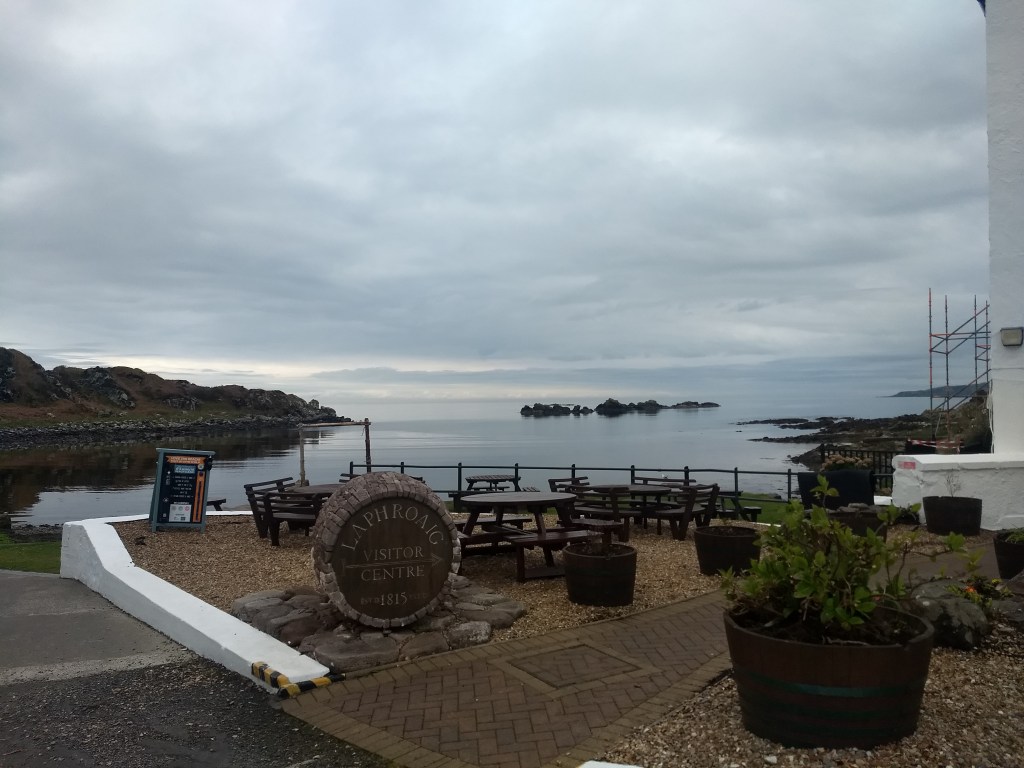
We were super-excited about visiting Laphroaig: it is one of the first malts we remember having and buying, a few years back, and its peat was one of the things that hooked us up to single malt. Even now, despite not connecting with all expressions, it still has a special place. The distillery layout looked very old, with the visitor centre door right next to a beach – really pretty.

When we checked in, we found out that the coffee is complimentary, hurray!!! Our guide was Caroline, and the tour obviously started from the malting floors, where they malt about 10% of their barley, and the kiln, where some of their magic (ie peat) was laying around.

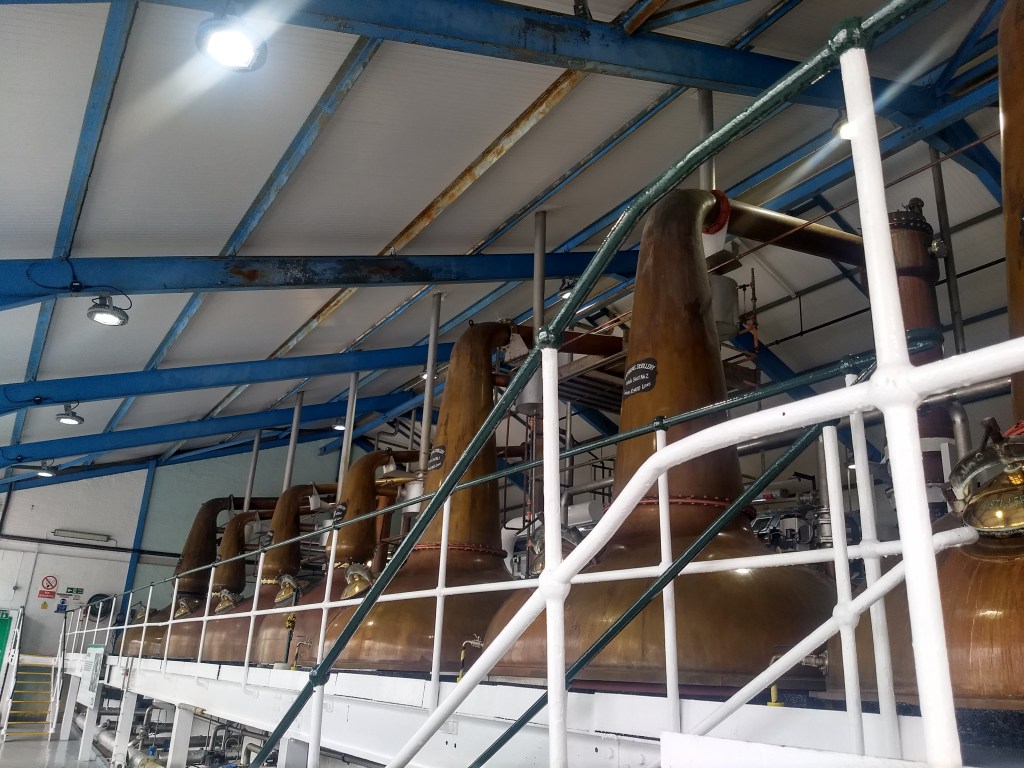
The tour went through the rest of production, up to the still room, in a separate building. One of the 7 stills is definitely bigger than the others, but we were told that all the spirit produced is mixed together anyway (also the spirit produced with the sourced and their own malted barley is mixed).

In the courtyard, Caroline told us that most barrels are from Makers Mark bourbon distillery, in Kentucky, an old acquaintance of us. Another signature is the use of quarter casks, still made with American oak, but smaller in size and therefore imparting a stronger flavour to the whisky. Last stop before the tasting was the dunnage warehouse (where a tasting was going onโ€ฆhopefully weโ€™ll be able to catch that next time!) for a sneaky peak of their casks resting.

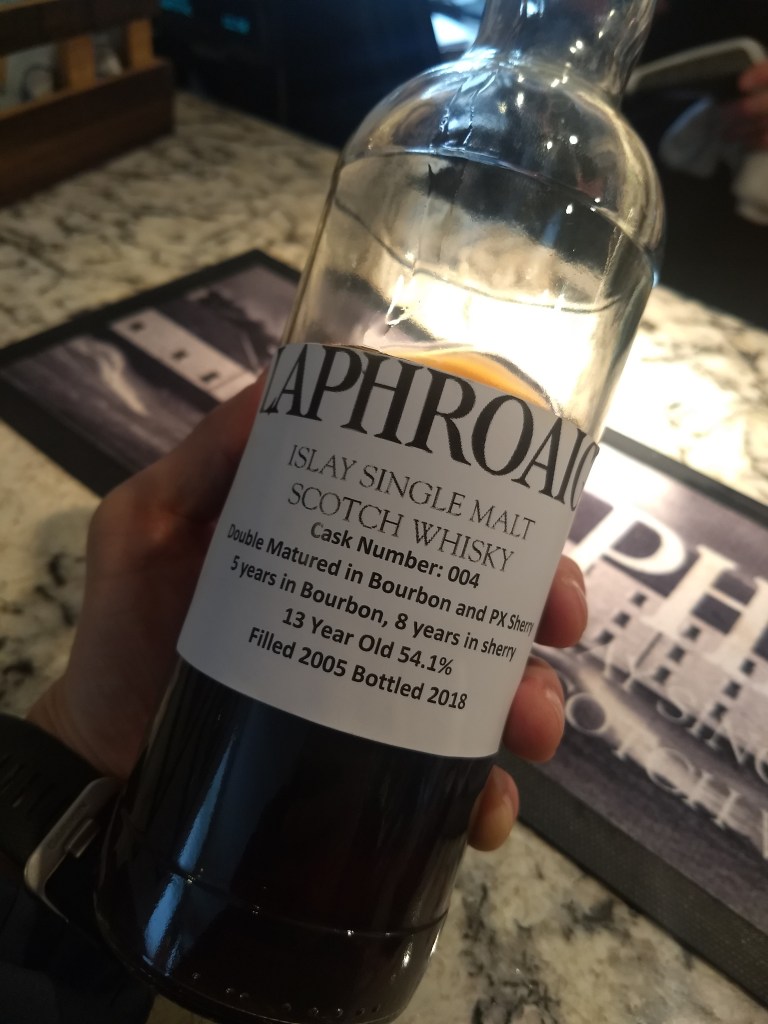
Back to the visitor centre, itโ€™s time for the tasting. Other than the lanyard and the wee glass, Caroline gave us three tokens each, which we could spend to get some of the available drams: 1 token for the regular Laphroaig 10 and the Select, 2 tokens for the 10y cask strength, etc. An opportunity to custom the tasting experience, we both thought this is very smart. We had 6 tokens between us, so we opted for the Lore (2 tokens, never tried before), the Quarter Cask (1 token, tried a long time before) and the Cairdeas 2021 bottling, finished in ex-PX casks (the only 3-token dram). At the bar, we had some light snacks and a dram from the warehouse tasting cask (the only available to try, not to buy), a 13y which spent 5y in an ex-bourbon and 8y in an ex-PX cask: really delicious!

Back on the Three distilleries path, our next and last stop was a very celebrated one (even in an American TV show): Lagavulin Distillery! Right next to the sea, and it didnโ€™t undergo any apparent rebuilding โ€“ really beautiful.

The interior is also very home-y (a friend suggested that it looks like a ship, which it definitely does!) and the shop is quite small compared to many other distilleries. Everything is there however: some distillery exclusives, some past Feis Ile and Jazz Festival bottlings, some limited releases and even the Caol Ila range (this being still closed for renovation). While waiting for the Warehouse tasting to start, we sat in a very cozy room, where among the things on display we saw a bottle of the last Malt Mill run. A guide came to pick us up (a big group of over 20 people!) and brought us to the warehouse, where Ian MacArthur was ready to start the tasting! He was very entertaining, making jokes and passing around some very tasty drams. At some point he also made some people sing, it was definitely one of our funniest tastings. The three samples from the casks were a 10y, a 12y and a 25y, all from refilled casks. This had great educational value, which allowed us to deeply appreciate the core of Lagavulin nature. The fourth was the 2021 Feis Ile bottling, 13y in ex-bourbon and finished for 5/6 months in white port, a type of finish that we encountered a couple of times recently and, so far, didnโ€™t disappoint. So, on paper the tasting was doneโ€ฆbut Ian moved on and gave us other two samples: the distillery exclusive, a NAS (a marriage of 8, 12 and 15/16y), bottled at 53.5%, and the 2018 Jazz Festival (marriage of 8, 12 and 25y, refill bourbon and sherry)โ€ฆwhat a flight of great drams!

This tasting really made clear that Diageo distilleries can actually provide great value and a great experience! Jokes aside, we had other good tastings, but this was truly an experience. At the bar we tried another few drams: the Caol Ila distillery exclusive (finished in wine, awesome!), the Lagavulin 9y Game of Thrones (compared to the first and only other time we tried it, we found it a bit dullโ€ฆ probably because of the comparison), and finally the 12y cask strength from Diageoโ€™s 2021 special release.

We left Lagavulin very happy on a bus towards Bowmore first, then to Port Askaig ferry terminal, ready (but not really) to go back to mainland. During the stop at Bowmore we had enough time to buy a disposable grill, so dinner was sorted. On the ferry we relaxed, and started to address the big elephant in the room: what to do with the campervan on the next morning.


Laphroaig Experience Tour

Price: ยฃ15.00 pp (April 2022)

Tasting: drams of choice with token systems, with wee glass and lanyard to take home. Options were: Select (40%), 10y (40%), Quarter Cask (48%), 10y Sherry Oak Finish (40%), Lore (48%), 10y Cask Strength Batch 011 (58.6%) and Cairdeas 2021 PX Casks (58.9%)

Target: casual tourists, whisky novices and enthusiasts

Value for money: Very good

Highlights: token system for drams, free coffee in the shop

Link: https://www.laphroaig.com/gb


Lagavulin Warehouse Experience

Price: ยฃ38.00 pp (April 2022)

Tasting: 10y (3rd fill European cask, 56%), 12y (2nd fill European cask, 51%), Feis Isle 2021 (13y + 5-6 months finish in white port, 56.1%), 25y (refill European cask, 52%), Distillery Exclusive (double maturation in ex-bourbon and recharred cask, 53.1%), Jazz Festival (2018)

Target: whisky enthusiasts and geeks

Value for money: Good

Distillery Exclusive: double maturation in ex-bourbon and recharred cask (53.1%)

Highlights: Iain, the bar and the relaxed atmosphere

Things we did not like: nothing really

Link: https://www.malts.com/en-row/distilleries/lagavulin

#9 A daytrip visit to Pitlochry: Blair Athol

Raindrops keep falling…in my dram


A rainy day trip to yet another Diageo workhorse distillery (and a wee rant about bottles pricing).

Over the last three years, we embraced the dry January tradition. After over a month in Italy, this year felt even more necessary to regenerate our livers for a few weeksโ€ฆand, as usual, they were the slowest of the year.
For this reason too we were particularly thrilled when we woke up on a rainy Sunday morning in February for our first distillery trip of the year! It was an old acquaintance of us: Blair Athol, in Pitlochry. We had already visited it in July 2019, although only for a tasting in their unique bar (a former copper mashtun IS the bar). Since then, we tried a number of Blair Athol expressions, mostly from the SMWS, and were never disappointed.
When planning the trip we were quite happy to realise that we could do it in a day using public transportation. The return bus ticket was less than ยฃ20 each, more environmentally friendly and way cheaper than going by car. Pitlochry is just about 1h and 40 minutes away from Edinburgh, and if it wasnโ€™t for a 15-20 minutes stop in Perth, the bus trip would have matched that duration.
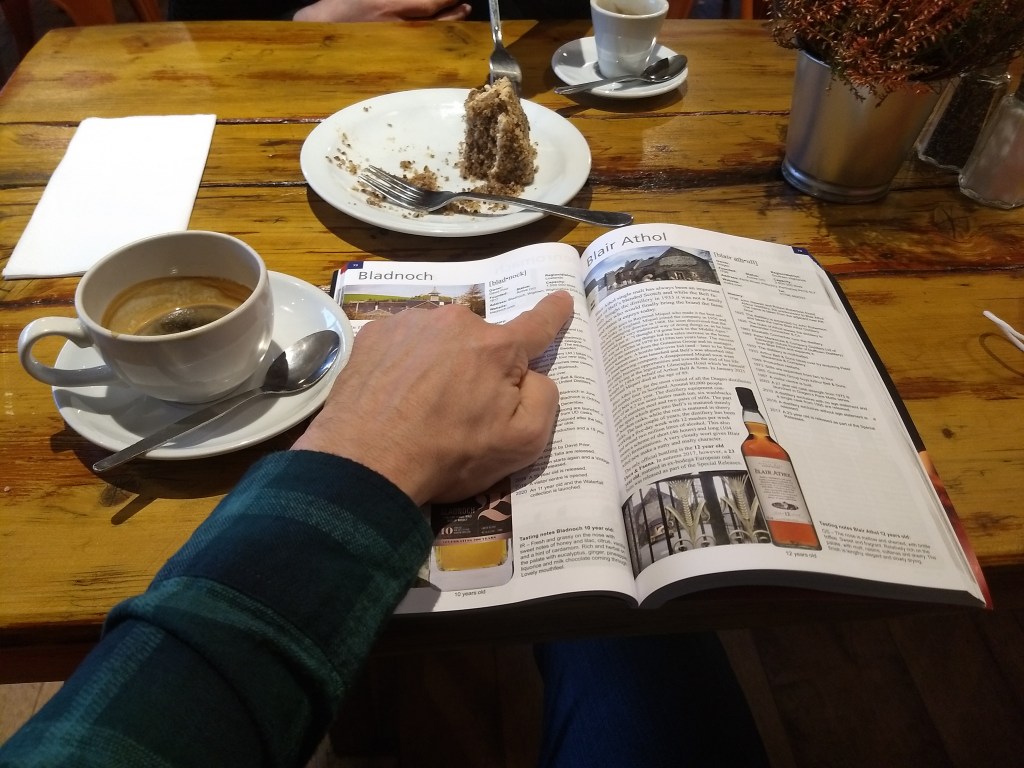
We woke up quite early and walked our way up the Leith Walk to the bus station, only stopping to grab a coffee and a roll at the Snax Cafรจ (W Register St), just a few minutes away from the station: the only one open at 7.30am on a Sunday (and probably the cheapest in the area). We canโ€™t say the bus ride was exactly smooth, as the table was vibrating so much that we couldnโ€™t leave our coffees on it until we hit the highway. But in a figurative sense, it was a smooth ride indeed. Once in Pitlochry, we had enough time for a second breakfast, espresso and (a very yummy) cake this time, in the very cosy Escape Route Cafรฉ, while hiding from the rain.

Feeding our minds…and our stomachs.

With an extra half-slice of cake in the stomach, we were definitely ready for the tour! Since we were here in 2019 the tours offer has changed a bit. When we booked there were three experiences available (at the time of writing they added a fourth: Blair Athol Cask and Cocktail experience, for ยฃ75): the Signature Tour (ยฃ16, โ€œguided distillery experienceโ€ with three drams), the Allt Dour Tour (ยฃ35) and the Managers Tasting Experience tour (ยฃ65). According to their webpage, the latter two included 6 drams, so we inquired about the difference and learned that while the Allt Dour Tour features a mix of Blair Athol and other Diageoโ€™s distilleries’ drams, the Managers Tasting Experience is an exclusively Blair Athol tasting, with two samples from casks and two distillery exclusives. We chose the latter, of course.

Ready? Ready!

Our tour guide was David, whose kindness didnโ€™t betray the fame Canadians have. Commonly to other distillery guides we met, he moved there when about to retire and decided to pick up a part-time job at the distillery. We both agree that it sounds like a very good plan.
As the tour started David told us that the 99.7% of Blair Athol single malt goes into blends, mostly Bellโ€™s. We knew it, but not to that extent. We were also surprised by how the production process is still very manual, in contrast with other Diageo workhorses such as Clynelish, mostly automated.

The still room.

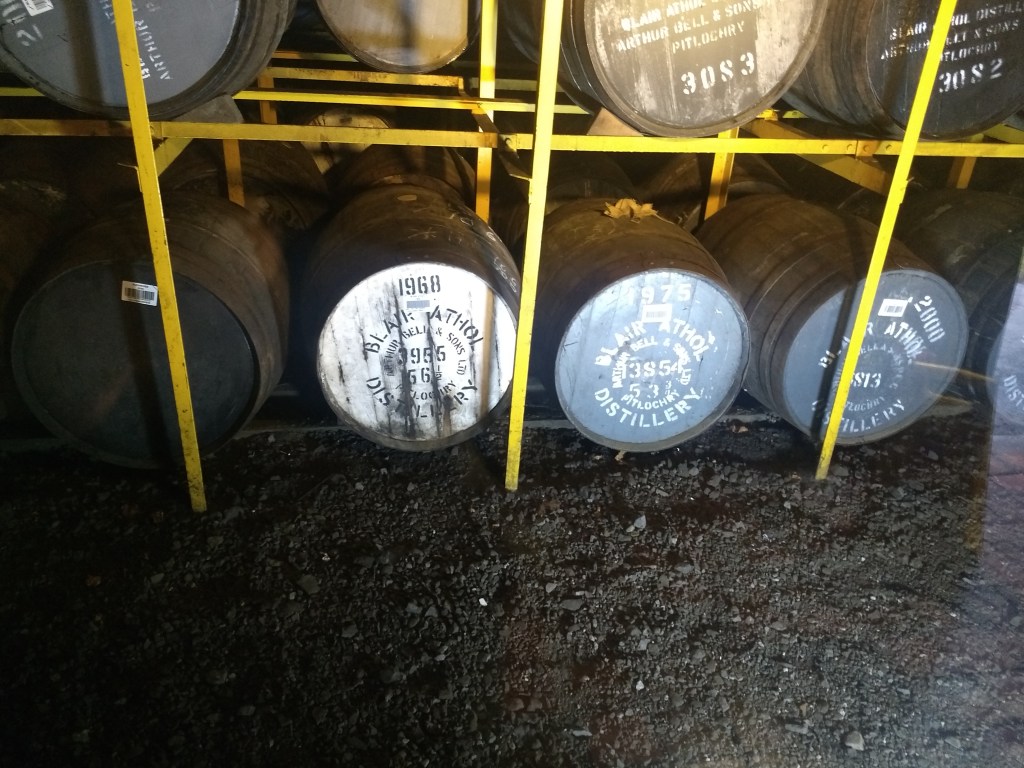
There is no filling room, as the new make spirit is loaded into tankers and put into casks at the main Diageo facilities near Alloa. We moved to one of the few dunnage warehouses they have on site, which keeps casks dating back to the 60sโ€ฆAwesome smell!

We felt younger in here.

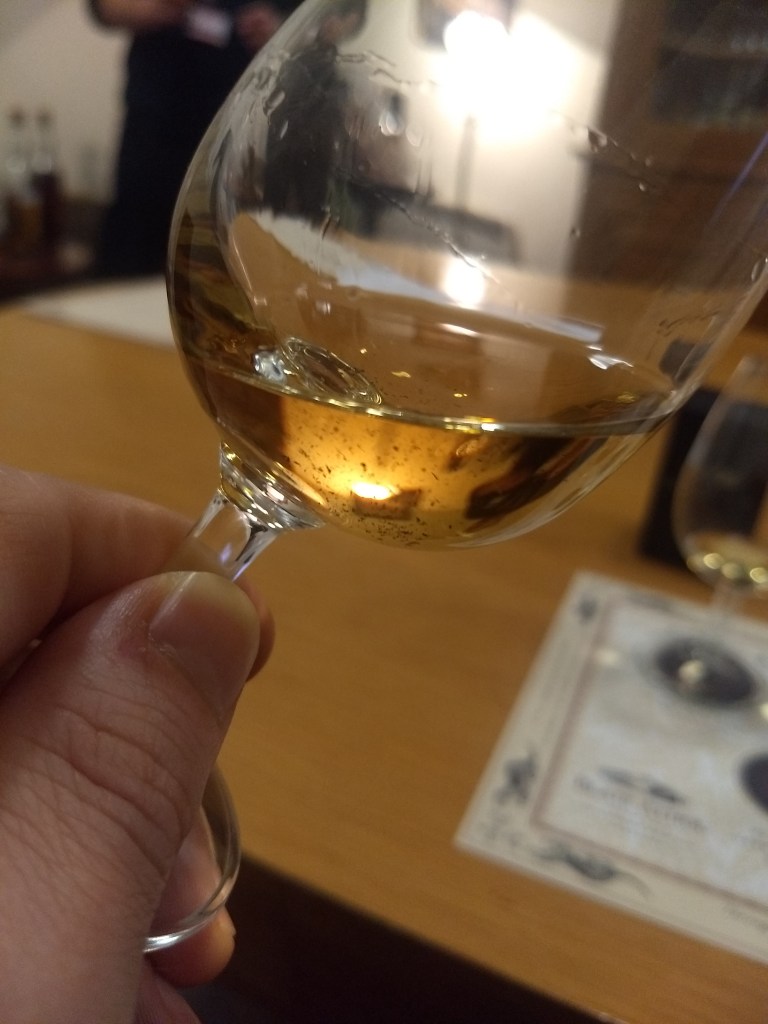
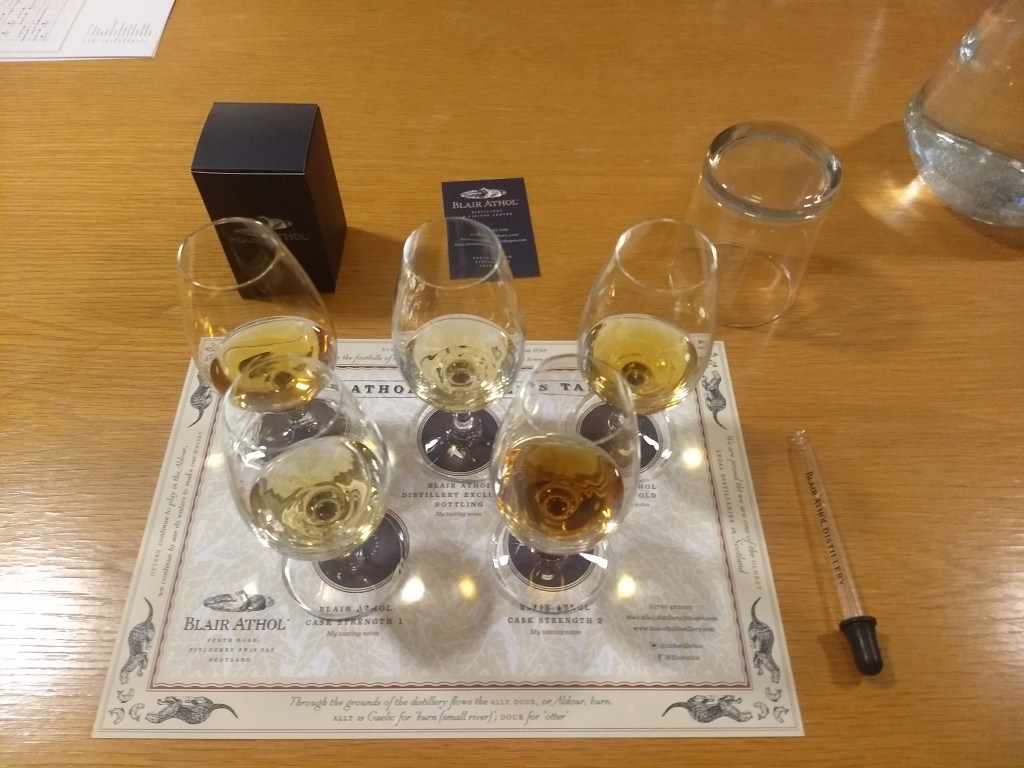
After the tour, we moved to a very small but cosy room accessible from the courtyard, where five drams were waiting for us. The first one was the Blair Athol 12y Flora and Fauna. We discovered that it comes from only first-fill ex-sherry casks and is not artificially coloured (which makes sense, given the former). We wondered why they donโ€™t put it on the label. The second dram was their Distillery Exclusive. The age is not stated, however it is a bit higher in abv (48%) and from โ€œrefill, rejuvenated and American oak ex-bourbon casksโ€. Very buttery and sweet dram, we thought more ex-bourbon casks than sherry ones were in the vatting. The third was a cracking dram: Blair Athol 23y (58.4%, 2017 special release, cracking price as well, unfortunately). Then, we had two samples from the cask, a 2009 vintage from an ex-bourbon barrel and a 1993 vintage from an ex-sherry butt.

Directly from the cask!

While both lovely, the bourbon was truly great, a shame it wasn’t for sale. Finally, David gave us a wee sample of the 11y bottle-your-own expression (56.2%, full maturation in ex-red wine casks)…Maybe it was the 6th dram, although the โ€œwe are gifting thisโ€ feel of it was not great since it was advertised on the website and in the email.

A quite nice tasting.

As the tour ended, we were conducted to the distillery shop. To be honest it felt a bit rushed, with most of our samples still in the glassโ€ฆFortunately we had empties with us.
We returned to the village to look for food, which we found (in good quantities) at the Old Mill Inn: the lamb Sunday roast was particularly tasty! The rain didnโ€™t stop however, so except for a wee walk up to the local church courtyard, we spent the rest of the afternoon in a pub, watching the England rugby team smashing Italy yet again.

Happiness before post-rugby depression.

The bus was perfectly on time and took us back home while we were happily sipping the leftovers from the tasting.

The glasses they gave us at the distillery turned out to be handy.

It was a nice experience to revisit a distillery we had seen in the early days of our whisky journey. The liquid did not disappoint, as well as the staff, nice and welcoming. However, here we need to have a bit of a rant about distillery bottle pricing and offering (***). Blair Athol is the fifth Diageo distillery we visited in the last year, the others being Clynelish, Ord, Lochnagar, and Cardhu. All of them had a Distillery Exclusive (all 48% and non-age statement), priced at ยฃ85 or ยฃ90. All except Ord, if we recall correctly, had a bottle-your-own expression: single cask, naturally presented, usually around 11-12y, in all cases ยฃ120. First, in our opinion, both distillery exclusive and bottle-your-own are overpriced. We are prepared and willing to pay a premium for special expressions and distillery exclusives, and we are also aware of the current pricesโ€™ madness. However, it needs to be somehow justified. 120 quids for a 11-12y naturally presented is quite steep, 30 quids above single cask expressions of similar age at other distilleries (Glenallachie or Auchentoshan). Furthermore, how is it possible that all these cask permutations come always at the same price? Talking about the Distillery Exclusive range, these are decently sized batches (6000 bottles), still non-age statement whisky and not cask-strength: how come they cost ยฃ85/90? As an example, the Glenlivet bottle-your-own, a small batch as well, came for a much lower price (ยฃ55 for the 12y, ยฃ70 for the 15y, both cask-strength). We find really hard to explain the logic behind prices, it looks almost like they want to take advantage of whisky enthusiasts, which is not great, in particular considering the very convenient price of the entry level expressions in their core ranges. We can see why new and independent distilleries would push prices a bit, but here we are at decades-old sites backed by a huge multinational company. It is a shame because, in spite of the nice visits we had at these distilleries, this left us a bitter taste, and we probably wonโ€™t rush to go back and check out new bottlings.


Blair Athol – The Managers Tasting Experience

Price: ยฃ65.00 pp (February 2022)

Tasting: 6 drams, BA 12y (F&F, 43%), BA Distillery Exclusive (see below), BA 23y 2017 special release, BA ex-bourbon cask sample, BA ex-sherry cask sample, BA Bottle your own (see below)

Target: whisky geeks

Value for money: a wee bit pricey

Highlights: the single cask drams

Things we did not like: the sampled drams not for sale, and see rant above (***)

Distillery exclusive: BA bottle-your-own (11y, ex-red wine cask, NC, NCF, 56.1%, ยฃ120) and BA Distillery Exclusive (NAS, 48%, ยฃ90)

Link: https://www.malts.com/en-gb/distilleries/blair-athol

NAS: non-age statement, NC: non-coloured, NCF: non-chill filtered


#2.1 A very Scottish summer holiday

A trip to Orkney Speyside et al.
(day 1)

Our first day of our supposed-to-be in Orkney holiday, but actually we went to Speyside. First stop: Royal Lochnagar! 

(Forward to Day 10 / Days 7-8-9 / Days 5-6 / Day 4 / Day 3 / Day 2)

Here we are, almost ready to start our summer holidays, after months of hard work! We decided to avoid unnecessary risks and to stay in Scotland, so despite our stock of Parmigiano Reggiano is finished, we decided not to travel back to Italy to visit our families. Instead, a destination we craved for long: Orkney! But thenโ€ฆPING!

Unfortunately, Gianluigi had a contact with a person who tested positive for Covid (who at the time forgot to get his jab…please trust an epidemiologist: go get it now if you haven’t done so yet!) and at the time the rule was still self-isolation for 10 days no matter what. So, the holiday is โ€œoot the windaeโ€ (including visits to Highland Park, Scapa, Wolfburn, and Pultneyโ€ฆ). However, we rapidly bounced back: we used the days in self-isolation to regroup, cancel all the reservations and make a new plan. We took advantage of a voucher for a campervan which we were supposed to use for a holiday on Islay last year (first victim of the pandemic) and we rented the vehicle for 10 days. Since Highland Park was fully booked for the period, we changed our destination: Speyside + โ€œletโ€™s see what we can fit inโ€.

The wee campervan.

We were very excited because itโ€™s our first trip with a campervan, which gave us a great freedom to travel around the country without being worried of not finding a room. We arrived at the rental place in Broxburn loaded like mules, and here we go!

After a quick stop in Perth for gas, a coffee and some groceries, we got to the Cairngorms, which is always a pleasure because of its spectacular landscape. We parked at the Balmoral Castle parking (where overnight stays are allowed and there is also a drinking water fountain), and we bet that by now you guessed which distillery we were heading to: Royal Lochnagar!

The Cairngorms in a typical Scottish summer day.

The distillery was built in 1845, after two previous establishments were burned to the ground, and it gained the Royal Warrant after a visit of Queen Victoria in 1848. Today itโ€™s the smallest in the huge Diageo portfolio, with a capacity of just 500,000 mlpa and, unlike others we recently visited, itโ€™s completely manual. We arrived there after a 20-minute walk, the distillery is made by a bunch of lovely stone buildings, almost hidden in a very picturesque landscape.

The tour started in the former mill room, since today they get the barley already milled. The guide Cara was knowledgeable and although sometimes we felt she was sticking to a script, she was able to sneak in some quite funny jokes. The tour moved swiftly to the next stages of production: mashing, fermentation (two wooden washbacks), and distillation: a magnificent couple of onion-shaped stills.

Teresa in awe in front of the Royal Lochnagar stills.

In the filling store we learn that the most used cask here is refill sherry butts, which (as you can guess) have been previously used by other Diageoโ€™s distilleries. They have around a thousand casks storage capacity on site, the rest goes to the warehouse up in Moray, at Glenlossie.

After briefly visiting the courtyard (btw, nice view of the worm-tub condenser from there), we went to a warehouse space for a sensorial experience: Cara made us dip a few pieces of paper into cask-strength whisky drams, each characterised by different cask or flavour profile, one was a Lagavulin). Unfortunately we could only nose those dramsโ€ฆ. But no big deal, as the tour ended with a tasting, which we could both enjoy since we had already parked (hurray!!!).

The old malting floor..and, behind it, the Queen’s estate.

The first dram was their main core range expression, the Royal Lochnagar 12 year old (bottled at 40%). Second, their Distillery Exclusive (batch 1), which includes maturation in first fill European oak and refill sherry and bourbon casks (NAS, bottled at 48%). The last two drams were quite spectacular: the Selected Reserve, despite its 43% abv (NAS but apparently around 20y) and the 175th Anniversary edition, a 17y cask strength (56.3%). Unfortunately, the last two bottles were well above our budget (between ยฃ170 and 250), as well as the โ€œbottle your ownโ€ (a 14y, 54.9% for ยฃ150), so we decided to get the Distillery Exclusive (ยฃ90)โ€ฆand as a travel dram (or โ€œsacrificial whiskyโ€, like two pals of our whisky group taught us) a bottle of the 12y: with the 10% discount it was quite convenient.

A great final tasting!

We slowly strolled back to the campervan, and we barely had time to cook some dinner before it started to rain cats and dogs. So, we took a dram of our other travel whisky, a young but quite tasty Miltonduff from the SMWSโ€ฆas an anticipation of what was waiting for us in that incredible region that is โ€œSpeysideโ€.


Royal Lochnagar Expressions Tour

Price: ยฃ17.50 pp (July 2021)

Tasting: 4 drams (12y, Distillery Exclusive, Selected Reserve and 175th Anniversary)

Target: both whisky novices and more experienced โ€˜drammersโ€™

Value for money: very good (also, it includes 10% discount on the Diageo range)

Highlights: the buildings and the sensorial experience

Things we did not like: nothing really

Link: https://www.malts.com/en-gb/distilleries/royal-lochnagar