
Back to the city:
Starward distillery
TL; DR: After driving back to Melbourne, we visited another distillery: Starward. It is one of the few Australian whiskies we’d tried before the trip, and the distillery is modern and dynamic. The tour was very informative, and they had a great range of drams to try at the bar. A nice visit!
(missed Part 3/Part 2/Part 1?)
The drive back from Kinglake was uneventful, although as we approached Melbourne roads were busy, which we didn’t expect on a Thursday early afternoon. Despite the traffic, we got back to our hotel in time to park the car, refresh ourselves at the hotel, and grab a cab to get to our next destination in Port Melbourne, south-west from the central business district: Starward, one of the most well-known distilleries in Victoria and Australia. Despite being in what looked like a mostly business area, it can be reached by bus (although we didn’t have enough time that day). From the outside the distillery looks like an industrial warehouse, its presence is only given away by some advertisement panels at the front, where the predominant colour is an electric purple-ish blue.
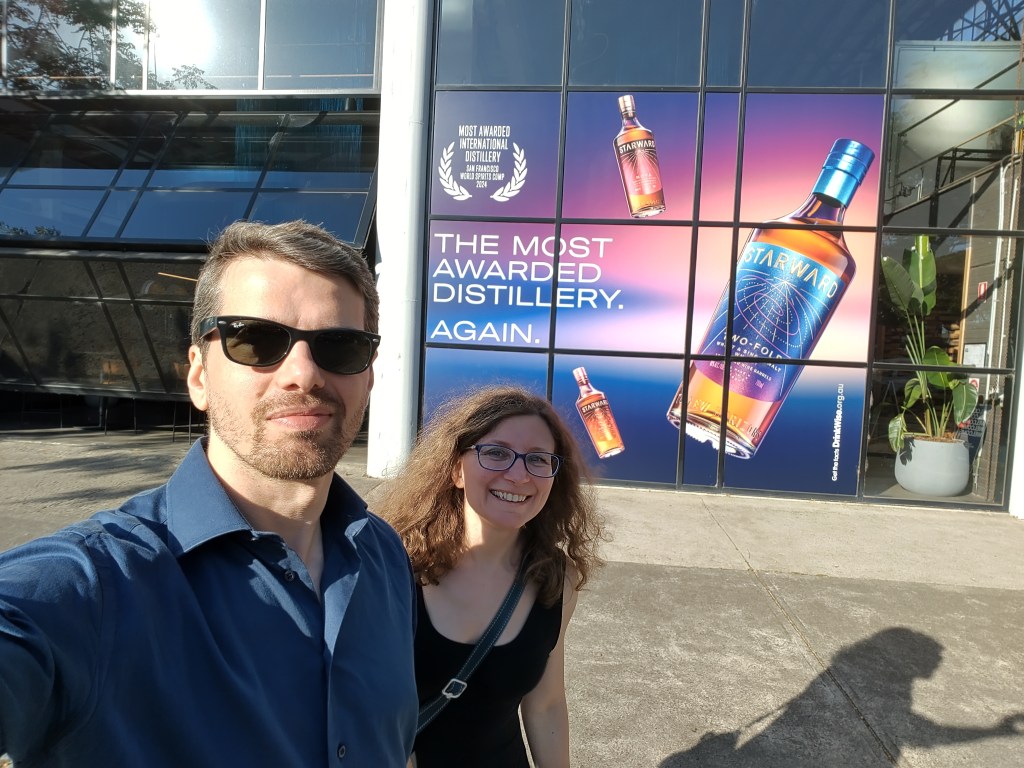
Refreshed and ready for round two.
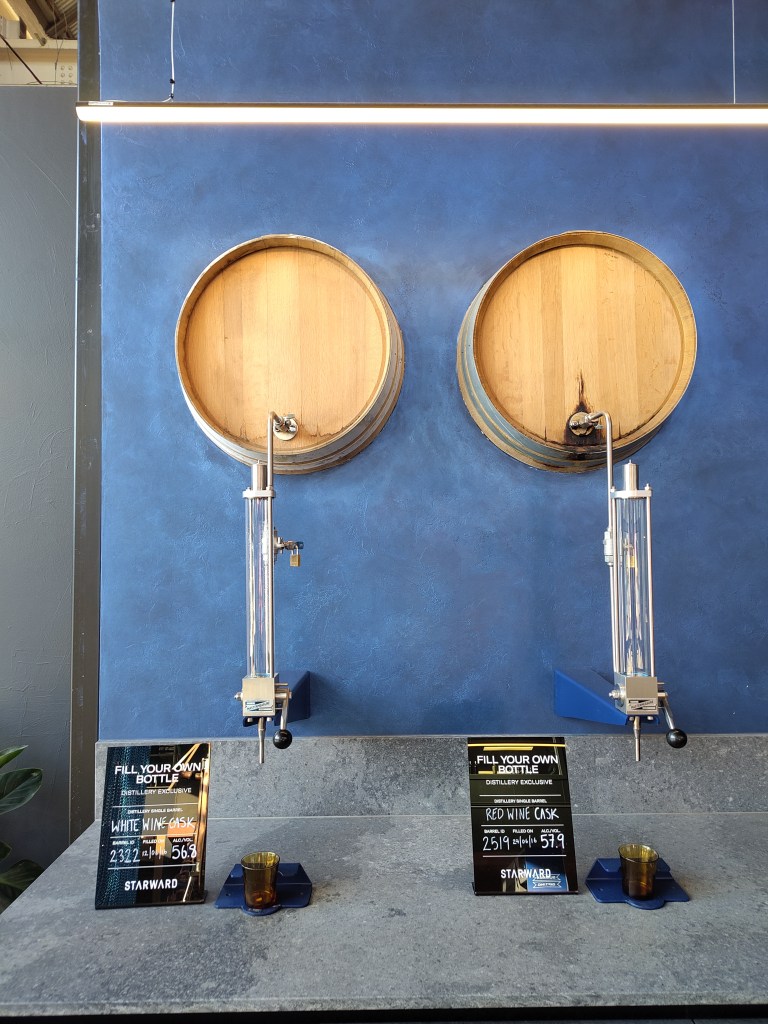
Inside the building, the blue is still the main colour: the space is very wide, with the shop right after the entrance, as well as one of the old stills. On the left side there is a long bar, showcasing two bottle-your-own casks: the price tag betrayed the Diageo’s involvement in the distillery ($250.00). The distillery production is past the hospitality area, which has both low tables and barrels used for tastings. In the 5-10 minutes before the tour started, we mostly checked out the shop, and the many expressions available for purchase.
Our guide for the day was Felix, who was very knowledgeable and promptly replied to all our questions. The first thing he asked us, though, was to leave our phones in a locker, for ‘safety’ and to avoid taking picture of production: a very weird company policy. Because of that, we don’t have any pictures of production, and we couldn’t take notes on our phones as we usually do. Instead, the day after we recorded everything in agent Cooper-style vocal messages while driving, to be used by our future selves rather than Diane.
The distillery was founded in the 2000s by David Vitale, who used to be a brewer: because of this, he was keen to maintain some brewing elements in his whisky. Thus, the malted barley they use is a pale ale malt from New South Wales. The malt is then mashed with water coming from Melbourne city aqueduct and, once done, put into one of the stainless steel washbacks. Here fermentation is kickstarted with a (secret) yeast recipe composed by mostly brewer and some distiller yeasts. It usually lasts five days, but it can go ahead to up to eight, continuing the trend of long fermentations we observed in this trip.
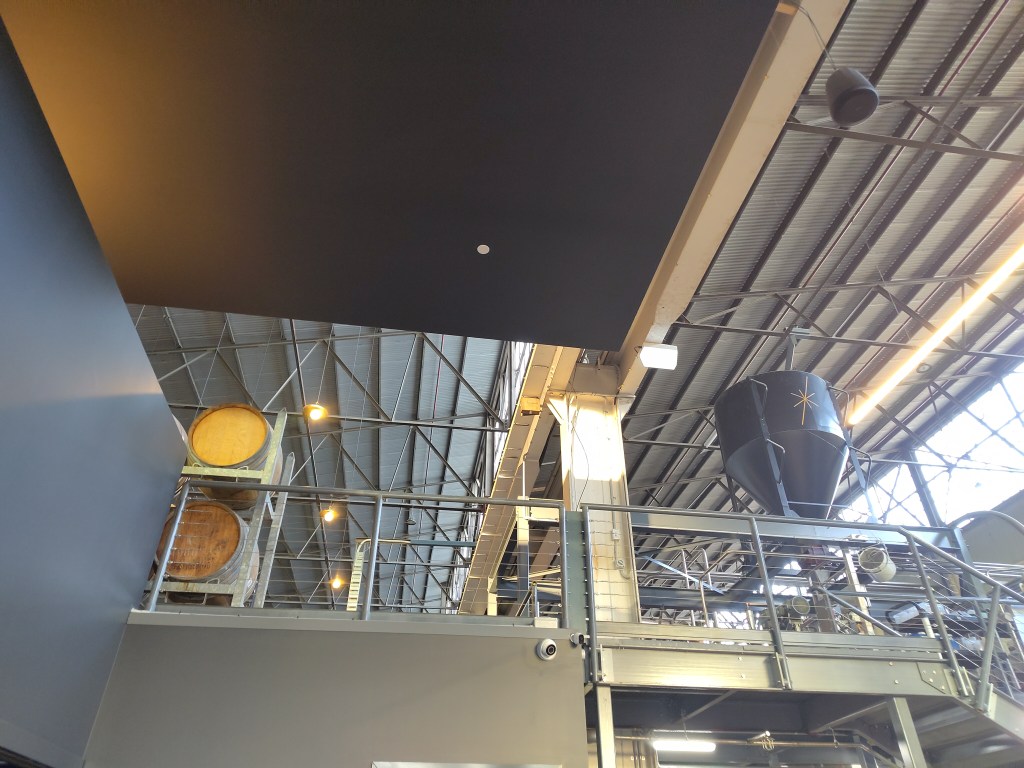
The only part of production we could see from the bar.
The spirit is double distilled in a pair of stills from the Italian maker Frilli (like Raasay and Teeling). The spirit still has a cooling jacket, to help regulate the temperature when the weather is too hot (it’d be harder to regulate the temperature of the entire massive open space). The spirit cut point is high, and for the newmake spirit they don’t use anything below the mid-sixties (64-67%), with the rest recycled as feints and mixed with the foreshots. The newmake spirit is then diluted to 55% before casks are filled. It is a lower abv compared to many distilleries, in particular in Scotland – this is because the climate causes the abv to increase while maturing, similarly to other distilleries in Australia, but also in other temperate areas like Kentucky.
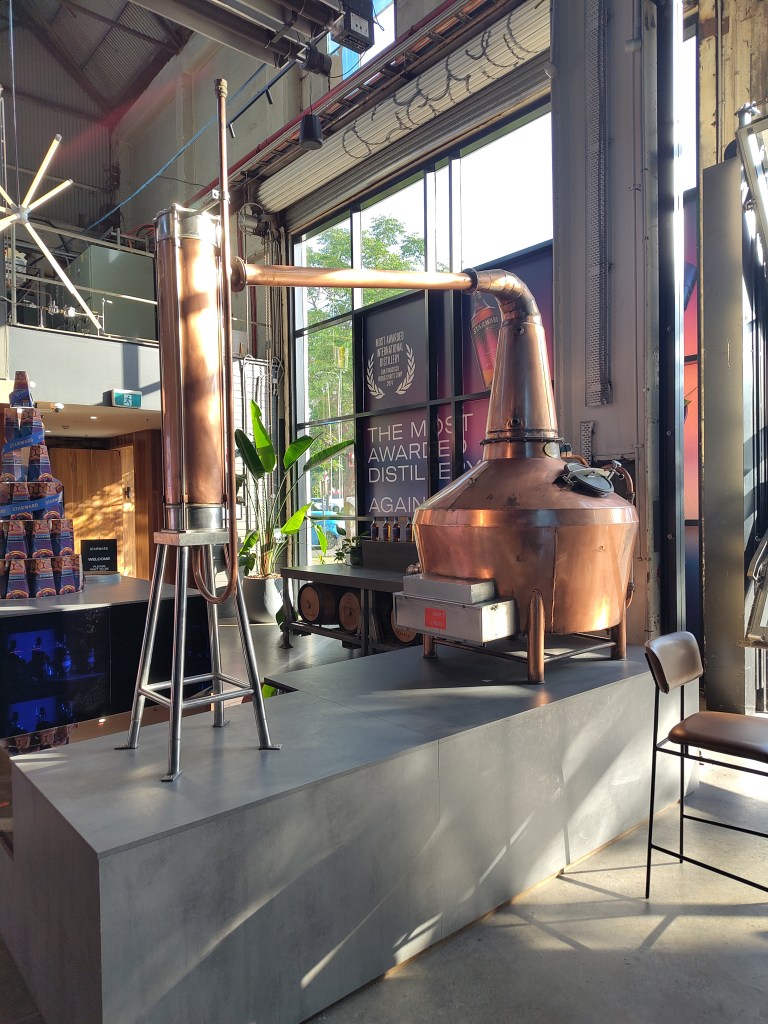
As we could not take pictures in the production area, you’ve got one of an old still.
Regarding the cask choice, they aimed for a distinctive Australian signature, thus they mature their core whiskies in ex-red wine casks, mostly French oak, but they also use some American oak barrique. The reason why they did not choose Australian fortified wines casks was that there are not enough to maintain a core range (they didn’t say, but probably another reason is that wine casks are cheaper, as reflected in the fair price of the entry expressions). So, they still use fortified wine casks, together with a variety of other casks, but mostly for small batches or single cask bottlings.

Not the greatest picture, but it gives an idea of the space.
After the tour of production, it was time for the tasting: Starward was one of the few Australian whiskies we’d tried before this trip. Specifically, we’d tried the Fortis, thanks to our subscription to Whisky Me. The tasting started with a blended whisky, the Two-Fold (they have another one, Honeycomb). For this blend of wheat and malted barley, they source the wheat newmake spirit from elsewhere, and they mature it on site. It’s a very basic offering, mostly marketed as a cocktail component, but we found it punchy above its weight, considering it is bottled at 40%, and unexpectedly oily. The second dram was the Nova, matured in ex-red wine casks (French oak) and bottled at 41%. It was our least favourite. Finally, we tried the 100 Proof (name coming from its abv of 50%, so American proof), matured in American oak ex-Pinot Noir casks: this one was delicious, with creamy and red fruits notes, and not too tannic (although, compared to the average single malt drinker, our tolerance for tannins is probably much higher…We “blame” our Italian upbringing).
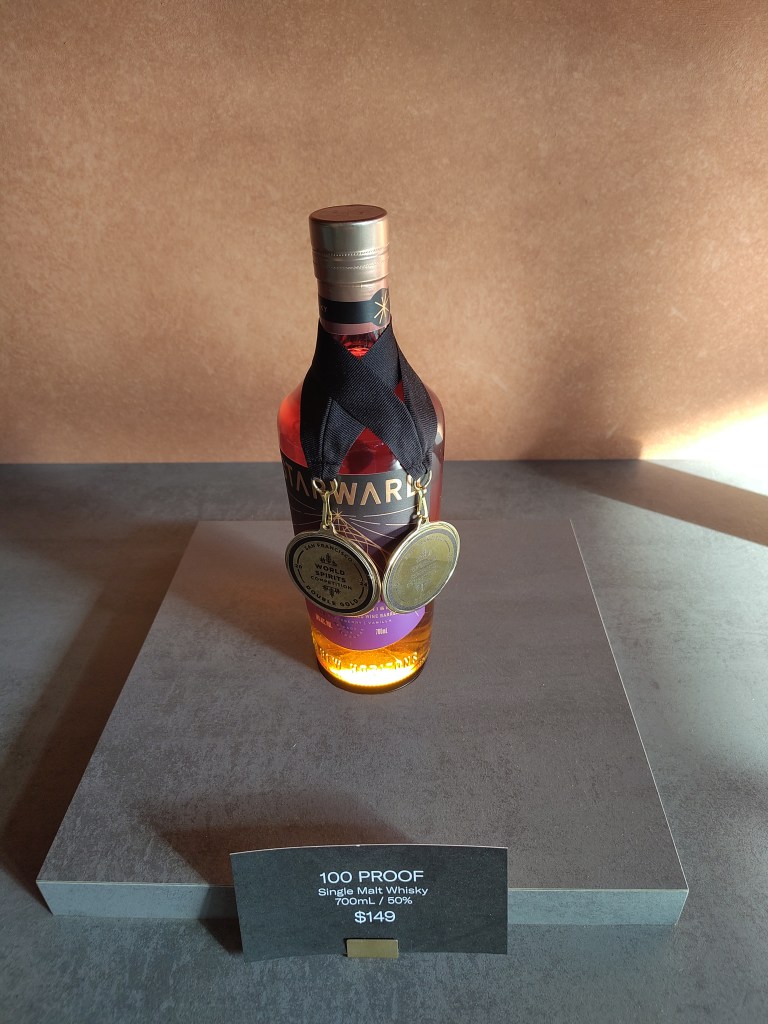
Our favourite of the tasting.
By the time the tasting ended their kitchen was closed, but we decided to stay at the bar anyway to try more expressions – not only bottlings available to purchase, but also curiosities and the odd ones. Here, we found the highest abv whisky we ever tried: 73.45%, first fill American oak red wine. Almost like chewing wood, but some water tamed it, and it was delicious. We also tried some of their peated cask finished whiskies, but not the Lagavulin edition whose price carried a premium: $199, compared to the $149 for another undisclosed Islay distillery, we’ll leave you to guess which (just remember who partially owns Starward…). The dram was good, but it didn’t blow our socks off. Another we tried was the Yering Station Pinot Noir finish (the same winery we’d visited that same morning). This one was tasty, but with a similar profile to the 100 Proof. We also tried the Munich malt whisky, the Botryties matured (Australian “sauternes”), the Shiraz octave cask finish, and finally, the one we liked the most: one matured in a single American oak barrel, previously holding red wine. Really delicious, a shame it wasn’t on sale.
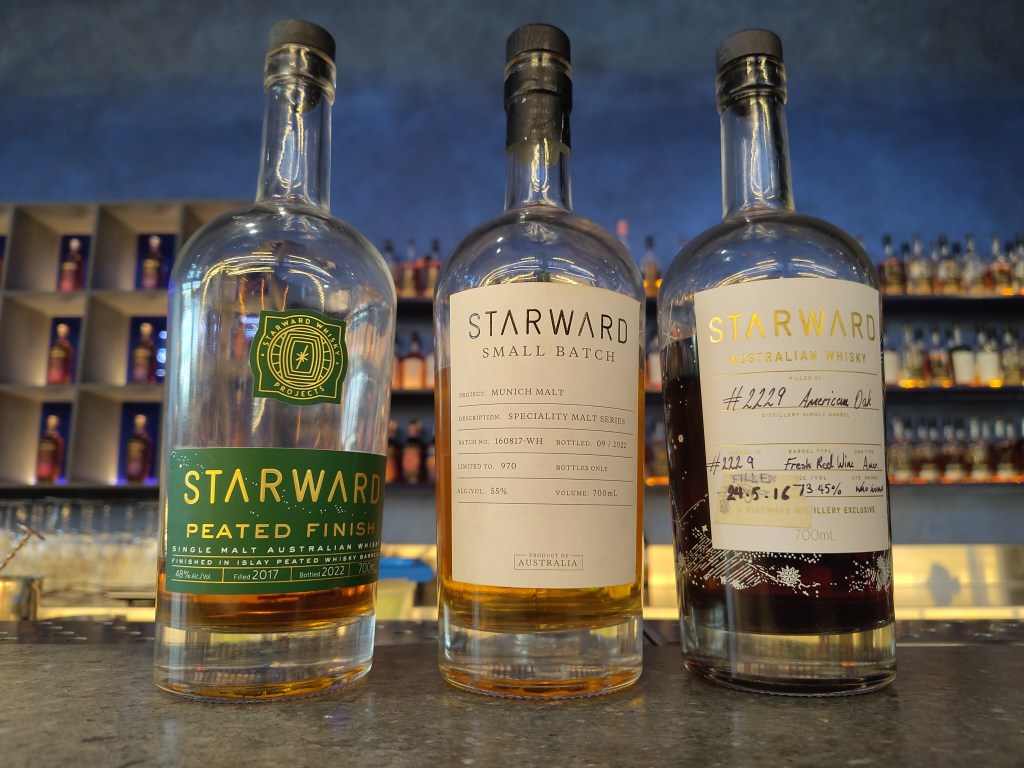
Our curiosity was satistied…
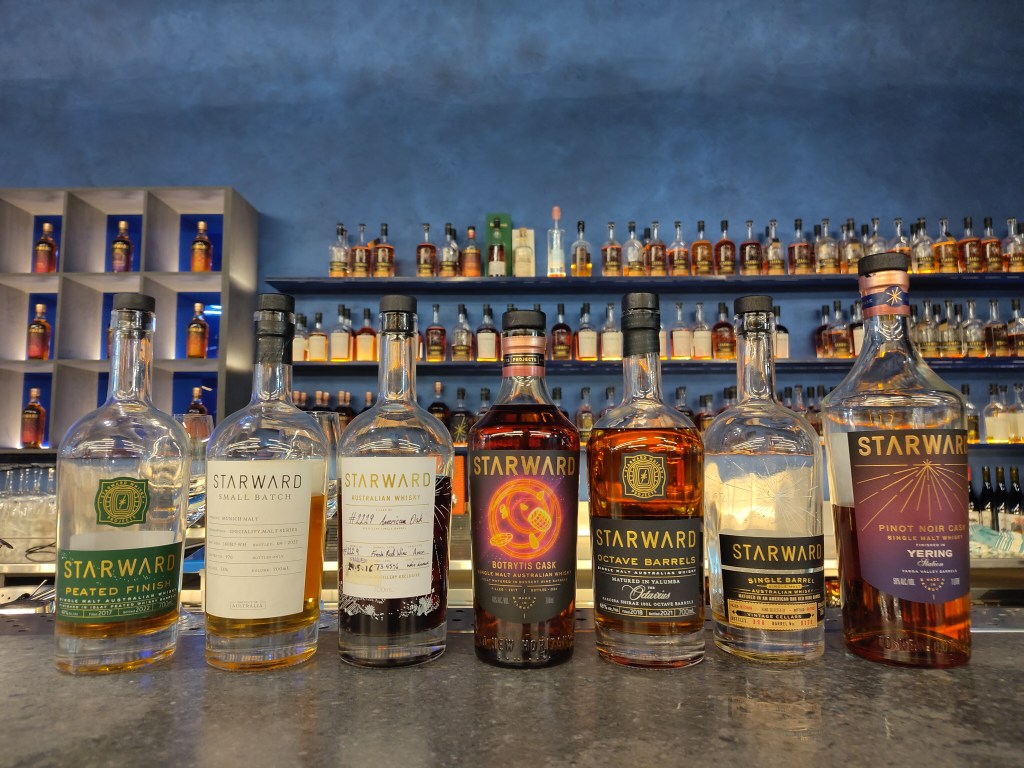
…More than satisfied.
Tasting those drams made us realise how, to our palate, Starward works best with American oak wine barrels. Overall, the quality of whisky was surprisingly good, and it was a very interesting tour (in spite of the awkward phone policy), and Felix a great guide. It was a shame we couldn’t do their Masterclass and Barrel Tasting ($160.00pp), but is runs only once a week on a Saturday, and it clashed with the rest of our plans.
After the drams, we needed some food: so we got a table at a nearby restaurant, the Railway Club Hotel, where we had one of the best beef steaks ever! After dinner, we took it easy and enjoyed a 40-minute walk back to our hotel.
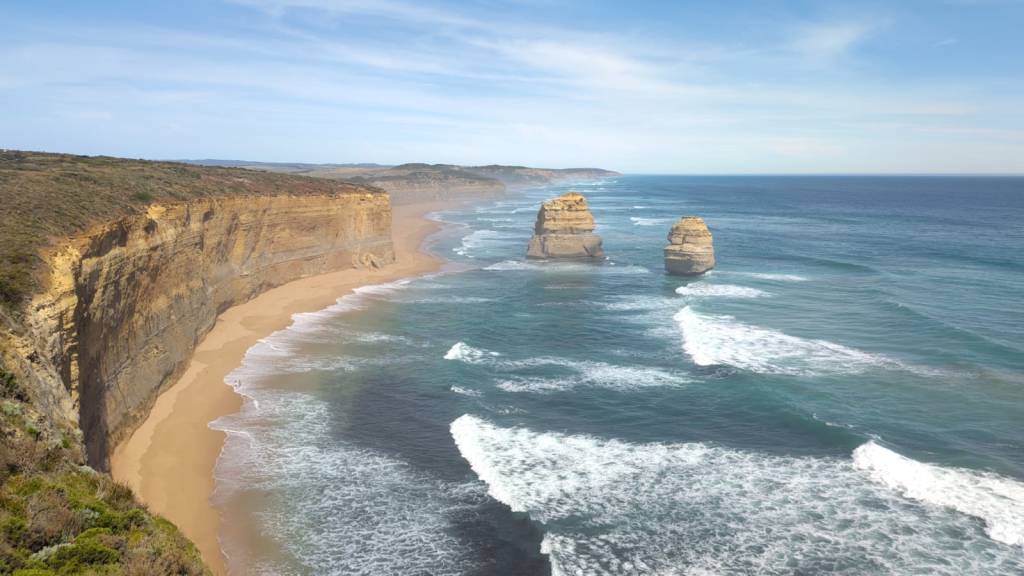
On the road, the Great Ocean Road.
The next day we finally left Melbourne, driving towards Adelaide on the Great Ocean Road. In spite of the short stay, we had fun in the city, and we were pleasantly surprised by the great whisky scene! Definitely a lot of stuff to do for whisky geek visiting. We won’t bother you much with the rest of our non-whisky holiday (well…maybe a pic or two), but the drive was amazing and we spotted some very cool animals!
This was not the last whisky story of our holidays, stay tuned for the last one! Until next time, slainte!
Starward Distillery Tour
Price: AUD 60.00 pp (November 2024)
Duration: 1hr
Tasting: 3 drams, Two-Fold blended whisky (40%), Nova Single Malt (41%), 100 Proof (50%)
Target: tourists and whisky novices
Value for money: ok
Highlights: the variety of expressions available at the bar
Recommended: if you’re in Melbourne, why not?
Link: https://starward.com.au/


 …Maybe next time is going to to be better?
 Dramming around