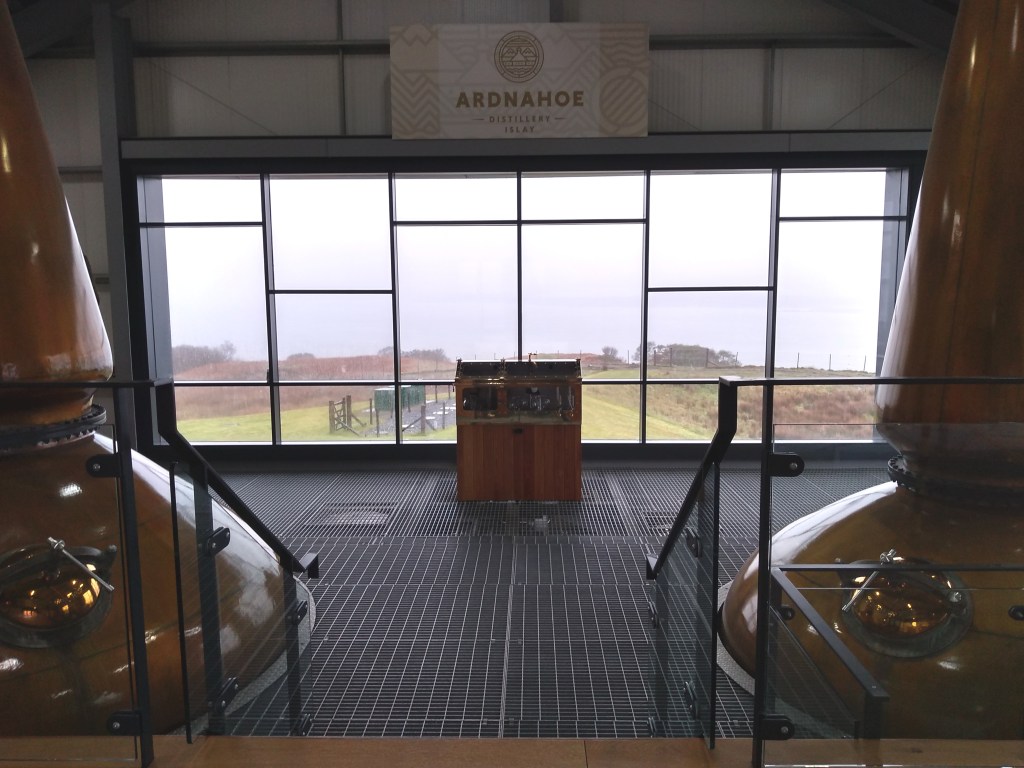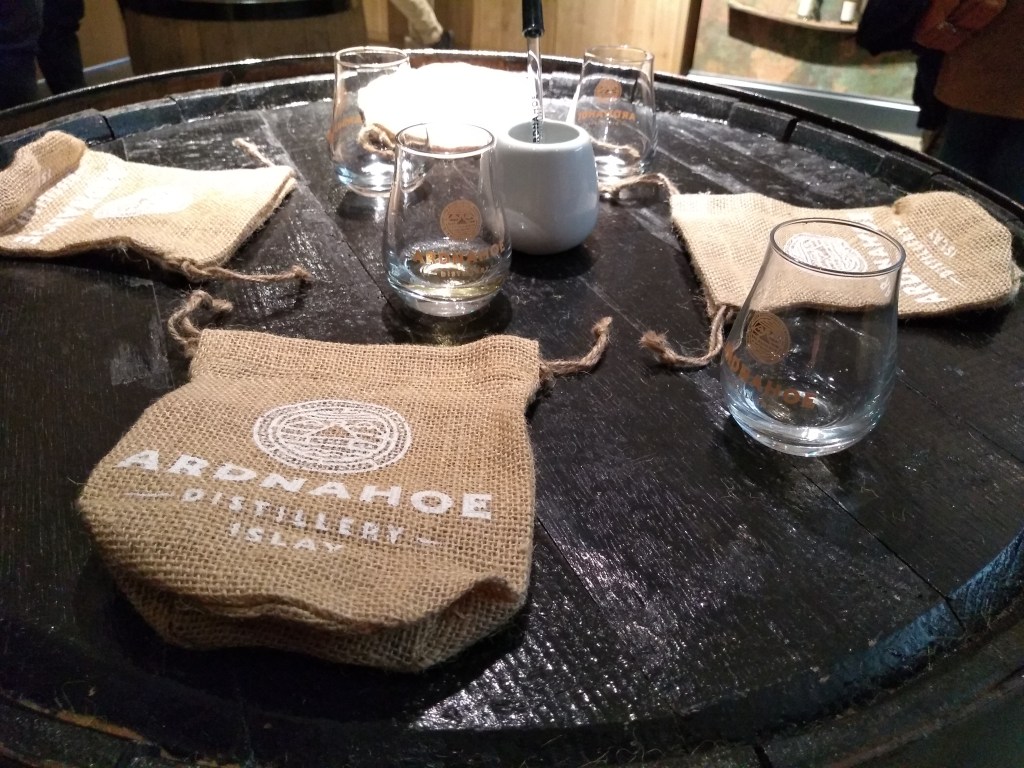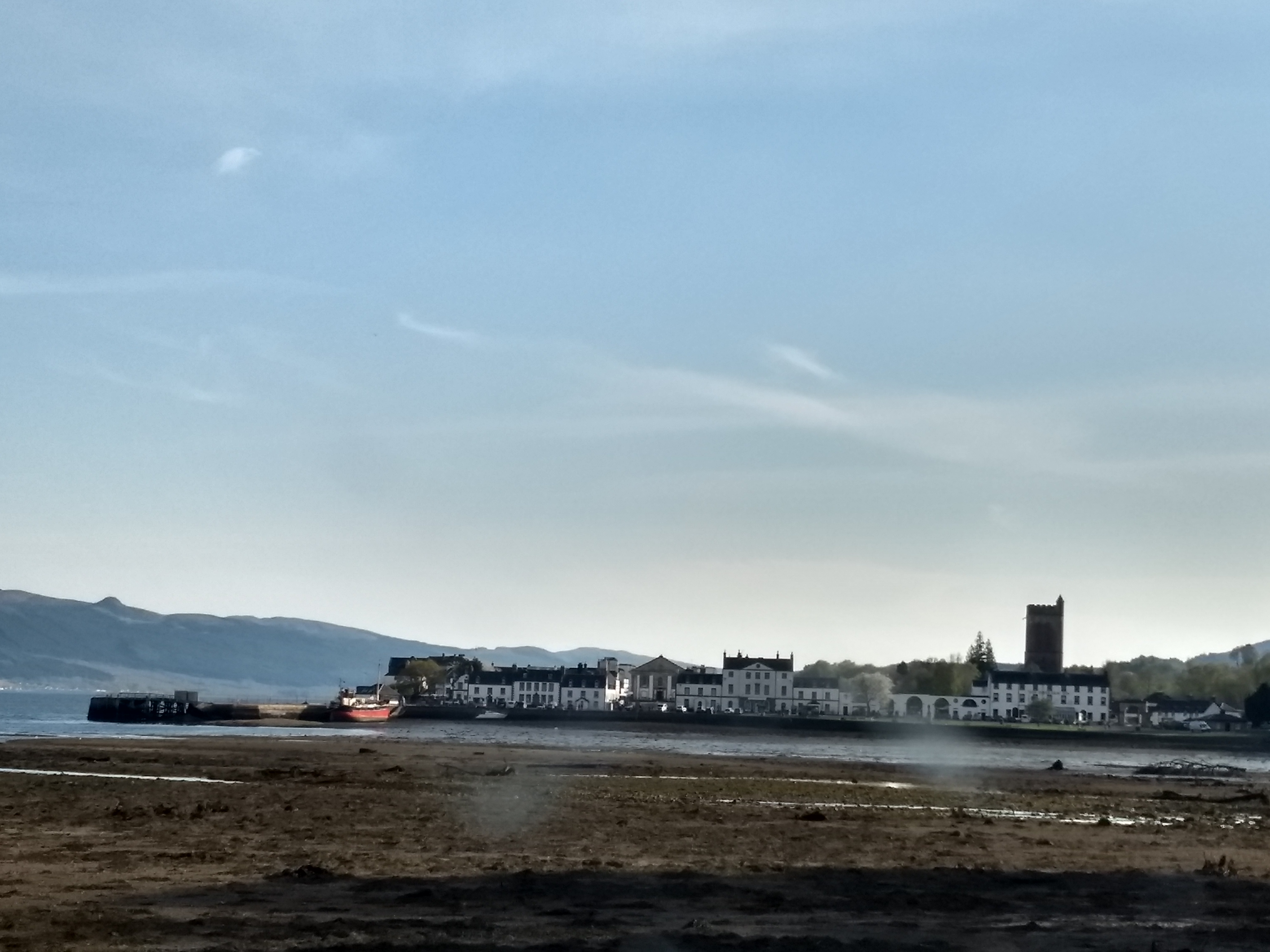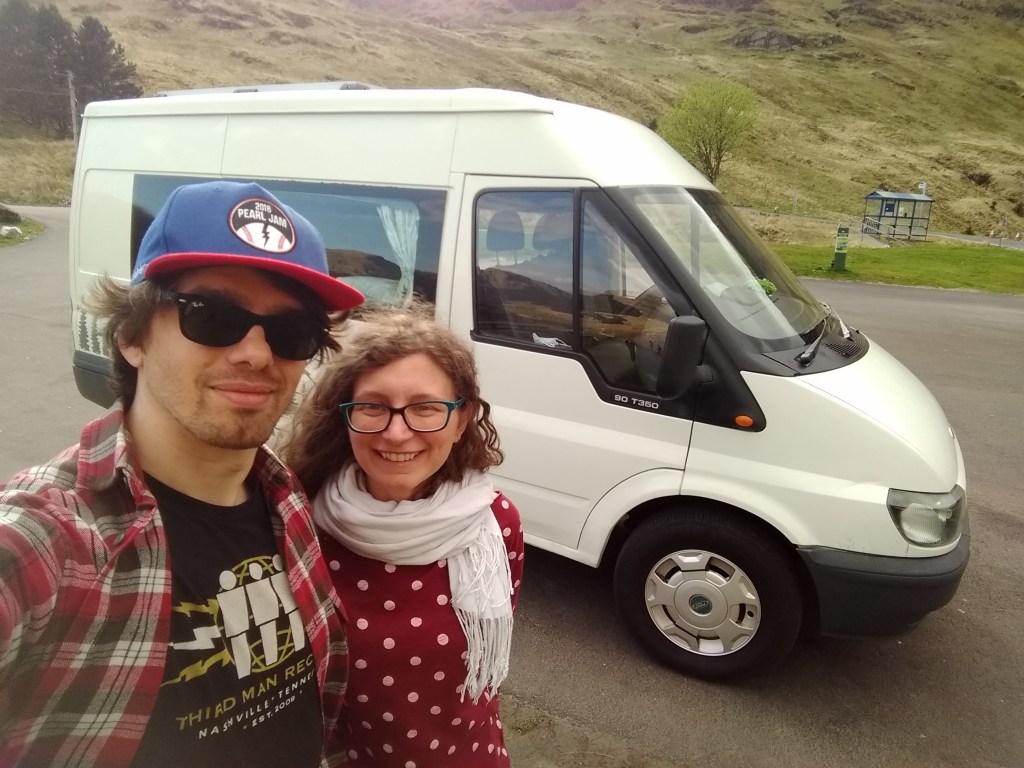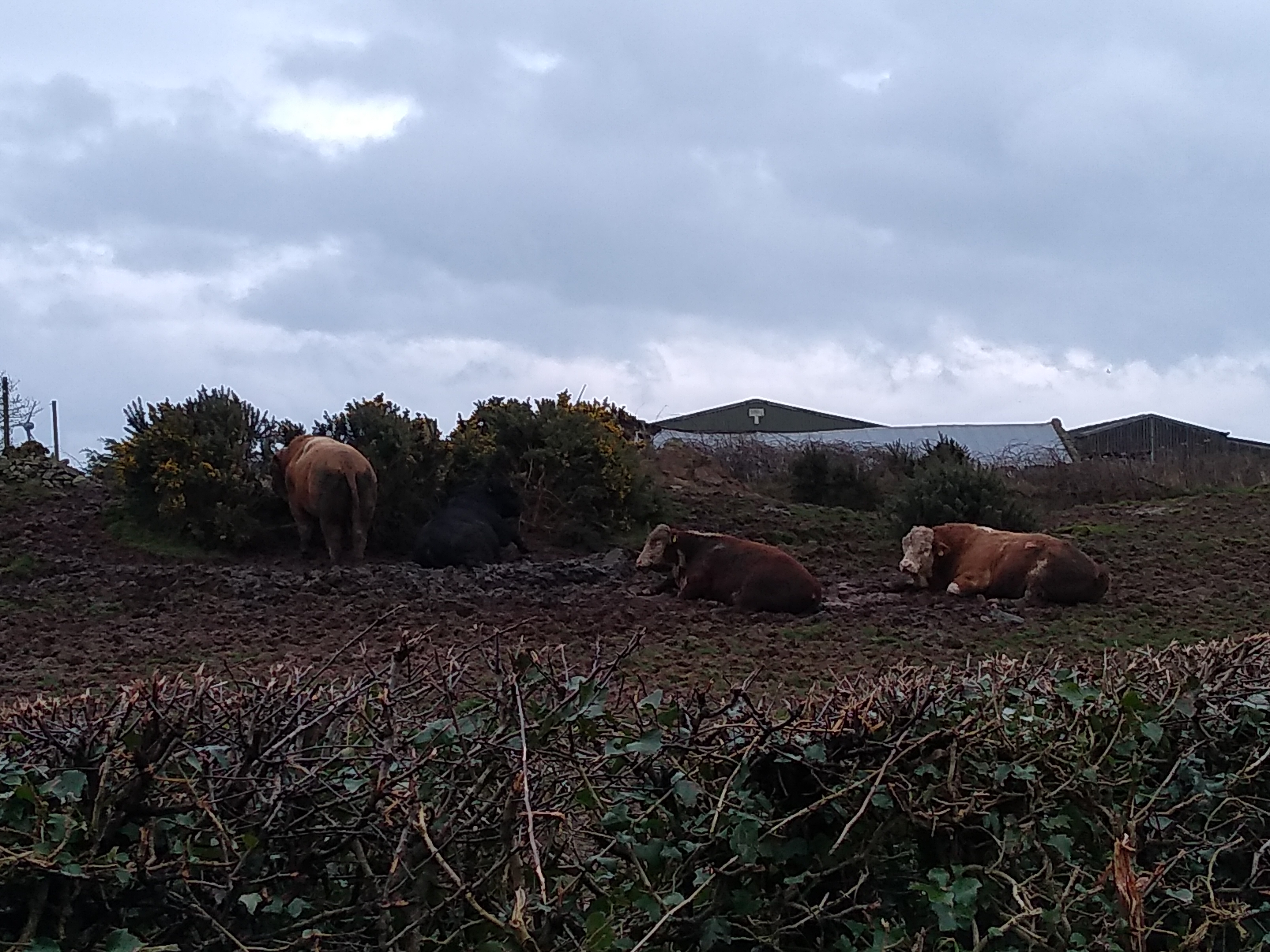
Finally, THE day arrived. It was a matter of time, not โifโ but โwhenโโฆ our very first trip to the mighty Isle of Islay! But letโs go in order: itโs not the first time we booked a trip there. Last time we had rented campervan for 10 days, booked the ferries, booked tours in all 8 available distilleries (Caol Ila visitor centre was, and still is, closed for renovation), a trip to Jura, and a couple of other distilleries on the way. But that trip was due to happen in March 2020, so you can guess how things went downโฆ
This time we took things a bit easier, we only booked 3-4 weeks in advance. We were able to get a campervan for an acceptable price (unfortunately the price of most accommodations on the island was more than the van alone), but this time just for a long weekend: 3 full days on the island (+ 2 half-days for the travel back and forth), and 6 distilleries, still pretty good! So, when the day came, we woke up super early: run, breakfast, packing, a bit of house cleaning, lunch and, finally, picking up the van near the Leith Links.
This was still the happy part of the day.
The company we used works like an โAirBnB of campervansโ: they are an intermediary but vehicles are privately owned. Our โhostโ was very nice and she explained carefully all the features of the camper, which was definitely an upgrade compared to the one we used in Speyside and Highlands last summer, having a little sink and the hobs. We jumped on it, a quick stop home to get our stuff, and then straight towards the West Coast!
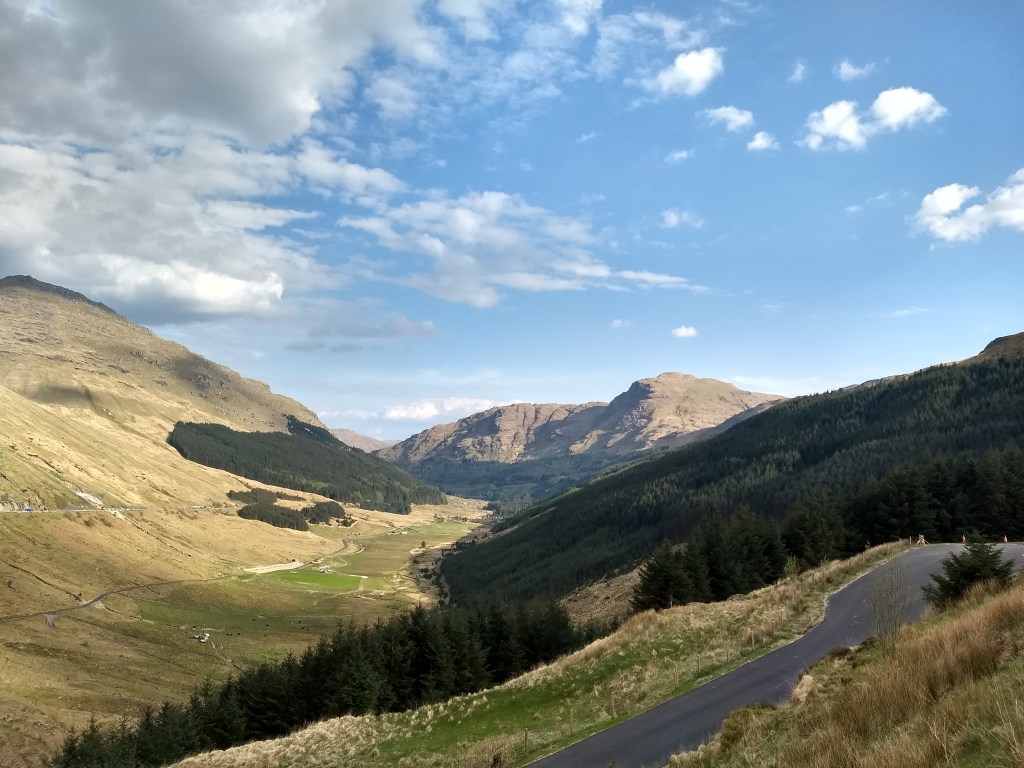
The trip was smooth, we took the highway to Stirling, then drove west towards Drymen, and kept going along Loch Lomond. We stopped at the Rest and Be Thankful area to stretch our legs, and again at the Lochgilpheadโs Tesco for gas and some groceries.
Rest and Be Thankful, aka the calm before the storm…
When it was time to restart the vehicle, plot twist! The campervan just wouldnโt start. We called the assistance, which said that they would take around 2 hours to come. Was it the battery? That was what we hoped for, but by turning the key the radio and lights were working, very bad omen. The assistance arrived (meanwhile, we had already changed our ferry ticket for the next morning), and the verdict was ruthless: the starter motor broke down, no way to replace it in the evening nor on the Saturday morning, we’d have had to wait until maybe Monday, but more likely Tuesday for something to happen (the perks of a bank holiday weekend). For a moment we were speechless, thinking โis this really happening? Does it mean we wonโt be able to go to Islay, AGAIN?โ
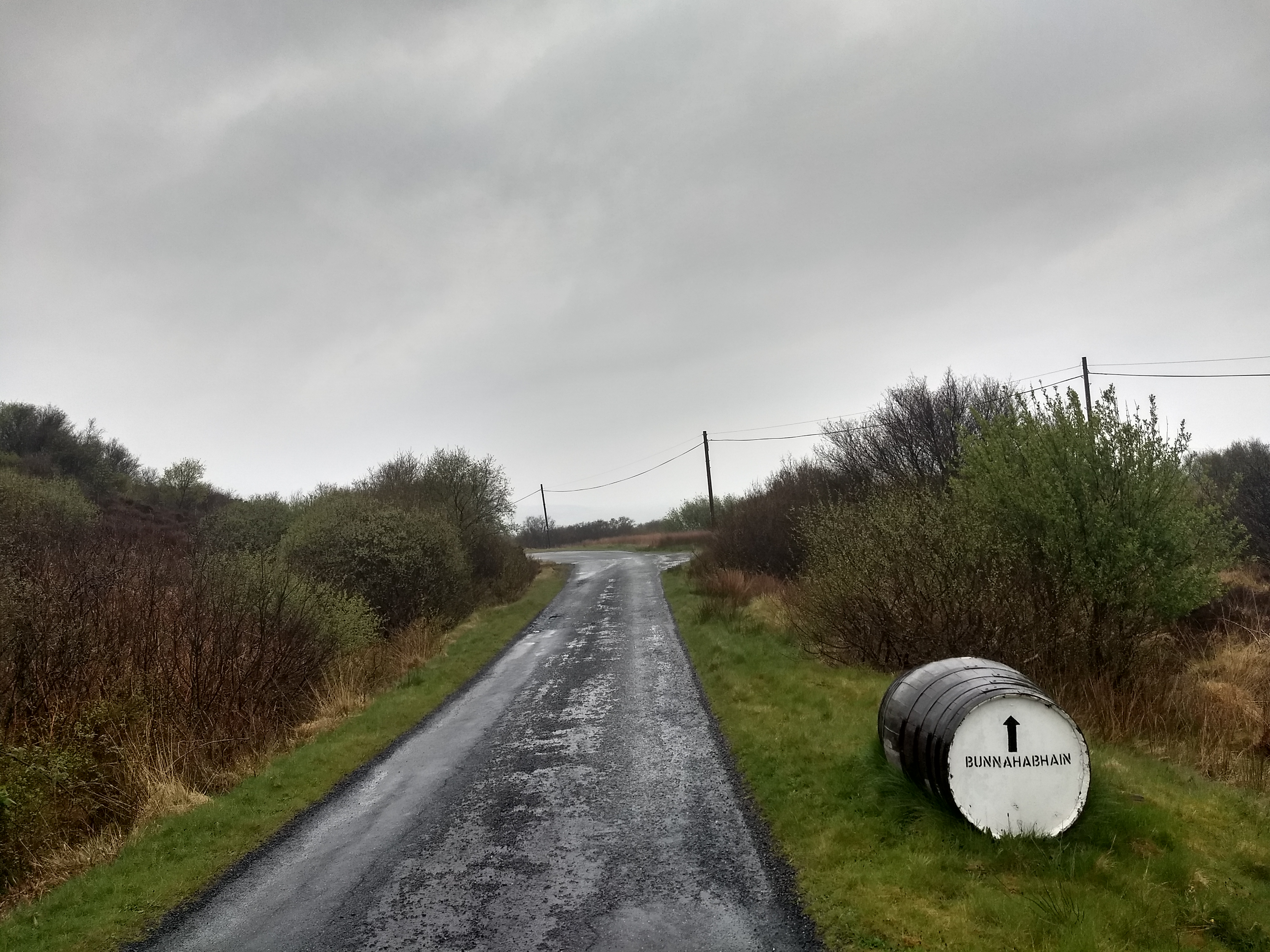
But an idea crossed our minds: if there was nothing to do until Tuesday anyway, we could just go to Islay on foot for the weekend, couldnโt we? The assistance guy turned on the campervan, fortunately the parking lot was on a slope (Gianluigi still remembered how to push things from his rugby years). So, back in the campervan we drove to the parking lot at the Kennacraig ferry terminal.
Plan B mode ON
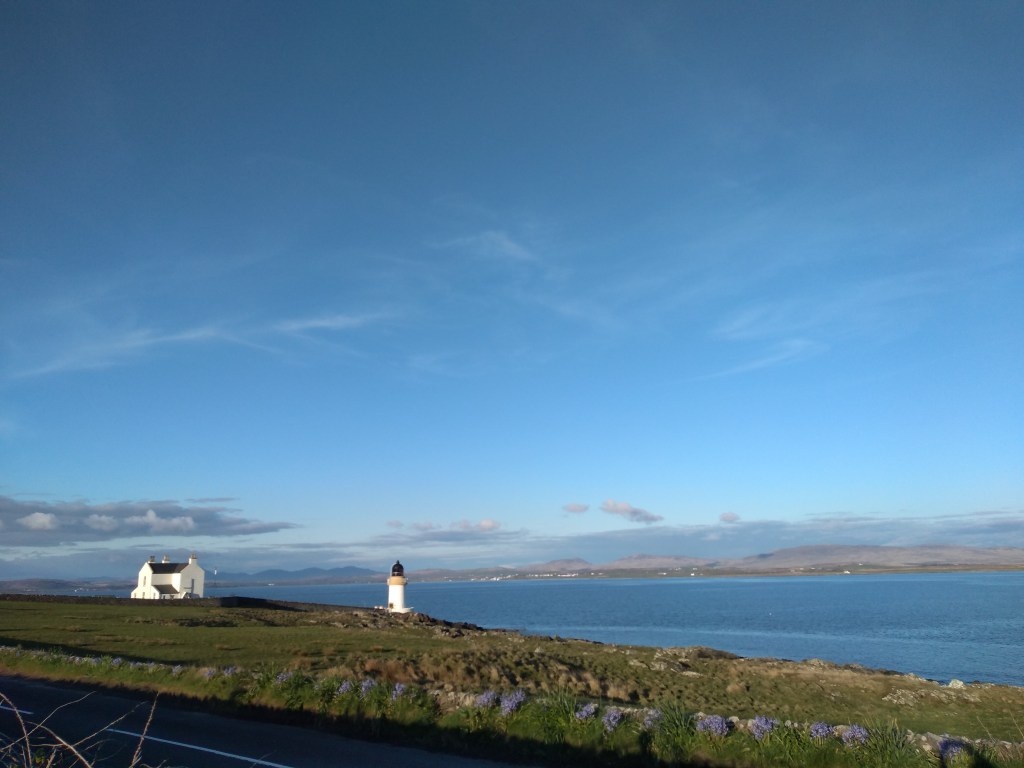
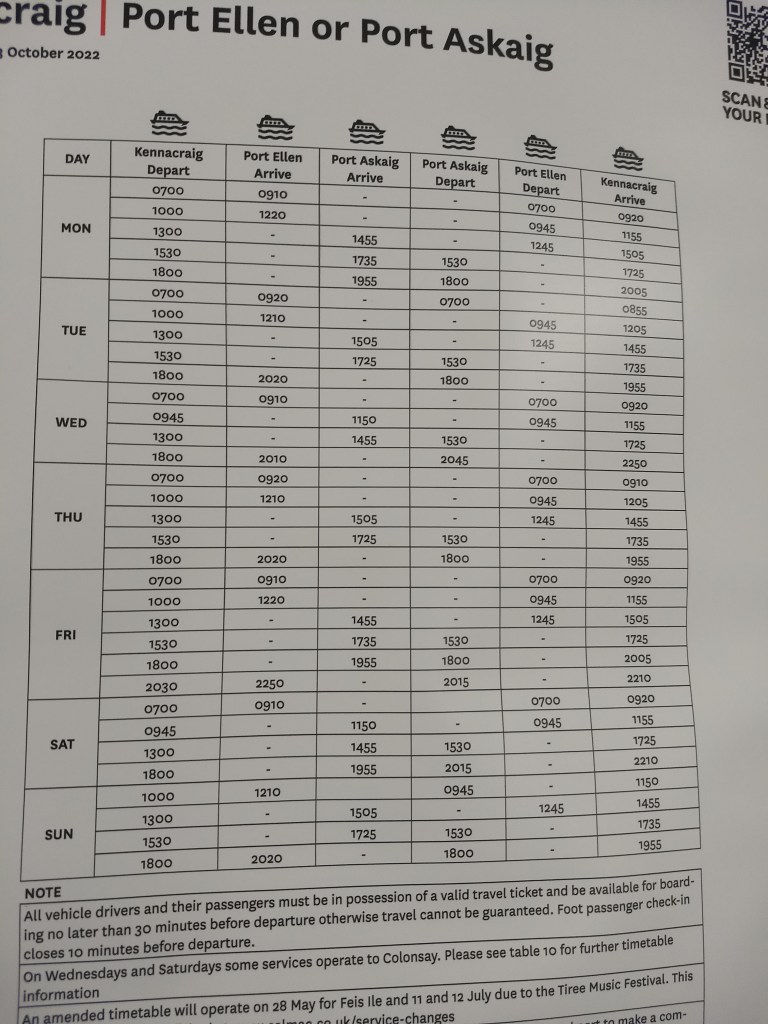
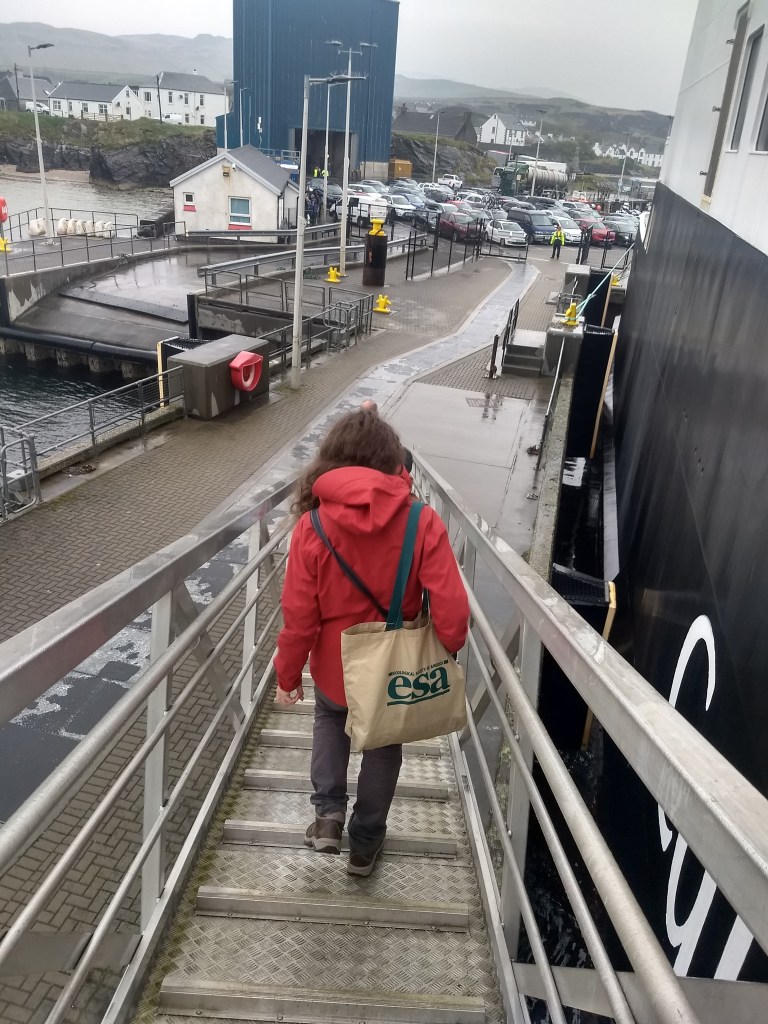
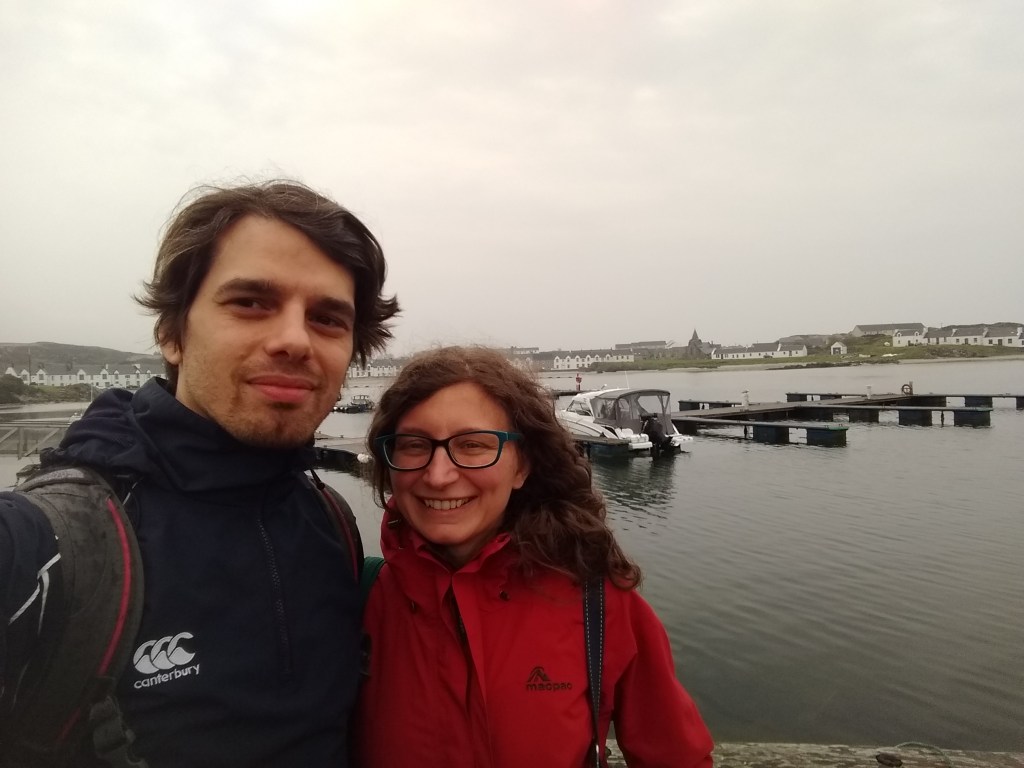
We spent the night in the campervan, not really in the mood for drams and not sleeping much either. In the morning we packed the only backpack we brought (we didnโt take two with us becauseโฆ โWe have the campervan, why would we need two backpacks?โ So naรฏve!) with the very minimal: laptop, a change of underwear and t-shirt each, toothbrush, the Malt Year Book 2022 (fundamental), some food in a tote bag. During the ferry trip we found an accommodation on the island for the night and arranged some taxi rides (of course, the first distillery was the farthest away from the terminal). Our arrival in Port Ellen was very emotional and for a moment we forgot all of our worries and starter motors: we were finally on the Isle of Islay!
We woke up after a resting night in our hotel in Workington. The night before we had had the chance to explore the town, but after the restaurant and a pint we decided to head back to the hotel. At that point face masks werenโt mandatory anymore in England, in spite of the high Covid rates, and this wasnโt making us very comfortable.
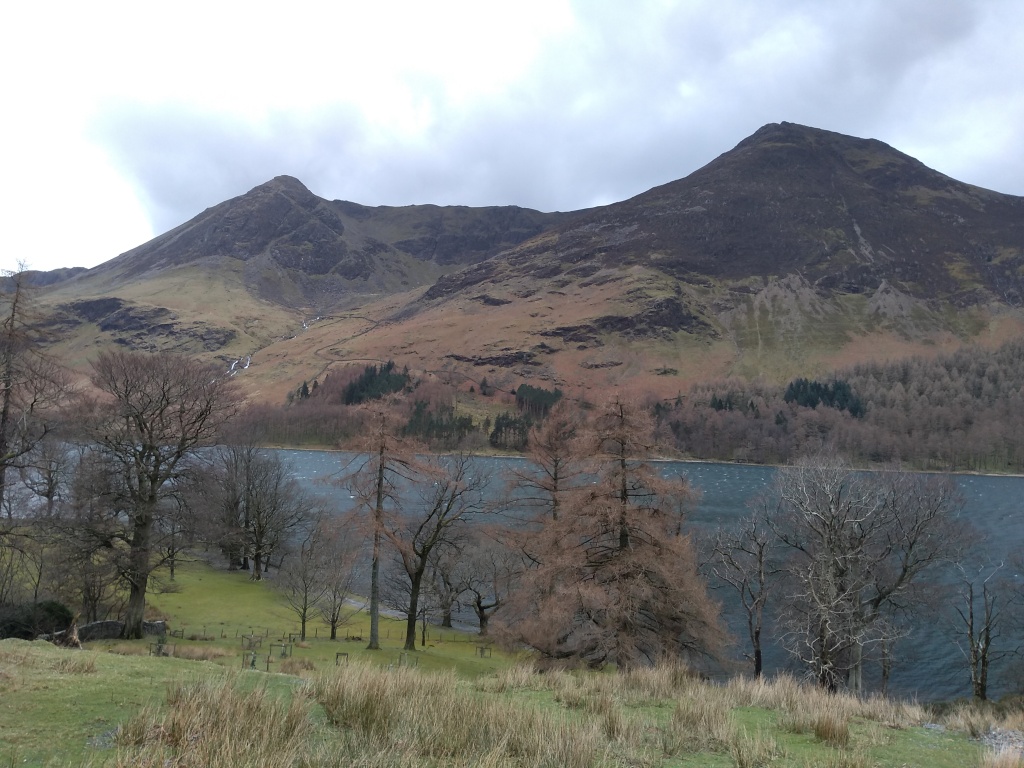
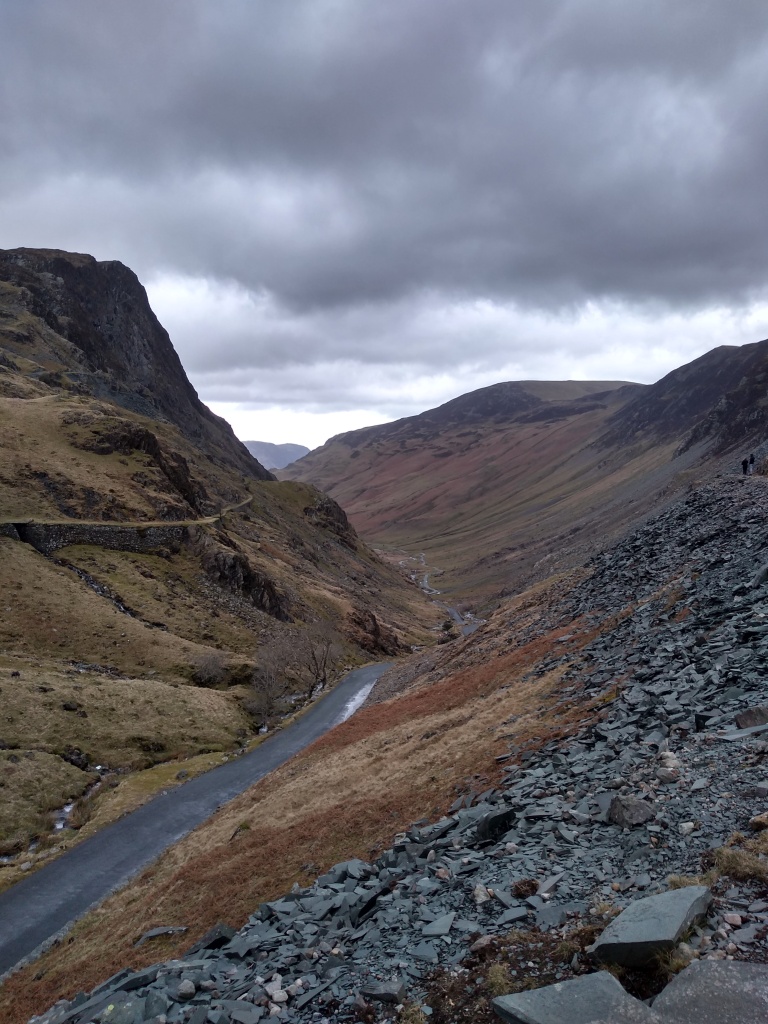
Our hotel was only half-hour away from the distillery, but we decided to take the long road and drive through the Lakes region. The road was not the easiest, long chunks of single tracks (which we got acquainted with during our trips in the Highlands) and even some very steep ones, which Cliff took like a champion! This choice, however, rewarded us, as the landscape was truly beautiful!
Snooping around the Lakes District.
While driving through the posh village of Kenswick we also understood why we couldnโt find any decently priced accommodation for the night in the area. As we left the hills behind us, we entered in a very flat and smooth valley along Bassenwaite lake.
Cliff, you made it!
We were a bit ahead of schedule, so the fact that Gianluigi missed the turn (twice) for the distillery gave us the chance to explore the area even more! However, the third time is the charm (as someone would sayโฆdonโt know exactly whom though) and we finally arrived at the Lakes Distillery.
We learned about them a few years ago and we were both very curious about it. We had reserved the Lakes Whisky Tour at noon (hours are different now, every day at 11.30 and some days at 3.30pm), which is whisky focused. The regular tour instead includes vodka and gin production, which could be a solution if you are accompanied by non-whisky drinkers. Other options are the whisky and chocolate pairing (all Wednesdays and Saturdays at 3.30p), and the โpet the alpacasโ experience.
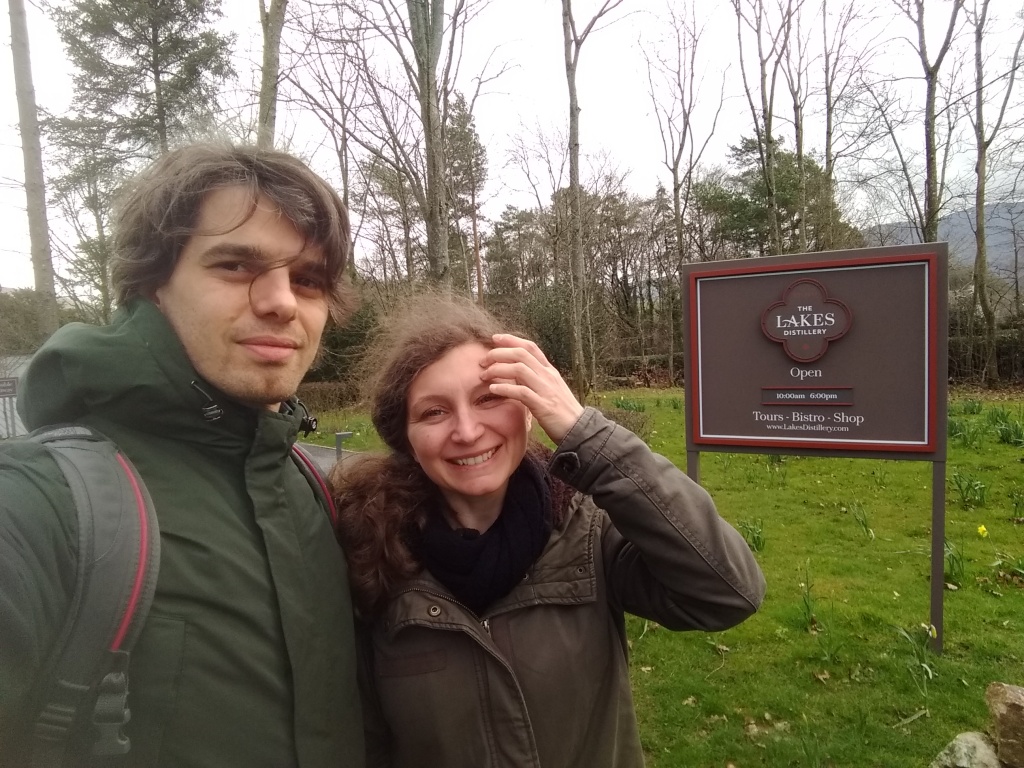
Happy in the wind.
The whole site was clearly designed with visitors in mind, so while waiting for the tour to start, we had a coffee at their restaurant (which is a proper one!). We barely made it, because it was fully booked for lunch. This is something that surprised us, but considering the restrictions easing and that the distillery sits in a very touristic region, we could have expected it (so, if you want to have a meal there, booking is strongly suggested!). Our guide was Sonja, and she started the tour explaining how it took a while for the funders to find the right spot, which they found in the Victorian farmhouse where the distillery is built. The distillery opened in 2014, and theyโve been expanding their production by repurposing some of the buildings previously used for cask storage.
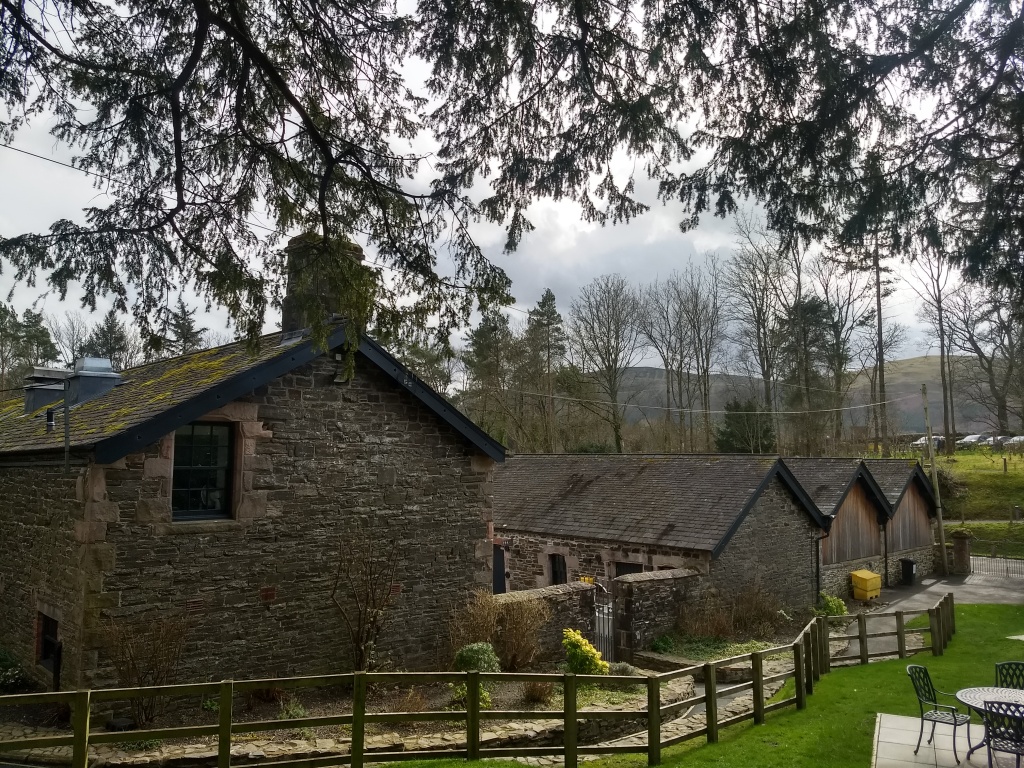
Yes, this used to be a farm.
We moved to a dark room where we watched a (spectacular but a bit too long) drone video following the water source of the distillery, the river Derwent, from the Sprinkling Tarn in the Lakes district to the Irish Sea in Workington (ah!). We moved to the production (where pics were not allowed), which is tightly fit in the old farm barn buildings. Here we could see something very peculiar: the spirit still has two condensers – a usual copper one and a stainless steel one. Sonja told us that it is there for experiments, it should produce a heavier new make because of the missing interaction with the copper. She also told us that none of the whisky released so far went through this condenser. The final part in the tour was in another dark room (not a warehouse, unfortunately), where we were talked through the effect of different types of wood on the whisky maturation.
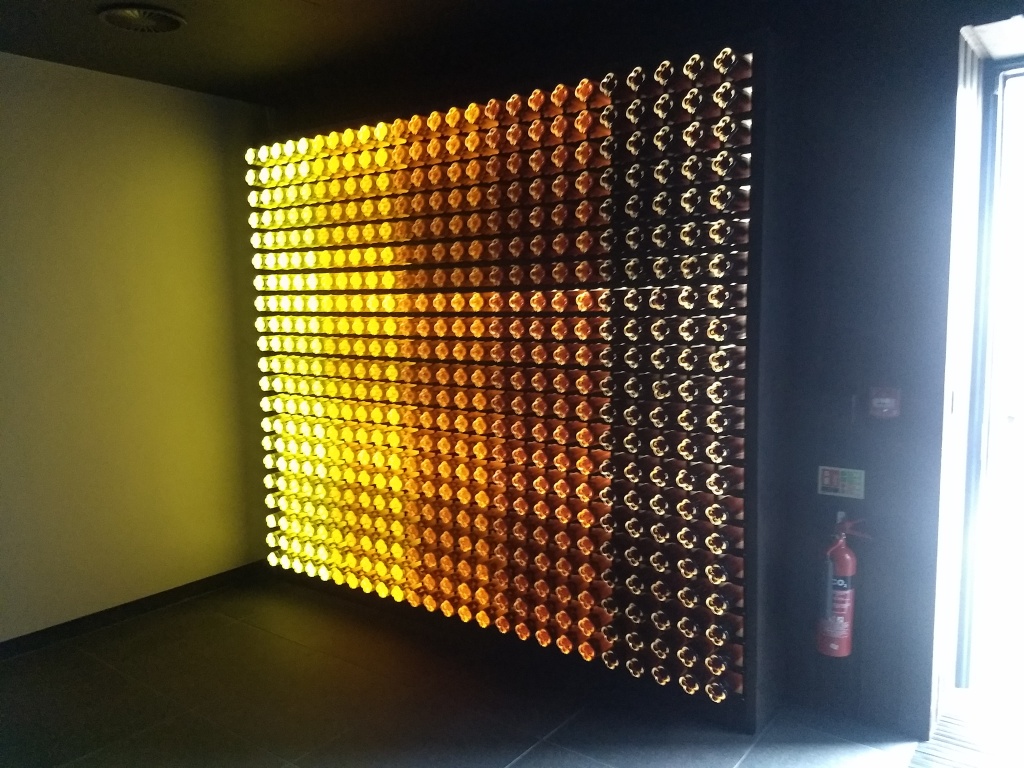
Maturating whisky, maturing colour.
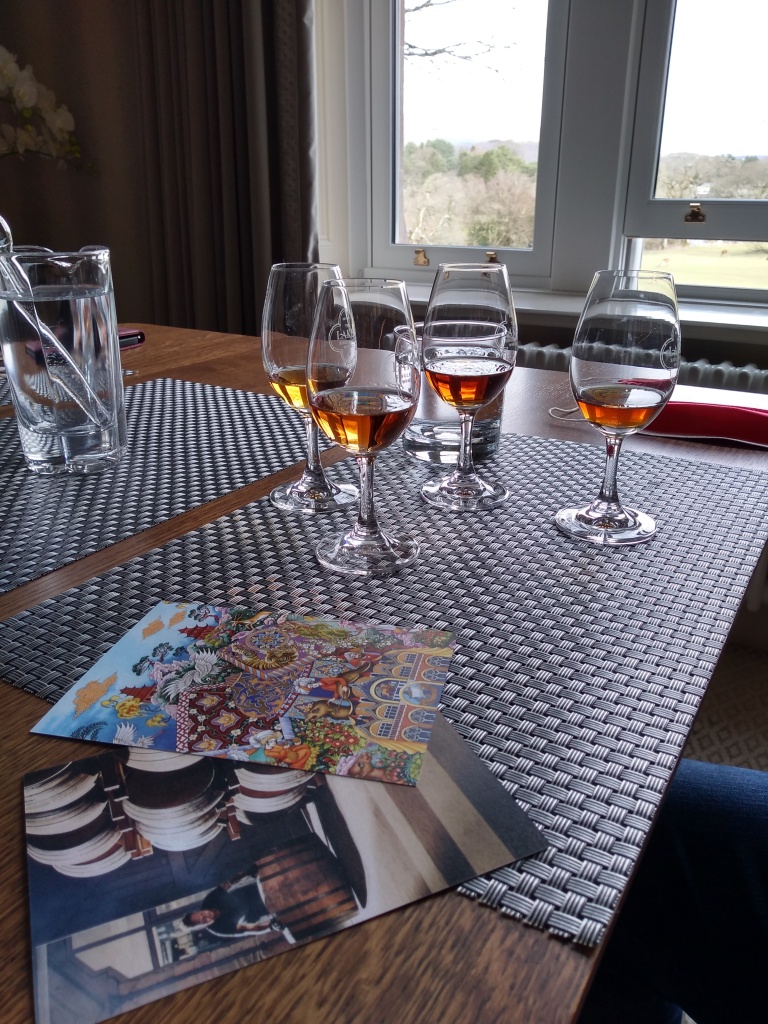
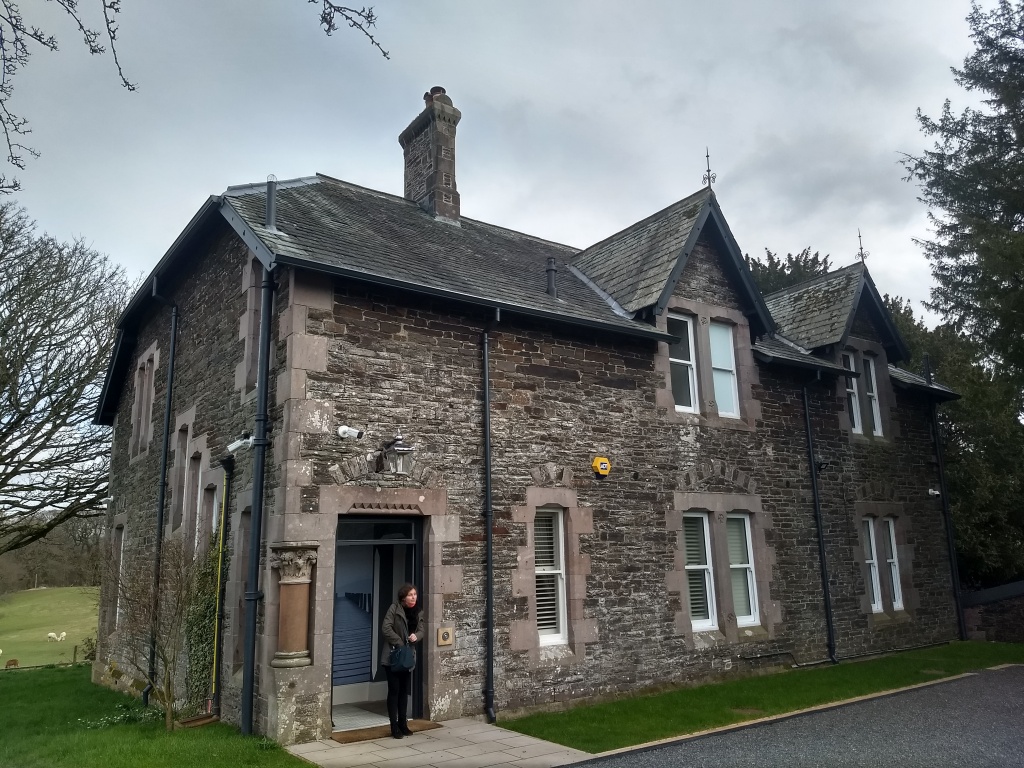
Afterwards Sonja led us to a different building, a beautiful house just on a wee hill behind the distillery, with the alpaca farm on the back: tasting time! After a wee pause for restroom, the tasting started with the newmake, followed by a 1 year-old dram aged in a sherry cask. This is very important to them, as the Lakes whisky style is generally very sherry/European oak forward. We moved on to a couple of their One, the line of their blended whisky, including other malts and grain whiskies from Scotland. We had the sherry and port finishes, both very drinkable (someone would say โdrams for drinking, not for thinkingโ), displaying again the ability to play with different woods. Finally, we got a dram of their last (at the time) release, the Mosaic single malt. This very rich and aromatic dram would have been clearly the highlight of the tasting, but Sonja decided to give us an extra dram: the Whiskymaker Reserve N 4, which was truly great (and sold-out, ouch).
Tasting time!
After the tasting we had a wee meal at their restaurant, but just before that we went back to the shop for a wee taste of two other Ones: the Moscatel and the Orange Wine cask finishes. While the first was more balanced, the latter had a very particular note that we havenโt found anywhere else, so we went for that one. Finally, we got into the car and headed back to Leith, crossing the South of Scotland and some unexpected but amazing landscapes around Moffat and Biggar. Tipsy Teresa (she necked all of her drams, of course!) was definitely very happy for her birthday celebrationsโฆwhile Gianluigi was already thinking about how to top this next year!
The house of the raising drams!
So, our first visit to an English whisky distillery happened, and it was good one indeedy! Thanks to the visit, we could see how their (former, apparently) whisky maker Dhavall Gandhi gave a very clear direction to their whisky. While definitely sherry-oriented, the drams we had were not โsherry bombsโ, and the influence was more nuanced and balanced โ we both thought Dhavall is an amazing blender. For us, some whiskies to keep an eye on and, unsurprisingly, weโll likely return to visit!
The Lakes Distillery Whisky Tour
Price: ยฃ35.00 pp (March 2022)
Tasting: Lakes new make spirit, 1y malt spirit (ex-sherry cask), The One Port & Sherry finish blended whiskies (both 46.6%, NAS, NC, NCF), the Mosaic Single Malt (46.6%, NAS, NC, NCF)
Target: whisky enthusiasts and geeks
Value for money: Good
Highlights: the distillery is very beautiful and in a great spot
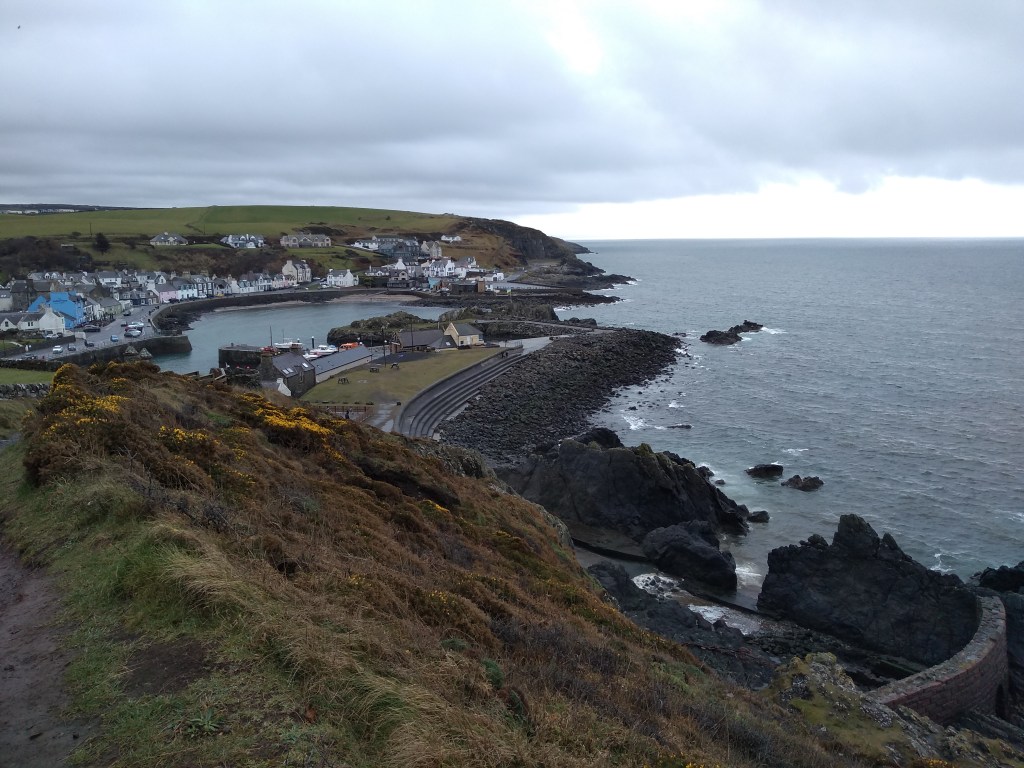
The morning wasnโt too cold as we went to a nearby hotel for a big breakfast. We went for a short walk on the cliff around Portpatrick, the view of the village was pretty spectacular, but the clouds prevented us to spot Irelandโฆhopefully next time!
Quiet, cloudy morning in Portpatrick.
First stop in the morning, Newton Stewart. It looked as a nice, quiet village. Here we met up with Tom, a Gianluigiโs former colleague and his family for coffee and cake. It was great catching up with him, since Gianluigi and Tom hadnโt met in person since March 2020, despite spending a big chunk of the pandemic working together building a Covid model for Scotland.
The road between Newton Stewart and Annan was a quite different landscape compared to others in Scotland. A rug of intense green rolling hills, punctuated by cattle and sheep quietly grazing. We stopped by a smokehouse just past Creetown, on the main road, to get some of their delicious goodies. Past Dumfries, instead keeping on the main road, we drove straight south to Caerlaverock Castle. The visitor centre and the castle were closed, but it was possible to park nearby and, thanks to a sunny day, take a walk in the park. The castle looks like a proper medieval fort, including a catapult โparkedโ in front of it as a reminder of those walls purpose. As we will learn from the Wikipedia page, this has been under siege many times, until it was abandoned in 1640.
Beautiful castle behind an even more beautiful catapult!
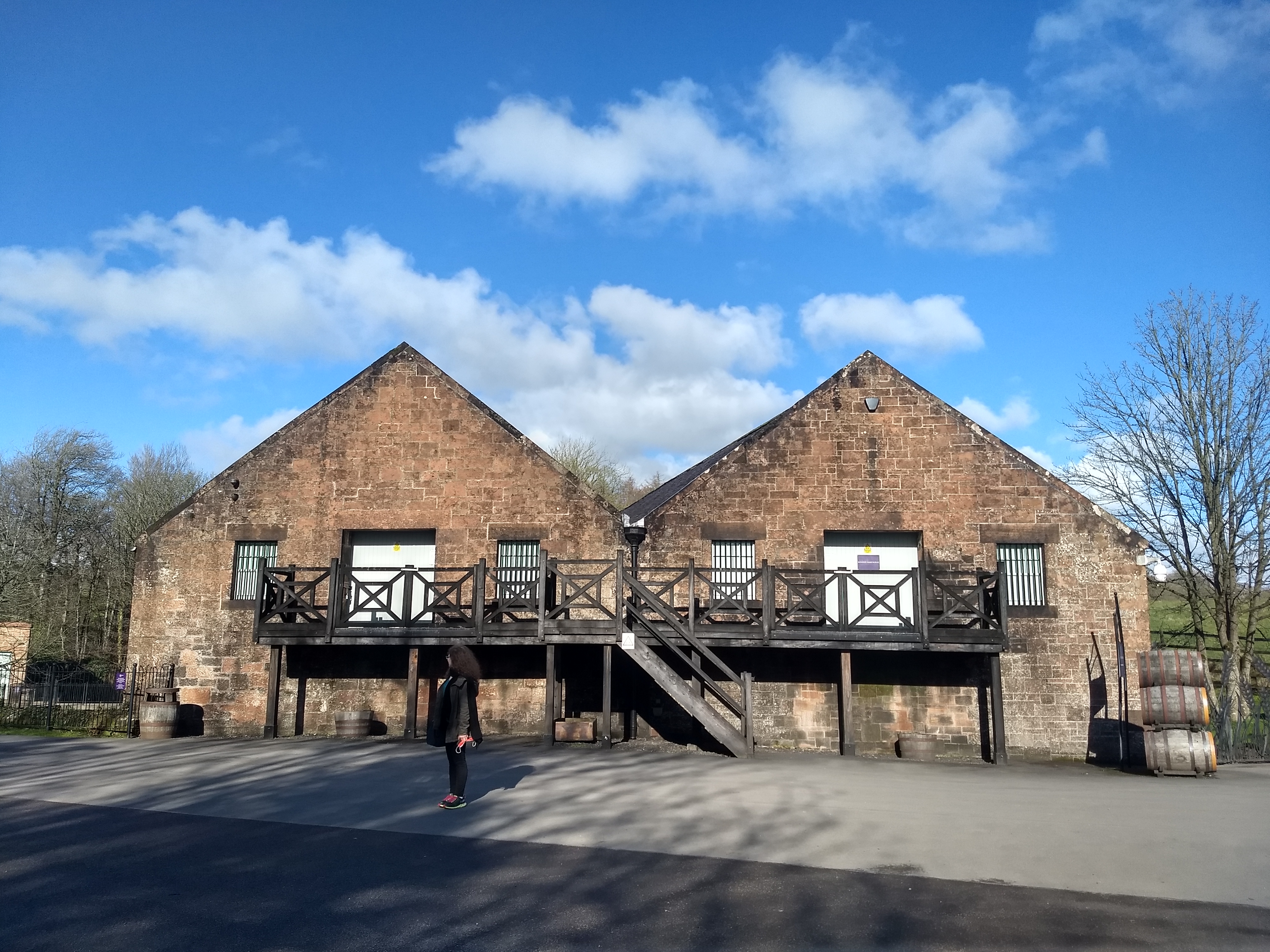
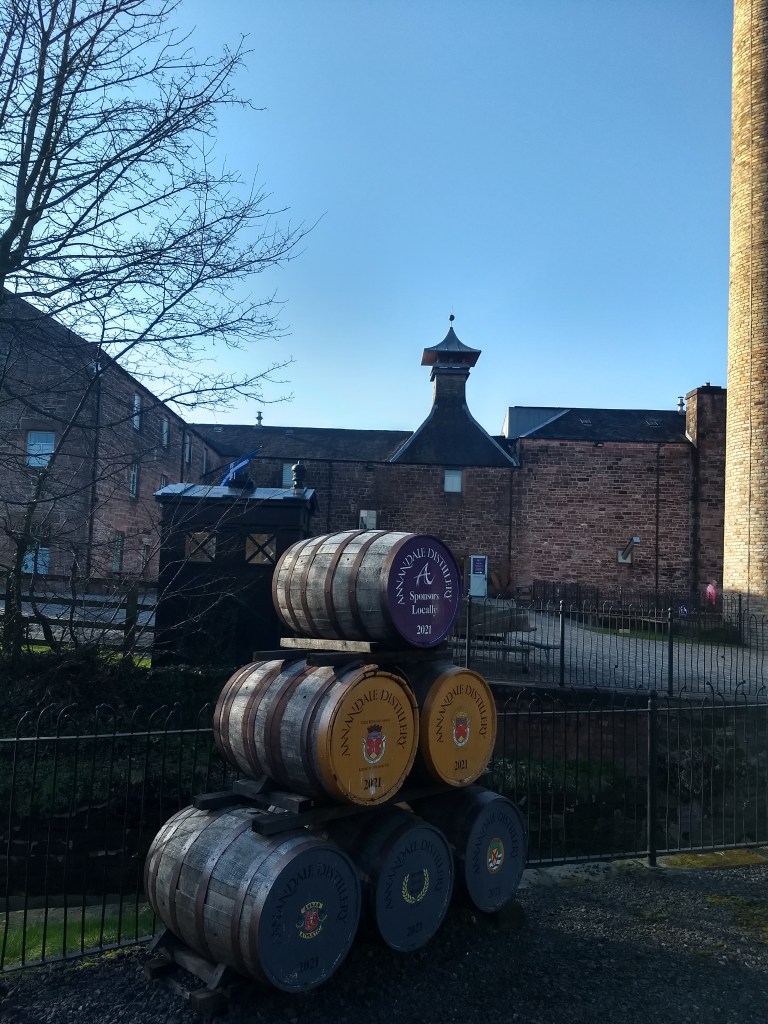
It took just a short half-hour drive to arrive to Annandale from the castle. As we left the car in the wide parking lot, we could admire the awesome restorations of the distillery buildings. It sits in a nice spot as well, close to a stream and surrounded by fields and woods, almost like a postcard! We checked-in at the visitor centreโs shop (where we got our very first whisky lanyard!) and while waiting for the tour to start, we had a coffee at the Maltings, their cafรจ.
Checking in at Annandale.
Other than the basic tour there are other three options available, which is possible to enquire about from the website: one focused on the buildings restoration, one about the new owners journey and project, and a technical one about whisky production. Gianluigi enquired about the latter, but that week the person in charge was on annual leave, so he chose the basic tour (prices of the alternative ones are not specified on the website).
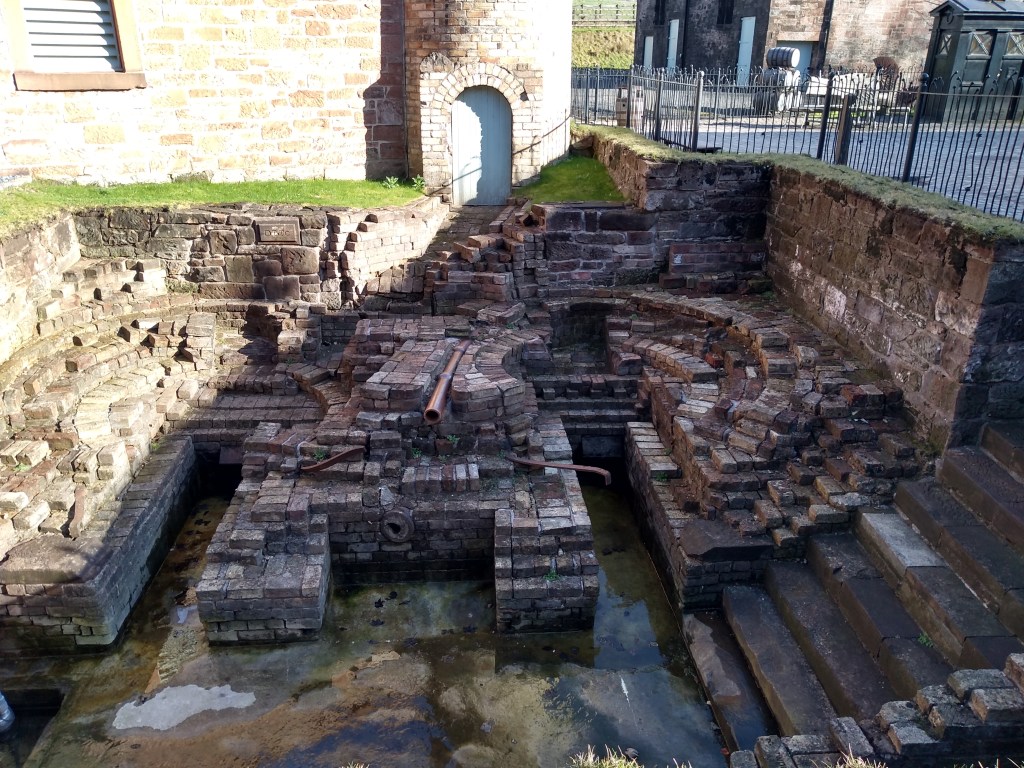
Our guide led us to the room where the tour started. While she was explaining the history of the distillery, which dates back to 1836, she gave us a first dram of a blended scotch whisky prototype (not on sale yet), a blend of North British grain whisky with their peated expression (Man OโSword), diluted at 40%: despite the thin mouthfeel, not bad at all! The distillery was bought by the Walker family in 1893 as a source of peated single malt for their blends: their kiln used peat from local bogs, making it a pretty unique malt. Compared to other peated malts, it was also easier to transport it to Kilmarnock. The distillery was closed and dismantled in 1924, and prior to their acquisition by David Thomson and Teresa Church in the late 2000s, it was abandoned. When the renovation happened, all the equipment was new, making it another (almost) 200 years old โnew distilleryโ, similarly to Bladnoch. In the middle of the courtyard we could admire the old stillhouse buildingโs base, with the two circular structures that used to host the stills.
A piece of whisky history.
The historical ties of these distillery donโt end here, as they decided to name their single malts after two very important characters tied with the local and Scottish history: while their unpeated whisky is named โMan OโWordsโ in honor of Robert Burns, their peated one is the โMan OโSwordโ, after Robert The Bruce (and the peat doesnโt come from the area anymore, but itโs sourced by the Simpson maltsters).
As we moved to the production area, we spotted the similarities with other distilleries influenced by the late Dr Jim Swan (Lindores Abbey). In particular, they have a mashtun closed by a copper lid, and three stills: one wash still and two twins, slightly smaller, spirit stills.
All in one room: mashtun, washbacks and……Stills!
In the filling room, a poster of Doddie Wair, which filled their first peated cask. The dunnage warehouse is on two levels, and here is where we had a wee taste of their products (well, not Gianluigi as he was driving). We tasted their peated and unpeated Rascally Liquor (newmake spirit bottled at 63.5%), and their young Man OโWords and Man OโSword from bourbon casks (unchillfiltered, natural color and cask strength). Back in the shop, we realised that all their bottling were ยฃ80-85 or over, depending on the cask type, so we opted for a tasting set of 6x5cl drams: peated and unpeated single malts in ex-bourbon, ex-sherry and STR casks, a good compromise (we still have to taste them howeverโฆ). For what we could taste on that day (but also in another Kask Whisky tasting, when we had a dram of their sherry cask matured Man OโWordsโฆ and a real sherry cask, not a seasoned one) the whisky is very promising, and we are excited to see what is in their plans in the years to come!
Dunnage warehouses.
As we left the distillery Teresa wasnโt aware of the next stop, and she was really clueless until we crossed the border with (cracks in the sky noise) England!!! The distillery for the next day was, of course, the Lakes distillery, but Gianluigi decided to spend the night in a town on the coast, Workington. We stayed in the very clean and tidy Hall Park Hotel, which has a bar as well, so before dinner we could watch the second half of the England-Ireland 6 Nations game from a comfy couch in our room with a pint! Sublime!
So another distillery in the sack, this time the beauty of Annandale really made the difference. We will definitely go back for another tour (hopefully the technical one), maybe in a few years when more expressions of this whisky will be available.
Annandale Distillery Tour and Tasting
Price: ยฃ20.00 pp (February 2022…But there was a discount at the time, we paid ยฃ10pp)
Tasting: Blended scotch (a blend of North British grain and their peated single malt, 40%), Rascal spirit (new make), Man OโWord & Man OโSword (unpeated and peated, NC, NCF, CS)…and wee glass and laynard to take home
Target: everyone
Value for money: Good
Highlights: The beautiful site
Distillery Exclusive: Man OโWords and Man OโSword single cask bottle your own vintage 2015 (CS, NCF, NC, ~ยฃ60 for a 375ml bottle)
Things we did not like: Feeling like broken records, but the bottling prices were a bit steep again
Another trip to discover distilleries in the Lowlands on a special occasion: Teresaโs birthday.ย
(Want to read the whole story? Go to Day 2 or Day 3)
There was one trip we aimed to do back in 2020, but because of you know what, we postponed it: Dumfries and Galloway. We heard this is a lovely region and, very important for us, home of two single malt distilleries, Annandale and Bladnoch.
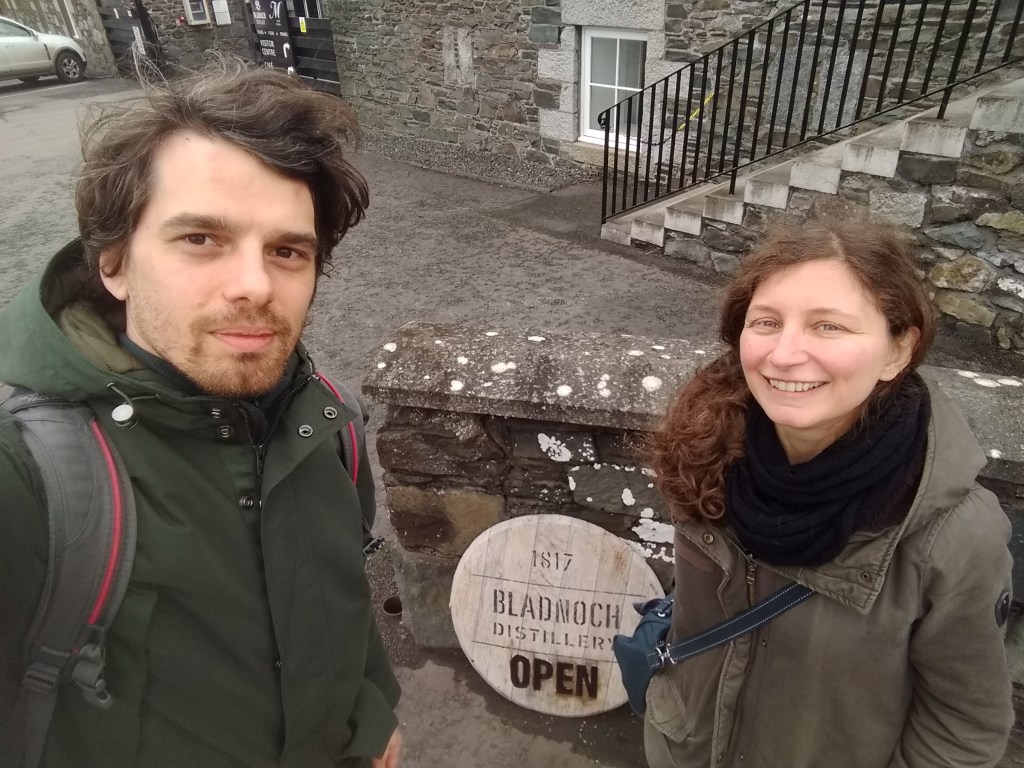
This year, Gianluigi decided to catch up with this trip, and the perfect occasion was Teresaโs birthday, in March. He organized the trip as a surprise, so on that Friday morning when we ignited Cliffโs rowdy motor (thanks again Justine!), Teresa had no idea where we were going. As we left the city and didnโt take the Fifth of Forth bridge, Teresa recognized the landscape of the M8 towards Glasgow, so she narrowed down her guesses to two: Arran or Galloway. As we turned south towards Ayrshire, she got the correct guess. Smart lady! The distillery visit of the day was at Bladnoch. Their 1817 Tour is only available on Wednesdays and Fridays at 11.30, and because Gianluigi wanted to drive on the Ayrshire coast (which is a bit longer route), we had an early start.
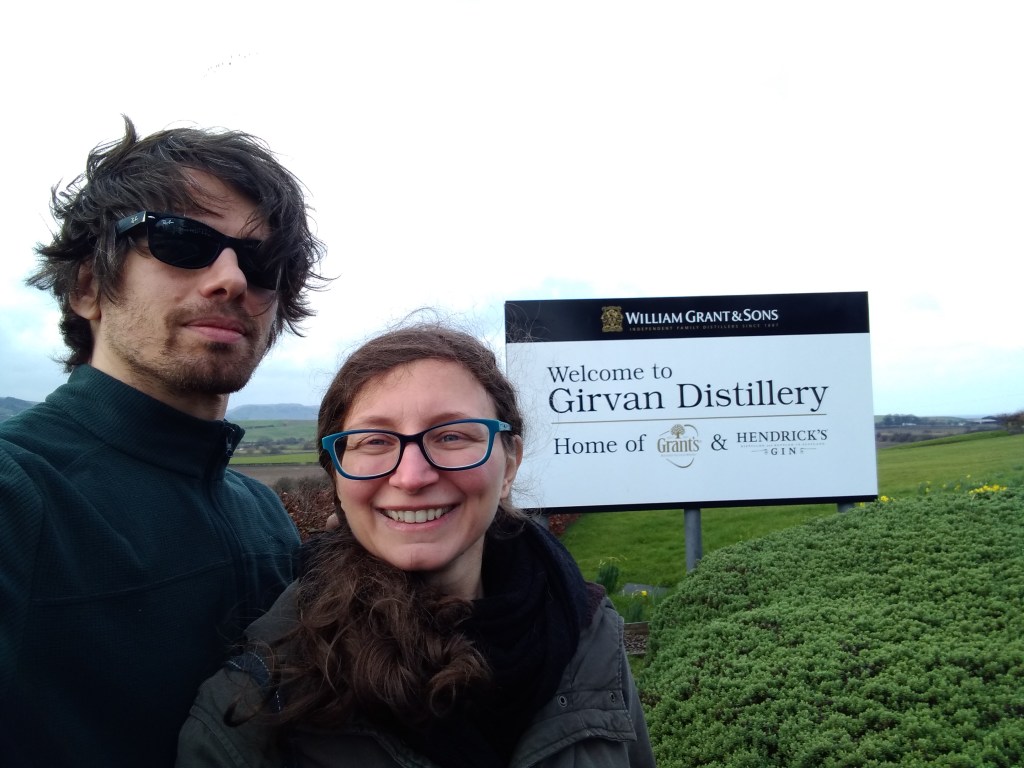
Ayrshire itself is now home of at least three whisky distilleries in two production sites. One is the huge Girvan complex, owned by Willian Grant & Sons (the same company owning Glenfiddich, Balvenie and Kininvie, in Speyside) and including the Girvan grain distillery and Ailsa Bay (and for gin lovers, this is the place where Hendrickโs is produced). We briefly stopped to take a picture and snoop around the site.
Nosing around Girvan…in the wind.
The third one is a new small farm distillery called Lochlea, who released their first whisky in early 2022. They donโt have a visitor centre, but in some interviews on podcasts and on an article on the Whisky Magazine, they seemed to suggest they could welcome small groups of visitors, if contacted by time. That was very far from the reply they sent to Gianluigiโs email, which was polite but categorical in saying that, because it is a farm distillery, there is zero chance of welcoming guests (to be honest, that was not the case when a few weeks ago it was showed on social media that they actually had bloggers/podcasters, but hey ho!). Along the coast we also drove past Cairnryan, where the ferries to Northern Ireland leave, and the nice town of Stranraer, which we pictured much smaller.
Since the day was cloudy but not rainy (yetโฆ), we decided to park the car in Wigtown and reach the distillery on foot. Wigtown is a very cute village and the Scottish capital of books. The place is in fact full of bookshops where you can find both new and second-hand books. In the afternoon, after the distillery visit and lunch, we took advantage of it to enlarge our collection of Ian Rankin novels and whisky books. The walk from the village main square to the distillery was about 20 minutes long on a very quiet road through a rural landscape which weโll find very characteristic of the area.
Tour and tasting…we’re coming!
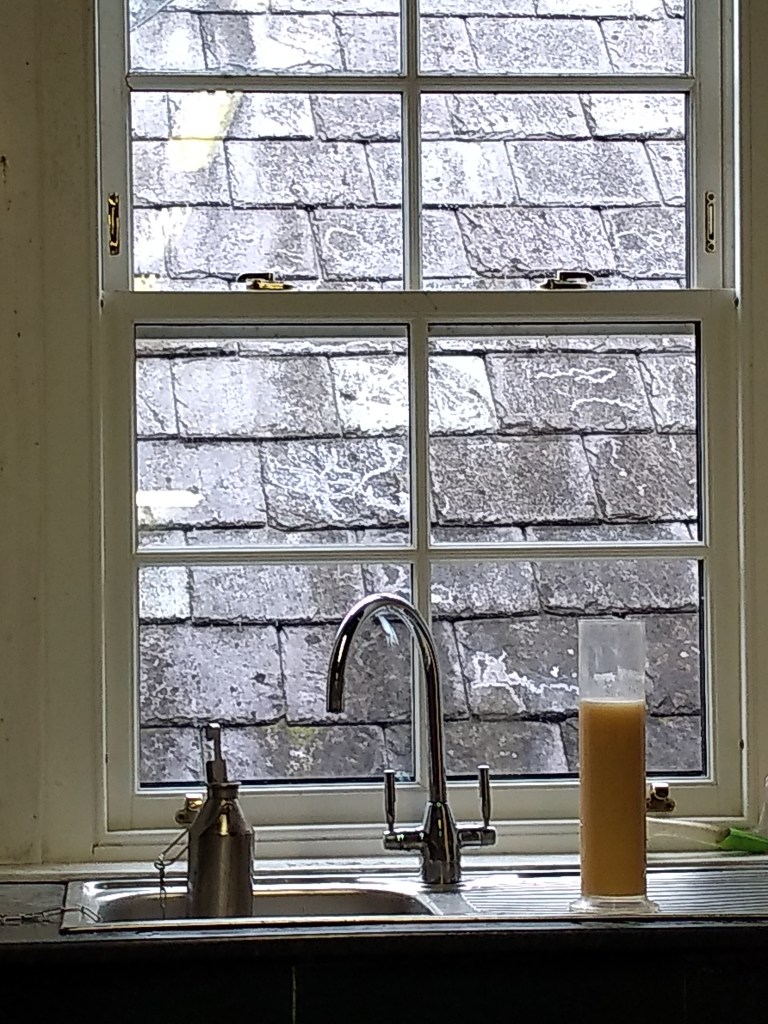
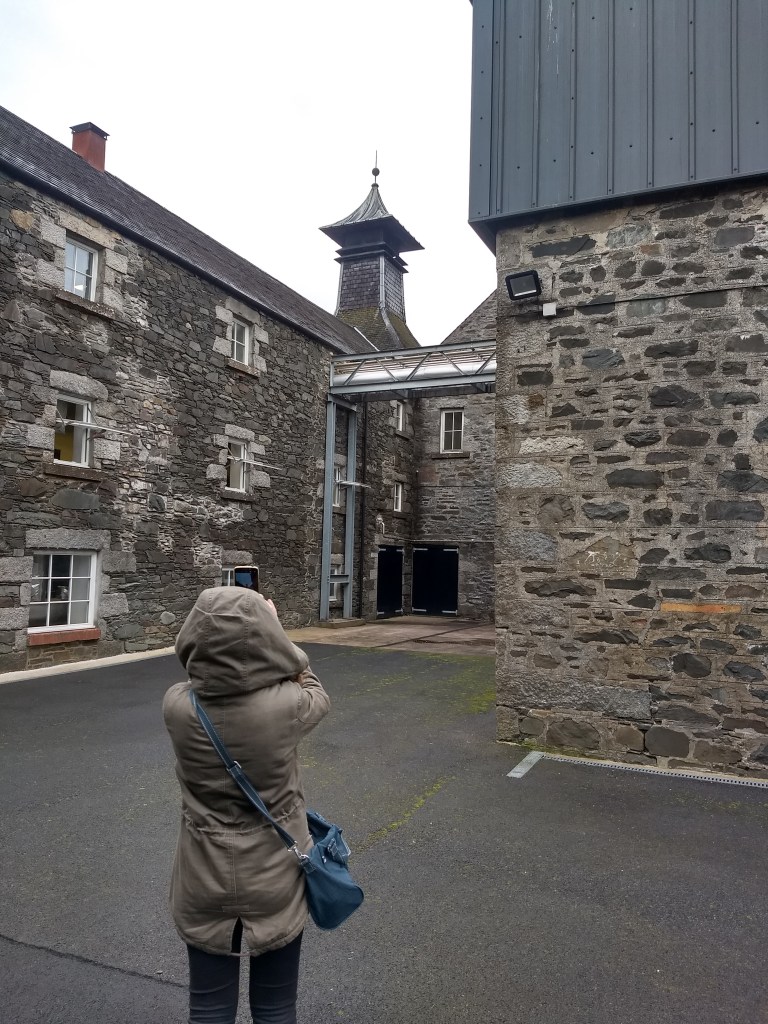
As we crossed Bladnochโs doors we realised how new the visitor centre, shop, restaurant are, and we checked in right away with our tour guide, James. He used to work as a chef, until he decided to join the Bladnoch team part time as a guide for their tour and, occasionally, to prepare meals for business visitors. When the tour started he told us how everything changed when the distillery was bought by Richard Prior in 2015, in particular the distilling plant (stills, washbacks, etc.). So, it is basically a new 200 years old distillery! We moved to the mill room, where he showed us how the shuttle box is used with a scale to check that the mill grinded husk, flour and grist at the correct ratio. We made a brief stop at the closed steel mash-tun, and moved to the room with 6 wooden (Douglas Fir) washbacks. James and the operator showed us how to measure the alcohol content of the wash, before and after fermentation (very similar to what we did in our timid attempts to brew beer at home, actually).
Very sophistcated equipment…
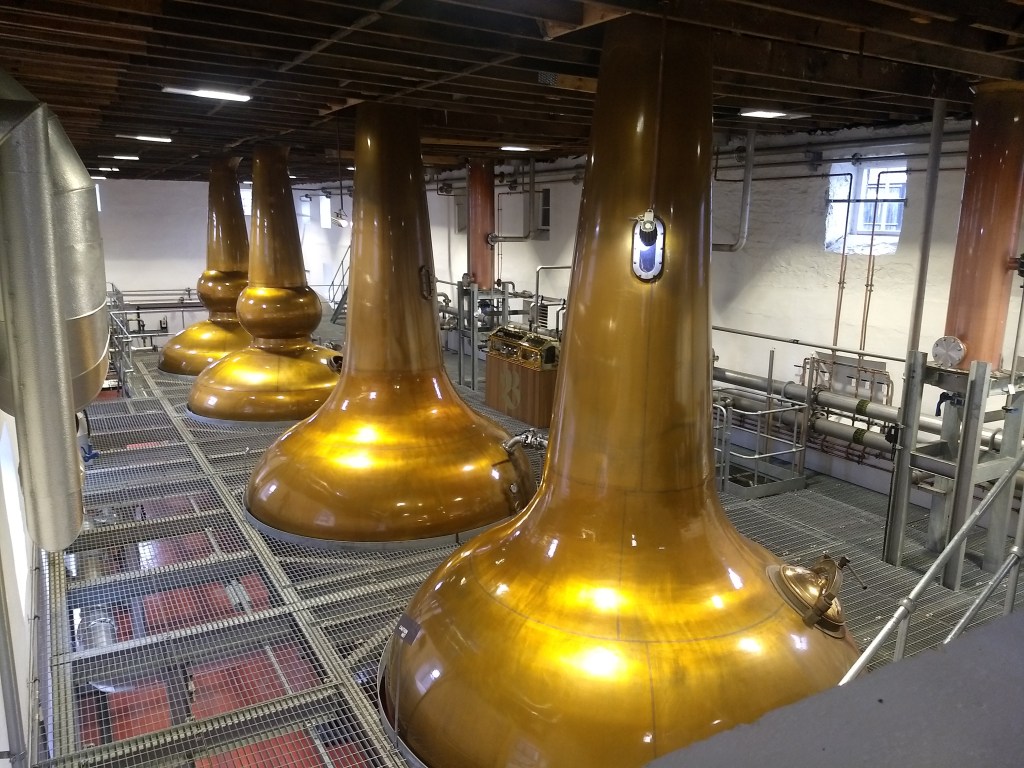
We moved to the still room, where four shiny copper stills (two wash stills and two spirit stills) were actually working! It was very nice to see the liquid been distilled through the wash stillโs little window.
What a beautiful still room!
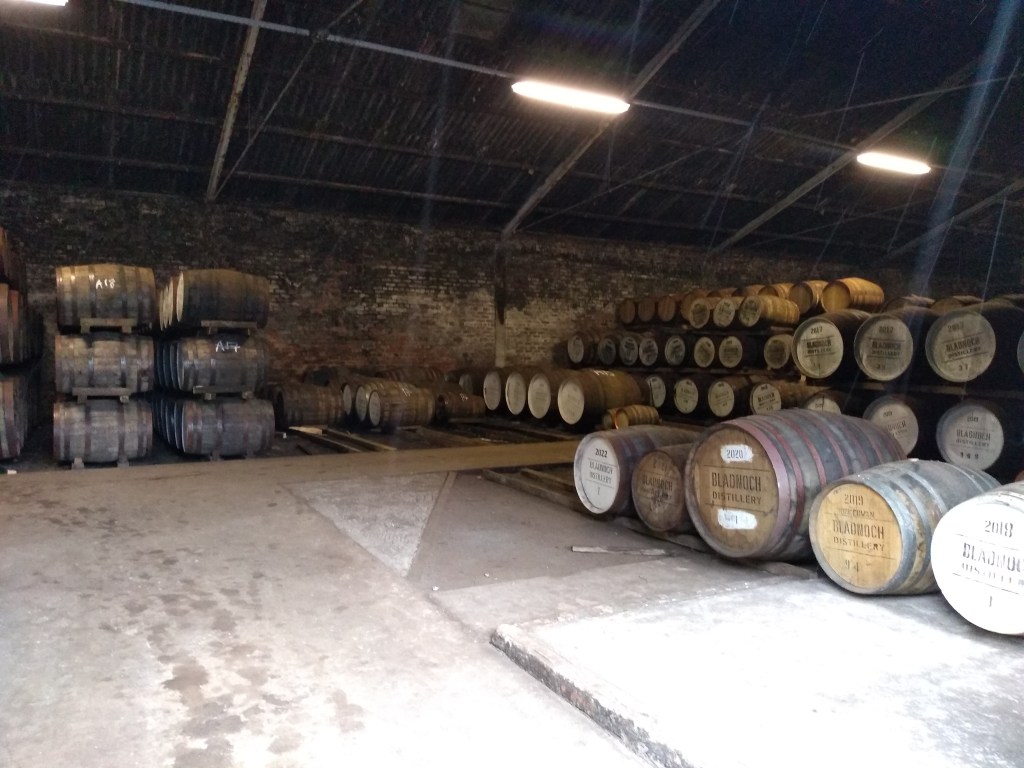
Once in the courtyard, we could admire the old distillery building including the malting floors, that are now used as offices. James also showed us the water source, just behind the old buildings. We spent a while inside the dunnage warehouse (where we couldnโt take pictures, except from outside the door). The new make spirit is maturing in a variety of casks: quarters, lot of sherry hogsheads, lot of wine barriques, bourbon, etc.
Birthday girl and the old malting floors.Casks, casks, and…more casks.
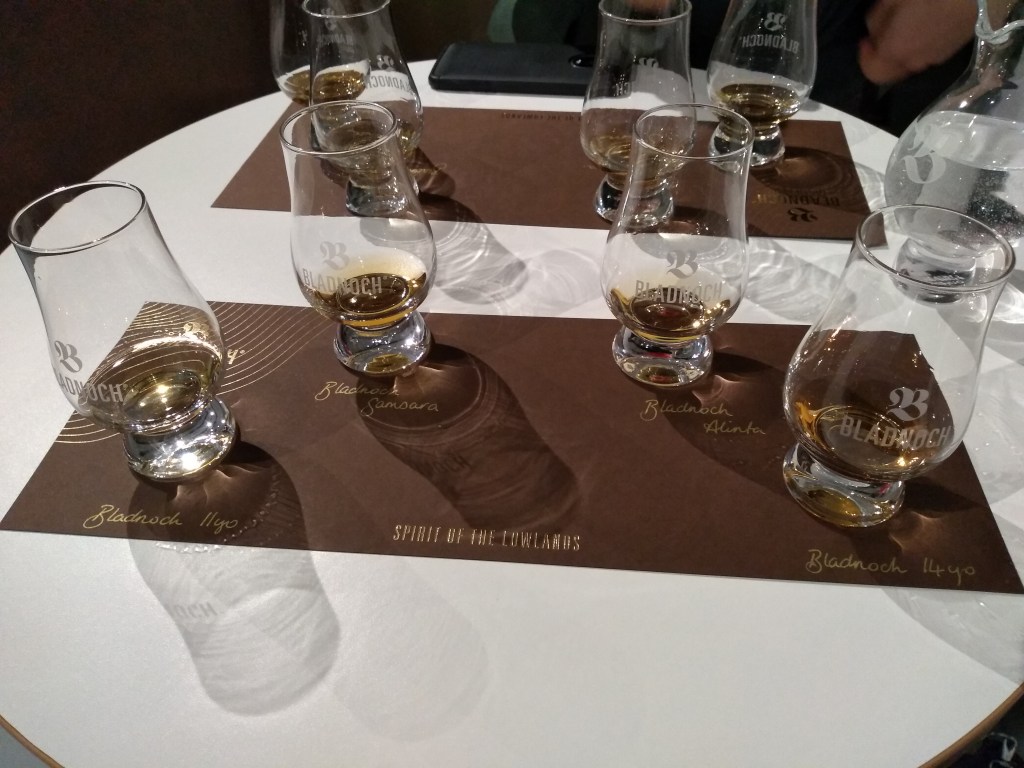
We finally got to the tasting room, adjacent to the shop, where 5 drams were waiting for us: the new make spirit (nice surprise!), and four of their core range expressions (see summary below). Because most of the whisky they are currently bottling comes from the previous owners, at this point in their journey they want to showcase what they can do with the range of casks available. In our opinion all the four drams were all very cask-forward and enjoyable, although not mind-blowing. The two stand-out were the 14 y/o matured in ex-oloroso sherry casks, and the 19 y/o matured in ex-PX casks, of which James gave us a wee taste at the bar. A shame the price of both was a bit too steep. After the tour we stayed for a quick meal at their nice cafรฉ: a plate of smoked duck and salmon, very good!
A (not so) wee taste of Bladnoch.
On the way back to Wigtown it started raining (sad trombone sound), so as we got into the village we sought refuge in another cafรฉ (that was Gianluigiโs excuse to get another cakeโฆ). After leaving Wigtown (with a few more books in the trunk) and driving around a bit we directed ourselves towards our place for the night: the Waterfront Hotel in Portpatrick. This is a quite spectacular village on the Rhinns of Galloway peninsula, right in front of Ireland (which we couldnโt see because of the clouds). Our room was very โcosyโ (not to say tiny), but the staff was nice enough to give us one with a spectacular sea view. We had a delicious meal at the Connorโs restaurant, where we could also taste a couple of discontinued Bladnoch expressions: the 10 y/o (which Ralfy talked a lot aboutโฆand in fairness, it was one of the best we tried) and the 17 y/o.
Despite not bringing any bottle with us, we were very happy to have visited Bladnoch distillery. This experience was an example how the guideโs enthusiasm and knowledge can really โmake the tourโ, which otherwise could have been a very โstandardโ one. So, to James, Slรกinte!
Bladnoch 1817 Tour & Tasting
Price: ยฃ50.00 pp + ยฃ5 per transaction (March 2022)
Tasting: Bladnoch new make spirit (63.5%), 11y/o (46.7% , NCF, NC, ex-bourbon casks), Samsara (46.7%, NAS, NCF, NC, California wine and ex-bourbon casks), 14y/o (46.7% , NCF, NC, oloroso sherry casks), Alinta (peated, 47% , NAS, NCF, NC, 1st fill ex-bourbon and 1st fill ex-sherry casks)โฆand the glencairn to take home
Target: whisky enthusiasts and geeks
Value for money: a bit pricey but the in-depth tour made up for it
Highlights: the very enthusiastic guide James and the possibility of tasting extra drams
A Sunday trip with Justine around the Lowlands looking for lost distilleries (this time, requiring a car and a very knowledgeable friend!)
(Missed the other trips in and around Edinburgh? Here they are: One/Two/Three)
There was a time when the Lowlands had less than a handful of single malt distilleries left, mainly Auchentoshan, in Glasgow, and Glenkinchie, near Edinburgh. Until it was purchased by Richard Prior in 2015, Bladnoch had a very tormented history, with many stop-and-go. Other very popular distilleries closed during the whisky loch, such as Rosebank (closed in 1993), Littlemill (1992), Inverleven (1991), and St. Magdalene (1983). While the first is in the process of being rebuilt, the other ones are gone forever.
Many grain distilleries experienced a very similar fate. During the whisky loch and in later years Caledonian (closed in 1988), Cambus (1993, now Diageoโs cooperage), Dumbarton (2002), and Port Dundas (2011) closed down, while the production got progressively concentrated in the few remaining, like Cameronbridge (Fife), North British (Edinburgh), Strathclyde (Glasgow), Starlaw (Livingston), and Girvan (Ayrshire).
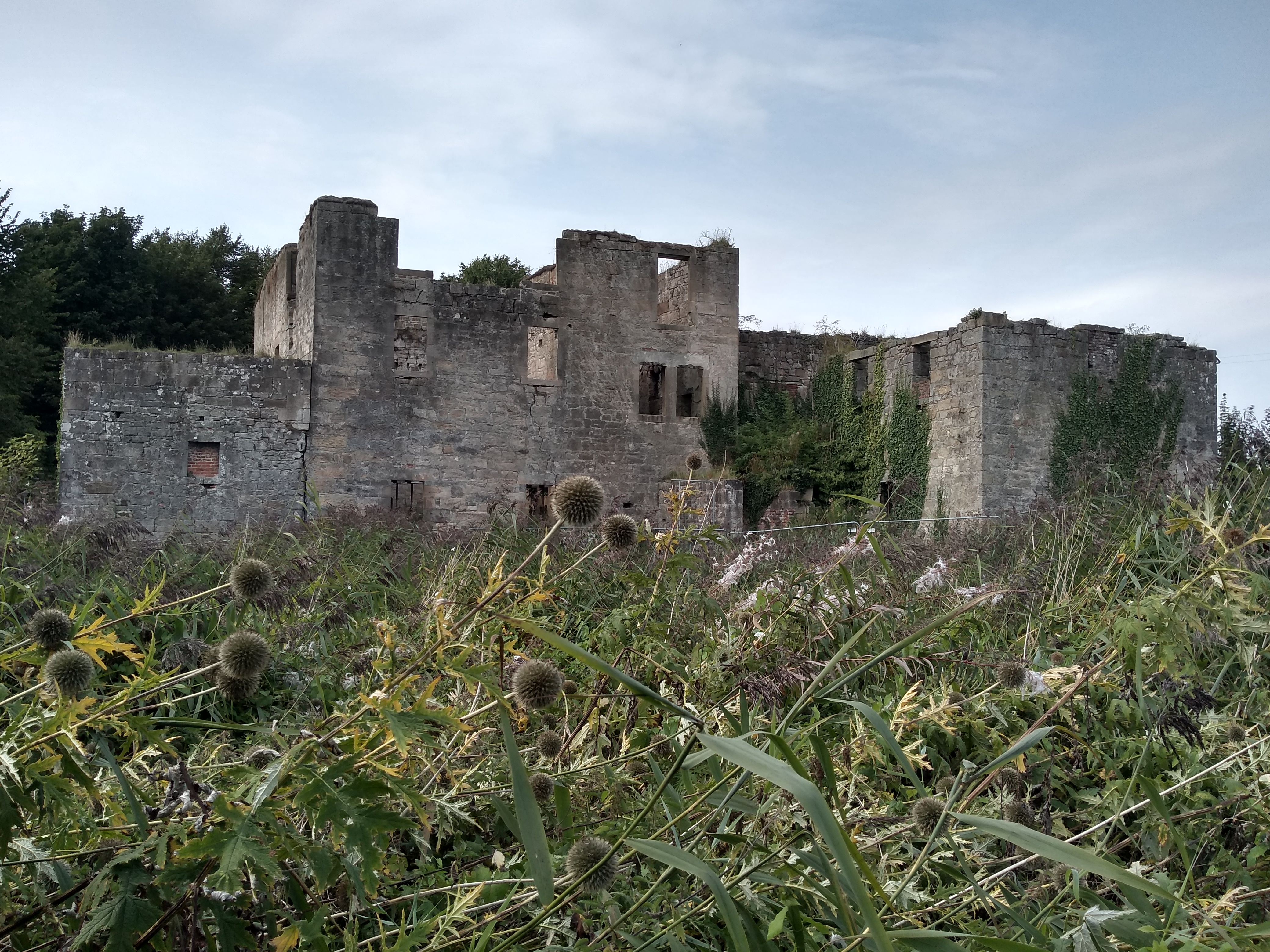
Scottish whisky went through several ups and downs in its history, and already during the 19th century saw massive plants closing down. One of these was the Kennetpans distillery, near Alloa.
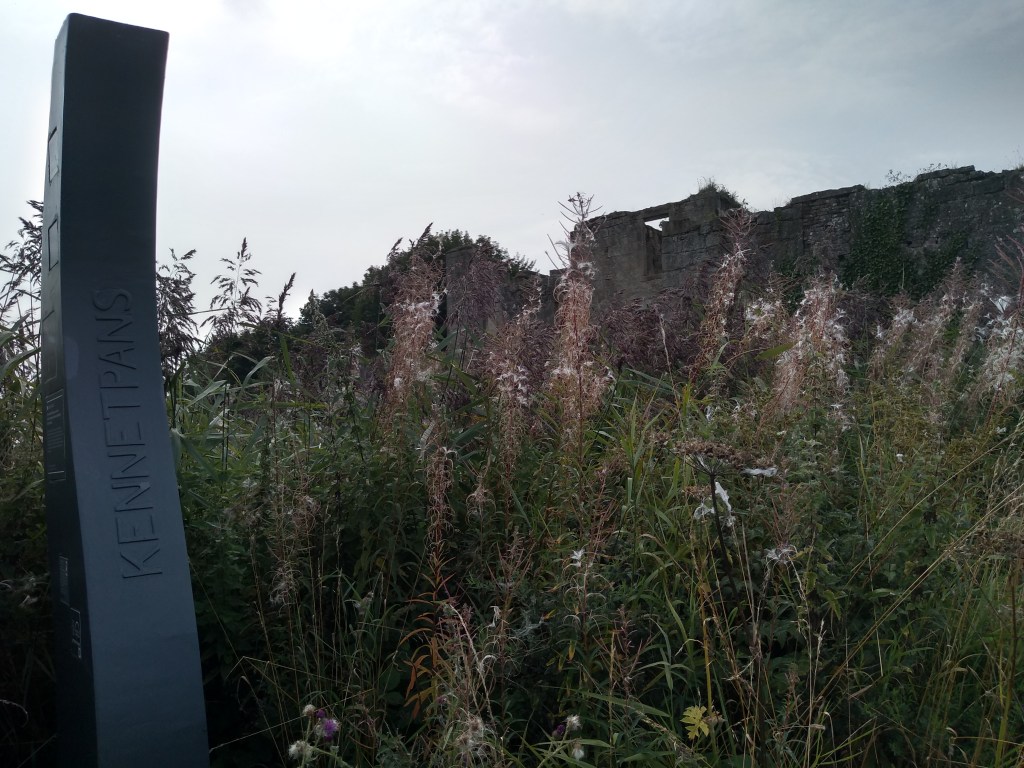
Hidden sign of a hidden story.
This distillery was funded by the Steins family in the first half of the 1700s, and was followed a few decades later by the Kilbagie distillery. The two plants were massive for the time. They were connected by a canal and a railway, and were the first exporting bulk spirit outside of Scotland. The family was related through marriage to the Haig, of Cameronbridge, and the Jamesons, of the famous Irish whiskey. Following an increase in duties on spirit in the late 1780s and after a bribe attempt, John Stein and his family fell in disgrace, and the Kennetpans distillery was sequestered, sold, and finally closed in 1825, probably made obsolete by the invention of the Coffey column still. For you history buffs, there is a great website dedicated to Kennetpans (see here or below).
We were totally unaware of this โancientโ history, until a Sunday in September 2021 when our friend Justine (Kask Whisky) proposed to go there. Had already done our weekend run, we happily joined her! The site is a few km from the village, kind of in the middle of nowhere. We left the car a few hundred meters away, and we slowly explored what is left of the building. It was not possible to get very close because of safety fences, and the thick vegetation partially covered the building. However, it was possible to get a sense of the size of the plant, which at the time must have been massive indeed! As it was still early afternoon, and having being lucky with a very sunny and warm day, we decided to stay a bit in the area and take our exploration further.
Lost distilleries, theory and practice.
The trend of distilleries shutting down slowed down in the late 1990s and it was actually reverted in the 2000s, in particular for single malt distilleries. In 2007 the gigantic Ailsa Bay distillery was commissioned and built in just 9 months (12 millions of alcohol liters per annum produced). This is owned by Grant & Sons and is on the same site as the Girvan grain distillery. Almost a decade later, it was followed by a plethora of new distilleries, opening all over the place south of the Highland line. We already talked about a few of those, such as Holyrood (Edinburgh, 2019), and the Borders (Hawick, 2017). Another one, the Falkirk distillery, had been in plans for almost a decade, and in 2020 finally started producing spirit. We drove there, and we were able to take a few pictures from the gate. We found the building quite beautiful, with the few remaining works mostly limited to the parking lot. We are definitely looking forward to visit it!
Open soon to visitors, please!
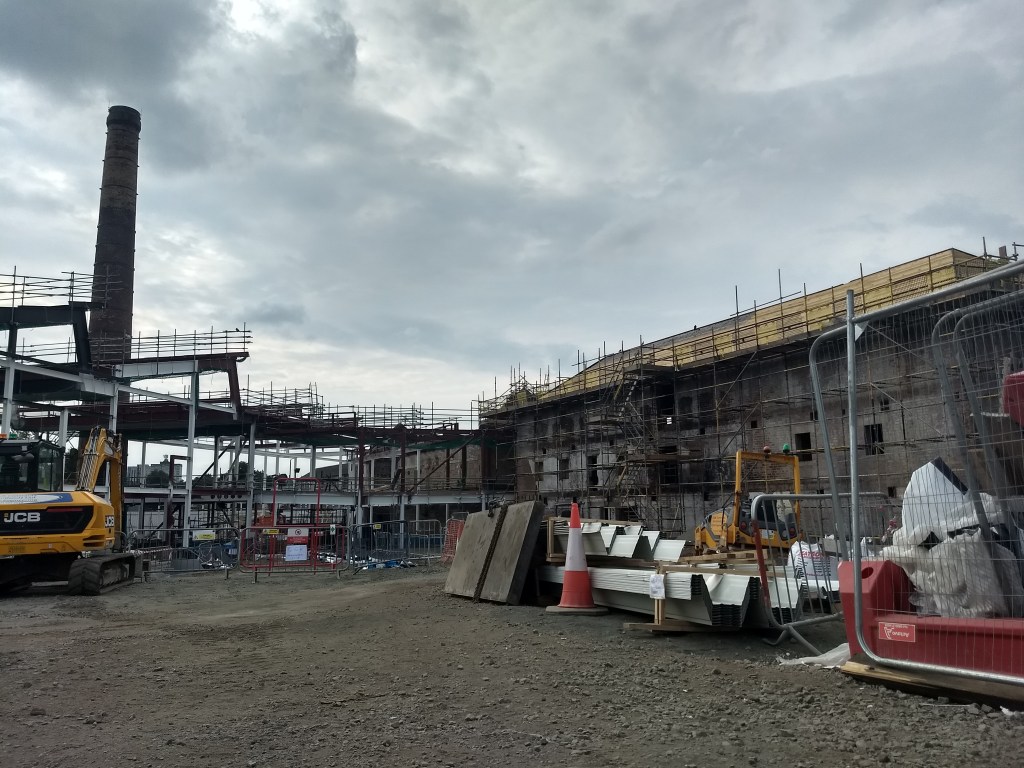
Not far from there, another distillery that will be firing its stills soon is the missed Rosebank, still in Falkirk. Ian McLeod (already owners of Glengoyne and Tamdhu) purchased the trade mark back in 2017 together with some old stocks, and the construction is happening as we write. On that day we could just see the skeleton of the building, which didnโt look much like a distillery yet. Now works are well ahead, as you can see from their social media accounts.
Rosebank or…when whisky makes building sites interesting.
Fourth and last stop of the day was the old St. Magdalene distillery, in Linlithgow. It closed down in 1983 and, similarly to Caledonia and Dean distilleries in Edinburgh, was made into flats a decade later. However, the structure of the building, including the pagoda roof and the warehouse, is still admirable from the street. Being in Linlithgow, we decided to stop at Du Vin Bouchers, a very nice wine and whisky bar, for cheese and drams. The bar is very cosy, and the choice of whiskies is excellent, in particular from the Dram Fool independent bottler range. They also host Jolly Toper tastings. As the day was getting to an end, Justine slowly drove us back to Leith, ending this day full of whisky history!
A bunch of flats that used to be St. Magdalene distillery.
Thinking about all this whisky history, made of ups and downs, and of spirit first flowing, then stopping, and now flowing again, many questions popped in our heads. One is, how many of these new distilleries would survive a potential whisky loch? How many distilleries are too many? And, once maturity is reached, will these spirits be different enough for each to find their ecological niche in the whisky landscape? These questions are just food for thoughts right now, and they are not definitely ours to answer. At the moment we feel extremely lucky to witness a new golden era of whisky, and being spoiled for choice! Long live the Lowlands malt, slainte!
When we stop and think about it, itโs incredible how this all started, almost by chance. Someone would say โserendipityโ. Roy Aquavitae centered one of his vPubs around this concept, telling the story of how he stumbled upon whisky (scotch in his case) at some point in his life, almost by chance. We are no different.
Back in August 2016, we had picked up the Bourbon Trail Passport at Heaven Hill, the first whisky distillery we ever visited. At the time, to complete the passport, there were only 9 distilleries to visit. Just to give you an idea on how quickly things are changing in the world of whisk(e)y, now there are 18 (and, on top of that, there is also an alternative Craft Bourbon Trail). Had there been that many at the time, we probably wouldnโt have completed it. However, with only 6 to go after our roadtrip in the South, we thought it was doable in a weekend, so there we go!
March 2017, Teresa was back in Illinois to visit. We were coming out of a quite cold winter, at least for our standards – earlier in January the temperature wouldnโt have gone above -10C for an entire week, with peaks (well, drops) at around -23C. One Friday, we rented a car and drove straight to Louisville, where we had our hotel booked.
The Saturday was particularly challenging, with four distilleries visits planned. This is still the maximum number of distilleries we visited in a single day, and to be honest, we wouldnโt do that again, but rather take an extra day. The driver of the day was Gianluigi, and that meant he only took a sniff from the samples and a few tiny sips, planning to fully enjoy the stuff later at the hotel.
First off, Maker’s Mark, joining the first tour of the day. The distillery is in a very nice location, with rolling green hills (like many places in Kentucky), wood, and black and red buildings.
Beautiful morning at Maker’s Mark.
As for Jim Beam earlier in August, in the tasting at the end of the tour we appreciated the range of flavours a single distillery could produce, and although their flagship product was not our favourite, some of the other drams were truly excellent (we wish we could remember what they wereโฆ).
After we were done with the Makerโs Mark and their very generous tasting, we headed North-East towards Woodford Reserve. There, we only did a tasting, a couple of drams paired with chocolate for about 10 dollars.
Wee tasting at Woodford Reserve.
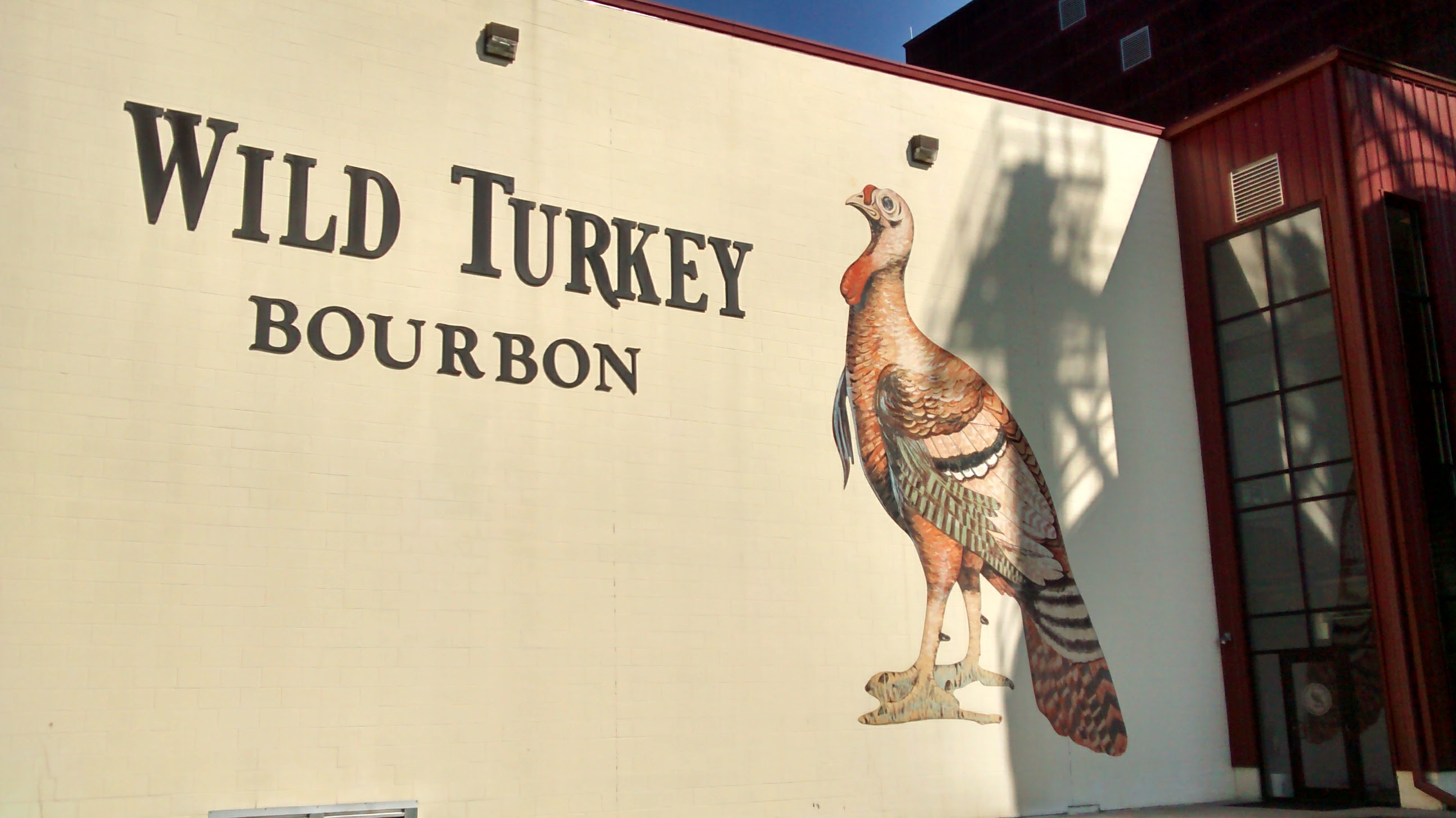
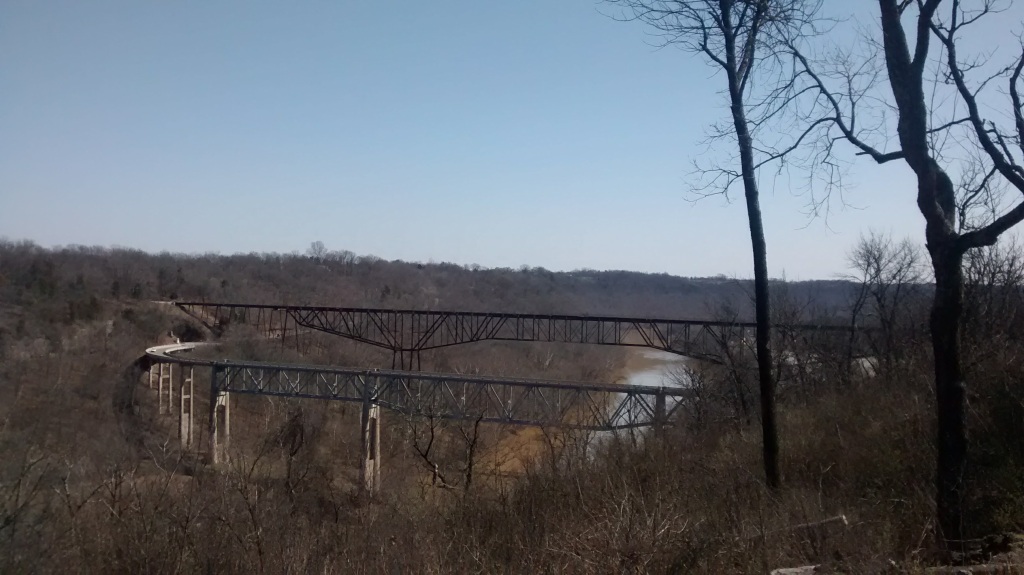
As the previous distillery, it looked quite nicely immersed in the rural landscape. A bit of a change would have come later, at Wild Turkey. Compared to the other ones, the Campari-owned distillery looked more like an industrial plant (or maybe the other ones are just better at hiding this, considering they all produce a huge amount of spirit). This not to say we did not like it, on the contrary we loved it! Also, the tasting room was in a very scenic spot, overlooking an old rail bridge. Here they gave us four drams, including a delicious Rye whiskey and a less so honey liquor (some things you just canโt unlearnโฆdefinitely not a drink for us). The other stuff was great however, and Wild Turkey is now one of our โnever without at least a bottle in the cabinetโ (at the moment: the 101 and the Rare Breed).
Wild Turkey tasting (yes, they gave us the glasses!) and……the view from the tasting room.
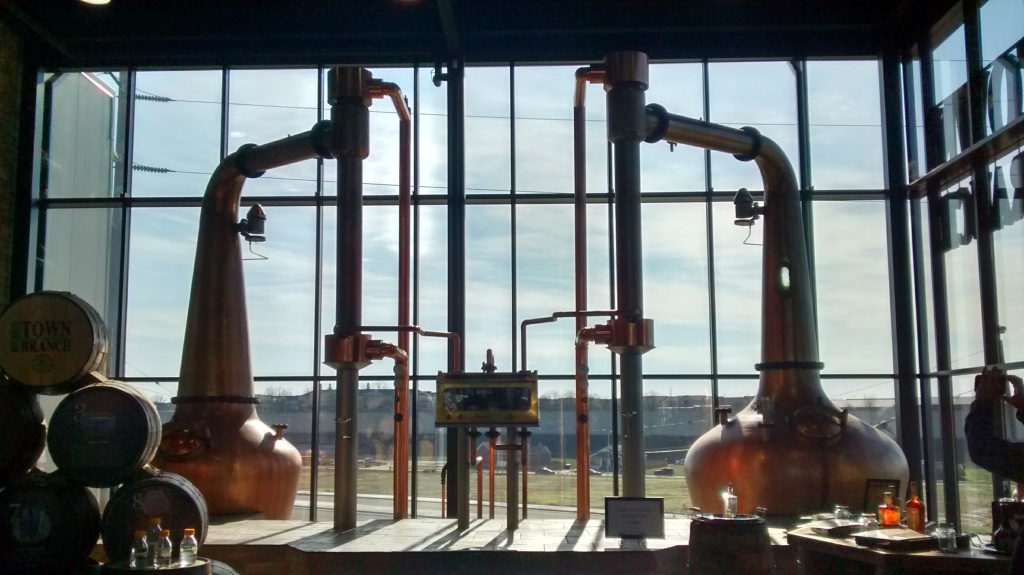
We moved on to the last distillery of the day: Town Branch. Located in downtown Lexington, it marked the move from the rural landscape of the early part of the day, to a nice and vibrant urban atmosphere. We picked the distillery tour only, skipping the brewery part, which brought us into the whiskey making plant. Particularly notable was the still room with the two long-necked copper stills, and a big window overlooking the landscape.
What a still room they have at Town Branch!
We enjoyed the view while enjoying the tasting at the end of the tour. We drove back to Louisville for dinner, which we had at the Feast BBQโฆguess what we had? Weโll just say that the beef brisket was spectacular.
Sunday started slowly, taking advantage of the hotelโs facilities, including a (first) light breakfast. We drove towards downtown Louisville to have a (second) bigger breakfast, which we had in a local restaurant called Wild Eggs: holy molly that quesadilla (yes, Gianluigi does still rememberโฆ)! We then moved to the first of the two distilleries of the day: the Evan Williams experience, in the middle of the city. Although the main Evan Williams production is at Jim Beamโs, here they have a little experimental distillery with a capacity of one barrel per week. We chose the tasting experience, which was organised as a tour in a speak-easy bar, with the guide dressed as a bartender of the 1920s-30s. The drams here were pretty awesome, we still fondly remember a 12y/o (which we hugely regret not buyingโฆwhat newbies!) and a 22y/o bourbon that blowed our socks off! Unfortunately for Teresa, she was the designated driver for the day, but she eagerly packeted the samples for later.
We proceeded to the last distillery of the trip where weโd have (finally!) our Bourbon Trail Passport completed: Bulleit!
No longer newbies (well…), Bourbon Trail done!
To this day this is still one of our favourite bourbons, probably also because of the high rye content of the mashbill. Their Rye whiskey is also a favourite of ours, and we’re not the only ones: months later the bottle of Bulleit Rye that Gianluigi had gifted to his parents evaporated in mysterious circumstances (a dinner party, apparently…or maybe angel share?).
Our trip was over, and we finally headed back to Illinois, tired but happy to have done something special (including the fact that in all tours we were the only non-Americans). Thinking back to this experience today, it seems like ages ago. Maybe itโs because of the pandemic, or maybe the years have really gone by, or maybe it’s just that so many ‘whisk(e)y things’ have happend afterwards.
Today whysk(e)y is not just our hobby, it’s our gateway to a world of flavour and experiences. Visiting distilleries is by far our favourite holiday-type, we love getting to know whisk(e)y and the people making it. Every distillery has its own story and is embedded in its own unique atmosphere, which cannot be replicated anywhere else. We are never tired of learning, and with 50 and counting distilleries visited now, we still feel there is not enough time to learn and see all the things we would like to! And all started with a โwhy notโโฆ.serendipity?
How a bad weather day throwed us into the world of whisk(e)y!
So, how did a couple of Italians, whose families’ drink of choice has been wine for (probably) generations, get caught into the fabulous world of whisky? Well, thanks to a road trip in the United States South and to a very nice host. But letโs not go ahead of ourselves and proceed in order.
Before 2016, we did not have much idea about what whisk(e)y was nor how it was made. In 2015 Gianluigi moved to Illinois, right in the middle of mid-west. One evening, a friend poured him something that he never forgot, something new: a Laphroaig. That prompted him to purchase a couple of scotch bottles (two because he first bought a Glenfiddich 12y, thinking that it would have been the sameโฆhow dare him!). Besides that, not muchโฆwhisk(e)y was just another spirit. Teresa was a bit more experienced (so to speak), as from time to time she would end an evening with friends with peated whisky instead of amaro.
Comes 2016, Teresa arrived to Illinois for the summer holidays. We had decided to take a road-trip, our favourite style of vacation. This time, a really big one: the mighty South! From Illinois down to Kentucky (through Indiana), Nashville, the Appalachian Mountains, Charleston SC, Savannah GA, then straight West to New Orleans, up to Memphis, St. Louis, and back to Illinois.
First stop: Louisville, Kentucky (KY)…you probably already see where this is going. At the time we were still using AirBnB (later we decided to stop because of the increasing cost of living that this and other short-term rent companies are causing to locals, who struggle to find affordable flats, in particular in cities like Edinburgh) and we stayed in a typical American suburbia house, hosted by a very nice couple. While having a relaxed chat in the evening, he poured us some bourbon and suggested us to take the exit 112 from the Interstate 65, because there were a few open distilleries just 10 to 15 minutes away. We looked at each other and thought: “why not”?
The day after came, and the weather was not exactly a delight. So, a further reason to take a few hours for the โbourbon detourโ. First, we tried the farthest from the highway, the Heaven Hill Bourbon Heritage Center, in Bardstown. We were unlucky there, as the tour had just left, but a tasting would have started soon enough. In the meantime, we could admire the huge rickhouses on the rolling hills outside the visitor centre.
Rickhouses at Heaven Hill.
The tasting was very informative, covering the history of the distillery and all the brands they had acquired, in particular after the prohibition era. The line-up was made of four drams, the first one (a rye) promptly necked by Teresa despite the guide telling us to take a wee sipโฆ of course Gianluigi shared his afterwards. There was also an Elijah Craig bourbon, while the final dram was a very “woody” example of how, sometimes, too long maturation can go wrong. At the visitor centre, we spotted the Kentucky Bourbon passport, which we both took and put the Heaven Hill stamp on.
A new challenge ahead: getting all the distillery stamps!
We tried our luck at the next distillery: Four Roses (actually, the warehouse and bottling plant in Cox’s Creek). Again, no luck, the tour had just started, so we did the tasting, again. We had their three main bourbons for the (ridiculous) price of $5.00: the Four Roses Bourbon, Small Batch and Single Barrel. While Teresa loved the latter, Gianluigi preferred the middle one, but overall we were surprised by how good it was (Gianluigi in particular, as he remembered a drunken night of over a decade earlier fuelled by an unpleasant Four Roses bourbon).
Back in the car, we headed towards the third and last distillery (for now), Jim Beam. Here we were finally able to take the tour (hurray!).
Our very first distillery tour!
It was a great experience, the guide was very funny and prepared, a great start for newbies like us. We could understand how whiskey is made, and walk inside one of these huge rickhouses we kept seeing around, and all the rules of bourbon and rye (>50% corn/rye, new oak barrels, etc). At the end we could choose two or three drams in their huge product range (great favourites, Bakerโs and Knob Creek).
What we could choose from.
Here, by trying several expressions next to each other, we could fully appreciate how bourbons (and whisky in general) can be very different despite being produced on the same site. And in this moment, folks, the seed of our curiosity towards whisk(e)y was first planted in our mind, taste buds, and heart, paving the way to what would have happened next.
[If you are only interested in our whisk(e)y journey, you can skip the rest and go to the second episode. Otherwise keep reading about our road trip]
The trip continued not as smoothly as we would have liked. Nashville was great, although the Music Broadway was a bit too fake for us (in three out of four bars we entered the band played โSweet Home Alabamaโ, in all four โTake me Home, Country Roadsโ). That was compensated by an early morning visit to Jack Whiteโs Third Man Records store and a delicious fried chicken lunch!
Happy guy at Third Man Records.
The Appalachians and the Smokey Mountains were also great. After driving through Chattanooga and before the Blue Ridge Highway, we stayed near Sylva (NC) where our friend Matt (if you want to know all the coolest things about plant ecology, he is the guy! here his website and podcast) brought us to taste delicious beers at the local Innovation Brewing.
After a detour to Charlotte (NC) to pick up two Pearl Jam tickets and before visiting the stunning Charlestone (SC), we had our first setback: bed bugs! We left the motel (clearly too randomly picked) in the middle of the night to avoid being eaten alive (fortunately we had not opened our luggage to avoid our clothes smelling like cigarette…not sure about calling that luck). But the real issue happened the day after: 10 minutes before reaching our (more carefully picked) motel right outside Savannah (GA), we got rear-ended by a distracted lady on the highway! We were intact, the car not so much, and we had to spend half of the next day trying to get another one from the closest open (it was Saturdayโฆ) car rental branch. Thankfully this didn’t translate into a huge financial issue, as we were covered by the roadside assistance insurance. Since then we have always included it in our rentals!
That was the last bad thing happened to us during the trip (hurray!).
Teresa hugging the King in Nashville!
Savannah was truly gorgeous, a shame we could not stay more. At one point we were having a beer on the river side, and a guy asked Gianluigi if he could take a picture him and his gilrfriend. โOf courseโ, the prompt reply. The phone was filming a video, however, and when Gianluigi was about to tell the guy, he realized that the guy was proposing to his (soon) fiancรฉ. Gianluigi could not hold back a loud “holy s**t!”, ruining the proposal video forever. Teresa laughed at the idea of the two showing it at the wedding.
After driving through the Florida Panhandle (if for any reason you happen to be in Fernandina Beach, close to Jacksonville, get a sandwich at the Hola! Cuban Cafรจ: OMG!!!), we finally arrived at the most awaited stop-over: New Orleans.
Amazing live music in NOLA!
We both fell in love with the city, its atmosphere and the music which seems to permeate every bit of life. Even Gianluigi, contrary to Teresa not a big jazz fan, couldnโt stop speaking of how great that was, in particular after a concert at the Preservation Hall. Following NOLA, another music city: Memphis, one of the cradles of Blues, with a capital โBโ (and the best pulled-pork we have ever had!).
Spectacular Missisipi river side in Memphis!
Final stop: St. Louis, once an important industrial centre, now a tale of two sides: it is staggering, and frankly very sad, the difference of livelihood between neighbourhoods, sign of deep inequalities (to be fair, that was a constant of all cities we visited during this and other trips in the US).
What about the other KY distilleries? Well, youโll have to wait until next week. Stay tuned and slรกinte!
For the first time we visited a winery in the Bolgheri area in Tuscanyโฆwith a Scottish connection!
Because of you know what, we havenโt visited our families for over a year, skipping the Italian Christmas for the very first time in 2020. Almost unforgivable!
This year, we made up by staying over a month between Piacenza (in the Emilia-Romagna region) and Florence. Both areas are famous (well, one more than the otherโฆ) for great food (of course, the lesser famous is the one with better foodโฆTeresa might disagree with this statement) and delicious wine. This makes visiting our families even nicer. The only problem is the lack of whisky distilleries, with the next whisky trip planned weeks ahead. Nonetheless, we found a way to keep our palate trained with a different kind of experience.
In scotch whisky, red wine cask finishes are a relatively recent trend. Surfing the web, we realised that for more experienced whisky aficionados this might be still an unusual, and not always welcome, finish/maturation. Instead, for people like us that have been into whisk(e)y for a few years only, this feels pretty normal. Indeed, we were able to connect more easily with many red wine cask finished drams, such as the Arran Amarone cask, the Port Charlotte MRC, the Ledaig Sinclair Rioja finish or the Longrow Red(s). In our experience, French wine casks seem to be the most prevalent, but we are seeing more and more Italian wine casks.
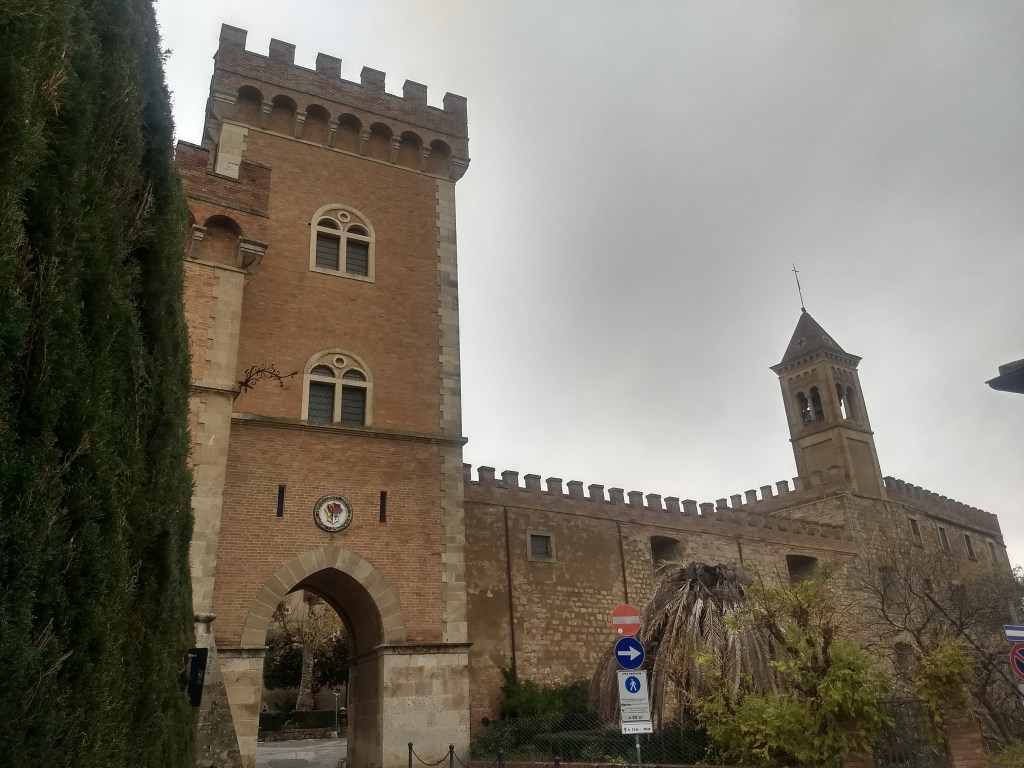
The Bolgheri village gate.
Two drams that recently surprised us came from GlenAllachie: the first was a widely distributed 11y single malt, bottled at 48%; the second was again 11y, but cask strength and only available at the distillery (click here for more about that trip!). Both were finished in red wine casks from the Grattamacco winery, located on the hills in the Bolgheri area (Livorno Province), an officially recognized wine geographical denomination. In recent years (well, recent in โscotch timeโ) Bolgheri wine has become really popular, with over 60 wineries now active in the area. All of this just to say that one morning we woke up and said: โWhy donโt we just try to check that out?โ โWine not?โ (wink-wink). So there we go! We booked a tour, took the car and drove! We left Florence quite early and after a quick stop for gas and to allow Gianluigi a second breakfast with a delicious pistachio custard croissant, we were on our way to discover a new place! The ride was almost two hours but quite smooth, in fact we arrived early. We thought about taking a walk, but after realising how frickinโ cold it was, we just rang the wineryโs bell.
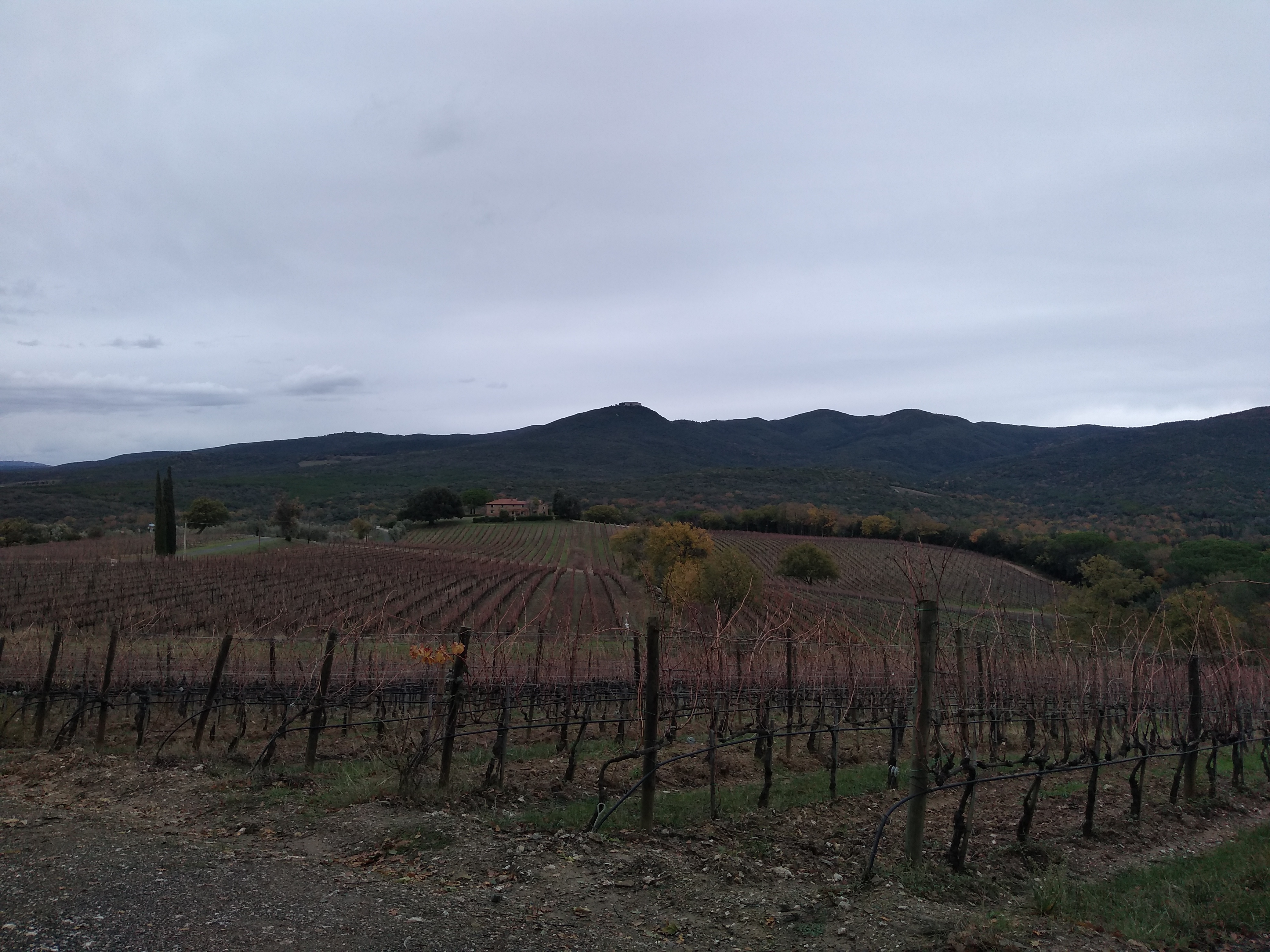
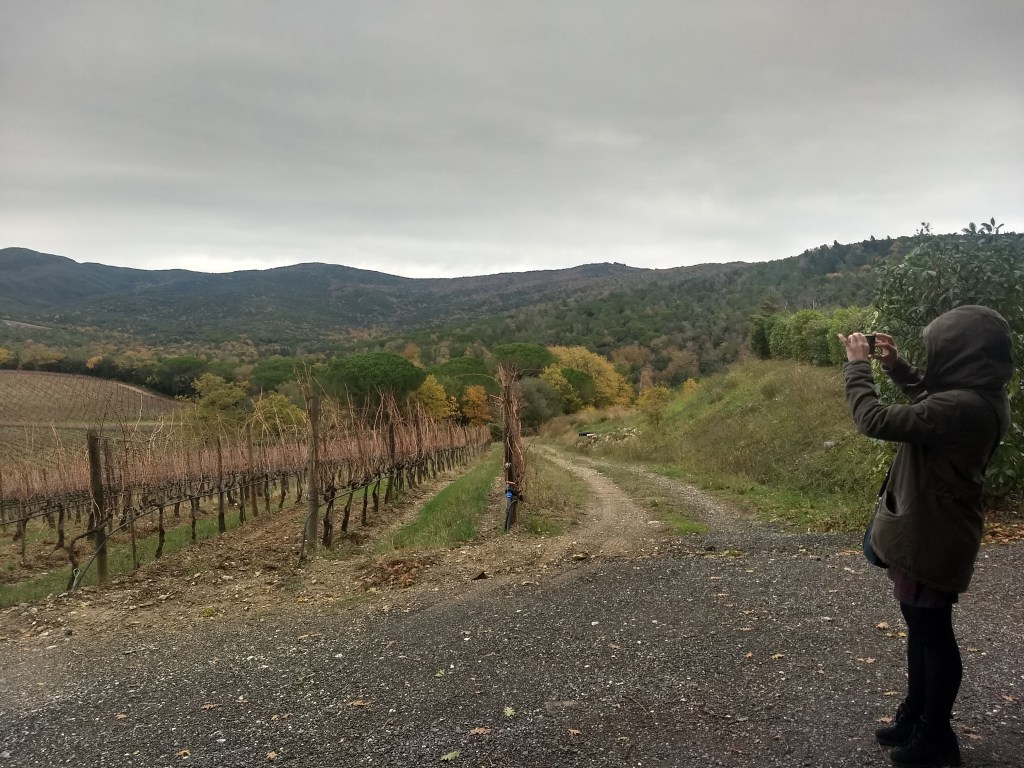
Taking pictures of the vineyard while freezing.
Michela, our guide, was already waiting for us. After our vaccination passesโ check, the visit started in the tasting room, which featured an amazing view on the hills and the Tirreno sea. Michela told us the story of the winery, which was founded in the late 70s by a guy from Lombardy, and sold in 2002 to the Colle Massari company. Compared to other wineries in the area, the estate is at a slightly higher altitude (around 2-300m on the sea level), therefore with a slightly different micro-climate.
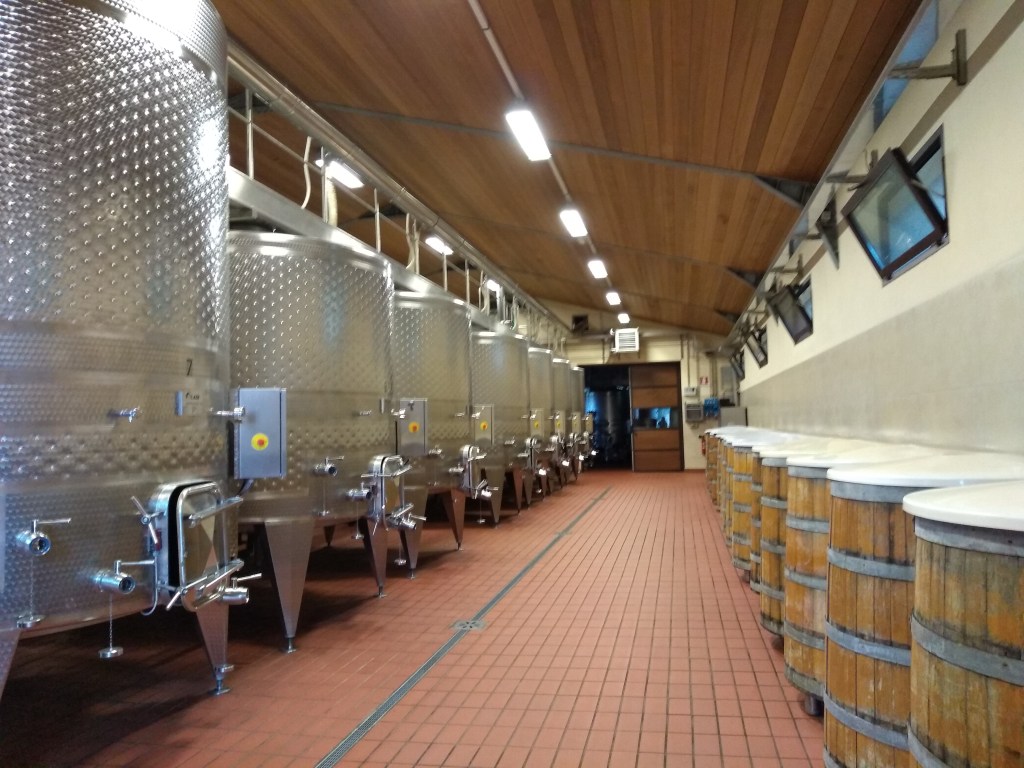
The fermenting vats of the Grattamacco winery
After the introduction, we moved to the main production building. They harvest several grapes: Cabernet-Sauvignon (which is the main component of their red wines), Cabernet-Franc, Sangiovese, Merlot and Vermentino. Grapes are mechanically soft-pressed and cleaned to get the must, which is fermented in two types of vessel: metal big tanks or wooden 500 litres open vats (which smell great!). Then, we visited the cellar, where the casks are stored, divided by vintage. All casks are from the Taransaud tonnellerie (cooperage) and are of course made of French oak (Quercus robur)โฆthe smell down there was amazing too! We could also take a look at what Michela called โthe libraryโ, where all the vintage bottles (starting from the early 80s) are stored. They use the casks up to four times, before selling them to other smaller wineries or to distilleries to make awesome whiskies (like the GlenAllachie). The vinaccia (leftover of the wine production) is sent to a distillery in Veneto region to produce Grattamacco grappa, and they also grow olives to produce olive oil.
The cellar.
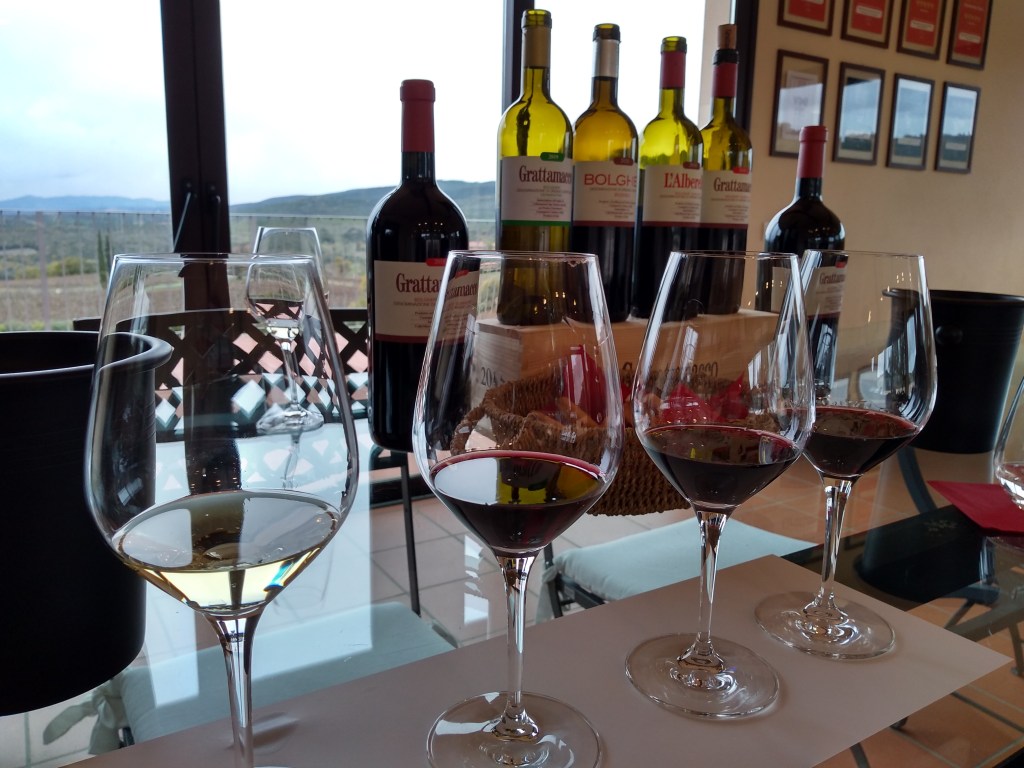
And now, the wine tasting. First off, a white wine, made 100% with Vermentino grapes. We were both pleasantly surprised by how good it was (both not huge fans of white wines, but this oneโฆWOW!). Second, the Bolgheri Rosso, made with four grape varieties (Cabernet-Sauvignon, Cabernet-Franc, Sangiovese and Merlot), fermented in the metal tanks, and aged 5-6 months. The third and fourth were the stars of the tasting: lโAlberello, single vineyard (less than 2 hectares, Cabernet-Sauvignon and Cabernet-Franc grapes) and aged for almost 18 months. Finally, the long awaited Grattamacco: fermented in oak vats, aged 18 months, mostly Cabernet-sauvignon (~65%) with an addition of Merlot and Sangiovese, with the percentages varying each year. These two wines were both sublime, and it was really hard to decide which one was the best! Anyway, thanks to this visit we sorted out a number of Christmas gifts.
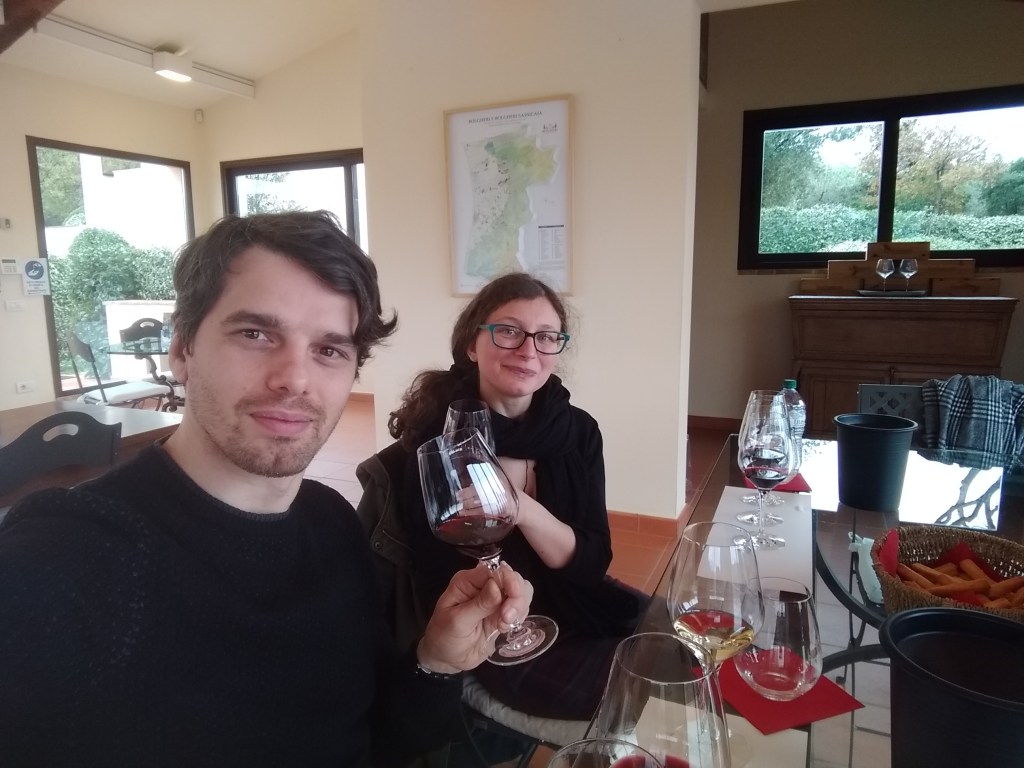
The tasting!
Before going back to Florence, we had a nice lunch in a nearby restaurant (an โagriristoroโ, actually), with delicious local food: wild-boar and beef roast. We slowly drove to the (quite small) Bolgheri village, where we took a walk, had a coffee and another glass of wine for the non-driver (Gianluigi): the mighty Sassicaia (mighty also for the price).
Definitely happy to try something different!
Overall, this was an amazing day and no less fun than the trips we usually do, the ones where we end up saying: โwe should do this again asap!โ! Being our first winery, we felt like total newbies again, but it was a great educational experience (btw, please correct us if we wrote anything wrong!). We have learned so much about this amazing nectar which has been on our familiesโ tables since we were kids. And the wine spoke for itself!
Grattamacco Winery Tour and Tasting
Price: 35.00 EUR pp (December 2021)
Tasting: 4 glasses of wine – Grattamacco Vermentino (white), Bolgheri Rosso (red), LโAlberello DOC single vineyard (red), Grattamacco Bolgheri (red)
Target: anyone
Value for money: looked good to us, but we can’t really tell as this was our very first winery tour
Highlights: the view from the tasting room, the tour in the cellar and the winesโฆpretty much everything!
And finally itโs the Springbank-Glengyle day! During our first trip here, back in 2018, we only visited Glen Scotia and opted for the Cadenheadโs Warehouse tour instead of the Mitchellโs company distilleriesโฆwhat did we miss! Fortunately, the folks at Springbank were nice enough to offer us a tour on a Saturday, which is normally closed (many thanks to Mary for that), and a tasting at their newly build Washback (spoiler: the bar is made of an actual wooden washback!).
Dry peat and wet peat!
Since we were the only group, we could tour the distilleries all together. First off, Springbank. We started off with the malting facility, which they still do 100% on their own (and we realised how this is the bottleneck of their production size, but also their strength). There was barley drying on the malting floor, one of the first times we actually saw this stage of the process happening live. Of course, it is all done like in the old times, and as a testimony of this there was also a hi-fi system (go 90s!) to keep the workers company.
The Springbank mashtun.
Moving outside, another thing new to us: a pile of dry peat and one of wet peat. The knowledgeable Mary told us that they are used in a slightly different way depending on the product they are producing. The kiln is run for 30h with hot air when they are producing the unpeated Hazelburn (10% of their production), for 6h with peat and 30h with hot air for Springbank (80% of their production), and up to 48h with peat smoke for the (quite heavily) peated Longrow (another 10% of the production).
In case you need a recap about distillation.
Moving to the next production stages, the mashtuns, (actual) washbacks and stills, we could again see how hands-on are all the processes here: no computers, everything very manual. In a world moving too fast, it is comforting to find a place where time seems to slow down, and where people definitely take their time to do things. And rightly so, since their bottlings normally fly off the shelves like pigeons after a gunshot. Next up, the warehouse, which is of course the best smelling place of the distillery, as alwaysโฆeheh.
Dreamland!
Glengyle brought us back to slightly more modern times. Opened in 2004, one of the reasons being to circumvent a rule of the SWA (Scotch Whisky Association) which wouldnโt allow to call an area a whisky region with only 2 distilleries. The stills came from the defunct Ben Wyvis distillery, dismantled in 1977. The distillery looked more โconventionalโ, although still way less automated than many distilleries we visited, which looked like they could be run by computersโฆmaybe in a dystopian future that will happen and the machines will take control on humanity by poisoning the booze! Donโt worry, we are not becoming sci-fi writers, and going back to Glengyle distillery we could spot the window which inspired the Kilkerran Single Malt logo: a selfie was a must!
Glengyle, or the second distillery tour in less than two hours.
At the Washback bar we picked a Hazelburn and a Longrow flights, since they included drams we were not very familiar with. Both awesome, in particular the former: the Hazelburn Cognac SC knocked our socks off! And among the latter, the (at the time) just released Longrow 18 was outstanding.
The smile only a flight of Hazelburns can give you!
After a few extra drams, the party moved to another bar, were we took turns wearing a โ90s Meg Ryanโ wigโฆWe’ll spare you the pictures! We had dinner at Number 42 – great food quality (probably one of the best fish&chips tried so far), although not ideal combination of small portions and high prices. The night still ended on a high after a few drams at the Ardshiel.
On the last day we had a free morning. Many (including Teresa after a run and a shower) joined Justine in a lost distilleries’ hunt – Benmore, Argyll and so many others! Meanwhile, in preparation for the upcoming half marathon, Gianluigi went for a 24k run on the hills around the town. Fortunately, the weather wasnโt too bad, so he could actually take some (far from decent) pictures!
A bench overlooking Campbeltown.
In the afternoon we attended the last event of the trip, a Glen Scotia tasting with Ian MacAlister at the Ardshiel Hotel. We started with the 10y, a very new bottling destined to grocery stores. This is why it is bottled at a 40% abv, like their other NAS supermarket release, the Campbeltown Harbour. Similar to this, and in spite of the 40%, it is a quite drinkable sweet dram, very well engineered for a broader audience. The other three drams – Warehouseman’s Edition (2005 recharred American oak finished in first fill oloroso, 56.2%), Single Cask Shop Bottling (2013 highly peated 1st fill bourbon, 61.4%) and Master Distillers Edition (2002 refill American oak hothead, 57.3%) – were all outstanding, with the Single Cask Shop Bottling being the one we liked the most. At this point, Ian surprised us with two more drams. The first one was a 2002 single-cask refill PX, which he (and us) loved – too bad there isn’t enough for a bottling, it was quite unique! The second was their new festive bottling, a 12y cask strength which has spent some time in heavily charred and oloroso casks, frankly delicious!
Last but not least: the Glen Scotia tasting!
We were all quite happy (wellโฆyou know), and the party naturally moved to the Ardshiel bar, with Ian staying with us for a couple of pints and many chats. Dinner was booked there as well: delicious and again great service, strongly suggested! Back to the bar, our friend Cath started playing the guitar and singing. At some point Gianluigi was invited to play the guitar, but it was not a great success since Tool and Mastodon songs are not quite as sing-along songs as he would think, who knew! He somehow managed to remember Donโt look back in anger and Everlong to accompany Cath solid effort, before passing the guitar back to her. Probably because of the many drams, we went to bed quite early, although it felt like 1am!
The day after was smooth, returning back to Edinburgh with only a quick stop at Fyne Ales to grab a few of their sour beers, with anything notable happening. As a first group trip, we really enjoyed it. And it was awesome to spend time with people sharing our same whisky passion and which up to now we had mostly met on Zoom. Going to Campbeltown again was great, and put back in perspective how whisky can (and should) be enjoyed at a slower pace, after all the FOMO and online hysteria which went crazy during the pandemic. Canโt wait to go back!
Springbank Tour
Price: ยฃ10.00 pp (October 2021)
Tasting: a 20ml of Springbank 10 and a 50ml of Springbank Distillery Visitors bottling (NAS 46%), and a sampler glass
Since our last trip to Speyside and Highlands almost two months have gone by. In the meantime, we: worked, got covid, recovered from covid, ran, got our smell and taste back, worked a bit more, a couple of tastings, some tenth phone calls to British Gas, worked again. The usual.
We are very excited for this trip: it is the first time we are going to do a โwhisky holidayโ as part of a big group, and not just the two of us or with a couple of friends. We went as part of the Facebook-based Edinburgh Whisky Group, managed by the tireless Justine from Kask Whisky. Since the first lockdown this group has grown substantially (guess not much else to do, uh?) and we did a good number of tastings, often directed by brand ambassadors or distillers. We had planned this weekend for a while, and we decided that Campbeltown was the perfect destination for a group of whisky aficionados: 3 distilleries, 2 independent bottlers, a long whisky related history and heritage, enough pubs and restaurants, and everything at walking distance. What else?
For the two of us it is the second time we land in this hidden gem of a place. The first time was exactly 3 years before, at the end of September 2018, when our whisky journey was still in its infancy. That was also the first time we visited a scotch whisky distillery together (Glen Scotia, specifically), and the Warehouse tasting we took at the time was quite a surprise.
Group A is in town!
Back to the trip, being a large group, we had to take part to some tastings separately because of Covid-related safety issues. We were in the first group (group A), which meant we needed to be in Campbeltown in the early afternoon, which in turn meant we had to leave Leith in the early morning. Justine came to pick as up at 9.30, sharp as razor, with her glorious car Clifford (Cliff for friends). The ride was smooth (not according to some squirrels, apparently) and quick, not too much traffic in Glasgow, and no queue for gasoline (at that time the biggest news on the British press was the gasoline shortage, which thankfully didnโt affect us). We stopped in Inveraray for a quick lunch: in line with our Italian culture, we prepared food at home. Less in line with that, we prepared Spanish tortilla sandwiches, which are always lovely. Back in the car, the second leg was even smoother than the first one. So around 3pm, we finally arrived at our destination! So excited!
We parked the car at the Ardshiel Hotel, but instead of doing the check-in we immediately went to the Cadenheadโs shop, just to look around on what was there (we felt like kids in a candy store after months of diet). We resisted to the temptation to buy anything rght away (HOLD!) and we moved on to the site of our first activity: the Cadenheadโs Warehouse tasting! Those sweet 7 words every person wants to hear the most: โPlease, follow me down to the warehouseโ!
Casks pyramids outside Springbank, always a nice view.
The first time we attended this tasting was in 2018, and we remember that we had at least 7 or 8 drams in a very informal setting, with the guide drawing the liquid directly from the casks. This time the set up is a bit more structured (everyone has a well-distanced barrel holding a glass and a bottle of water in front of them), and Jenna McIntosh, usually their sales manager, is going to guide us through the 6 drams for this one. First off, a delicious Glen Elgin, 12 years of age in a first fill ex-bourbon cask, and a 9y Glen Garioch, with 3 years spent in a Tawny port cask, betrayed by a pink-ish colour common to other drams matured in similar casks. Moving on, a grain: Cameronbridge distilled and casked in 1989 and a 18y Glenfarclas, coca-cola coloured because of a 2y finish in an ex-PX sherry cask. Finally, the two peated drams: one just lightmy peated, a 12y โOrkneyโ, the other quite peated 9y Caol Ila, both in ex-bourbon casks.
Cadenhead’s tasting aka best way to start a whisky trip.
While the Glen Elgin (very clean dram, crispy with vanilla and coconut notes from the bourbon cask very prominent) and the Caol Ila were both delicious, they were somehow โknownโ to us (we have a SMWS 13y Glen Elgin in our cabinet and a 10y Thompson Brothers Caol Ila, both very similar in taste), the Glen Garioch and the โOrkneyโ were something new to us, which we quite appreciated: fruity and spiritely the first, farmyard-y and smoky the latter. The grain was delicious too, as many grains of that age, while the Glenfarclas was a bit disappointing for a dram that old: thin and not very flavourful.
A full cage…so rare!
After the tasting, we could grab a couple of bottles at the Springbank shop, one from the cage (a friendโs request) and the 12y cask strength batch 23 released the week before (and, of course, sold out online), before getting the tastingโs bottles at the Cadenheadโs shop. We had dinner at the Argyll Arms pub (coincidentally, the hotel where we stayed on our first trip in 2018) and a couple of drams back at the Ardshiel Hotel. For a first day on holiday, that was plenty, and we called it a night!
Cadenhead’s Warehouse tasting
Price: ยฃ35.00 pp (September 2021)
Tasting: 6 cask strength drams. This time ours were: 12y Glen Elgin, 9y Glen Garioch, 32y Cameronbridge, 18y Glenfarclas, 12y “Orkney” and 9y Caol Ila, plus a “perfect dram” glass (similar to the Whisky Exchange ones).