
Catching up Kininvie
TL; DR: May again, which means Spirit of Speyside again! And again, we tried to bag as many distillery tours as we could. First off, the mysterious Kininvie: hidden behind their stablemate Balvenie, it’s a treasure to be found…and we’ll have a pleasant surprise too!
In the last couple of years, the Spirit of Speyside has become one of the unmissable events for us. It’s a festival, but it doesn’t feel like one, probably because of the wide area the events are spread around: the whole of Speyside! There are so many events: fairs, walks, tastings, tours, even runs! Of course, for us it is a good opportunity to visit distilleries that are normally closed to public. In 2023 we managed to visit “a few”, this year we tried to do the same.
This year we made our long weekend a wee bit shorter: from Thursday to Sunday only, skipping the Wednesday and the Monday. It was enough, because, unlike last year, we managed to book all the distilleries we wanted to visit over 4 days! The only ones we decided to pass on were Glen Keith (the event is insanely expensive, like north of £250… yes, it included Strathisla, which we visited twice already, but still a brainfart) and Glenglassaugh (the event was pricey, £200, but included visits at Benriach and Glendronach too, transport and lunch…not a bad deal, but still too much considering all the other visits we’d planned).
The first distillery we hit this year was Kininvie, in Dufftown. It is owned by W. M. Grants, like Glenfiddich and Balvenie. Actually, we’d already visited most of the distillery during our fantastic tour of Balvenie in 2021, with James. Mash-tun and washbacks are indeed in the same building as Balvenie’s ones, and the mill is actually the same! This time though, we will see everything about Kininvie!
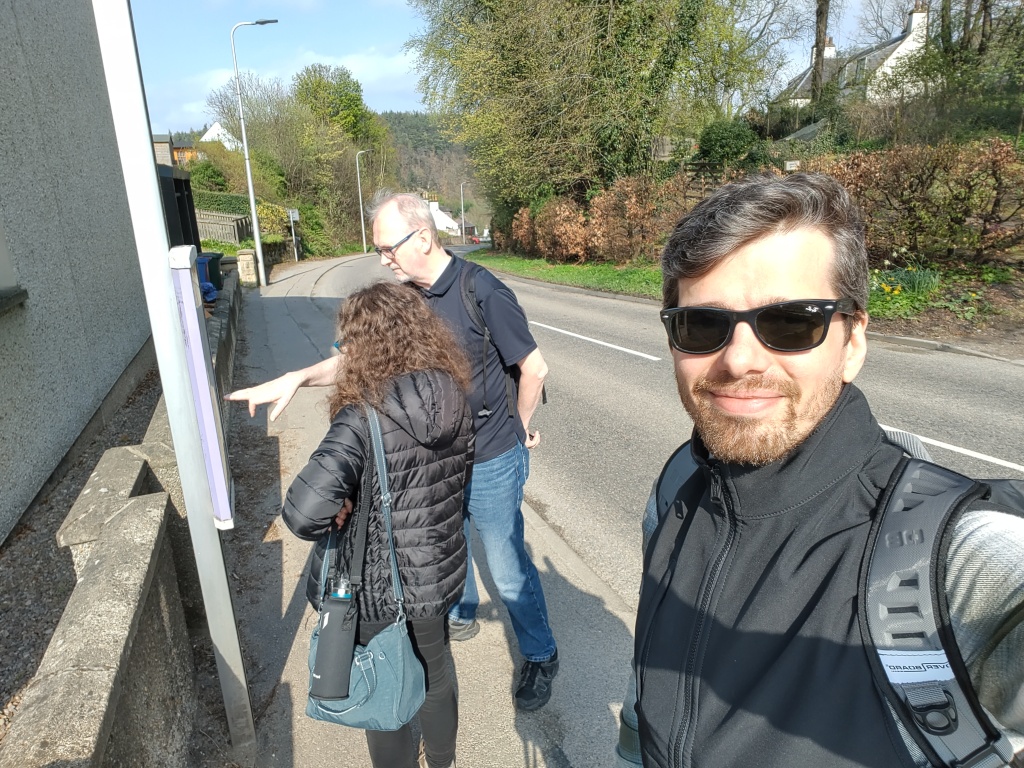
A cryptic bus timetable…
Back to the trip, we left early in the morning, as the tour was at 11am (but also to avoid the silly Edinburgh’s rush hour traffic…silly because given the size of the city, it shouldn’t be like that). We also left a bit earlier because we’d planned to leave the van in Craigellachie, get the bus to Dufftown, walk back to Craigellachie after the tour. Everything went according to plan, except that the bus from Craigellachie to Dufftown was, like, over 20 minutes late. No problem though, we were still able to get there in time for our tour, and in the meanwhile we had time to chat to our friend Graham Fraser, who was taking the same bus to go to Glenfiddich instead. He is a fellow vPub barfly and also a “drammer around” like us, but more experienced, with over a 100 Scottish distilleries under his belt: impressive!
After checking in at the Balvenie visitor centre, we had a big surprise: Paul (who we met at Linkwood last year) has recently moved to Balvenie and Kininvie as production manager, and would give us the tour! He is a super nice guy, and thanks to his impressive career in whisky, also extremely knowledgeable, so we were super happy about that!
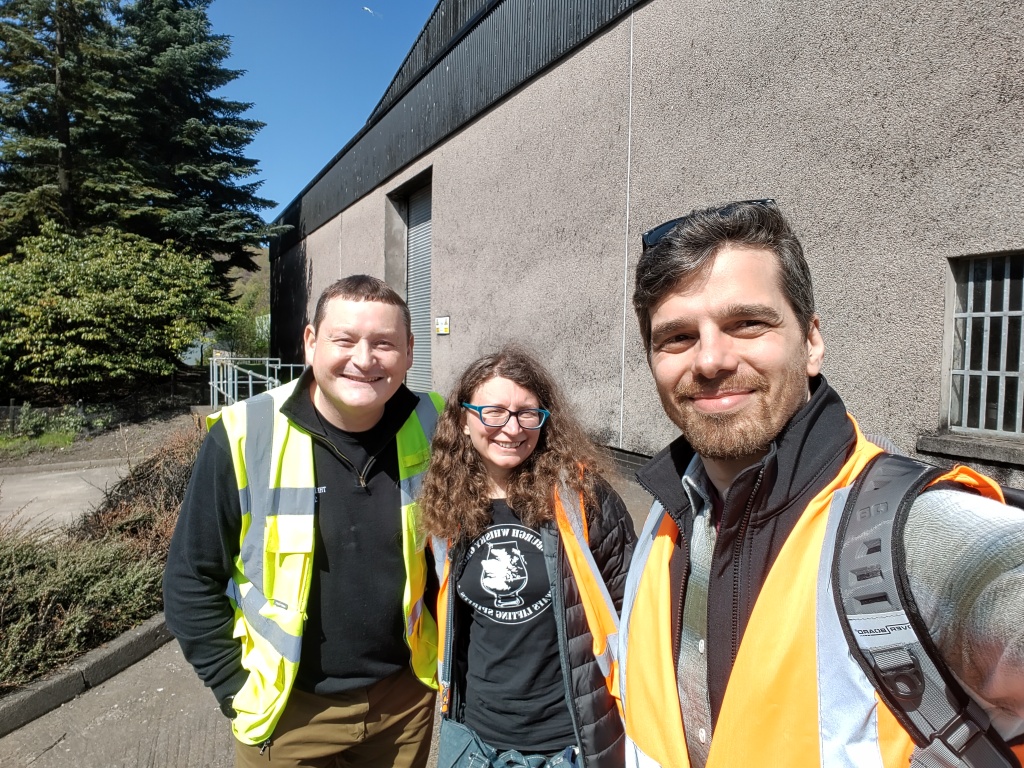
Paul gave us the tour, such a nice surprise!
The history of Kininvie is peculiar: it was built in 1990 to supply malt for blends (Grant’s and later Monkey Shoulder), instead of Glenfiddich and Balvenie, kept to be bottled as single malts. They started producing on the 4th of July of the same year, and nowadays the equipment is also used to experiment with barley and yeast strains, including running a rye campaign every year before the silent season: Paul was very excited about the freedom to experiment.
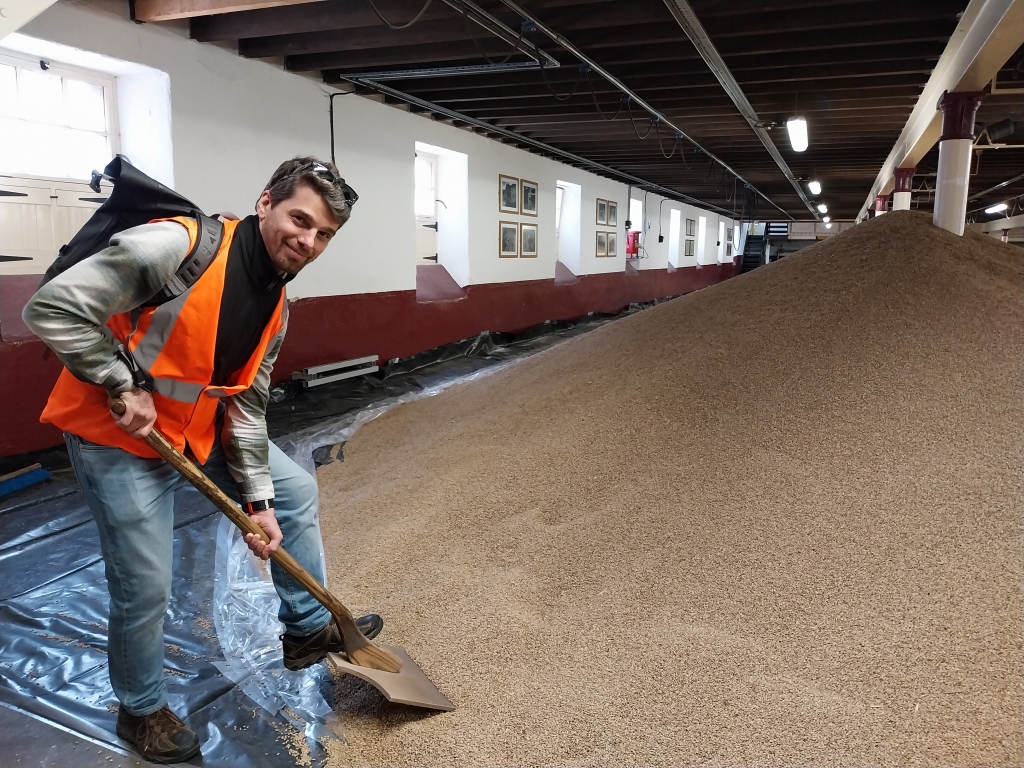
A happy “worker” at Balvenie malting floor.
The tour started with a visit of the Balvenie malting floor and kiln, which was under repair waiting for some replacement parts. After a walk in the kiln, we moved to the main production building with mill, mash-tuns and washbacks. On average they do up to 25 mashes per week, using 240 tons of barley. When they don’t experiment, the barley strains used at the moment are Sassie or a mix of Sassie and Diablo, which have mostly replaced Lauriet. The barley is mashed with the usual three waters at increasing temperatures (65, 75 and 85C). Fermentation takes place in one of the 10 wooden washbacks, next door to the Balvenie’s ones. They use Mauri yeast and go for either a short fermentation (60h) to get a cereal-y cloudy wort, or a long one (over 70h) to obtain a lighter and fruitier one: the one we tried was very sweet, and Teresa picked up notes of white chocolate.
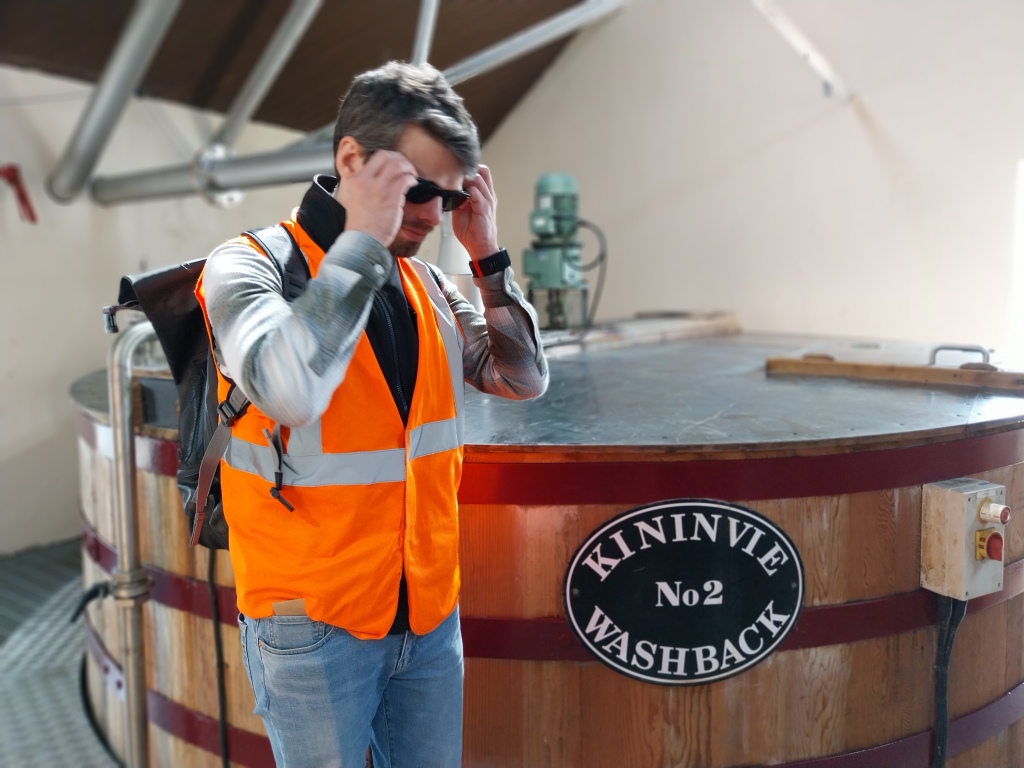
Gianluigi feels cool because it’s his 100th distillery!!!
Finally, it’s time to visit the still room, located in a hidden (hence the name of the tour) dedicated building behind Balvenie. They have three triples of stills (with enough space for a fourth, in case of expansion), for a total of nine. Each triplet works as a unit, with one big wash still for the first distillation and two smaller spirit stills for the second one. The cut points are very variable depending on what they are producing, but usually the second distillation takes 10 hours: 1.5 to heat up, 4.5 for heads and tails and 3 for the heart run. Once at the spirit safe (the piece of equipment used to control the cut points of the distillation run), we could try some newmake spirit, at a whooping abv of 70%! A very nice touch!
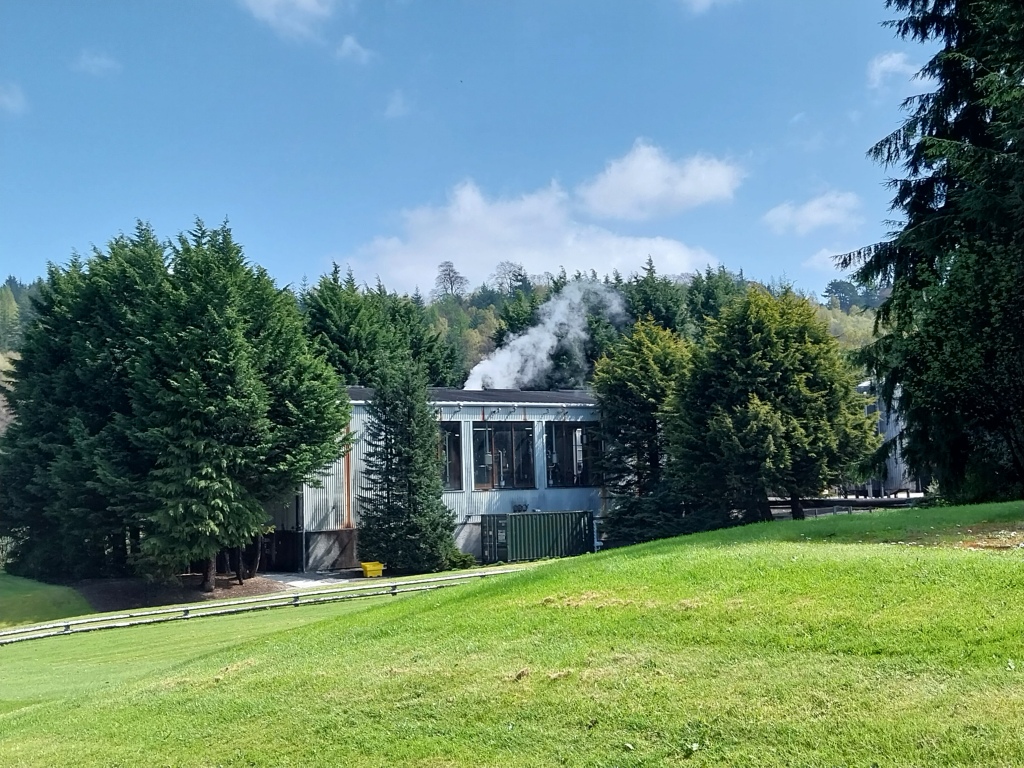
A hidden still room…
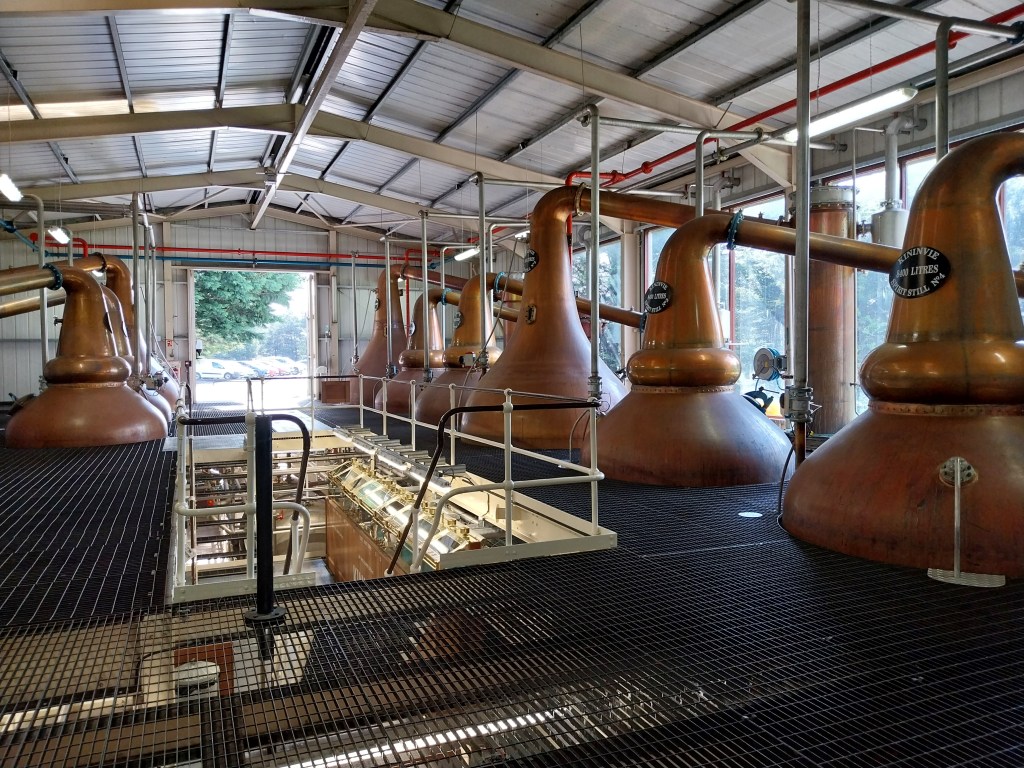
…a beautiful one.
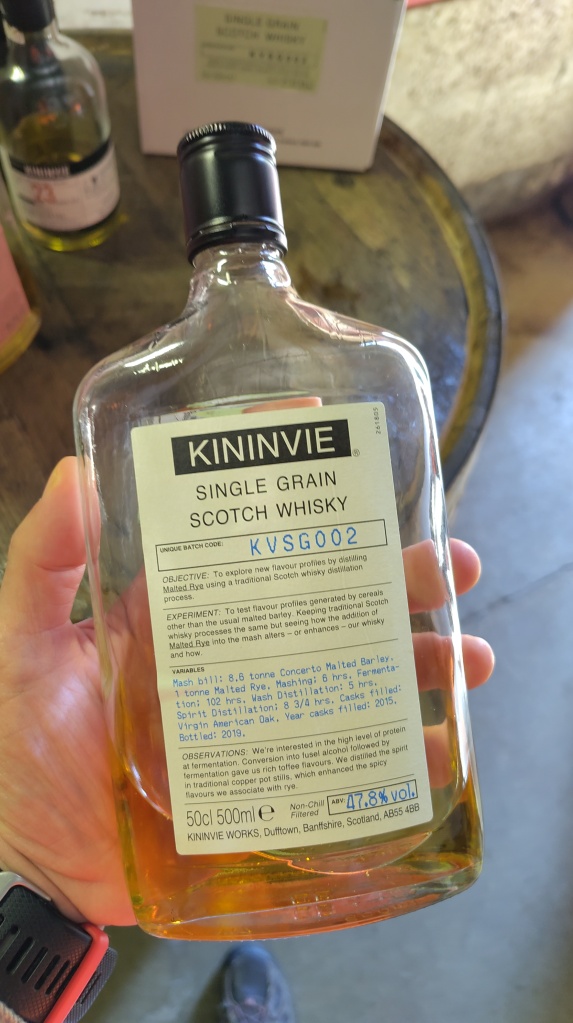
After that, we moved to one of their massive racked warehouses next door, where after a brief, nerdy chat with the warehouse manager George, we tried some drams. Kininvie releases are very rare: the only one we’d tried previously was during an online event in 2020, as part of the Belfast Whisky Week: the KVSM001, a 5yr triple distilled single malt matured in ex-bourbon casks. We had like it back then, so we were now quite excited and curious about the tasting at the distillery. We started with a “single distillery blend”, KVSB003: a vatting of single malt (matured in European oak casks) and single grain (matured in virgin American oak) produced at the same distillery, 4yr and bottled at 48.2% abv. The second one was a component of this blend, the single grain KVSG002: it is actually a rye whisky (although we think it wouldn’t comply with the American definition of “rye whiskey” because the rye part was less than 51% of the mashbill, only 1 ton malted rye vs. 8.6 ton malted barley), matured in virgin American oak, distilled in 2015 and bottled in 2019 at 47.8%. These drams were both quite interesting, but we recently find rye whisky a bit too herbaceous, particularly the ones produced in Scotland and Europe. Nonetheless, we were quite excited because the labels on the bottles provided a great deal of information, a real deal for us whisky nerds!

We then moved to a single malt, a 23yr distilled in 1991 from a combination of hogshead and sherry butts, bottled at 42.6% (a bit weak to our palate, but nicely tropical and balanced). Finally, the gem was the cask sample: a 10-year single malt from a first refill Sherry butt at 68.4% (the cask filling strength was 70.3% abv!!!): it definitely needed water, but once it opened up it was really fantastic!
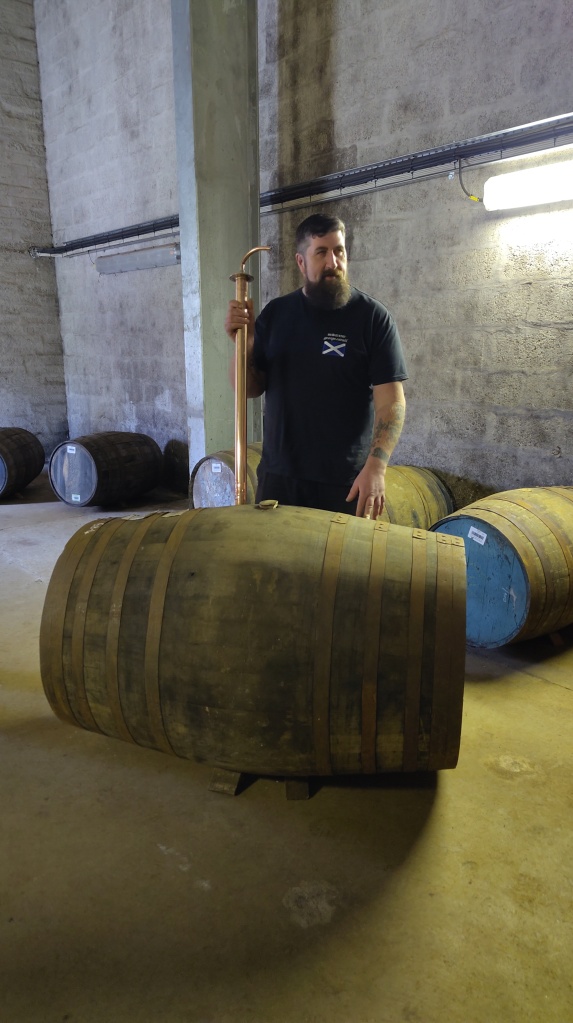
And with this visit, the Spirit of Speyside festival was officially underway, starting with a bang! Like we noted last year, the staff were so happy to show us around, truly a refreshing experience, and so nice to see Paul in his new role! But it was time to move to our second whisky “adventure” of the day, so we quickly left the distillery on foot.
Stay tuned for more on this. Until then, slainte!
Kininvie Hidden Distillery Tour
Price: £60.00 pp (Spirit of Speyside 2024)
Duration: 2hr
Tasting: 5 drams, Kininvie single distillery blended KVSB003 (single grain rye whisky and single malt), single grain rye whisky KVSG002, Kininvie 23y Single malt, cask sample (ex-sherry cask, 10y) and newmake spirit (for details see the descriptions above)
Target: whisky nerds
Value for money: good
Highlights: the still room
Recommended: yes
Link: https://tickets.spiritofspeyside.com/sales/events/2024-festival/kininvie-hidden-distillery-tou


 …Maybe next time is going to to be better?
 Dramming around