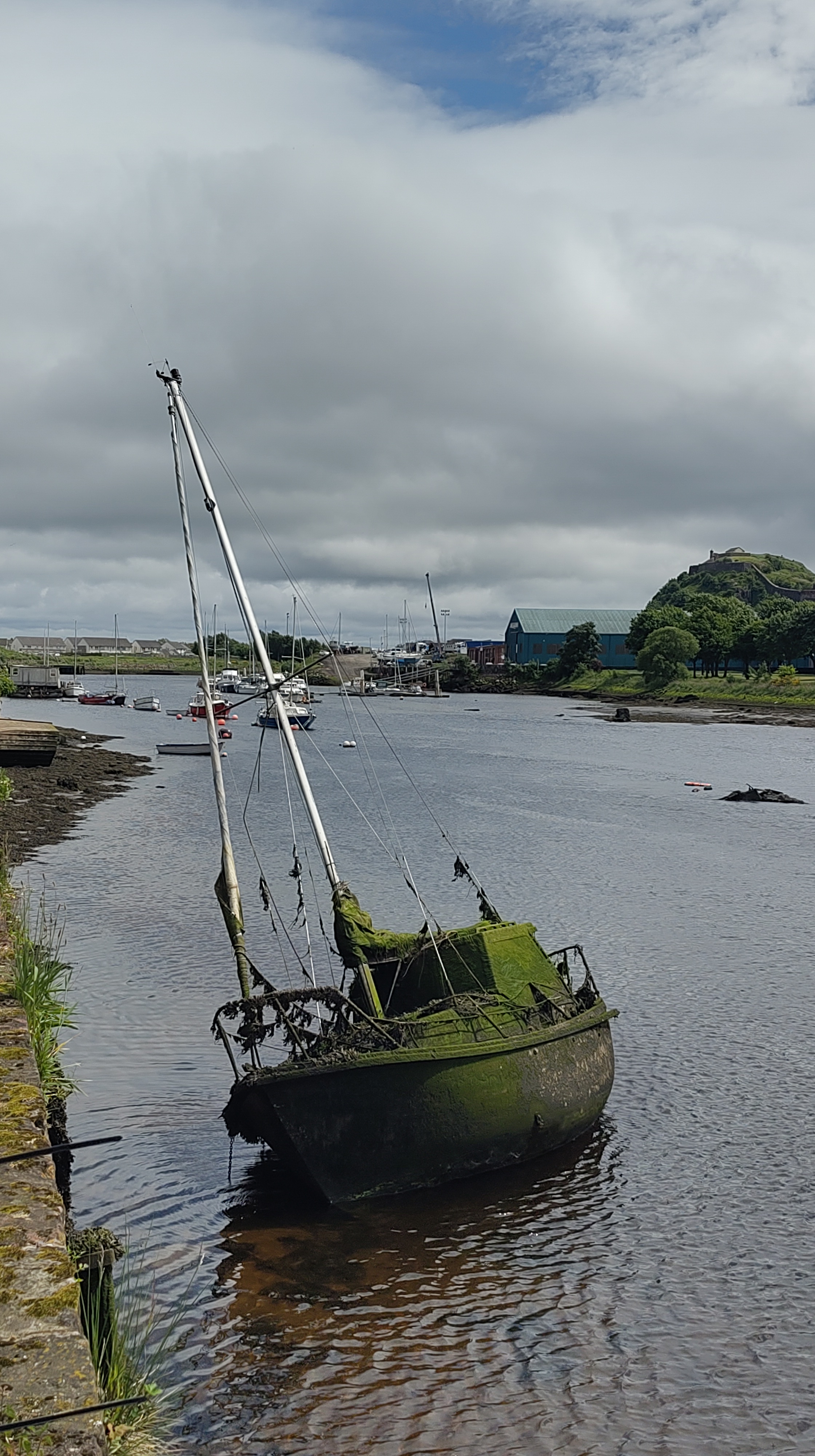
Back in the Lowlands
TL; DR: After Glengoyne distillery, we headed down back to the Lowlands. First Dumbarton, then Auchentoshan. We had a very in-depth tour, which was great, and we could appreciate every bit of their unique triple distillation process. Worth the money, just a shame the drams were basic.
(missed Part 1?)
As we came out Glengoyne distillery, we definitely needed some food. Fortunately, we had a couple of sandwiches we got earlier at the Turnip the Beat cafe, quite delicious ones, which we devoured in the Glengoyne visitors parking lot (thus, already in the Lowlands). We soon left though, heading first towards Loch Lomond, and then south. We had a few hours to spare, so we went to Dumbarton, which we’d never visited before.
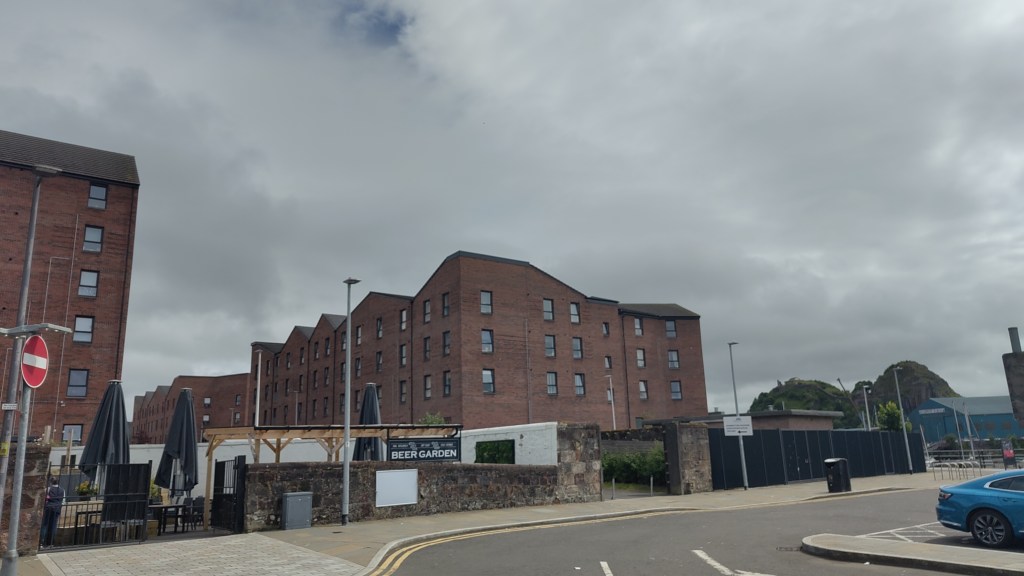
Distilleries in the past, houses today.
Dumbarton used to be home to the namesake grain distillery, and (on the same site) the Inverleven single malt distillery. Both distilleries started producing in 1938, Inverleven was then closed in 1991 and Dumbarton in 2002. Today there is a housing development on the site, which kept some of the red brick buildings. Other than that, the only remaining signs of this town whisky history are the massive warehouses on the road to Glasgow. We parked at the bottom of the Dumbarton Rock, a huge volcanic plug with a castle on top of it (you guessed it, the Dumbarton Castle). Unfortunately, the castle was closed due to illness (!!!), so we only took a short stroll in the garden below the rock, near the estuary of the river Leven, and then got a coffee and a light bite in town.
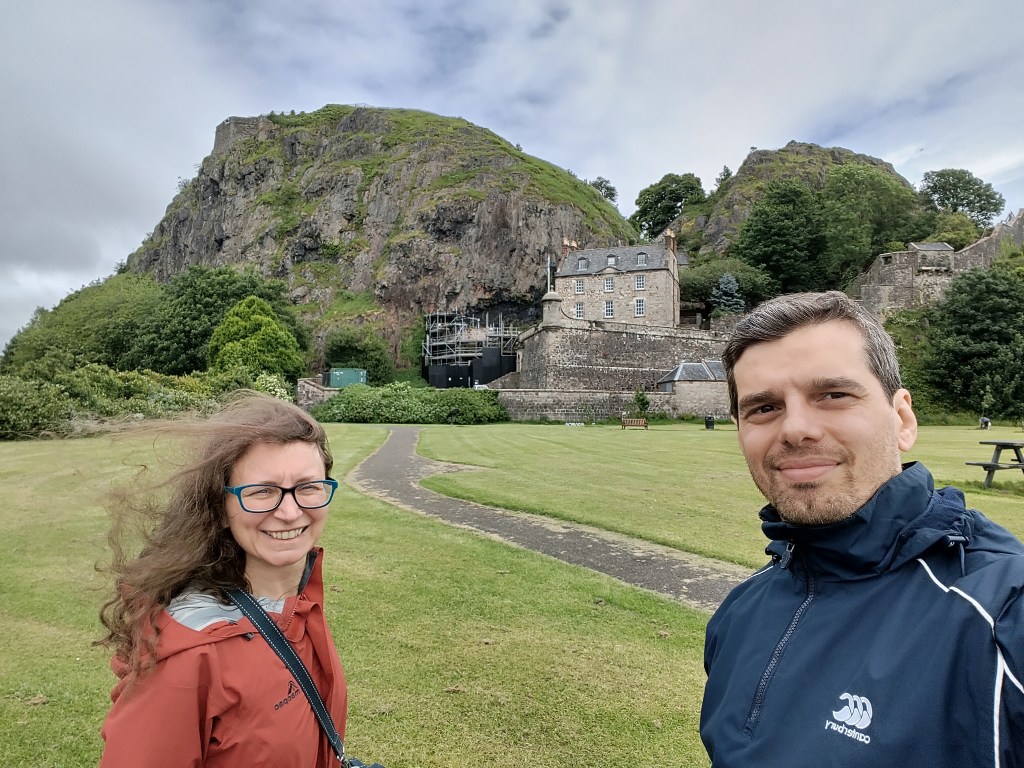
A pretty spot, a pity we couldn’t visit the castle.
The coffee break was longer than we thought, so we had to sprint to Auchentoshan distillery right away. We got there at the exact minute the tour was starting (although we’d called them to warn we could be late). Our guide was Anya, who started the tour with some history: the distillery was founded in 1817 (licensed in 1823), and the name means the “corner of the field”, referring to where the barley was initially harvested. As a matter of fact, there used to be a farm on site since the 1500s.
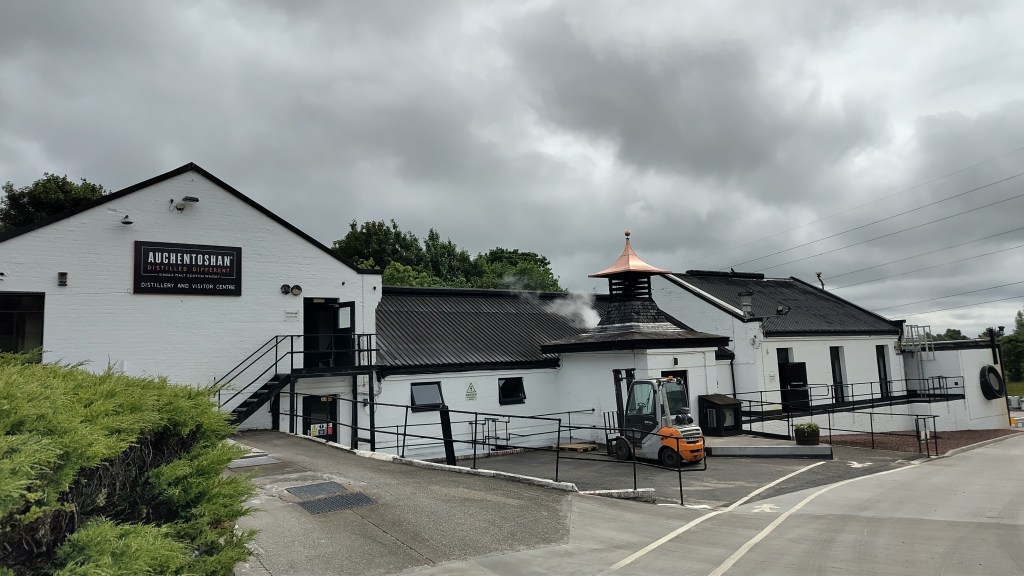
Just on time!
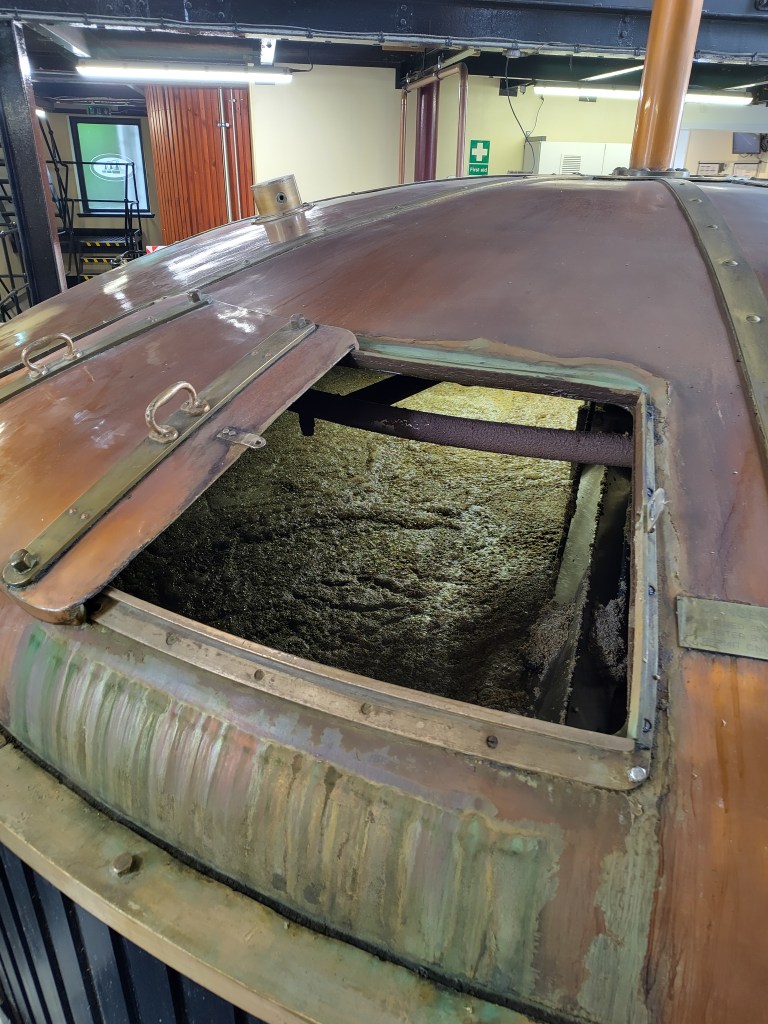
Moving to production, for the mashing they use 7 tons of barley sourced from the big maltsters (Baird, Simpson and Crisp), which goes into a semi-Lauter mashtun with the usual three waters at increasing temperature. Anya told us they’d just replaced a manual scale with an electronic one, but apparently the new scale needs recalibrating so often that the time savings are not substantial: not all trials go well, we guess. After mashing, the sugary wort is moved to one of the nine washbacks (four made of Oregon pine, five of stainless steel), for a 70h fermentation.
One of the peculiarities of Auchentoshan is their triple distillation, a practice that was once common in the Lowlands distilleries, but gradually disappeared. Now other distilleries we visited do some triple distilled runs at times (Benriach, Benromach, Sprinbgank/Hazelburn, Glengyle), but Auchentoshan remained the only one doing it regularly, before the very recent reopening of Rosebank distillery, in Falkirk. The wash still can hold 17,500 litres, the intermediate 8,200 litres and the spirit still 11,500 litres. Anya described the process well, but it was also good to have, right in front of the stills, a scheme describing everything in detail – it made it more intuitive. Being triple distilled, the spirit has a higher abv than usual: they take a cut between 82.6% and 80%, average 81%.
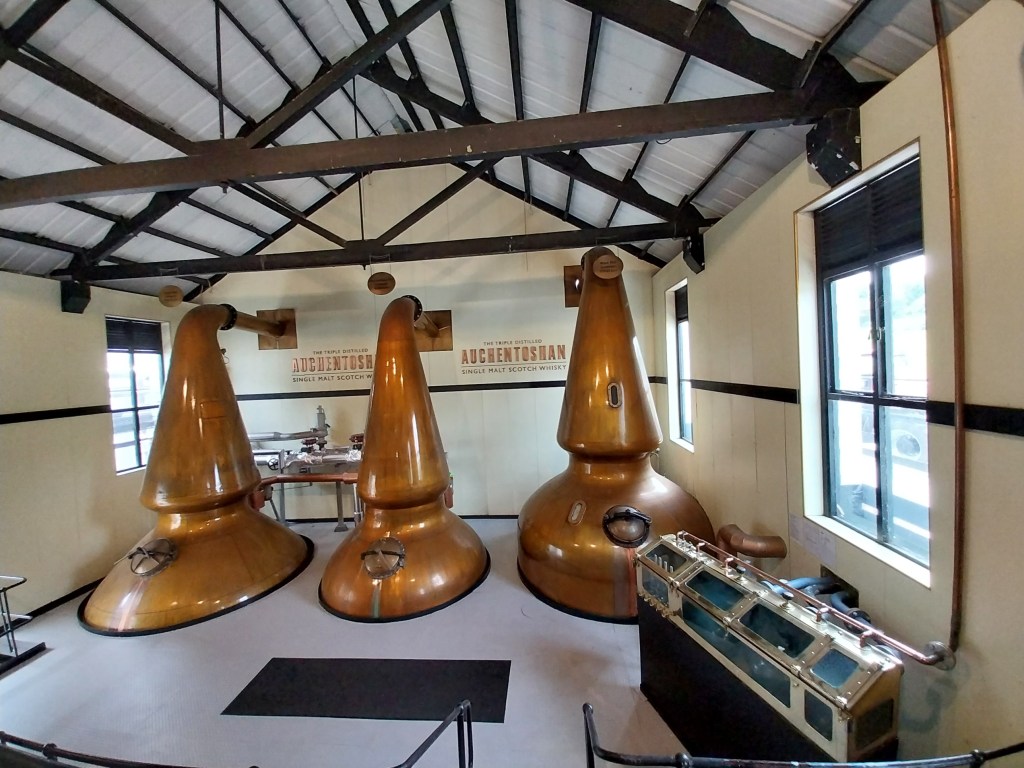
A really cool still room…

…with a really cool explainer.
After the still room, Anya walked us into the warehouse, where she explained the maturation process while letting us look at different cask types. Casking and blending don’t happen on site, but in Springburn, where the other Suntory facilities are located.
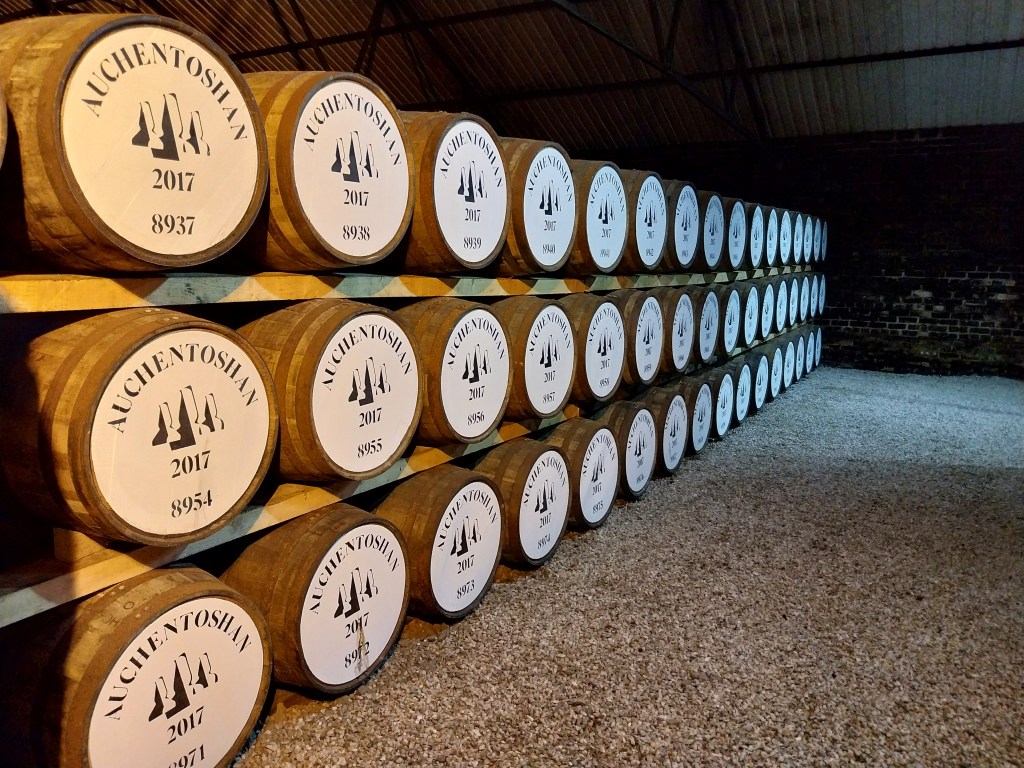
Always nice getting to see dampy warehouses.
Finally, we went back to the distillery for the tasting, in the same tasting room/bar where we had our tasting back in 2021, above the visitor centre entrance and shop. This time the tasting was not so good – we got a dram of the American Oak (40%, non-age statement, apparently mostly 6y, with some 5y, whisky) and of the 12y (40%), that is, the two most basic expressions. The wee mug they gave us to take home, instead of the usual gleincarn, was a very nice touch, though. We get that this was the entry level tour, but it wouldn’t have costed them much to replace the American Oak with another more ‘advanced’ expression: in the shop they have both Bartender’s Malt limited editions, batch 01 (47%) and 2 (50%), the Sauvignon Blanc cask finish (47%), the travel retail range and a couple of distillery exclusive bottlings (see below), so plenty of options (in theory). Fortunately, at the shop they gave us a wee taste of one of the distillery exclusives, a delicious 9y sherry matured whisky, from an Oloroso cask (59.7%).
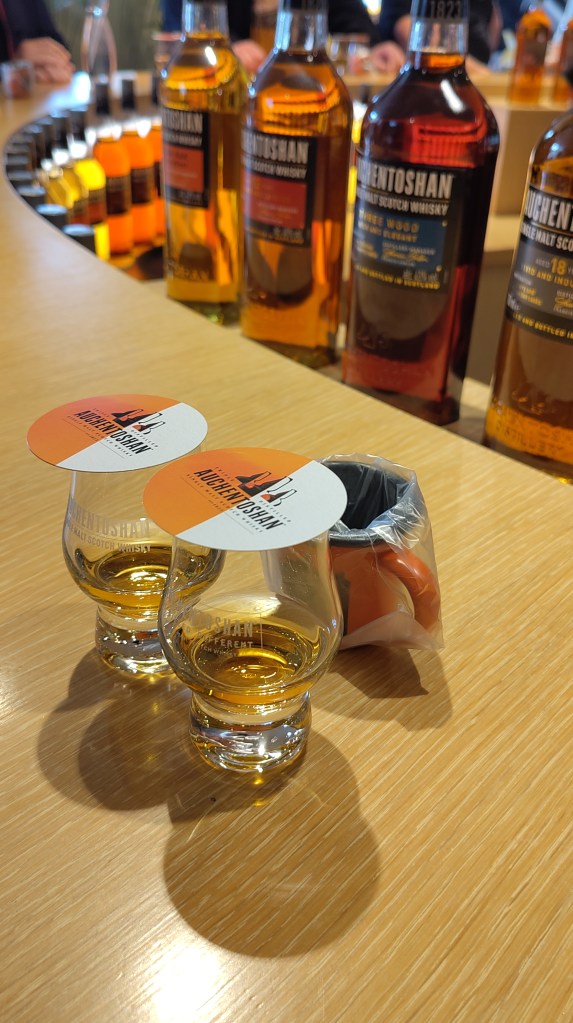
At first, we were not sure whether it was a good idea to do the basic tour, but in the end Anya was a great host: very clear and precise when describing the production process of this very unique distillery, she really made our day, so we were happy that we’d decided to go for it. As we said, the dram selection could have been better (yes, in this respect we could have opted for a different ‘experience’), but this has nothing to do with the guide.
Stay tuned for more whisky action, some smoky stuff coming soon…Until then, slainte!
Auchentoshan Origin Tour
Price: £18.00 pp (June 2024)
Duration: 1hr
Tasting: 2 drams, Auchentoshan American Oak (40%) and 12y (40%), plus a complimentary mini-mug
Distillery Exclusives: Auchentoshan hand-bottled distillery 9y Oloroso cask (59.7%, distilled 22/10/14, bottled 1/6/24, £90/30 for 70/20cl) and 22y Oloroso cask (56.2%, distilled 15/10/02, £250 for 70cl)
Target: tourists and casual drinkers
Value for money: good
Highlights: the triple distillation process showcase
Recommended: yes
Link: https://www.auchentoshan.com/
 Dramming around