#56.2 Dramming Down Under

The hidden still in Melbourne


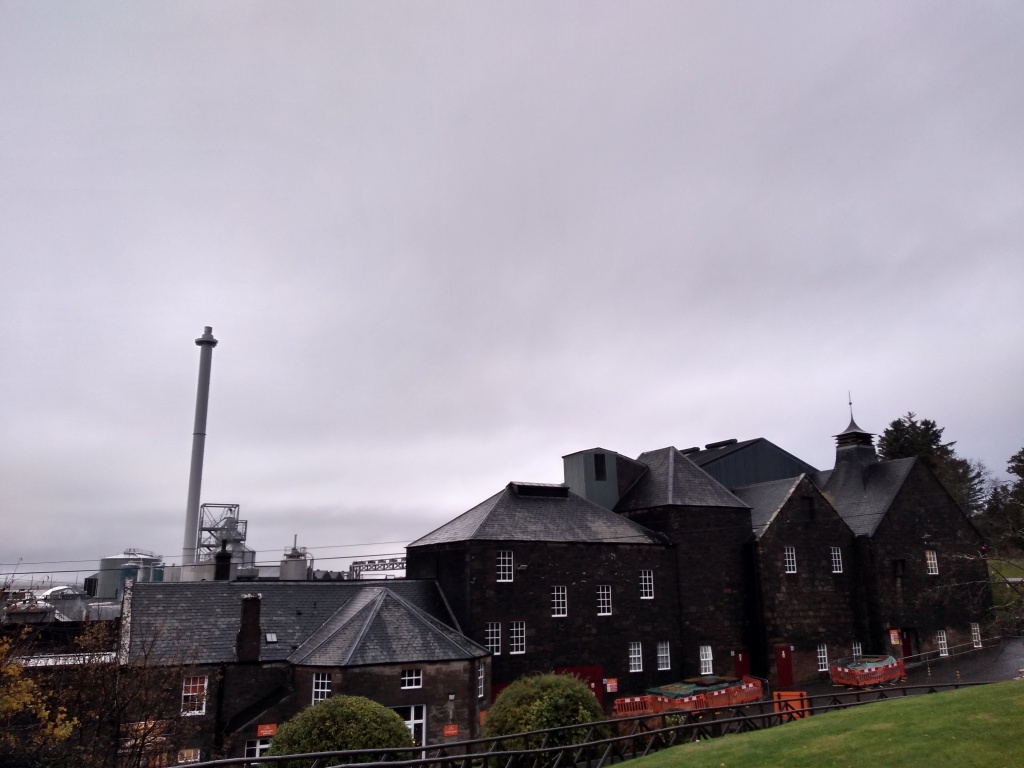
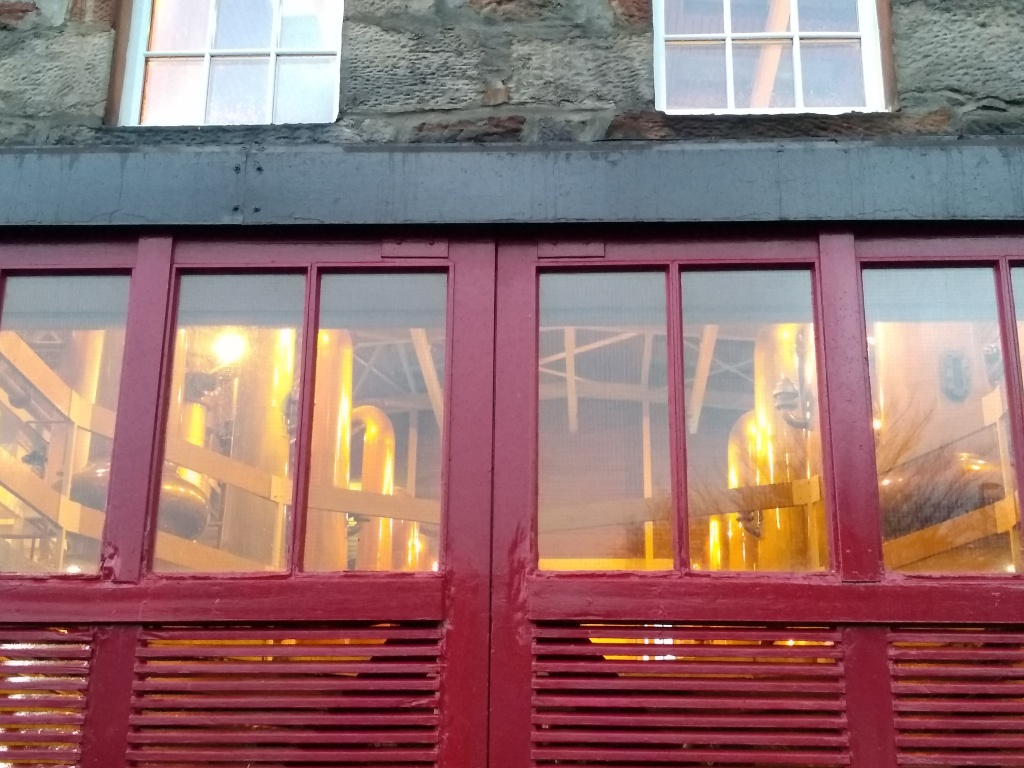
TL; DR: From Sydney, we soon flew into Melbourne, where we were pleasantly surprised by the lively and interesting whisky scene. We checked out some bars, as well as local distilleries. We found out about one, Bakery Hill, at the last minute. The very welcoming staff gave us an in-depth tour of this very urban-style distillery. And they produce delicious whisky! 

(missed Part 1?)

After the visit to Archie Rose, we paused our whisky activities for a couple of days. After the distillery tour, we went straight to Manly (north of the city) to check out the famous beach and relax. The day after, together with one of Gianluigiโ€™s colleagues and his cousin, we went to visit the spectacular Blue Mountains, about an hour outside the city – definitely worth it. Finally, on a sunny Tuesday morning, we flew to Melbourne. Once arrived, we headed towards the rental car place where, after a long wait, we got our car and drove straight to a car park near the hotel in the CBD. While we wouldnโ€™t use the car for the first day or two, having it would pay off a few days later. In the evening, we met with a Teresaโ€™s former colleague and then explored the cityโ€™s whisky scene, starting with the Whisky Den – an incredible choice of whisky, including many Australian, in a super cozy venue: thumbs up from us!
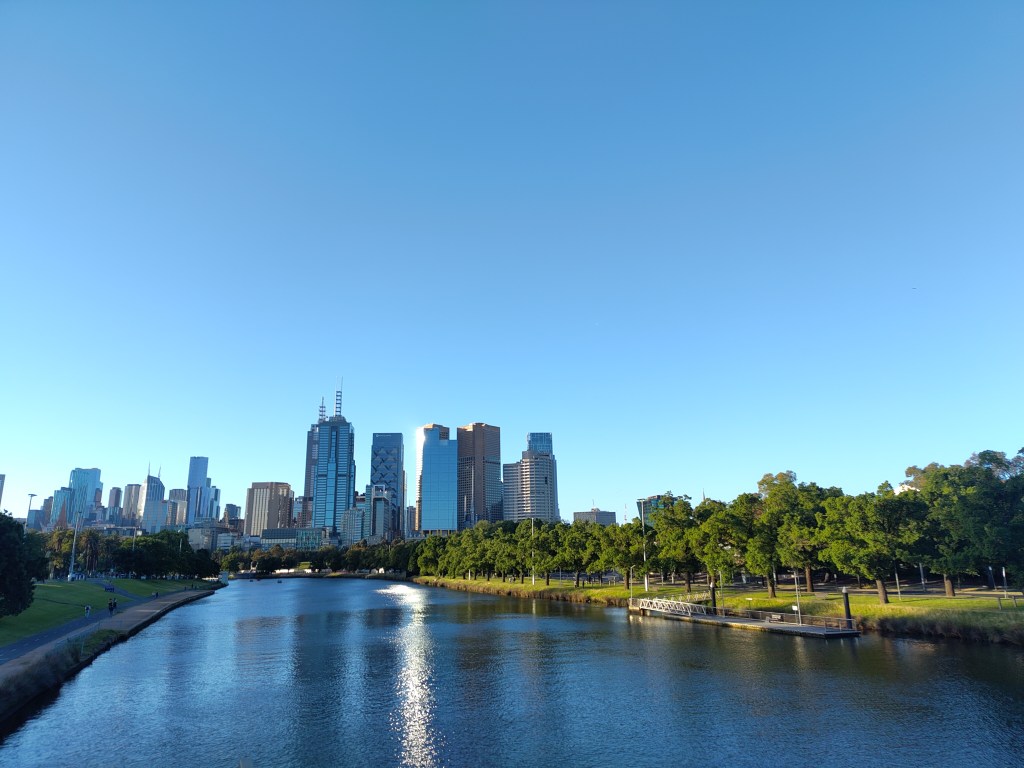
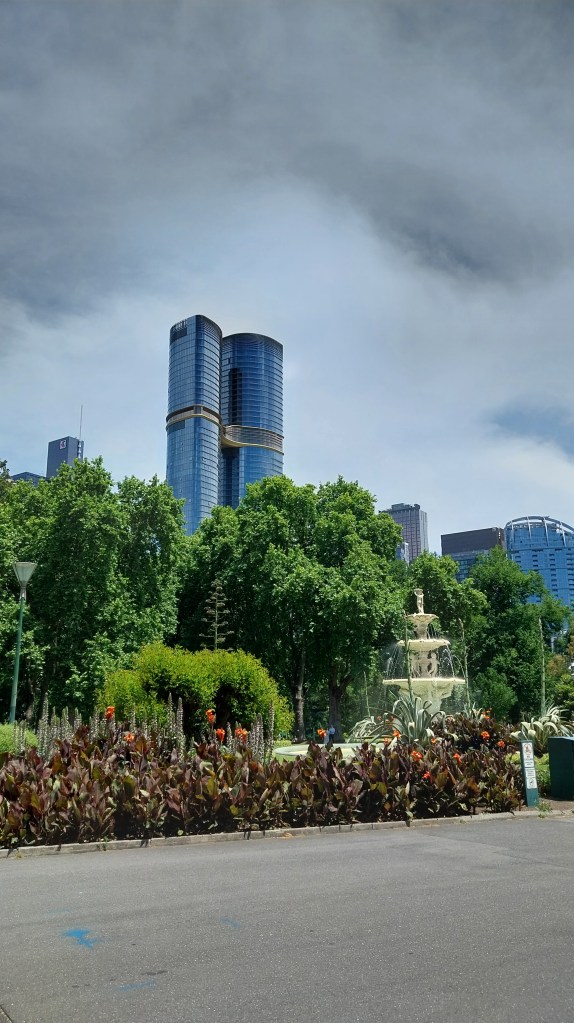
We didn’t take pictures at the Whisky Den, so you get Melbourne skyline instead.

Right before taking off from Sydney, our pal Joe (from the Edinburgh Whisky Group) had given us some advice about distilleries and whisky bars to check out in the city. A suggestion was a distillery called Bakery Hill. Armed with hope but not expecting much, we sent them an email straight away to ask if we could visit the day after, the only option we had to accommodate a tour while in Melbourne. To our surprise, they replied confirming their availability for a tour, fantastic! So, the next morning we took a train from the Southern Cross station towards Kensington, North-west from the CBD. The building is a small warehouse, very well hidden in the urban context, so much so that, at first, we cluelessly walked almost a block past it.
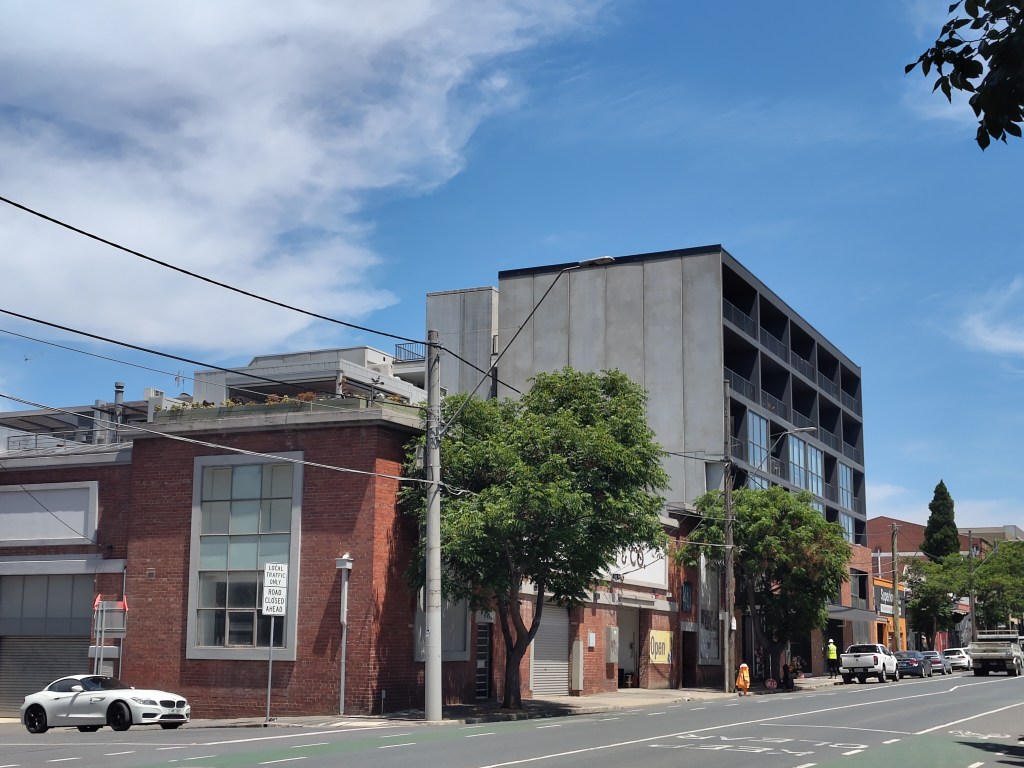
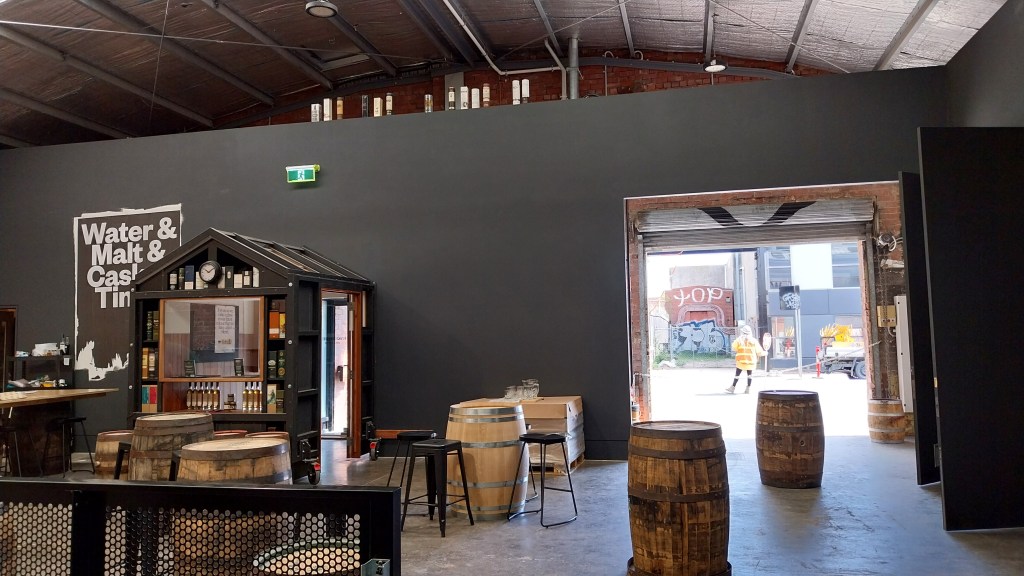
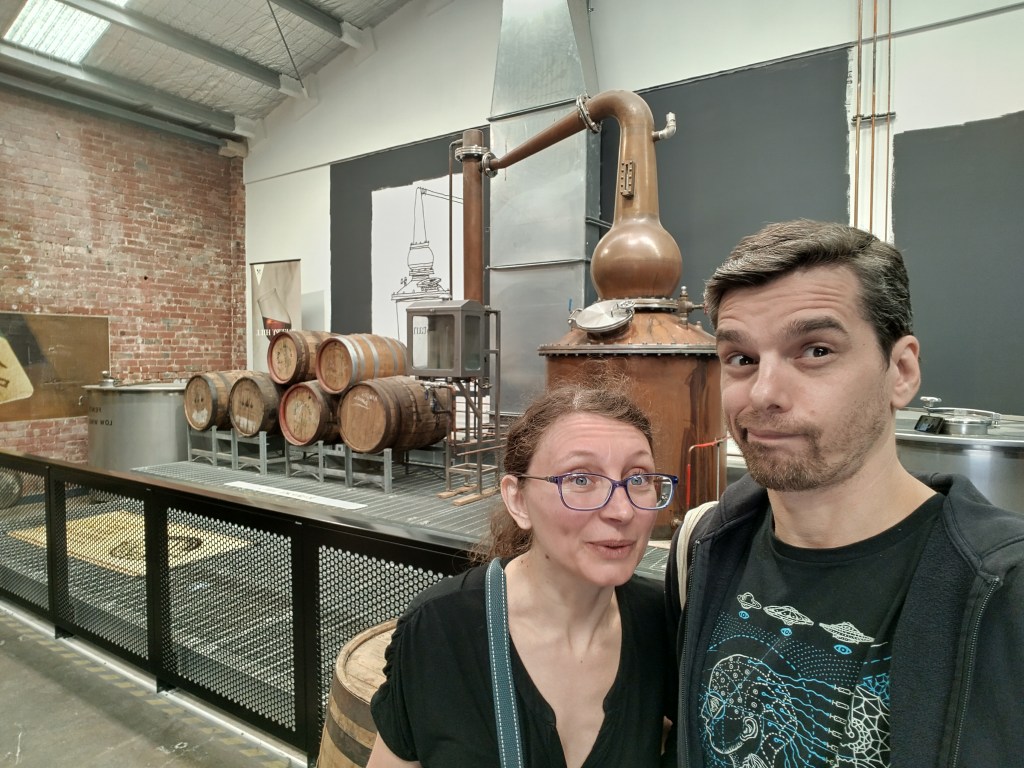
We were welcomed by Pete, one of the distillers and ownerโ€™s son. In fact, the distillery was set up in 1999 by David Baker, a former chemistry teacher, who wanted to prove that it is possible to make a good whisky in places other than Scotland. The distillery was originally outside the city, and they first released whisky in 2003. They then moved to within the city boundaries, only a year before our visit, in 2023. Now the distillery is mostly run by Davidโ€™s sons, Andrew and Pete. Except for a small space they carved out for a shop and a small office, the distillery has two main large areas, divided by a wall. The first one is occupied by the still, a space for tastings and events, and racked casks on the side. The space is also used for other activities, for example while we were there Andrew was preparing their upcoming first blended whisky release (their single malt vatted with Australian grain whisky from ex-bourbon casks, 46%). The rest of production is located in the adjacent area, again with casks racked on all sides.
About production, the unpeated malt they use is sourced from New South Wales. The peated malt is currently sourced from New Zealand, while until a few years ago they were getting it from Scotland. They use 320kg of malted barley per mash, which is processed manually in a very โ€œtraditionalโ€ way. Fermentation is kickstarted with brewerโ€™s yeast and is quite long, 5 days. Funnily, the two washbacks are named after a children TV show called Bananas in Pyjamas, thus Banana 1 and Banana 2.

They currently have one 1,000-litre still where they run both distillations. However, a new 3,000 litre wash still was due to arrive soon (at the time of visiting). As for maturation, they use mainly American oak ex-bourbon casks, in particular from Brown Foreman, including Jack Daniel’s. They mostly bottle single cask whiskies (in 50cl bottles), and everything every whisky nerd wants to know is handwritten on the back label: distillation and bottling dates, cask number. The whisky is usually older than other local producers, the ones we tried were between the 5 and 8 years old.
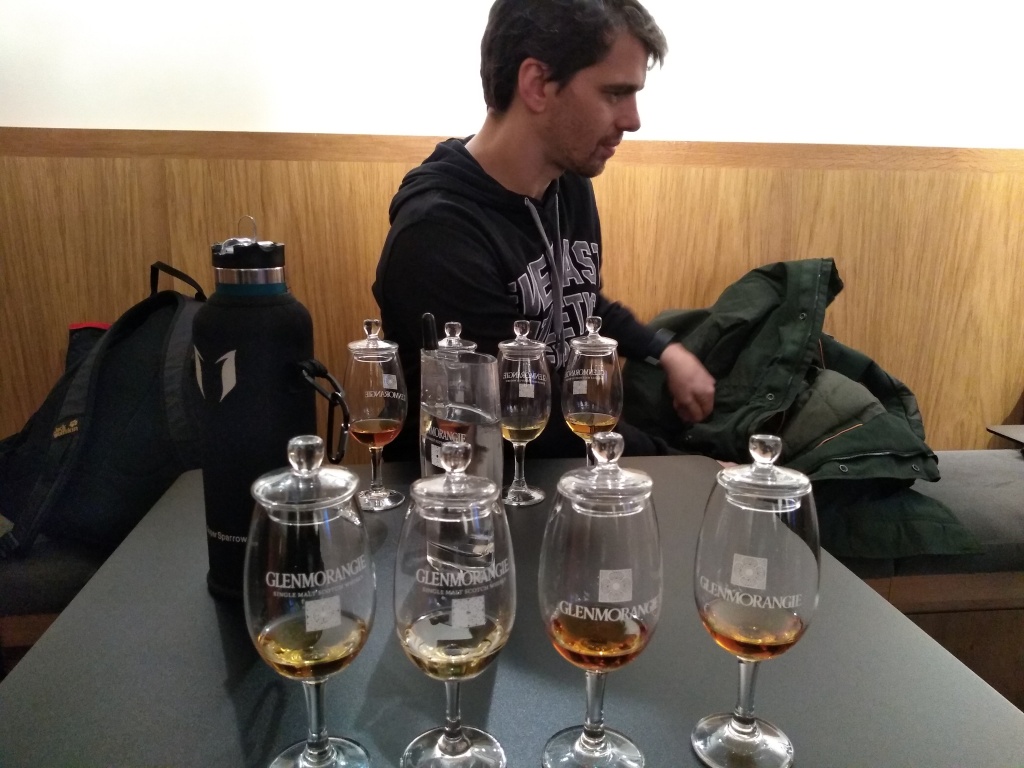
Their current Signature range includes five single malts: Classic (unpeated, 46%, ex-bourbon), Double Wood (unpeated, 46%, finished in 1st fill French oak ex-red wine cask), Peated (46%, ex-bourbon), Classic Cask Strength (unpeated, 60%, ex-bourbon), and Peated Cask Strength (60%, ex-bourbon). In our tasting, we tried four of them in this order, except for the Classic Cask Strength. They were all very good, but the two peated expressions โ€œknocked it out of the parkโ€ for us. They also do limited and seasonal releases, among the latter the Blunderbuss (after 5y in ex-bourbon, finished for 2y in Kalash Imperial Stout barrels) and the El Dorado (matured for 1.5y in Apera, i.e. โ€œAustralian sherryโ€, casks and finished for 3y in ex-bourbon). To note, they produce a gin too, the Oxford Traditional Gin (40%). Pete also told us that they started to work with some UK based independent bottlers to try get some of their whisky over here: Atom Brands already released one expression from them under That Boutique-y Whisky Company brand (the hilarious label was inspired by Breaking Bad series, given David Baker’s past as chemistry teacher).
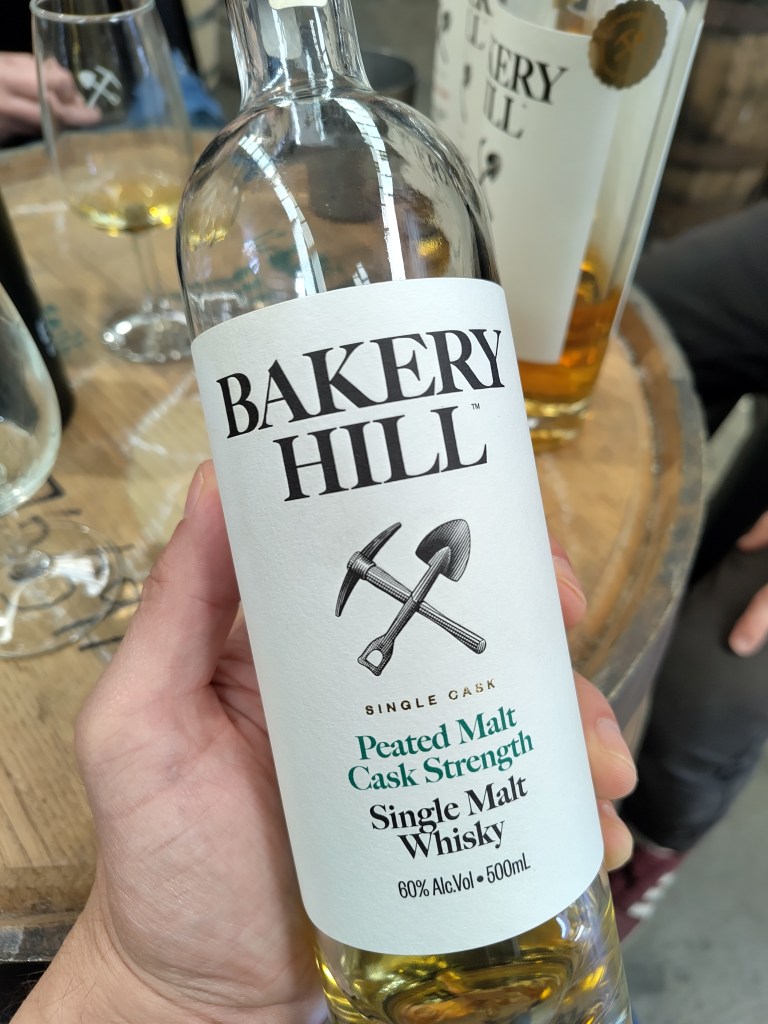
We loved the concept of this distillery: self-contained, doing things properly, and this ethos totally transpires in the quality of their drams. Bottles are pricey to be fully honest, even compared to some of their peers, but given the production size and the fact that they bottle one cask at the time, we can see why. Overall, one distillery we are super happy to have visited, and weโ€™d definitely go back (in the unlikely case weโ€™ll find ourselves in Melbourne, again)!

After the distillery we had a quick bite in a very nice cafรฉ across the road, before getting on a bus towards Fitzroy and other areas in the north of Melbourne. In Fitzroy, we also paid a visit to the Elysian Whisky bar, on Brunswick Road: what a bar! We had a lovely chat with the owners (we were there kind of early, so the only ones), who suggested drams to try and guided us through them. One great thing of Australian whisky bars is that it is possible to order half-size drams (15ml, versus the 30ml full dram), which are a bit easier on the liver (and on the wallet), in particular for whisky curious people like us who always wants to try a few.
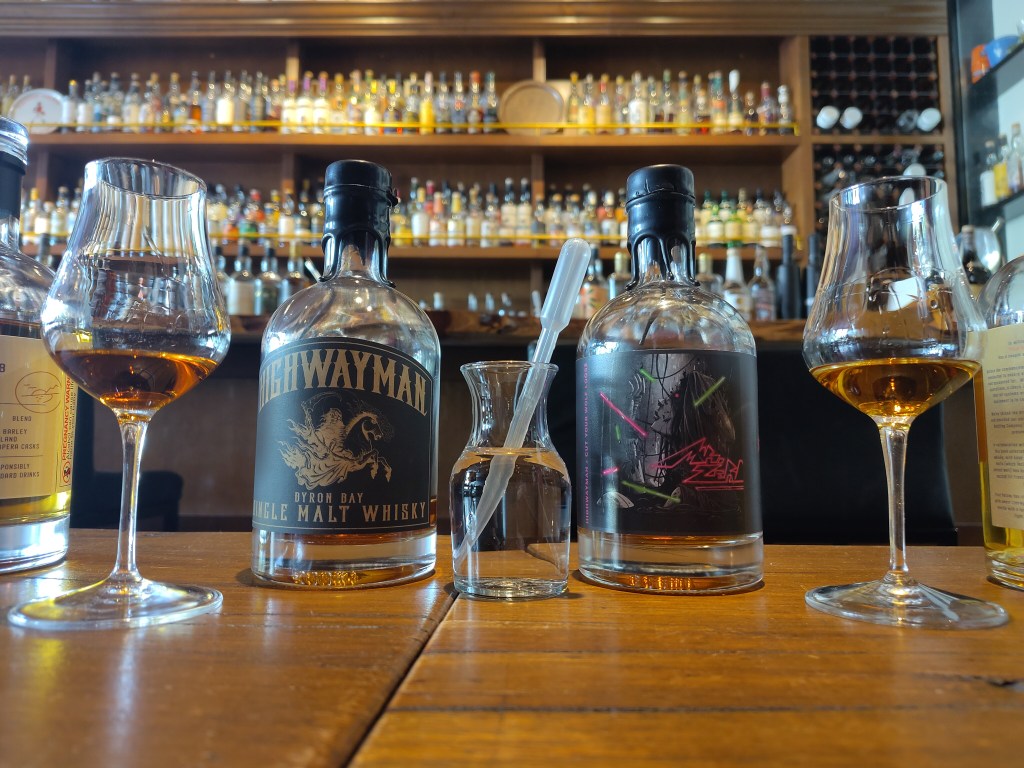
After dinner we visited another fantastic whisky bar, Whisky and Alement, where we had another great time chatting with the super knowledgeable staff, who ended up gifting us a pin for their 10y anniversaryโ€ฆwhich was four years before, ahah!

A great distillery tour and two great whisky bars, what a whisky day that was. We did other stuff (including getting the worst coffee of the entire holiday, and finding an awesome record in a second-hand music store, Travels by the American band Defeater if youโ€™re curious), but the three above were definitely the highlights of the day.

Stay tuned for the rest of our Melbourne (and surroundings) action! Until the next time, slainte!


Bakery Hill Distillery Tour

Price: AUD 35.00 pp (November 2024)

Duration: 1hr 30min

Tasting: Classic single malt (46%), Double Wood single malt (46%), Peated single malt (46%), Peated cask strength single malt (60%)

Target: whisky enthusiasts

Value for money: good

Highlights: the history of the distillery and its urban style

Recommended: absolutely yes!

Link: https://bakeryhill.com/


#55.4 All drams great and small

A dram-y day at the Distillers Lounge, in Scarborough


TL; DR: On the (almost) final day of our trip we didnโ€™t visit any whisky distillery, but a rum one. It is located inside the Distillers Lounge, in Scarborough, where we had a full-on English whisky tasting and a great meal, before turning our attention to rum. It was a very fun day, and we have to say the quality of English whisky is really improving! 

(missed Part 3/Part 2/Part 1?)

On the Sunday morning, in spite of the very busy Saturday (two distillery tours, a brewery visit and the quiz), we woke up surprisingly rested. The morning was easy, we had breakfast in the van and a short stroll in Hunmanby, before gathering with the troop (except for some, who headed back home earlier) at the train station. Our destination was not far away: Scarborough, on the Yorkshire coast. In our understanding, Scarborough used to be a popular seaside destination for rich people to clear their lungs during the Industrial Revolution, in particular around the Victorian era. Nowadays, it doesnโ€™t look as glorious, with a lot of closed up units on the high street, we guess one of the many victims of the massive deindustrialisation of the 80s and 90s.

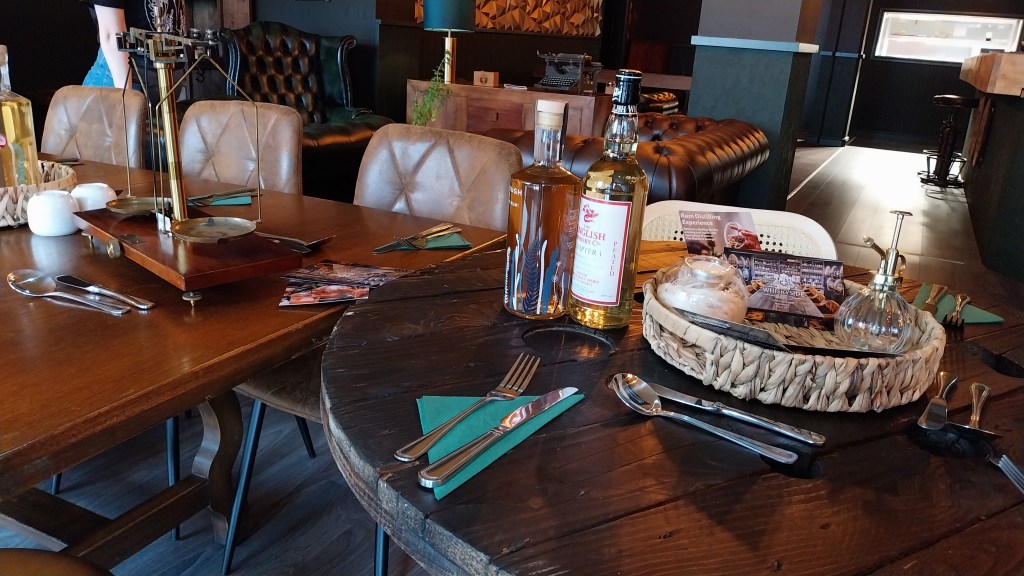
Now, one could ask: โ€œWhat were you doing there, then?โ€, which is a more than legit question, given the above. Well, itโ€™s easy: because of the Distiller’s Lounge. This is a venue, conveniently located at walking distance from the train station, with a restaurant, a tasting bar and a spiced rum distillery.

The whisky tasting bar is managed by Whiskyside, a small company run by Matt, promoting and selling English whiskies. As you can guess, the plan was a full-on English single malt whisky tasting. The location was a room underneath the main bar, looking a lot like a cellar. There, the biggest collection of English whiskies we ever saw was on display. It included pretty much everything you could think of, from limited releases and from independent bottlers. We even spotted a Bimber bottled by the guys behind Whisky Facile, an Italian whisky review website and blog.

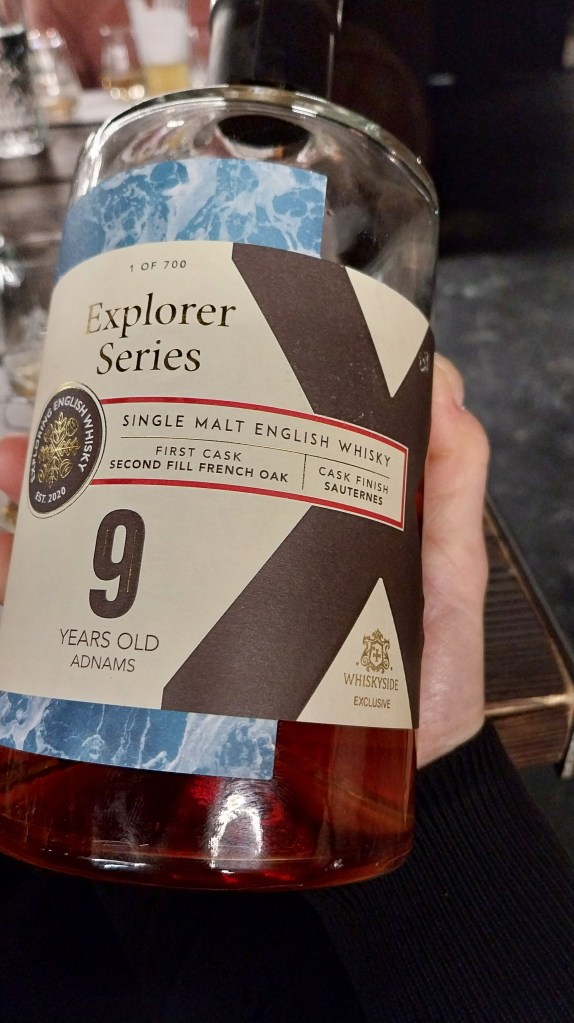
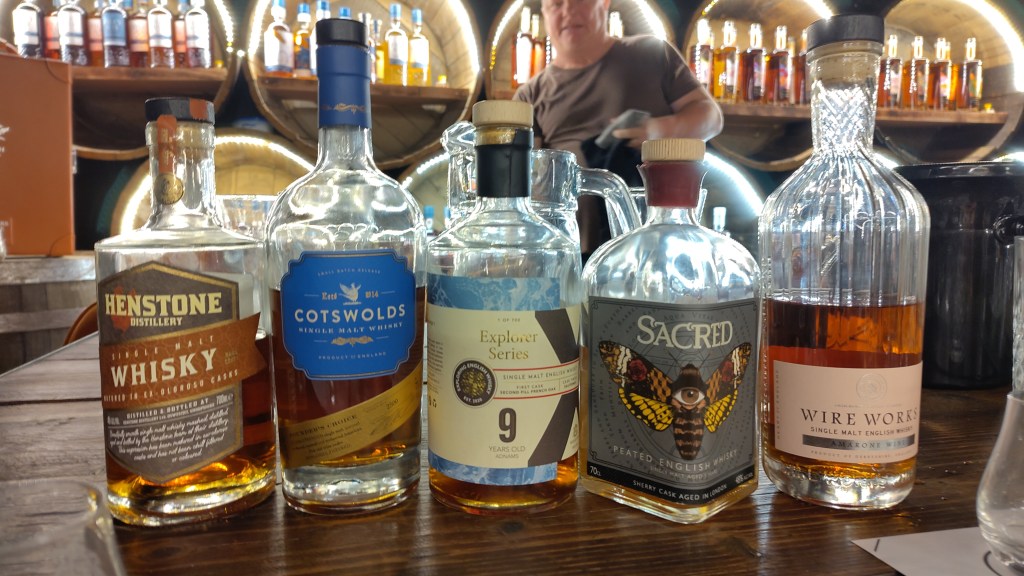
The tasting started with a first for us, a Henstone single malt, from a distillery in the Shropshire (near the Welsh border) established in 2017. A young expression, but quite round despite the age, matured in ex-oloroso sherry casks. The second dram was an old acquaintance, the Cotswolds (visited in Summer 2023) Founderโ€™s Choice, a small batch release (in this case 2,500 bottles), fully matured in STR casks (former wine casks, shaved, toasted and recharred). It comes from the Cotswoldโ€™s small batches of the same cask type, ranging from ex-bourbon to ex-sherry, ex-peated whisky, etc. A very nice dram, very drinkable, but it didnโ€™t impress us, contrary to the one that followed. This was from Adnams, a brewery and distillery in Southwold, which we had tried one or twice before. This expression was a 9-year old bottled for Whiskyside, bottled at 55%, part of their Explorers Series. The combination of casks is quite unusual: matured in second-fill French oak casks, and then finished in ex-Sauternes barriques (for two years), a finish that we generally struggle to appreciate. This one, however, smashed all our prejudice on Sauternes casks, as it was delicious, full of sweet, cream and chocolaty notes: tiramisรน in a glass. What was weird is that we came across the same tasting notes independently, before sharing them.

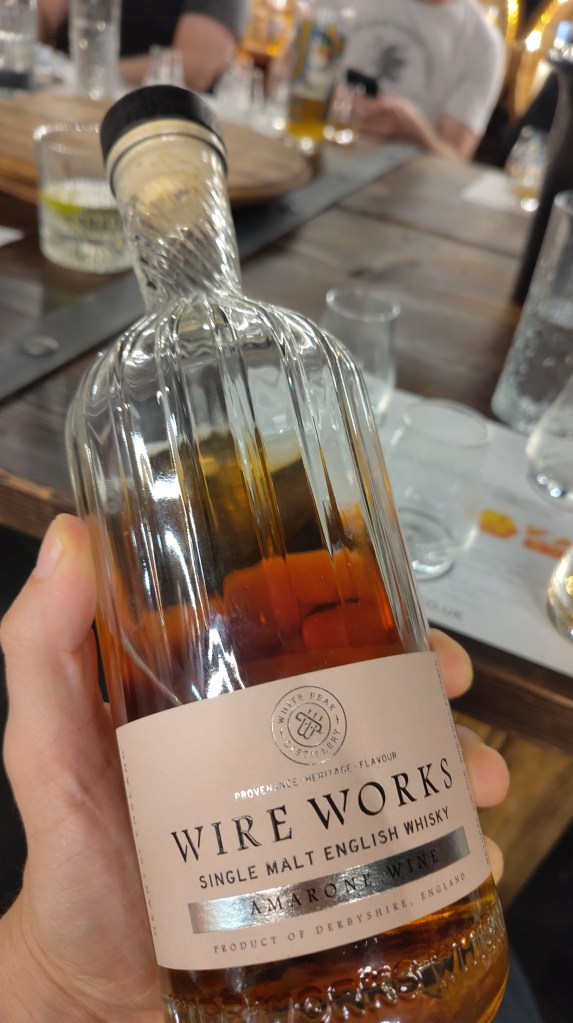
The fourth dram marked the introduction of peat. First off, a 5y single malt finished in ex-PX casks (from Bodega Navarro, previously in ex-bourbon hogsheads). In our understanding this one was from the English distillery, but bottled in 2019 by Sacred Spirits (or Sacred Gin), after the second maturation in London (donโ€™t know why it is important, but it is stressed on both the label and the website). It was a decent dram, but again we were blown off by the final one: a lightly peated Wireworks (from White Peak distillery, one of our favourite tours in 2023) matured in ex-Amarone red wine casks, bottled at 54.1% and made in a small batch of 662 bottles. Grilled berries notes, an excellent dram. Overall, it was an impressive tasting, it showed how good English whisky can be, even at young age.

After the tasting, we moved back upstairs for the meal, which included two courses for slightly less than 30 quid. When we saw the price, weeks before (one of the necessary evils of these group holidays is that we have to choose our meals weeks in advance), we were not so convinced. Truth be told, it was a fantastic meal, in particular the lamb was one of the best we ever had since we moved to the UK.

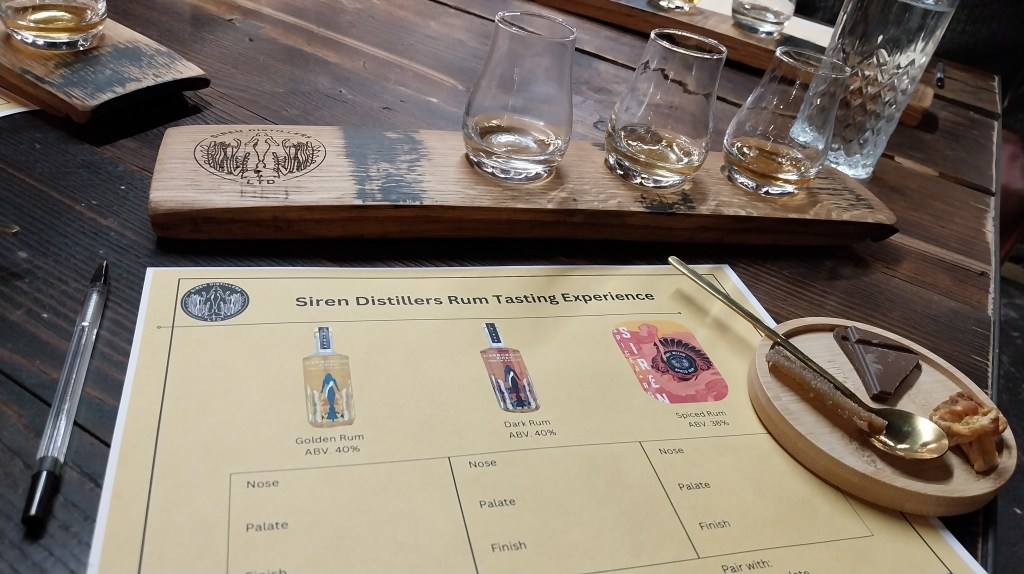
After this tasty lunch, we went back to the cellar, this time for another tasting: a rum one, with mainly tots from the local Siren Distillers company, run by Jamie and Anna. The distillery is in the Distiller’s Lounge itself, right upstairs, with the still in the window. (Update March 2025: we learned from posts on social media that the collaboration between the Distillers Lounge and Siren Distillers ceased, so they moved to a different location).

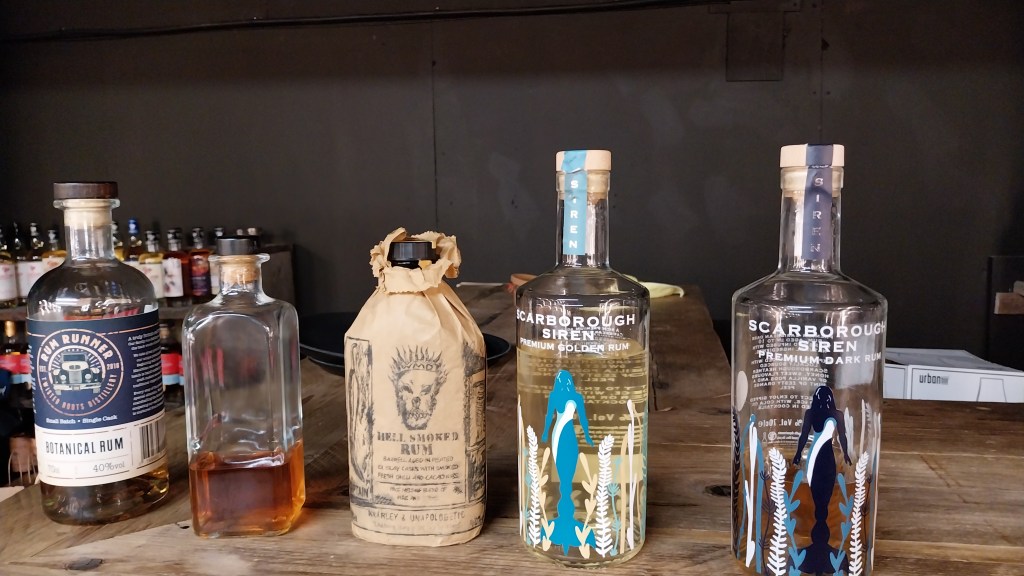
Their main activity is to source rum, and then redistill or infuse it with their spices of choice. From their range, we tried the Golden rum (40%, blend of 5y Caribbean rums, infused with honey, orange peel and vanilla), the Dark rum (40%, blend of Caribbean rums, including a 10y Jamaican one, and again infused with honey, orange peel and vanilla), and a preview sample of their Spiced rum (38%, redistilled with a number of spices), respectively paired with candied ginger, dried pineapple and dark chocolate.

We also tried the Botanical rum from Rum Runner (40%, distilled at Twisted Roots Distillery, aged in ex-red wine French oak cask), and a spicy (yes, spiced, but also SPICY) rum, the Hell Smoked Rum (40%, barrel-aged in peated ex-Islay Whisky casks with fresh chili peppers and cacao nibs). It was an interesting tasting, although we are not really into spiced rum, so we didnโ€™t (and still donโ€™t) have much basis for comparisons.

After the train back to Hunmanby, we had a last pint at the Piebald Inn (to Gianluigiโ€™s disappointment, the kitchen was already closed) before retiring to the van. Overall, it was a very fun day, and we were particularly impressed with the English whiskies we tried. One popular Glaswegian whisky youtuber said (more than once) that there is nothing like good English whisky to keep Scottish producers on their toesโ€ฆTrue or not, we can definitely say that the quality of these malts is good in general, fantastic at times! And hospitality-wise, many Scottish producers should take example from their neighbours.

It was the last โ€œofficialโ€ day of the All Drams Great and Small tour, but we saved one last whisky experience for the following day. Until then, slainte!


The Distiller’s Lounge
Link: https://www.jspubcompany.co.uk/distillers-lounge/

Whiskyside
Link: https://whiskyside.co.uk/

Siren Distillers
Link: https://www.sirendistillersltd.com/
#55.3 All drams great and small

An English malt with a Tasmanian twist and an eye for sustainability


TL; DR: From Ellers Farm, we went directly to another distillery: Cooper King. Inspired by Tasmanian craft distilleries, they produce other spirits other than single malt, with a very interesting set up. And, everything is done in the most sustainable way possible, kudos! After the visit, we went to Brew York, for a tour, dinner, and a quiz! 

(missed Part 2/Part 1?)

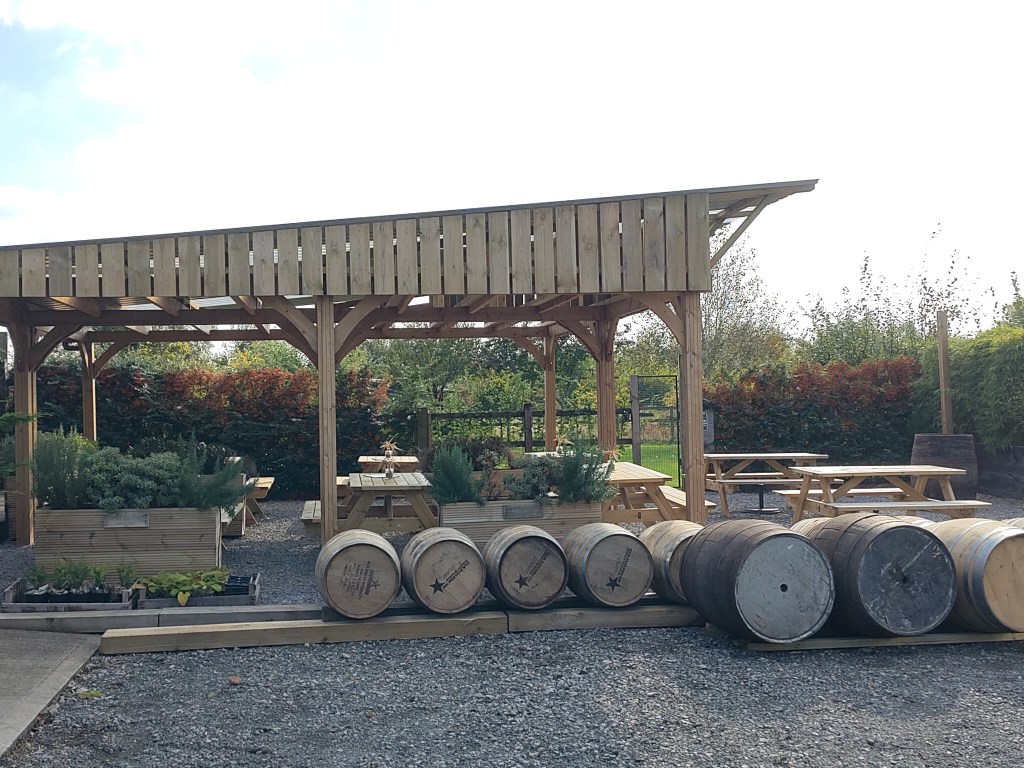
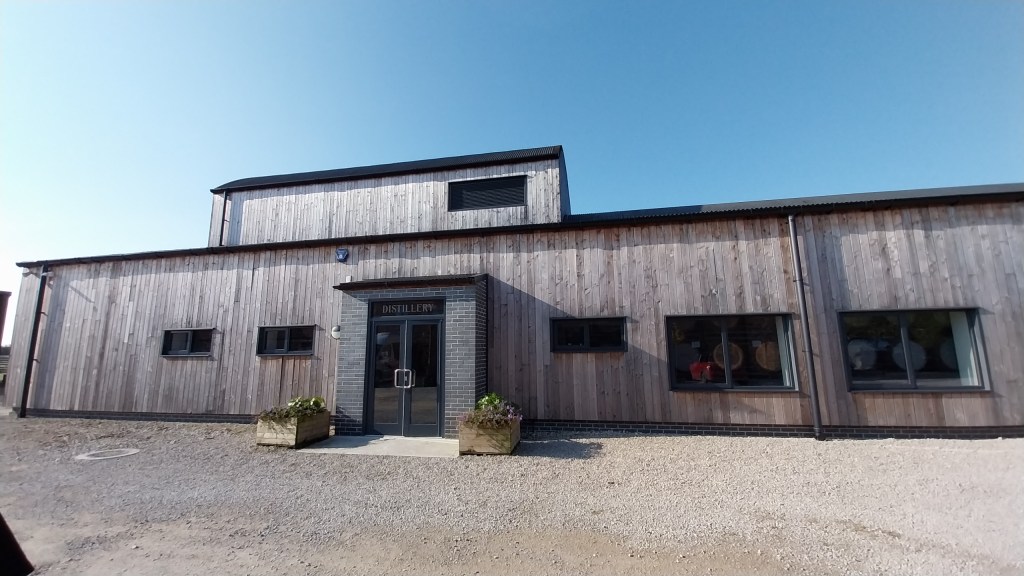
After the visit at Ellers Farm, we jumped back on the minibus. Our next destination was only about half hour away driving north-west, approximately 13 km north from the city of York, in the village of Sutton-on-Forest. The distillery is called Cooper King, just outside the village. It was founded by Abbie and Chris, a couple who got the inspiration while travelling in Australia and visiting local distilleries. The distillery is named after Charles Cooper King, Chrisโ€™ great-great-grandfather. The main building is just a few meters from the gravel parking lot, and it harbours a bar/shop and production. There is also a nice wee garden outside, with wooden tables and benches, which we took advantage of after the tour. It was a nice sunny day!

We were welcomed by Mark, tour guide and assistant distiller. Like others, he came on board as a crowdfunder. At some point (in our understanding) the two founders Abbie and Chris asked who among the crowdfunders wanted to be more involved, and Mark answered the call. We could clearly see his passion for the project. He explained that, in 2014, Abbie and Chris, once a biochemist and an architect, moved to Australia to travel, and started working as fruit pickers. Then, they went to Tasmania, and after getting in contact with Sullivanโ€™s Cove and Lark, they decided to go back to England and produce a Tasmanian-style whisky. Back in Yorkshire, they bought the land thanks to a crowdfunding, as well as a 900-litre pot still (Neilson) straight from Australia.

Another principle they had in mind when setting up the distillery was sustainability. The electricity comes from renewable sources, of which 60% is produced on site with solar panels: this contributed to make them the first net-zero distillery in England. They also have a programme for planting trees and restoring woodland and wildflowers habitat for each bottle they sell. Moreover, they chose lighter bottles, and offer refills at the distillery, for a few quid less.

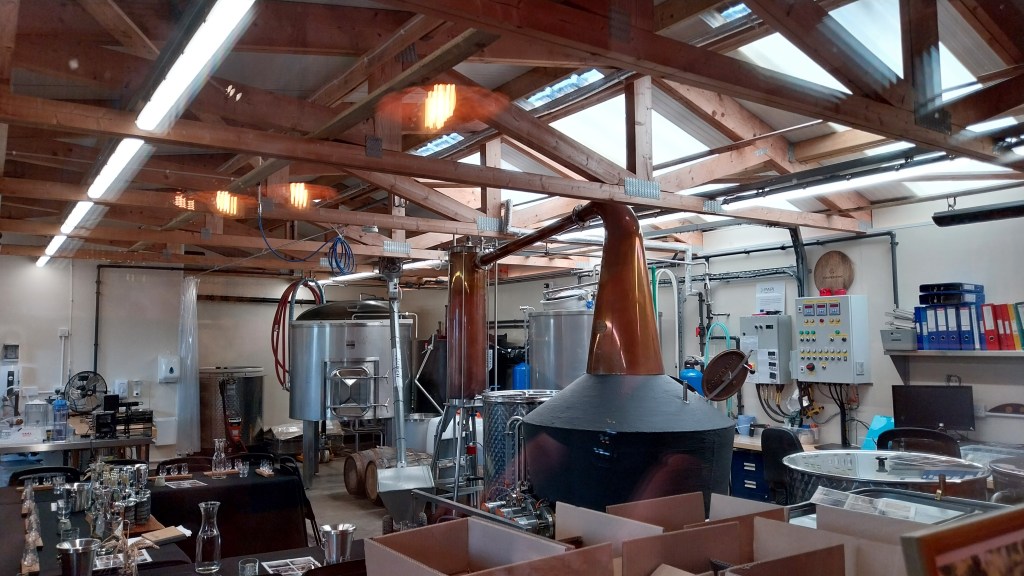
Production-wise, they use Maris Otter barley malted in middle England. They pre-heat the small mashtun before mashing the malt. After that, the remaining draff goes out to local farmers to feed cows. Fermentation takes place in a 1750-litre plastic vessel (usually only half full to avoid foam accidents) and lasts seven days. Both distillations happen in the same still, which is different to what we saw in all the Scottish distilleries we visited so far. At first, Neilson the still was heated externally, but to make the process more efficient it was sent to Scotland for modifications and is now internally heated and insulated.

The wash gets distilled to 25% abv, while the heart of the second distillation comes out on average at 75%, before getting diluted by filtered tap-water. Needless to say, everything in the distillery is very manual, except for the gin and vodka very modern cold-distillation machines (which take only about 10% of energy compared to a classic copper pot distillation).

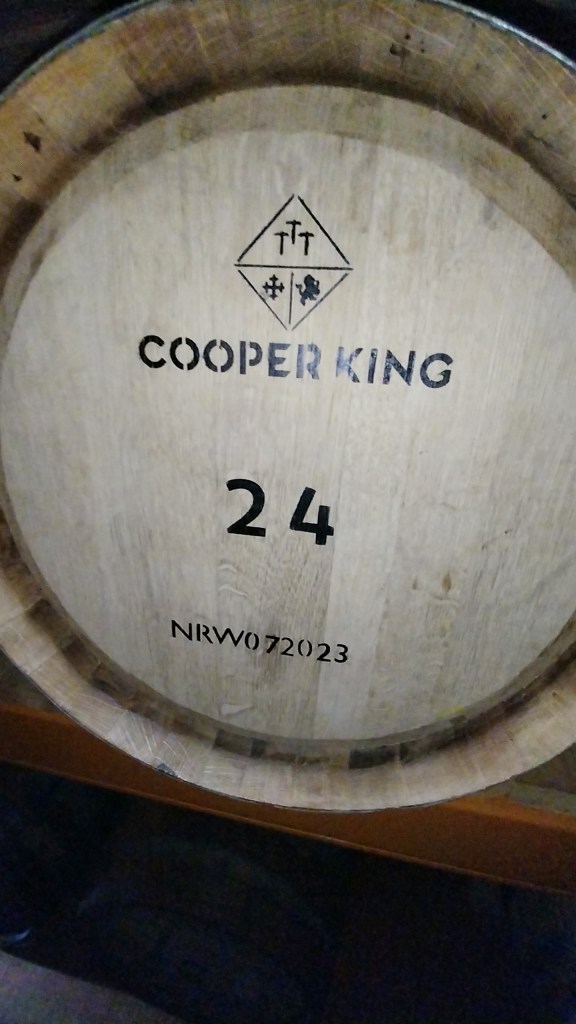
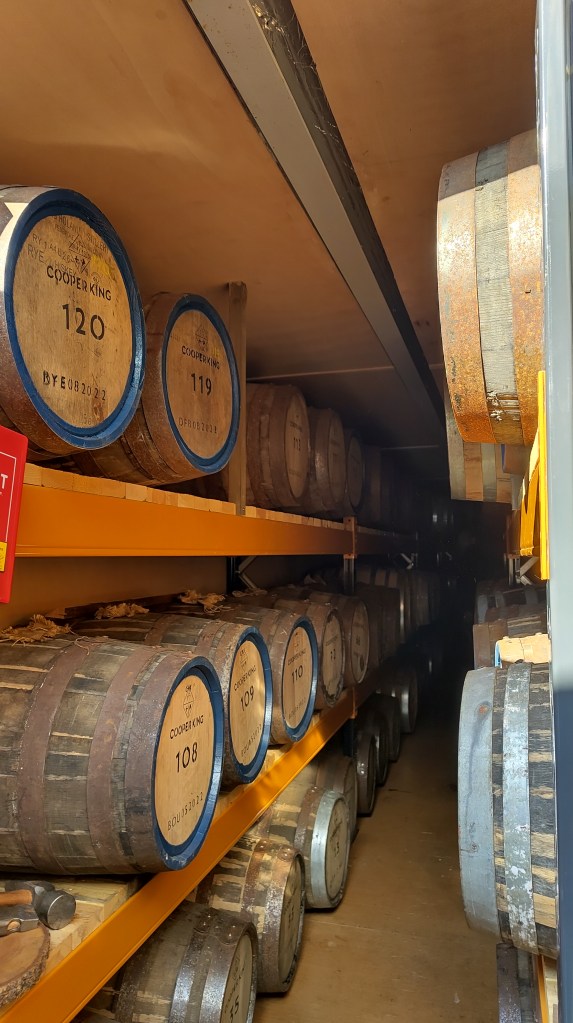
They use a variety of casks from all over the world, and their main American cask supplier is the Garrison Brothers distillery, in Texas. Casks are kept in a safe container behind the distillery, while waiting to get a proper warehouse. They started distilling newmake spirit in 2018, and their first whisky was released in October 2023, about a year before our visit.

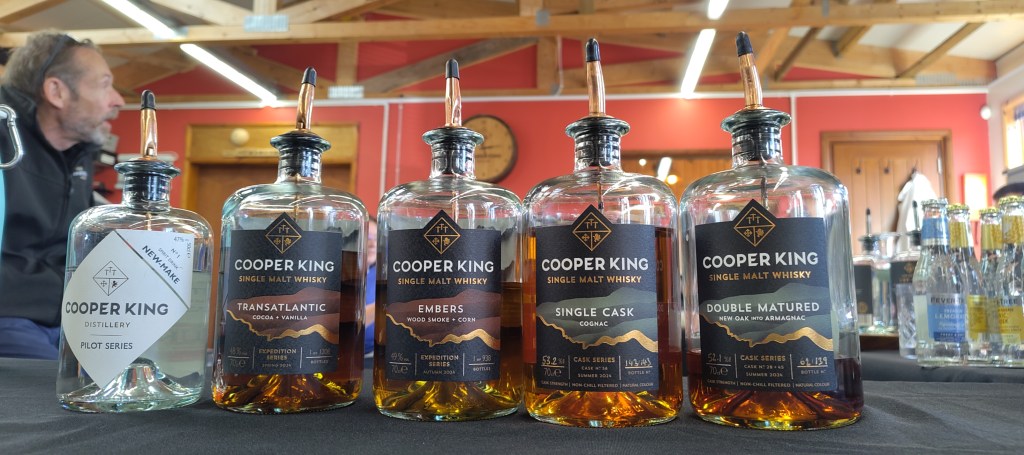
While we were outside checking out the casks, another member of staff set up the tasting in the main production room, which also serves as a tasting location. First, we went through five liquors and gins (see below), but as itโ€™s not really our focus, we wonโ€™t spend many words on it. We were really interested in their whiskies. The first one was not exactly that: a newmake spirit, from the โ€œPilot Seriesโ€ and bottled at 47%. It was followed by two single malts from their โ€œExpedition Seriesโ€, Transatlantic (ex-bourbon and ex-wine casks, 48%), and Embers (charred ex-bourbon casks, 49%). Then, two single casks: first, an ex-Cognac matured single malt, bottled at the 53.2% natural cask strength; second, a dram first matured in virgin oak casks, then re-racked into an ex-Armagnac cask, again cask strength at 52.1%. The evaporation (or โ€œangel shareโ€) is higher compared to Scotland, about 4%, which combined with other specific conditions, might cause the abv to be lower for such young whisky. Overall, we could tell the degree of experimentation at this distillery is high.

After the tasting we had a few minutes to spend in the sunny patio, sipping on our leftover drinks, before getting back on the mini-bus. We headed towards York, precisely the Brew York Brewery. Despite the city location is not their main production facility anymore (that one is in Yorkโ€™s outskirts), itโ€™s still a massive place. We did a production tour (ยฃ15, including four tastes) and then had dinner there (they do a range of Asian-inspired dishes, which were delicious, albeit heavy on spring onion). Unfortunately, the place was too noisy for the next scheduled activity, a whisky-based quiz, so we had to move to a quieter pub nearby. The quiz, organised by our whisky veteran pal Charlie, was great fun, and we went back to base all very happy.

What a great afternoon and evening we had! At that time, we had tried very few craft Australian whiskies (and even less Tasmanian ones), so the link between them and Cooper King was not evident to us. At the time of writing however (after a serendipitous trip to Australiaโ€ฆStay tuned in the coming weeks for more), the connection is quite obvious: we spotted a very typical herbaceous note in Cooper King drams, the same we found in most whiskies down under. Overall, itโ€™s a very interesting project, which we are very glad we got to know more of.

Next up, another Yorkshire whisky day, but not a distillery! Until next time, slainte!


Cooper King Distillery Bespoke Tour

Price: ยฃ20.00 pp (October 2024)

Duration: 1hr 30min

Tasting: 5 spirits (Dry Gin, 42%; Herb Gin, 40%; Smoked+Spice Dry Gin, 41%; Black Cardamom Vodka, 40%; Berry+Basil liqueur, 25%) and 4 drams: Transatlantic (48%, ex-bourbon and ex-wine, 1208 bottles), Embers (ex-bourbon, 49%, 938 bottles), ex-Cognac matured single cask (53.2%), virgin oak/ex-Armagnac cask (52.1%)

Target: whisky and spirit enthusiasts

Value for money: very good

Highlights: the distillery set up

Recommended: yes

Link: https://www.cooperkingdistillery.co.uk/


#55.2 All drams great and small

Compares apples with malt: Ellers Farm


TL; DR: After a good night sleep, it was time for another couple of Yorkshire distilleries, starting from Ellers Farm. Initially only a vodka distillery, they soon moved into gin and other liquors and spirits. The plan is to release a single malt in 2025. A very different take on whisky distillation, even compared to other English distilleries.ย 

(missed Part 1?)

Done with the distillery tour at the Spirit of Yorkshire distillery, we slowly walked back to the Pie Bald Inn, and to Mr Vantastic. After some rest, it was time for dinner: we were eager to try the renowned pies. They did not disappoint, the pies were very good, and portions quite big, so big that we both had some leftovers (which rarely happens with Gianluigi)!

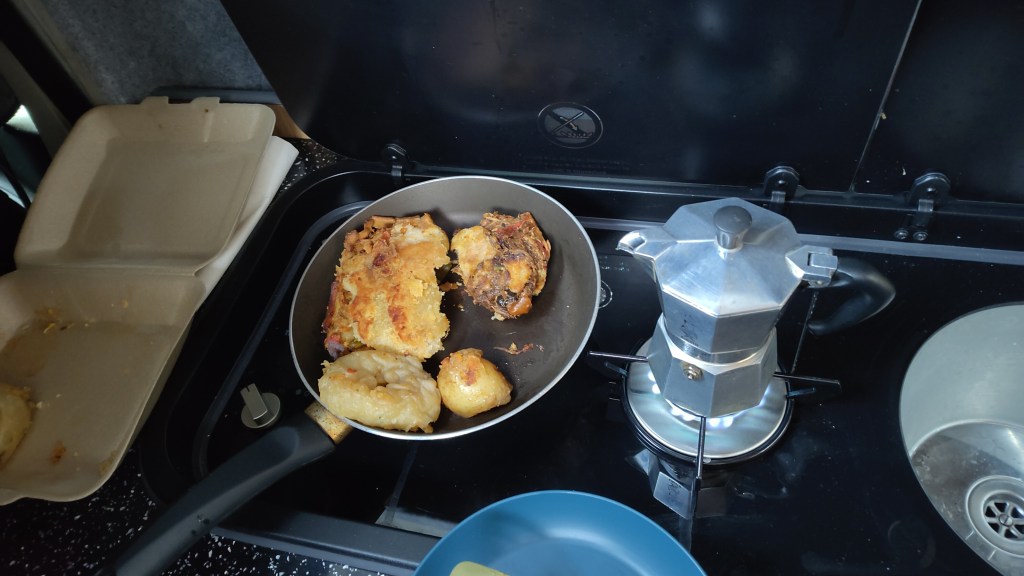
ย We woke up feeling well rested and ready for the day ahead. For breakfast we had the leftovers from the night before, warmed up in a pan in the campervan – great smell afterwards. We needed a big breakfast, as the programme of the day was ambitious: two distillery visits and a brewery tour. To make things easier for everyone, Justine had booked a small coach for the day.

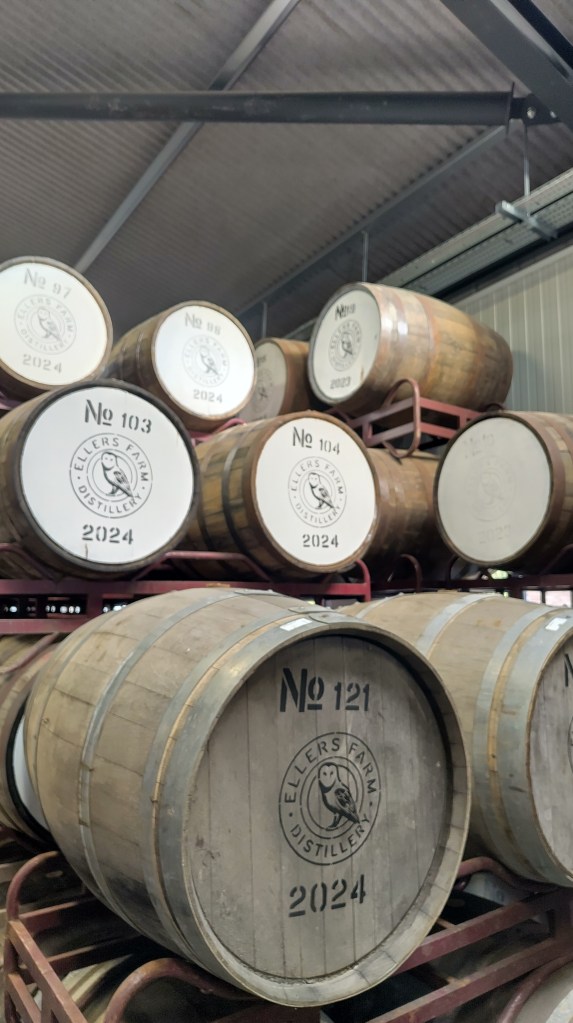
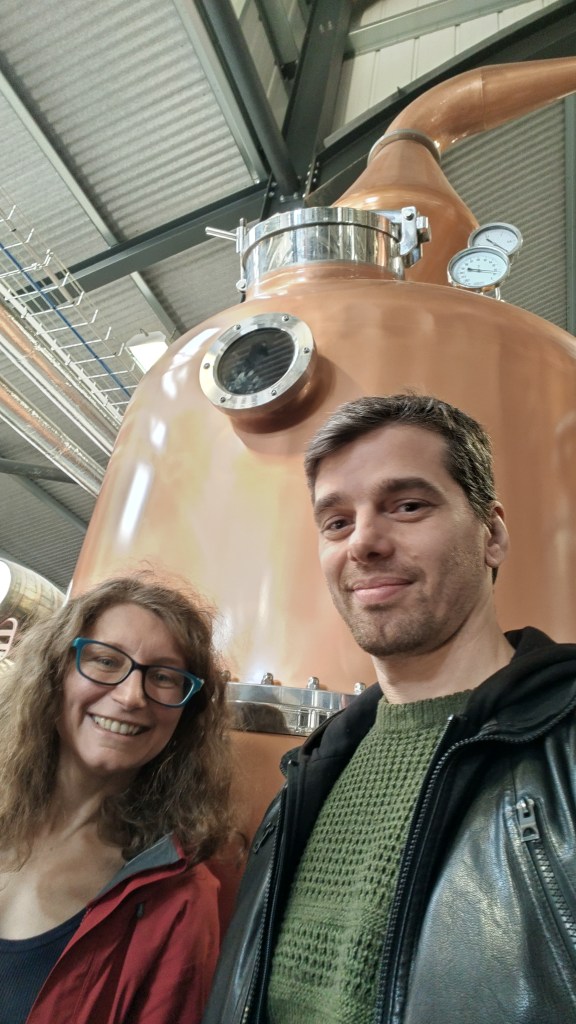
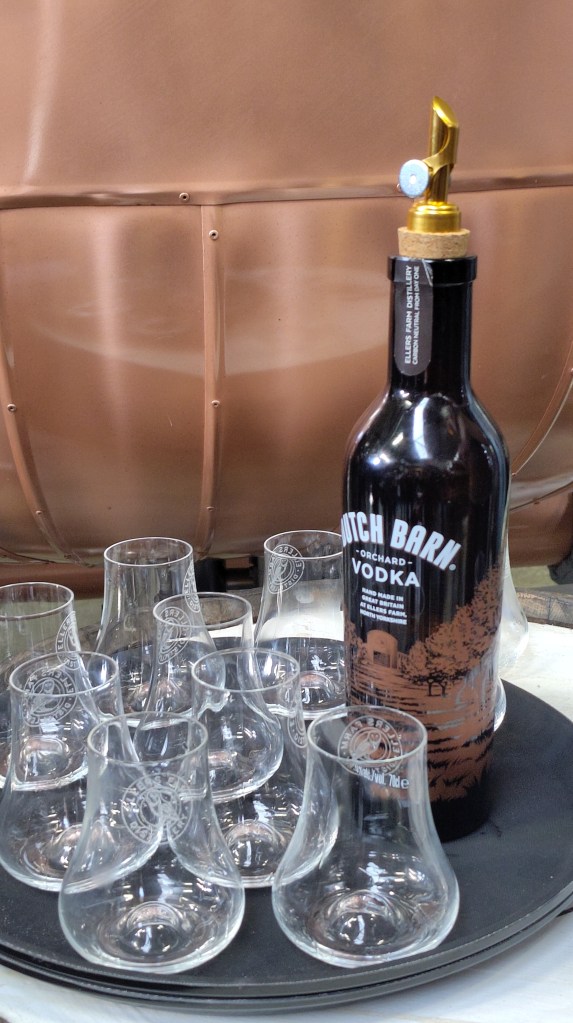
After about 50 minutes driving inland in the sunny Yorkshire countryside, we arrived at our first destination: Ellers Farm Distillery, in Stamford Bridge. This distillery might be popular because of a certain comedian coming on board, but more on that later. The site is an old farm, with one of the buildings now hosting the visitor centre and shop, a tasting room and some offices. We were welcomed by Ollie who, after a brief introduction, showed us around. The founder, Chris Fraser, started getting into drinks in 2014 after spotting an apple orchard whose fruits were not getting picked but instead left to rot on or under the trees. He started using the apples to make cider, followed by brandy and โ€œcalvados-styleโ€ spirits using a small still. He then came up with the idea to distill to high proof to make an apple vodka. So the Dutch Barn Vodka was born! The name comes from the type of barn that there used to be on the site before the conversion into a distillery โ€“ to us, despite the โ€œDutchโ€ adjective, the building looked more of American style. Later on, the Y-gin (Y for Yorkshire) was added to the portfolio. Today, 20% of the (B Corp) company is owned by employees, and there are plans to reach net zero by 2040. In 2023, Ricky Gervais was asked to feature in an advertisement, but instead he came on board as co-owner.ย 

A Dutch barn converted into a distillery.

Production takes place in the building on the other side of the courtyard. They use water coming from a 263-meter-deep borehole, and put the apples in a 8,000-litre fermenter with their own strain of yeast, to get a 12-15% abv โ€œwashโ€ (not sure if this is the nameโ€ฆ). The distillation happens first in a column still (‘Magic Mike’, great name) made in Italy, but also in a pot still (see below) and two rectification stills (with 26 and 25 distillation plates) for a total of 70 distillations: apparently, the two parts combined would make it one of the tallest stills in Europe (please if you work at the distillery and thing we got this wrong let us know, our notes were a bit foggy). Within the stills, about 70% of the liquid is recirculating, while 30% comes out as vodka. To note, they also have another mini-still, โ€˜Crystalโ€™ to reduce the level of methanol.

Success came right after their launch in 2022, with Waitrose being one of the first clients (for those not living in the UK, a very posh supermarket chain). When Asda (a bigger chain) also wanted to distribute their vodka, they increased production. At the time of our visit, they were about to launch in the American market, which meant further expansion from the current 1.3 millions of litres per year production.

Still in 2022, they started a collaboration with Theakston Brewery, producer of the popular (but unknown to us before this visit) Old Peculier beer, to make English single malt. The brewery provides the fermented wash: it is made with 100% malted barley (from Muntons maltster) and is fermented for 96 hours with two different yeasts, one at the bottom and one at the top of the vessel. They also let it reast for another 12 days, to get to 16 days in total.ย Once at the distillery, it goes first into an 8.5m-tall column still (‘Magic Mike’, great name) to get to 40%, and then in a 2,500-litre copper pot still (โ€˜Granny Smithโ€™, another brilliant name), described by Ollie as their distiller Jamieโ€™s โ€œbrain childโ€.

For every distillation run, they produce about 7 casks worth of newmake spirit, mostly filled at 63% after diluting from the original strength of 80%, with the borehole water. Their most prevalent casks are ex-bourbon barrels from Heaven Hill distillery, in the US. Some of the casks are kept in the production shed, but the majority rests in another building on site which we didnโ€™t visit. The first cask was laid out in August 2022, and they aim to have their first malt ready in November this year (2025). In the meanwhile, to follow the journey of the spirit, they have setup the Evolution Collection: a set of 50cl bottle spirits, taken every six months from 0 to 24, and the final first single malt whisky, all bottled at 46% (the whole set for the not cheap, but not unreasonable either, price of ยฃ500).

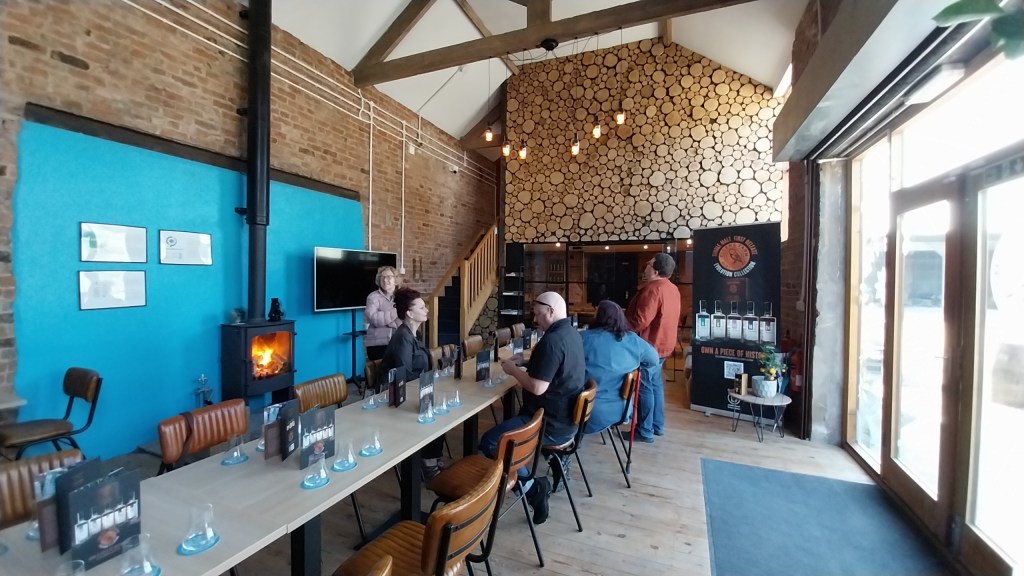
After the visit of the production area (and a sip of the Dutch Barn Vodka) we went back to the visitor centre for the tasting: the 3-dram lineup started with the newmake spirit, followed by the 6- and 12-month spirits. The three samples were very interesting and very promising, all three at 46% and characterised by notes of grilled pineapple and other tropical fruits. The second dram had notes of banana and, surprisingly, of burnt (in a good way), while we got apple pie but some herbal ones too from the last one. As the tasting was turning to an end, Ollie took out the โ€œliqueurs cartโ€ with several gins, coffee liqueurs and others to try. Some of them were definitely very nice, although itโ€™s not really our scene, but perfect for those friends or family members who like lower abv and sweet drinks.

This visit was really good, we could feel the enthusiasm around this project, and how much thought is put in every aspect of production. Also, this was probably one of the most generous tours we have done so far, which is not a given these days, in particular given the silly prices of whisky experiences (at the time of writing, the Spirit of Speyside 2025 program was just out, with many companies really taking the proverbial piss). The one from Ellers Farm is definitely a single malt release weโ€™re going to keep an eye on!

Stay tuned with us for the rest of our Yorkshire boozy day! Until the next time, slainte!


Ellers Farm Distillery Bespoke Tour

Price: ยฃ10.00 pp (October 2024)

Tasting: newmake spirit โ€œThe Bairnโ€ (46%), 6 months-old spirit (46%), 12 months-old spirit (46%)

Target: whisky and spirits enthusiasts

Value for money: very good

Highlights: the staff enthusiasm and friendliness, and also a paradise for those interested in different types of distillation

Recommended: yes!

Link: https://www.ellersfarmdistillery.com/
#55.1 All drams great and small

The Top of the Wold and the Spirit of Yorkshire


TL; DR: This year the jolly gang of the Edinburgh Whisky Group chose a controversial destination for the annual trip: Yorkshire, in England! Plenty of distilleries and other destinations, starting from one of the most celebrated English whisky distilleries: the Spirit of Yorkshire! The tour(s) and tasting exceeded our expectations: this distillery is a strongly suggested destination for whisky lovers!ย 

With the start of the autumn (or fall, for those of you on the other side of the pond), it was time again for the Edinburgh Whisky Group annual trip. Our first destination was Campbeltown, in 2021: plenty of whisky activities, all at walking distance from each other, just perfect. The trips that followed, Speyside in 2022 and Northern Highlands in 2023, were logistically harder to organise for Justine, as they required getting a coach, and playing Tetris with the various distilleriesโ€™ availability. One thing Justine had to face, despite her huge effort and the number of distilleries in those areas, was the unwillingness of many to accommodate a large group (with exceptions, such as Glen Moray and Glenallachie), open their doors for the ones usually closed to visitors (again some exceptions, like Dornoch), or just arrange something different for usโ€ฆIn some cases even replying to emails seemed to be too big of an effort!

For the 2024 trip, Justine had a great idea up her sleeves: going south of the border, to England! Specifically, to Yorkshire. English whisky has seen a renaissance in the past decade, going from one distillery (The English distillery, in East Anglia), to a few tenths, as testified by the ever changing map maintained by Cooper King (a caveat though, some of them are gin distilleries possibly laying cask of newmake spirit, so take this number with a pinch of saltโ€ฆNevertheless, 55 is quite impressive!). We had already โ€œdrammed aroundโ€ England, with visits to the Lakes Distillery (March โ€™22), Copper Rivet (October โ€™22), White Peaks, and Cotswolds (both July โ€™23), with White Peaks being the most impressive, in terms of location, quality of the whisky and, last but not least, company ethos. Because weโ€™d enjoyed these โ€˜tastersโ€™, we were quite curious of this deep dive in the English whisky scene, so when October came, we were really excited!

We left Leith on the Thursday night, sleeping half-way between there and the โ€œbase campโ€ of our trip, the Piebald Inn, in Hunmamby. This is a quite famous hotel and restaurant, in particular for the number (and quality) of their piesโ€ฆAlthough Gianluigi was a bit disappointed when he learned that the Quarter Horse or the Chestnut Horse pies were not really made with horsemeat, dโ€™oh! We got there in the morning, just in time for the group meet-up. For our first day, we had a brewery and a distillery tour: Wold Top Brewery and Spirit of Yorkshire Distillery, both owned by the Mellor family.

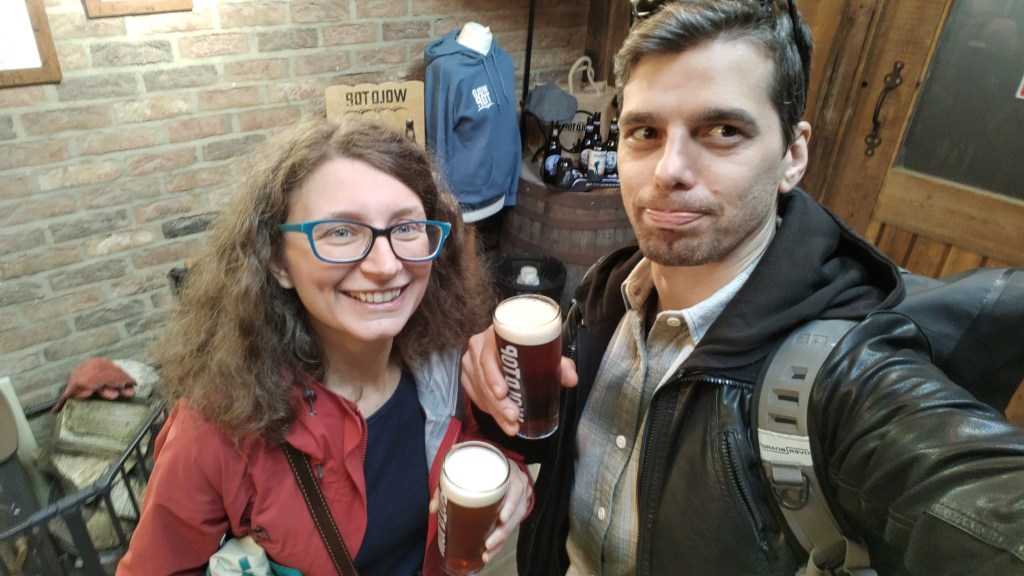
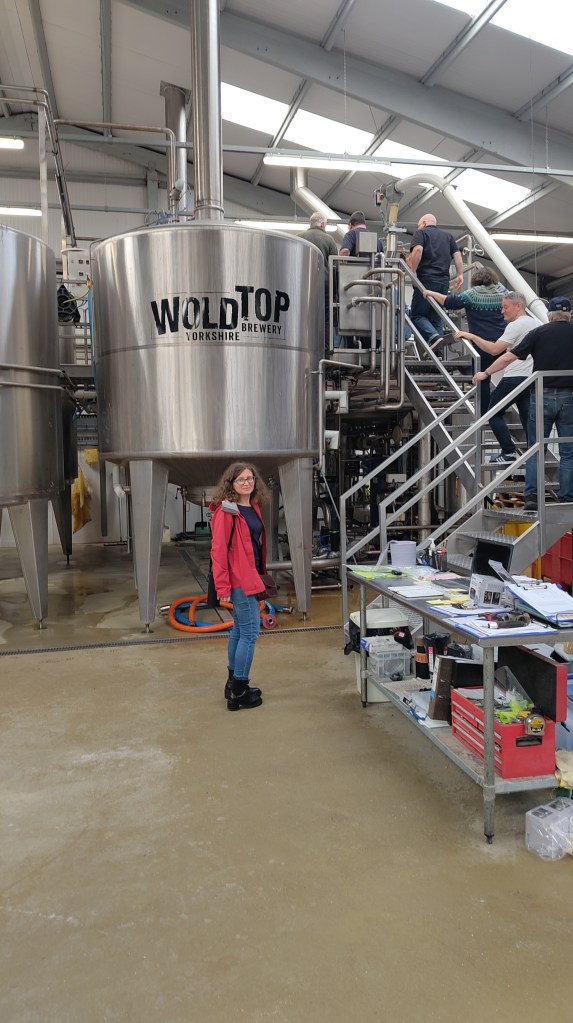
We started from the brewery, called Wold Top because Wolds are the hills where the brewery is located (itโ€™s not a typo!). We got there by taxi, and as we settled in the brewery visitor centre and bar, they offered us a half pint (with a pint glass to keep), nice welcome! Sam, our guide, put on a well-made video about the brewery history. It was founded in 2003 by Tom and Gill Mellor on their farm, and it’s currently run by their daughter Kate and her husband Alex. Knowing that this part of Yorkshire is ideal to grow brewersโ€™ and distillersโ€™ barley, and realising that the farm sits on a great water source, they decided to cut the middleman and start producing their own beer, farm-to-glass. At first the biggest issue was distribution (they started with farmers markets), because of the remoteness of the area. In 2008 they installed their own bottling plant, and in 2012 and 2016 they expanded with new kits and started doing contract brews as well. For a while, the location could also be hired as a wedding venue, but that stopped a few years ago. In 2016, they also started distilling, but weโ€™ll talk more about that later. For the beer, they mainly use Lauriet barley, which is sent to Muntons for malting. The barley is malted to eight different โ€œcoloursโ€, but sometimes they also use wheat and, more rarely, corn. They use over 40 varieties of hops from all over the world.

A welcome half pint, nice!

After the video, we moved to the production area next door, also used as an extension for their events (and indeed, decorations from the October Fest were still hanging around). In this location they produce both the beer and the fermented wash for the distillery. After checking out the modern malt mill, we climbed a stair to get on top of a catwalk and check out the mushtuns, including the kettle to boil the beer (one of the main differences between making beer and whisky, beside the addition of hops), where the beer wash is boiled for 75 minutes. Next to the catwalk, the stainless steel washbacks for fermentation. The beer is kept in conditioning tanks for 2 to 4 weeks before going straight into casks (i.e. unfiltered), then chilled, filtered and finally put into kegs or bottles. We headed back to the (cosy) bar for another half pint, while our pal Stephen (after asking permission to the staff) served us a dram of a Filey Bay single malt finished in a Wold Top beer barrel (Ex-IPA finish, Whisky Exchange exclusive bottled for the 2024 Whisky Show, 51.5%) – a preview of what was about to come.

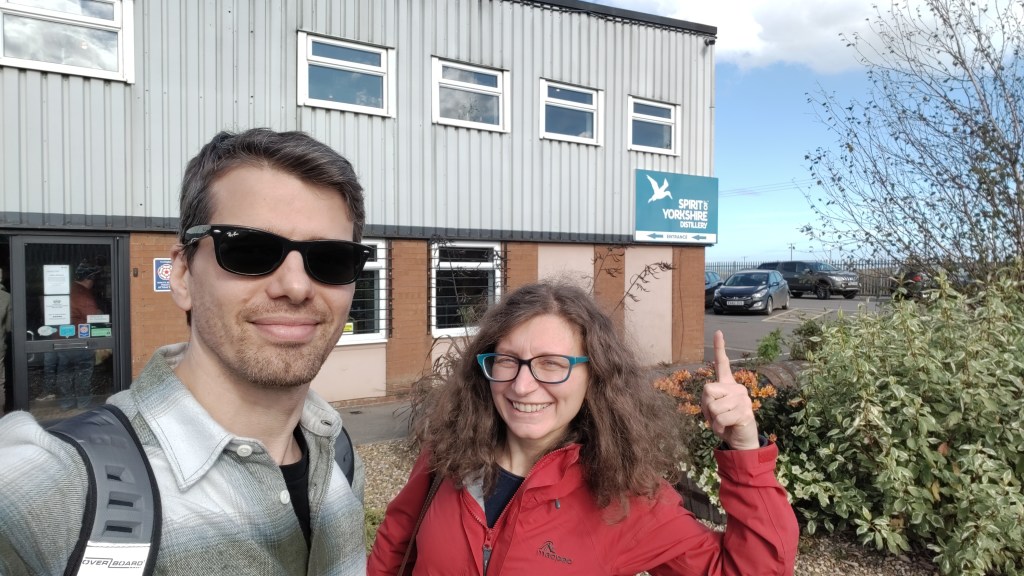
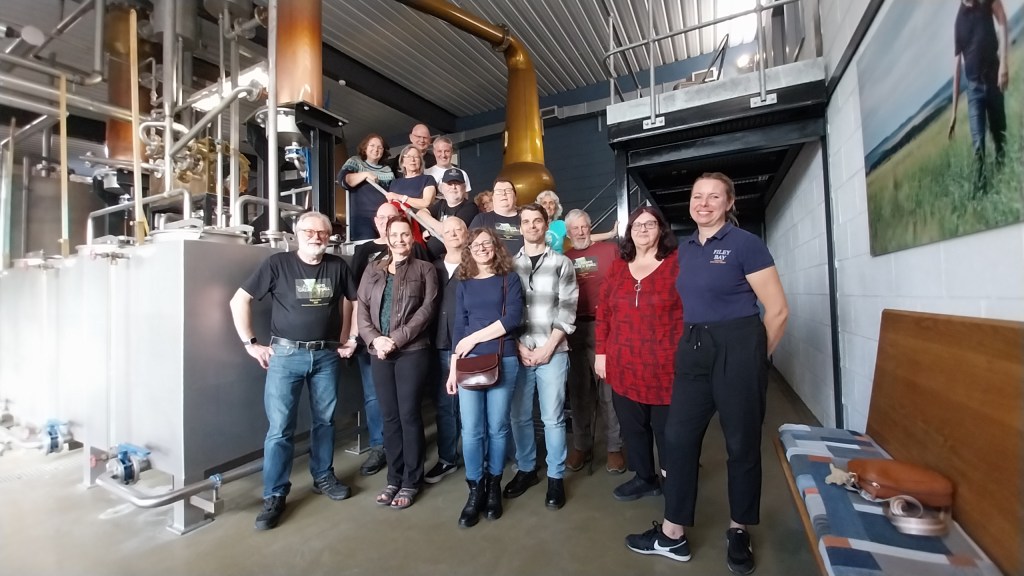
We headed back to Hunmamby (again by taxi), to the Spirit of Yorkshire distillery. The building is in a small industrial estate, and other than distilling they also have a shop and a bar/cafรฉ (The Pot Still) overlooking the still room. We had tables booked for lunch, and after the (nice) meal, we started the tour with our guide Justina. She gave us a welcome dram (the Flagship) while telling us the history of the distillery, which was built in 2016 and opened to visitors in 2017, with many options for tours and tastings.

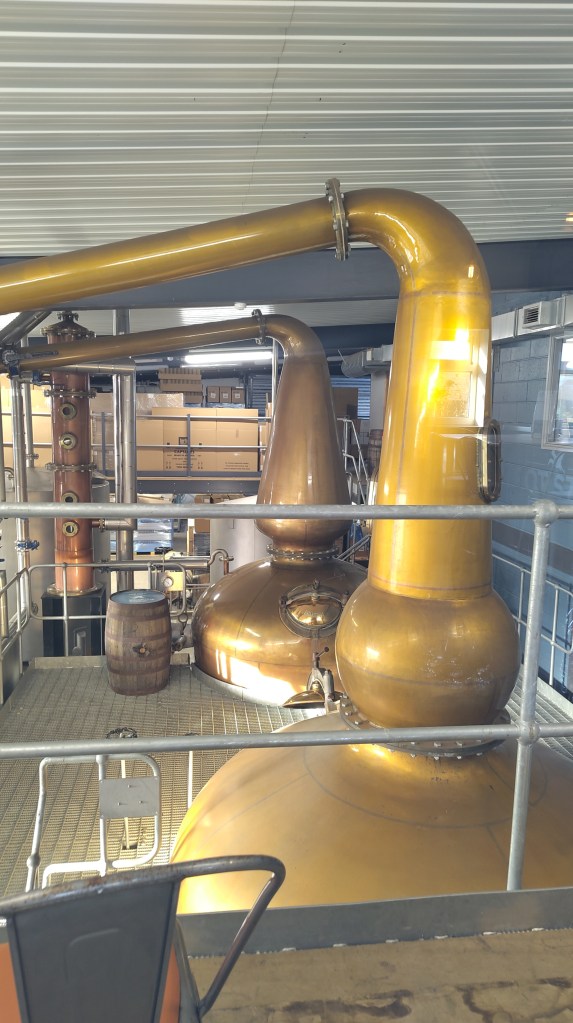
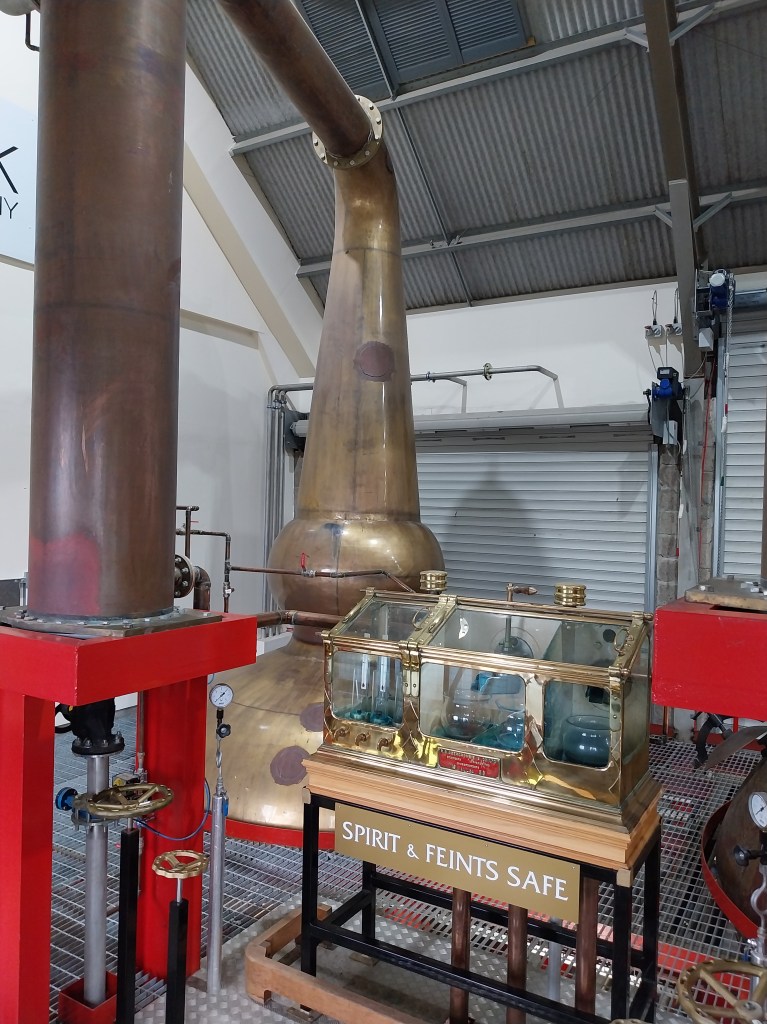
The fermented wash comes twice a week from the brewery on a tractor, 20,000 litres in total. For the whisky, they usually use Concerto barley in spring, and Vessel in winter. Fermentation lasts 75 to 95 hours, and the yeast is added twice, at different temperatures (two types of yeast, we missed which varieties though). The first pot still holds 5,000 litres, which are reduced to 1,700 after the first distillation. The second pot still is 3,500 litres, and after 10-15 minutes of foreshots, they collect 500 litres of spirit for about 1-1.5 hours, with cuts between 77-76% and 69% abv. Here is the novelty, they also have a small column still, which they use for 6 months a year in tandem with the pot still. For the column still, the 400 litres cut is taken between 86 and 85%. This system, as for many other new distilleries, was suggested by the late Dr Jim Swan, and because we are in England, and the grain used is barley, they can call it single malt whisky. The newmake spirits from the column and pot stills are put into casks separately, and then blended before bottling to get the required flavour profile: their flagship product is 50/50 column and pot still whisky, and it is fractionally married aiming for consistency; everything else they produce is made in small batches.

The full capacity would be 450,000 litres of alcohol per year, but their usual production is between 12 casks per week (about 82,000 litres) which are stored in a bonded warehouse off site, but near the farm. Casks are then moved back to the distillery for bottling, in their new automated bottling line, able to make 600 bottles per hour. Everything is non-chill filtered and no colouring is added.

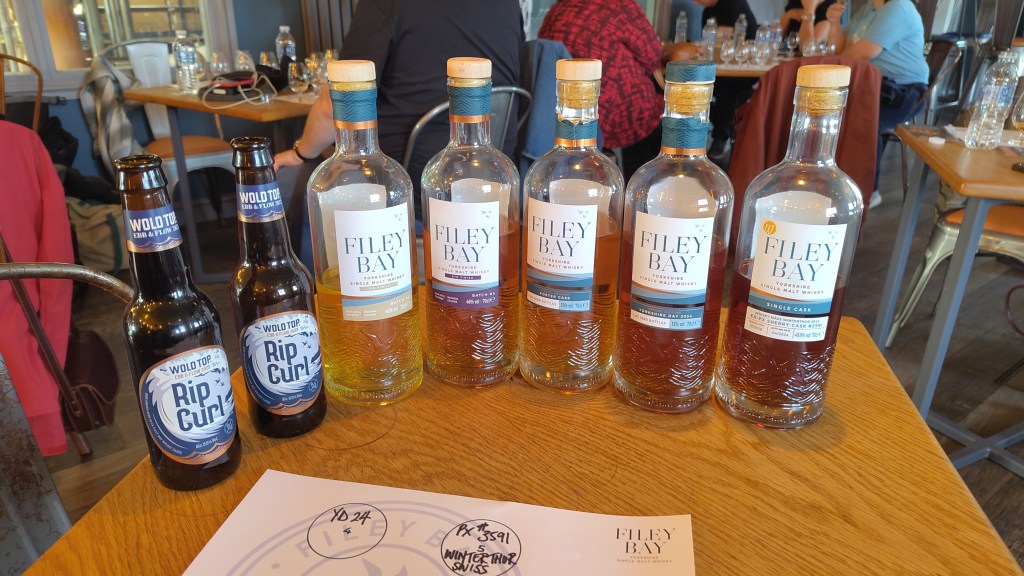
After the very comprehensive tour, for the tasting we went back to the cafe, which they closed for the occasion. We explored their current range of single malts and variety of cask they use, including two expressions from beer casks (full tasting description below). At the shop they offered us another nip of things we might want to try (peated and Moscatel cask finish for us, to complete their range). Happy, we then headed back to the Pie Bald Inn.

It was a great visit, we learned how things can be done differently compared to Scotch whisky, and still obtain a great result in such a short time (first release was in 2019 only) – the distillery is not even 10 years old! The array of whiskies we tried was very interesting, showcasing a great variety of flavours.

Stay tuned with us for more English whisky action! Until the next time, slainte!


Wold Top Brewery Tour + Spirit of Yorkshire Distillery Tour

Price: ยฃ12.50 pp + ยฃ30.00 (October 2024, our experience was a combination of the Brewery and Distillery tour, ยฃ25.00, and the Distillery tour & Deep Dive tasting, ยฃ30.00)

Duration: 1hr 30min + 2hrs

Tasting: 2 half pints of choice at the brewery and 6 Filey Bay drams at the distillery: the Flagship (46%, NAS, ยฃ55); IPA finish Batch 2 (46%, 6-7 months finish in a barrel that hold an IPA for 7-8 months, ยฃ65), STR Batch 4 (46%, finished for 7-8 months, ยฃ65); Porter Cask (50%, similar to their flagship, but finished for over a year in barrel that held Rip Curl porter for 14 months, sold out); Yorkshire Special Release 2024 (55%, matured in STR, then re-casked in ex-Madeira, ex-Sherry and finally virgin oak casks, ยฃ95); and a single cask bottled for the whisky marked (49.9% cask strength!, fully matured in ex-PX casks, distilled in December 2018, bottled in 2024)

Distillery exclusive: the Yorkshire Special Release 2024 (see above)

Target: beer and whisky enthusiasts

Value for money: very good

Highlights: the whisky and the welcoming staff

Recommended: absolutely

Link: https://www.woldtopbrewery.co.uk/, https://www.spiritofyorkshire.com/

#50 Falkirk distillery

Old stills for a new whisky


TL; DR: On a gloomy Friday afternoon, we visited the Falkirk distillery, guess where? While surrounded by construction sites, the distillery is up and going (well, not when we visited, as it was silent season): one of the most classical distillery layouts among new distilleries we visited so far. The drams we tried reflected this, maybe merit of some old stills being used?ย 

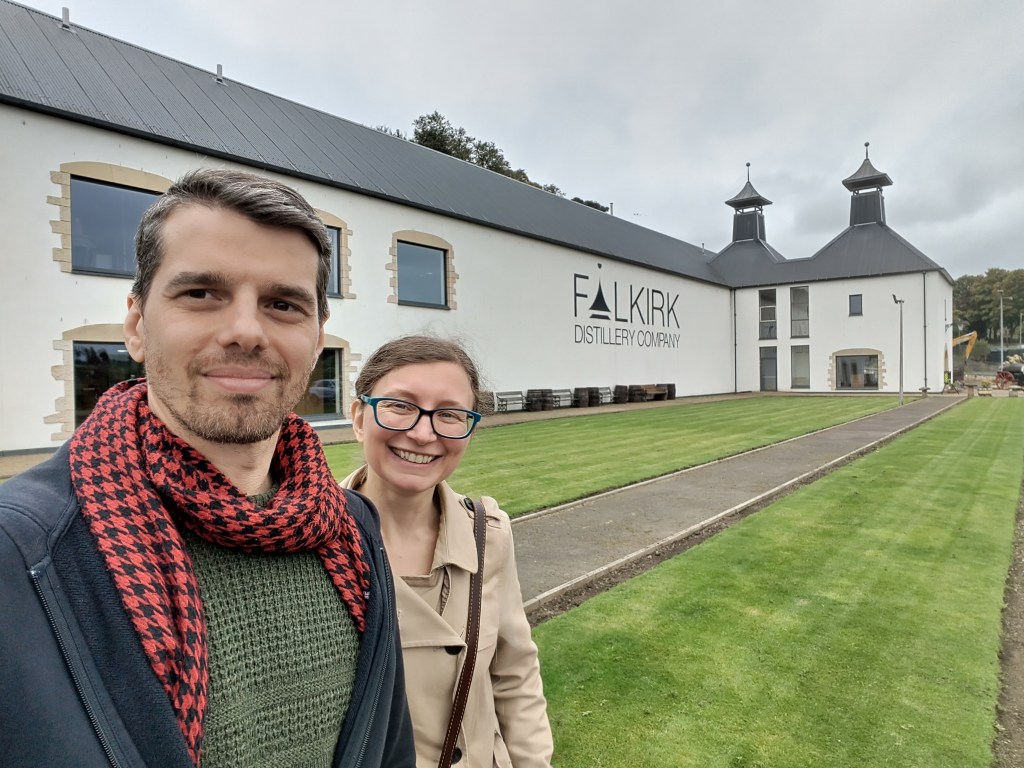
In 2021, on a lazy summer Sunday towards the end of the pandemic, we joined our friend and whisky expert Justine (btw, her new book on the Pattison brothers and their crash is due soon!) on a drive around the Central belt, to visit the site of an old distillery, Kennetpans. After visiting the site, mostly ruins, we did a couple of detours on our way home. One was to check out the construction works at Rosebank distillery, the other one to look at a newly built distillery, the Falkirk distillery indeed! The distillery building was fully up, all white and shiny, with the home brand painted on the side, while some construction was still going on in the car park. This September, over three years later, it was time to go back, and check the distillery out.

The Falkirk whisky got on many whisky peopleโ€™s radar last year, but for the wrong reason:ย  their first release was priced just south of ยฃ200; it surprised many and enraged a few. We donโ€™t know anybody who bought a bottle for themselves, but of course it was sold out, so bottles are probably laying in some collectorโ€™s cabinet, or in the storage of some hopeful flipper. That was followed by a more reasonably priced release, named after the distillery founder: George Stewart, for ยฃ58. It is still available on their website, and the proceedings are going to Prostate Scotland charity.

Distillery tours are available through email reservation and only during weekdays, which prompted us to take a few hours off on a Friday afternoon. At the time the tour was ยฃ20, now there is an extra option for a three-dram tour instead of two, for ยฃ25. The person who answered our email was also the guide for the tour, Zilvinas (or Zi), who has been working at the distillery for a while in different roles.

As we arrived at the distillery, we noticed some construction works around the parking lot. Zi told us later that the plan is for a restaurant/cafรจ next to the distillery, and for commercial units in the building on the other side of the parking lot.

Zi welcomed us very warmly and was a great host throughout the tour. To start, we watched an introductory video with some words from the founder, and some drone footage in the distillery. We then moved to production, of course starting with the milling: they are equipped with a modern 4-roller Buhler mill, so no Porteous, nor Bobby Mill, which makes sense for a fairly new distillery. They use Lauriet malt, from Boortmalt in Speyside, exclusively unpeated as they are aiming for a typical floral, lowlander style. The malt is automatically processed in the mill, and the resulting grist split is the usual 70/20/10 (grit/husk/flour).

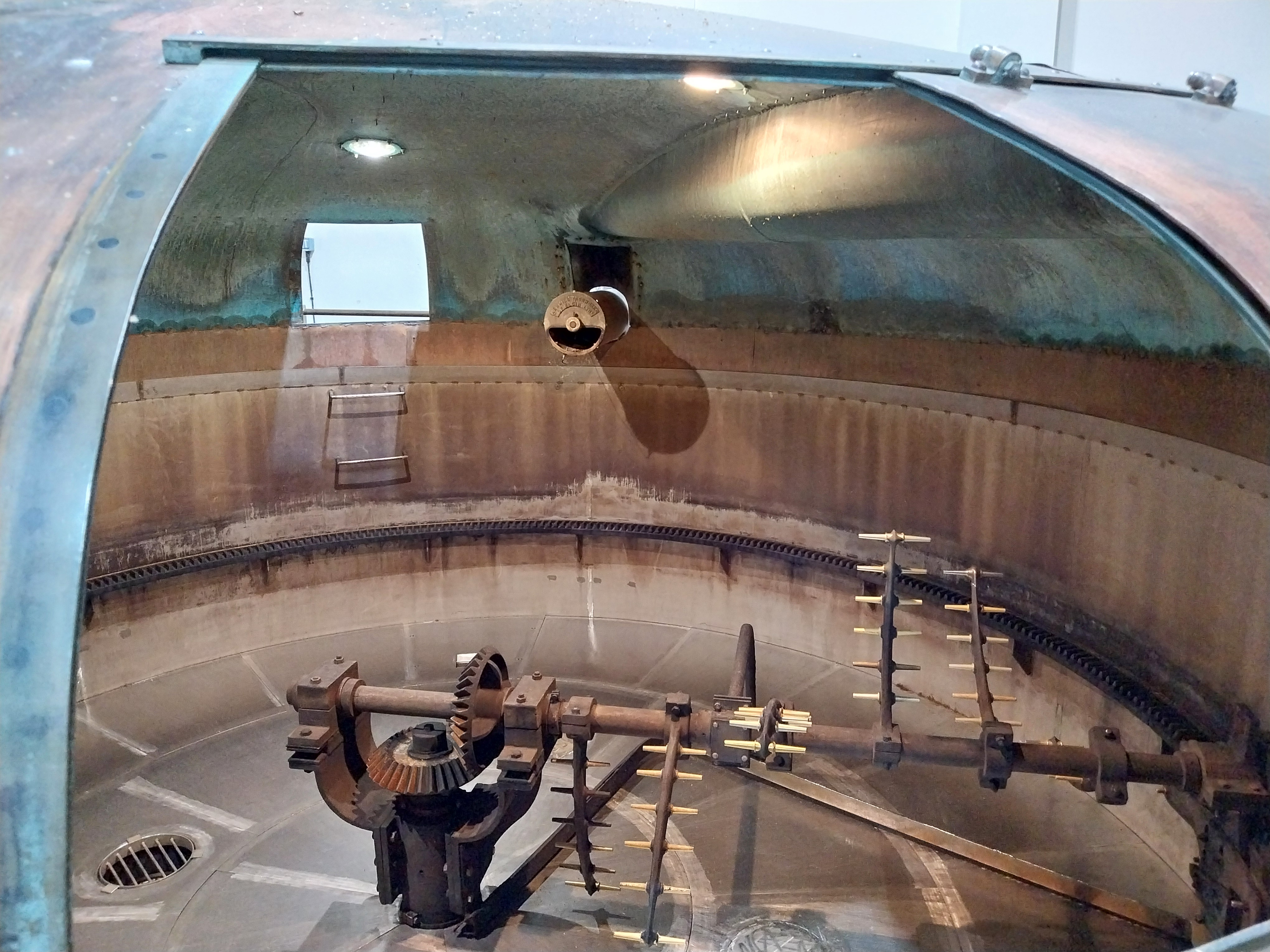
Here, we could see the first piece of old equipment: the mashtun. A massive 4.5t semi-lauter tun, it comes from the defunct Caperdonich distillery. The distillery, also called Glen Grant #2, was closed in 2002 and demolished in 2011 to make space for the stills-maker Forsyths (which we visited in 2023). The only new part is the plates underneath the tun, used to obtain a very clear and filtered wort. They use three waters, which they draw from a 90m deep borehole, at increasing temperatures (60ยฐC, 72ยฐC, and finally 85ยฐC). They do two to three mashes per week, but theyโ€™re aiming for 10 a week, for a total of about 750,000 litres of alcohol per annum. The wort then goes into one of the six stainless-steel washbacks, each one with a 34,000-litre capacity (but only filled up to 20,000 litres for safety). Fermentation is kickstarted with 75kg of distillersโ€™ yeast and lasts 100 hours.

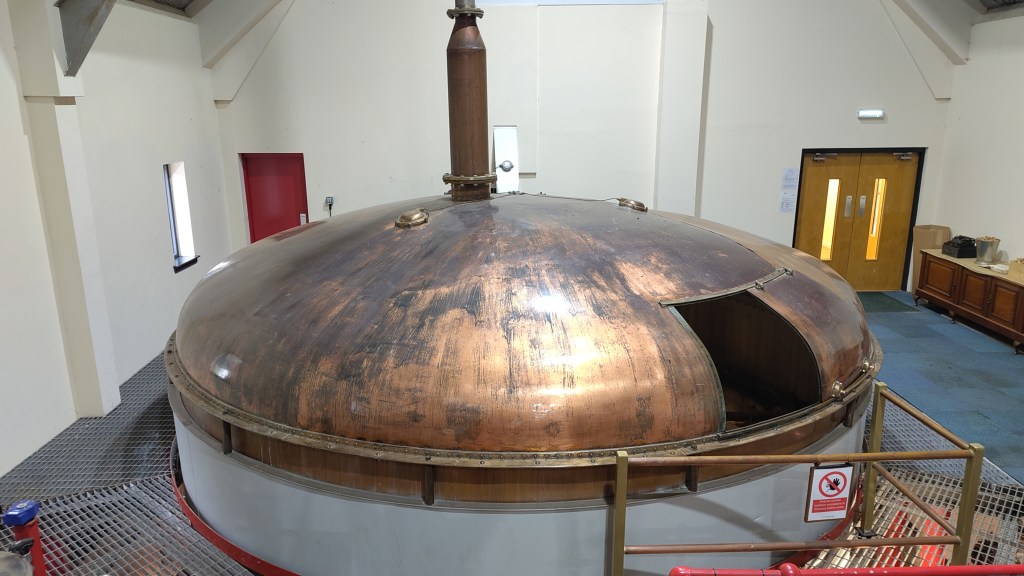
And then, the other piece of Caperdonich equipment: the two stills (another couple was sold to Belgiumโ€™s Owl Distillery). They are magnificent, and it is great that Falkirk gave them new life. The stills are heated with steam from a gas boiler, and they are run quite slowly to increase the reflux in the spirit. During the second distillation they take a cut from 75-76%abv down to 65%, in about 2.50-3 hours. From two mashes they get about 4,200 litres of spirit before dilution to 63.5% abv to fill the casks.

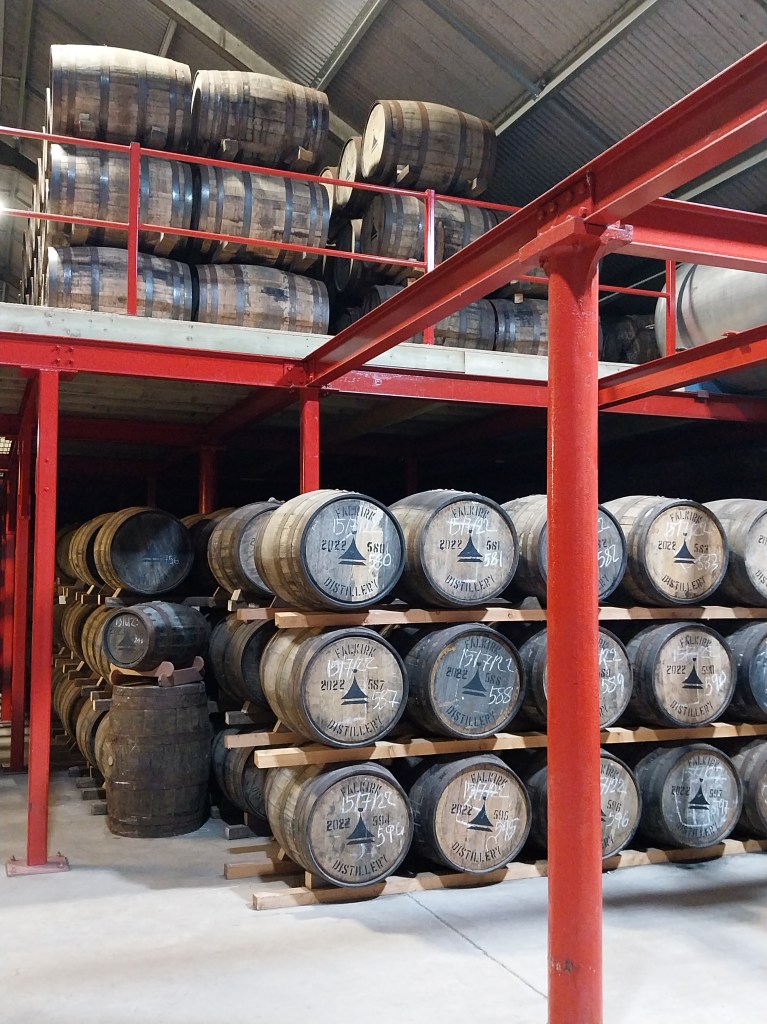
They have two warehouses on site, and they are planning for a third. We visited the first one, which was a โ€œsemi-dunnageโ€ on two floors: the cask are stored horizontally three high, but the floor was not earth but concrete. They mostly use ex-bourbon American standard barrels from Heaven Hills, less often from Jack Daniels, and sometime other casks too, like Oloroso sherry.

After this, we went to the shop to pick up our drams to go, as we needed to head back home. The two drams were the newmake spirit (63.5%) and the George Stewart expression (48%). We also got an extra dram from a small ex-sherry firkin (about 40 litres), 3.5 years old, at 58-59%. In the shop there was a bit of a mix of stuff on sale: some gift packs with aged spirit (not yet whisky), merchandise, and some random bottles of whisky on sale. We remember spotting a Deanston 12, but also a Laphroaig Select and maybe a Famous Grouse.

A few days later, at home, we tried the drams: overall we found them quite solid, particularly compared to other young distilleries. The newmake spirit was very fruity with notes of pear juice (which we often find in newmake spirit), and a very nice mouthcoating. The George Stewart was very tropical, with bananas, banana bread and honey notes. Overall pleasant, but you could tell it’s very young and the finish was a bit short. Finally, the sherry firkin was obviously a very cask-forward dram, with leather, trifle, pine forest, nuts, Xmas spices, chocolate, oak, and sour cherry. We wouldnโ€™t have said it was that young though.

The spirit we tried is very promising, quite tasty overall. The tour was nice, again Zi was a great and very knowledgeable hostโ€ฆHe answered so many questions! However, it felt a bit strange that this year they prolonged the silent season for over two months (at the time of the visit, now we donโ€™t know). Hopefully, things will be on track soon!

Stay tuned for more Central belt action, and until then, slainte!


Private Falkirk Distillery Tour

Price: ยฃ20.00 pp (September 2024)

Duration: 1hr

Tasting: newmake spirit (63.5%), George Stewart single malt (3.5-4yr, 46%)

Target: whisky nerds

Value for money: good

Highlights: Zi was an excellent guide

Recommended: yes

Link: : https://www.falkirkdistillery.com/

#45.2 Stepping over the (Highland) line!

Back in the Lowlands


TL; DR: After Glengoyne distillery, we headed down back to the Lowlands. First Dumbarton, then Auchentoshan. We had a very in-depth tour, which was great, and we could appreciate every bit of their unique triple distillation process. Worth the money, just a shame the drams were basic. 

(missed Part 1?)

As we came out Glengoyne distillery, we definitely needed some food. Fortunately, we had a couple of sandwiches we got earlier at the Turnip the Beat cafe, quite delicious ones, which we devoured in the Glengoyne visitors parking lot (thus, already in the Lowlands). We soon left though, heading first towards Loch Lomond, and then south. We had a few hours to spare, so we went to Dumbarton, which weโ€™d never visited before.

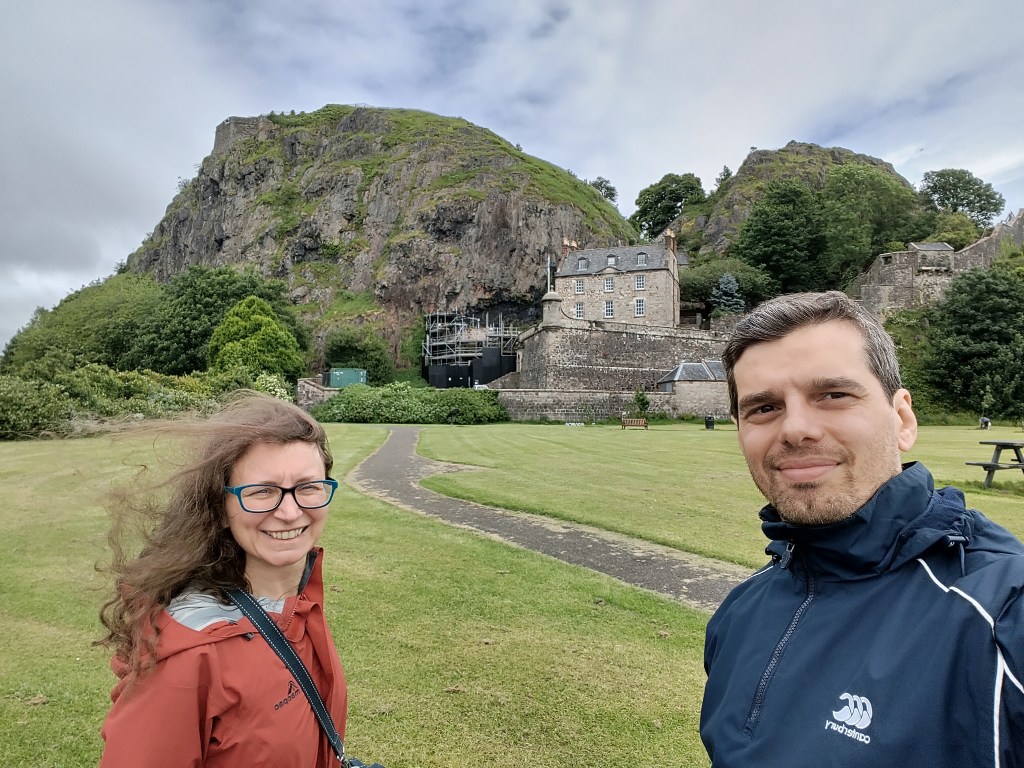
Dumbarton used to be home to the namesake grain distillery, and (on the same site) the Inverleven single malt distillery. Both distilleries started producing in 1938, Inverleven was then closed in 1991 and Dumbarton in 2002. Today there is a housing development on the site, which kept some of the red brick buildings. Other than that, the only remaining signs of this town whisky history are the massive warehouses on the road to Glasgow. We parked at the bottom of the Dumbarton Rock, a huge volcanic plug with a castle on top of it (you guessed it, the Dumbarton Castle). Unfortunately, the castle was closed due to illness (!!!), so we only took a short stroll in the garden below the rock, near the estuary of the river Leven, and then got a coffee and a light bite in town.

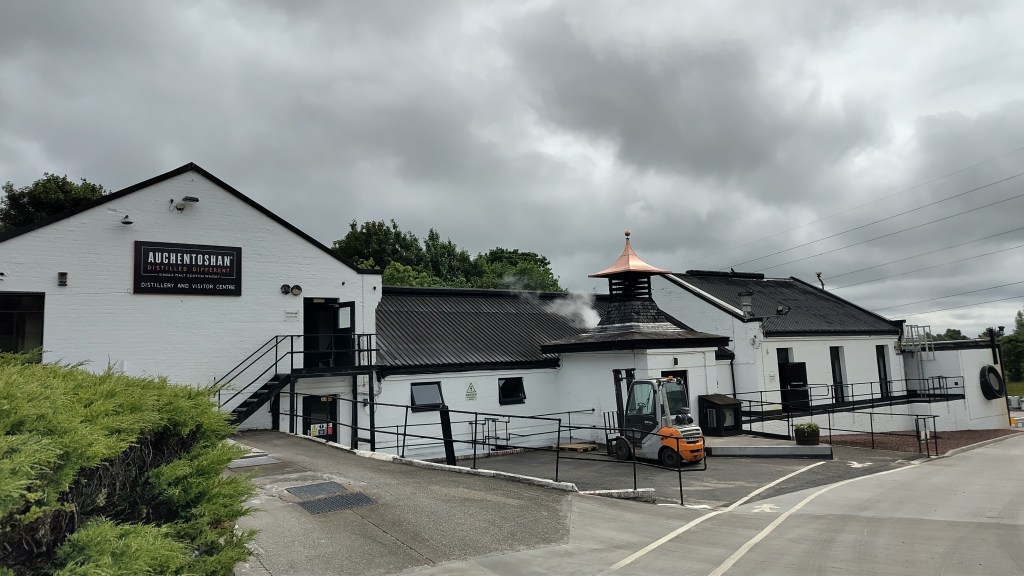
The coffee break was longer than we thought, so we had to sprint to Auchentoshan distillery right away. We got there at the exact minute the tour was starting (although weโ€™d called them to warn we could be late). Our guide was Anya, who started the tour with some history: the distillery was founded in 1817 (licensed in 1823), and the name means the โ€œcorner of the fieldโ€, referring to where the barley was initially harvested. As a matter of fact, there used to be a farm on site since the 1500s.

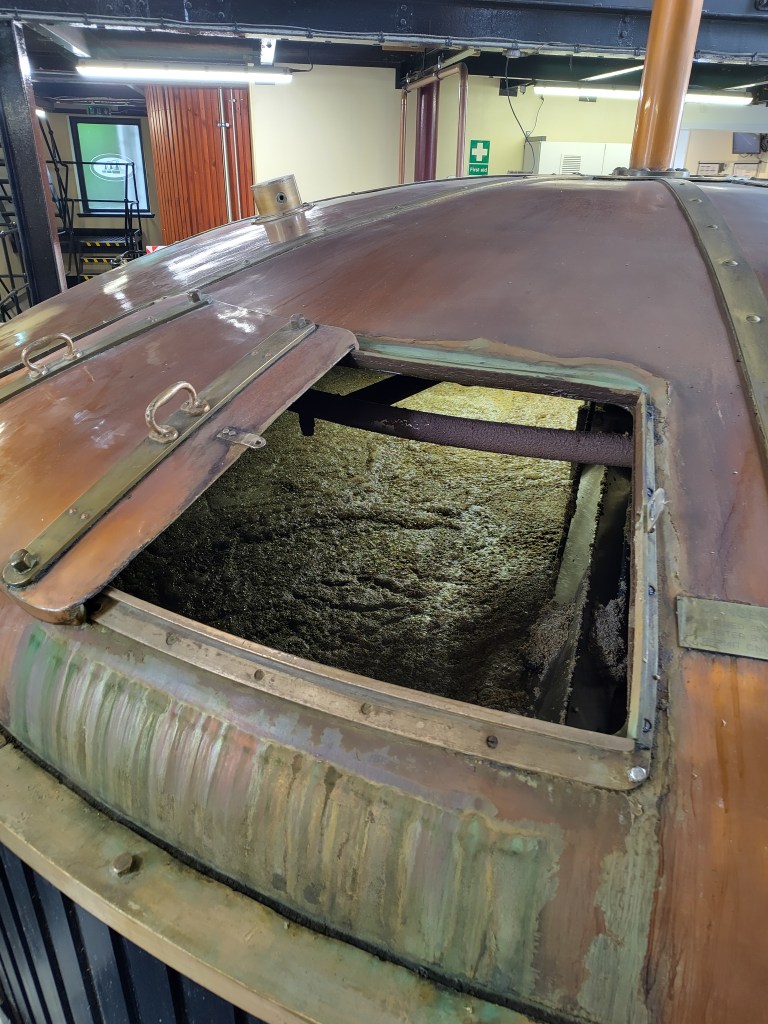
Moving to production, for the mashing they use 7 tons of barley sourced from the big maltsters (Baird, Simpson and Crisp), which goes into a semi-Lauter mashtun with the usual three waters at increasing temperature. Anya told us theyโ€™d just replaced a manual scale with an electronic one, but apparently the new scale needs recalibrating so often that the time savings are not substantial: not all trials go well, we guess. After mashing, the sugary wort is moved to one of the nine washbacks (four made of Oregon pine, five of stainless steel), for a 70h fermentation.

Semi-Lauter mashtun at work.

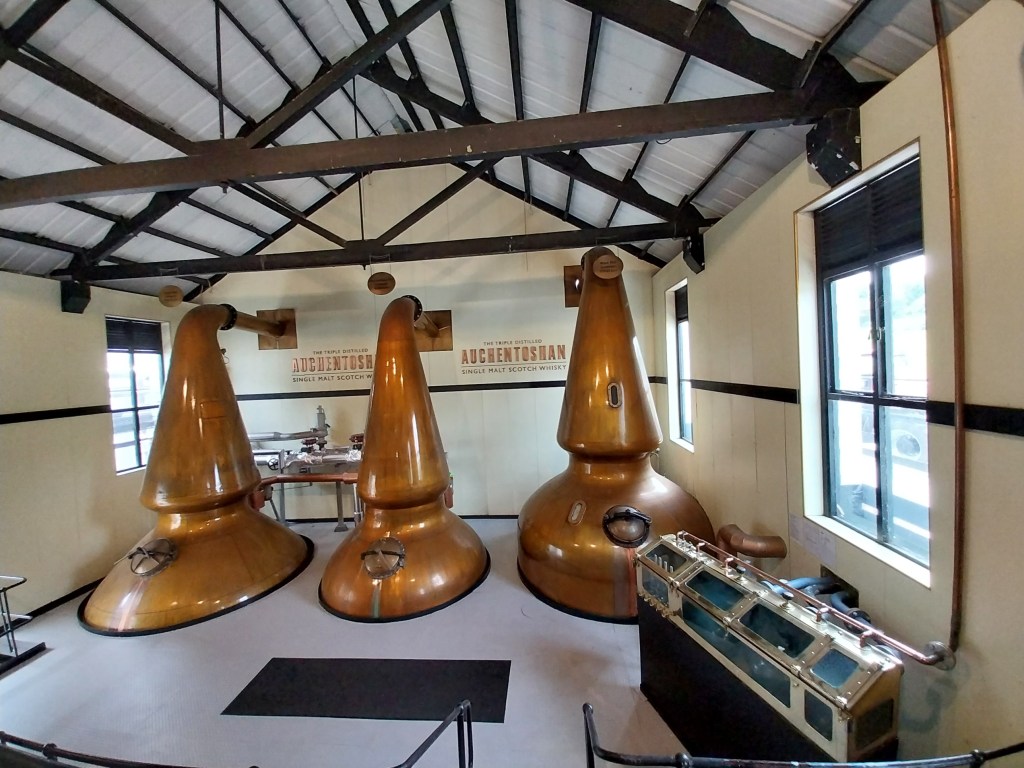
One of the peculiarities of Auchentoshan is their triple distillation, a practice that was once common in the Lowlands distilleries, but gradually disappeared. Now other distilleries we visited do some triple distilled runs at times (Benriach, Benromach, Sprinbgank/Hazelburn, Glengyle), but Auchentoshan remained the only one doing it regularly, before the very recent reopening of Rosebank distillery, in Falkirk. The wash still can hold 17,500 litres, the intermediate 8,200 litres and the spirit still 11,500 litres. Anya described the process well, but it was also good to have, right in front of the stills, a scheme describing everything in detail โ€“ it made it more intuitive. Being triple distilled, the spirit has a higher abv than usual: they take a cut between 82.6% and 80%, average 81%.

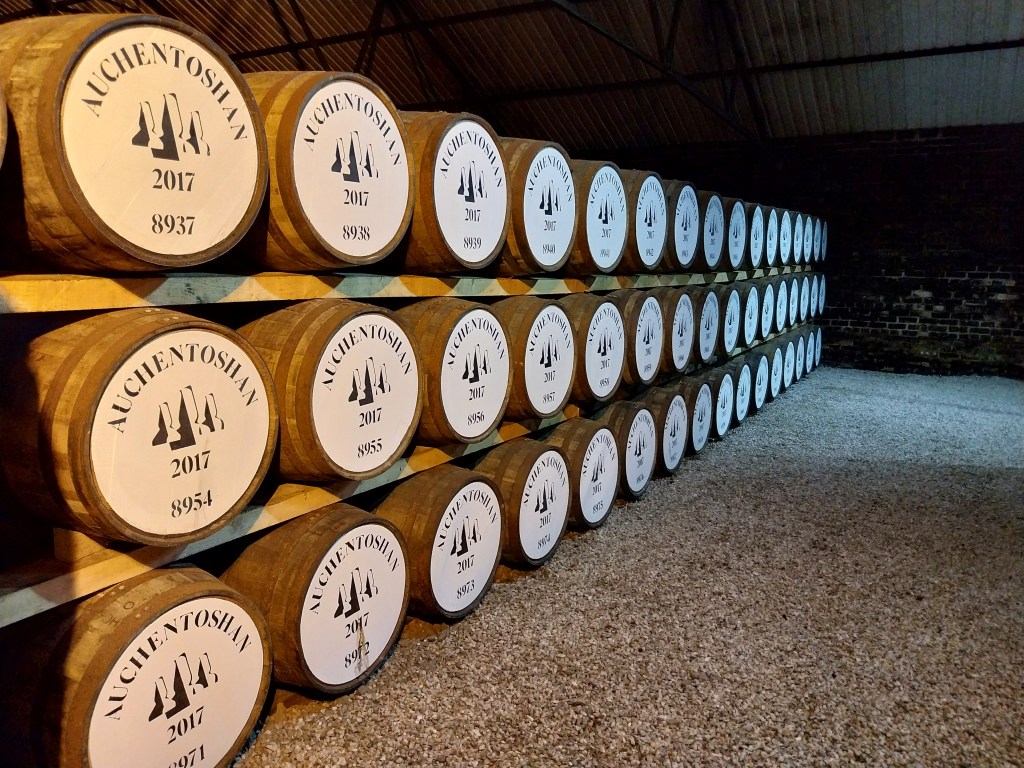
After the still room, Anya walked us into the warehouse, where she explained the maturation process while letting us look at different cask types. Casking and blending donโ€™t happen on site, but in Springburn, where the other Suntory facilities are located.

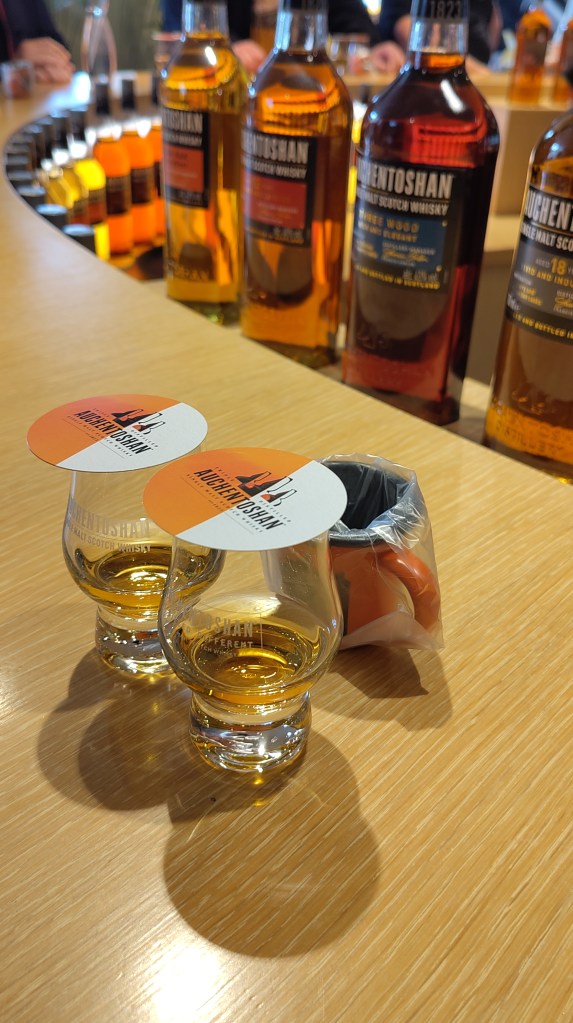
Finally, we went back to the distillery for the tasting, in the same tasting room/bar where we had our tasting back in 2021, above the visitor centre entrance and shop. This time the tasting was not so good – we got a dram of the American Oak (40%, non-age statement, apparently mostly 6y, with some 5y, whisky) and of the 12y (40%), that is, the two most basic expressions. The wee mug they gave us to take home, instead of the usual gleincarn, was a very nice touch, though. We get that this was the entry level tour, but it wouldnโ€™t have costed them much to replace the American Oak with another more โ€˜advancedโ€™ expression: in the shop they have both Bartenderโ€™s Malt limited editions, batch 01 (47%) and 2 (50%), the Sauvignon Blanc cask finish (47%), the travel retail range and a couple of distillery exclusive bottlings (see below), so plenty of options (in theory). Fortunately, at the shop they gave us a wee taste of one of the distillery exclusives, a delicious 9y sherry matured whisky, from an Oloroso cask (59.7%).

Two drams and a wee mug.

At first, we were not sure whether it was a good idea to do the basic tour, but in the end Anya was a great host: very clear and precise when describing the production process of this very unique distillery, she really made our day, so we were happy that we’d decided to go for it. As we said, the dram selection could have been better (yes, in this respect we could have opted for a different โ€˜experienceโ€™), but this has nothing to do with the guide.

Stay tuned for more whisky action, some smoky stuff coming soonโ€ฆUntil then, slainte!


Auchentoshan Origin Tour

Price: ยฃ18.00 pp (June 2024)

Duration: 1hr

Tasting: 2 drams, Auchentoshan American Oak (40%) and 12y (40%), plus a complimentary mini-mug

Distillery Exclusives: Auchentoshan hand-bottled  distillery 9y Oloroso cask (59.7%, distilled 22/10/14, bottled 1/6/24, ยฃ90/30 for 70/20cl) and 22y Oloroso cask (56.2%, distilled 15/10/02, ยฃ250 for 70cl)

Target: tourists and casual drinkers

Value for money: good

Highlights: the triple distillation process showcase

Recommended: yes

Link: https://www.auchentoshan.com/

#42.3 A weekend on Skye


Raasay, paradise


TL; DR: As we woke up on the Saturday we drove to Sconser, to take a ferry to the Isle of Raasay. We visited the distillery, where we had an amazing in-depth 3hr tour and tasting, we hiked and, the next morning, we drove around this truly amazing corner of the world. 

(missed Part 2/Part 1?)

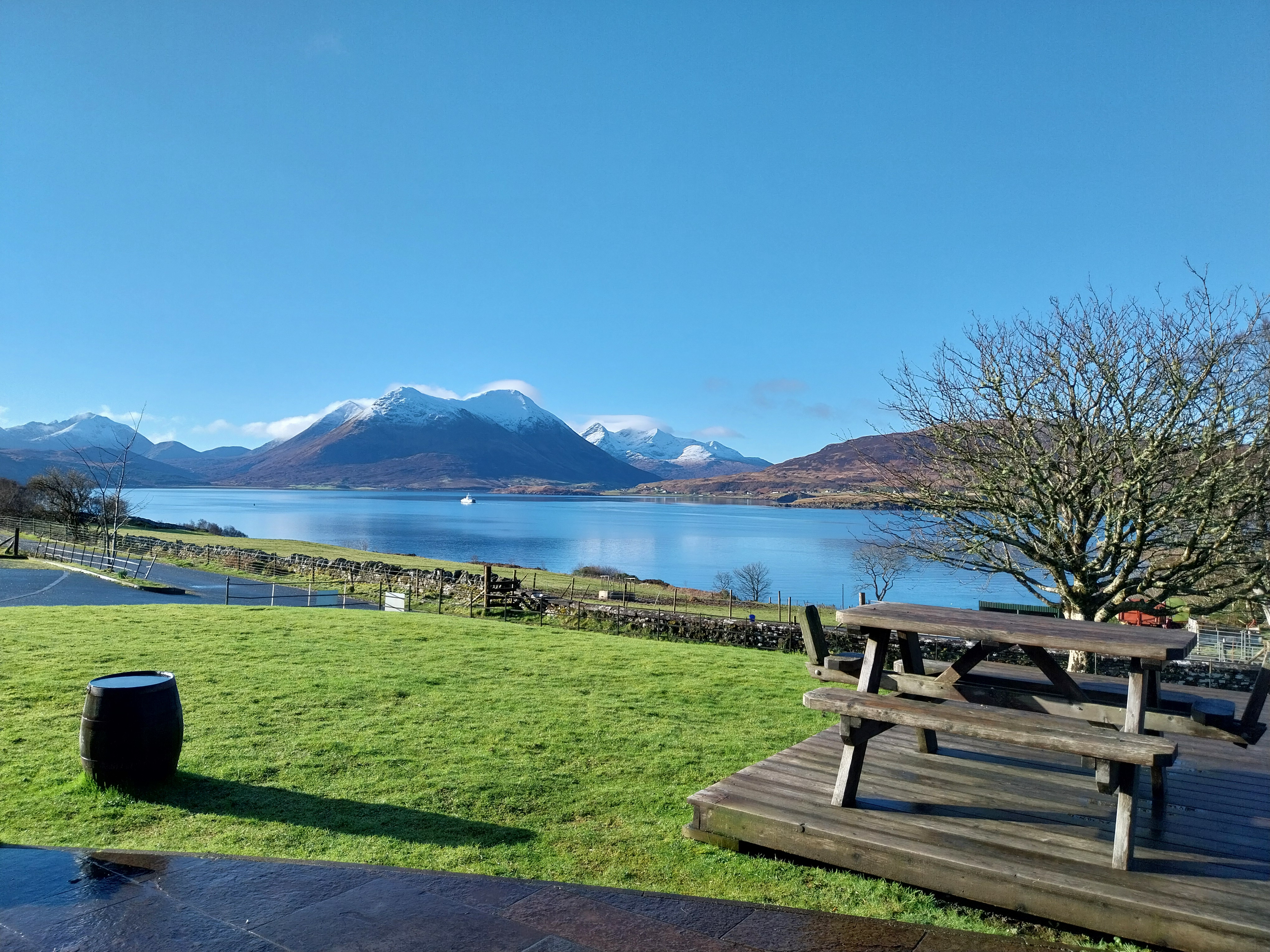
Waking up in a place like Carbost is something else. Despite the many campervans, the morning was very quiet, and the only sounds we could hear were the waves gently crashing on the shore. After packing up the bed and before getting on the move, we walked down to the pier, to get some of the fresh (very fresh!) morning sea breeze. We left Carbost after a short stop at the public toilets in front of Talisker distillery. It didnโ€™t take long to get to Sconser, and as we were slightly early, we had time to fix ourselves a coffee with the Bialettiโ€™s moka (well, still Italians after all) before the ferry to Raasay.

It was the first time on the island for us. Although geographically close to the mainland, Raasay can only be reached from Skye. The crossing was about 20 minutes, and once there we parked at the pier, where there are also public restrooms and a 24h open waiting room. The distillery was only 10-minute walking, so we decided to just walk there and see how the day would pan out. Our plan depended on the weather: if it was nice, we would have spent the night on the island, otherwise we would have taken the last ferry. It was a glorious day, so we ended up taking the ferry the next morning.

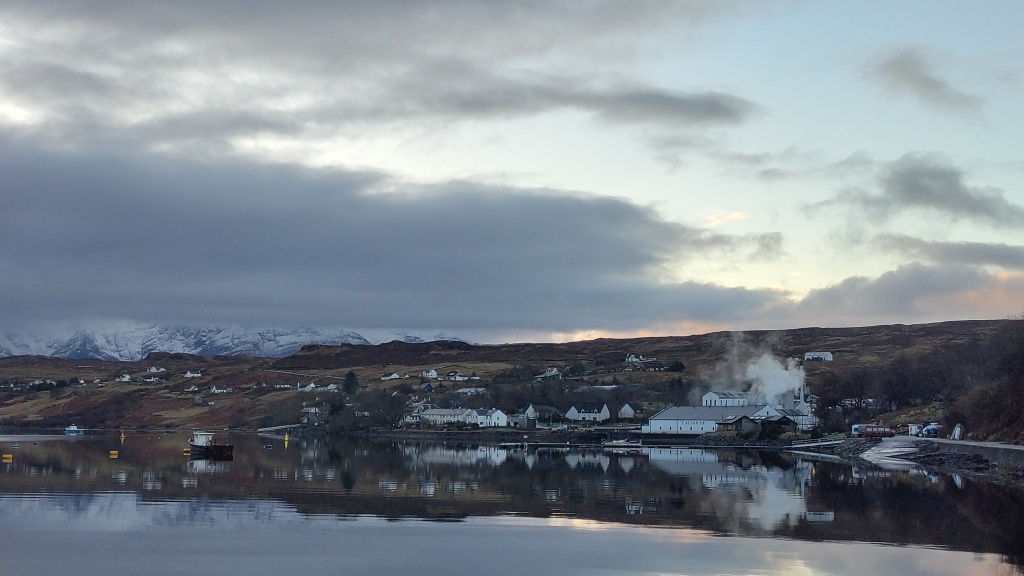
The distillery is in Clachan, just outside Inverarish, the main village. On the way there, there is an old market/barn building, now mostly abandoned. It wonโ€™t be the first one we spot, as the current population is only about 190 people (up by 30 with respect to the 161 marked on the Raasay Single Malt bottles). At that cross we turned right, leaving the Raasay House and Hotel on the left: a huge former mansion, now a tourist centre only open in high season. The main distillery building is called the Borodale House, an old Victorian house that used to be a hotel with a pub before it was bought by the company R&B Distillers to build the distillery. Other than distillery and shop, there are also a hotel, a restaurant and a bar serving hot food until mid-afternoon.

Being the off season and a Saturday, not all tour options were available, but we found one that seemed great: the Dunnage Cask Tour, which included a tour of the distillery and the bottling plant and a warehouse tasting. As we checked in at the distillery we had a brief scare: our reservation was lost in translation, apparently someone had forgotten to mark it down. The shop manager was very cool about it though, she said there we just needed to wait a bit, and as an apology she offered us a coffee (nice touch). We waited in the bar, taking advantage of the incredible view of Skye from the big windows on a very sunny day. Gabriel, our guide, arrived about 40 minutes later (directly from home). His family moved to the island when he was a kid, and he and his brothers represent a good percentage of the 30-odd distillery workers. This is his side job, while heโ€™s studying to get a medical degree. Gianluigi wondered how his life would be different if, instead of doing chemical analyses on tomato sauce, he had worked in a distillery as a student job.

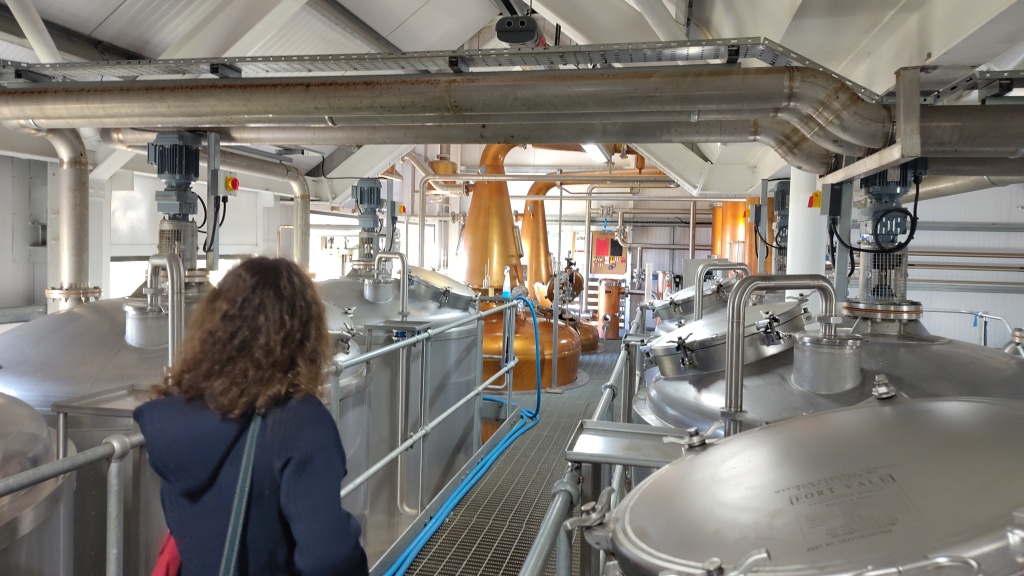
Gabriel was extremely knowledgeable, and while we visited the various stages of production in the very contained area, he provided a huge amount of information. Starting with the barley, they get 30-ton a month of it from the Kintyre peninsula, and the two strains they are using are Lauriet and Concerto. For the peated runs, they get 48ppm (part of phenols per million) barley, malted using Highland peat from the north-east of Scotland. As for the milling, their grist composition is slightly different from others, with only 9% of flour, 19% of husks, and 72% of grit. Their water source is a 60m deep borehole located behind the distillery.

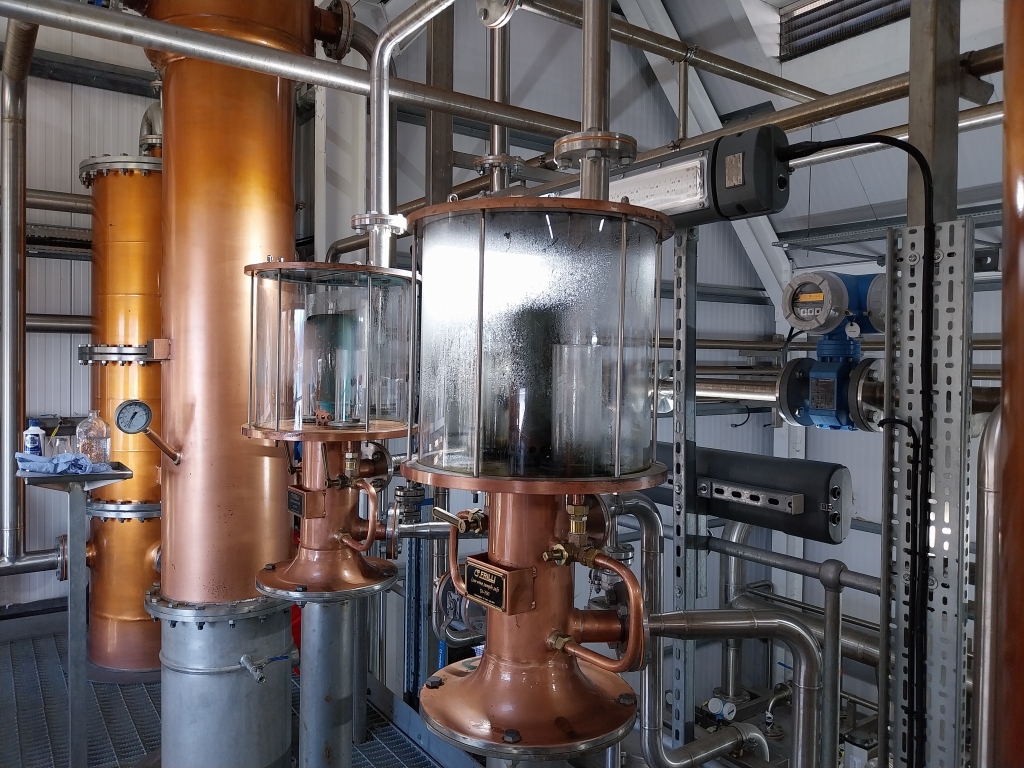
Mashing happens in a big 1.1-ton stainless steel closed mashtun with the usual three waters at increasing temperature, and they aim for a cloudy worth. Linked to the 5-day production week, fermentation is between 3 and 5 days. They have six stainless steel washbacks equipped with a cooling jacket, to slow down fermentation and allow the (liquid) yeast to extract โ€œas much flavour as possibleโ€. The two stills (wash-, 5000-litre, and spirit, 3600-litre) are made by Frilli, an Italian firm from Siena (like Teeling in Ireland and Inchdairnie in Fife), and the cut they take from the second distillation is usually between 75% and 65% abv. When they do peated runs, they use the cooling jacket in the lyne arm to increase reflux and get a lightly peated spirit. The peated newmake spirit comes out at about 14ppm, which is then reduced to 7-8ppm during maturation. It was actually very informative to get to know the ppm level on the liquid, especially when many distilleries only refer to the barley specification.

The production area includes a gin still, where they run the sourced neutral grain spirit with the chosen botanicals (which, of course, we donโ€™t remember). After the production tour, we took some stairs outside the building, to get to the bottling plant, on top of the hill behind the distillery. There, Gabriel showed us the manual and automatic bottling machines, but also how lots for different markets get labelled and stored until they get shipped. Back to the main building, Gabriel took us on a jeep and drove to the warehouse.

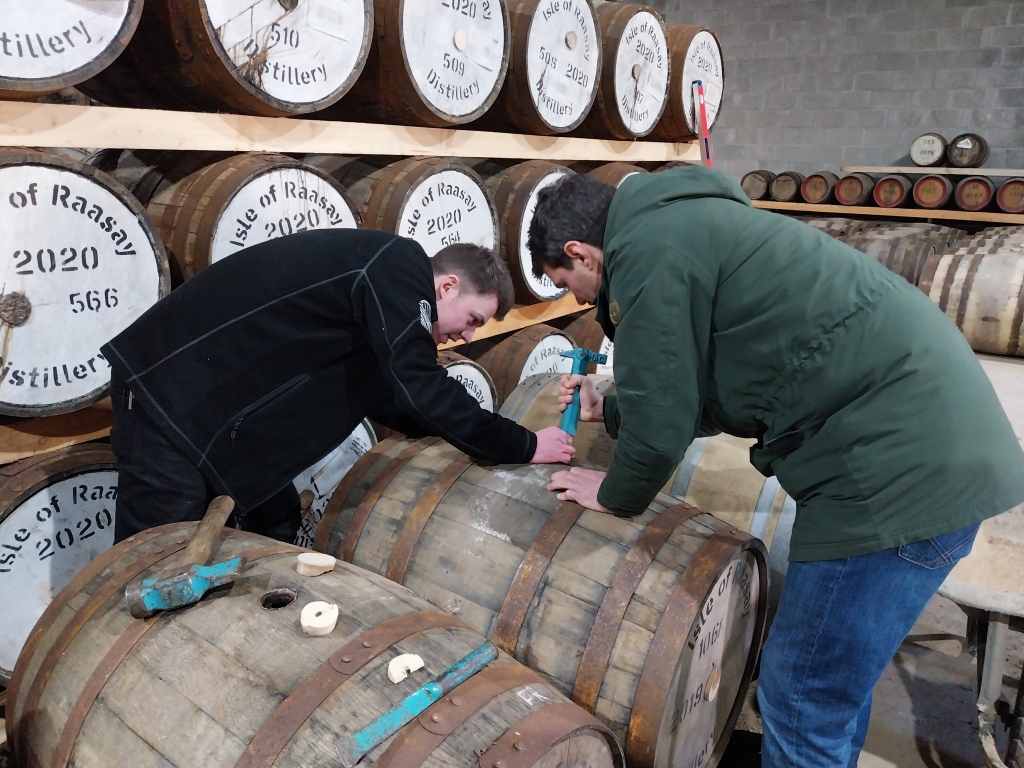
It was the time for the tasting, but first Gabriel let us take the bungs out of the casksโ€ฆan operation that took us very long, as we are both quite clumsy, but we could finally get a taste of the yummy content. The tasting consisted of six drams, one for each component of the Raasay Single Malt, their main core expression. These whiskies are matured in ex-Rye, ex-Bordeaux red wine, and Chinquapin virgin oak casks, both unpeated and peated. We knew what to expect: during the pandemic we did an online tasting of these six components, although they were not 3-year-old yet, so technically not whisky. This time these are properly whiskies, as the vintage of the cask was 2019 for the unpeated, and 2020 for the peated ones.

We loved the peated chinquapin oak, and the unpeated ex-bordeaux and ex-rye casks – one extra confirmation that, if done properly, young whisky can be delicious too. This range is available to buy at the distillery (when we visited, not the peated ones) bottled in the Na Sia range (Gaelic for โ€œThe sixโ€). While sipping the last dram, Gabriel took us around the warehouse, and we found out that they recently started using re-fill casks (initially they used only first fill).

After the tasting we were definitely ready for some food, which we got back at the distillery while trying a nip of the bottlings available at the shop (Slaintรจ Club bottlings, Year of the Dragon and others, see below in the box).

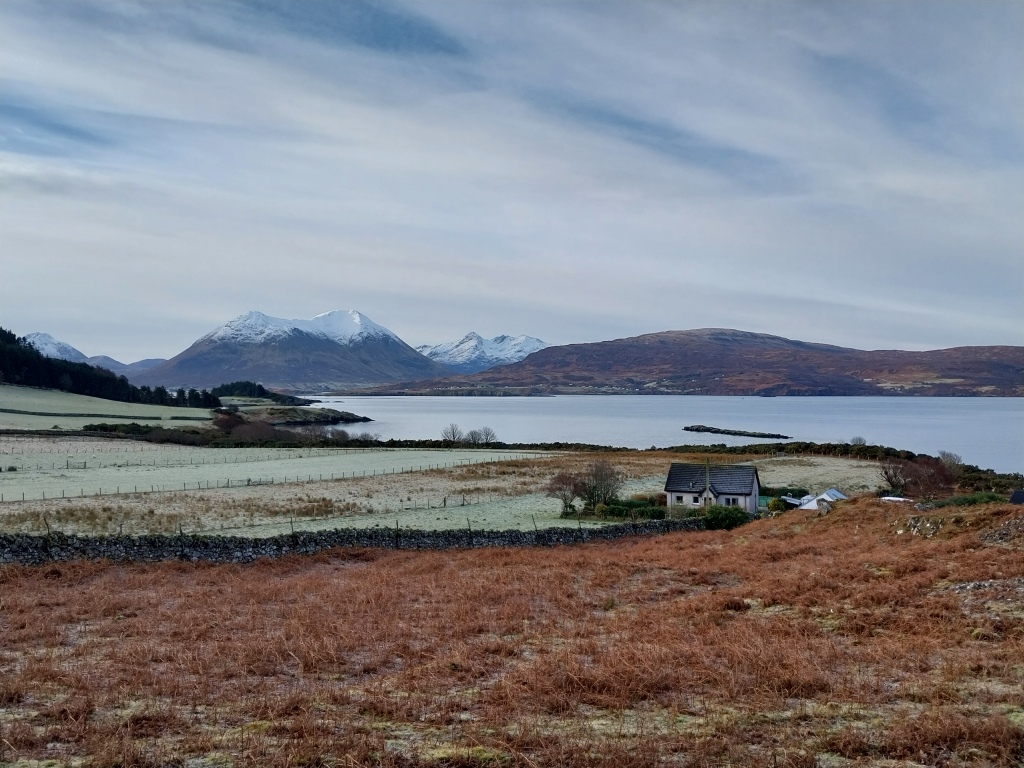
Left the distillery, it was a very nice evening, so instead of going back to the van we decided to go for a walk to the village and then to the hill behind the distillery, Temptation Hillโ€ฆdespite the cheesy name, it was quite beautiful and very relaxing. Back at the van, we had dinner, but we soon went to bed, after such a great day.

The following morning, we decided to skip the first ferry of the day to drive around the island: we probably drove along all the possible roads, talking advantage of some breath-taking landscapes – from the very north of the Island, along the mighty Callumโ€™s Road, with a very interesting story, to the south and its the old pier (and frankly, quite too many abandoned vehiclesโ€ฆ). We finally took the ferry for Skye around midday, and from there we drove almost non-stop to Leith (well, non-stop because most cafes along the road were closedโ€ฆexpect for the Apiary in Dalwhinnie, where we had some delicious cakes).  

This was one of the best experiences we had in a while, both the distillery visit (thanks Gabriel!) and the scenery. Raasay is truly a paradise that weโ€™d like to explore more, so we really canโ€™t wait to go back for a holidayโ€ฆwell, and maybe a couple of drams too!

Until next time, slainte.


Raasay Dunnage Cask Warehouse Tour

Price: ยฃ75.00 pp (February 2024)

Duration: 2-3 hr

Tasting: 6 drams from the cask, 5y cask strength unpeated ex-Rye cask, ex-Bordeaux wine cask and ex-Chinquapin oak (virgin oak), and peated ex-Rye cask, ex-Bordeaux wine cask and ex-Chinquapin oak

Distillery Exclusive: the Na Sia range (see above), Raasay Scottish Whisky Distillery of the year 2022 (4y and 10 months, finished in Quercus humboltii Colombian oak, 50.7%), Tourism Destination of the Year Celebration (4y, finished in ex-Manzanilla casks, 52%)

Target: whisky geeks

Value for money: good

Highlights: everything

Recommended: a bit pricey but totally worth it!

Link: https://raasaydistillery.com/


#41.2 Fife Whisky Festival 2024

Inside the green distillery…Aberargie!


TL; DR: After another successful Fife Whisky Festival under our belt, we got to visit a new Fife distillery, Aberargie! Owned by an independent bottler company, Morrison Distillers (Carn Mor, Old Perth and Mac Talla), they have a clear plan for their whisky. They gave us a great tour, and what an amazing tasting! 

(missed Part 1?)

And here we are, after the opening dinner (!), the two Fife Whisky Festival sessions (!!) and the Sunday morning Adelphi masterclass (!!!), it was finally time for the final event: the visit to Aberargie distillery!(!!!!) Compared to other new distilleries, they are quite under the radar, although we were already aware of its existence since our first trip to Lindores in late 2021, as the distillery can be clearly seen from the road to Newburgh. It is owned by the Morrison Distillers group (formerly Morrison & Mackay), which also has connections to other distilleries, in particular Bowmore. Their malt is not on sale yet, so their main business is still that of independent bottlers. They own the Carn Mor brand, for single casks or small batches, Old Perth, a fully sherry-matured blended malt (coming in different configurations) and the recent Mac-Talla, a range of Islay single malts but from undisclosed distilleries (they were very adamant about not saying from which one). 

We were welcomed by Greame, head of production, and Thomas, the brand ambassador who was at the festival the day before. Thomas told us that we were the first visitors ever: what an honour! The site buildings include an office/bottling hall, the production (where we headed) and of course the warehouses. Inside, Maree, brand manager, and David from production were waiting for us in a meeting room. Tasting mats had already been prepared, with four โ€œOld Perthโ€ marked spots, and four โ€œMac-Tallaโ€ ones. Once everyone took their seat, Greame started explaining the history of the company, which used to focus on fruit liqueurs, and talked about their connections to Bowmore, Auchentoshan and Glen Garioch. The distillery started operating in 2017, and barley is sourced from their own surrounding farm. Itโ€™s a farm-to-bottle site, except for malting that is done at Simpson. During this chat, we started with the tasting: first, an 8y cask sample destined to become part of a bottling from the Old Perth range, fully matured in ex-Oloroso casks, and reduced to 48% abv. The second dram was from the same (undisclosed) distillery, same age, same abv, but distilled in a different way (apparently this distillery has both stainless steel and copper condensers) and fully matured in an ex-PX cask. The third sample was the Old Perth 12y (46%, chill-filtered, natural colour), one of the three core range expressions (the others being the Original, NAS, and the cask strength). 

At this point, the group was split in two for the tour of the distillery. We were in the second group, with David and Thomas. As usual, we started with barley storage and milling; the mill is a modern one, near the two malt bins with a capacity of 28 tons, and it can process batches of 2 tons. Almost all the whisky they produced so far is unpeated, and they almost uniquely used Golden Promise barley. They aim for 9 mashes per week in their semi-Leuter mashtun, collecting the sugars through the usual 3 waters at increasing temperatures. They recently increased the number of washbacks, from 6 to 9, all stainless steel, where fermentation takes from 3 to 6 days and it is ignited by 20 kg of dried yeast. They have two stills, a 10,000-litre wash still and a 7,500-litre spirit still, both using steam coils as heat source. They collect the heart of the distillation from 74% to 60.5%abv, one of the largest cuts we heard of. Because they do a 5-week production, their capacity is currently around 250,000 litres of alcohol per annum.

The two groups were then reunited in the courtyard, just before getting inside the racked warehouse. There, they have temporary tanks where the spirit (both theirs and the sourced one) is kept before being casked. Itโ€™s quite a big operation, which made sense considering the availability of bottles from their independent bottler side. Still in the warehouse, we could spot a number of distilleriesโ€™ names and different types of casks. We walked a bit more inside, until the point where seven big butts were on display: contrary to most of the current sherry casks, which are seasoned for the whisky industry, these were bodega casks, which were actually used in sherry production for decades. Theyโ€™d originally acquired ten, but only seven survived, and they are used to put to rest the whisky that ends up into the non-aged Old Perth (Original and Cask strength expressions), in a Solera-like system. We had a sample of it (again diluted to 48% abv), and we found it dirty but exquisite. 

After this, we headed back to the meeting room, where food was waiting for us. While we were eating, they started pouring the final four drams. Three of these were from the Mac-Talla range, starting with the Flรนran (53.8%, single cask ex-bourbon), from the Flavourscape collection. This series is a collaboration with artist Marzia Sileno, who created a series of drawings inspired by the whiskies. In this case, the drawing recalls the flowery and light character of the whisky. This was followed by the Mac-Talla Mara, their cask strength expression (58.2%), a vatting of 25% first fill and 75% refill ex-bourbon cask: itโ€™s a very spritely and delicious Isla drams, we both loved it (well, Gianluigi a few days later at homeโ€ฆ). Finally, a novelty: the Mac-Talla Oloroso, a vatting of about 20 caks bottled at 54.8%, that was going to be announced the very next day: a delicious sherried peated malt. The final dram was a real banger: a cask sample of a 1996 Bowmore from a 2nd fill ex-oloroso, at a natural strength of 47.4%. What can we say, we had a very few drams that good so far, an explosion of tropical fruits, surrounded by soft sweet smoke. A gem.

The event ended there, although it lasted almost an hour more than expected – not bad, it was really worth it. We made our way to the office for the pop-up shop theyโ€™d set up for the occasion, to grab some โ€œsouvenirsโ€. This was an amazing event, truly very well planned and definitely for whisky geeks and, by what we could see, organised by whisky geeks. They were extremely generous with the drams, they also provided 30ml samples for the drivers! We will keep our eyes peeled for their release, although itโ€™s not going to be out soon. In the meanwhile, we can enjoy their fantastic whiskies from the Mac Talla and Old Perth ranges, which we got to know quite well during the visit. A visit which, by the way, marked Teresaโ€™s 100th distillery visit!

100 distilleries, yay!

The day ended with us driving back to Cupar to help Justine and Karen clean up the Corn Exchange after the third and final masterclass, and we managed to get some leftover from the Woodrowโ€™s of Edinburgh masterclass (and because weโ€™d run out of sample bottles, we temporarily stored them in coffee cups). What a great weekend, weโ€™re already looking forward to next year. 

Until next time, slainte!


Morrison Distillers

Link: https://www.morrisondistillers.com/

#39.3 The Highlander Trip

Down the neck of the giraffe


TL; DR: Third and final distillery of the day (not of the trip), Glenmorangie. The behemoth of the north, producing one of the best-selling malts, a visit weโ€™d postponed for some time. A visit weโ€™ll remember as one of the funniest we had in a while.

(missed Part 2/Part 1?)

The tour and tasting at Balblair ended under a heavy rain. We were quick in jumping back on the bus, which drove us to the next distillery: Glenmorangie! The distillery is located next to the A9 just passed Tain (you canโ€™t see it from the highway), a mere 10 minutes away from Balblair. Weโ€™d never had the chance to visit it before, despite driving past it more than a few times. 

Despite its popularity, we havenโ€™t tried many Glenmorangie expressions. Probably one of the reasons is that it doesnโ€™t appear often at independent bottlers, and when it does it usually carries a high price premium (unless itโ€™s marked as โ€œsecret Highlandsโ€, of course). Other than the omnipresent 10y โ€œthe Originalโ€, we tried the 12y Lasanta (sherry cask finished) and 14y Quinta Ruban (Port cask finished) in a tasting back in 2020, both solid. About other popular expressions, we recently tried the 18y – delicious and very drinkable (the 43% ABV helped), while because of our lack of enthusiasm for Sauternes finishes in general, we never gave a chance to โ€œthe Nectarโ€, the expression formerly known as Nectar Dโ€™Or. We also tasted the โ€œA Tale of Cakeโ€ (Tokaj wine finish) in a tasting, sweet but truly delicious, but until our distillery visit that was the only one in the โ€œA Tale ofโ€ฆโ€ range weโ€™d tried. To note, not long ago, Glenmorangie have also brought up a โ€œBarrel Selectโ€ range, including expressions finished in Malaga, Cognac, Palo Cortado, Amontillado, and more recently Calvados (and similar to the โ€œA Tale ofโ€ฆโ€ range, originally priced around ยฃ75-80).

Anyway, back to the trip! The driver left us in the parking lot, from which the 7-mlpa size of the distillery can be fully appreciated. We took a few pics, and then we started walking down a short path to the visitor centre, which is in front of the main distillery building, on the other side of a small lane. There is also an orange giraffe statue on the path: it is associated to the brand because of the height of Glenmorangie pot stills, the tallest in Scotland. These are considered to contribute to the lightness of this spirit by allowing only light molecules to climb up the tall stillsโ€™ necks and leap over to the lyne arms and the condensers. 

Contrary to Balblair, the visitor centre is very brightly lighted, almost like an airport duty free and, in general, it felt very โ€œcorporateโ€. On display, other than the usual merchandise, there were most of their recent bottlings, but also some older expressions: we spotted some bottles of the โ€œA Tales of Cakeโ€, priced at ยฃ350 (the RRP in 2020 was ยฃ75!). Needless to say, they stayed on the shelf. 

The charm of old buildings.

We were given a few minutes to check the shop and for a neep in the loo, after which our guide Lewis walked us outside the visitor centre and into the distillery building to start the tour. We gathered in a small room (which we filled quite quickly), where a very expensive Renovo bike made with some leftover wood from old casks was displayed, for a short introduction. We immediately realised Lewis was a great character, definitely one of the most entertaining guides we had in recent years. He quickly picked up that we were whisky nerds, so instead of describing all the phases of production (which all of us knewโ€ฆprobably too well) he sat back and replied to all our gazillion questions with a very dry humour. When he was asked โ€œwhat about the 12 men of Tain?โ€ (in front of a picture of them on the wall) he answered โ€œwell, they were 12โ€ฆand they came from Tainโ€. 

Because of this, and because pictures were not allowed inside the distillery, we donโ€™t have many notes about Glenmorangie. The tour inside was quite standard – milling, mashing, and fermenting – but we could try the wort, a nice touch. The still room is really huge, almost looking like a cathedral. After that, we went back to the courtyard, where we could look at (but unfortunately not go inside) the Lighthouse: a new small fully equipped distillery next to the old one, where Dr Bill Lumsden, the Head of Distillation for both Glenmorangie and Ardbeg (one of the great innovators in current times) can run small batches and experiments. The building in itself is very beautiful, and somehow fits nicely next to the old buildings. 

We can see why they called it the Lighthouse.

After wee look at a warehouse, it was finally time for the tasting, prepared in a room just behind the visitor centre. It was a bespoke tasting, so to minimise the chances that someone already had some of the drams, our friend Justine (who organised the trip) chose one recent expression and 3 distillery exclusives. We started with the last of the โ€œA Tale ofโ€ releases, โ€œA Tale of Tokyoโ€ (46%), finished in Mizunara oak. It was good but not memorable: all the whiskies finished in Mizunara oak that we tried (3 or 4) were interesting but thatโ€™s it, not something weโ€™d go for. The other three drams were sublime: two single casks, one matured in a custom oak barrel and one in red wine, and the last a vatting of two ex-Pedro Ximenex sherry casks. Really great drams, just a shame that the price tag was a bit too high for us. 

Lewis humour (well, and these last three whiskies) made our tour at Glenmorangie quite unique, and it didnโ€™t feel corporate at all (which some of us were worried about). Experiences like this are the ones that really stay in our memory, and we are so grateful for.  

We left the distillery empty-handed, but very happy nonetheless, and after a brief bus drive to Dornoch, it was time for dinner, after which we went back to the van for a good sleep (spoiler: it was not!).

Stay tuned to hear about it, and until next week, Slainte!


Glenmorangie Tour & Bespoke Tasting

Price: ยฃ65.00 pp (November 2023)

Duration: 1hr 30min

Tasting: 4 drams, Tales of Tokyo (46%, NAS), Distillery Managerโ€™s Selection (2nd fill custom cask, 56.1%), Distillery Exclusive Release Cask 12835 (12y, vintage 2006, bottled 2019, ex-red wine cask, 55.1%), Distillery Exclusive Release Cask 1784 (16y, vintage 2003, bottled 2019, PX sherry, 55%)

Distillery Exclusives: see above

Target: everyone

Value for money: pricey, but at least we tried something new

Highlights: Lewis really made this tour memorable

Recommended: yes

Link: https://www.glenmorangie.com/