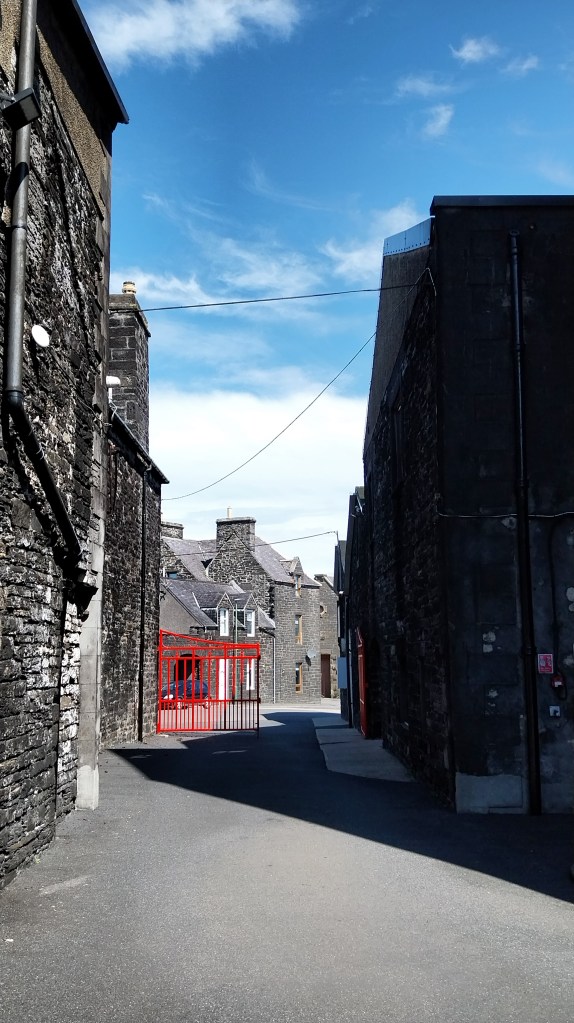
Pulteney: the old one in Wick
TL; DR: Another long weekend this summer, this time up to the Northmost North of the Northern Highlands. And we have a special guest, Edoardo again, Gianluigi’s brother and whisky enthusiast. First off, the oldest distillery in the area: Pulteney. A nice tour ending with a decent 4-dram tasting.
It’s slightly windy at the Ruthven Barracks, but not cold at all. The night is very clear, and if it wasn’t for the midges we could have spent some time outside. Instead, we retread immediately inside Mr Vantastic, accompanied by the distant noise of vehicles driving on the A9. We arrived directly from Glasgow, the two of us and Edoardo, Gianluigi’s brother. He was supposed to land in Edinburgh around lunchtime, and the idea was to go visit Glasgow where he’d never been despite his many travels to Scotland. However, the flight was delayed by over 90 minutes (thanks Easyjet), plus another 40 to wait for the luggage, which meant that by the time him and Gianluigi parked the van in Glasgow, it was already late afternoon. On top of that, it started pouring rain, so not much sightseeing happened that day. Instead, the two brothers sheltered at the Pot Still, waiting for Teresa to come out of the office. After a spicy meal at the Rosa’s Thai, we left towards the destination for the long weekend: the Northern Highlands.
As we were saying, we stopped for the night at the Ruthven Barracks car park, near Kingussie. It is slightly uneven and there are no facilities, so it was ok for one night, but probably next time we’ll search for an alternative spot. The next day we had an early start anyway: the 3-hour drive was interrupted only by a 15-minute break in Aviemore for coffee and roll. We had an appointment at a very old and popular distillery, that somehow, we never came across during our trips: Pulteney, in Wick. It belongs to Inver House, together with Balblair, Speyburn (both visited), Knockdhu and Balmenach (both closed to visitors, so naye). The single malt, Old Pulteney, is famous for being a coastal dram and their basic expressions are very prevalent in supermarkets (Harbour and 12y, both 40%abv).
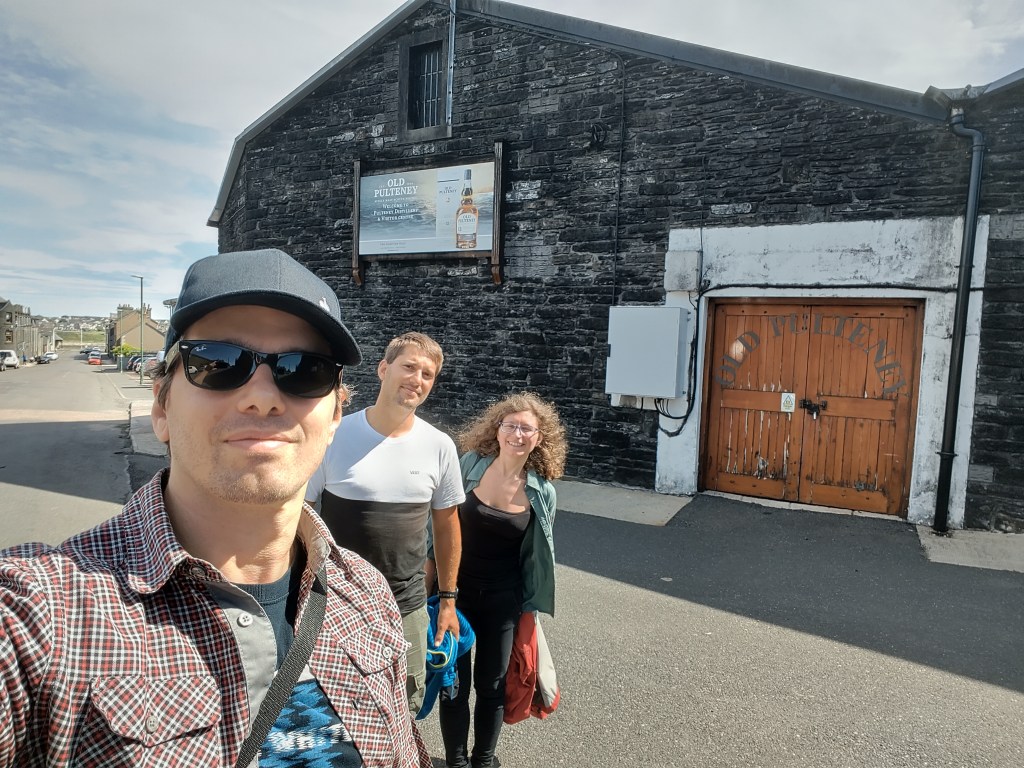
A long drive to get here, but totally worth it.
Pulteney distillery will turn 200 next year and is currently stretching the silent season to allow some renovations in time for the celebrations. In the mid-1880s Alfred Barnard approached it, and the Royal Bourgh of Wick, from the north, travelling along the rugged coast, on his way south after spending some time on Orkney. Instead, we arrived from the south, on the smooth A99: things must have changed quite a bit in the last 140 years. The distillery is in the southern part of the village, before the Wick River, and between the main road and the coast. We parked Mr Vantastic near the Pulteney community centre, just next door. You can tell the old from the new buildings around, as the former are all blackened by the Baudoinia fungus, digesting away the alcohol in the “angels’ share” (i.e. evaporating). We got in a few minutes earlier to check the shop before our tour started: the front part is very small, but in the back, they have a bigger lounge decorated with memorabilia, and a spacious but cosy tasting room. We chose the From the Source tour (£40.00pp), which has an improved tasting compared to A Taste of Old Pulteney (£20.00pp, 2 drams), but not as expensive as the Flagship Experience (£125.00pp!!!, 6 drams).
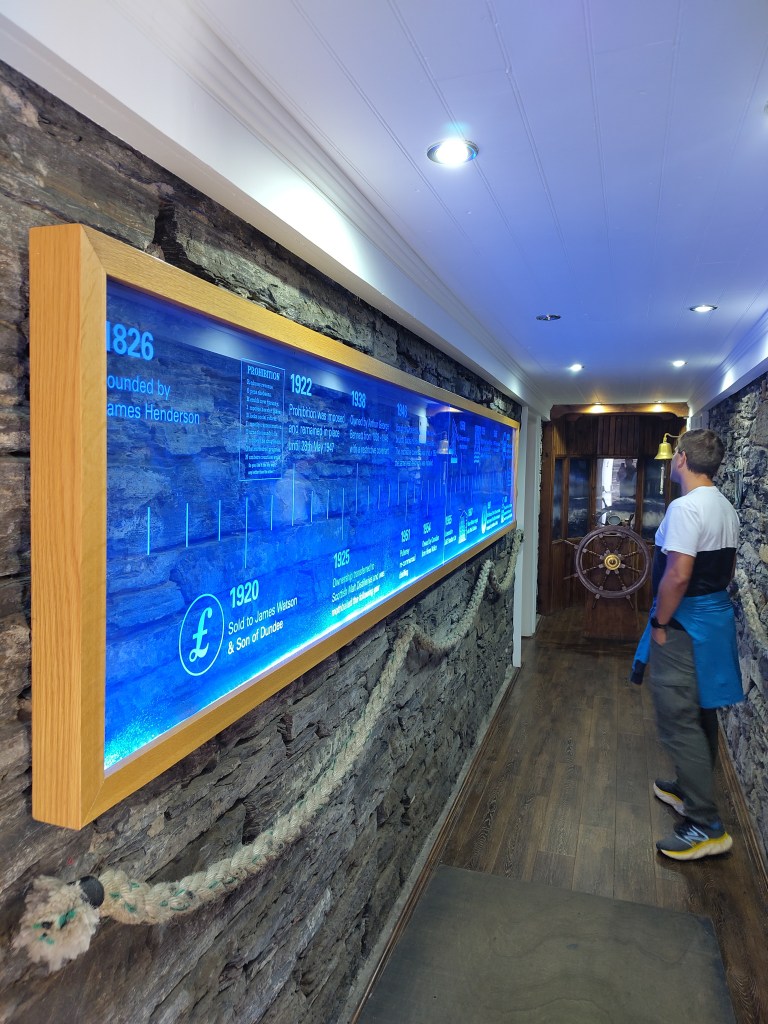
Reading about the history of the distillery before the tour.
Our guide was Tim, who used to work in Glasgow before going back to his native Wick during the pandemic, and it was a small tour: the three of us and another person. Tim started with the usual history of the distillery – founded in 1826, initially was only accessible by the sea, and it was acquired by John Dewar & Sons in 1924, which in turn joined the Distillery Company Limited (DCL, Diageo’s precursor) in 1925. After prohibition started in Wick in 1922, the distillery was closed in 1930 and reopened in 1951, four years after prohibition was abolished. The distillery than went to Hiram Walker’s (1954), Allied Distillers (1961) and finally to Inver House (1995). During the Hiram Walker period, Pulteney malt was a component of Ballantine’s blended Scotch.
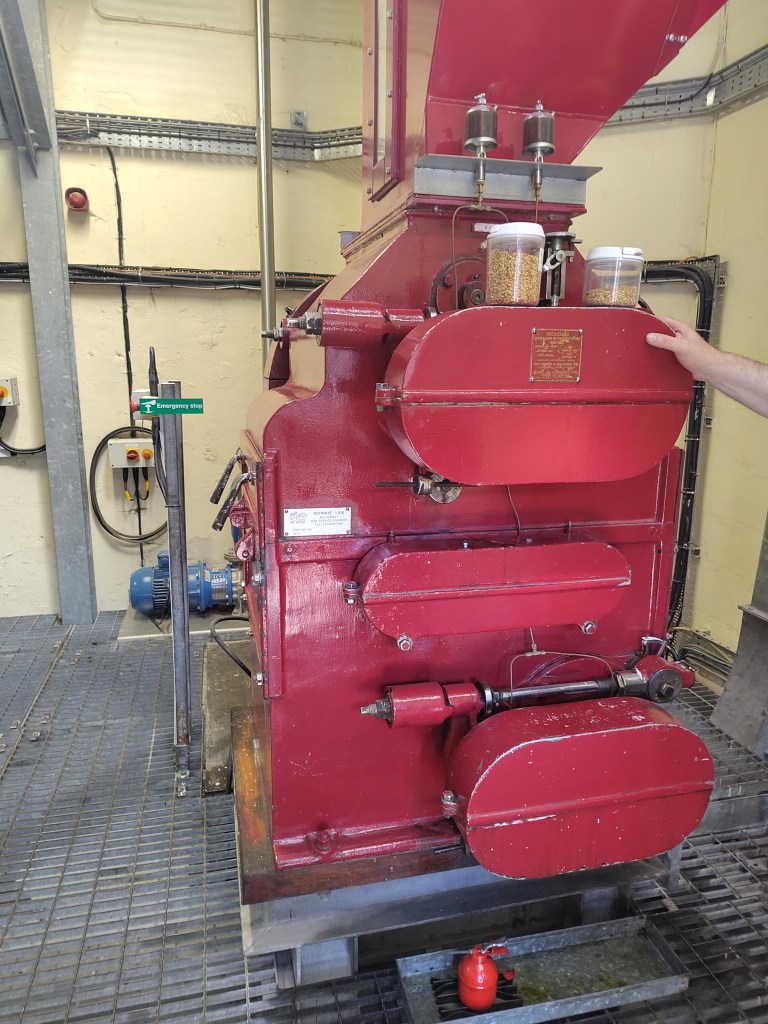
A classic Porteus mill.
The malting floor, dismissed decades ago, was above the visitor centre, while the cooperage used to be in one of the visitor rooms. Nowadays they bring in malted barley from Inverness, in 30ton weekly batches. They have a bright red Porteus mill for grinding the malt, and water comes from Loch Hempriggs (to the south of Wick) in a stream system engineered by Telford, that we’d see later. Each mash is done with 5 tons of grist, in a copper-lidded mashtun, which was replaced about 20 years ago. They do four rounds of water at increasing temperatures (60° to 90°C), with the last two ready for the next mash. The (cloudy) mash is then pumped into one of the seven washbacks, while the draff is sent away for cattle feed. Fermentation lasts 60 hours normally, 100 for the batches going over the weekend, and is triggered by 25 kg of distiller’s yeast which is added to the 23,500 litres of wort. At the end of the process, they get an approximately 8.5% abv wash, which is then sent to the wash still.
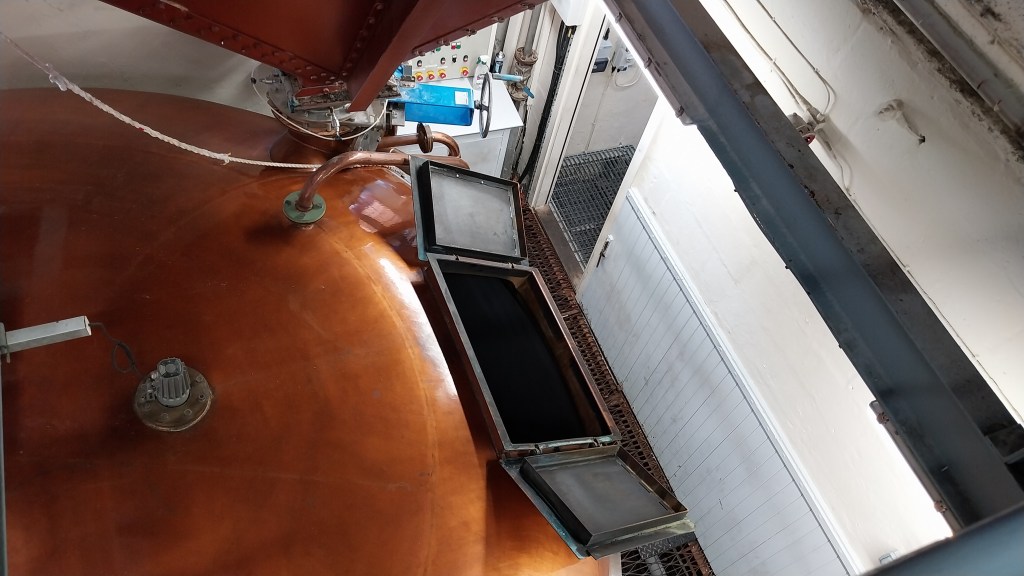
The mashtun from above.
They have two stills: the wash still has the top clearly cut off (it was too tall for the building) and has a massive bulge in the middle, much bigger than usual; and the spirit still lyne arm is almost entangled – definitely a unique pair of stills. Each still is equipped with a stainless-steel squared worm tub condenser, with a 110m copper pipe inside, placed outside the still room. In the second distillation the foreshots usually last 16 minutes and the first cut is taken depending on the temperature, while the second is taken at 68%.
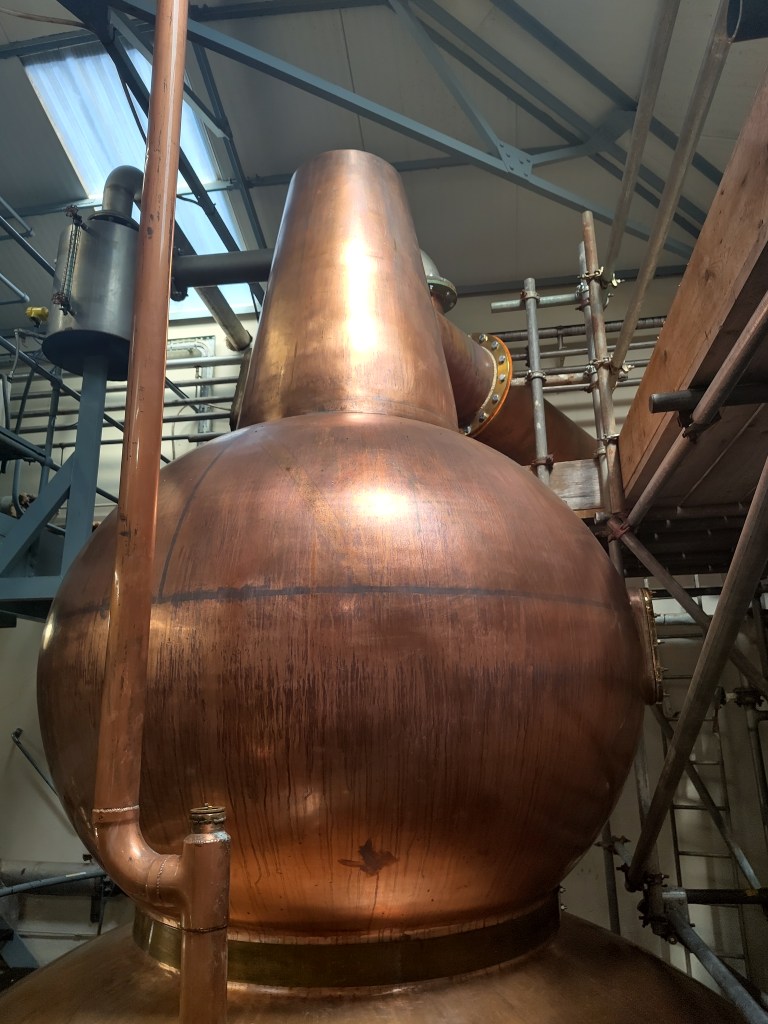
The most unusual wash still…
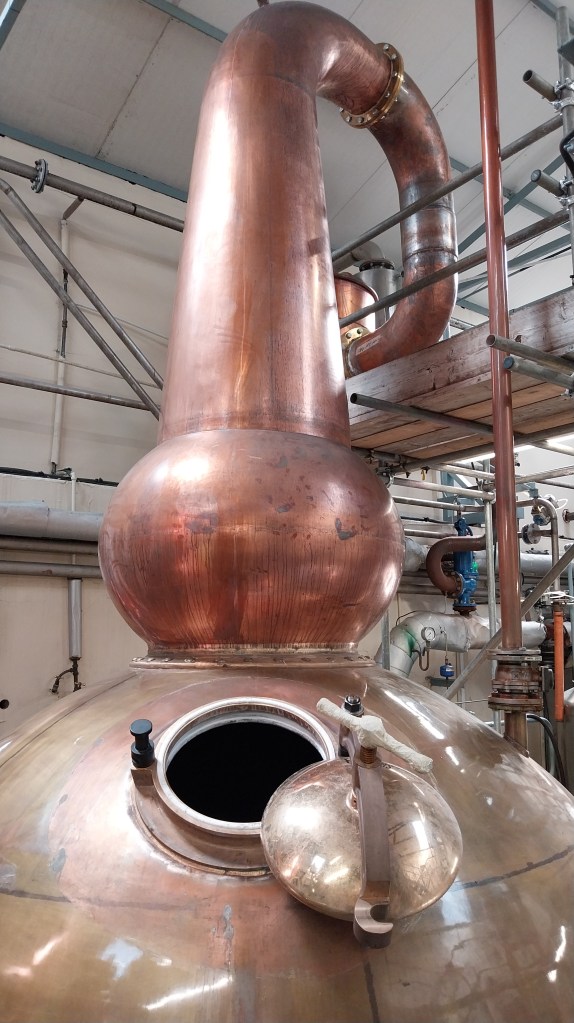
…and a slightly less unusual spirit still. Look at that lyne arm!
After the still room, we went back outside in the courtyard, and then into the filling store: they cask onsite but also fill tankers, in particular for the distillate that is sold to third parties, mostly for blends (still Ballantine’s? The Inver House blend is the Hanky Bannister though). After checking out the biomass boiler, we visited the warehouses: 10,000 casks are stored on their side in rows 3 high in a warehouse (but not dunnage, as the floor is concrete), while other 14,000 are in the other buildings, mostly racked. However, they are in the process of building another four warehouses, to accommodate for Pulteney production of about 1.2 million litres of alcohol per year. The mostly fill ex-bourbon casks from Jim Beam, but inside the warehouse we spotted other casks too, sherry in particular.

Terror in the warehouse.
It was time for the tasting, in a very cosy and wide room. We started with the classic Old Pulteney 12 (40%), mostly matured in refill ex-bourbon cask. It’s a very decent malt, possibly a bit thin. We can’t just help wonder how increasing the abv to 43% or 46%, and not chill-filtering it, would improve it. It was followed by the 15y and the 18y, both bottled at 46% (yay!), and both with a similar double-maturation (or finishing?) concept: they spend 13 and 14 years in ex-bourbon casks, and they are then re-racked into Oloroso sherry casks. They’re solid and tasty drams, benefiting from the saltiness of the spirit and the dark fruitness (is this a thing?) of the cask finish. Finally, our last dram was supposed to be the distillery exclusive (as it was advertised on the website, see below for the specs), but apparently they’d finished their “tasting stock” (whatever that means in corporate BS language, they still had many bottles in the shop), so instead they gave us the second expression of their Coastal Series, matured 5-6 years in ex-bourbon and then 5-6 years in Ruby Port seasoned cask. Not bad, but a tad too sweet.
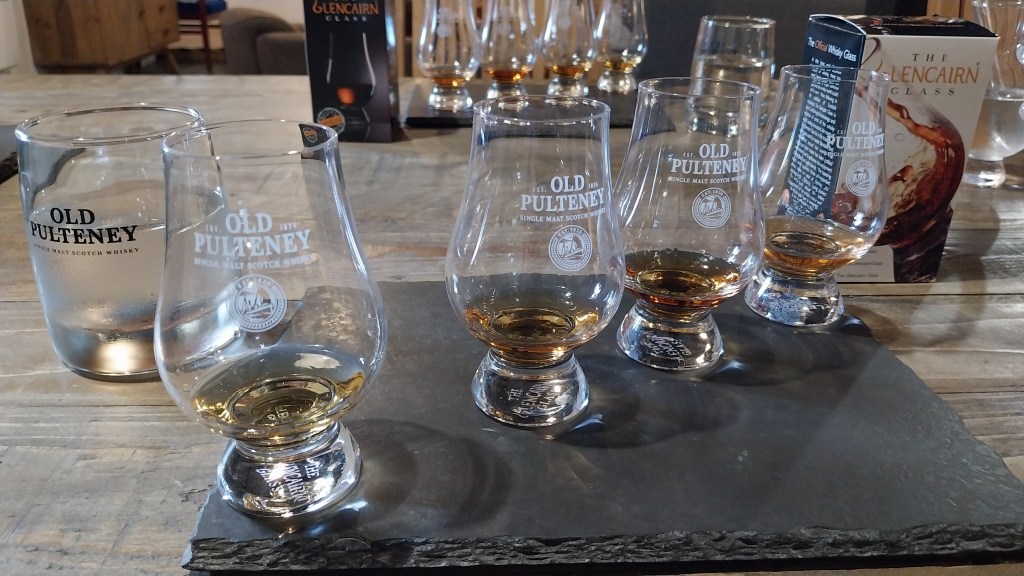
Nice display for the tasting.
When Teresa and Edoardo finished their drams, we went back to the shop and quickly left. Overall, the distillery was super interesting, the tour was fine, the tasting was decent, and Tim was a knowledgeable guide. Being in such a remote place (about 5hr driving from the Central Belt) you’d think they could do something a bit more special, but it was along the lines of the Balblair tour we did back in 2023. So, unless we’ll be in the area for their 200th anniversary, we’ll hardly go back…Never say never, though.
Next up a much much nerdier experience, so stay tuned! Until then, slàinte!
Pulteney ‘From The Source’ Tour
Price: £40.00 pp (July 2025)
Duration: 2hr
Tasting: 4 drams, Old Pulteney 12 (40%), 15 (46%), 18 (46%) and Coastal Series Port cask matured (46%), plus a complimentary glencairn
Distillery exclusive: D.E. French Cask matured (NAS, 53%, £85.00); Distillery Hand Bottling ex-Sherry cask (13y, 2010-2024, 62.5%, £130.00); Distillery Hand Bottling ex-Bourbon cask (18y, 2006-2025, 58.4%, £150.00)
Highlights: the shape of the stills and the site in general
Target: whisky curious, the tasting was a bit too basic for the enthusiasts
Value for money: ok
Recommended: for Old Pulteney fans
Link: https://oldpulteney.com/visit-pulteney-distillery/



 Dramming around