An English malt with a Tasmanian twist and an eye for sustainability
TL; DR: From Ellers Farm, we went directly to another distillery: Cooper King. Inspired by Tasmanian craft distilleries, they produce other spirits other than single malt, with a very interesting set up. And, everything is done in the most sustainable way possible, kudos! After the visit, we went to Brew York, for a tour, dinner, and a quiz!
After the visit at Ellers Farm, we jumped back on the minibus. Our next destination was only about half hour away driving north-west, approximately 13 km north from the city of York, in the village of Sutton-on-Forest. The distillery is called Cooper King, just outside the village. It was founded by Abbie and Chris, a couple who got the inspiration while travelling in Australia and visiting local distilleries. The distillery is named after Charles Cooper King, Chris’ great-great-grandfather. The main building is just a few meters from the gravel parking lot, and it harbours a bar/shop and production. There is also a nice wee garden outside, with wooden tables and benches, which we took advantage of after the tour. It was a nice sunny day!
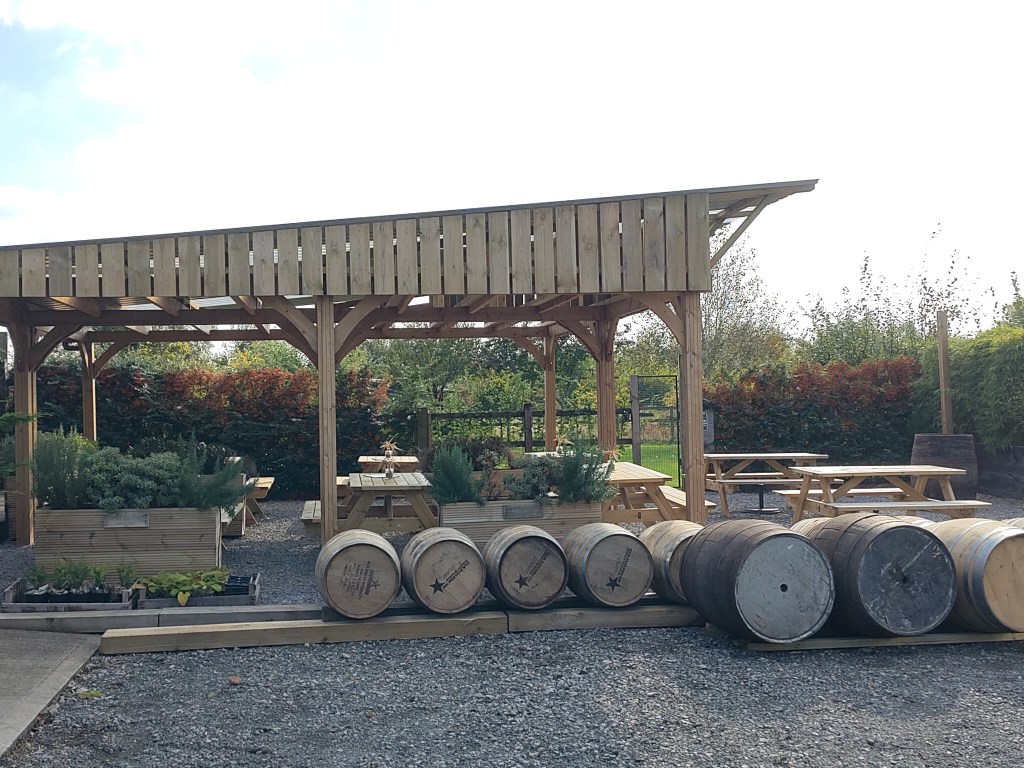
Nice set up outside.
We were welcomed by Mark, tour guide and assistant distiller. Like others, he came on board as a crowdfunder. At some point (in our understanding) the two founders Abbie and Chris asked who among the crowdfunders wanted to be more involved, and Mark answered the call. We could clearly see his passion for the project. He explained that, in 2014, Abbie and Chris, once a biochemist and an architect, moved to Australia to travel, and started working as fruit pickers. Then, they went to Tasmania, and after getting in contact with Sullivan’s Cove and Lark, they decided to go back to England and produce a Tasmanian-style whisky. Back in Yorkshire, they bought the land thanks to a crowdfunding, as well as a 900-litre pot still (Neilson) straight from Australia.
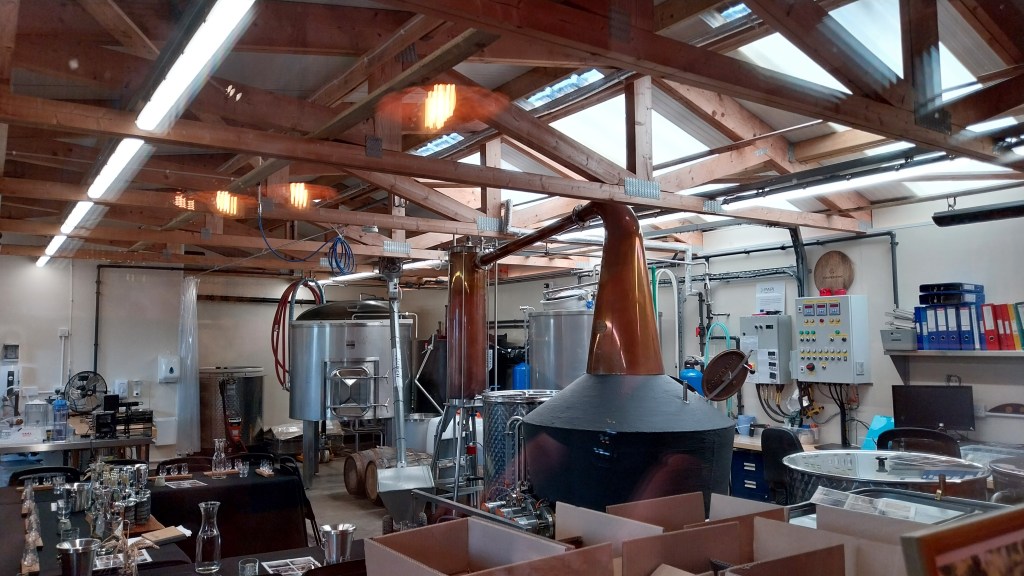
Cooper King distillery in one shot.
Another principle they had in mind when setting up the distillery was sustainability. The electricity comes from renewable sources, of which 60% is produced on site with solar panels: this contributed to make them the first net-zero distillery in England. They also have a programme for planting trees and restoring woodland and wildflowers habitat for each bottle they sell. Moreover, they chose lighter bottles, and offer refills at the distillery, for a few quid less.

Ready for the tour.
Production-wise, they use Maris Otter barley malted in middle England. They pre-heat the small mashtun before mashing the malt. After that, the remaining draff goes out to local farmers to feed cows. Fermentation takes place in a 1750-litre plastic vessel (usually only half full to avoid foam accidents) and lasts seven days. Both distillations happen in the same still, which is different to what we saw in all the Scottish distilleries we visited so far. At first, Neilson the still was heated externally, but to make the process more efficient it was sent to Scotland for modifications and is now internally heated and insulated.

Inside Neilson.
The wash gets distilled to 25% abv, while the heart of the second distillation comes out on average at 75%, before getting diluted by filtered tap-water. Needless to say, everything in the distillery is very manual, except for the gin and vodka very modern cold-distillation machines (which take only about 10% of energy compared to a classic copper pot distillation).

Super-modern gin and vodka distillation.
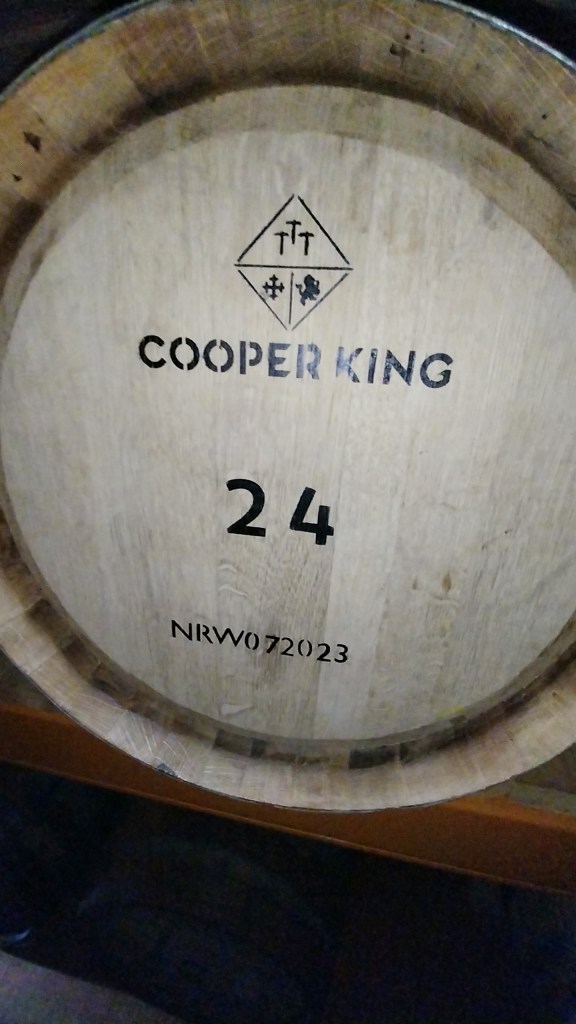
They use a variety of casks from all over the world, and their main American cask supplier is the Garrison Brothers distillery, in Texas. Casks are kept in a safe container behind the distillery, while waiting to get a proper warehouse. They started distilling newmake spirit in 2018, and their first whisky was released in October 2023, about a year before our visit.
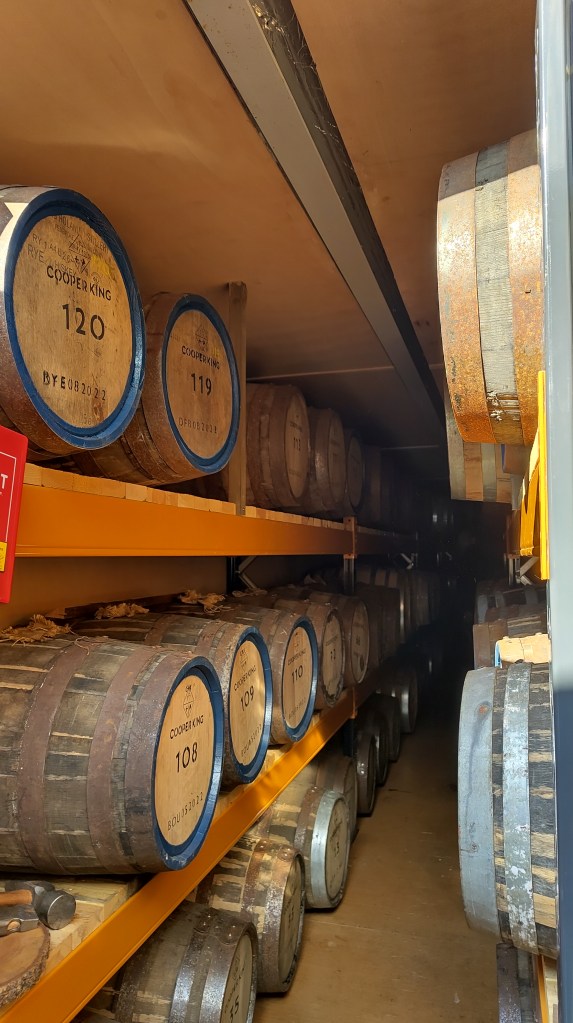
And Cooper King warehouse in one shot.
While we were outside checking out the casks, another member of staff set up the tasting in the main production room, which also serves as a tasting location. First, we went through five liquors and gins (see below), but as it’s not really our focus, we won’t spend many words on it. We were really interested in their whiskies. The first one was not exactly that: a newmake spirit, from the “Pilot Series” and bottled at 47%. It was followed by two single malts from their “Expedition Series”, Transatlantic (ex-bourbon and ex-wine casks, 48%), and Embers (charred ex-bourbon casks, 49%). Then, two single casks: first, an ex-Cognac matured single malt, bottled at the 53.2% natural cask strength; second, a dram first matured in virgin oak casks, then re-racked into an ex-Armagnac cask, again cask strength at 52.1%. The evaporation (or “angel share”) is higher compared to Scotland, about 4%, which combined with other specific conditions, might cause the abv to be lower for such young whisky. Overall, we could tell the degree of experimentation at this distillery is high.
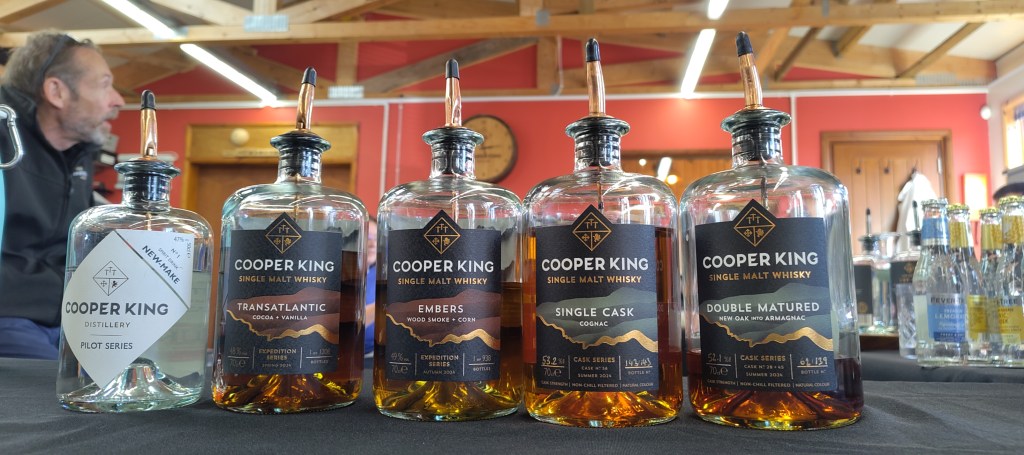
The whisky part of the tasting, with our guide Mark.
After the tasting we had a few minutes to spend in the sunny patio, sipping on our leftover drinks, before getting back on the mini-bus. We headed towards York, precisely the Brew York Brewery. Despite the city location is not their main production facility anymore (that one is in York’s outskirts), it’s still a massive place. We did a production tour (£15, including four tastes) and then had dinner there (they do a range of Asian-inspired dishes, which were delicious, albeit heavy on spring onion). Unfortunately, the place was too noisy for the next scheduled activity, a whisky-based quiz, so we had to move to a quieter pub nearby. The quiz, organised by our whisky veteran pal Charlie, was great fun, and we went back to base all very happy.
What a great afternoon and evening we had! At that time, we had tried very few craft Australian whiskies (and even less Tasmanian ones), so the link between them and Cooper King was not evident to us. At the time of writing however (after a serendipitous trip to Australia…Stay tuned in the coming weeks for more), the connection is quite obvious: we spotted a very typical herbaceous note in Cooper King drams, the same we found in most whiskies down under. Overall, it’s a very interesting project, which we are very glad we got to know more of.
Next up, another Yorkshire whisky day, but not a distillery! Until next time, slainte!
Cooper King Distillery Bespoke Tour
Price: £20.00 pp (October 2024)
Duration: 1hr 30min
Tasting: 5 spirits (Dry Gin, 42%; Herb Gin, 40%; Smoked+Spice Dry Gin, 41%; Black Cardamom Vodka, 40%; Berry+Basil liqueur, 25%) and 4 drams: Transatlantic (48%, ex-bourbon and ex-wine, 1208 bottles), Embers (ex-bourbon, 49%, 938 bottles), ex-Cognac matured single cask (53.2%), virgin oak/ex-Armagnac cask (52.1%)
Target: whisky and spirit enthusiasts
Value for money: very good
Highlights: the distillery set up
Recommended: yes
Link: https://www.cooperkingdistillery.co.uk/
 Dramming around