One last stop on the Deveron: Macduff
TL; DR: The final stop of this story takes place along a small river called Deveron: at the Macduff distillery! Tucked into a small glen, this “modern” Bacardi/Dewar’s workhorse was open to the public over a weekend for charity. Another great tour, definitely worth the trip there!
(missed Part 3/Part 2/Part 1?)
In the morning, we woke up rested. We could hear the sound of the sea in the distance: waves and seagulls, although it was sometimes hidden by the cars and trucks driving on the A90. It wasn’t too cold, so after dressing up and putting away the rock-and-roll bed, we made coffee and had breakfast in the van. Then, we quickly left the parking spot. Because we had some time (our tour wasn’t until noon), instead of heading straight towards our destination, we drove to Newburgh, just up north. We parked and after a short walk we arrived at the Seal Beach: opposite a small river, there was a colony of grey seals laying on the beach. A couple of researchers from the Aberdeen University told us they were counting them, using a drone to fly over and taking pictures.
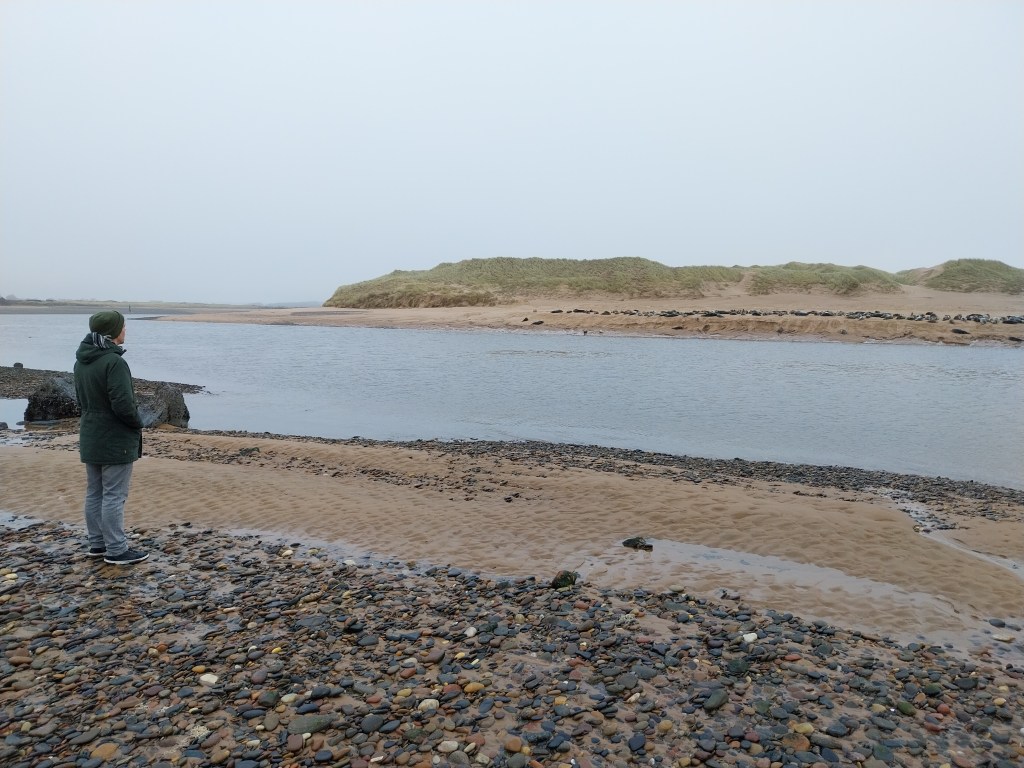
Man and seals.
A very enjoyable stroll, but it was soon time to go back to Mr Vantastic and get to our destination, the Macduff distillery. We had enough time to stop for a (very early) lunch in the village called Macduff itself, which is on the coast, divided from Banff by the river Deveron. The village looks a bit run down (maybe the overcast weather didn’t help), but we found a very nice diner, the Seafront Cafè, where we had a warm and hearty soup.
From there to the distillery it was only a few-minute drive: instead of turning right on the Banff bridge, we kept on the main road for a bit, and then turned right into a small road that led us straight to the distillery, at the end of a downhill. While production is in a (almost square) building on the left, a big warehouse is on the right. This is owned and used by Brown Forman, as we were told when at Glenglassaugh. We checked in and found the same team we’d met at Royal Brackla, nice! This time we went on tour with Luke and David, the distillery supervisor, while the others took their lunch break. The crowd was mostly local people, which was actually great to see!
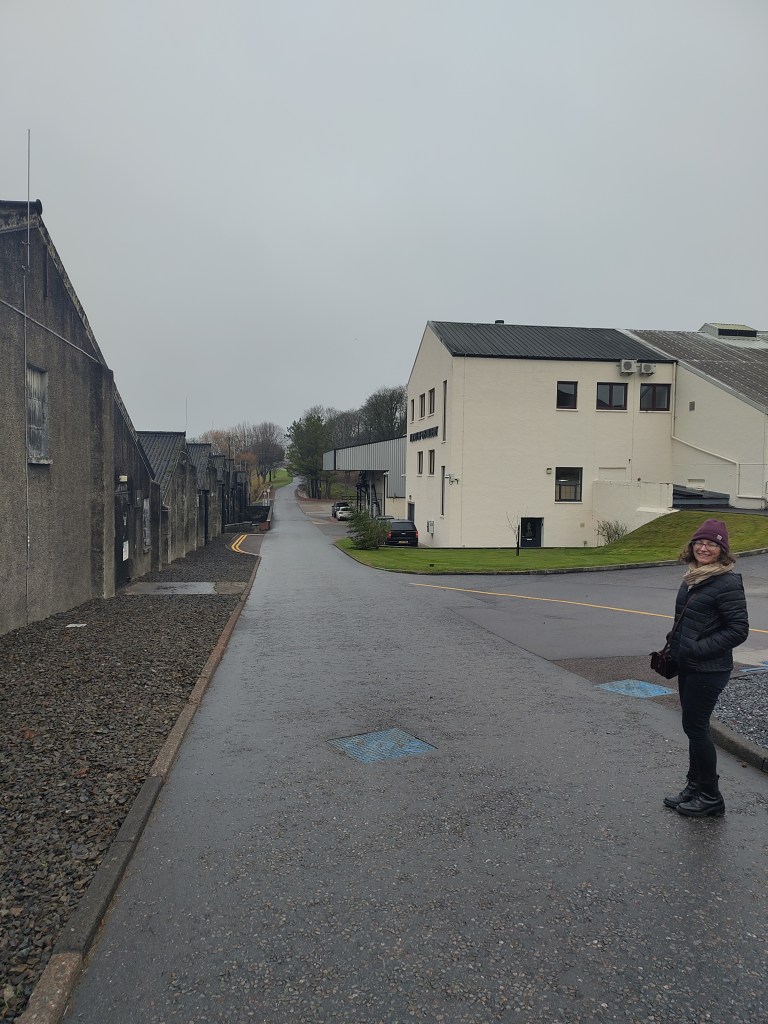
Possibly not the most charming site…
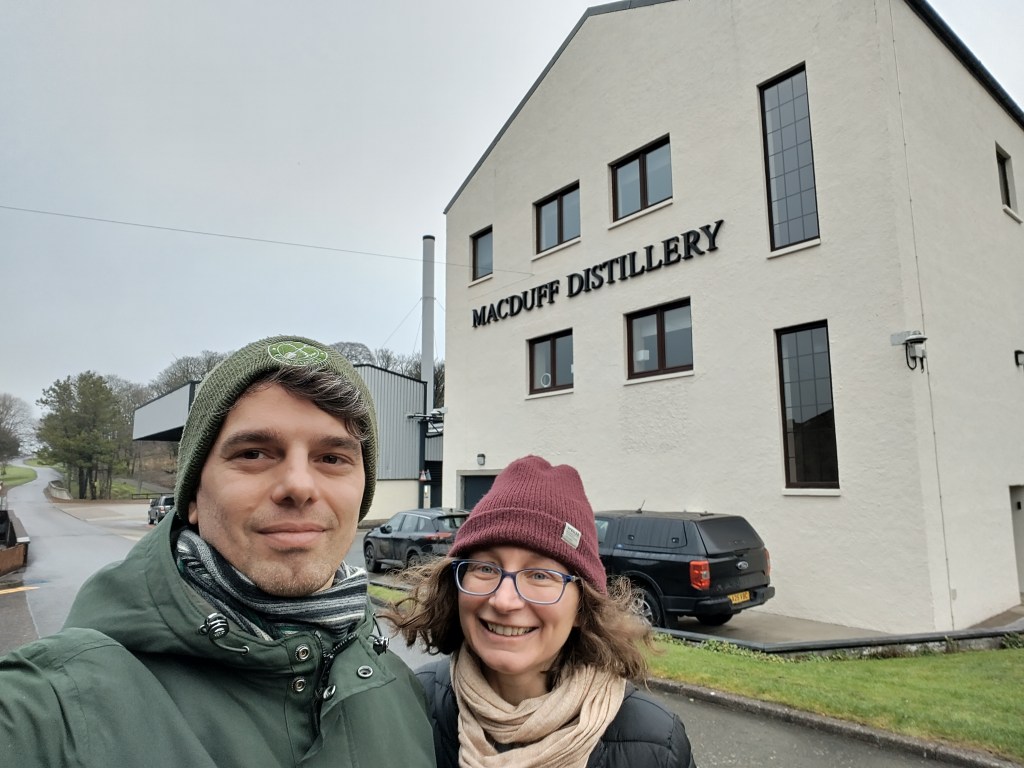
…but still, very excited to be here!
Compared the other distilleries we visited in this area, Macduff is almost the new kid in town: construction works started in 1958, and production started in 1960. Founded by a consortium of four businessmen from Glasgow, it was sold for the first time in 1964 and changed hands a few times, until landing in the Martini group, and then with Bacardi. At the time the distillery was state of the art. They never had a malting floor, but they used to have a cooperage on site. The spot was chosen because of its water source, the Gelley burn flowing into the Deveron just up the road. This water is used for cooling, while the water for the mash comes from a spring (we think) a few miles afield.
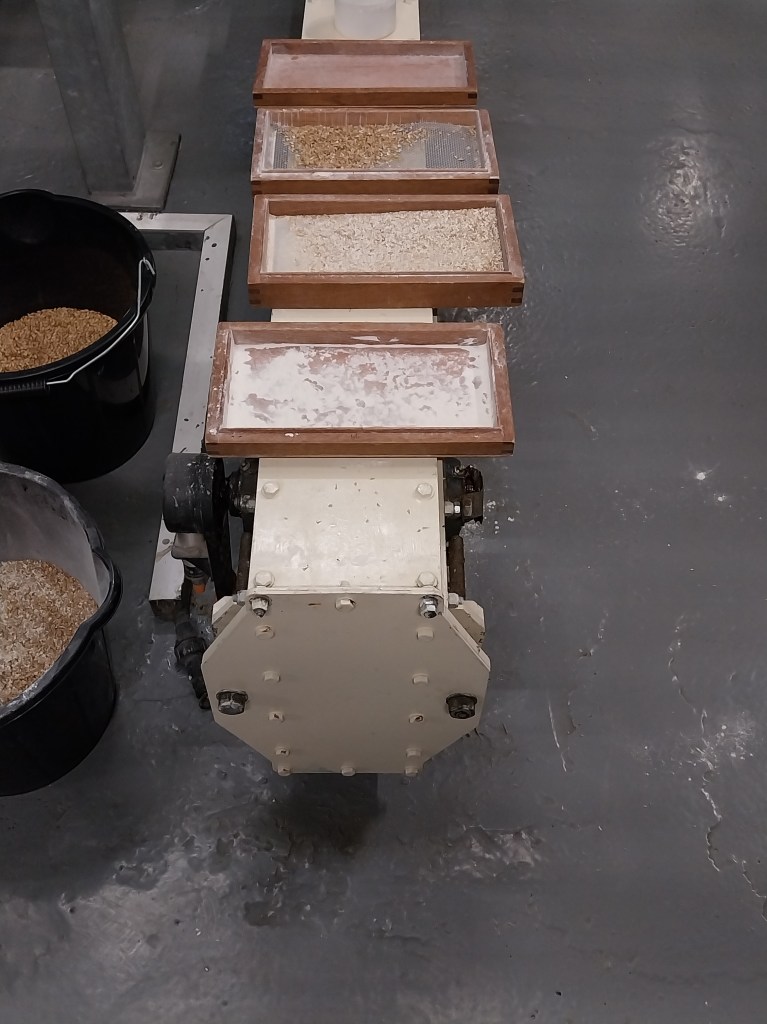
The malted barley, fully unpeated, comes from Baird and Simpsons, 28 ton per delivery (with 5-6 deliveries per week). At the moment they use Laureate, which allows them to produce 416 litres of spirit per ton of malt. In the past they used some peated malt as well, and last year they also tested chocolate and crystal malt for very limited batches. The malt is milled with a Buhler mill installed in 2007, a brand we saw several times around, especially in new distilleries. The grist has the usual husk/grit/flour ratio of 20/70/10, and is stored in a new grist bin, installed as part of a recent £3m renovation. For each of the 17 mashes they do weekly in the full leuter mashtun, they use 9 tonnes of malt, to which they add water at 63°C. The second and third waters, the latter used for the following mash, are added at 75°C and 85°C, respectively. The full mash is then transferred to one of the nine steel washbacks, where liquid distiller’s yeast is added after 7,000 litres are filled in. Fermentation lasts between 56 and 120 hours, depending on the day of the week it starts.
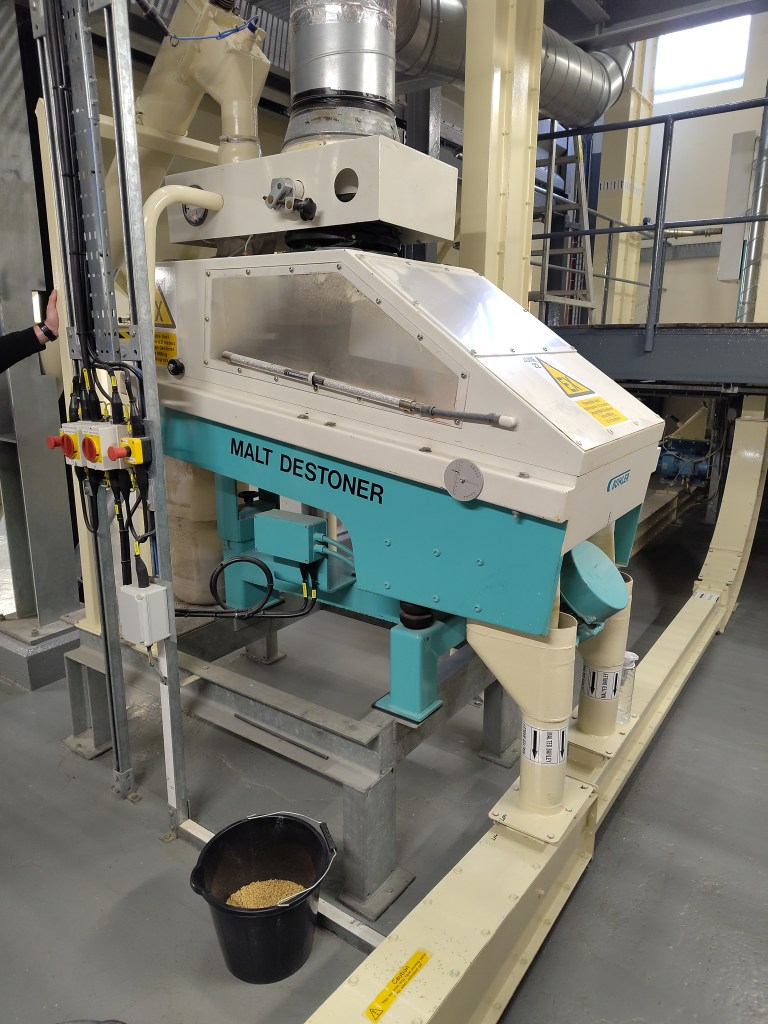
New milling equipment.
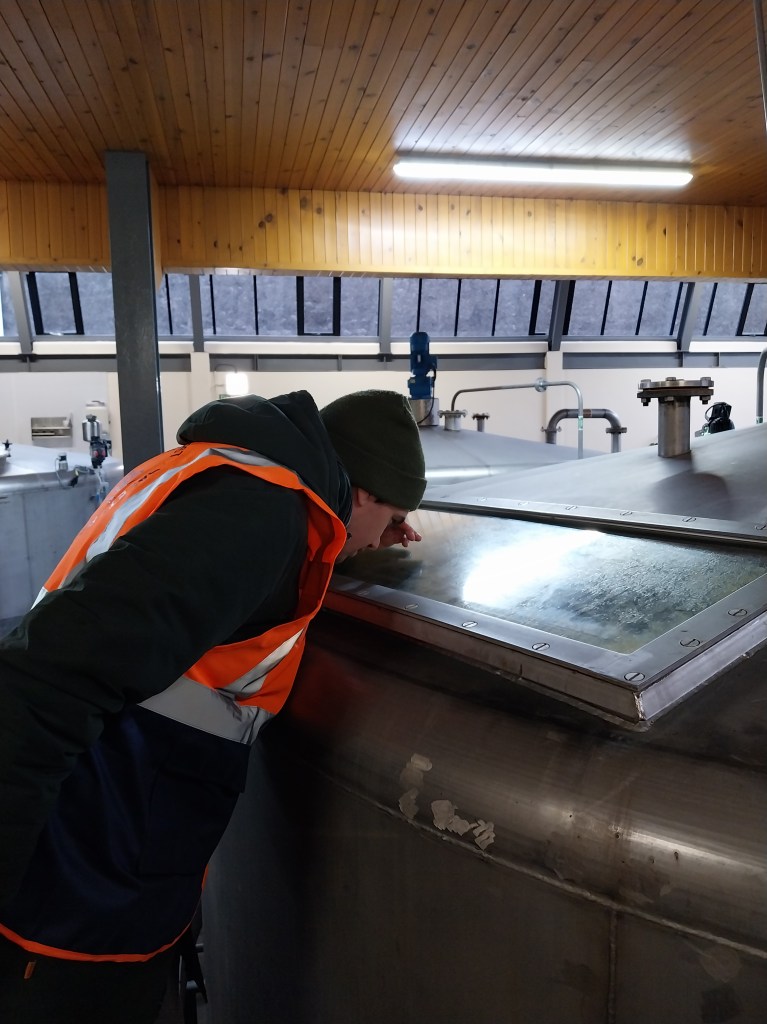
Checking fermentation.
When we arrived in the still room, we couldn’t help but notice the peculiar shape of the stills, and the horizontal condensers: everything was set up this way to save space. The wash still charge is 28,000 litres, while the spirit still one is 16,200, with a third coming from the foreshots and feints from the previous distillation. In the second distillation they discard about 300-litre of foreshots, and collect the spirit between 74% and 65%; in total the distillation lasts 10-12 hours. This year they produced about 2.8 million litres of pure alcohol, slightly less than previous years. A third of the produced spirit, which is shipped to Glasgow in tankers, is destined to the blended scotch whisky William Lawson (we never saw it here in Scotland, but it can easily be found in Italian supermarkets), a third to Dewar’s, and a third is sold to other companies. Only a minimal part (0.5%) is bottled under either of their two current brands: Deveron or Glen Deveron. They took the name from the nearby river because they couldn’t use “Macduff”, too similar to a brand belonging to W. Grants. While the Deveron is for the UK market (you might see around a 10y and a 12y version), the “Glen” is used for the travel retail, although in our understanding this might change.
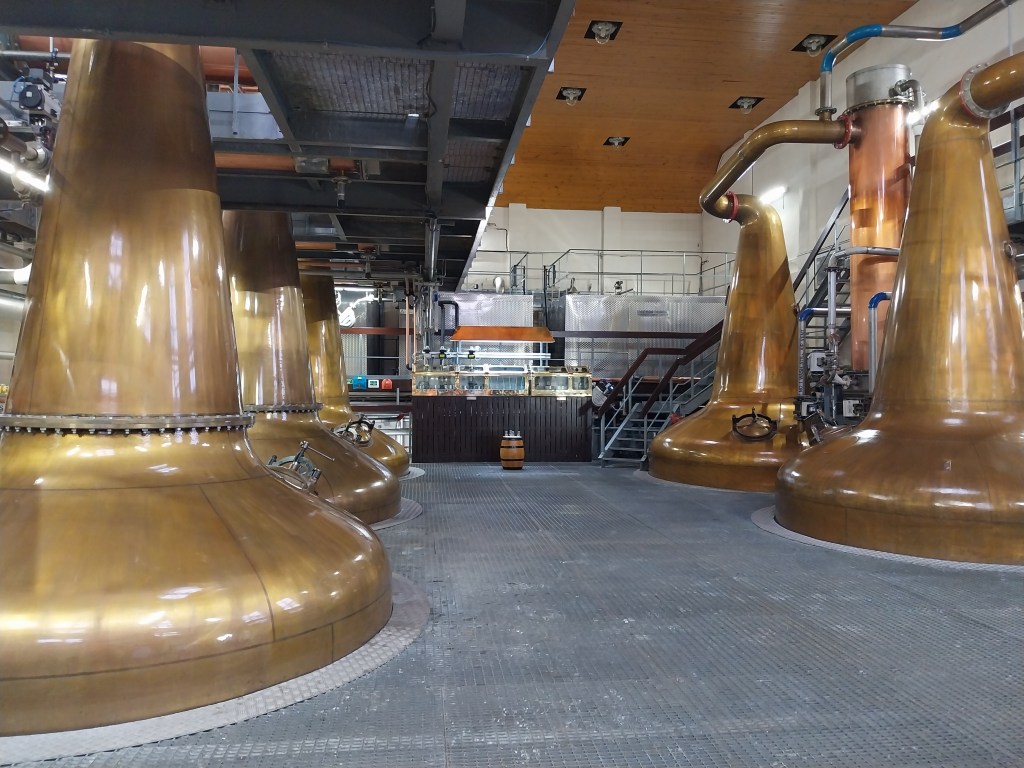
A beautiful still room…
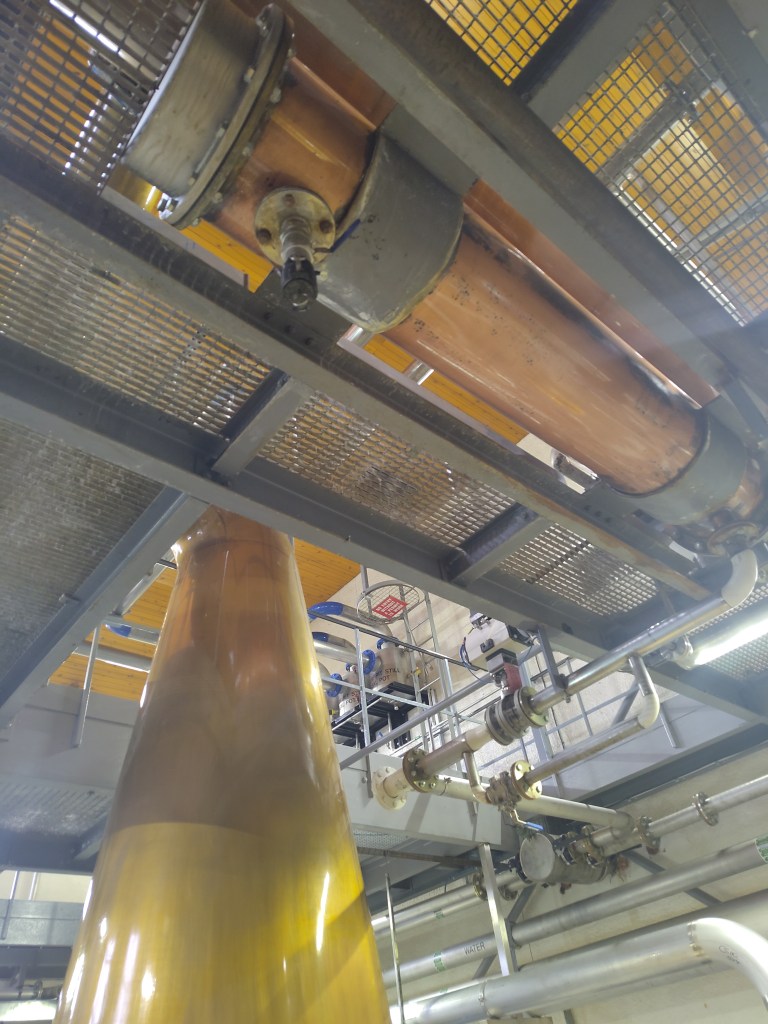
…with the unexpected detail, look at that horizontal condenser!
It finally came the time for the tasting! The 10y was skipped so the lineup started with the Deveron 12y: an inoffensive dram, bottled at 40%, from both ex-bourbon and sherry casks. It was followed by three Glen Deveron: 16y, 20y and 25y, again all bottled at 40%, and again from both ex-bourbon and sherry casks, except for the 25y which was exclusively from 1st fill and refill oloroso casks. They all went down very smoothly, probably because of the abv, but we struggled to grasp the character of the distillery. We know how good Macduff can be – one the best sherried whiskies we had (from the Electric Coo range) was a 12y Macduff from an Oloroso butt, truly great stuff! To their credit all the expressions were greatly priced for the day, in particular the 16y (£65) and the 20y (£90).
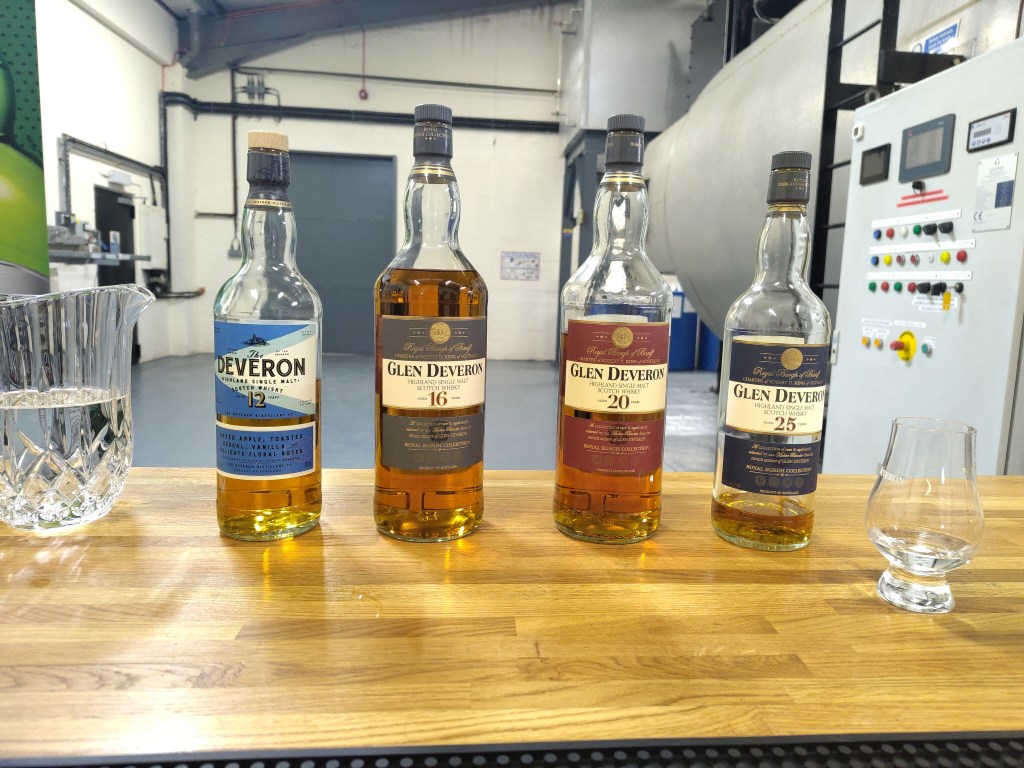
The tasting lineup.
That was all, for the trip (we slowly drove back to Edinburgh) and for our series of distillery visits in the eastern Highlands. It was a nice wee string of tours in the space of a few weeks: it was great to see the new visitor centre at Glencadam, but the team at Bacardi/Dewar’s really knocked it out of the park! Both visits at Royal Brackla and Macduff were excellent, interesting and nerdy (as we like it), but accessible for casual drinkers as well, and a great value. It’s crazy to think that we paid less for the last three distillery tours (Brackla, Glencadam, and Macduff) than for Glenglassaugh alone. Someone at Brown Forman might want to rethink their strategy.
Stay tuned for our next story in a couple of weeks! Until then, slàinte!
Macduff Distillery Tour
Price: £20.00 pp (December 2025)
Duration: 1hr 30min
Tasting: The Deveron 12y (40%), Glen Deveron 16y (40%), Glen Deveron 20y (40%), Glen Deveron 25y (40%)
Target: everyone
Value for money: great!
Highlights: the workhorse production plant
Recommended: absolutely, keep an eye on their socials
Link: https://www.thedeveron.com/
 Dramming around