Dramming on to the North Sea: Glenglassaugh
TL; DR: This year we finally made it to the Dornoch Whisky Festival, where we had a blast! On the road there we did a quite long detour to Glenglassaugh, in the Aberdeenshire, for a distillery tour. The distillery is very interesting and the tour was good, but it was one of the most overpriced experiences we had recently.
A few months back, towards the end of 2025, we visited a few distilleries in the north-eastern Highlands: east to the A9 (the stub between Perth and Inverness), but not Speyside. In fact, almost like a horseshoe around Speyside. There used to be many more distilleries in this region back in the day – from Alfred Barnard’s book The Distilleries of The United Kingdom: Bennachie, Glenaden, Glenugie, Bon Accord, Devanha, Strathdee, Glenury Royal, Brechin/North Port, Banff and others. Some still stand, and while we already visited a few (Glen Garioch, Glendronach, Royal Lochnagar, Fettercairn & Arbikie), for a reason or another we kept missing some others.
The first of these trips happened in October, a month that for us used to mean Dramathon. While it’s a fun event, after 4 years (in which we ran 3 because the 2023 one was cancelled due to a flood red warning) we definitely needed a change, so we decided to attend the Dornoch Whisky Festival instead, an event we’d wanted to check out for a while. On the way up there, we took a (not so) short detour, to visit Glenglassaugh distillery. In the pandemic aftermath it was closed to the public, except for possibly some events during the Spirit of Speyside (even if technically it’s not considered a Speyside distillery). However, earlier in the year we discovered that tours became available.
The distillery is on the coast between Aberdeen and Inverness, not exactly behind the corner, going there on our way to the Dornoch Whisky Festival (even if it meant an hour of extra driving) saved an extra trip. We split the drive in two by leaving the city on the Thursday night: the perks of Mr Vantastic. We spent the night near Stonehaven, and in the morning, we drove along the coast: the weather was not great, so it wasn’t the smartest of the plans. After a coffee and a roll in Peterhead, we went straight to the distillery.
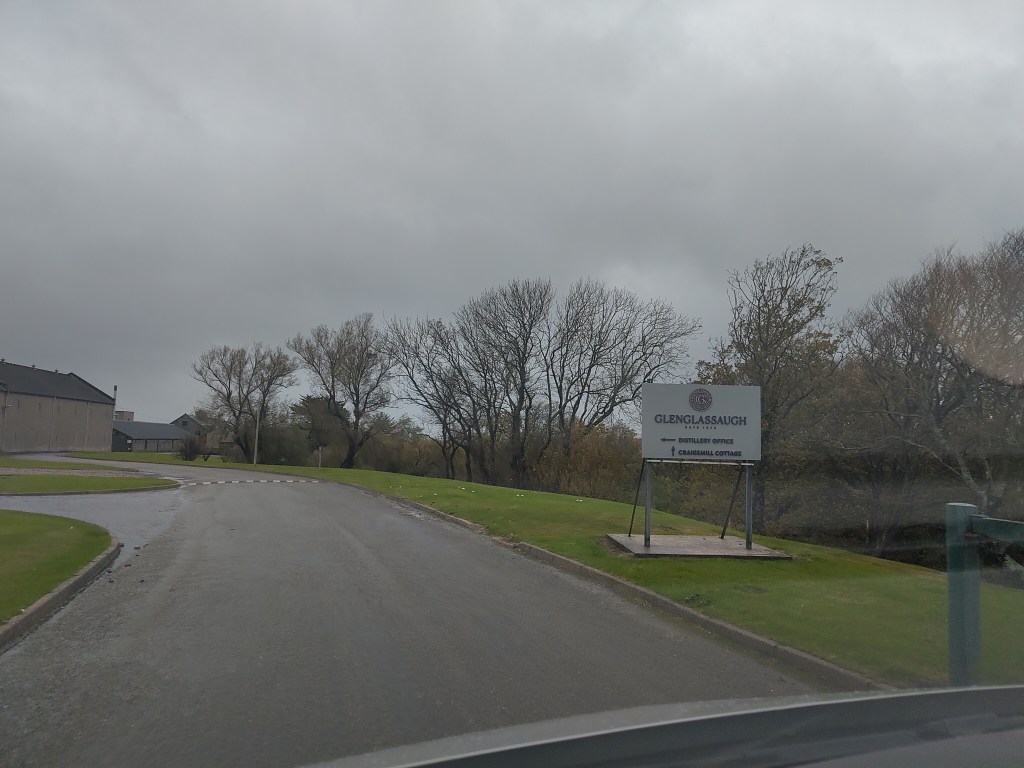
Finally got here…
Coming from Portsoy, Glenglassaugh is tucked between the A98 and the North Sea, just before Sandend Bay: an old windmill stands just past the entrance road, almost to signal it (well, if you know). We turned right into a small downhill road, next to a large warehouse complex, to reach the visitors’ car park. Next to it, a building marked as “visitor centre” but looking disused. We then realised that the actual visitor centre was the next building, an old and beautiful mansion.
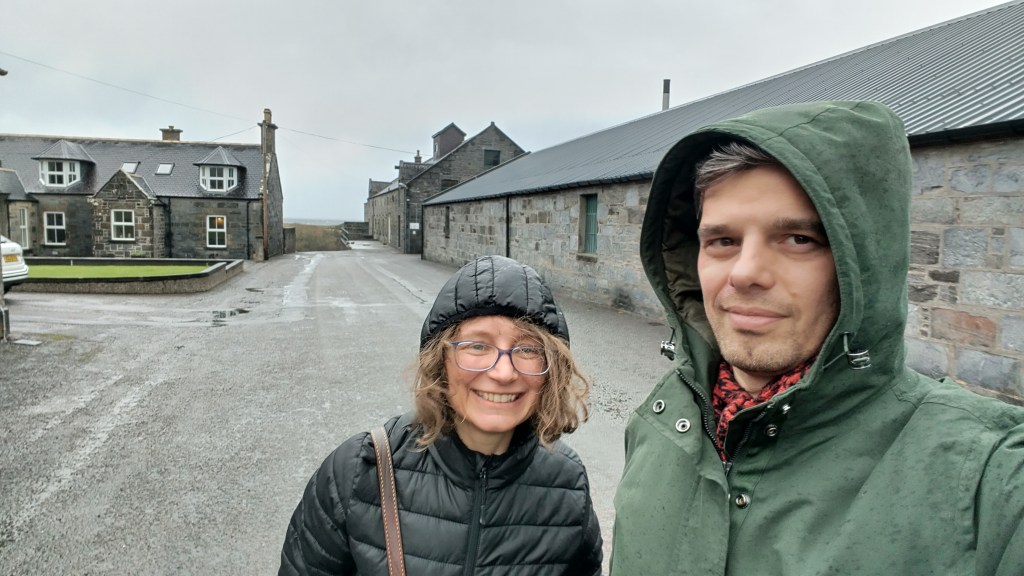
…for another distillery tour in the rain.
Our guide, Marie, welcomed us inside and made us coffee, a nice touch. Unfortunately, the chimney was not on, but the large room was very cozy nonetheless. After a pleasant chat, Marie delved into the history of the distillery and how it is now part of the Brown Forman portfolio, together with Benriach and Glendronach (not the same link as before for the latter, because we visited it twice!) in Scotland, and also Jack Daniel’s, Woodford Reserve, and other brands. The distillery started production on the 4th of December 1875 by an entrepreneur called James Muir, who had connections with the engineering world and owned a wine shop in Portsoy. The name Glassaugh comes from the nearby burn, which starts about 8 miles uphill from a spring. After Muir death’s, the distillery fell in the hands of their nephews, but it was eventually sold to Highland Distillers in 1892, and later mothballed in 1907. It was reopened once again in 1959, with a substantial revamp, while some of the old original buildings used as warehouses. The aim was to use the malt as a component for the Famous Grouse: however, the spirit was too overpowering, and in between then and 1986, when it closed, a number of changes were made to try to “tame” it.
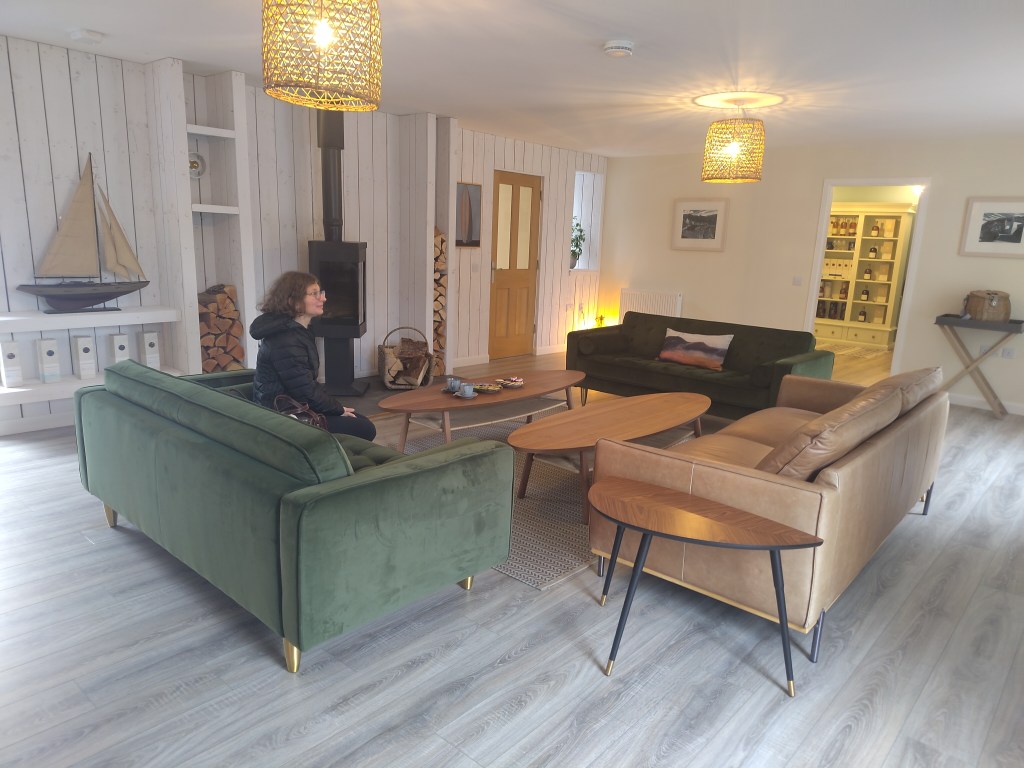
Not a bad spot to listen to the distillery history.
The distillery was reopened by another company in 2008, while in 2012 they launched the whisky Revival. It was then bought by Billy Walker in 2013 and sold, together with Benriach and Glendronach, to Brown Forman in 2017. Recently, production has slowed down, and at the time of our visit Glenglassaugh was running at about 50%, sharing the same production staff with Benriach.
After this detailed introduction, we went outside to check out the production. We started with the malt bins and the mill room, in a stone building alongside the road that goes downhill towards the Sandend beach. We were supposed to have a short walk to the beach, and have there our first dram, the Glenglassaugh Sandend. This is a higher abv (50.5%) non-age stated whisky, mostly from ex-bourbon casks, but with Manzanilla and Oloroso sherry as well: probably, the best dram of their core range. Unfortunately, it was still “pishing doon”, so we tasted the dram in the mill room instead, admiring the old Porteus mill crashing malted barley into grist (usual shares for husk/grit/flour, 20/70/10). Different to most distilleries, at Glenglassaugh, most of the “new” equipment was made by Porteus, implying that Ronnie Lee, the Welsh engineer who maintains Porteus machines, spends there about 2 weeks every time.
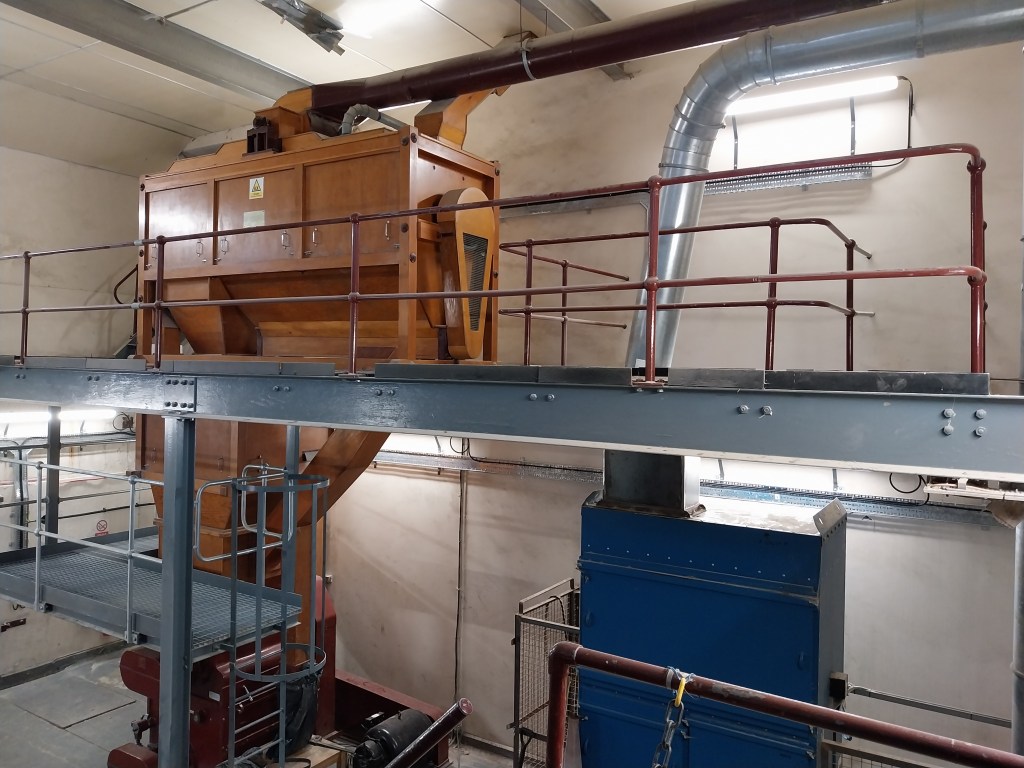
The mill room.
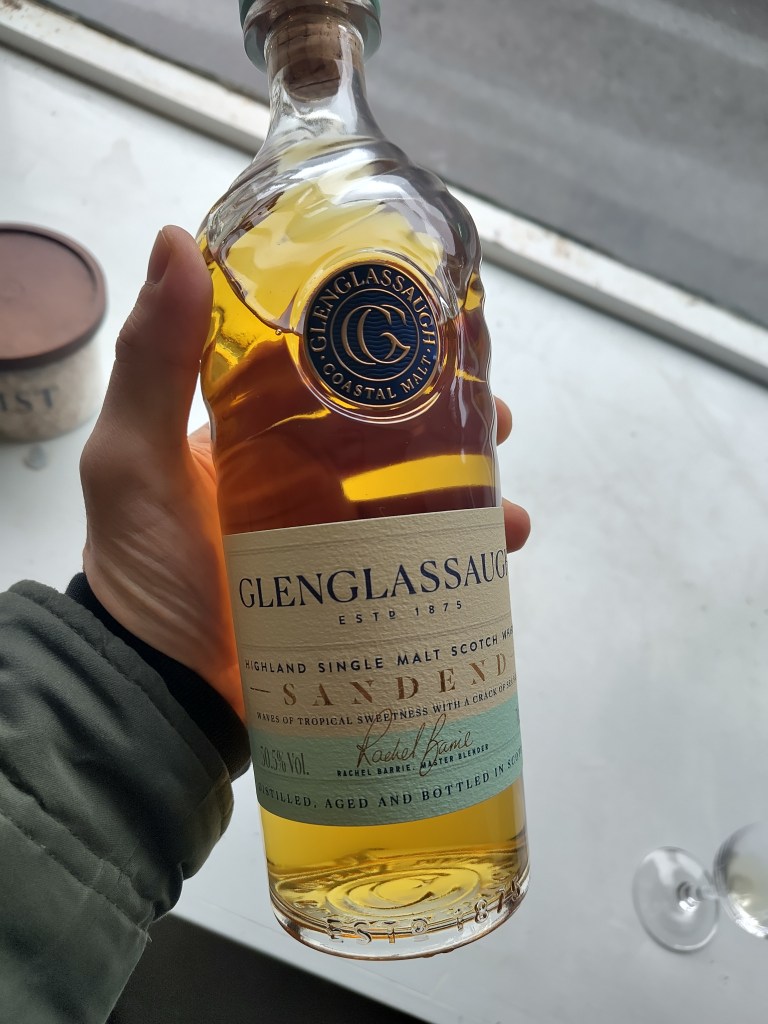
Dramming in the mill room.
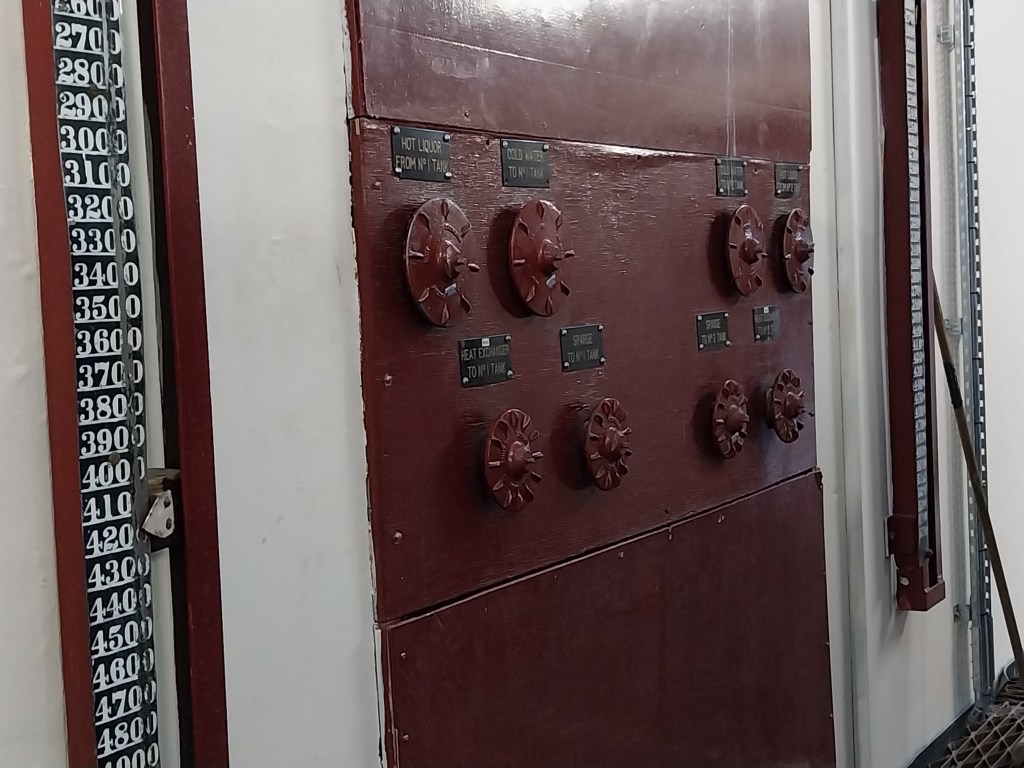
After the dram, we went to the “new” (i.e. 1959) building, clearly a product of the (bad?) taste of that age. The mashtun is 20,000 litres, made of cast iron and with a copper lid, which resisted a robbery attempt during the last mothballing period (not the same luck for some of the copper pipes though). Between the first and second water, they collect 24,000 litres only. The third and last water amount to 17,000 litres, used as first water for the following batch.
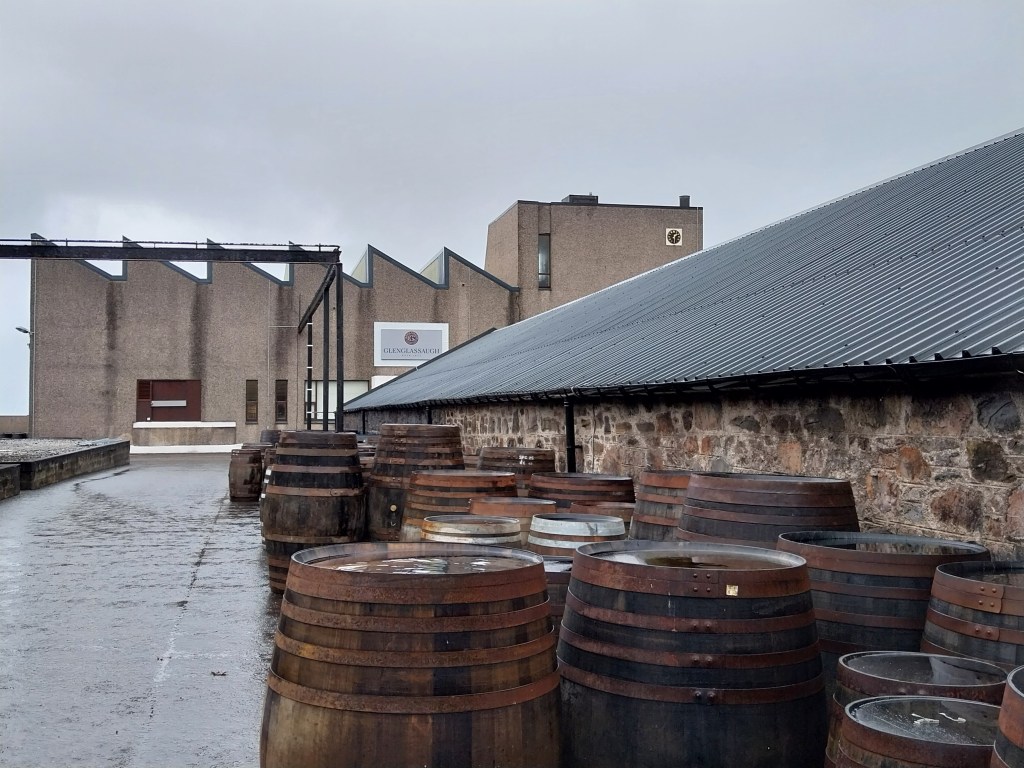
Not the most impressive building…
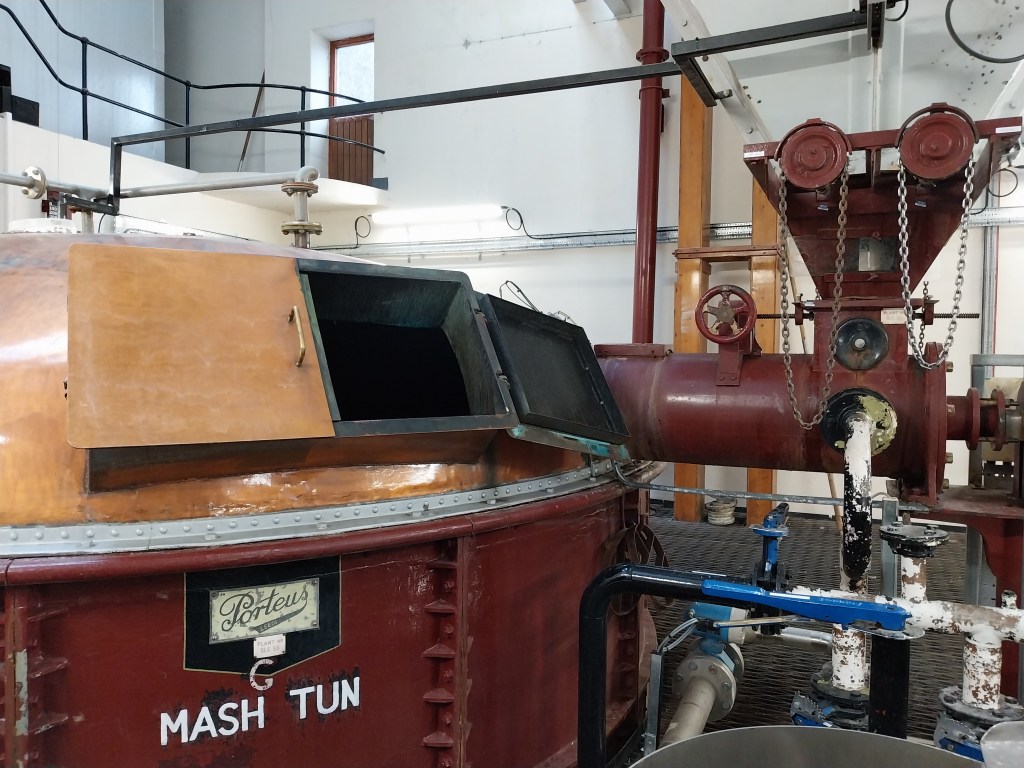
A Porteus mashtun, nice!
Mashing lasts 7 hours, and they aim for a cloudy wort, which is then moved to one of the 6 washbacks (4 Douglas Fir, 2 stainless steel). There, fermentation lasts about 60 hours, before the wash is distilled twice: first 12,000 litres go through the wash still (so, each mashing and fermentation produce enough wash for two distillations), then 7,000 litres of low wines (at 25%abv) are distilled again in the spirit still. The wash still is externally heated by a steam jacket, while the spirit still has a steam coil inside. The stills were installed in 1974: one of the many attempts to “tame” the spirit. The spirit cut is between 75% and 63%, for an average of about 68.8%, which is filled into casks.
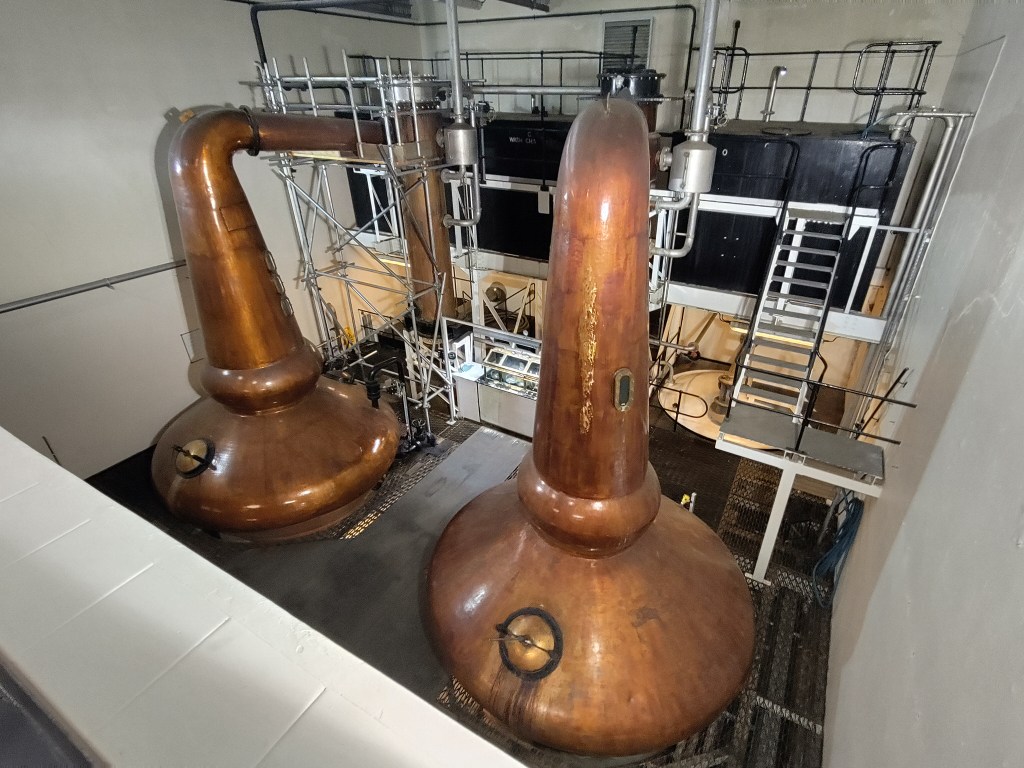
A different perspective, still from above.
After that, we visited a dunnage warehouse, one of the three on site, together with three palletised ones. They also own some warehouses a few miles down the road, at Macduff distillery (owned by Bacardi). They use a variety of casks, some going back to the late 1960s, including a new for us: a Missandra cask form a very old winery in Crimea.
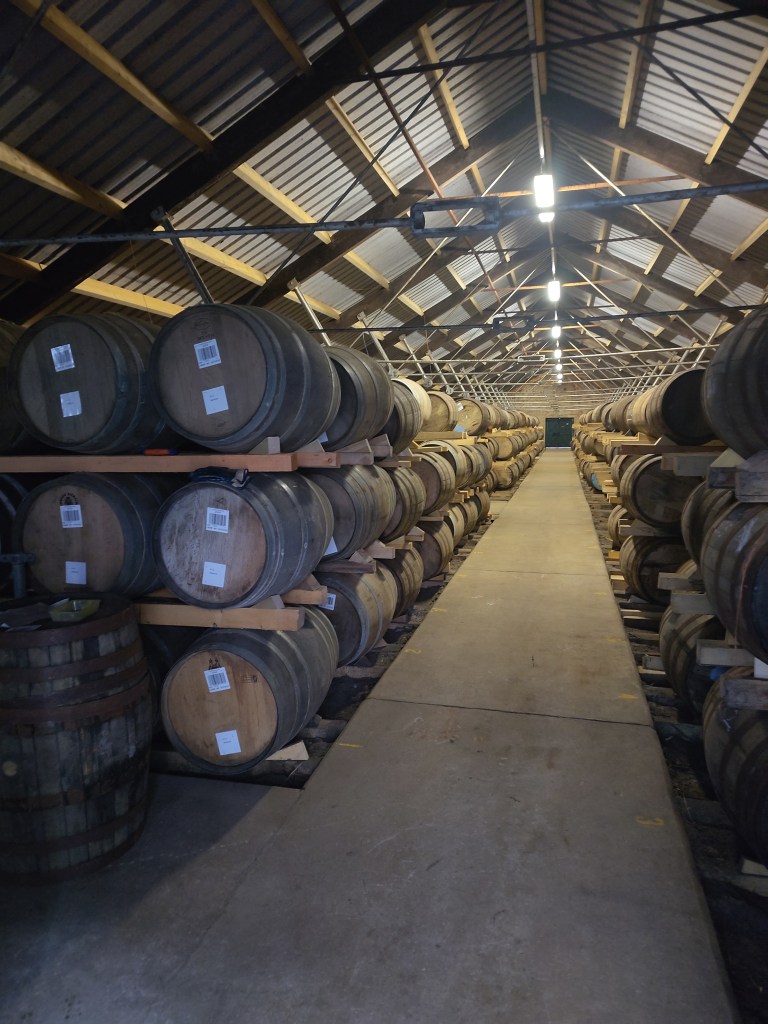
Where Dr. Rachel Barrie selects casks.
Back at the visitor centre, four drams were waiting for us in a cosy tasting room. The first two drams are part of the latest Glenglassaugh revamp from 2023, together with the Sandend we tried before: a 12 year old (45%), from a selection of ex-bourbon, sherry and red wine casks; and a peated (30-45ppm) non-age stated single malt finished in port casks (49%), the Portsoy (named after the nearby village). Finally, we tried two expressions from a wood-finish range that came out in 2017, right after Brown Forman took over. Both started their life in 1st fill ex-bourbon casks, but one was finished for two years in a PX sherry cask (46%), while the other one, peated, was finished in an American oak virgin cask (46%). The latter one was the one Gianluigi liked the most, unusual as for him virgin oak finishes can be a hit-or-miss. Teresa liked the Portsoy as well, very leathery and decadent, while we both enjoyed the Sandend, crisp and lively.
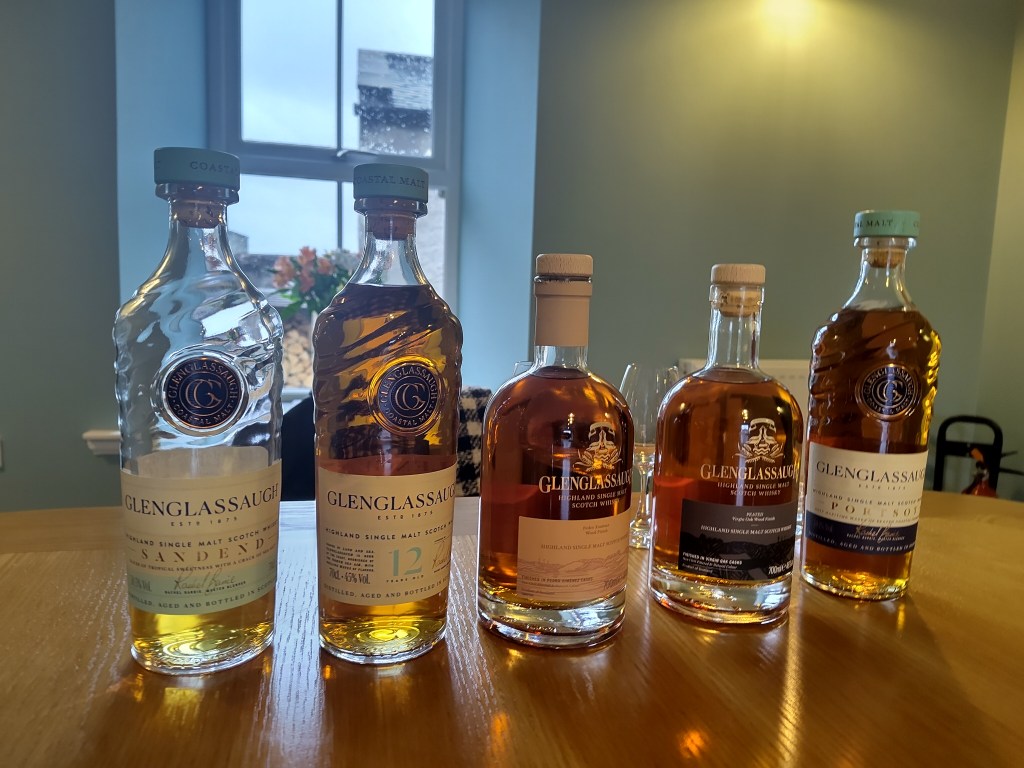
Exploration of recent and less recent releases.
Said that, we were expecting more from this experience. Marie was a perfect host, very competent, knowledgeable, kind, and enthusiastic: she really was great and we learned a lot about the distillery. We don’t mind either having 1 or 2 drams from the core range (which we can find pretty much anywhere in whisky shops and some bars) to set the benchmark, nor 15ml drams, which we think it’s enough to taste. However, for £90, we expected something else from the rest of the tasting: possibly some drams from the cask, or some older expressions. Or at least, a reason that makes you want to go back and say: “well, it was pricey, but it was worth it”. Unfortunately, none of that was on the menu, probably because of corporate greediness or for a push to “premiumisation”. Well, at least there wasn’t one of those grossly overpriced bottle-your-own expressions like at other distilleries (Diageo anyone? CVH?), but we don’t know if this is a positive or a negative at this point. The distillery is in a great location, with an interesting story, and the whisky is tasty, such a shame to misuse its potential like this.
Because this post is long enough, we won’t delve into the fantastic Dornoch Whisky Festival, we’ll save it for another occasion. Stay tuned for our next distillery visit in the North East, coming next week! Until then, slàinte!
Glenglassaugh Distillery Tour
Price: £90.00 pp (October 2025, £95 at the time of writing)
Duration: 2hr 30min
Tasting: 5 Glenglassaugh single malts, the 12y (45%, chill-filtered); Sandend (50.5%, NAS, ex-bourbon casks); Portsoy (49.1%, finished in Port casks); small batch PX cask finish (NAS, 46%); small batch Peated virgin oak cask (NAS, 46%).
Target: whisky fans and distillery baggers like us
Value for money: not great
Highlights: the location
Recommended: only if you’re desperate to visit it, otherwise there are more sensibly priced options nearby
Link: https://www.glenglassaugh.com/

 Dramming around