A distillery next door
TL; DR: Back in October, and thanks to our pal Graham, we visited a distillery that is less than one km from our door: not the one you are probably thinking, rather Bonnington distillery. The manager Gregor welcomed and showed us around the premise. A very interesting project, and a surprisingly maritime single malt.
Our first contact with the distillery we’re talking about in this blog post was in April 2024, during the Biscuit Factory Beverage Festival (one of the many ‘drinks’ events in vibrant Leith), when other than the main festival, we attended a Bonnington & Crabbie tasting, in collaboration with Justine from Kask Whisky. There, we met their responsible for marketing, whom we shared contacts with, hoping for an informal tour of the Bonnington distillery. While we lost contact, our whisky pal Graham Fraser managed to keep in touch, got the details of the distillery manager, Gregor, and arranged a visit for early October this year. Persevere.
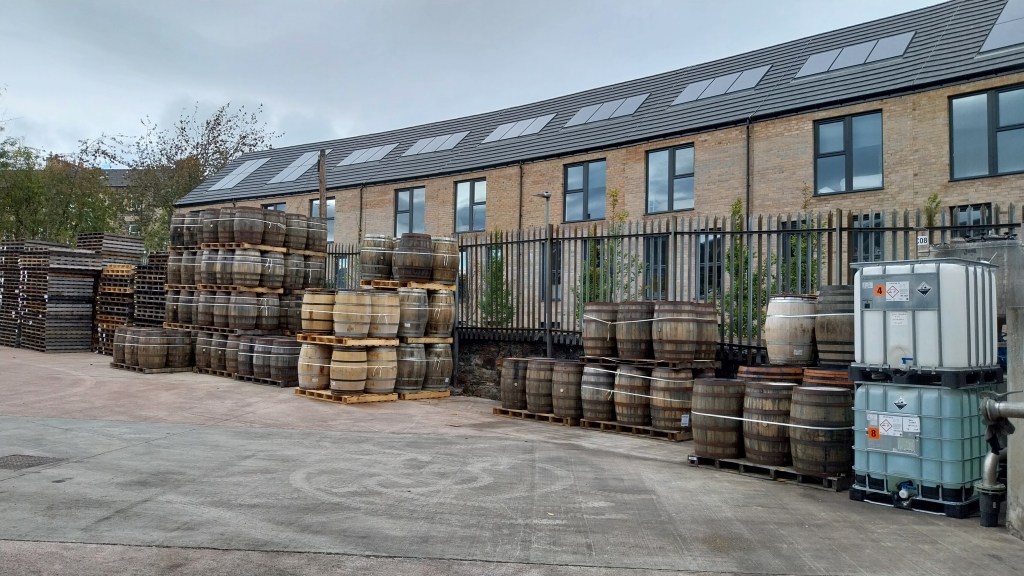
We run close to these casks almost every week!
Bonnington can be considered our “local” distillery, it’s really not even one km for our place, and it’s next to the Water of Leith Walk, so we often run just next to it. A few times we even smelled either the mash or the wash, which is nice but not a great incentive for a run, eheh! The distillery belongs to the Halewood Artisanal Spirits, together with a sister distillery in England (Bankhall), and our auld acquaintance Aber Falls, in north Wales. The company also owns the popular Whitley Neill gin, and Crabbie, famous for their green alcoholic ginger beer. John Crabbie is a whisky brand with strong ties to Leith, as the man who carried this name, including the now lost Yardheads distillery. For more of the history though, we’d suggest checking out Justine content, in particular her whisky history blogs on Substack. The group also included a smaller and experimental distillery located not too far away, in Granton, called Chain Pier. It was active only for a little while, from 2018 until January 2020, and so far only a handful of bottlings have been released, including by a few independent bottlers. Back to Bonnington distillery, the current site was chosen because it was the largest available in the EH6 postcode area, generally associated with Leith. The site has some history, as it was built as far back as the early 16th century, including the Bonnington Manor House, while the area was also involved in the 1560 Siege of Leith. This delayed the operations by about 6 months, for the inevitable archaeological assessments. To note, there used to be an unrelated short-lived previous Bonnington distillery not too far away, near the Biscuit Factory.
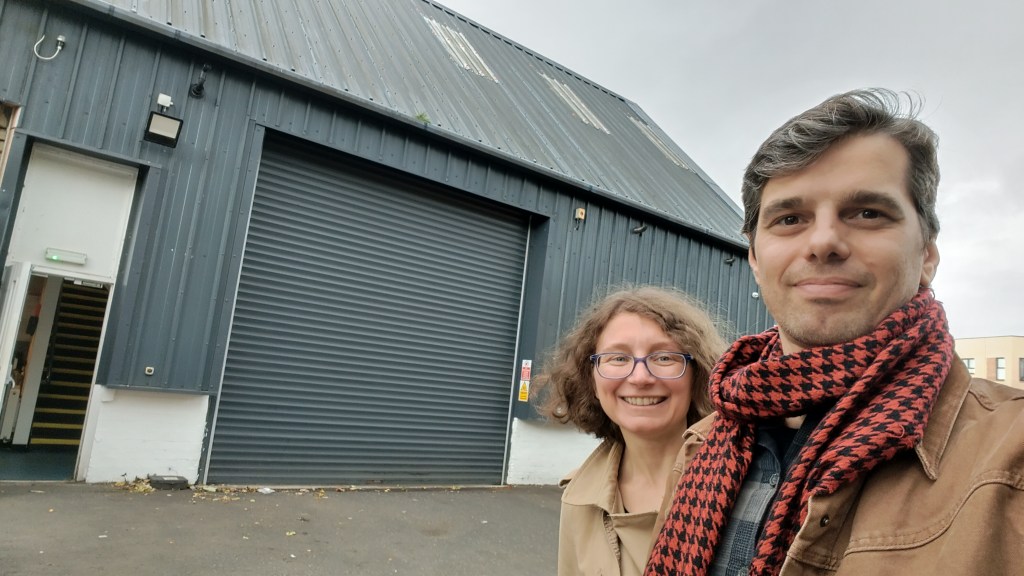
You wouldn’t say we’re outside a distillery.
The land was bought in 2017 and construction works started the following year. The distillery was completed in 2019, their first mash in December. They didn’t fill their first cask until the 20th of March 2020: a notable date, as it was the day before the first COVID-19 lockdown. Before starting, they went through the original purchase records to figure the original style of Crabbie’s whisky, finding out that it was a Highland style of whisky – they decided to reproduce it.
Back to the tour, Gregor started describing production in the courtyard, partly occupied by a few tanks, for draff (sent to anaerobic digestion) and pot ale, and two 30-ton malt silos. They employ 6 operators (out of 11 staff) and run 24/5 with four mashes a day, and each mash uses about 2 tons of malt. The output is about of 750,000 litres of pure alcohol per year, if they were to run 24/7 they could reach about 1.1 million lpa, but that’s not in the plans right now.
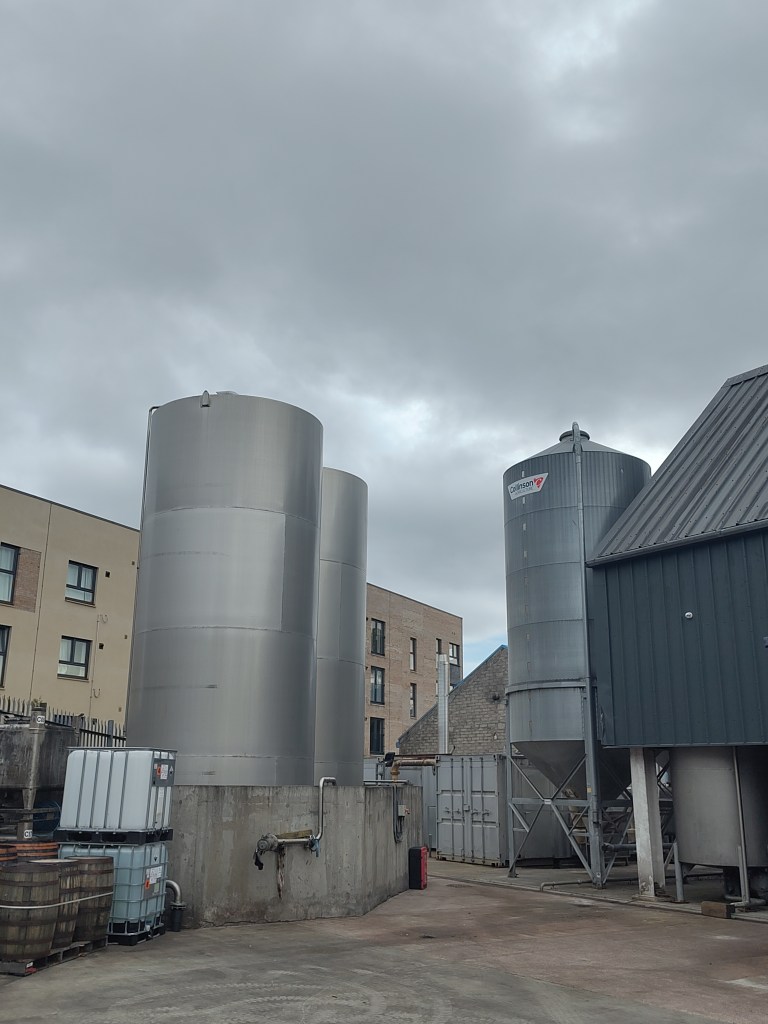
Ok, maybe these silos give it away…
The production water is sourced from a 120-meter-deep borehole, while the malt is sourced from either Beard or Crisp, with 3 deliveries every fortnight. When we visited, they’d just finished their peated run, which lasts a month and uses 190 tons of malt peated to 50 ppm. The mill is a modern AR2000, coloured bright red, which produces a grist with approximately the “usual” husk/grit/flour split (20%/70%/10%). They mash in a 2.5-ton semi-lauter mashtun with 3 waters at increasing temperature starting at around 63°C, obtaining a partially cloudy worth. They are equipped with 15 washbacks, 9 of which are in the next part of the building, past the stills, and they were added recently to increase capacity. They use MG+ yeast and, depending on the time of the week, fermentation can last either 150 or 80 hours. Gregor told us that the spirit obtained with the two fermentations is matured separately, and while the long distillation produces more stewed fruit notes, the short one enhances the biscuity notes: very interesting.
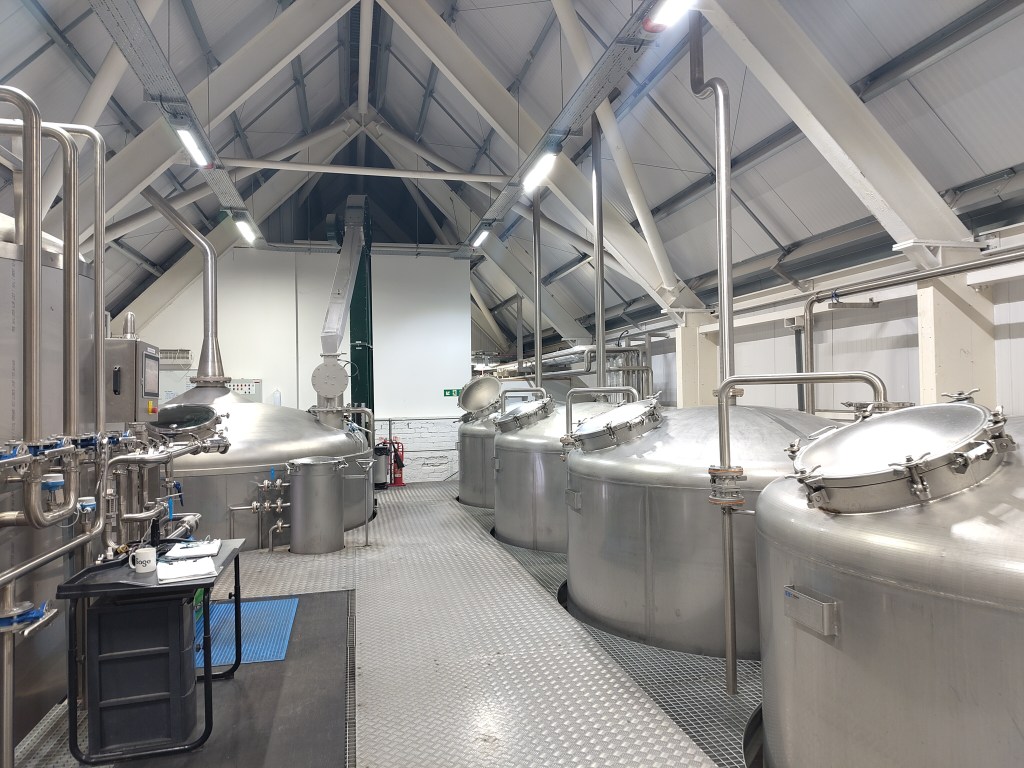
All stainless steel here.
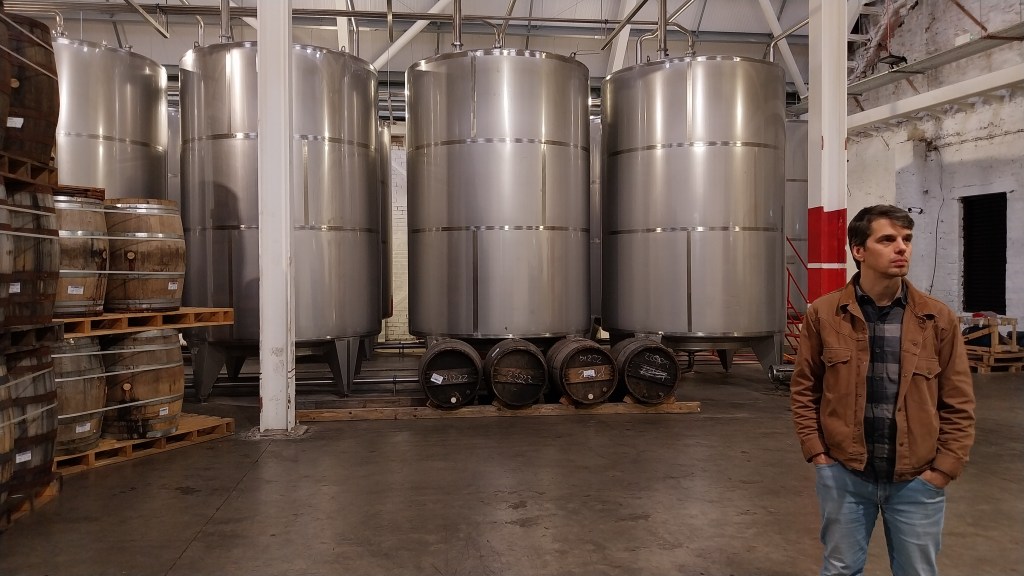
A man and the newly added washbacks.
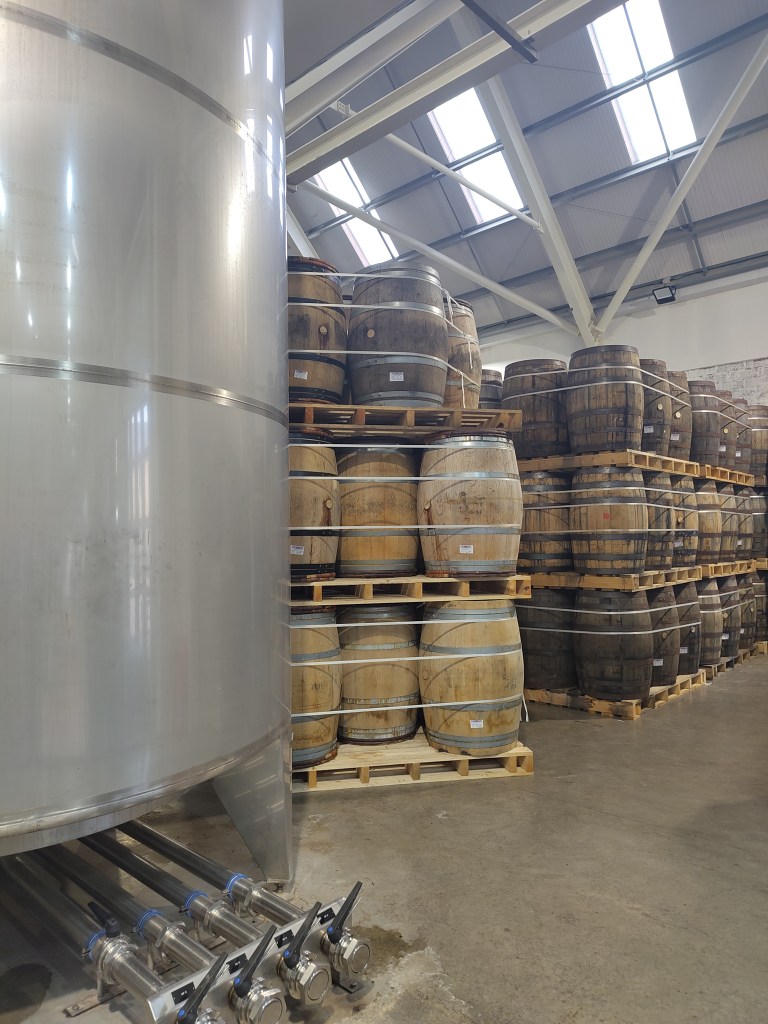
They have two gas boilers to get the steam for distillation, the wash still is 10,500 litres, while the spirit still “only” 7,500. Distillation is fast, to match the same time as mashing and, thus, facilitating the pipeline. The wash is preheated to about 60°C by a heat exchanger used to very cleverly cool down the pot ale in about 25 minutes, saving one hour of distillation time and gas consumption. The wash still produces about 20%abv low wines, which are then mixed with the head and tail of the previous run, which are obtained discarding the liquid above 75% and 62/61.5% abv of the second distillation. From each run, they obtain 1,100-1,200l of newmake spirit, at about 72% abv, which translates into about 130-140 casks per week. These are stored in their warehouses in Kirkaldy, as there isn’t much capacity on site. Casks are stored mainly palletised, as they have limited dunnage space, and are sourced from the Speyside Cooperage, unless they want something more special. Interestingly, they also have a spare gin still, but it hasn’t been used since March 2021, probably to avoid competition with their other gin brands.
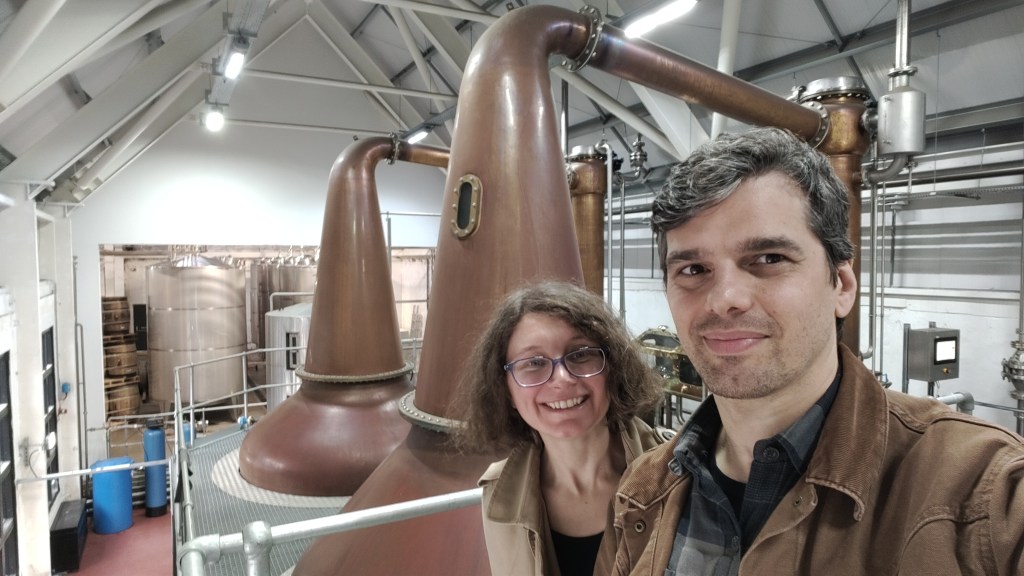
Classic picture.
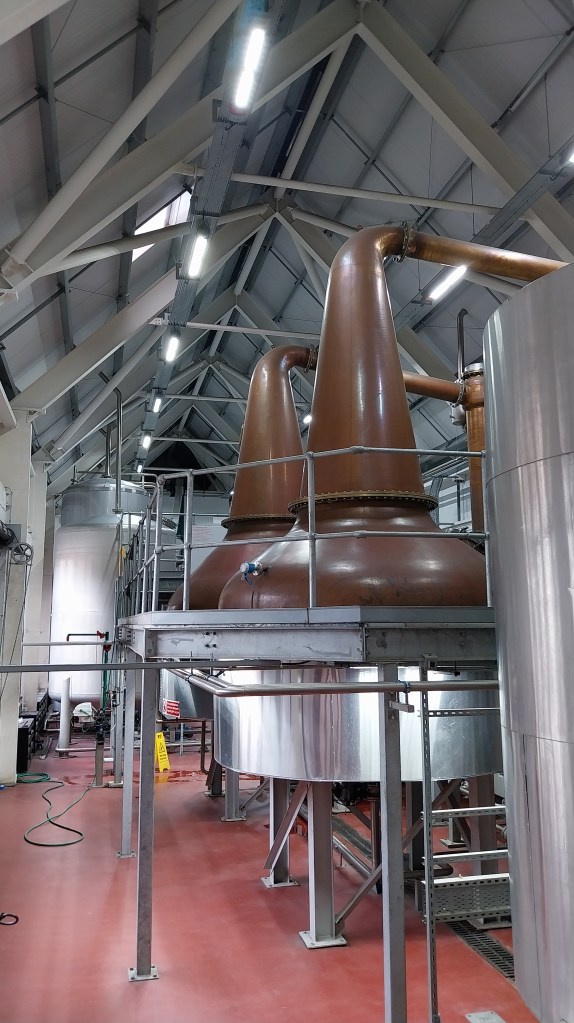
A less classic one. Always nice to see the stills from beneath.
After that, we went to a meeting room underneath the offices, where Gregor gave us a few sips of their products. We tried the John Crabbie and Johnny Cree (both non-age statement, NAS, 40%), which are fully matured in virgin oak and ex-bourbon casks, respectively. The former is not bad at all, just a bit watery due to the low abv. Currently the non-age statement expressions of both brands (the second named after John Crabbie’s business partner) are produced at the distillery, while in the future the aim is also to produced the aged Crabbie (12y and 15y, currently sourced whisky). Then we tried a few Bonnington single malts, a range which is reserved for small batches or single casks: the peated Muscat cask (NAS, 51%) was very tasty, while the unpeated Muscat was good too (NAS, 47%). The other available we didn’t try was the PX casks (NAS, 47%). In general, their whisky has a striking maritime character, which makes sense as we’re not that far away from the Forth, but it is something not usually associated with Lowlands malts.
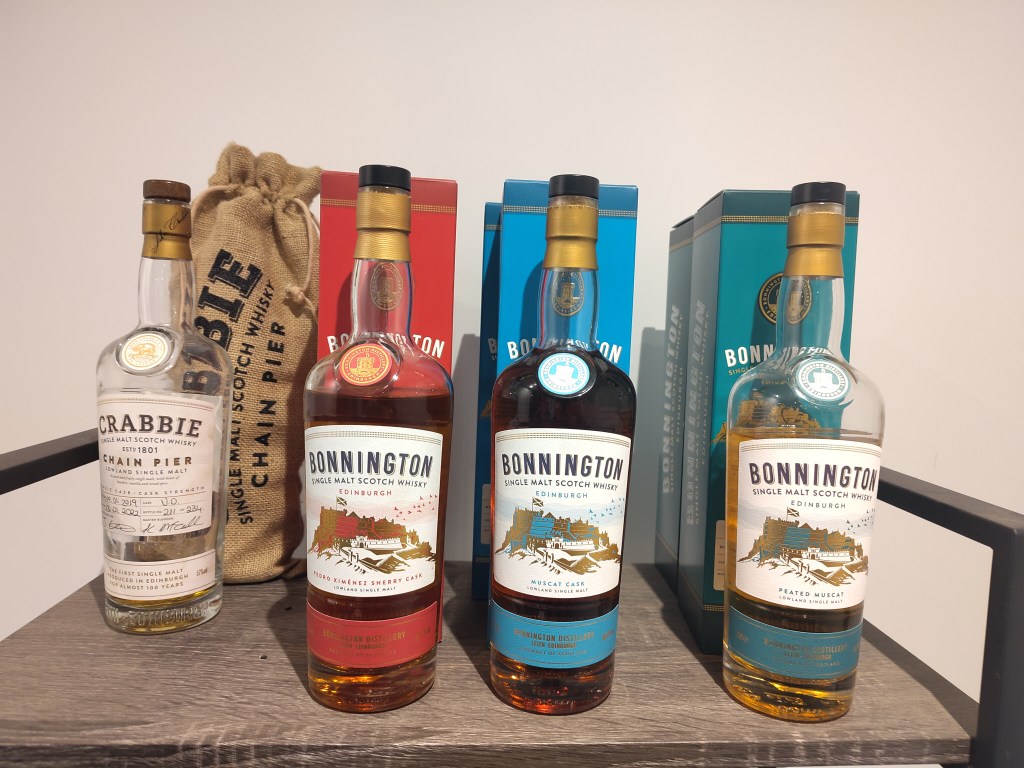
An interesting selection.
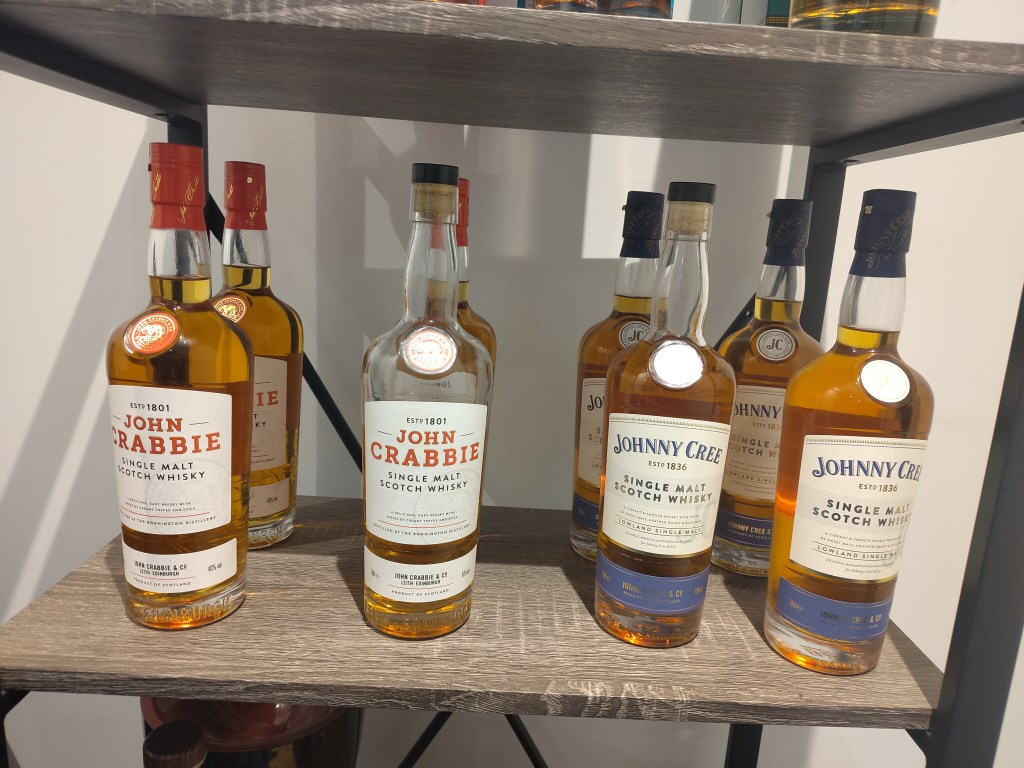
An interesting selection (continued).
After these drams it was time to go back home, so we first greeted Gregor, and once outside the distillery, our pal Graham. It was not our first time visiting a distillery with him, but the first in such an intimate tour: it was good that for once we weren’t the only ones asking for nerdy details, which Gregor patiently explained us with competence and knowledge. He said that, when he has time and if asked nicely, he likes showing people around. But he also said that random showups are a strong ‘nope’: it is still a production plant (something some whisky people don’t quite get…). As we walked home, we passed by the massive bonded warehouses built by the Pattison brothers just before their demise, and subsequently acquired by DCL. We are very happy that the whisky industry is returning to Leith, such a pivotal place for the history of our favourite drink.
Stay tuned for our next trip! Until then, slàinte!
Bonnington Distillery Bespoke Visit
Price: free (October 2025)
Duration: 1hr 30min
Tasting: a few sips from currently bottled single malts (see description above)
Target: anyone
Value for money: well…it was free
Highlights: the location and the compact production
Recommended: yes, but do get in touch with them first!
Link: https://crabbiewhisky.com/bonnington-distillery/


 Dramming around