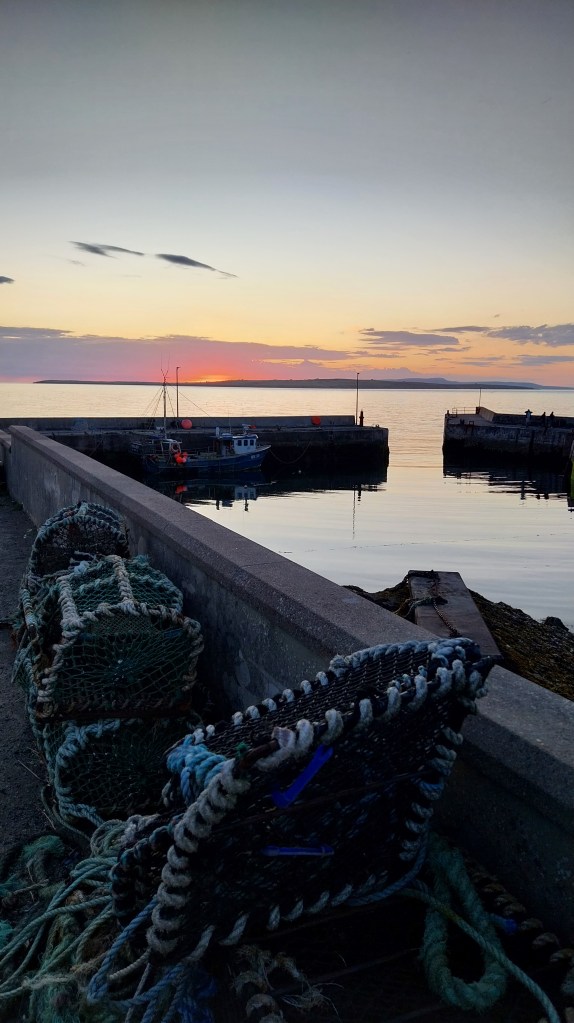
Pushing north: 8 Doors distillery
TL; DR: After the morning in Wick, we spent the rest of the day in John O’Groats. After a trip to a nearby lighthouse, we visited 8 Doors distillery, where Ryan gave us an extremely interesting and geeky tour of their operation. Even though we’ll have to wait for their single malt, it’s definitely a must-do visit!
(missed Part 1?)
There is a human tendency to order facts and figures, probably that’s why articles with rankings, billboards, such as “the X best records of year Y”, “Quentin Tarantino movies ranked”, and so on, preceded the internet by a long time. For whisky brands, having one of the ‘-est’ facts can often be an unmissable chance to make themselves notable, which has become particularly important since the massive wave of new players in the market (are we over 160 distilleries yet? For sure over 150, and just for malt ones). The “biggest”, “oldest”, “southmost”, “highest”, or “the only distillery on Skye”…which now became “the oldest distillery on Skye”. Although some of these traits might actually have a connection with the flavour profile of the whisky advertised, in most cases we wouldn’t read too much into it.
Nonetheless, going back to our long weekend up north, let’s talk about the northmost distilleries in Scotland. The northmost used to be Highland Park on Orkney, although now it’s probably been beaten by Lerwick distillery (assuming it’s online) on Shetland. On the mainland, it was Pulteney for a long time, but then the (imaginary) trophy went to Wolfburn. Nowadays there is a new winner of this race: 8 Doors distillery, in the village of John O’Groats, which is where we were headed after our tour at Pulteney. The village is only about half hour driving from Wick, almost straight north, along the rugged North Sea coast. We only stopped to put some diesel in the tank, and to save time we ate our pre-prepared sandwiches while driving (the Lidl rosemary focaccia, with grilled aubergines and roast turkey: delicious!). We took advantage of the stunning sunny, warm and breezy weather to visit the Duncansby Head Lighthouse.
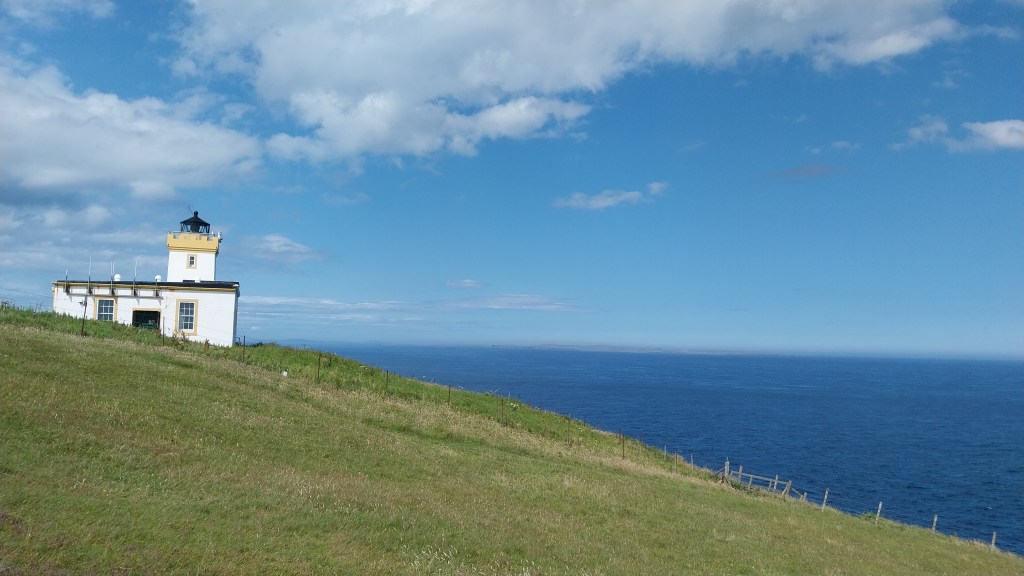
Such a nice day to head to a lighthouse.
It is only a few km away from John O’Groats, just a short drive on a secondary single-track road. The building is not accessible, but there is a stunning walk starting from the car-park on the cliff near a marine bird nest (we saw puffins here! Unfortunately our phones’ cameras are too crappy to take decent pictures) and a view on the Duncansby Stacks, a very scenic rock formation. Back to the car park, we drove to the John O’Groats Campsite to drop Mr. Vantastic before going to the distillery, which is just a couple of minutes away. As a matter of fact, everything in John O’Groats seems to be two minutes away from everything else: the distillery, the shop, the campsite, the signpost, the pier, the brewery, although the rest of the village is quite spread out.
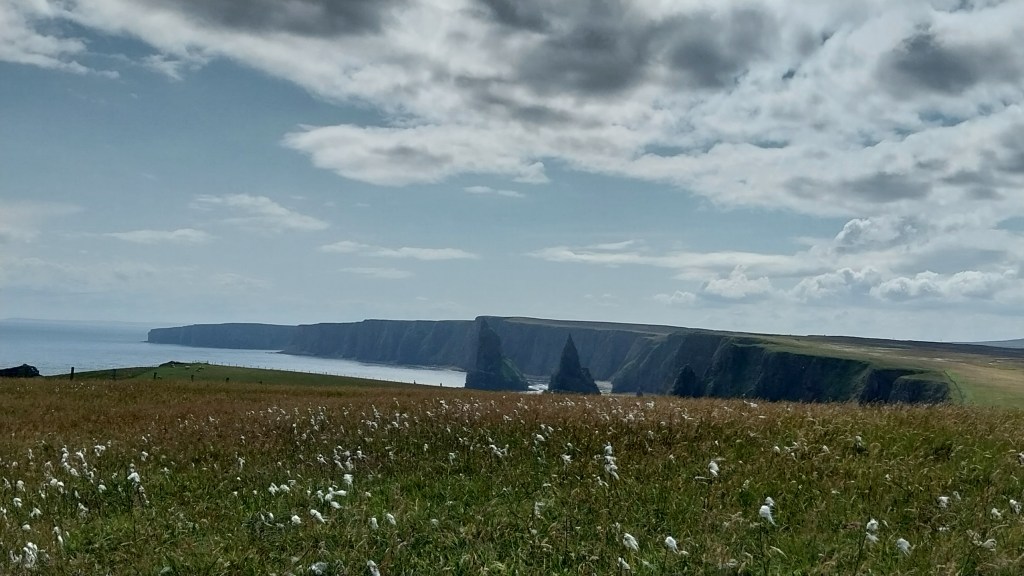
Duncansby Stacks…Breathtaking (the picture not so much).
We arrived at the 8 Doors distillery a few minutes after 3.00pm, the time we originally agreed with Ryan Sutherland, the distillery manager, who moved to 8 Doors after an extensive experience with William Grant & Sons (Glenfiddich, Balvenie, Grant’s). Ryan is a fellow barfly and although we’d never met in person before, we’d chatted online a few times. When we started planning this trip, we asked him if he could give us a tour of the site, which he kindly agreed to. As we entered the visitor centre, we had to move around a swarm of tourists coming from a cruise ship: not a rare occurrence in summer, as Ryan told us later, which can put some pressure on the staff. Fortunately, the shop/cafè is wide enough for everyone, it has a big window facing north towards the Pentland Firth and a fireplace – a cosy and relaxing space. Ryan took us to the tasting room, between the shop and production, to drop our bags, but we soon moved to the main production area. The distillery is quite self-contained, and from the main area we could see most of the equipment.
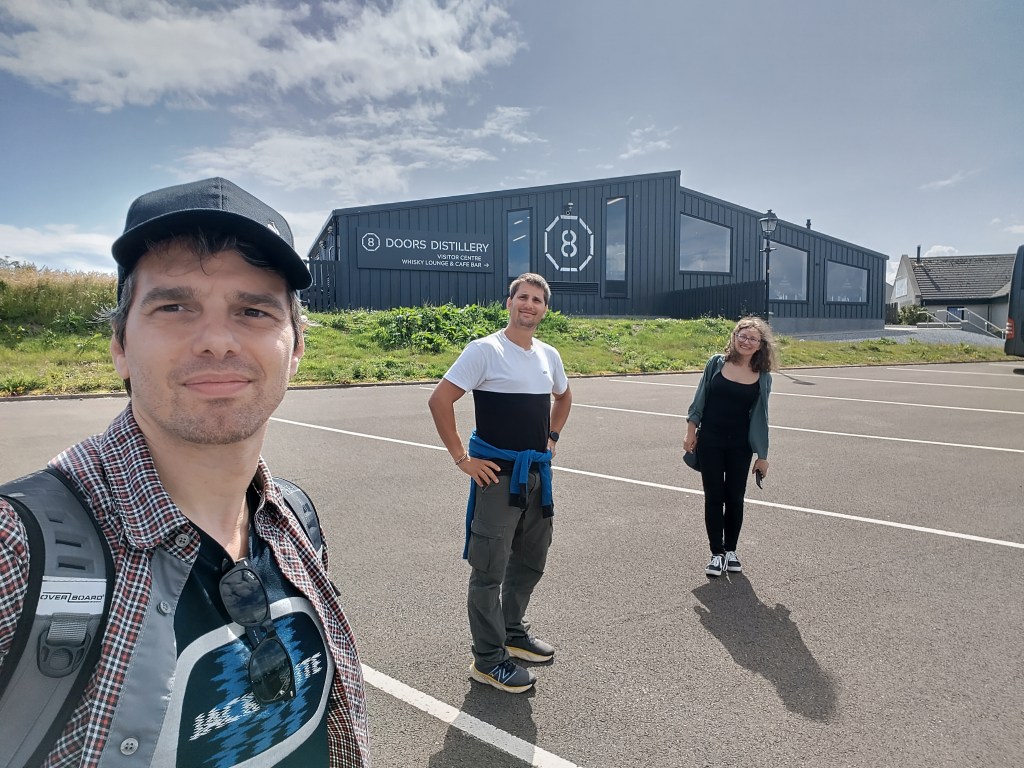
Ready for another distillery tour.
The distillery started production in 2022. Founders Kerry and Derek wanted to bring distilling back to John O’Groats and its community, and to do so they employed a consultant, John Ramsay (former Edrington), who is now the master blender. A short-lived distillery existed between 1826 and 1838, and illicit distilling was common in the area before. The name of the distillery comes from the founder of the village, John De Groot, which had seven sons and to avoid fights, he built an octagonal house where each of them (him and the sons) had a door and a window. We wondered if, in their shoes, we’d take the south facing one, for the sunlight, or the north facing one, for the view on the Firth.
The distillery is a small operation, producing only about 36,000 litres of spirit per year (in theory they could reach 45,000 litres), and is run by one operator, Andrew, and Ryan himself. Ryan described the setup in great detail, including all the small changes he is implementing to make the process more efficient – his engineering background shone through. There is no mill at the moment, so the malt comes in already milled from Simpson maltster (usual 20/70/10 split for husk/grit/flour), but in the future they are hoping to get the malt locally from Caithness producers. They are also considering using oat, which would be super interesting, as only a handful of Scottish distilleries are using this cereal (Inchdairnie and…actually we cannot think of any other).
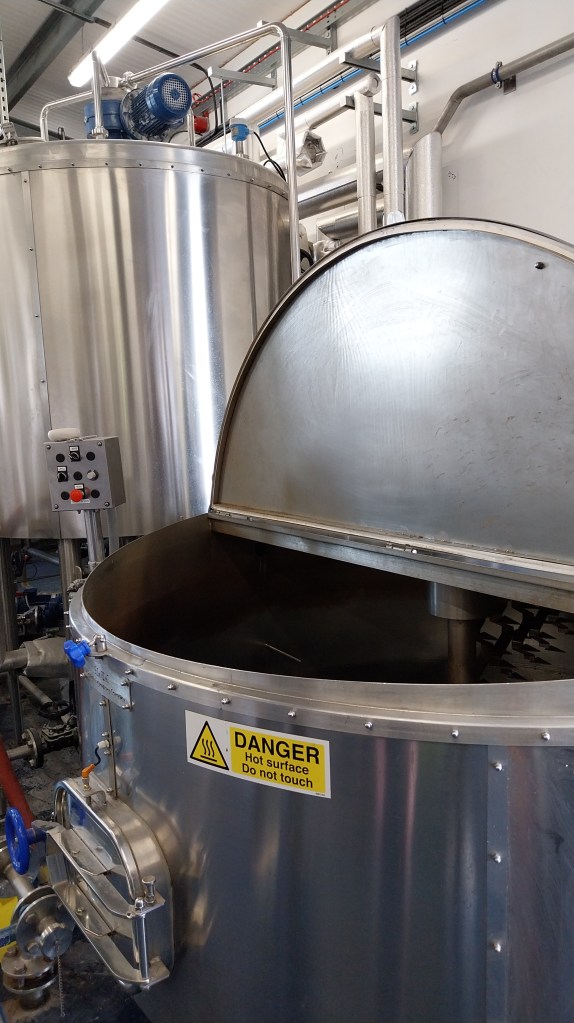
The repurposed mashtun.
The mashing equipment comes from a defunct brewery in East Lothian, Archfield Brewhouse, and has been repurposed to work in a distillery. Because of this, together with the usual mashtun, there is also a kettle, that comes in handy to pre-heat the water with the heat exchanger. For each mash they use one 400kg bag of grist together with 1,200 litres of water: the 3-to-1 ratio makes it a thick one, cloudy at first but they let it decant for a while. Between the first and second water they get 1,800 litres of wort, which is then moved to one of the four 2,000-litre stainless steel washbacks (there is a fifth, but it’s not been used). Fermentation lasts about 100 hours on average to get a wash at up to 9%abv. Here is where it gets interesting: depending on the variety of barley, they try to pick a yeast to obtain a determined flavour profile. Among the barley varieties used, Lauriet, Firefox and Diablo, but also Cara Gold, Maris Otter and Golden Promise. Yeast-wise, M1 is the main one, which results in a fruit-forward wash, but they also use XP for red fruits flavours, Norwegian beer yeast Kveik/Hornindal, MW, D23 and MGplus. In general, they produce their house-style for most of the year, while in December and January they run more experimental batches.

Fermentation check.
The stills and the spirit safe are on a raised floor, and fun fact: from there we spotted Mr Vantastic in the campsite! The stills are from Speyside Copperworks, which is now owned by Forsyths. The first distillation in the 1,700-litre wash still is very slow, about 7 hours, while the second one is carried out in the 1,300-litre spirit still. They run the foreshots for 15 minutes, then the heart (or spirit) is collected within 3 hours, from 71.5% to 64% abv. They aim to produce about one hogshead per day.
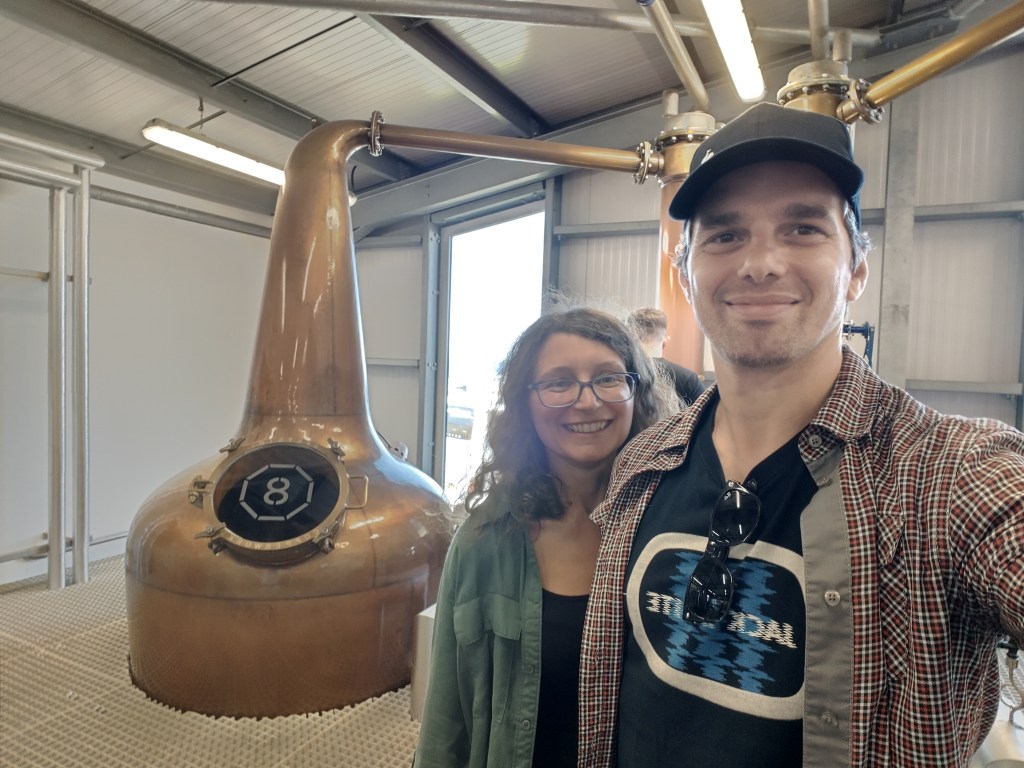
Sorry we’re covering the second still.
After all these technical details, Ryan took us outside to have a quick look at the LPG boiler and head to the warehouse, a low building on the other side of the distillery staff car park. Here we saw a multitude of casks of different sizes. They mostly fill ex-Sherry casks from Casknolia of various sizes (from 50-litre octave to 5,090-litre butts), but also casks previously used for their Seven Sons range. The filling strength is the standard 63.5%, and the type of cask used also depends on the barley/yeast combination: interesting experiments they are running at the moment are an ex-brandy cask filled with spirit obtained from Cara Gold barley and D23 yeast, or a former Booker’s bourbon cask with spirit fermented with Hornindal yeast. All of these, albeit technical, sounded very cool, and our science-y brains were quite triggered by all these potential permutations.
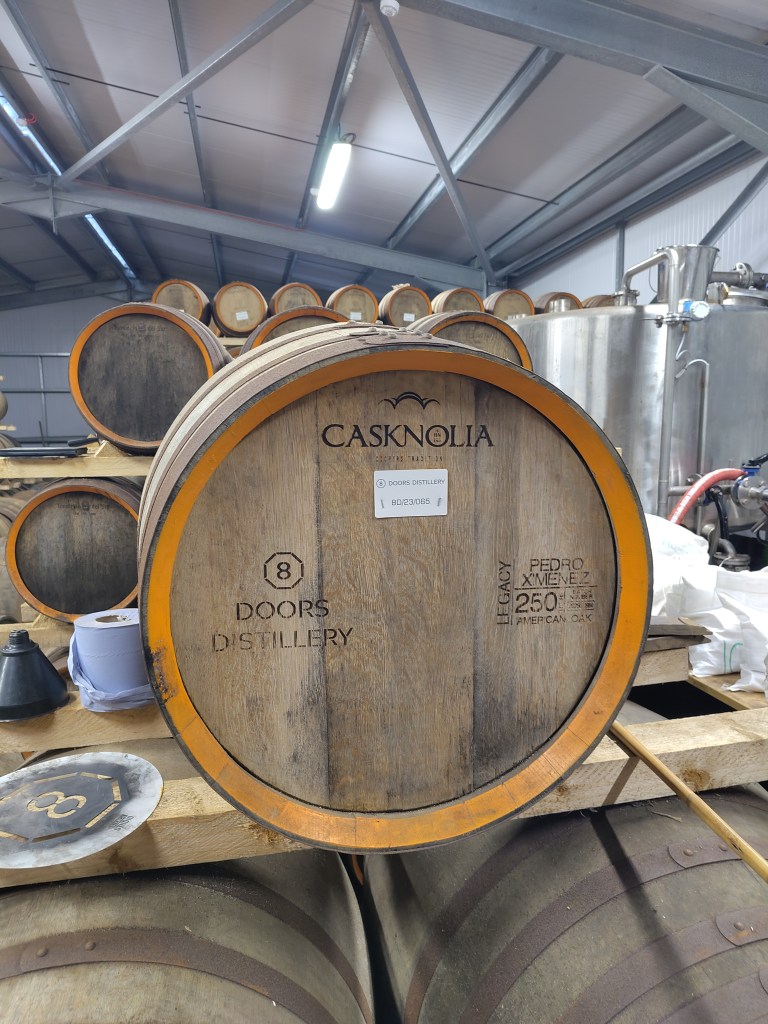
A peek into the warehouse next door.
Back to the tasting room, we were ready for the whisky flight. First off, a small taste of newmake spirit (63.5%), fruity and cereal, as you’d expect for a good one. Then, we moved on to the Seven Sons whisky range (named after John De Groot sons). First, the 10y blended scotch (46.7%), characterised by a high malt content (40%) with the grain component coming from North British. This is one of their “house” whiskies – not all batches are identical (this is the 9th), but they aim for a nice-sipping blend, and they nailed it! Edoardo took one home to share with his friends over the next 6 Nations – as Italians we need something good to hang on to. The second dram was a blended malt, a 12y teaspooned Dalrymple from Ailsa Bay, bottled at 57.1% (100 of the old imperial proofs), from a third fill European cask, which provided a mild and delicate flavour. The third dram was a single malt, a 6y sherried (Oloroso) and very vibrant Glen Wyvis from a Firkin cask (52.1%), the cherry on the top. We finished the tasting with their Five Ways whisky liqueur (22%), and a cheeky “Manager’s Dram”, a delicious blend produced with the idea of recreating a 1970s Famous Grouse.
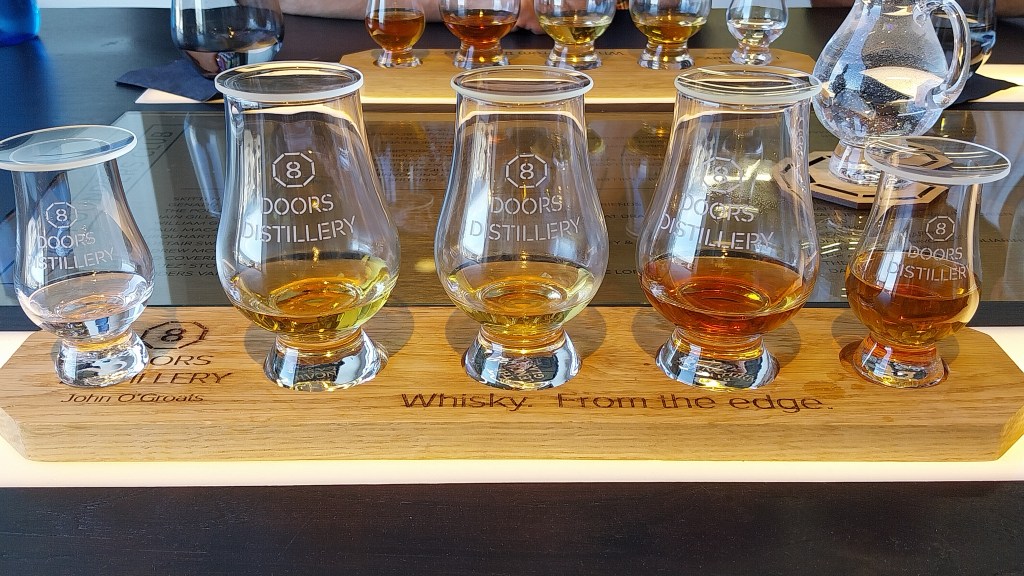
This will satisfy our thirst.
What a geeky and awesome tour! We loved everything about the distillery and how they set up their plan, and it was really great to listen to Ryan explaining in detail how the distillery works. 8 Doors is one to keep an eye on, where we’d like to go back to (not just for the beautiful scenery). We are looking forward to the release of their first single malt!
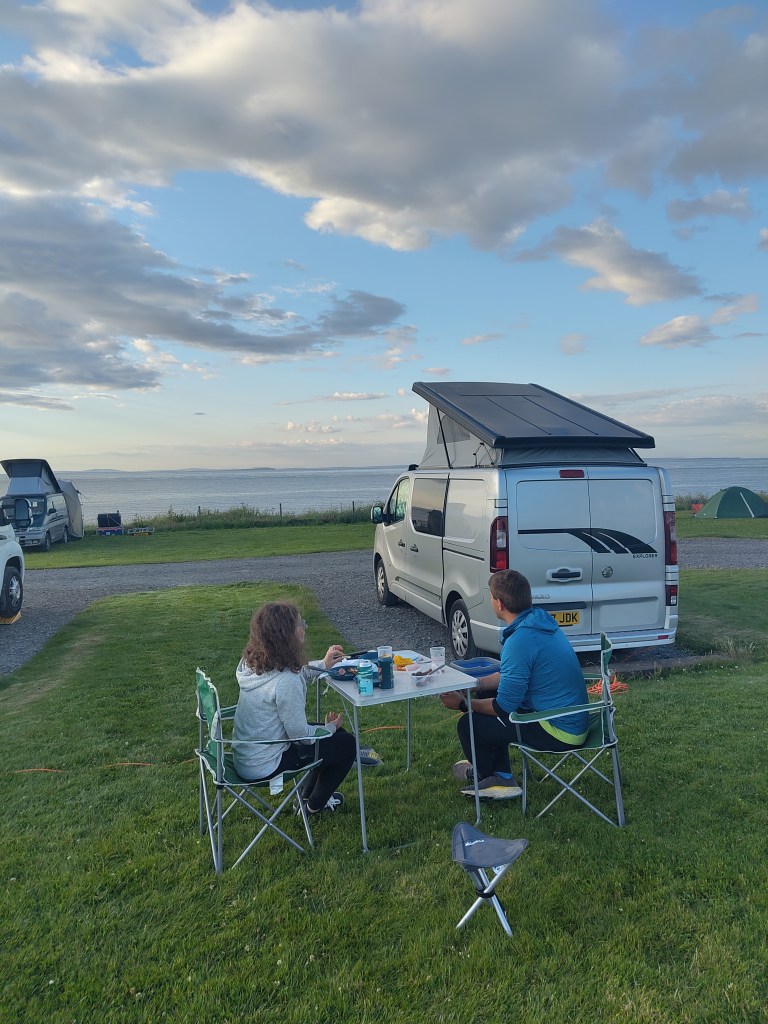
Not a bad spot for the night.
After the distillery, we walked a bit around John O’Groats, before going back to the van and start a barbecue. It was a bit windy, but nonetheless we managed to grill some massive Hellbent burgers. The evening ended with a pint at the John O’Groats brewery/pub, a very cosy place just in the middle of the village.
Next up, another former “northmost” distillery on mainland Scotland, so stay tuned! Until then, slàinte!
8 Doors Distillery (bespoke tour*)
Price: £23.33 pp (July 2025)
Duration: 2hr
Tasting: newmake spirit (63.5%) and 4 drams, Seven Sons Blended Whisky (10y, 46%), Blended Malt (12y, Dalrymple, 57.1%), Single Malt Glen Wyvis (6y, 52%), Five Ways Ginger Whisky Liqueur (22%)
Distillery exclusive: bottle-your-own versions of a whisky from the Seven Sons range and Five Ways whisky liqueur (forgot to take note of the prices, sorry)
Highlights: the location and Ryan’s knowledge
Target: casual tourists and whisky geeks alike
Value for money: very good
Recommended: yes
Link: https://www.8doorsdistillery.com/home
(*similar to the Behind the Scenes tour https://www.8doorsdistillery.com/tours, but longer and with extra drams)
 Dramming around