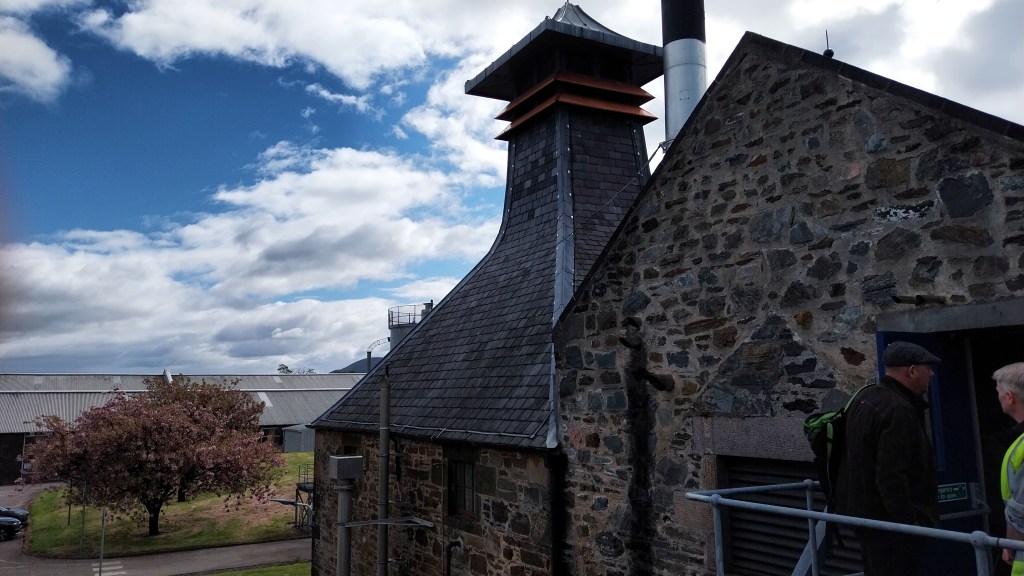
A workhorse in Buckie: Inchgower distillery
TL; DR: Another festival day, with a morning visit to another Diageo’s workhorse, Inchgower in Buckie. The distillery tour was good but, with only four tiny drams at the end, we cannot say it was good value for money. We then continued the day with a relaxing walk in Spey Bay and an independent bottlers’ tasting in Dufftown.
On the seafront near Portgordon, where we slept, the morning was cosy and sunny. We felt quite rested, thanks to the quietness of the place: only a few dog walkers showed up while we had a small breakfast and got ready for the day. Disappointingly, we didn’t spot any seals…Hopefully next time. Anyway, we were soon on our way to Buckie, another village on the Moray coast, on a hunt for a coffee and a scone. It took us some time to find a place open early, but then we landed at Pozzi on High Street.
The reason why we needed something open early was that we had to be at Inchgower distillery at 10 am, for our first whisky activity (or “experience”, if you want more exclusivity). The distillery is just outside Buckie, on the A98, the road that stretches from Fochabers all the way to Fraserburgh. The distillery sits on a big complex, with a lot of warehouses around (we’ll learn later that they can hold up to 36,000 casks). As we drove to the visitors parking lot, we noticed the numerous houses (some of which still owned by Diageo) originally built for the workers: it was obvious which one was the distillery manager’s. We also noticed the stonework, quite dark, possibly because of the Baudoinia fungus, that digests the alcohol in the air.
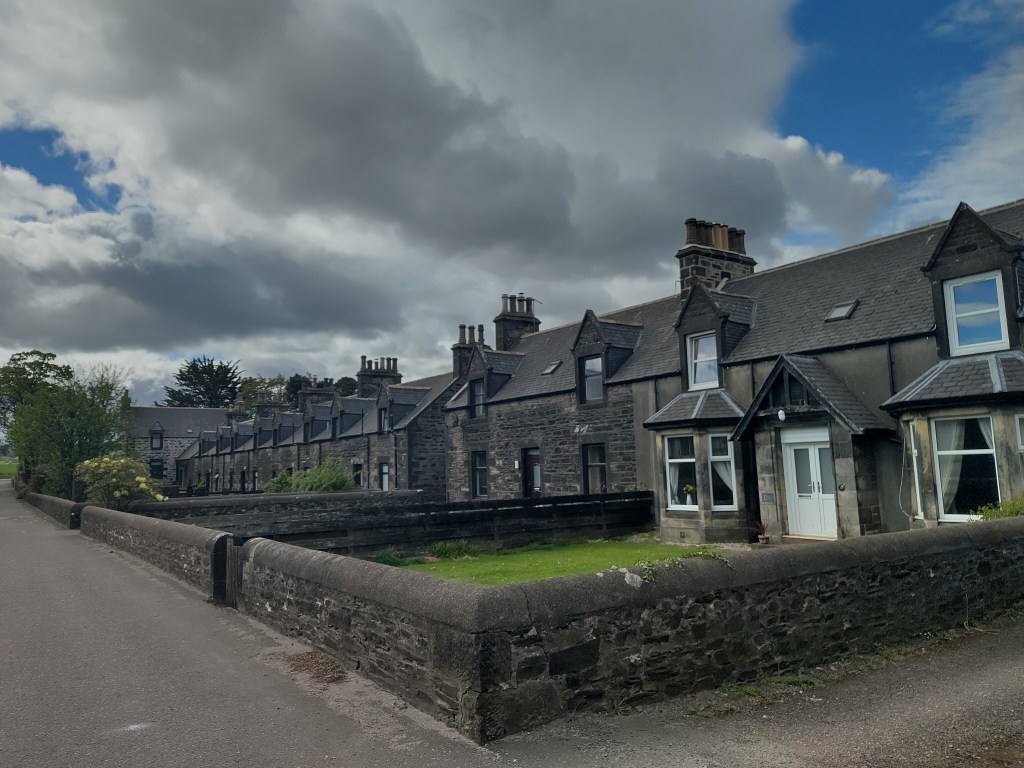
Cute distillery cottages.
We were really tight with time, so when we entered the offices, most of the other visitors were already seated around a large table, including our pals John and Jeeves. The staff offered us a coffee, which is always a nice touch. We said “office” and not “visitor centre” because this distillery doesn’t have one, as it is generally closed to the public. They are owned by Diageo, and needless to say, they are one of their hidden workhorses, and other than their Flora and Fauna release, we only know it thanks to independent bottlers.
As the last people came in, we started our visit with the distillery manager, Gary, who introduced himself. He is fairly new, as he came in a couple of years ago when the distillery was reopened, after some years of refurbishment. The distillery was founded in 1871, using the equipment from another one, Tochineal distillery. The first notable event we were told of is the acquisition of the distillery by Buckie council in 1936 after the founders, Alexander Wilson & Co, went bankrupt. It was then bought by Arthur Bell & Sons in 1938, and in 1966 it doubled capacity. Guinness took over Bell’s in 1985, and eventually the company became Diageo.
After this introduction, Gary and his team walked us outside, and because it was a decent day (cloudy but not rainy, yet), we climbed the malt bins stairs to have almost an aerial visual of the big distillery. The three silos can contain up to 60 tons of malt, enough for nine days of production.
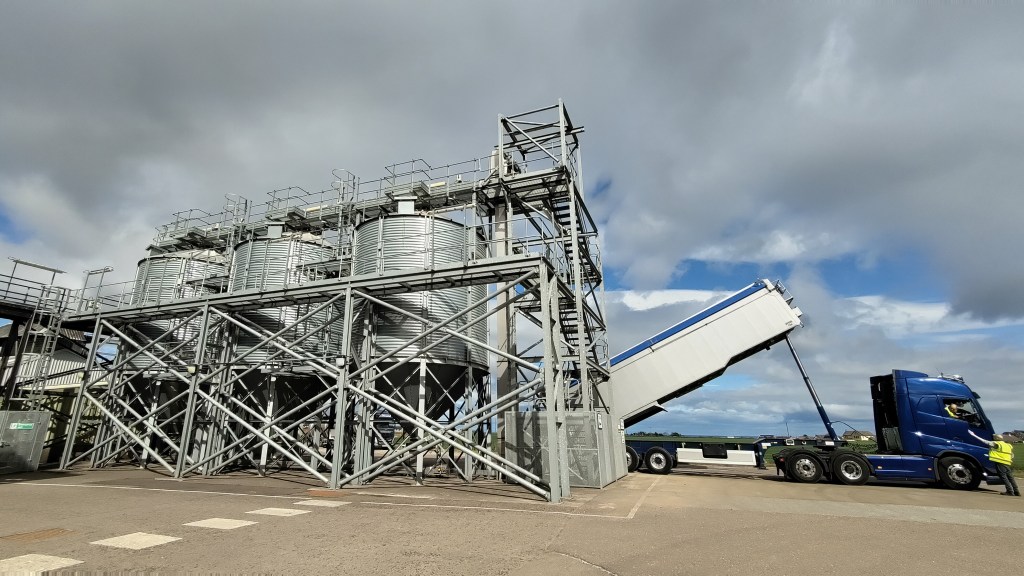
Yes, we climbed those stairs…
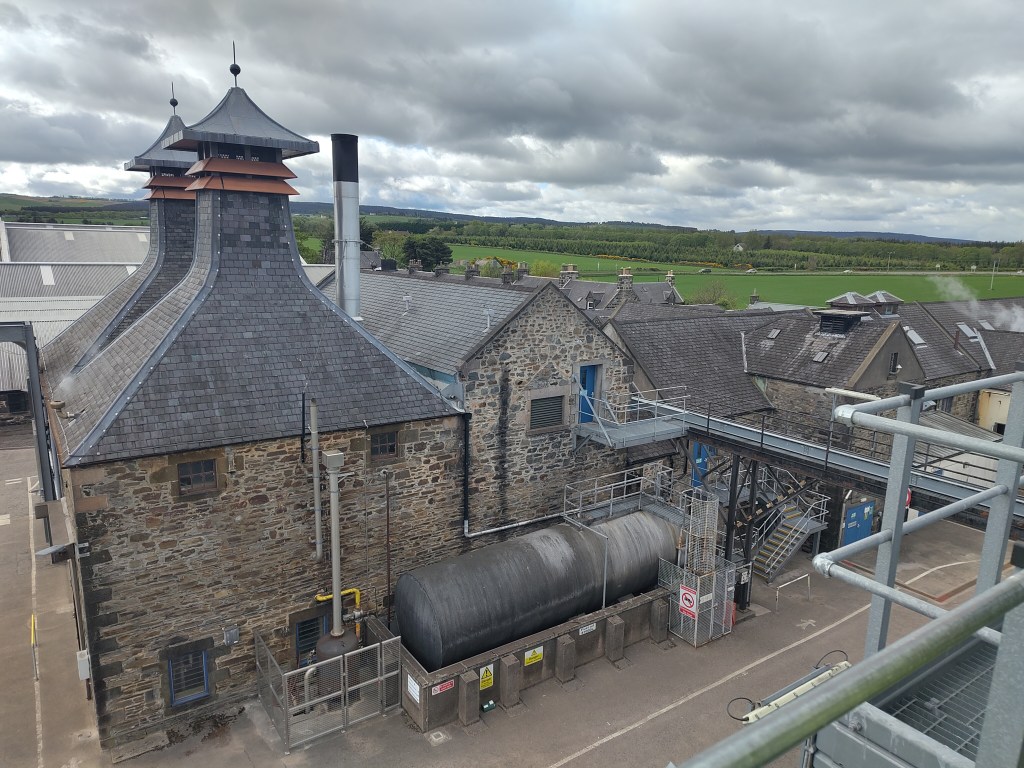
…definitely worth it.
We then moved inside the production building, where we saw a Bobby mill, according to them one of the oldest around (although they couldn’t tell us a precise date). The malt currently used is Diablo, for a fully unpeated production. The 8.36 tons leuter mashtun is one of those big stainless-steel ones, where mashing is done with the usual three waters at increasing temperature, for about 7-7.5 hours. Fermentation, activated by liquid distiller’s yeast, usually lasts about 46-48 hours, but can range from 40 to 100 (they work five days, so the longer ones are the ones going over the weekend). All this happens in wooden washbacks that can contain 37,000 litres.

Hello, Bobby.
They have two wash stills and two spirit stills, and from the latter they take a large spirit’s cut (the “heart”) from 72% to 55%. As usual, they discard the foreshots (or “head”) coming before, and the feints (or “tail”) coming after, and they mix it together with the low wines from the first distillation, to eventually redistill it. The newmake spirit is usually around 65-68% abv, and it is filled in tankers and sent to one of Diageo’s “casking” facilities.
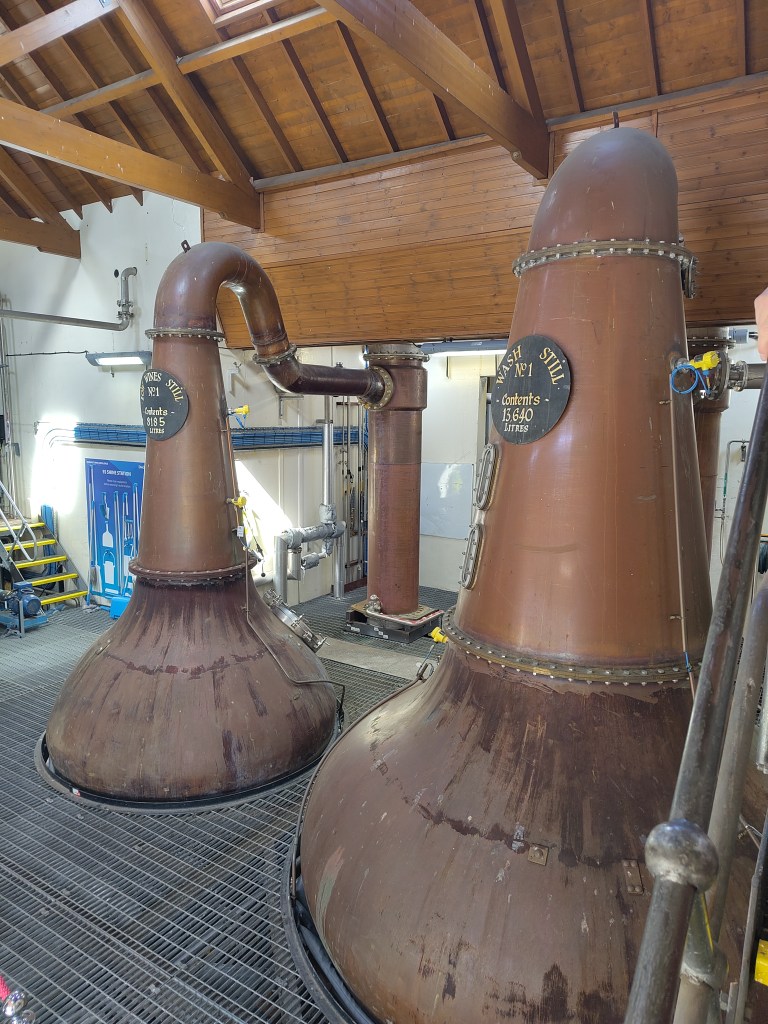
A good looking pair.
After production, we visited one of the warehouses, located in front of the row of houses for the tasting. The drams were on top of four casks lined up in front of us. We obviously started with the Flora and Fauna 14y (43%), as it is their flagship dram. The other three were cask samples: a 15y (vintage 2009, 56.6%) from an ex-bourbon cask, a more interesting version of the 14y we could say. The other two were a 35y (from 1989, 44.1%) from a refill cask, and a 28y (from 1996, 53.7%) from a sherry cask, which was obvious by looking at the colour. It was a good showcase of the distillery’s malt, where we could appreciate the heavy and meaty character of this whisky, which worked well with both cask types. At that point the tour was finished, we went back to the offices to pick up our bags and our gifts (one Cardhu branded highball glass and one cookie stamp each…no comment) and leave.
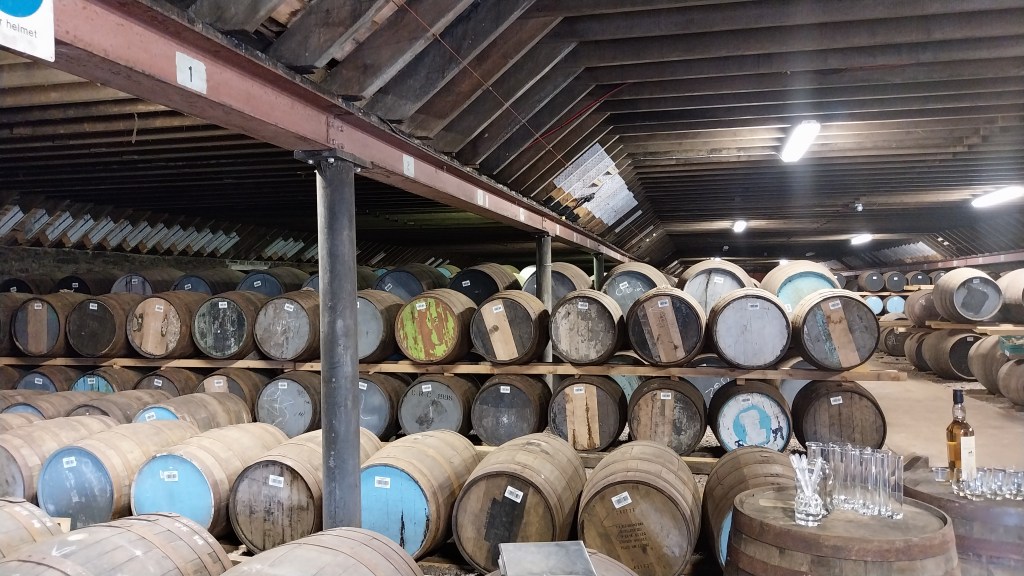
A great space for a tasting.

Nice to bump into whisky friends!
We had a few hours before the next event, so we drove to Spey Bay to check out the Scottish Dolphin Centre (spoiler: zero spotted dolphins). There, we had a nice walk around the mouth of the river Spey, and a tasty soup at the cafè/visitor centre.
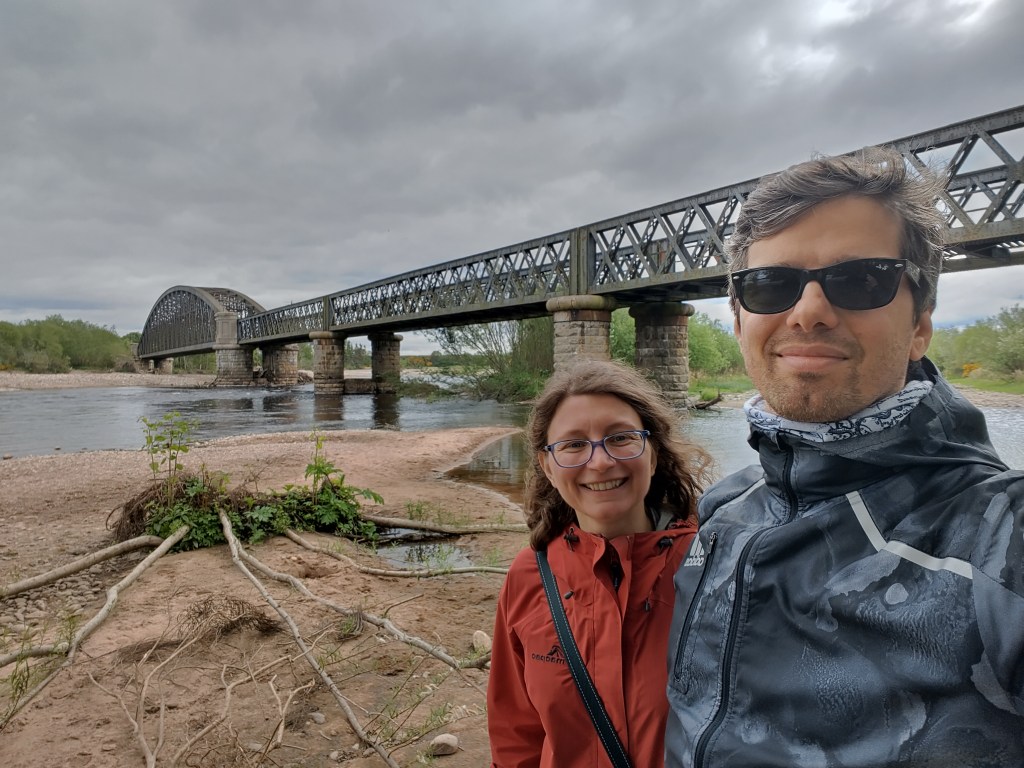
An icon of Speyside.
After that, we drove to Dufftown, as our next event was starting soon. It was the Independent Scotch tasting, hosted by David Stirk (for £30pp + Spirit of Speyside fee), at the Whisky Capital Inn: a great whisky bar and restaurant (and hotel as well) right in the centre of the small town. The tasting went through a bit of history as well, so we started with an old blend. It made sense, as if you think of it, blenders used to be the original “indy bottlers”. The blend was an Italian import D&L Deluxe Special Reserve (not telling much), bottled at 40% by a company called Block Grey & Block. Then, we moved on to a Berry Bros & Rudd Glen Elgin (2008, 53.4%, hogshead), followed by a Stirk Brothers Linkwood (2010, 13y, 50.0%) and a James Eadie Strathmill (2011, 13y, 55.6%, finished for 20 months in a 1st fill Malaga hogshead). Finally, a Little Brown Dog Highland Park (2014, 10y, 60.1%, from a random barrique), for the usual peated ending. Overall an interesting line-up, showcasing different cask types. After the tasting, we stayed at the Whisky Capital Inn for a delicious venison burger, before heading off.
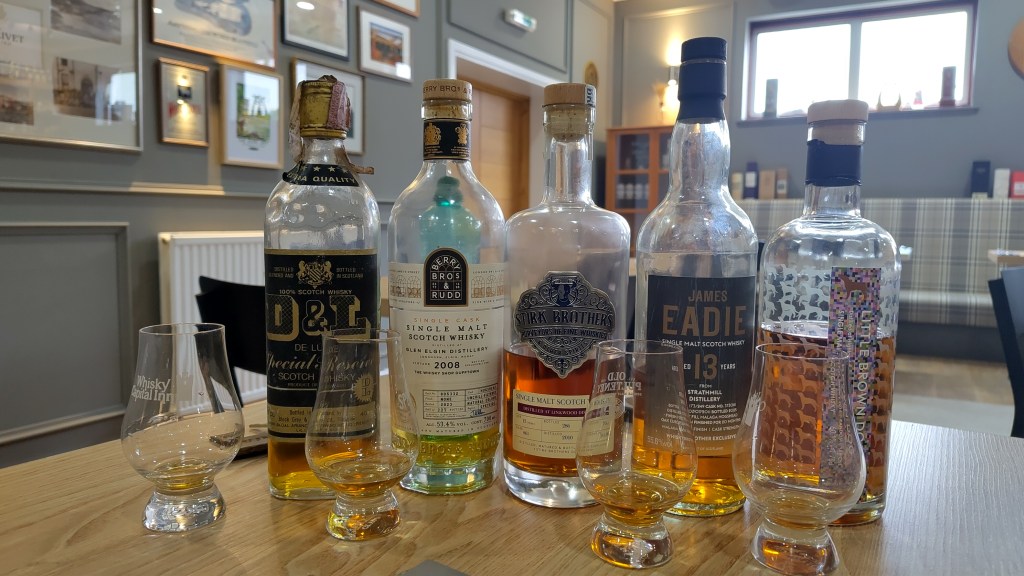
Independent Scotch tasting – a varied line-up.
Another good whisky day, with some good drams and some great banter! Unfortunately, the Inchgower tour, while very interesting and hosted by enthusiastic and passionate staff, was not good value for money: for £100, we expected at least 6 drams instead of four (although well aged, definitely better than the Johnny Walker that was served in previous Diageo’s Spirit of Speyside tours). What was even more awkward was the size of the drams: when Teresa filled her driver’s pack, we realised some of the drams filled less than a half of a 20ml sample bottle. Not very well played from Diageo.
Anyway, stay tuned for more Spirit of Speyside action! Until next week, slainte!
Inchgower Through the Decades Distillery Tour (Spirit of Speyside 2025)
Price: £100.00 pp + SoS transaction fee
Duration: 2hr
Tasting: 4 drams, Inchgower “Flora and Fauna” 14y (43%); cask samples 2009 (15, 56.6%, ex-bourbon cask; cask sample 1989 (35y, 44.1%, refill cask); and 1996 (28y, 53.7%, sherry cask)
Target: whisky geeks (and people trying to visit as many distilleries as possible)
Value for money: not great
Highlights: the climb to the malt silos
Recommended: only if you’re a massive Inchgower fan
Link: https://www.spiritofspeyside.com

 Dramming around