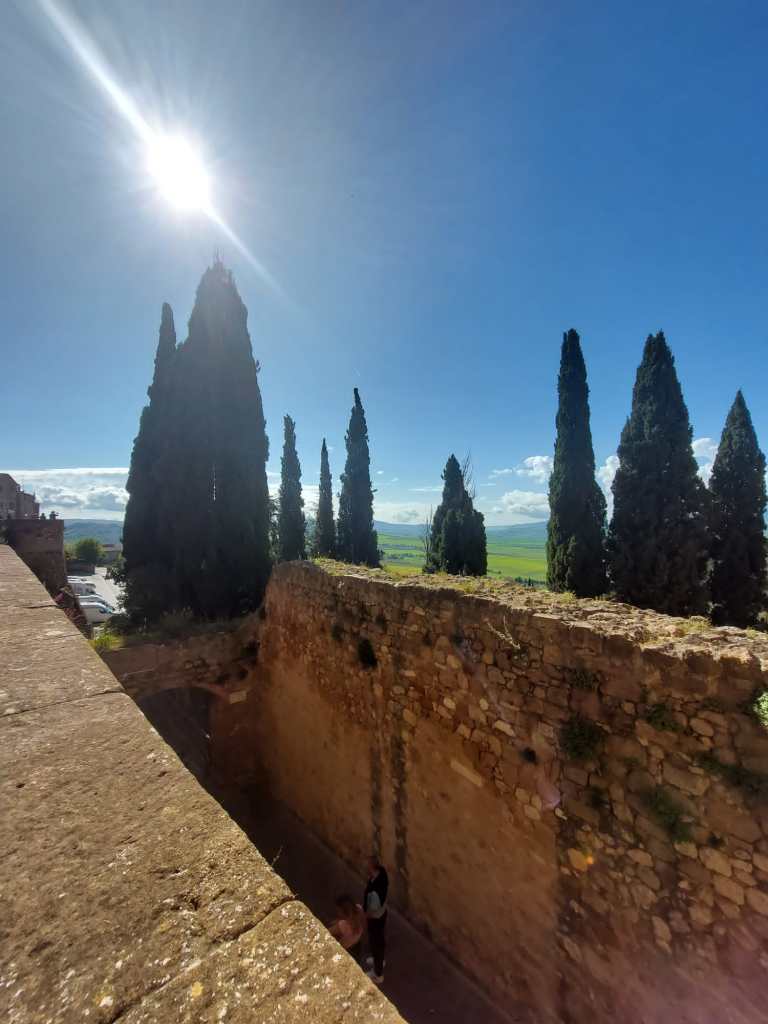
In the land of Brunello
TL; DR: While in Rome, do as the Romans do…while in Tuscany, go visit a winery. This time we went to Fattoria dei Barbi, in the land of Brunello di Montalcino. In this magnificent landscape, we learned about how Brunello is made during the visit of the historical cellar, and we tried some great wines.
One of the best things about our whisky journey is the renovated pleasure that now comes with eating or drinking in general. This is because of the continuous focus on aromas and flavours during whisky tastings, which slowly but constantly enhanced our senses of smell and taste. This didn’t happen in isolation though: during a 2018 trip in Thailand (no whisky stories there), we attended a cooking class which opened our minds in terms of spices use and flavour pairings. Over time, having a meal, a cup of coffee, or a pint, or even a walk in a meadow or in a wood have become much more pleasant experiences (and no worries, we don’t eat meadows…usually).
And here we come to wine: because of our Italian upbringing, many people assume we are good at the “wine thing” although, spoiler alert, we are definitely not. This is despite wine being homemade within our families, by Teresa’s grandfather and Gianluigi great-grandfather. Also, being brought up in Italy meant that wine was often on the table at dinner and during weekends. And, while we know the basics and we have our preferences (generally bold red wines that go well with meat, better if they spent some time in wood), we never went down this rabbit hole. Ironically, this started to come around (slowly) thanks to whisky: in 2021 we visited a winery in Tuscany because we learned that Glenallachie finished a whisky in casks from that winery: Grattamacco. As for fortified wines, we went to a few port houses in our 2022 holiday in Porto. We also indulged in some winery visits and tastings in Australia last year. Still not experts, but definitely more “flavour curious”.
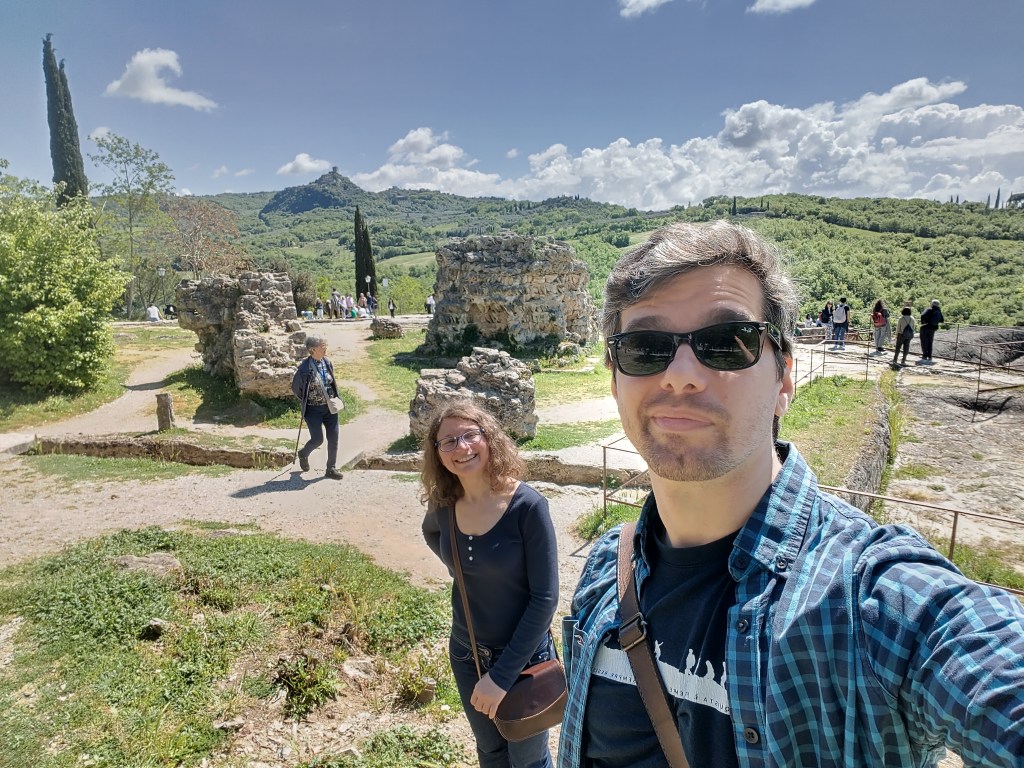
So, what’s better than improving our wine knowledge by visiting a winery in Tuscany? The occasion came in April this year (2025), for Teresa’s mother birthday: together with her sisters, she organised a two-day trip to Val d’Orcia, one of those places that look like a classic Tuscany postcard (wait, it is a Tuscany postcard!) – smooth rolling hills, small medieval towns on top of them, vineyards and meadows (again, not eaten). We left Florence early, and by mid-morning we were in Pienza: a town famous for its pecorino cheese (one of many), and contrary to others, purposedly (re)built by Pope Pius II in 1462, to reflect the ideals of the Renaissance. We then visited the charming Bagno Vignoni (a village famous for a very old spa), before stopping for lunch nearby, where we (meaning Teresa and Gianluigi) shared a very tasty 1.2kg “Bistecca Fiorentina”.
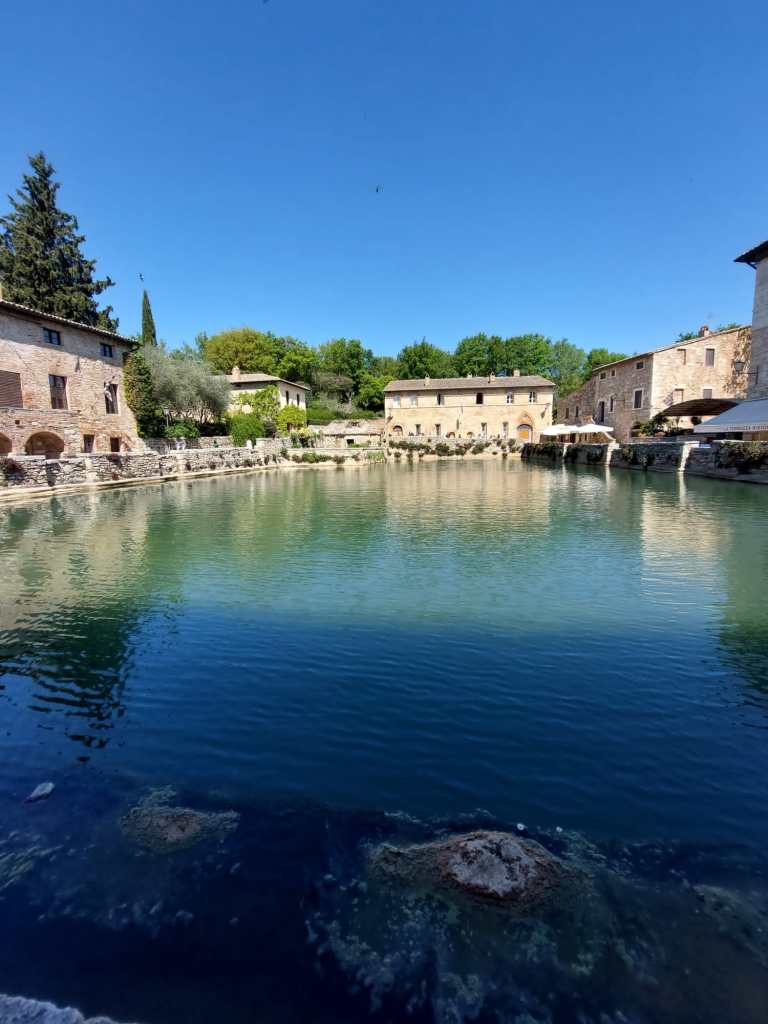
A spa village – Bagno Vignoni, very charming.
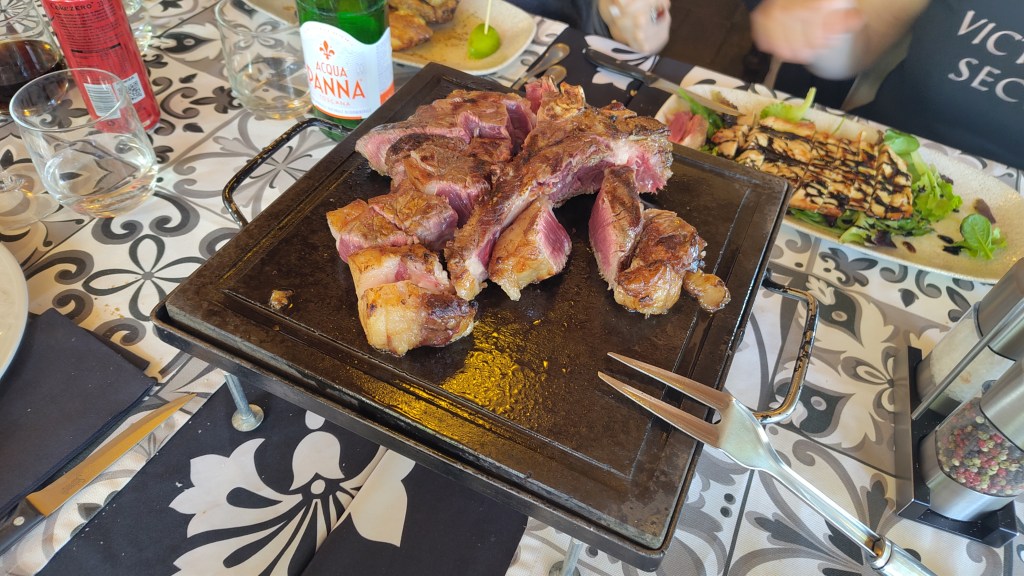
Maybe not charming, but still delicious bistecca fiorentina.
In the afternoon, we drove towards Montalcino, the hometown of the renowned Brunello of Montalcino wine. Until a while ago we never heard of a Brunello cask finished whisky, but the independent bottler Ferg & Harris recently close this gap.
Back to wine, the winery we chose was Fattoria dei Barbi – the tour was quite cheap, only €10 for the winery visit, while for the tasting we could pick (beforehand) between a few options: we chose a basic tasting (€25, four wines from the basic range) and an upgraded one (€35, focused on Brunello). The winery is very pretty, hidden from the main road and surrounded by woodland and, obviously, vineyards.
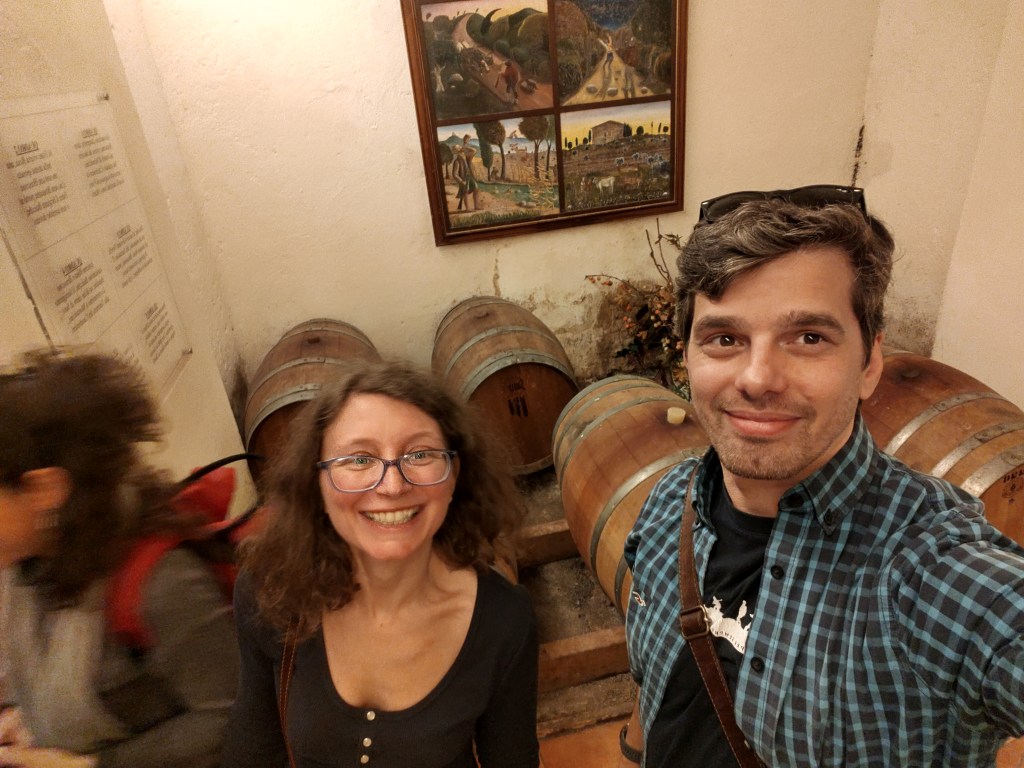
Just about avoided photo-bombing at the start of the tour.
The tour started in the shop, from which we could access the historical cellar, a series of connected rooms full of big barrels for fermentation and maturation. Interestingly, these barrels had a ‘tappo colmatore’ on top, a Leonardo Da Vinci invention, a lid to verify the level of liquid in the barrel and to allow the release of gas that might generate during maturation.
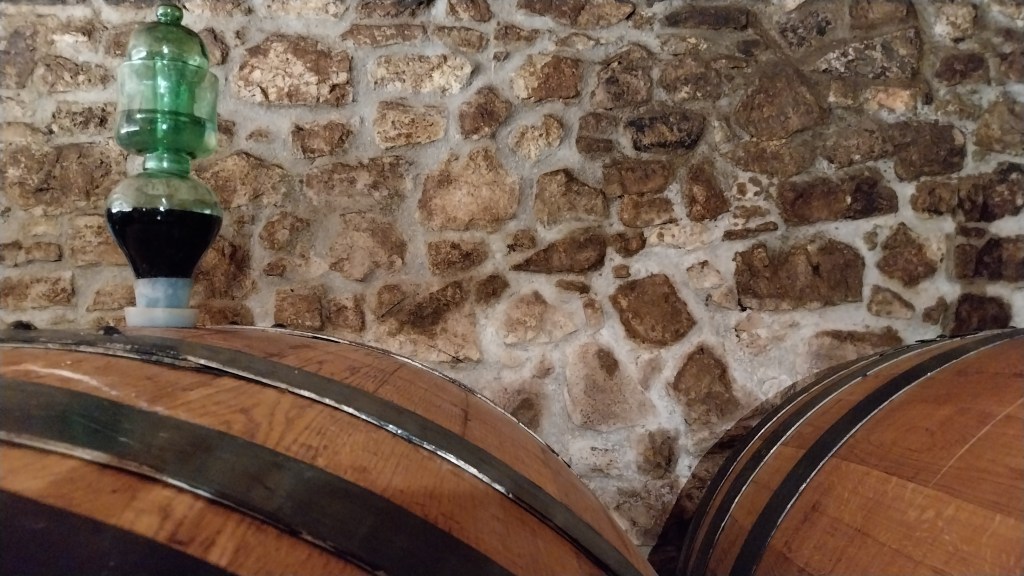
A new discovery for us – the ‘tappo colmatore’.
While moving from one room to the next one, our guide covered the history of the Colombini’s family, owners of the estate for centuries. Originally a farm, wine making became prevalent in the 1800s thanks to Pio Colombini, one of the producers who started bottling Brunello instead of selling casks to grocers (‘vinai’). His son Giovanni expanded the business and made it one of the first to sell Brunello overseas. But what makes a wine a Brunello? The rules were set in the 1980s, but in a nutshell, it needs to be 100% ‘Sangiovese grosso’ grapes, and the wine needs to age at least 5 years, of which at least two in oak barrels (mostly French oak) and at least 4 months in the bottle (the remaining time is usually spent in big wooden vats, with the above mentioned ‘tappo colmatore’). Similarly, for the Brunello Riserva the years are six, with 6 months spent in bottle (the rest is similar).
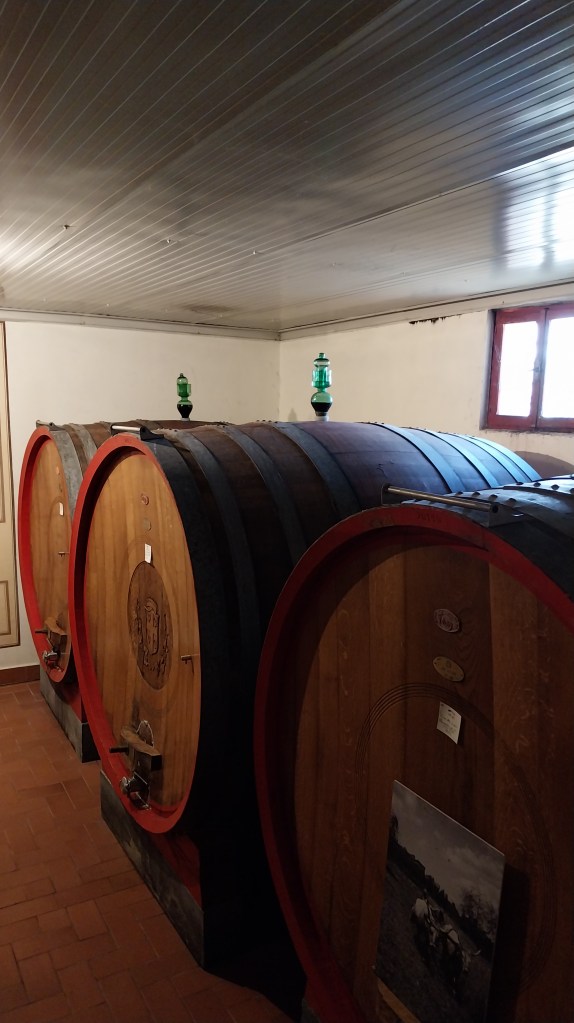
No, these are not the hogsheads we’re used to.
We didn’t get too geeky on the tour, so we don’t have many technical details to share, but listening to family stories while admiring the old cellar was a great experience. The wine cellar was spectacular, with bottles of all vintages (including our birth years, sob). Some you could buy, but you needed to enquire, and they might decide not to sell anyway. However, the guide admitted that many of those might probably be well past their best, and now they are just collectible items.
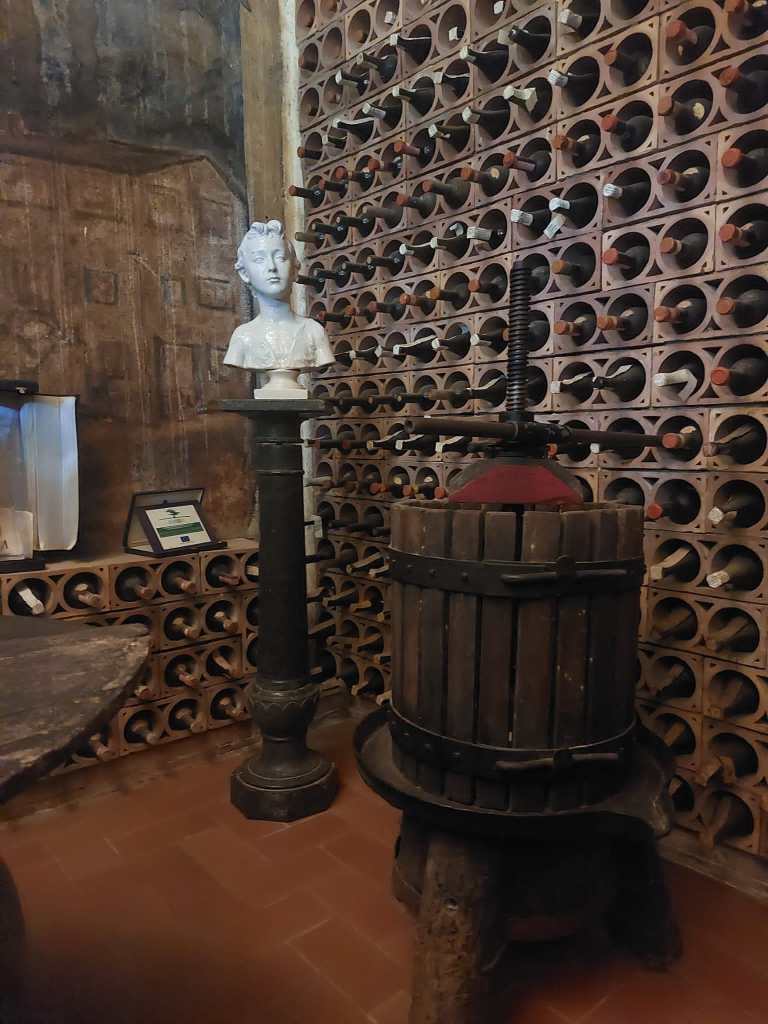
So much history…

…and yes, we’re that old.
The tour came to an end, and we went to the next building, the bar and tasting room. The basic flight showcased a wide range of products: we started with a white wine, Vermentino dei Barbi (vintage 2023), then moved to a “table wine” called Brusco dei Barbi (2020, 90% Sangiovese and the remainder a variety of grapes). The third wine was their Rosso di Montalcino (2023, 100% Sangiovese grape but not a Brunello). The crescendo ended with their main product, the Brunello di Montalcino (2019, blue label), honestly another level compared to the previous three. The other flight was focused on Brunello, and it took where the previous one left off with the Brunello di Montalcino, followed by another Brunello, single vineyard, called Vigna dei Fiori (2020, white label) which was great, and finally with the Brunello Riserva (2019, red label), truly stunning. We loved the combination of oak and fruitiness in those last three wines.
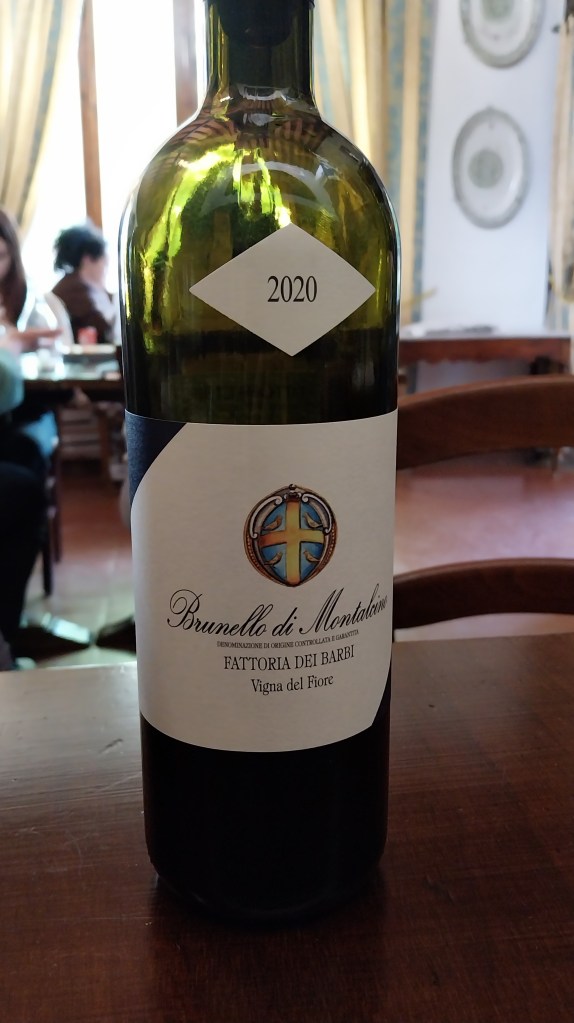
This one was beautiful…
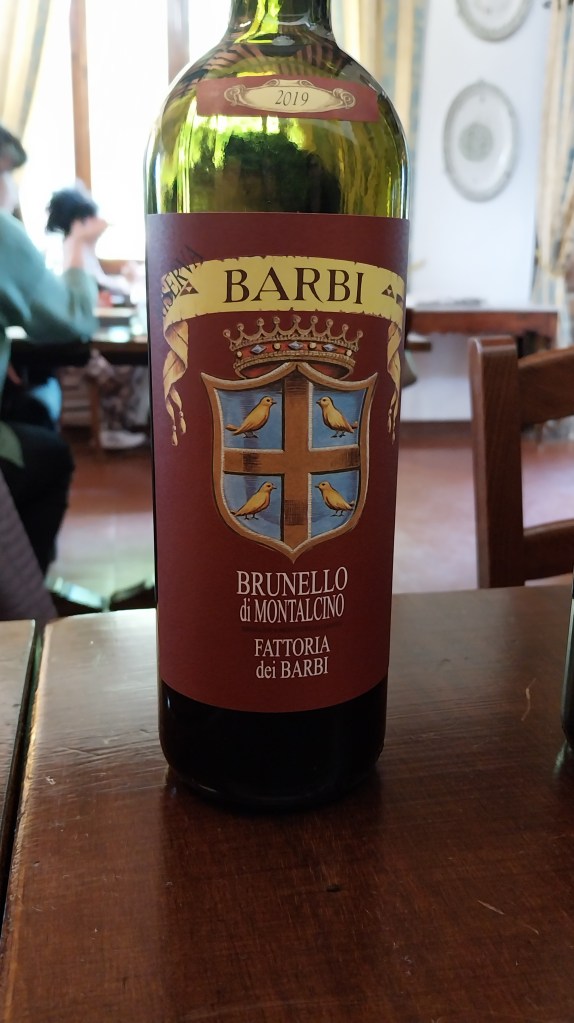
and this one, wow!
After the winery, we drove to Montalcino, the village, another beautiful “Tuscany-postcard” village, where we had a walk under a light rain and a gloomy sky, before a half pint in a local Circolo Arci (and from this, you can tell we’ve been living in Scotland for a long time) and the walk back to the flat booked for the night.
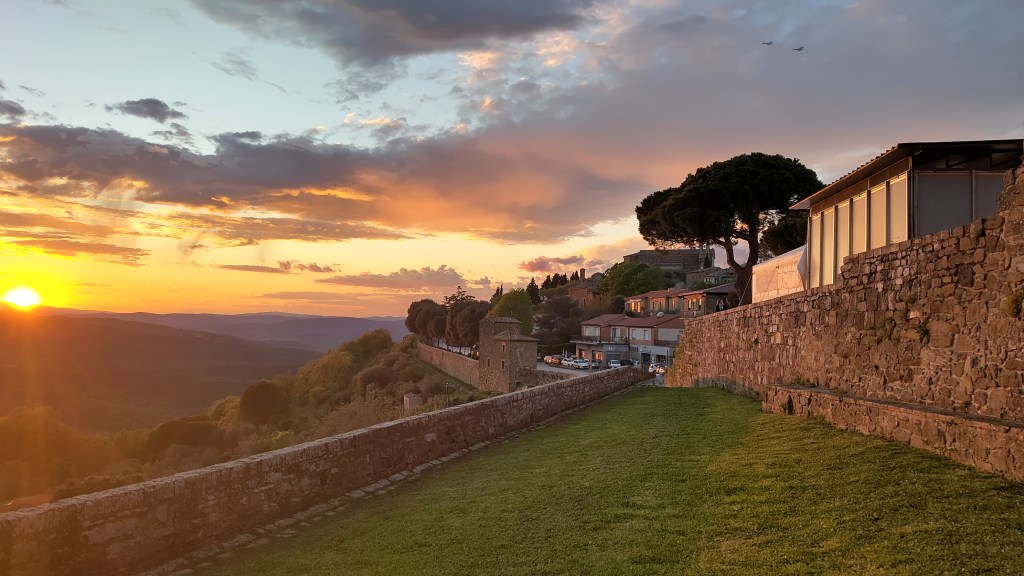
Beautiful sunset in Montalcino.
The next day, we spent some time at the Sant’Antimo Abbey, before driving to Siena for a stroll in this beautiful (albeit quite touristy) city, and lunch. From there, we went back to Florence.
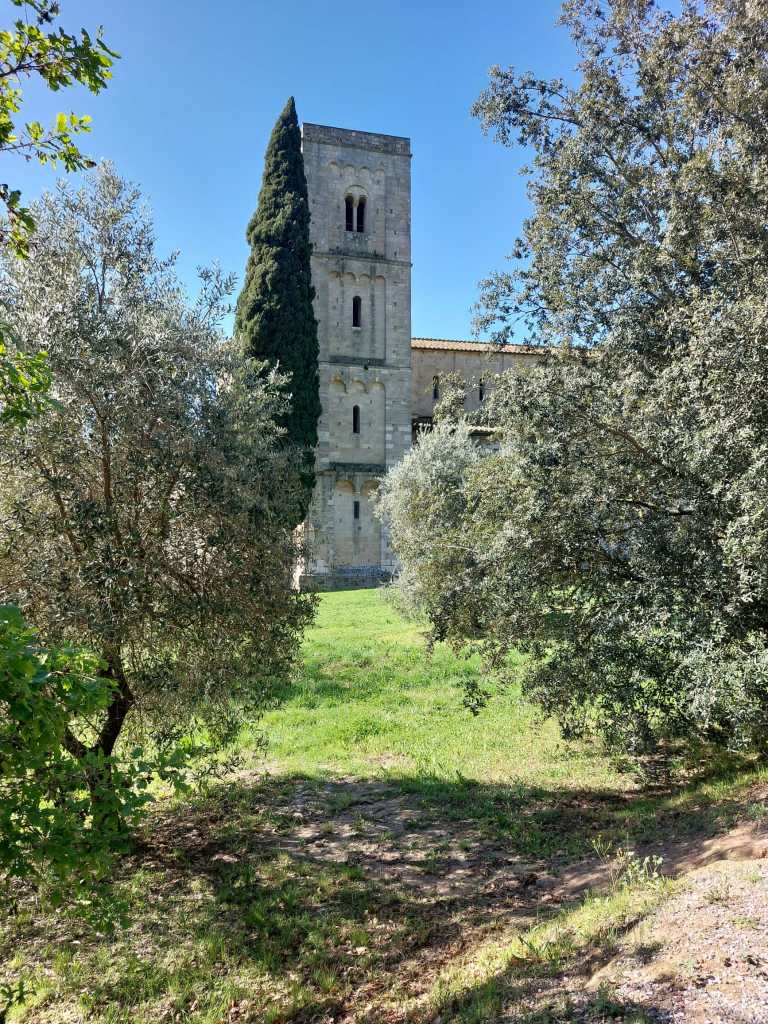
Sant’Antimo Abbey behind the olive trees.
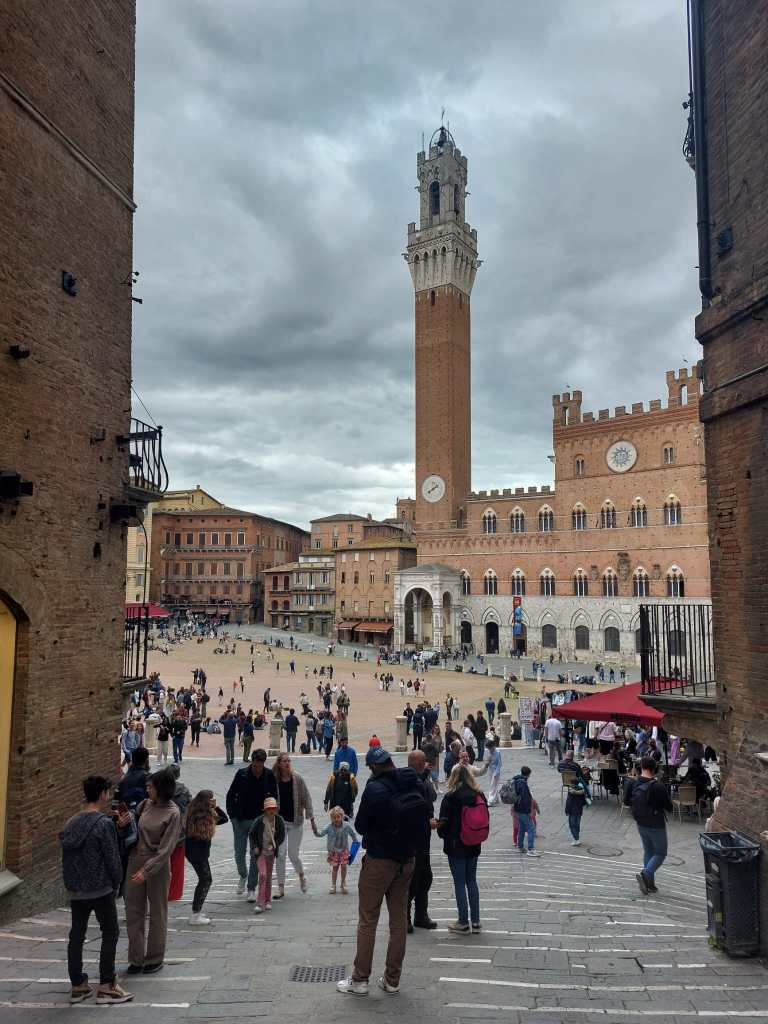
Classic picture of busy Siena.
And so, this is our latest “malternative” exploration, again in the esoteric world of wine. Overall, the visit was not as good as the one at Grattamacco of a few years back (maybe because this one was less intimate), but it was still very interesting and informative. The trio of Brunello’s was great though, something really worth to dig into for all the flavour-driven people.
We should say ‘salute’, but we keep our tradition instead, so, until next time, slainte!
Fattoria dei Barbi wine tour and tasting
Price: €10.00 pp (April 25) + €20.00/€35.00 for the tasting
Duration: 1hr (+ tasting at your own pace)
Tasting: the regular one, Vermentino, Brusco dei Barbi, Rosso di Montalcino, and Brunello di Montalcino; the advanced one, Brunello di Montalcino, Brunello di Montalcino Vigna del Fiore, and Brunello di Montalcino Riserva (vintage may change)
Target: everyone
Value for money: good
Highlights: the historical cellar
Recommended: we haven’t visited any other local wineries, but we had a good time
Link: https://www.fattoriadeibarbi.it/

 Dramming around