#56.4 Dramming Down Under

Back to the city:
Starward distillery


TL; DR: After driving back to Melbourne, we visited another distillery: Starward. It is one of the few Australian whiskies weโ€™d tried before the trip, and the distillery is modern and dynamic. The tour was very informative, and they had a great range of drams to try at the bar. A nice visit! 

(missed Part 3/Part 2/Part 1?)

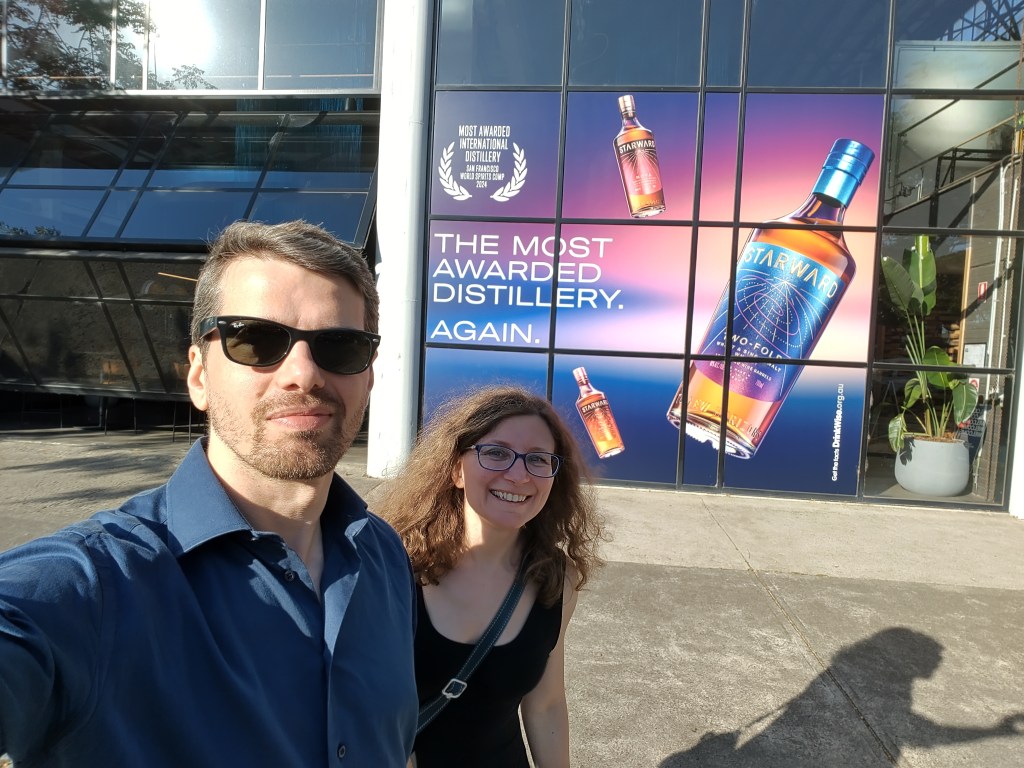
The drive back from Kinglake was uneventful, although as we approached Melbourne roads were busy, which we didnโ€™t expect on a Thursday early afternoon. Despite the traffic, we got back to our hotel in time to park the car, refresh ourselves at the hotel, and grab a cab to get to our next destination in Port Melbourne, south-west from the central business district: Starward, one of the most well-known distilleries in Victoria and Australia. Despite being in what looked like a mostly business area, it can be reached by bus (although we didnโ€™t have enough time that day). From the outside the distillery looks like an industrial warehouse, its presence is only given away by some advertisement panels at the front, where the predominant colour is an electric purple-ish blue.
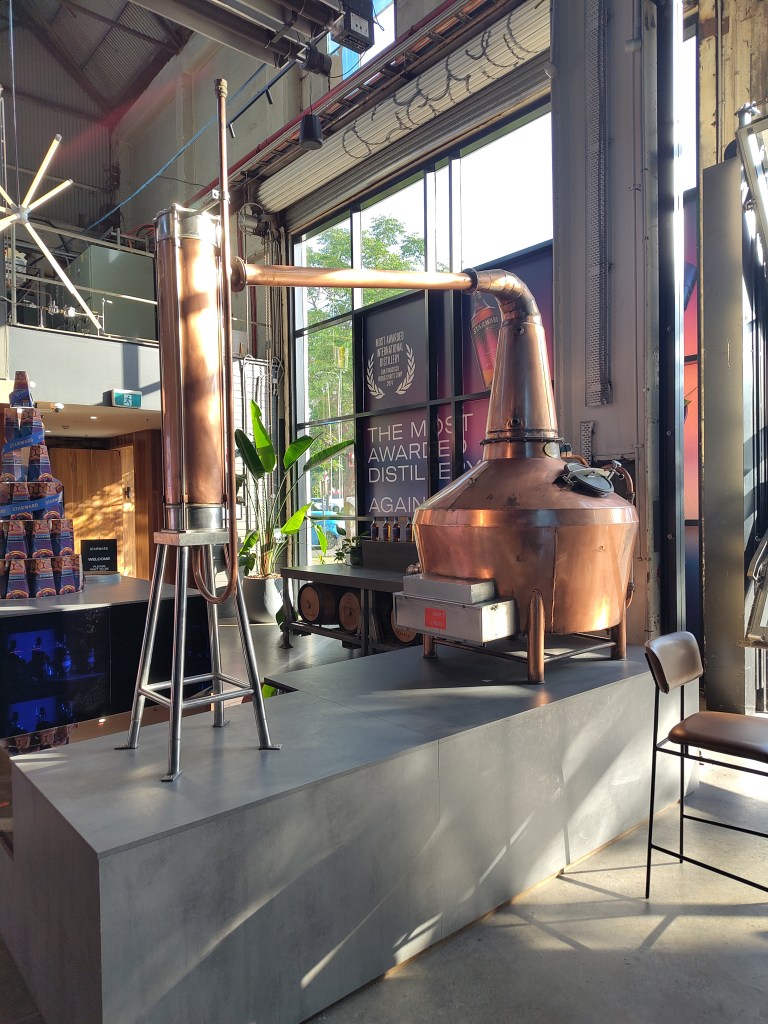
Inside the building, the blue is still the main colour: the space is very wide, with the shop right after the entrance, as well as one of the old stills. On the left side there is a long bar, showcasing two bottle-your-own casks: the price tag betrayed the Diageoโ€™s involvement in the distillery ($250.00). The distillery production is past the hospitality area, which has both low tables and barrels used for tastings. In the 5-10 minutes before the tour started, we mostly checked out the shop, and the many expressions available for purchase.
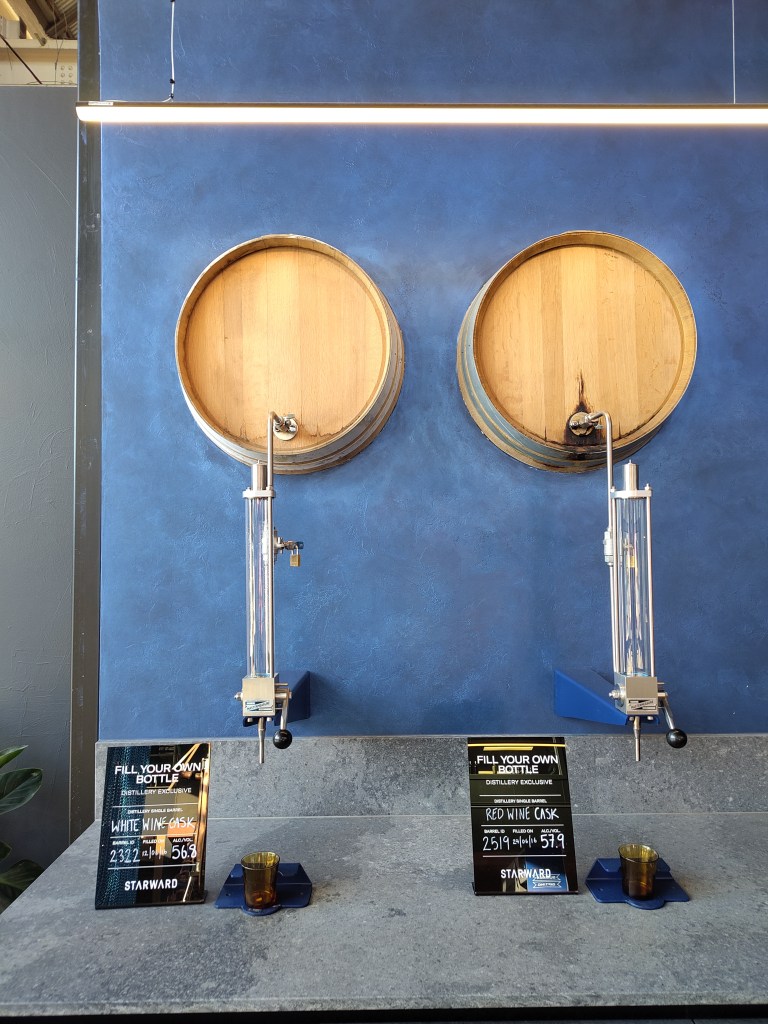
Pricey bottle-your-own.

Our guide for the day was Felix, who was very knowledgeable and promptly replied to all our questions. The first thing he asked us, though, was to leave our phones in a locker, for โ€˜safetyโ€™ and to avoid taking picture of production: a very weird company policy. Because of that, we donโ€™t have any pictures of production, and we couldnโ€™t take notes on our phones as we usually do. Instead, the day after we recorded everything in agent Cooper-style vocal messages while driving, to be used by our future selves rather than Diane.

The distillery was founded in the 2000s by David Vitale, who used to be a brewer: because of this, he was keen to maintain some brewing elements in his whisky. Thus, the malted barley they use is a pale ale malt from New South Wales. The malt is then mashed with water coming from Melbourne city aqueduct and, once done, put into one of the stainless steel washbacks. Here fermentation is kickstarted with a (secret) yeast recipe composed by mostly brewer and some distiller yeasts. It usually lasts five days, but it can go ahead to up to eight, continuing the trend of long fermentations we observed in this trip.
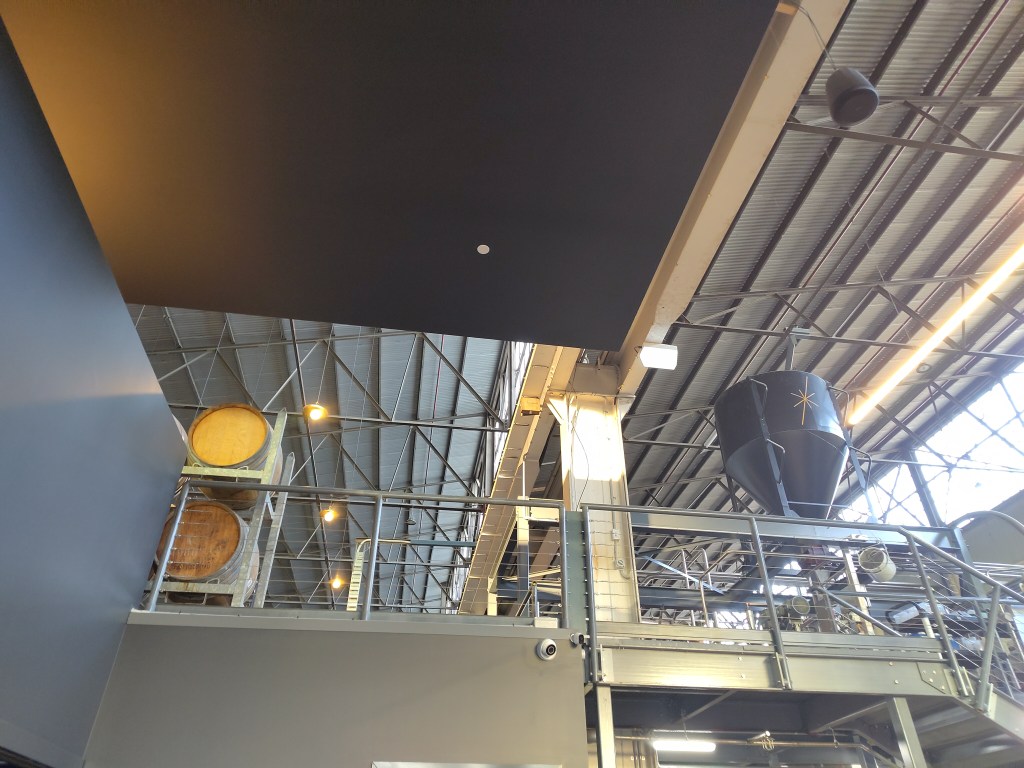
The spirit is double distilled in a pair of stills from the Italian maker Frilli (like Raasay and Teeling). The spirit still has a cooling jacket, to help regulate the temperature when the weather is too hot (itโ€™d be harder to regulate the temperature of the entire massive open space). The spirit cut point is high, and for the newmake spirit they donโ€™t use anything below the mid-sixties (64-67%), with the rest recycled as feints and mixed with the foreshots. The newmake spirit is then diluted to 55% before casks are filled. It is a lower abv compared to many distilleries, in particular in Scotland – this is because the climate causes the abv to increase while maturing, similarly to other distilleries in Australia, but also in other temperate areas like Kentucky.
Regarding the cask choice, they aimed for a distinctive Australian signature, thus they mature their core whiskies in ex-red wine casks, mostly French oak, but they also use some American oak barrique. The reason why they did not choose Australian fortified wines casks was that there are not enough to maintain a core range (they didnโ€™t say, but probably another reason is that wine casks are cheaper, as reflected in the fair price of the entry expressions). So, they still use fortified wine casks, together with a variety of other casks, but mostly for small batches or single cask bottlings.

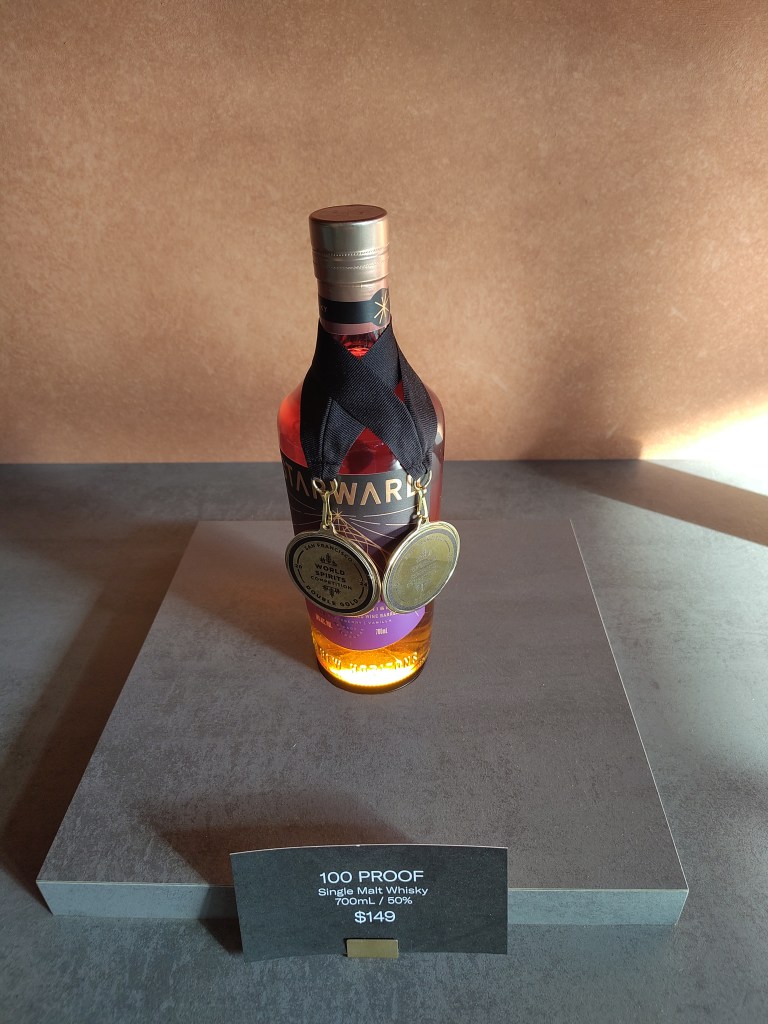
After the tour of production, it was time for the tasting: Starward was one of the few Australian whiskies weโ€™d tried before this trip. Specifically, we’d tried the Fortis, thanks to our subscription to Whisky Me. The tasting started with a blended whisky, the Two-Fold (they have another one, Honeycomb). For this blend of wheat and malted barley, they source the wheat newmake spirit from elsewhere, and they mature it on site. Itโ€™s a very basic offering, mostly marketed as a cocktail component, but we found it punchy above its weight, considering it is bottled at 40%, and unexpectedly oily. The second dram was the Nova, matured in ex-red wine casks (French oak) and bottled at 41%. It was our least favourite. Finally, we tried the 100 Proof (name coming from its abv of 50%, so American proof), matured in American oak ex-Pinot Noir casks: this one was delicious, with creamy and red fruits notes, and not too tannic (although, compared to the average single malt drinker, our tolerance for tannins is probably much higherโ€ฆWe โ€œblameโ€ our Italian upbringing).

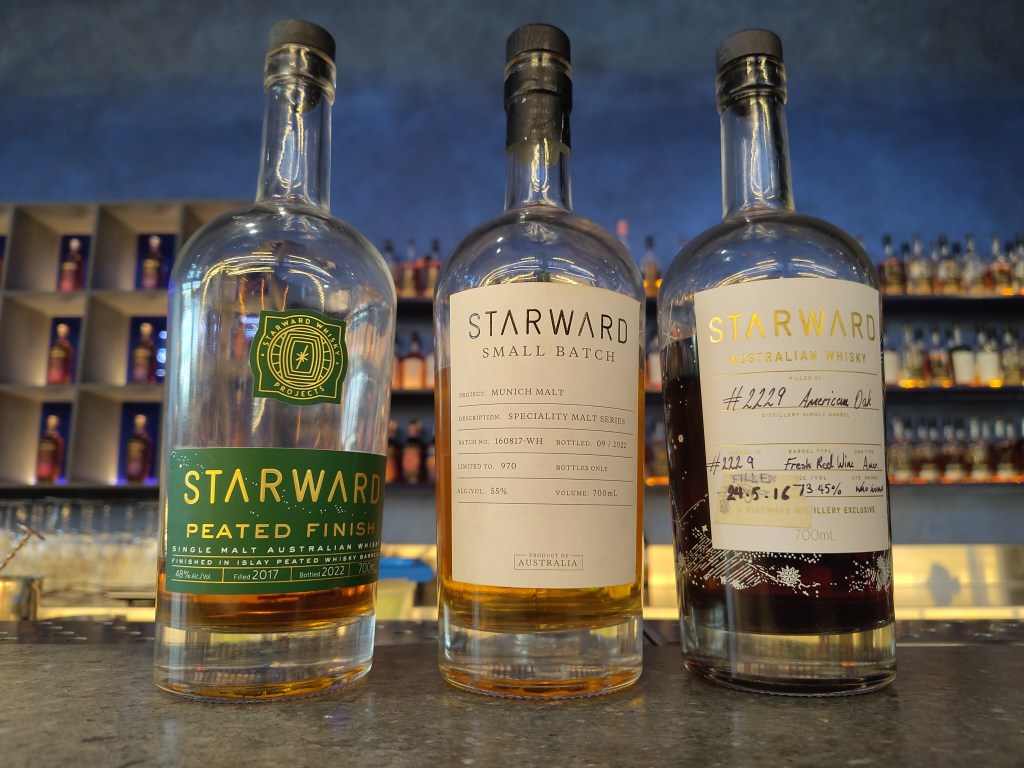
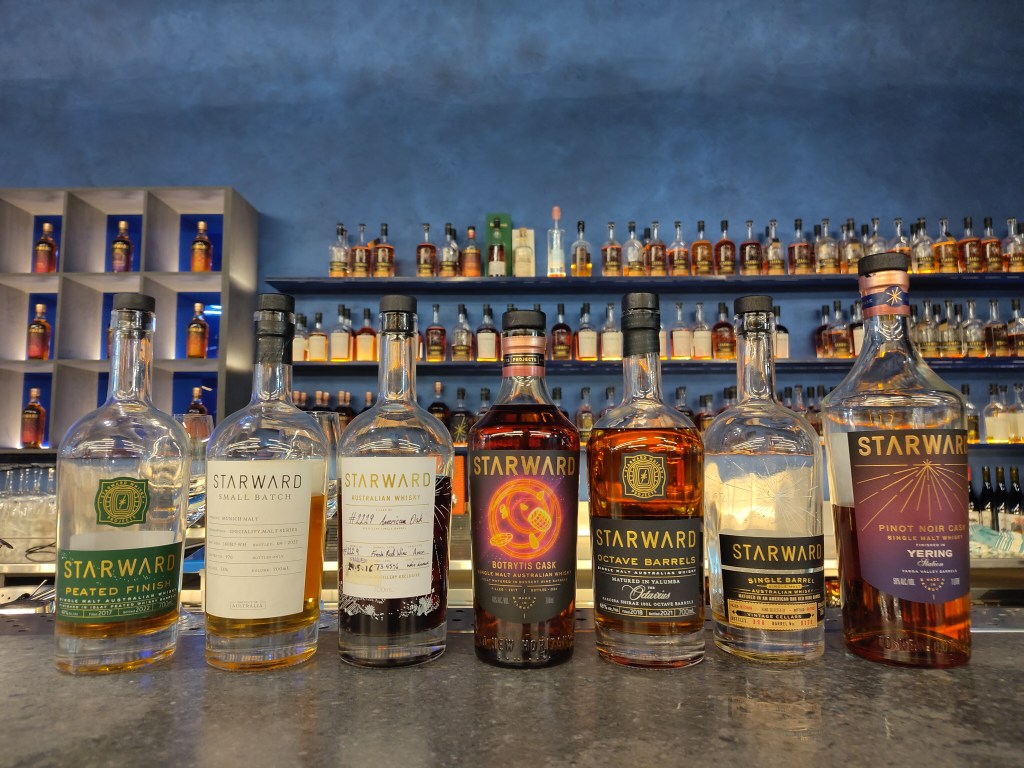
By the time the tasting ended their kitchen was closed, but we decided to stay at the bar anyway to try more expressions – not only bottlings available to purchase, but also curiosities and the odd ones. Here, we found the highest abv whisky we ever tried: 73.45%, first fill American oak red wine. Almost like chewing wood, but some water tamed it, and it was delicious. We also tried some of their peated cask finished whiskies, but not the Lagavulin edition whose price carried a premium: $199, compared to the $149 for another undisclosed Islay distillery, weโ€™ll leave you to guess which (just remember who partially owns Starwardโ€ฆ). The dram was good, but it didnโ€™t blow our socks off. Another we tried was the Yering Station Pinot Noir finish (the same winery we’d visited that same morning). This one was tasty, but with a similar profile to the 100 Proof. We also tried the Munich malt whisky, the Botryties matured (Australian โ€œsauternesโ€), the Shiraz octave cask finish, and finally, the one we liked the most: one matured in a single American oak barrel, previously holding red wine. Really delicious, a shame it wasnโ€™t on sale.

Tasting those drams made us realise how, to our palate, Starward works best with American oak wine barrels. Overall, the quality of whisky was surprisingly good, and it was a very interesting tour (in spite of the awkward phone policy), and Felix a great guide. It was a shame we couldnโ€™t do their Masterclass and Barrel Tasting ($160.00pp), but is runs only once a week on a Saturday, and it clashed with the rest of our plans.

After the drams, we needed some food: so we got a table at a nearby restaurant, the Railway Club Hotel, where we had one of the best beef steaks ever! After dinner, we took it easy and enjoyed a 40-minute walk back to our hotel.
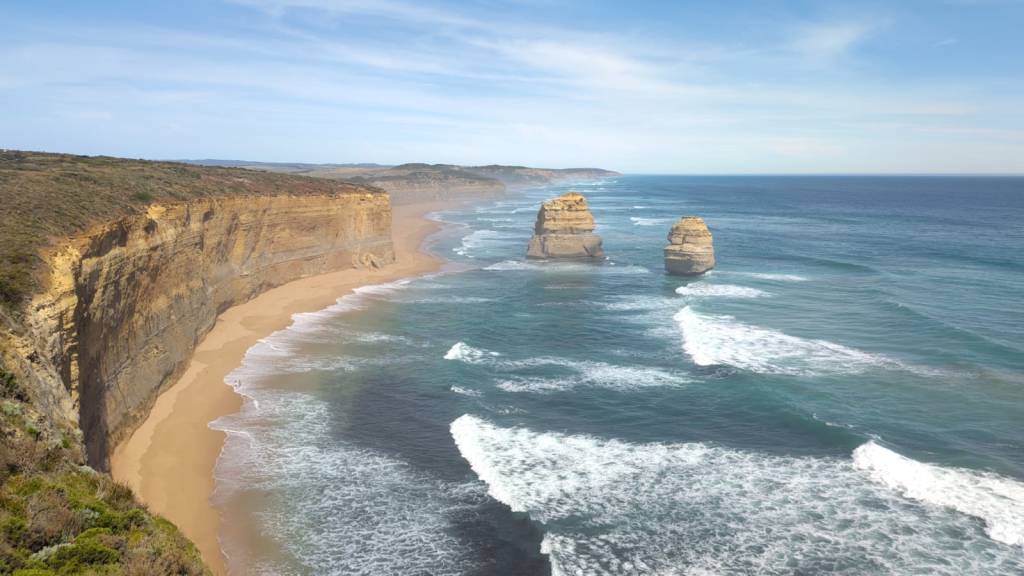
The next day we finally left Melbourne, driving towards Adelaide on the Great Ocean Road. In spite of the short stay, we had fun in the city, and we were pleasantly surprised by the great whisky scene! Definitely a lot of stuff to do for whisky geek visiting. We wonโ€™t bother you much with the rest of our non-whisky holiday (wellโ€ฆmaybe a pic or two), but the drive was amazing and we spotted some very cool animals!

This was not the last whisky story of our holidays, stay tuned for the last one! Until next time, slainte!


Starward Distillery Tour

Price: AUD 60.00 pp (November 2024)

Duration: 1hr

Tasting: 3 drams, Two-Fold blended whisky (40%), Nova Single Malt (41%), 100 Proof (50%)

Target: tourists and whisky novices

Value for money: ok

Highlights: the variety of expressions available at the bar

Recommended: if you’re in Melbourne, why not?

Link: https://starward.com.au/

#56.3 Dramming Down Under

The still in the Melbourne hills


TL; DR: Our third distillery visit of this trip, second in Victoria, was just outside Melbourne: Kinglake Distillery! A crafty distillery well hidden in the hills to the north-east of Melbourne, not too far from the Yarra Valley. We had a great time with Sam, one of the two owners, who showcased some very flavoursome single malts.ย 

(missed Part 2/Part 1?)

Our second full day in Melbourne was a busy one, with not one but two distillery visits. The first one was outside the city, so right after breakfast, we picked up our rented car and started driving, destination Kinglake, to the north-east of Melbourne. Years ago the area made the news as it was heavily affected by the 2009 massive bush fires. Once left Melbourneโ€™s central business district, we drove eastward, on the busy highway going to Sydney. We soon left the highway, to get into the Yarra Valley, a well renowned wine region.

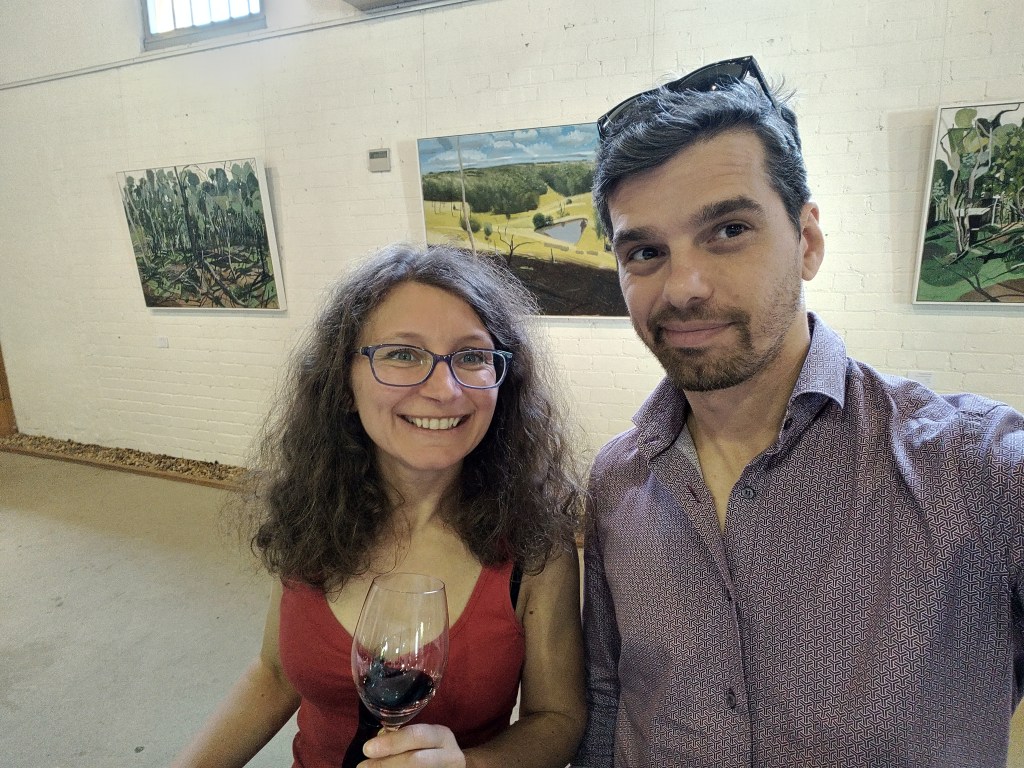
Because our first visit was after midday, we had enough time to visit one of the local wineries. Not knowing much about Australian wines (and not much about wine in general), we chose one of the oldest (and largest) producers: Yering Station. It is a big place indeed, other than the vineyard and the tasting room, they also have a bar and a fine dining restaurant. We went straight to the shop and tasting room, and chose a small tasting for us to share at the bar, which included five wines all coming from the estate for $20 (there is a cheaper tasting, $15, but with wines from their other estates or vineyards). It was a short but fun activity for wine newbies like us, and we liked the fruitiness and freshness of the products, in particular the red ones. We ended up buying a young and lively Pinot Noir with (2023 Yering Station), which we found perfect as an โ€œaperitivoโ€ for the coming days. Fun fact: if you buy a bottle priced over $35, the tasting is free. Some producers in the old continent should take note. Back to the car, we went to the next village to grab a sandwich before moving on.

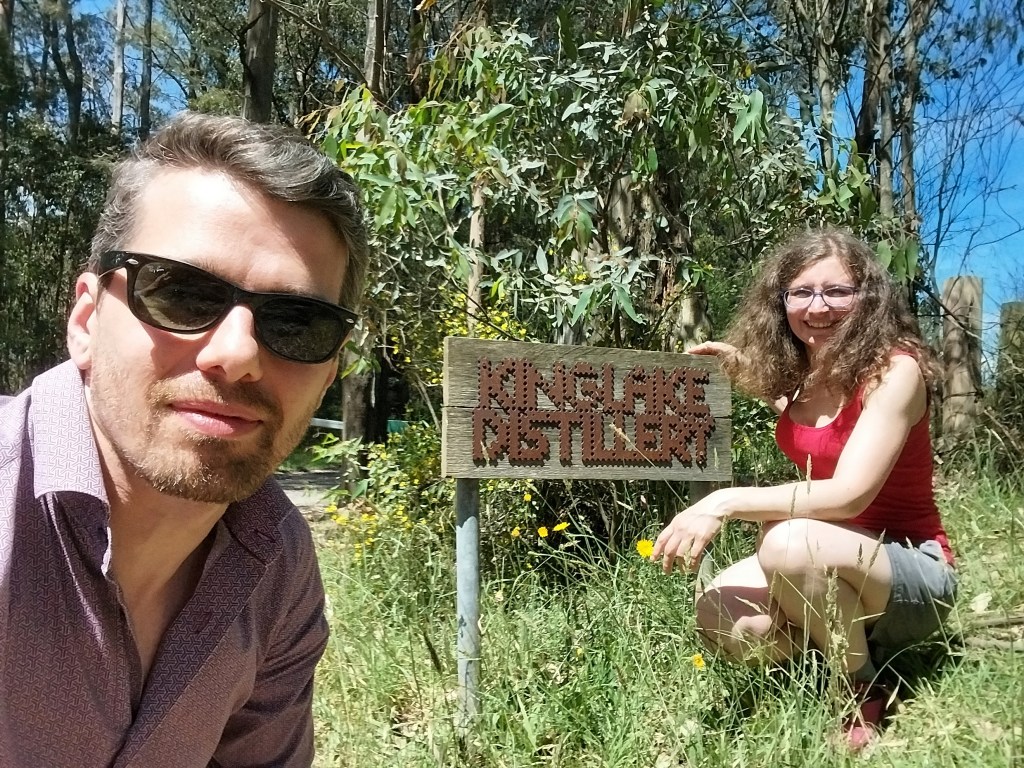
The Kinglake distillery is well hidden in the hills: as a matter of fact, it broke the record for the longest dirt road driven to get to a distillery, before held by Ncโ€™Nean: for a moment we thought the small MG car couldnโ€™t cope, but fortunately it did. The weather was sunny and mostly dry, so we were raising clouds of dust while driving. The landscape was quite pleasant: a mix of woodland and farmed fields, with many green fields around the distillery and a pond. From the website itโ€™s not possible to book tours or tastings (except for one very exclusive experience), but both Sam and Chantal, the two owners and distillers, replied emails quickly and they made themselves available on the dates we suggested. As we arrived, we were welcomed by Sam, who had a Queens of the Stone Age t-shirt on. That put us in a great mood right away.

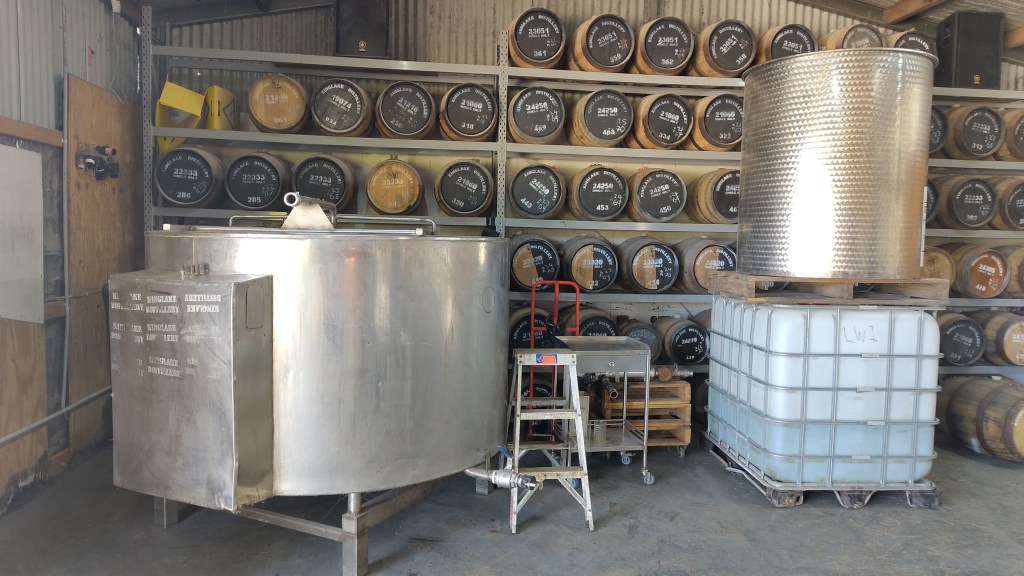
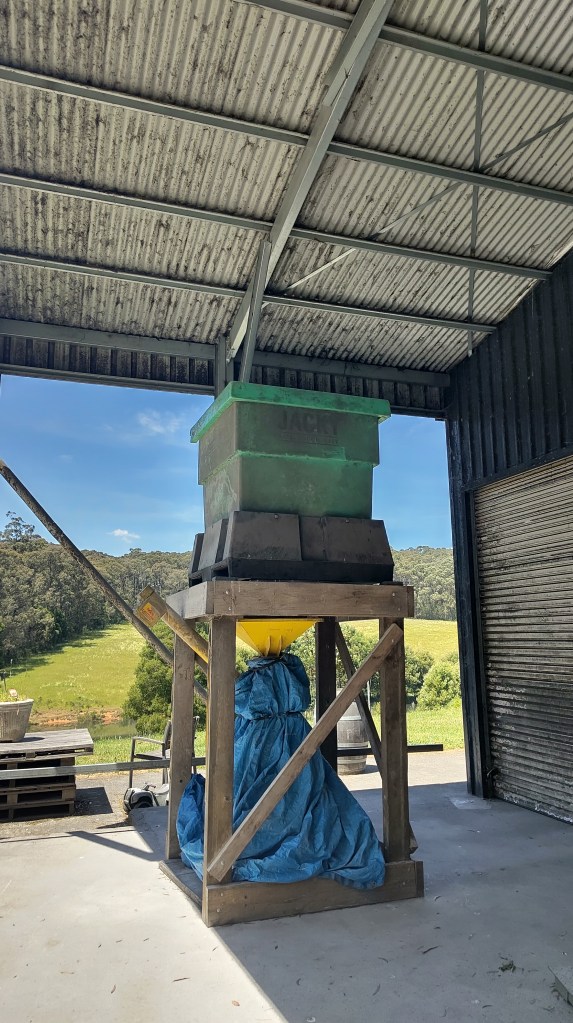
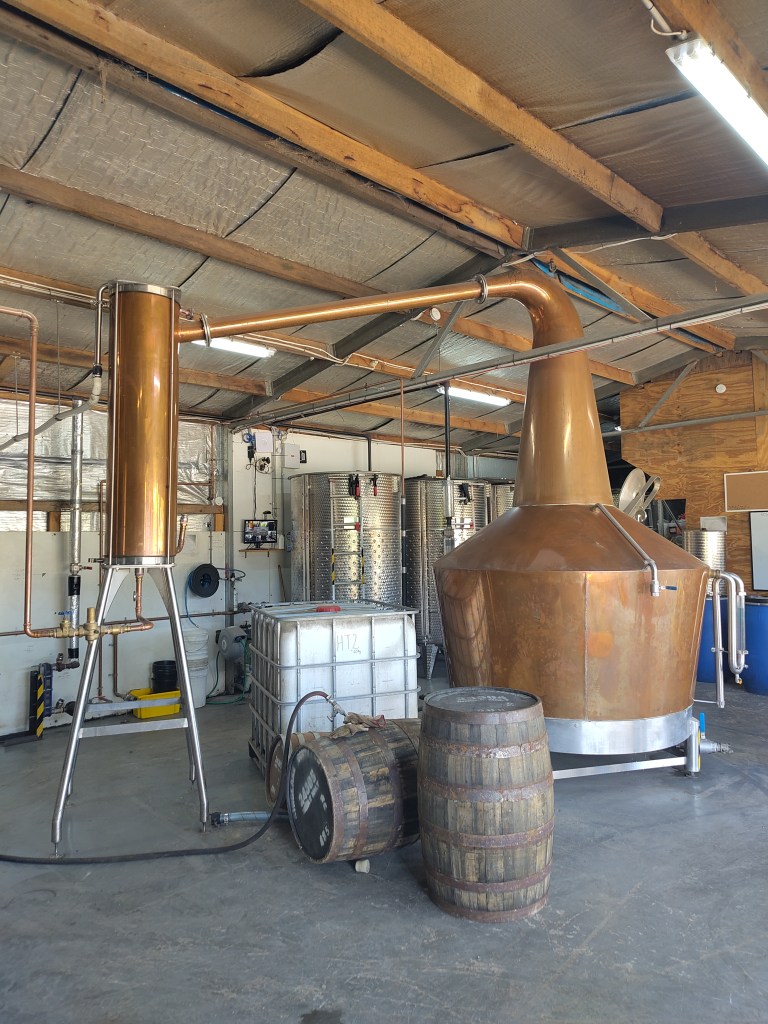
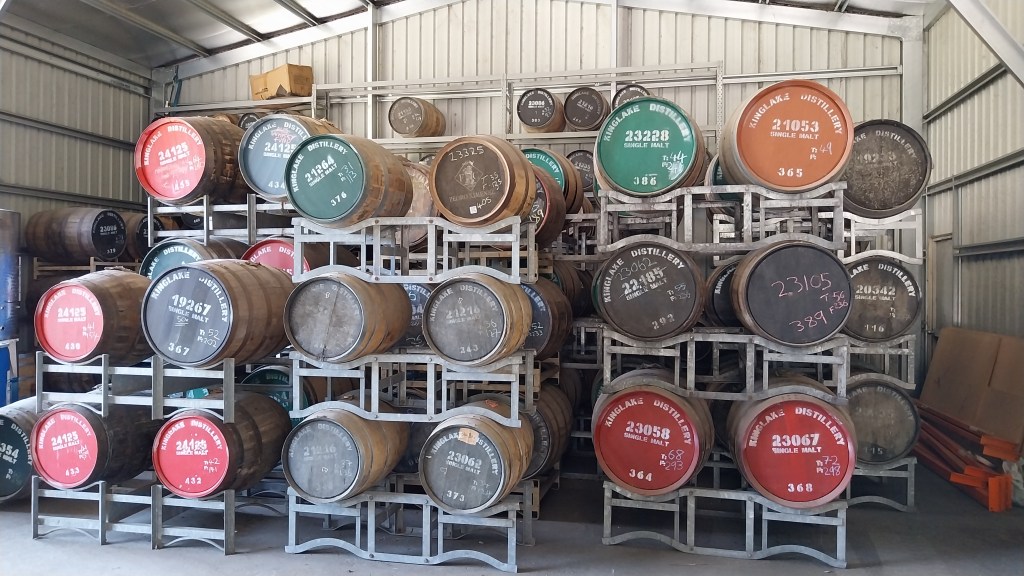
The distillery is totally off the grid, and at that time it consisted of two buildings, but in our understanding, they are building a new bar and tasting room (and their own house too). The first building we visited is split in two areas – one hosting a bar, a small tasting room, and the office, while the other production and some racked casks. The other building is mostly used as a warehouse, but it also hosts the mill. They started distilling in 2018, with a very specific plan in mind: first, trying to stick to ex-bourbon casks, in contrast with other Australian distilleries that focus on ex-wine casks to build on the country wine-producing heritage. Second, releasing small-batch bottlings rather than single casks, to achieve a house style and a consistency that is harder to get with single casks only, while trying to keep prices lower. A very sensible plan, if you ask us.

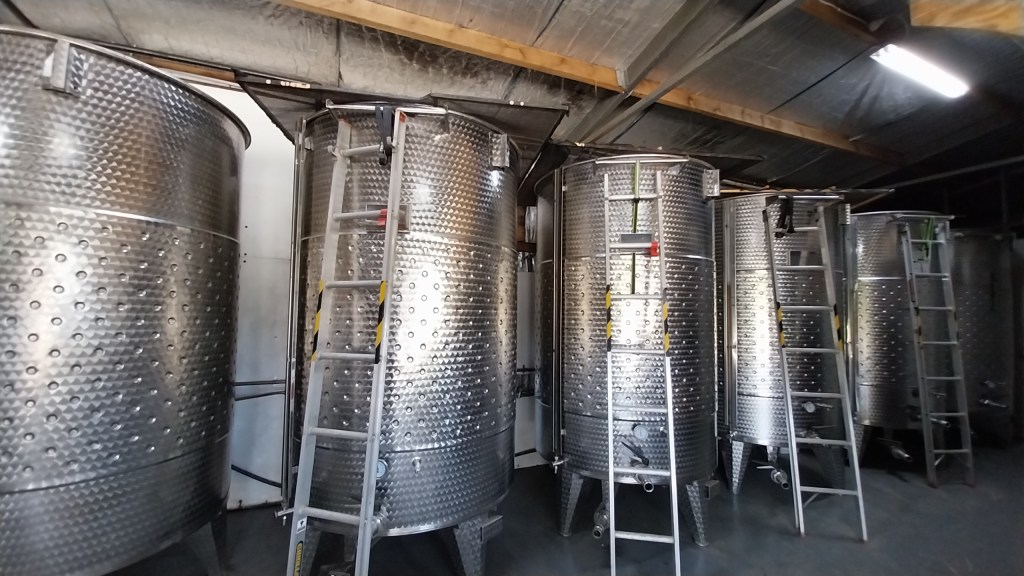
Production-wise, we found their process very interesting. One of the reasons they decided to start here is the source of water, Chryser Creek, which is on the distillery property and is so clean that it needs no treatment. The mashbill consists of four malted barley varieties: distillerโ€™s malt (Atlas La Trobe, similar to Maris Otter), Vienna Schooner, chocolate malt (only 4%, to keep balance), all sourced in New South Wales, and 25% of heavily peated malt from Scotland (Simpson malting). They mash everything together, unlike Archie Rose, for example, who mash and mature every malt variety separately. Once mashing is done in the 18,000-litre mashtun, they ferment the wort with M1 yeast in open top washbacks, not common! The open top is to allow natural yeast present in the air to contribute to the fermentation, a technique that is mostly used in rum production. Finally, both distillations happen in a single 2,500-litre still, taking a low cut deep into the feints.

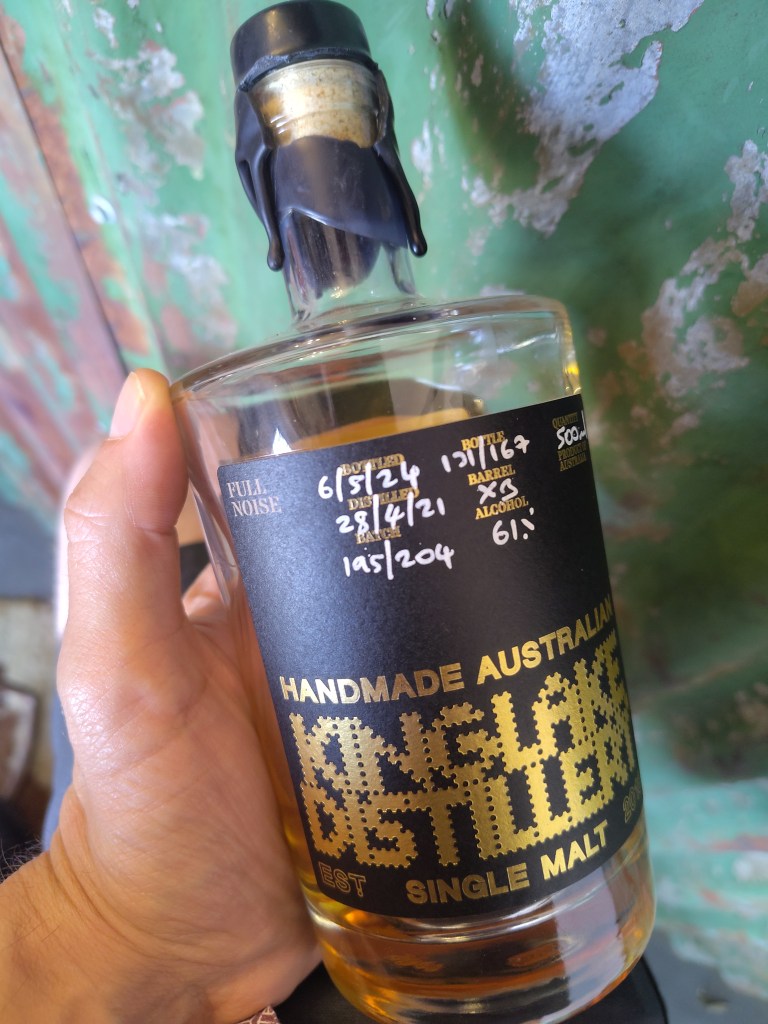
They fill casks on site, mainly in ex-bourbon barrels from Kentucky, sometimes resized in smaller casks by a local cooperage (quarter/octave-ish). Before we started the tour, Sam gave us a taste of the Oโ€™Gradys, one of their main expressions: ex-bourbon matured indeed, bottled at 46%abv (that batch, almost exactly 3y old). The second taste, later on, was of the Doubled Wood, starting in ex-bourbon but finished in Portuguese ex-Tawny Port barriques, made of French oak (again 46%, 3y). The third one, In the Blood, was a small batch of whisky finished in River Red Gum wood, and bottled at higher abv (60%, 3y), while for the last one, Full Noise, we went back to whisky fully matured in ex-bourbon cask, but at 61% (again, 3y of ageโ€ฆThe batch we bought though was 60%). Other than these drams they also release some limited editions, like The Bog Monster (unfortunately not tried and sold out, but sounding amazing from the description!). The drams we tried were all flavoursome, very vibrant, slightly funky, with herbaceous notes in some. We liked in particular the two fully ex-bourbon matured expressions, very creamy and fresh, showcasing how different climates can have a massive influence on the whisky (more on this next week).

As we left the distillery, and before driving back to Melbourne, we stopped for a walk at the Wombelano Falls, just a few minutes driving away and even more hidden in the hills (so much so that at some point we thought we had taken the wrong turn). Itโ€™s not a long walk from the car park to the waterfall observation point, but still a very pleasant and quiet one. Unfortunately we didnโ€™t spot any wildlife, only another couple who were leaving the trail to get closer to the falls in what looked like a not very safe part of the forest. We didnโ€™t hear anything in the news the next day, so we assume everything was alright for them. Once we got back to the car park, we left to get back to Melbourne in time, for our second distillery visit of the day. Great day so far, we only wished we had more time to explore the area.

Stay tuned for more on that! Until the next time, slainte!


Kinglake Distillery Tour

Price: free (November 2024)

Duration: 1hr 15min

Tasting: 4 single malts, Oโ€™Grady Stand (ex-bourbon casks, including resized, 46%abv, 3y); Doubled Wood (Portuguese ex-Tawny Port barriques finish, 46%, 3y); In the Blood (River Red Gum wood finish, 60%, 3y); Full Noise (ex-bourbon barrels, 61%, 3y)

Target: whisky enthusiasts

Value for money: NA

Highlights: the unique process and the wonderful location

Recommended: for whisky enthusiasts absolutely, worth the trip from the city and beyond

Link: https://kinglakedistillery.com.au/


#56.2 Dramming Down Under

The hidden still in Melbourne


TL; DR: From Sydney, we soon flew into Melbourne, where we were pleasantly surprised by the lively and interesting whisky scene. We checked out some bars, as well as local distilleries. We found out about one, Bakery Hill, at the last minute. The very welcoming staff gave us an in-depth tour of this very urban-style distillery. And they produce delicious whisky! 

(missed Part 1?)

After the visit to Archie Rose, we paused our whisky activities for a couple of days. After the distillery tour, we went straight to Manly (north of the city) to check out the famous beach and relax. The day after, together with one of Gianluigiโ€™s colleagues and his cousin, we went to visit the spectacular Blue Mountains, about an hour outside the city – definitely worth it. Finally, on a sunny Tuesday morning, we flew to Melbourne. Once arrived, we headed towards the rental car place where, after a long wait, we got our car and drove straight to a car park near the hotel in the CBD. While we wouldnโ€™t use the car for the first day or two, having it would pay off a few days later. In the evening, we met with a Teresaโ€™s former colleague and then explored the cityโ€™s whisky scene, starting with the Whisky Den – an incredible choice of whisky, including many Australian, in a super cozy venue: thumbs up from us!

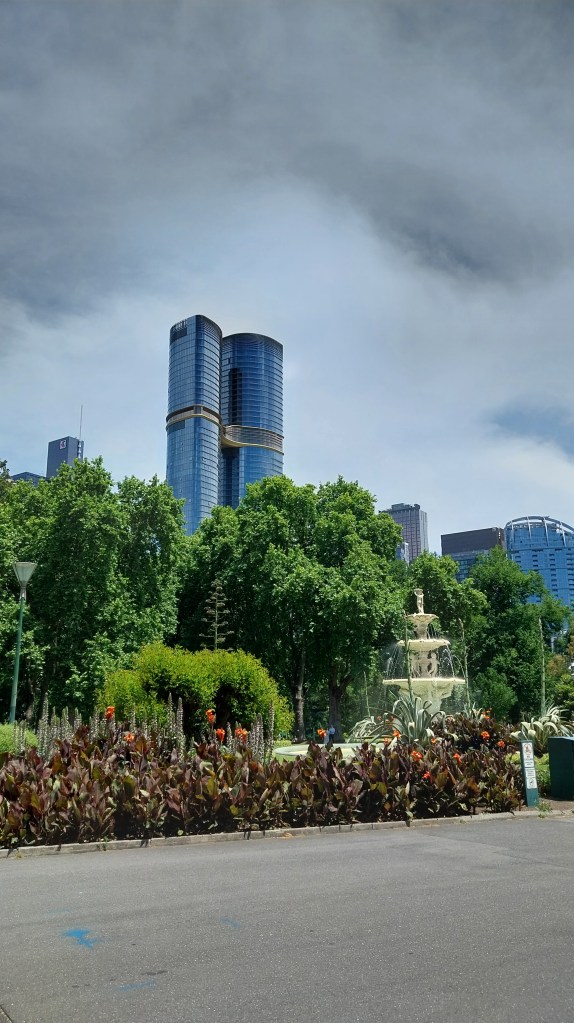
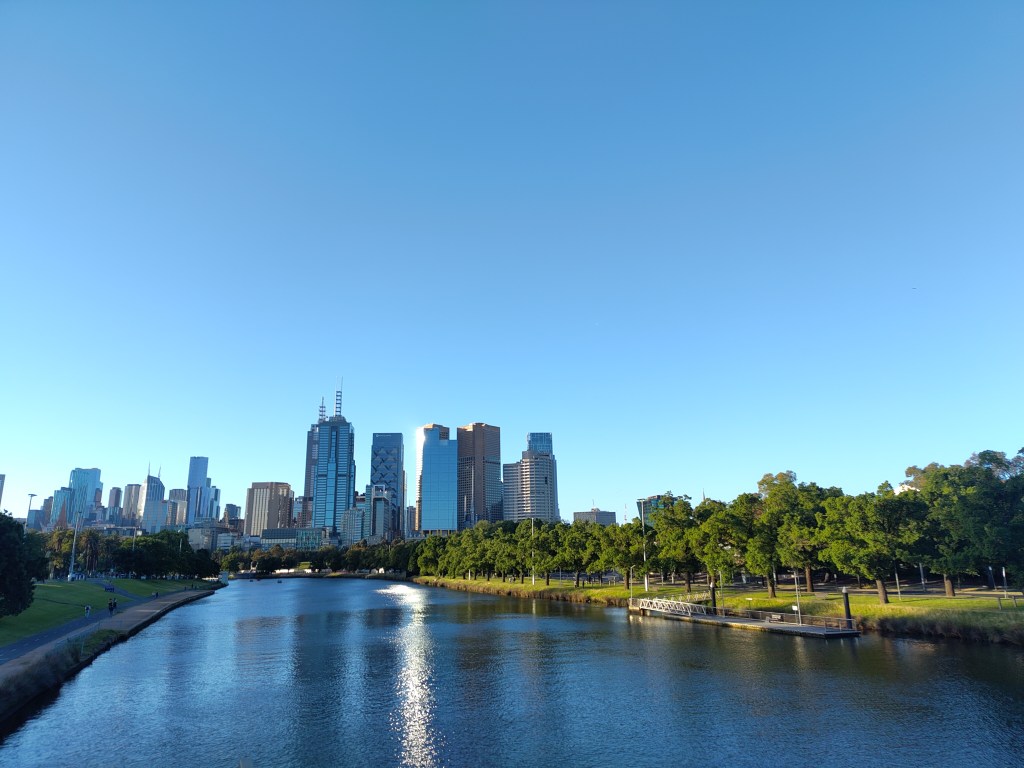
We didn’t take pictures at the Whisky Den, so you get Melbourne skyline instead.

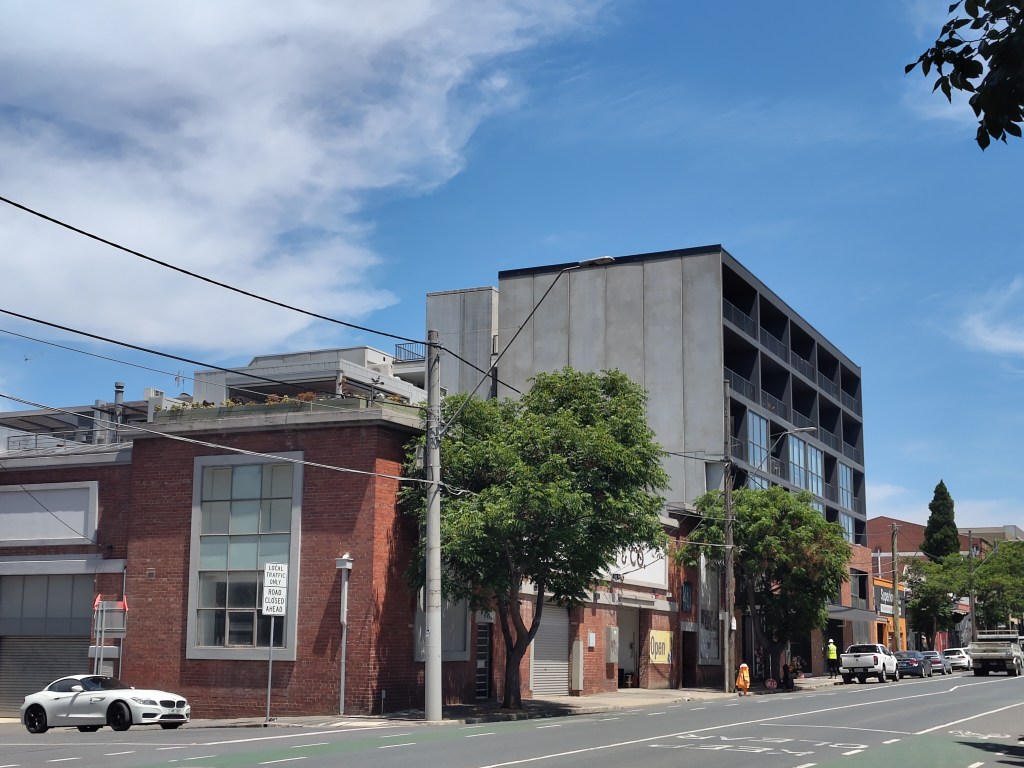
Right before taking off from Sydney, our pal Joe (from the Edinburgh Whisky Group) had given us some advice about distilleries and whisky bars to check out in the city. A suggestion was a distillery called Bakery Hill. Armed with hope but not expecting much, we sent them an email straight away to ask if we could visit the day after, the only option we had to accommodate a tour while in Melbourne. To our surprise, they replied confirming their availability for a tour, fantastic! So, the next morning we took a train from the Southern Cross station towards Kensington, North-west from the CBD. The building is a small warehouse, very well hidden in the urban context, so much so that, at first, we cluelessly walked almost a block past it.

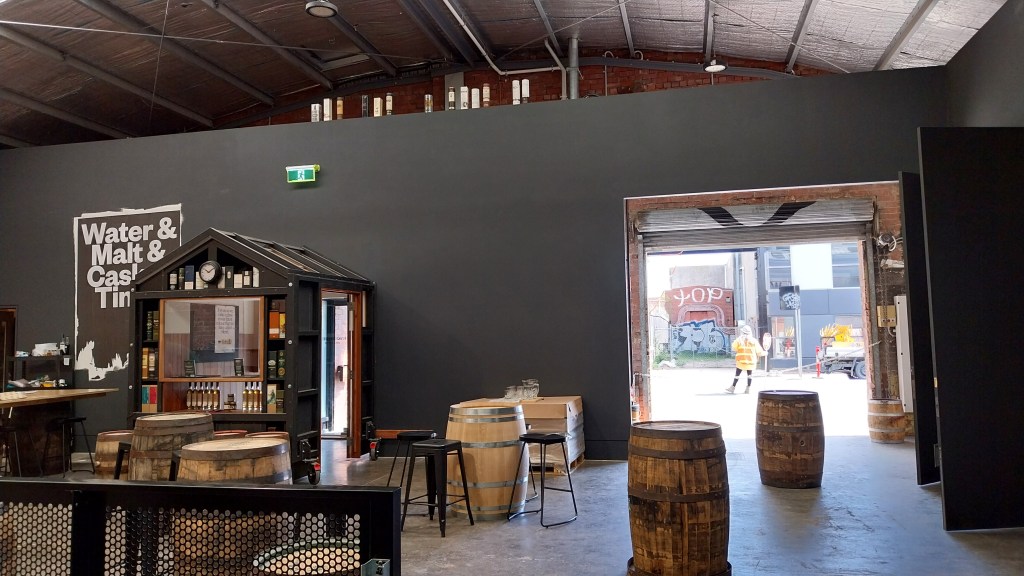
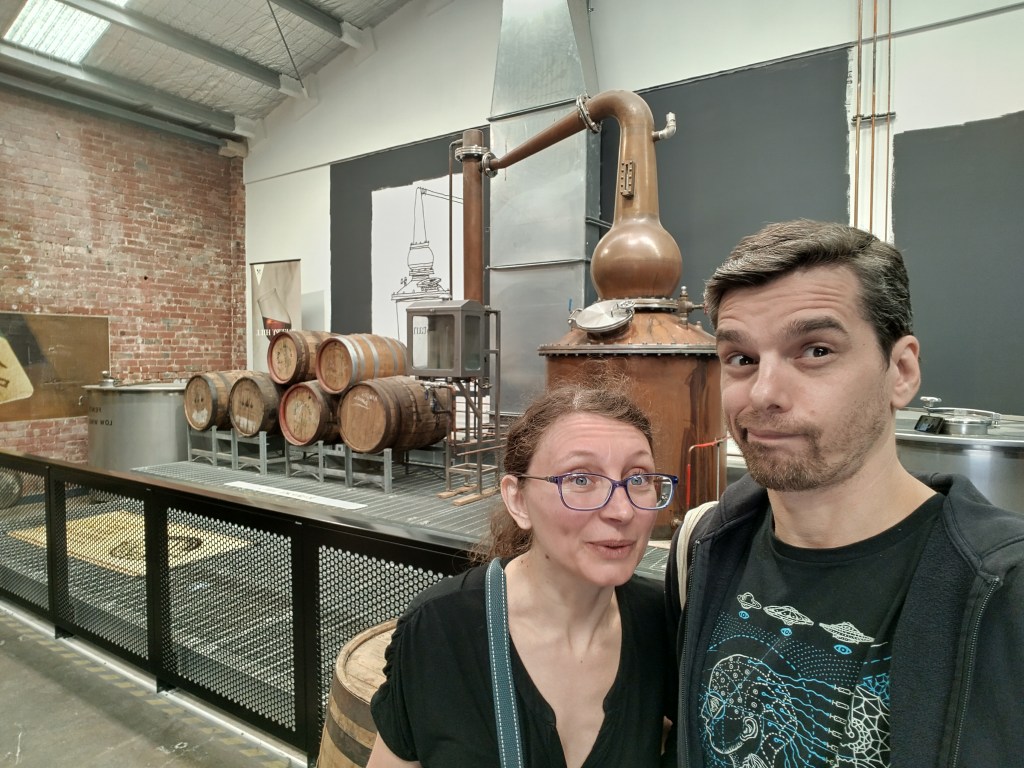
We were welcomed by Pete, one of the distillers and ownerโ€™s son. In fact, the distillery was set up in 1999 by David Baker, a former chemistry teacher, who wanted to prove that it is possible to make a good whisky in places other than Scotland. The distillery was originally outside the city, and they first released whisky in 2003. They then moved to within the city boundaries, only a year before our visit, in 2023. Now the distillery is mostly run by Davidโ€™s sons, Andrew and Pete. Except for a small space they carved out for a shop and a small office, the distillery has two main large areas, divided by a wall. The first one is occupied by the still, a space for tastings and events, and racked casks on the side. The space is also used for other activities, for example while we were there Andrew was preparing their upcoming first blended whisky release (their single malt vatted with Australian grain whisky from ex-bourbon casks, 46%). The rest of production is located in the adjacent area, again with casks racked on all sides.

About production, the unpeated malt they use is sourced from New South Wales. The peated malt is currently sourced from New Zealand, while until a few years ago they were getting it from Scotland. They use 320kg of malted barley per mash, which is processed manually in a very โ€œtraditionalโ€ way. Fermentation is kickstarted with brewerโ€™s yeast and is quite long, 5 days. Funnily, the two washbacks are named after a children TV show called Bananas in Pyjamas, thus Banana 1 and Banana 2.

They currently have one 1,000-litre still where they run both distillations. However, a new 3,000 litre wash still was due to arrive soon (at the time of visiting). As for maturation, they use mainly American oak ex-bourbon casks, in particular from Brown Foreman, including Jack Daniel’s. They mostly bottle single cask whiskies (in 50cl bottles), and everything every whisky nerd wants to know is handwritten on the back label: distillation and bottling dates, cask number. The whisky is usually older than other local producers, the ones we tried were between the 5 and 8 years old.

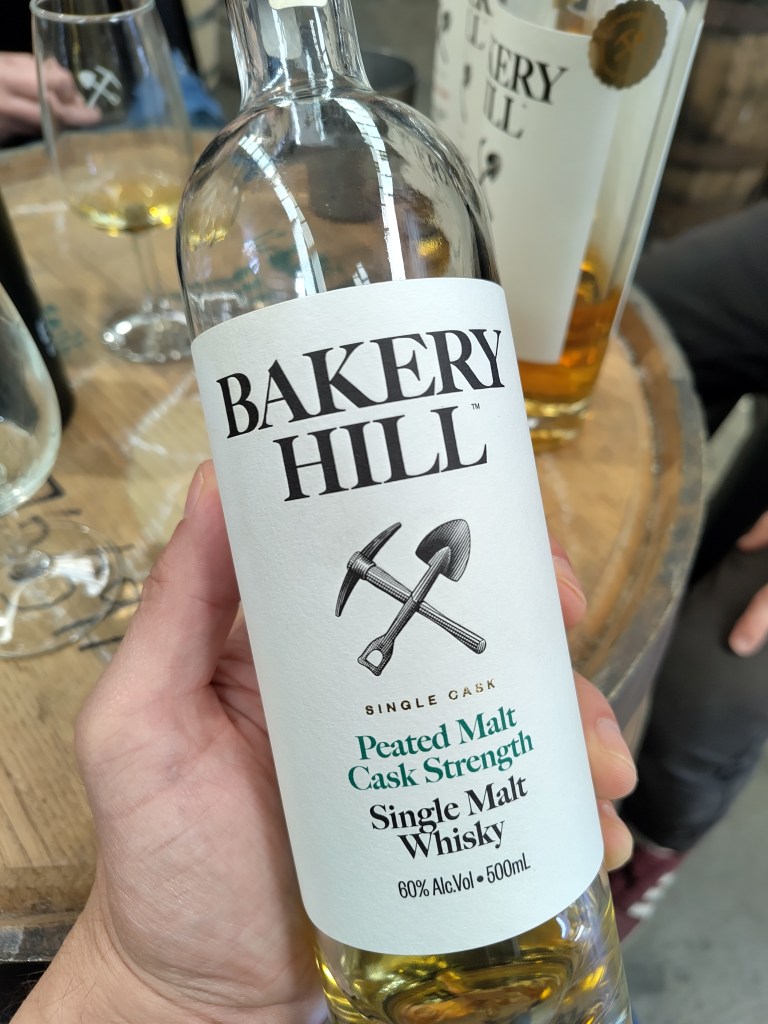
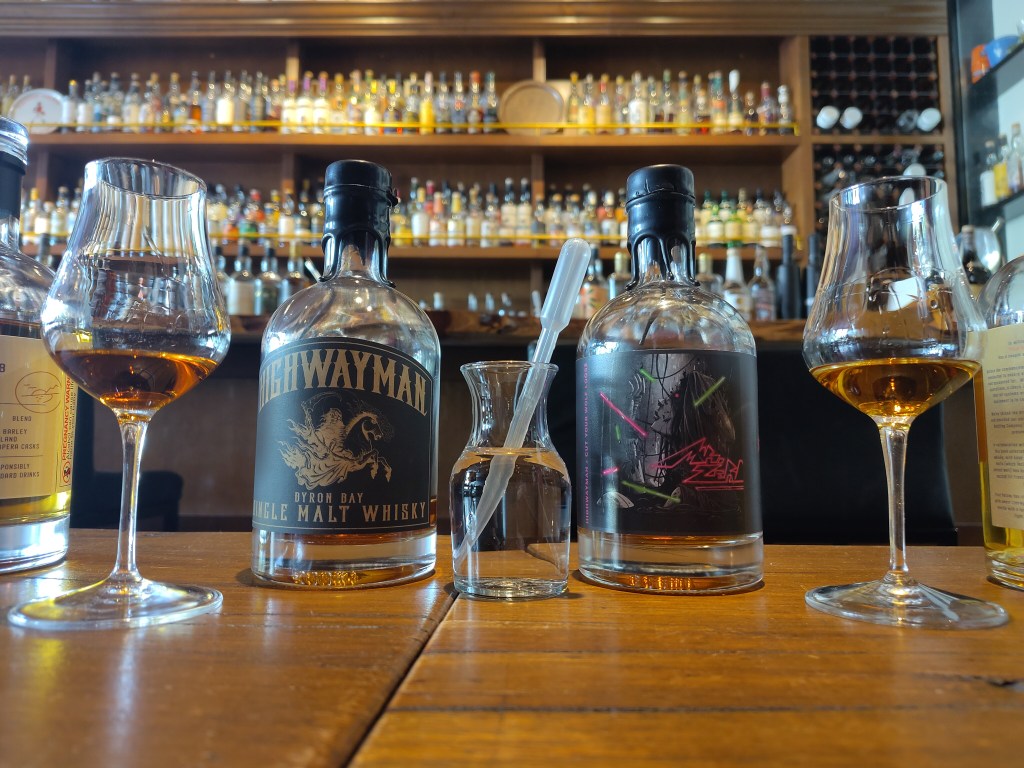
Their current Signature range includes five single malts: Classic (unpeated, 46%, ex-bourbon), Double Wood (unpeated, 46%, finished in 1st fill French oak ex-red wine cask), Peated (46%, ex-bourbon), Classic Cask Strength (unpeated, 60%, ex-bourbon), and Peated Cask Strength (60%, ex-bourbon). In our tasting, we tried four of them in this order, except for the Classic Cask Strength. They were all very good, but the two peated expressions โ€œknocked it out of the parkโ€ for us. They also do limited and seasonal releases, among the latter the Blunderbuss (after 5y in ex-bourbon, finished for 2y in Kalash Imperial Stout barrels) and the El Dorado (matured for 1.5y in Apera, i.e. โ€œAustralian sherryโ€, casks and finished for 3y in ex-bourbon). To note, they produce a gin too, the Oxford Traditional Gin (40%). Pete also told us that they started to work with some UK based independent bottlers to try get some of their whisky over here: Atom Brands already released one expression from them under That Boutique-y Whisky Company brand (the hilarious label was inspired by Breaking Bad series, given David Baker’s past as chemistry teacher).

We loved the concept of this distillery: self-contained, doing things properly, and this ethos totally transpires in the quality of their drams. Bottles are pricey to be fully honest, even compared to some of their peers, but given the production size and the fact that they bottle one cask at the time, we can see why. Overall, one distillery we are super happy to have visited, and weโ€™d definitely go back (in the unlikely case weโ€™ll find ourselves in Melbourne, again)!

After the distillery we had a quick bite in a very nice cafรฉ across the road, before getting on a bus towards Fitzroy and other areas in the north of Melbourne. In Fitzroy, we also paid a visit to the Elysian Whisky bar, on Brunswick Road: what a bar! We had a lovely chat with the owners (we were there kind of early, so the only ones), who suggested drams to try and guided us through them. One great thing of Australian whisky bars is that it is possible to order half-size drams (15ml, versus the 30ml full dram), which are a bit easier on the liver (and on the wallet), in particular for whisky curious people like us who always wants to try a few.

After dinner we visited another fantastic whisky bar, Whisky and Alement, where we had another great time chatting with the super knowledgeable staff, who ended up gifting us a pin for their 10y anniversaryโ€ฆwhich was four years before, ahah!

A great distillery tour and two great whisky bars, what a whisky day that was. We did other stuff (including getting the worst coffee of the entire holiday, and finding an awesome record in a second-hand music store, Travels by the American band Defeater if youโ€™re curious), but the three above were definitely the highlights of the day.

Stay tuned for the rest of our Melbourne (and surroundings) action! Until the next time, slainte!


Bakery Hill Distillery Tour

Price: AUD 35.00 pp (November 2024)

Duration: 1hr 30min

Tasting: Classic single malt (46%), Double Wood single malt (46%), Peated single malt (46%), Peated cask strength single malt (60%)

Target: whisky enthusiasts

Value for money: good

Highlights: the history of the distillery and its urban style

Recommended: absolutely yes!

Link: https://bakeryhill.com/


#56.1 Dramming Down Under


An old “new distillery” in Sydney


TL; DR: A few months ago, we went on holiday in Australia. This, of course, was the perfect occasion to explore the Australian whisky scene. First off, we visited Archie Rose distillery, in Sydney. The tour was on their old site, now a bar and function venue, but all the equipment is still there. A bit of a touristy experience, but nice to visit nonetheless. 

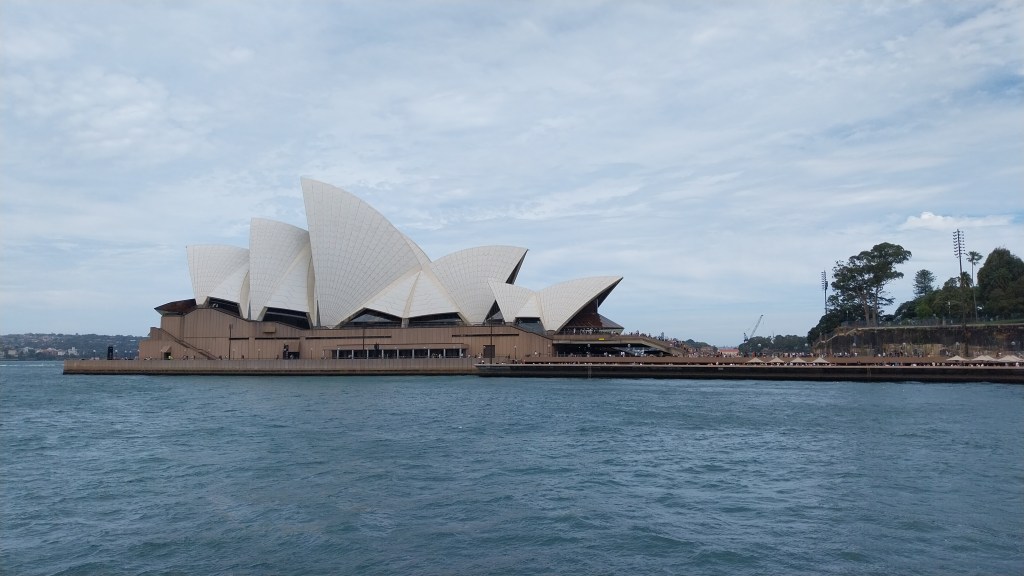
One of the few remaining perks of working in academia, in particular during these lean years, is the possibility to travel to meet colleagues and attend conferences. Gianluigi was particularly โ€œluckyโ€ in 2024, as the main conference he attended was in Sydney (Australia, not Sydney, Florida)! It was a first for Gianluigi, who never been down under before. Teresa, on the other hand, visited Australia about 10 years before but only briefly. So, all the planets aligned for an Australian holiday after Gianluigiโ€™s conference. And whatโ€™s better than going on some whisky exploration, while on holiday?

Before the trip, we didnโ€™t know much Australian whisky, for two main reasons. First, only a few expressions make it to Scotland. Second, some Australian bottlings (in particular from Tasmania) can be quite pricey, and itโ€™s hard to try them before buying, making them risky purchases. So, we were really excited to go on this trip and uncover some new flavours and drams!

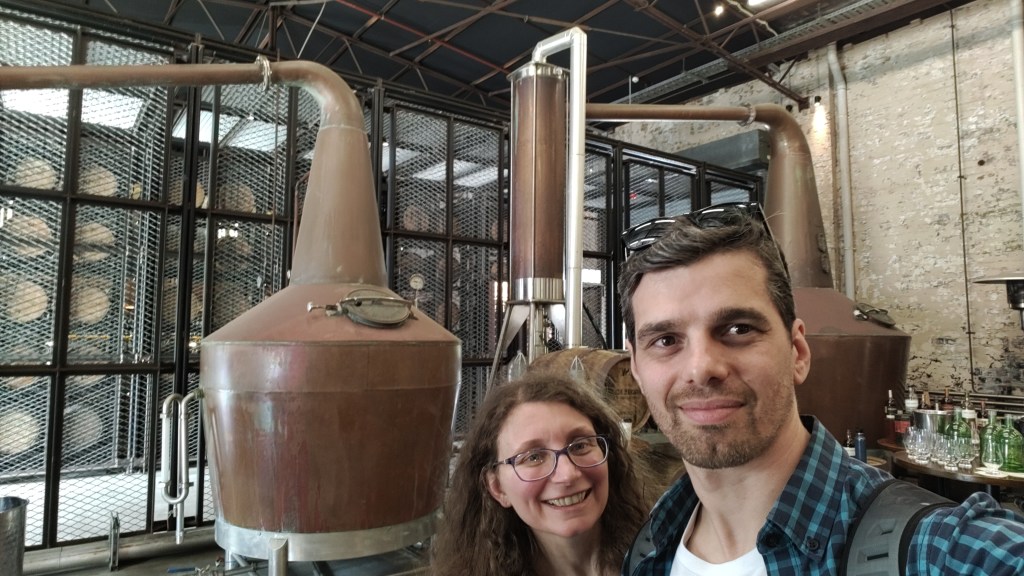
Our trip started in Sydney, with Teresa landing on a sunny Sunday morning, a day after the conference ended. We didnโ€™t want to spend many days in the city (Gianluigi had been there a week, Teresa already visited), and because our first distillery wasnโ€™t open for tours on Mondays, it was Sunday or (probably) never. Fortunately, Teresa landed early, so after checking in at the hotel, shower and a coffee (one of several), we were on the bus on our way to Archie Rose distillery. The distillery is located at the end of the Cannery Rosebery, a former cannery warehouse in the Sydneyโ€™s centre-south (between the centre and the airport), now hosting independent cafes, restaurants, shops (including a liquor store) and a gym: a very nice place. We were early, as usual, so while waiting we had a bite and a(nother) coffee in one of the cafes. When the time came, we entered the โ€œdistilleryโ€ through a narrow corridor, with casks behind fences from both sides. The word distillery is in quote because, as weโ€™ll find out soon, it isnโ€™t in production anymore – their production site is now in an industrial area of the city. All the equipment is still there and ready for use (so mothballed?), but the venue is now only used as a bar and for functions, hosting โ€œdistilleryโ€ tours and tastings.

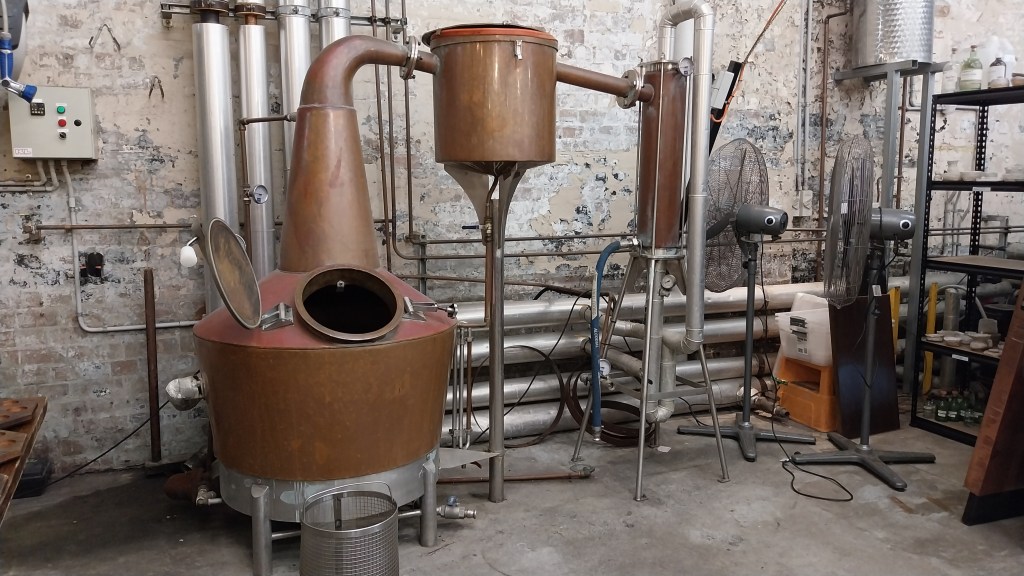
The tour guide, Caleb, welcomed us and, when everyone arrived (we were a large group, about twenty), started the tour. First, he introduced the business, that does not only distil whisky, but also gin, rum and vodka. They run some experiments too, like the Archiemite, a liquor flavoured like the Vegemite (we decided that trying the latter was plenty, though). The distillery was founded in 2014 by Will Edwards, in Sydney. In 2018 they moved to the new site, which is operational since 2020, and as we anticipated, the old site was โ€œmothballedโ€. The first part of the tour focused on gin, which they produce from wheat-based neutral grain spirit. They use one-shot distillation (the still is called Juniper Lopez) with a botanical basket. Each botanical is distilled in isolation, and then the different spirits are blended together: a peculiar approach for gin, given most producers distil the botanicals together (as far as we know).

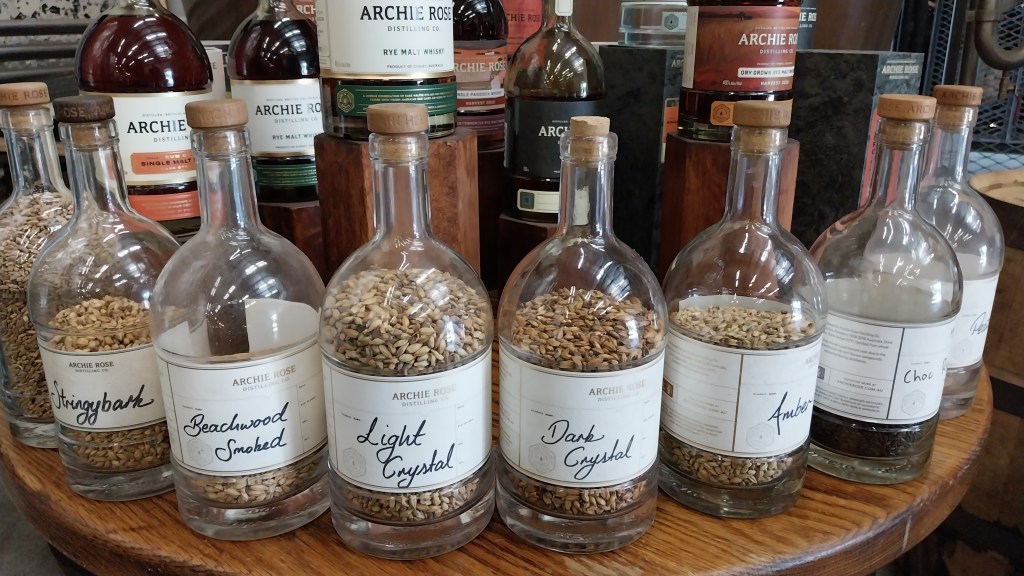
We soon moved to whisky (yay!): the grains, malted barley and malted rye, are mashed in their mashtun (spectacularly named Danzel Mashington!), before undergoing a 2-week fermentation. They had two stills (although the current distillery has many more), called Biggie and Small, with cut points in the second distillation depending on the grain type. One peculiarity of this distillery is that they use six varieties of malted barley, including (but not limited to): pale, peated pale, amber, chocolate, caramel, aromatic roasted, light and dark crystal. They used to mash them together in one mashbill, but they changed approach and now go for individual mashing, fermentation, distillation and maturation before blending the spirits together later on. This process is similar to what Canadians do with their blends, in our understanding.

Cask-wise, they mostly use ex-bourbon, ex-rye, ex-apera (a sherry-like fortified wine produced in Australia, renamed to avoid issues with Sherry GI, which has to be produced in Southern Spain), and virgin oak for the rye whisky. Exceptions are river red-gum tree casks and those used to mature their own rum (obtained from different molasses type, hence โ€œtriple rumโ€).

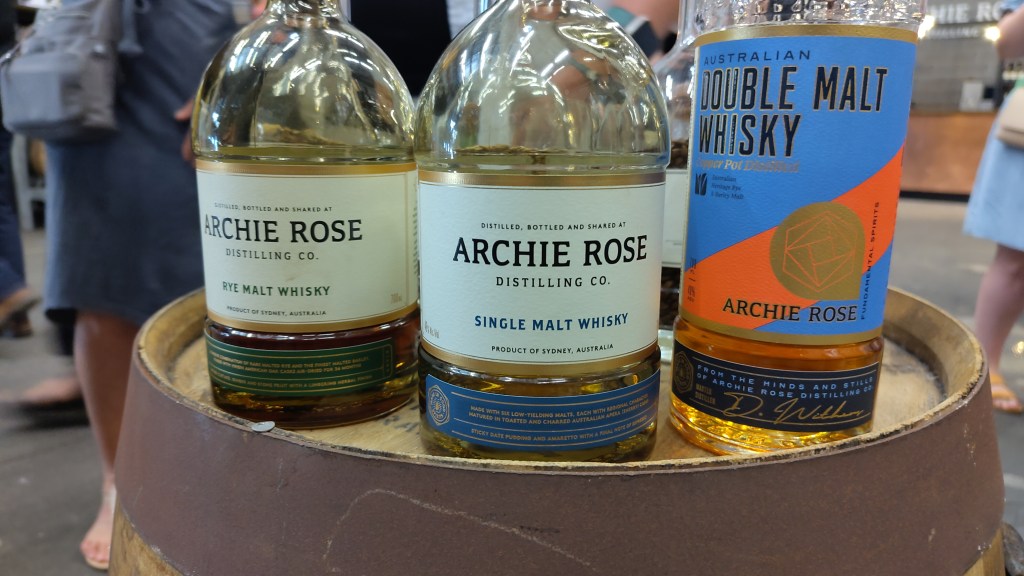
After the production tour, it was time for the tasting: we first tried 3 gins (see below), and then moved to whisky. First off, the Double Malt whisky, which is a blend of rye and single malts, bottled at 40% abv and made with cocktails in mind. Then, we tried both the Single malt and the Rye malt (both 46%): they were good, but both had some herbaceous/bitter notes that are not right up our street.

A wee taster of Aussie whisky.

Once the tour was over, we decided to visit their bigger bar (just next to the distillery) for a flight of their other bottlings. We tried the AR x ST Ali Blasphemy Coffee whisky (40%), a very interesting experimental whisky liquor with coffee used to dilute the abv instead of water. Then, we tried the Heritage Red Gum Cask Single malt (46%, Limited Edition #11), and the Rum Cask Single malt (58%, Limited Edition #10), with the latter being the winner for us. Finally, we had the two Opera House bottlings, the Classical whisky (ex-bourbon and apera casks, all NSW pale malt, bottled at 46%, 5,000 bottles), and the Contemporary whisky (same casks, NSW pale malt, ancient black malt, amber malt, Chocolate malt, again 46%, 3,000 bottles). The classical was our second favourited, after the rum cask. Side note, lots of geeky details on the bottles, nice!

Overall a pleasant visit, although the tour felt a bit corporate and too scripted. However, it was really great to try their whiskies, as the experimentation with malt varieties makes them very interesting. In Scotland only few distilleries embrace such level of experimentation, so for us it was good to try something different. 

Stay tuned for our next story, from another Australian state! Until the next time, slainte!


Archie Rose (former) Distillery Tour and Tasting

Price: 29.00AUD pp (November 2024)

Duration: 1hr

Tasting: Signature Dry gin (42%), Emerald Finger Lime gin (40%), Raw Honey gin (40%); Double malt whisky (40%, malted rye and barley), Single malt (46%), Rye malt (46%)

Target: tourists and whisky curious

Value for money: good

Highlights: the full-on experimentation approach

Recommended: if you have some time to spare in Sydney, why not?

Link: https://archierose.com.au/