#55.5 All drams great and small

A distillery in Northumbria


TL; DR: Our Yorkshire trip had officially ended on Monday morning, but on the way back from Hunmanby to Edinburgh, we and other pals we did a further tour: Ad Gefrin distillery, in Northumberland! Production is aligned with that of Scottish distilleries, but the Northumbria history museum makes the distillery very local. Including the restaurant and bar, it is a great visitor attraction. 

(missed Part 4/Part 3/Part 2/Part 1?)

For the last time, we woke up in sunny Yorkshire, inside our cosy campervan, Mr. Vantastic. The morning was fresh but not cold, we soon got dressed and went for breakfast at the Piebald Inn, where some of our pals were. It was time for our drive back to Leith, but not without a few stops on the long way home.

First, the coastal town of Whitby, a bit less than one hour drive from Hunmanby. A few people on the trip had recommended it to us, and it was indeed worthwhile. We didnโ€™t have much time to explore the pretty town, so we just climbed the โ€˜199 Stepsโ€™ to get a scenic view of the harbour and the old town, before getting a quick lunch and a coffee. Soon after, we were back on the road towards our next destination: the final distillery of the trip.

The distillery is Ad Gefrin (meaning the Hill of the Goatโ€ฆloved it!), in Northumberland, 20 minutes driving (14 miles) south from the Scottish border, in the town of Wooler. They started distilling in November 2022, and opened to public in March 2023. Weโ€™d heard of them a few years ago already, but didnโ€™t manage to visit until now, so we were quite excited. We met at the distillery with other few people from the Edinburgh Whisky Group. We were a bit tight with time, the last ones to arrive, so we had just enough time to park and get a (another) coffee in the very nice bar and restaurant, before the tour started.

Our guide for the tour was Lesley, who showed us the museum on the first floor. This is a very fascinating aspect of the distillery, and a first for us: except some old distillery equipment (Glen Ord), company heritage (Aberfeldy) or copper mining (Penderyn Swansea) exhibitions, we never saw a distillery with a proper history museum.
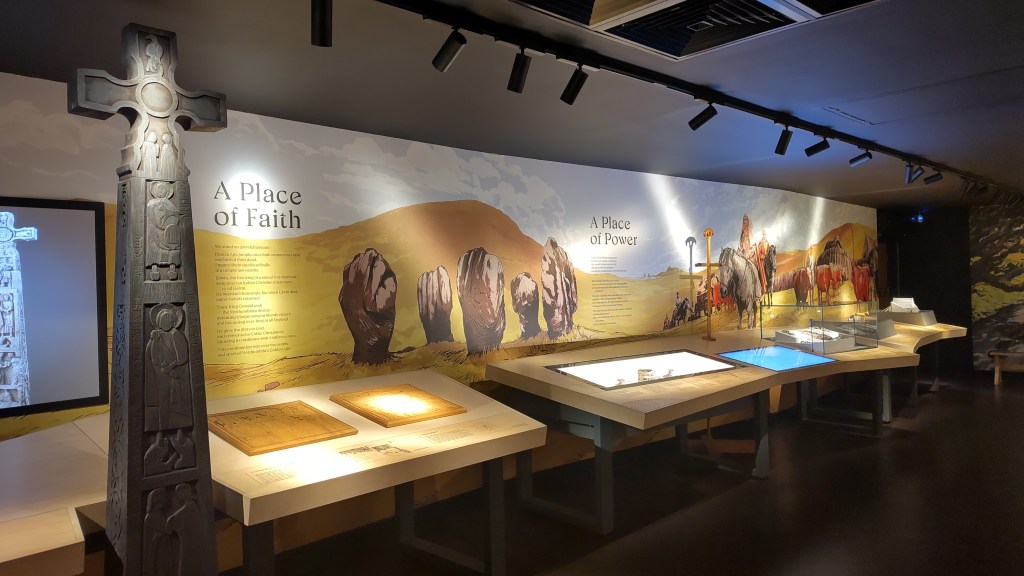
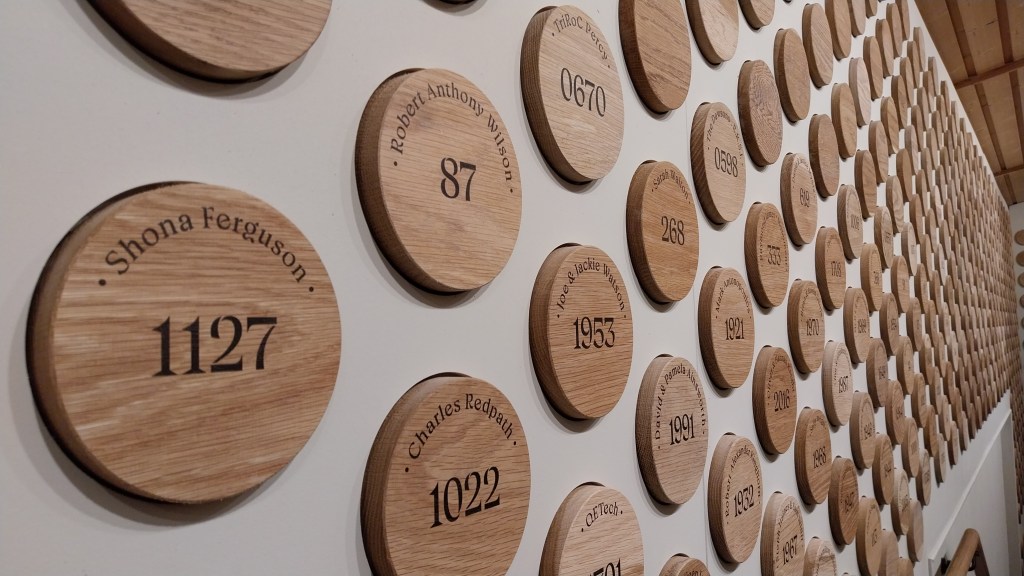
It hosts the collection of artefacts mostly from the Golden Age of Northumbria, when Gefrin was home of a Royal Palace, and it is possible to visit it for ยฃ10.00. Our knowledge of the troubled Britain history between the fall of the Roman empire and the arrival of William the Conqueror is foggy at best (and mostly due to The Last Kingdom TV show, ehmโ€ฆ), so for us it was quite interesting. It is linked to the Gefrin trust, which since 2002 is preserving and investigating the historical sites of Gefrin, first discovered in 1949. The whole project costed about ยฃ10m, and was partially funded by the local council. At the time of visit it had attracted over 70,000 visitors.

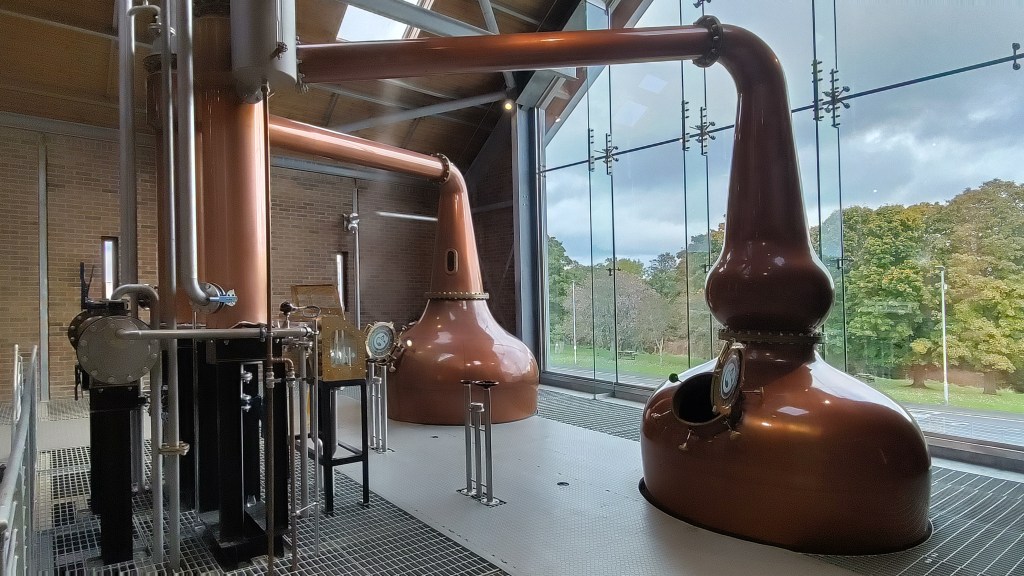
After a video and a few moments in the museum, it was time to check out production, literally behind a door from the exhibition. The distillery, which was set up in collaboration with Ben Murphy, the head distiller, now produces about 270,000 litres of pure alcohol per year. The water source is a borehole, while barley is sourced from four local farmers involved in the distillery business as well. These days, they mostly cultivate the Diablo variety for high yield, which is then sent to Simpsons for malting, in Berwick-upon-Tweed. They process about 25 tonnes of barley every three weeks, doing one mash per day. The malt is mostly unpeated, although before the winter holidays they run an 80% unpeated and 20% peated batch, with the peated barley at high phenols parts per million (ppm).
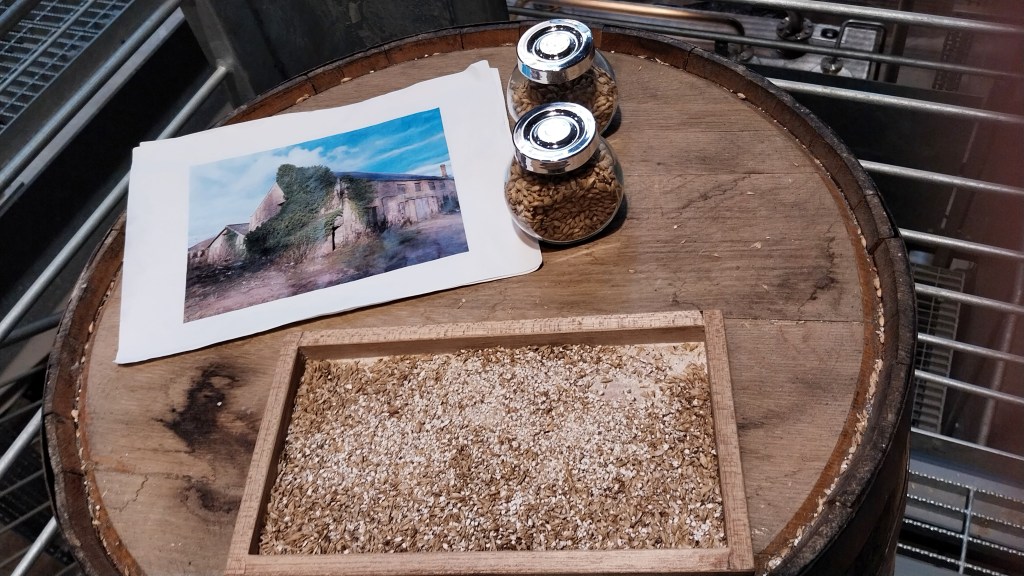
The mashing-fermenting-distilling equipment is from Forsyths, in Rothes, Speyside. The mashing process starts with a run of 65ยฐC water for about one hour, followed by a second run of water at 75ยฐC: from the two they obtain about 5,000 litres of wort. The third water, at 85ยฐC, is kept for the next mash. They currently have four washbacks, with plans to add another four. They use dried yeast, and fermentation lasts about 100 hours, resulting in a 8-9%abv wash.

Similar to Scottish single malt distilleries, they have a pair of stills, a 5,000-litre wash still, from which they obtain about 2,800 litres of low wines, and a 3,500-litre spirit still. In the latter, they cut the head to 75% abv, and then the tails from 65% abv, obtaining 600 litres of newmake spirit. Casks are filled on site, at the standard strength of 63.5%abv, and the bottling plant is on site too. They also produce gin with a dedicated still (fortunately!).
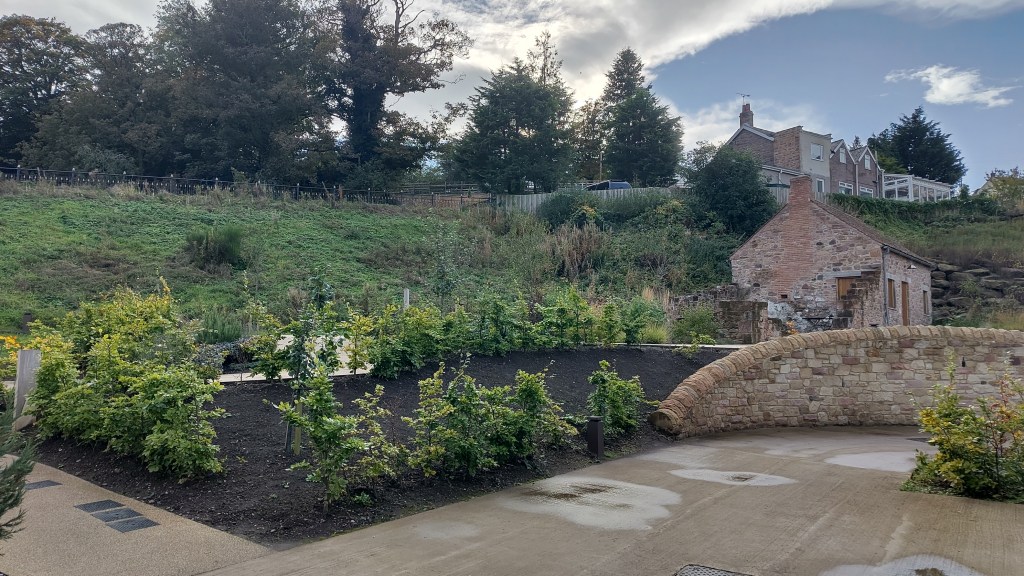
After the tour of production we walked outside, to a nearby, very beautiful building. This used to be an old mill, now used for storage. We also checked out a warehouse hosting, among other things, about 200 privately owned barrels.
Back at the visitor centre, it was time for the tasting with Gwen, another guide. First off, the Tacnbora, a blend of irish and Scottish malts and grain whisky, bottled at 42.7%abv, from Oloroso sherry, ex-Bourbon and American virgin oak barrels. It was sweet and drinkable, someone would call it a โ€œbreakfastโ€ dram. It was followed by their Thirlings Dry Gin (43.4%) and Flรฝte Whisky Cream Liqueur (17%). It was a very enjoyable visit, and we liked the idea of this project: not just a distillery, but rather a wider hub for all types of visitors, with a restaurant/bar and the museum.

Overall, it was a very interesting trip, an eye-opener on what other whisky producers are doing in neighbouring countries. Production-wise, Ad Gefrin was the most akin to a typical Scottish distillery, following the same path that other English distilleries took, like White Peak, Cotswolds and the Lakes. On the contrary, it was exciting to see how the other distilleries we visited could take advantage of more relaxed rules. For example, both Spirit of Yorkshire and Ellers Farm use wash not produced on the same site as the distillery (for the second, even produced by another company), while also mixing column and pot distillation. Cooper King have only one still to run both distillations, something we never observed in Scottish distilleries so far.

However, the thing that most hit us was the amazing hospitality. That might be due to the need of making a name for themselves, which is not granted by a geographical denomination of their products, but still, in all places we felt welcomed and not took advantage of. We cannot recommend enough to get in touch with these distilleries.

Until next time, slainte!


Ad Gefrin Distillery Tour

Price: ยฃ25.00 pp (October 2024)

Duration: 1hr

Tasting: Tacnbora (blended whisky, NAS, 42.7%, Batch 3); Thirlings Dry Gin (43.4%) and Flรฝte Whisky Cream Liqueur (17%)

Target: tourists and whisky novices

Value for money: ok

Highlights: the Northumbria history museum

Recommended: yes

Link: https://adgefrin.co.uk/


#55.4 All drams great and small

A dram-y day at the Distillers Lounge, in Scarborough


TL; DR: On the (almost) final day of our trip we didnโ€™t visit any whisky distillery, but a rum one. It is located inside the Distillers Lounge, in Scarborough, where we had a full-on English whisky tasting and a great meal, before turning our attention to rum. It was a very fun day, and we have to say the quality of English whisky is really improving! 

(missed Part 3/Part 2/Part 1?)

On the Sunday morning, in spite of the very busy Saturday (two distillery tours, a brewery visit and the quiz), we woke up surprisingly rested. The morning was easy, we had breakfast in the van and a short stroll in Hunmanby, before gathering with the troop (except for some, who headed back home earlier) at the train station. Our destination was not far away: Scarborough, on the Yorkshire coast. In our understanding, Scarborough used to be a popular seaside destination for rich people to clear their lungs during the Industrial Revolution, in particular around the Victorian era. Nowadays, it doesnโ€™t look as glorious, with a lot of closed up units on the high street, we guess one of the many victims of the massive deindustrialisation of the 80s and 90s.

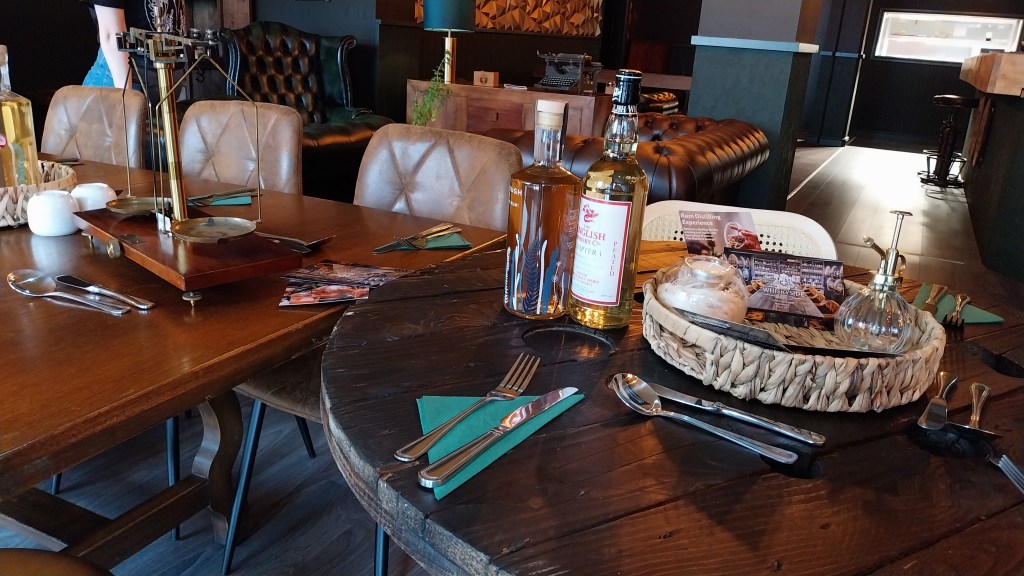
Now, one could ask: โ€œWhat were you doing there, then?โ€, which is a more than legit question, given the above. Well, itโ€™s easy: because of the Distiller’s Lounge. This is a venue, conveniently located at walking distance from the train station, with a restaurant, a tasting bar and a spiced rum distillery.

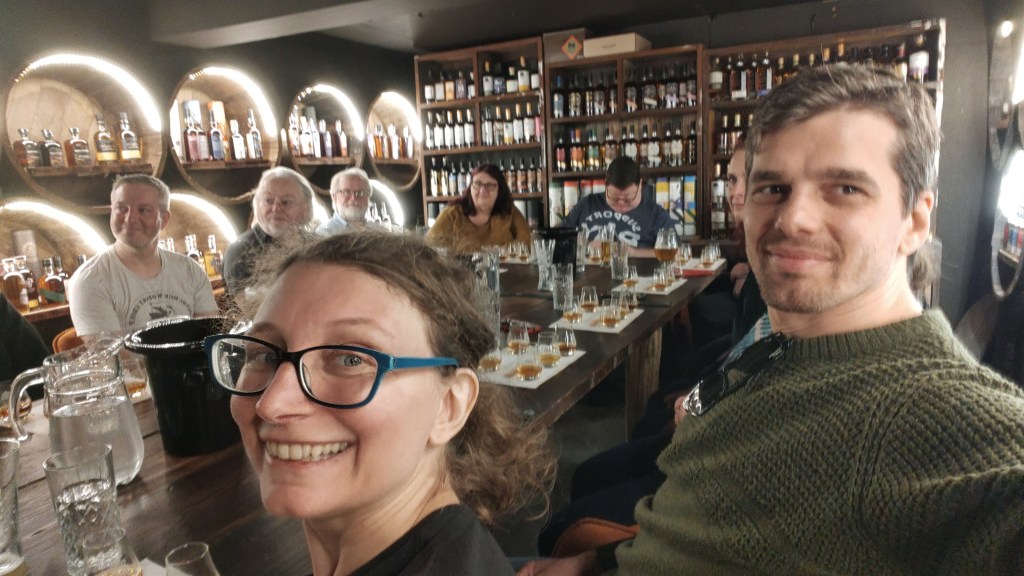
The whisky tasting bar is managed by Whiskyside, a small company run by Matt, promoting and selling English whiskies. As you can guess, the plan was a full-on English single malt whisky tasting. The location was a room underneath the main bar, looking a lot like a cellar. There, the biggest collection of English whiskies we ever saw was on display. It included pretty much everything you could think of, from limited releases and from independent bottlers. We even spotted a Bimber bottled by the guys behind Whisky Facile, an Italian whisky review website and blog.

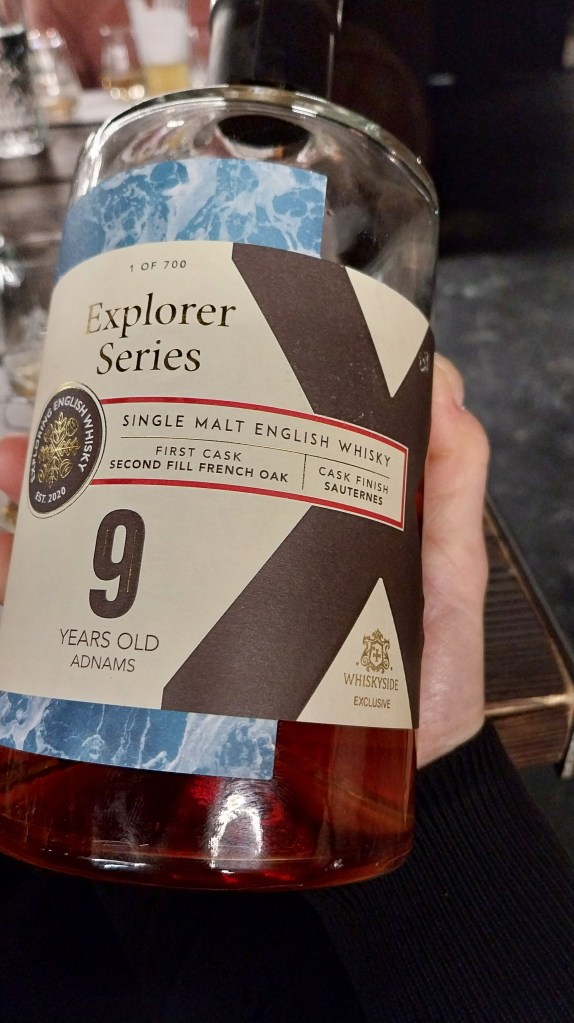
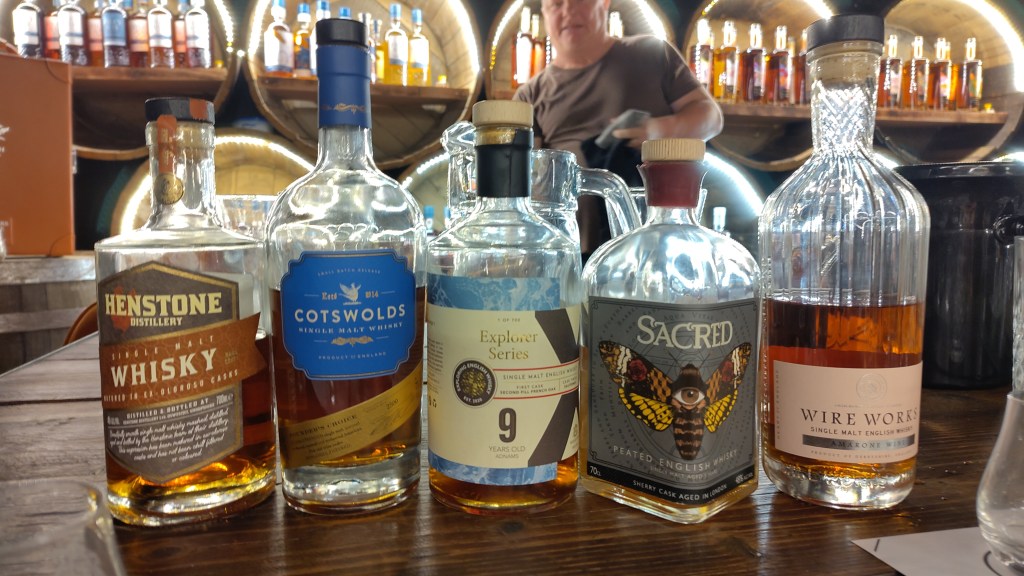
The tasting started with a first for us, a Henstone single malt, from a distillery in the Shropshire (near the Welsh border) established in 2017. A young expression, but quite round despite the age, matured in ex-oloroso sherry casks. The second dram was an old acquaintance, the Cotswolds (visited in Summer 2023) Founderโ€™s Choice, a small batch release (in this case 2,500 bottles), fully matured in STR casks (former wine casks, shaved, toasted and recharred). It comes from the Cotswoldโ€™s small batches of the same cask type, ranging from ex-bourbon to ex-sherry, ex-peated whisky, etc. A very nice dram, very drinkable, but it didnโ€™t impress us, contrary to the one that followed. This was from Adnams, a brewery and distillery in Southwold, which we had tried one or twice before. This expression was a 9-year old bottled for Whiskyside, bottled at 55%, part of their Explorers Series. The combination of casks is quite unusual: matured in second-fill French oak casks, and then finished in ex-Sauternes barriques (for two years), a finish that we generally struggle to appreciate. This one, however, smashed all our prejudice on Sauternes casks, as it was delicious, full of sweet, cream and chocolaty notes: tiramisรน in a glass. What was weird is that we came across the same tasting notes independently, before sharing them.

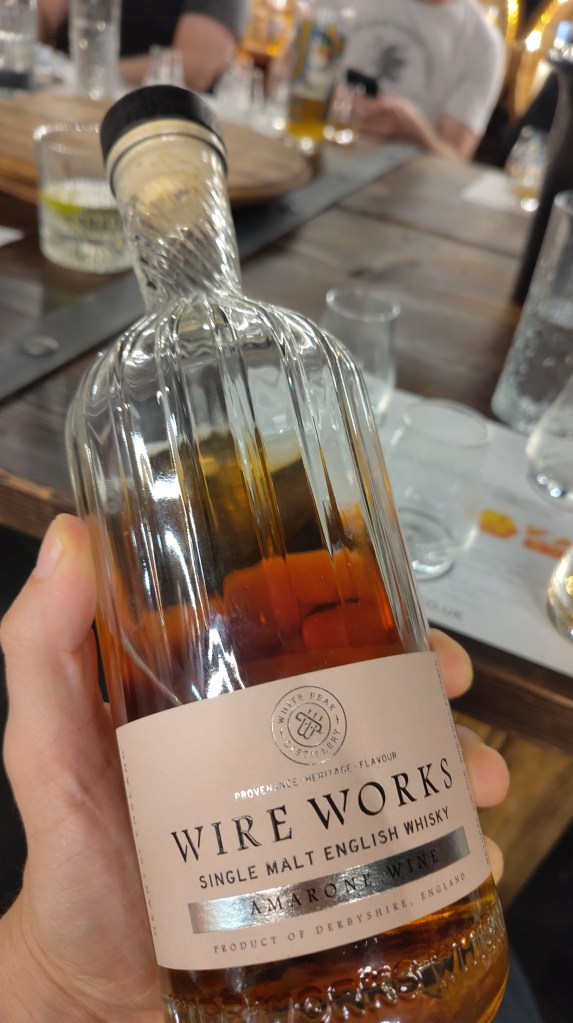
The fourth dram marked the introduction of peat. First off, a 5y single malt finished in ex-PX casks (from Bodega Navarro, previously in ex-bourbon hogsheads). In our understanding this one was from the English distillery, but bottled in 2019 by Sacred Spirits (or Sacred Gin), after the second maturation in London (donโ€™t know why it is important, but it is stressed on both the label and the website). It was a decent dram, but again we were blown off by the final one: a lightly peated Wireworks (from White Peak distillery, one of our favourite tours in 2023) matured in ex-Amarone red wine casks, bottled at 54.1% and made in a small batch of 662 bottles. Grilled berries notes, an excellent dram. Overall, it was an impressive tasting, it showed how good English whisky can be, even at young age.

After the tasting, we moved back upstairs for the meal, which included two courses for slightly less than 30 quid. When we saw the price, weeks before (one of the necessary evils of these group holidays is that we have to choose our meals weeks in advance), we were not so convinced. Truth be told, it was a fantastic meal, in particular the lamb was one of the best we ever had since we moved to the UK.

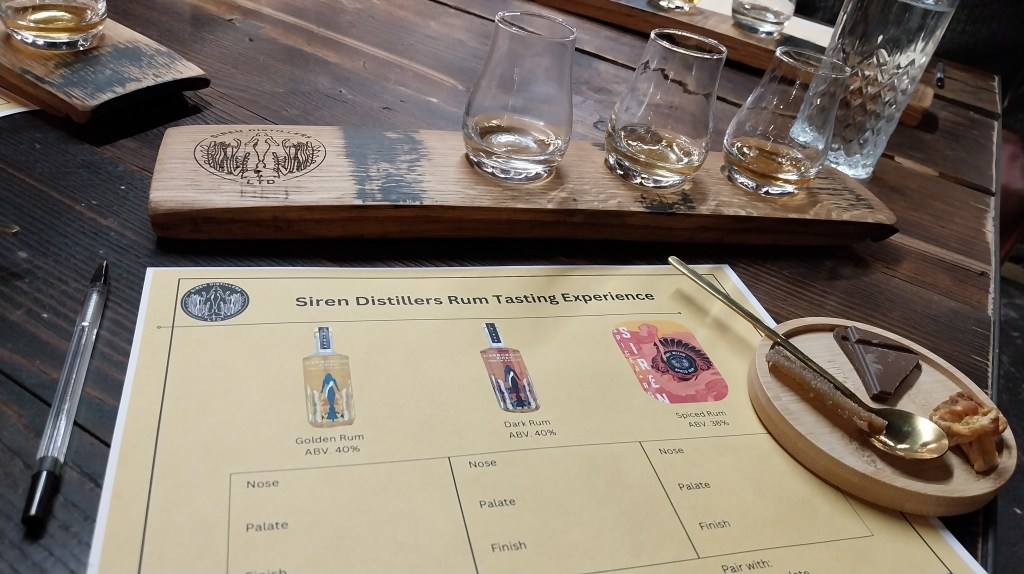
After this tasty lunch, we went back to the cellar, this time for another tasting: a rum one, with mainly tots from the local Siren Distillers company, run by Jamie and Anna. The distillery is in the Distiller’s Lounge itself, right upstairs, with the still in the window. (Update March 2025: we learned from posts on social media that the collaboration between the Distillers Lounge and Siren Distillers ceased, so they moved to a different location).

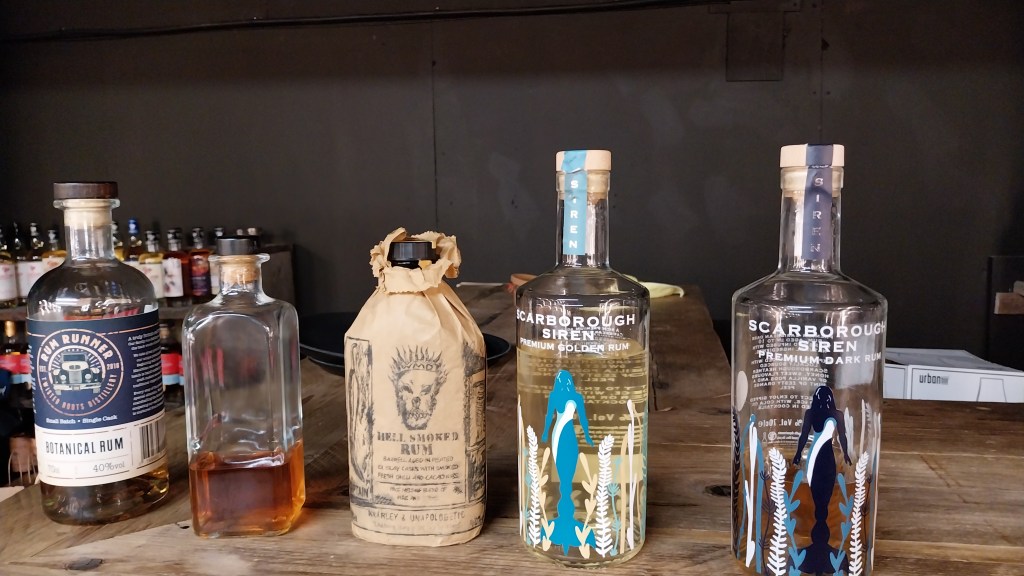
Their main activity is to source rum, and then redistill or infuse it with their spices of choice. From their range, we tried the Golden rum (40%, blend of 5y Caribbean rums, infused with honey, orange peel and vanilla), the Dark rum (40%, blend of Caribbean rums, including a 10y Jamaican one, and again infused with honey, orange peel and vanilla), and a preview sample of their Spiced rum (38%, redistilled with a number of spices), respectively paired with candied ginger, dried pineapple and dark chocolate.

We also tried the Botanical rum from Rum Runner (40%, distilled at Twisted Roots Distillery, aged in ex-red wine French oak cask), and a spicy (yes, spiced, but also SPICY) rum, the Hell Smoked Rum (40%, barrel-aged in peated ex-Islay Whisky casks with fresh chili peppers and cacao nibs). It was an interesting tasting, although we are not really into spiced rum, so we didnโ€™t (and still donโ€™t) have much basis for comparisons.

After the train back to Hunmanby, we had a last pint at the Piebald Inn (to Gianluigiโ€™s disappointment, the kitchen was already closed) before retiring to the van. Overall, it was a very fun day, and we were particularly impressed with the English whiskies we tried. One popular Glaswegian whisky youtuber said (more than once) that there is nothing like good English whisky to keep Scottish producers on their toesโ€ฆTrue or not, we can definitely say that the quality of these malts is good in general, fantastic at times! And hospitality-wise, many Scottish producers should take example from their neighbours.

It was the last โ€œofficialโ€ day of the All Drams Great and Small tour, but we saved one last whisky experience for the following day. Until then, slainte!


The Distiller’s Lounge
Link: https://www.jspubcompany.co.uk/distillers-lounge/

Whiskyside
Link: https://whiskyside.co.uk/

Siren Distillers
Link: https://www.sirendistillersltd.com/

#55.3 All drams great and small

An English malt with a Tasmanian twist and an eye for sustainability


TL; DR: From Ellers Farm, we went directly to another distillery: Cooper King. Inspired by Tasmanian craft distilleries, they produce other spirits other than single malt, with a very interesting set up. And, everything is done in the most sustainable way possible, kudos! After the visit, we went to Brew York, for a tour, dinner, and a quiz! 

(missed Part 2/Part 1?)

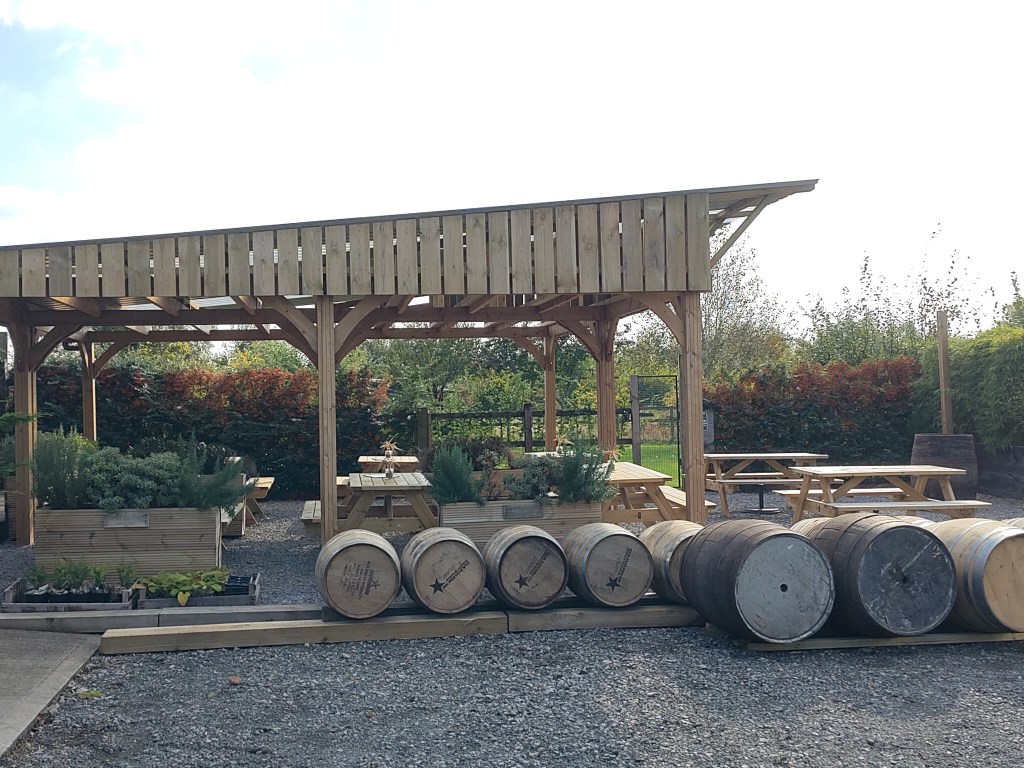
After the visit at Ellers Farm, we jumped back on the minibus. Our next destination was only about half hour away driving north-west, approximately 13 km north from the city of York, in the village of Sutton-on-Forest. The distillery is called Cooper King, just outside the village. It was founded by Abbie and Chris, a couple who got the inspiration while travelling in Australia and visiting local distilleries. The distillery is named after Charles Cooper King, Chrisโ€™ great-great-grandfather. The main building is just a few meters from the gravel parking lot, and it harbours a bar/shop and production. There is also a nice wee garden outside, with wooden tables and benches, which we took advantage of after the tour. It was a nice sunny day!

We were welcomed by Mark, tour guide and assistant distiller. Like others, he came on board as a crowdfunder. At some point (in our understanding) the two founders Abbie and Chris asked who among the crowdfunders wanted to be more involved, and Mark answered the call. We could clearly see his passion for the project. He explained that, in 2014, Abbie and Chris, once a biochemist and an architect, moved to Australia to travel, and started working as fruit pickers. Then, they went to Tasmania, and after getting in contact with Sullivanโ€™s Cove and Lark, they decided to go back to England and produce a Tasmanian-style whisky. Back in Yorkshire, they bought the land thanks to a crowdfunding, as well as a 900-litre pot still (Neilson) straight from Australia.

Another principle they had in mind when setting up the distillery was sustainability. The electricity comes from renewable sources, of which 60% is produced on site with solar panels: this contributed to make them the first net-zero distillery in England. They also have a programme for planting trees and restoring woodland and wildflowers habitat for each bottle they sell. Moreover, they chose lighter bottles, and offer refills at the distillery, for a few quid less.

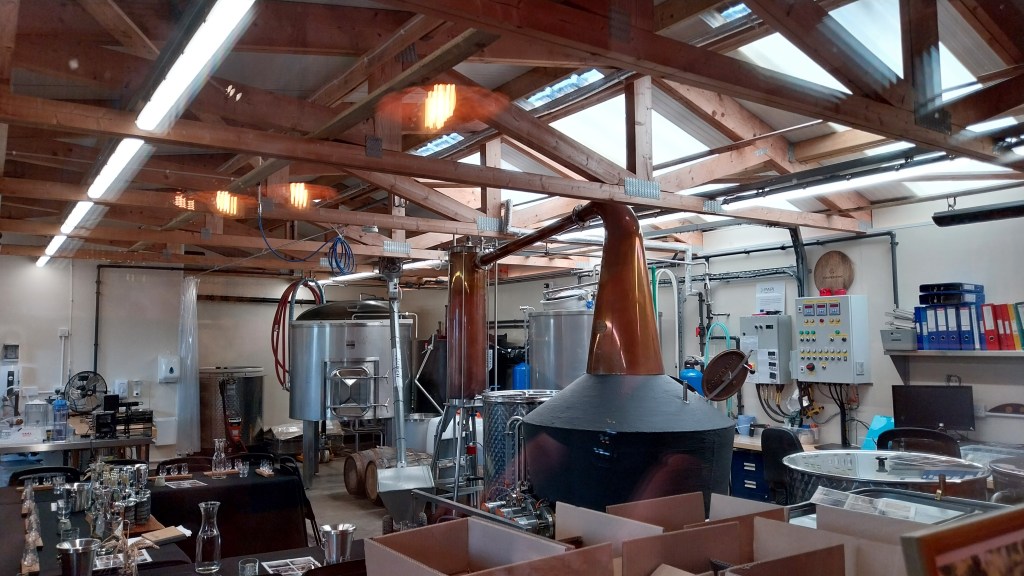
Production-wise, they use Maris Otter barley malted in middle England. They pre-heat the small mashtun before mashing the malt. After that, the remaining draff goes out to local farmers to feed cows. Fermentation takes place in a 1750-litre plastic vessel (usually only half full to avoid foam accidents) and lasts seven days. Both distillations happen in the same still, which is different to what we saw in all the Scottish distilleries we visited so far. At first, Neilson the still was heated externally, but to make the process more efficient it was sent to Scotland for modifications and is now internally heated and insulated.

The wash gets distilled to 25% abv, while the heart of the second distillation comes out on average at 75%, before getting diluted by filtered tap-water. Needless to say, everything in the distillery is very manual, except for the gin and vodka very modern cold-distillation machines (which take only about 10% of energy compared to a classic copper pot distillation).

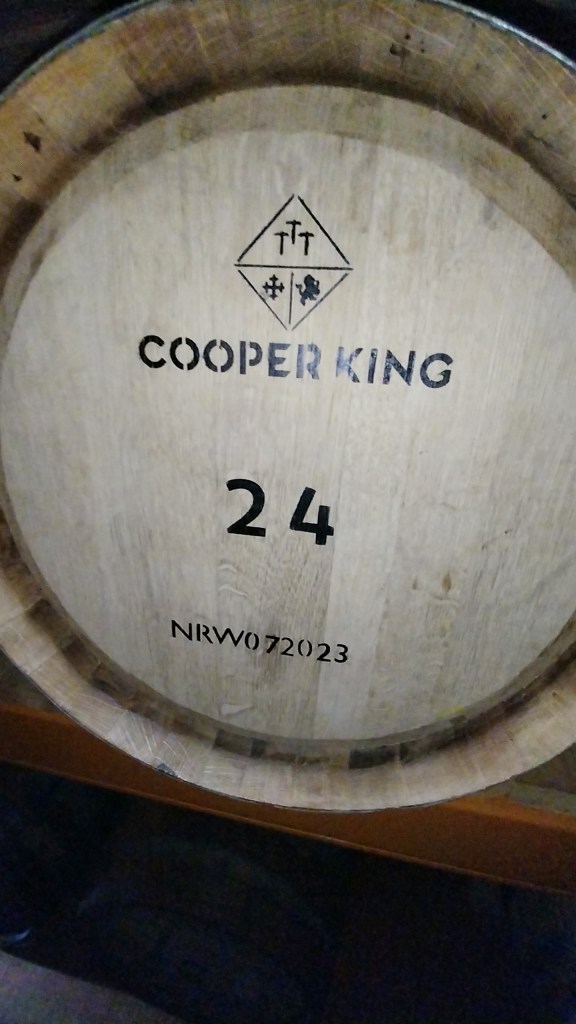
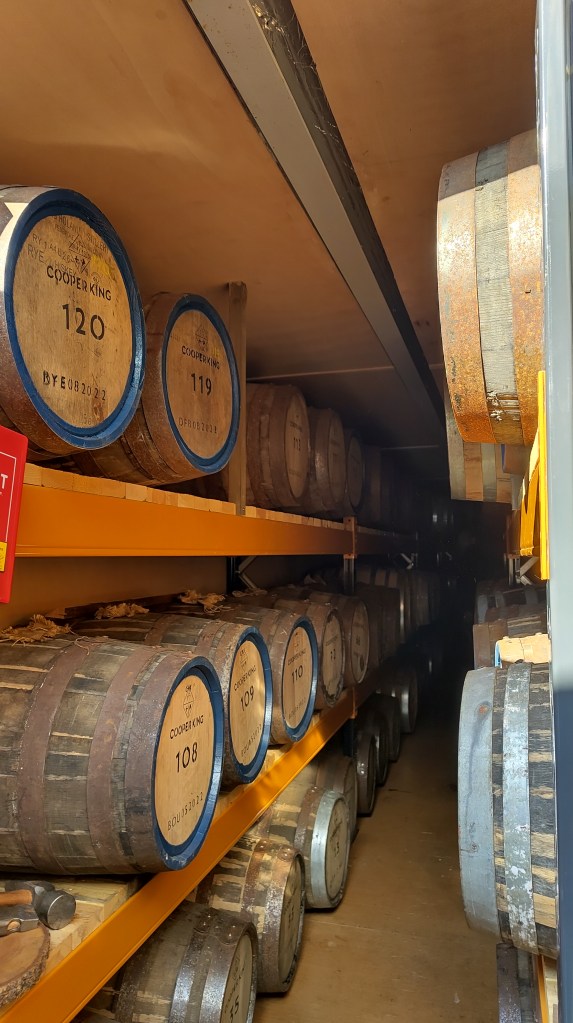
They use a variety of casks from all over the world, and their main American cask supplier is the Garrison Brothers distillery, in Texas. Casks are kept in a safe container behind the distillery, while waiting to get a proper warehouse. They started distilling newmake spirit in 2018, and their first whisky was released in October 2023, about a year before our visit.

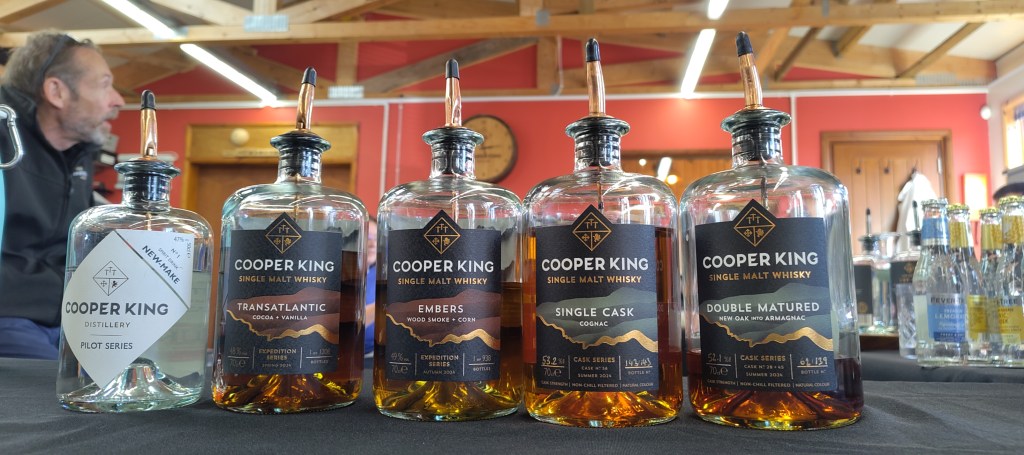
While we were outside checking out the casks, another member of staff set up the tasting in the main production room, which also serves as a tasting location. First, we went through five liquors and gins (see below), but as itโ€™s not really our focus, we wonโ€™t spend many words on it. We were really interested in their whiskies. The first one was not exactly that: a newmake spirit, from the โ€œPilot Seriesโ€ and bottled at 47%. It was followed by two single malts from their โ€œExpedition Seriesโ€, Transatlantic (ex-bourbon and ex-wine casks, 48%), and Embers (charred ex-bourbon casks, 49%). Then, two single casks: first, an ex-Cognac matured single malt, bottled at the 53.2% natural cask strength; second, a dram first matured in virgin oak casks, then re-racked into an ex-Armagnac cask, again cask strength at 52.1%. The evaporation (or โ€œangel shareโ€) is higher compared to Scotland, about 4%, which combined with other specific conditions, might cause the abv to be lower for such young whisky. Overall, we could tell the degree of experimentation at this distillery is high.

After the tasting we had a few minutes to spend in the sunny patio, sipping on our leftover drinks, before getting back on the mini-bus. We headed towards York, precisely the Brew York Brewery. Despite the city location is not their main production facility anymore (that one is in Yorkโ€™s outskirts), itโ€™s still a massive place. We did a production tour (ยฃ15, including four tastes) and then had dinner there (they do a range of Asian-inspired dishes, which were delicious, albeit heavy on spring onion). Unfortunately, the place was too noisy for the next scheduled activity, a whisky-based quiz, so we had to move to a quieter pub nearby. The quiz, organised by our whisky veteran pal Charlie, was great fun, and we went back to base all very happy.

What a great afternoon and evening we had! At that time, we had tried very few craft Australian whiskies (and even less Tasmanian ones), so the link between them and Cooper King was not evident to us. At the time of writing however (after a serendipitous trip to Australiaโ€ฆStay tuned in the coming weeks for more), the connection is quite obvious: we spotted a very typical herbaceous note in Cooper King drams, the same we found in most whiskies down under. Overall, itโ€™s a very interesting project, which we are very glad we got to know more of.

Next up, another Yorkshire whisky day, but not a distillery! Until next time, slainte!


Cooper King Distillery Bespoke Tour

Price: ยฃ20.00 pp (October 2024)

Duration: 1hr 30min

Tasting: 5 spirits (Dry Gin, 42%; Herb Gin, 40%; Smoked+Spice Dry Gin, 41%; Black Cardamom Vodka, 40%; Berry+Basil liqueur, 25%) and 4 drams: Transatlantic (48%, ex-bourbon and ex-wine, 1208 bottles), Embers (ex-bourbon, 49%, 938 bottles), ex-Cognac matured single cask (53.2%), virgin oak/ex-Armagnac cask (52.1%)

Target: whisky and spirit enthusiasts

Value for money: very good

Highlights: the distillery set up

Recommended: yes

Link: https://www.cooperkingdistillery.co.uk/