#46.1 The return of the smoke

The not-so-new guy on the block


TL; DR: More than two years after our first trip to Islay, we are finally back! This time, with Mr Vantastic and two special companions, we visited (almost) all the distilleries we didnโ€™t manage the first time, starting with one that, 2 years ago, was still a building site: Port Ellen! A very beautiful site, with an experimental twist. 

It is not by coincidence that Islay is called the Queen of the Hebrides. There is something magical about this island, and it is not just the whisky. Maybe it has to do with the effort and the long trip to get there (well, unless you fly from Glasgow), that will take you through the west of Scotland and then, after a 2-hour ferry trip, finally on the island! But yeah, once you know, you know.

Our last trip, in spring 2022, was quite unfortunate: the rented campervan broke, so we had to book last-minute accommodations and cabs. During the only walk we did, it pished down rain, so we were also wet and smelly. But somehow, we managed to visit all the six distilleries weโ€™d scheduled (Bunnahabhain, Ardnahoe, Kilchoman, Bruichladdich, Lagavulin and Laphroaig).

This trip was a long time coming, we would have liked to make it back in 2023,  but we couldnโ€™t. Another idea was to go earlier this year  (2024, if youโ€™re reading in the future) but the plan fell apart (well, we went to the stunning Raasay instead!). What finally made us take the step was the reopening of Port Ellen distillery. It originally opened in 1825, and the whisky was mainly used in blends. It was closed down by DCL (Distillery Company Ltd) during the whisky loch of the 80s, so together with many others, it didnโ€™t make it to the new millennium. In the meantime, however, the whisky became a cult among single malt lovers, particularly the well-aged expressions (according to some experts, their malt was not well regarded at young ages, one of the reasons for closing it down). Therefore, similarly to Brora (and Rosebank, by Ian McLeod), Diageo decided to revive it: basically, it was rebuilt from scratch, near the Port Ellen maltings, to the west of Port Ellen village. It started production earlier this year. It is open to visitors, but with Diageo being Diageo, the tour is astonishingly priced at ยฃ200 (two-fricking-hundred)! Unlike Brora though (where the two available tours costed respectively ยฃ350 and ยฃ600 the first time we drove by, now -July โ€™24- changed to ยฃ225 and ยฃ900, ludicrous), they offer a once-a-month open day (first Friday or Saturday of the month), running several free tours per day: yay!

We took advantage of it as soon as we could, and we booked a spot for the July open day, for us and our friend Justine (Kask Whisky). Because it was on a Friday, we organised the whole weekend around it, with visits to other distilleries too. A couple of weeks after we’d booked everything, Edo (Gianluigiโ€™s youngest brother) told us he wanted to come visit in July, so he joined us too. He likes whisky, and according to Gianluigi, he has the best palate of the family (heโ€™s an exceptional cook!). So there we were, on a Thursday morning, ready for our trip: at first the two of us, Edo, and Mr Vantastic, on the road.
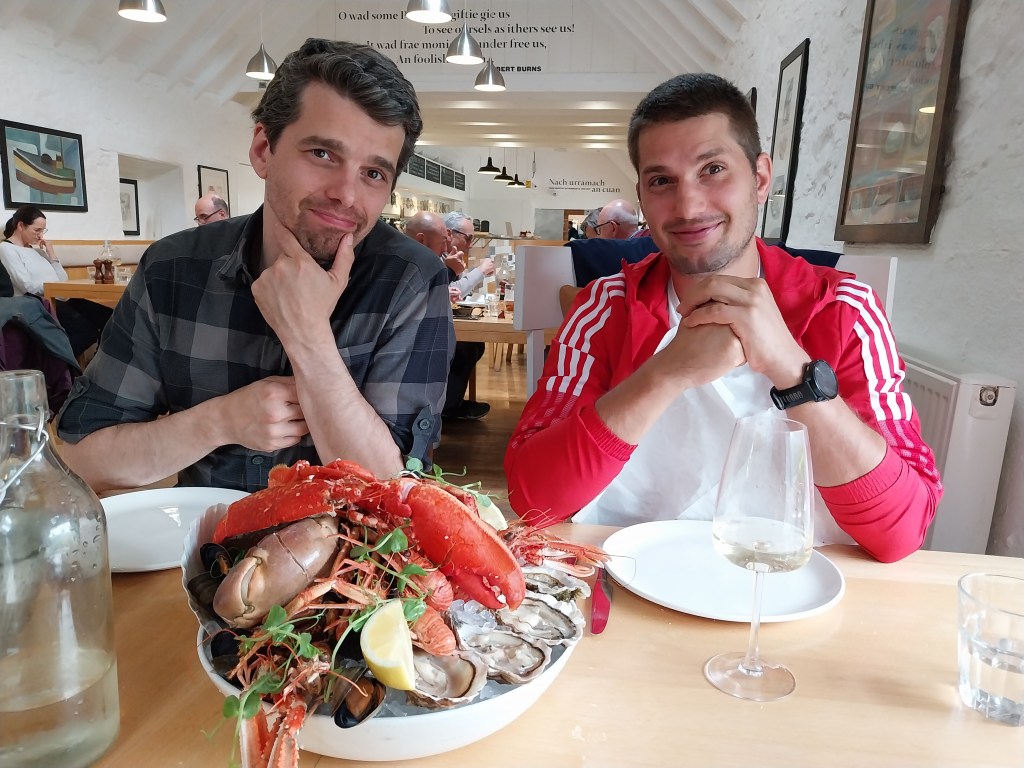
Our ferry was booked for the evening, so we did a few stops in between: Fyne Ales brewery (always very tasty pints) and for lunch at Loch Fyne Oysters, pricey but the array of seafood we ate was exceptional! We also briefly stopped at the George Hotel, Inveraray, to say โ€œhiโ€ to our friend Ivan (and for Gianluigi and Edo to get a dramโ€ฆTeresa was driving at that point). As we drove towards Kennacraig, the weather got worse, so much that they changed our destination, Port Askaig instead of Port Ellen (sad trombone sound). The wind was howling on Islay as well, but we drove straight to our parking for the night, while admiring some piles of peat drying out along the way. We parked our van next to Justineโ€™s Post Dram Prat and had a small meal and a few drams (the Ardray, a new Suntory blended scotch, was the surprise of the evening), before slowly drifting to bed.
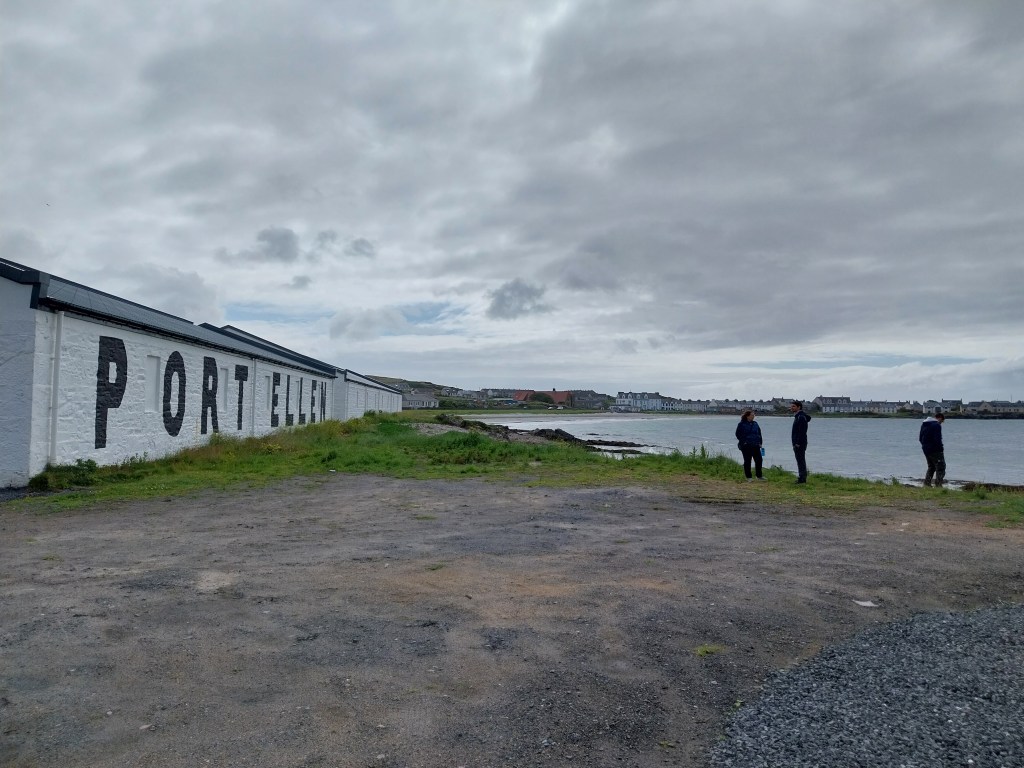
Because of the wind, which was still blowing in the morning, we couldnโ€™t get much sleepโ€ฆespecially Edo, who slept in the pop-up roof. We woke up early and had breakfast at the van with Justine. We were a tad slow, so before our visit we didnโ€™t do anything except packing up the van, but we still arrived early at the distillery. Indeed, we were the first ones there, and at first everything looked closed. Fortunately, about 10 minutes before the tour starting time, someone opened the door and checked us in: for the first tour they were waiting for other 14 people, so 18 in total!
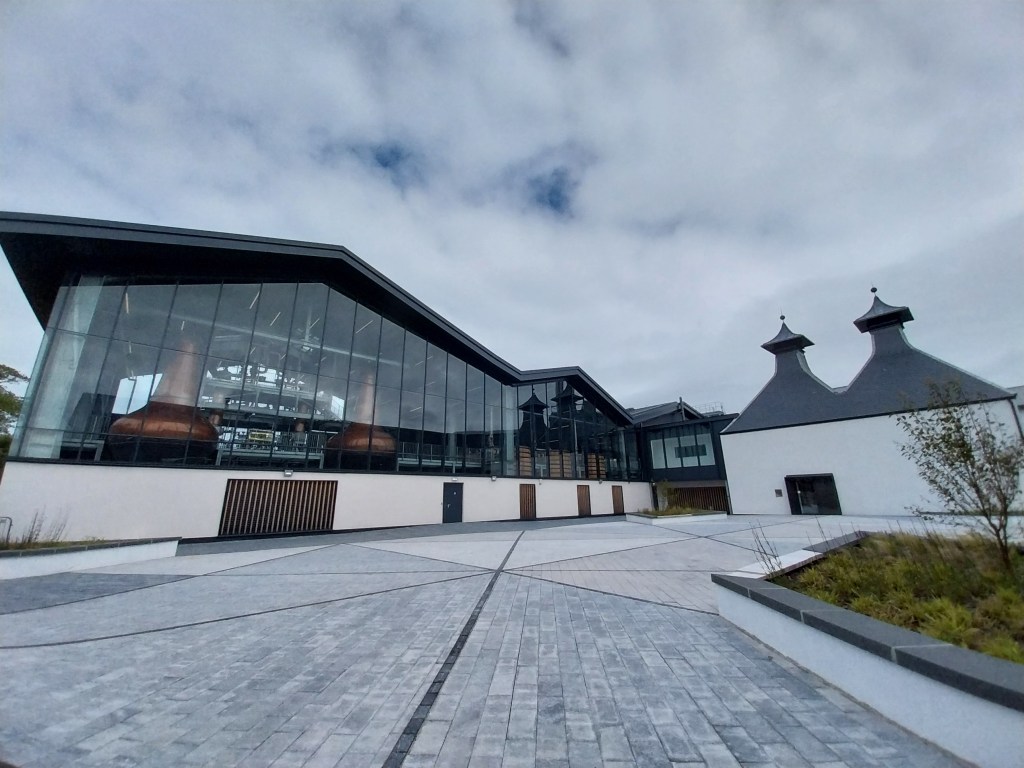
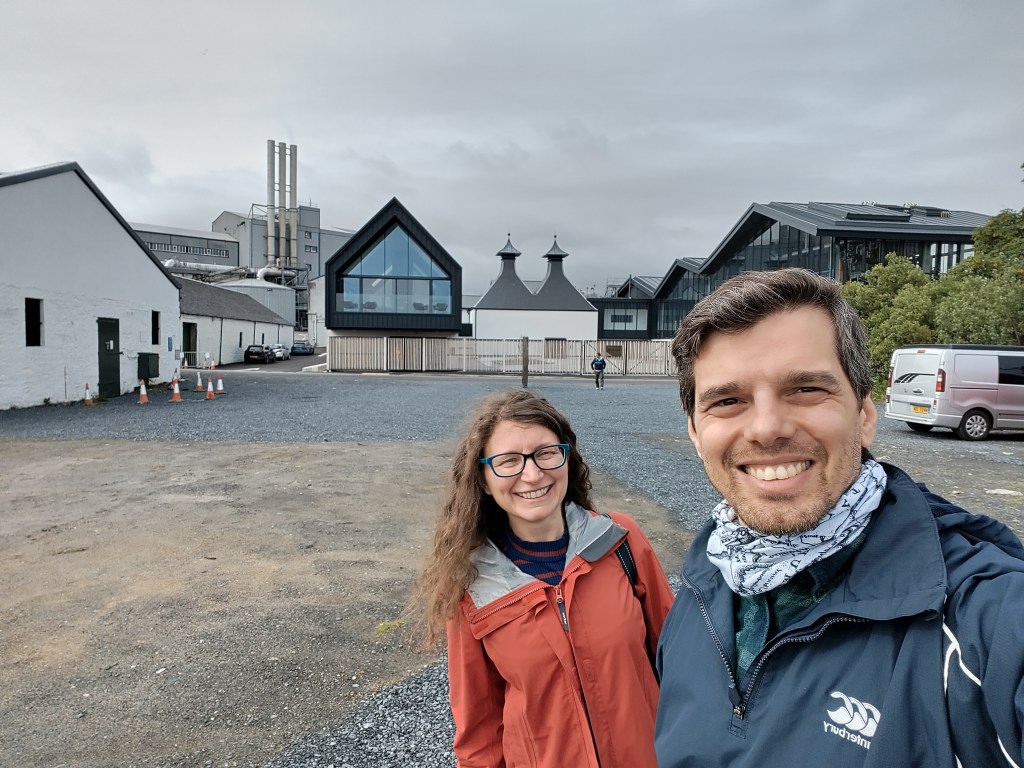
As everybody arrived, we started the tour with Allan, the distillery manager. He is very experienced, as he worked on all the four Diageo sites on the island (3 distilleries and the maltings), so we were quite excited. He started by showcasing the installations in the visitor centre hall. A note here: we call it โ€œvisitor centreโ€, but it is clearly different from what we are used to, even in comparison to other Diageo recently renovated distilleries. It is very modern looking and bright, and there is no shop (unless it is upstairs, where we didnโ€™t go). The clear intention was to set up something classyโ€ฆHowever, in a clumsy way, as to us it looked like a fancy residence or office lobby.
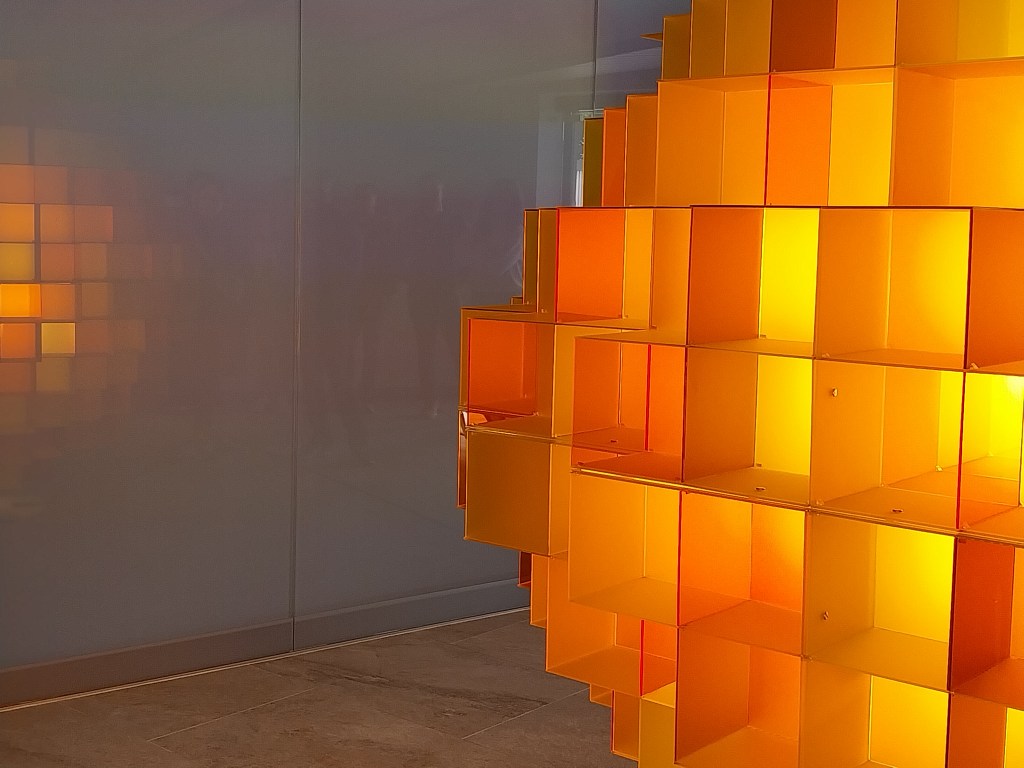
One great feature, instead, is their use of mostly renewable sources for energy. The distillery was (re)built with the intention of making it as carbon neutral as possible, which is very valuable. As we moved to production, Allan showed us their permanent lab, which is quite unique: here, a full-time analyst checks the peat levels in the barley and the spirit, thus serving both the distillery and the maltings.

We then took a look at the mill room, a very large space with a very modern mill, which we expected as the site has been totally rebuilt (so no Porteous here!). Back to the main production room, we were right in front of the mashtun: a stainless-steel big baby, semi-Leuter, with a shiny lid.
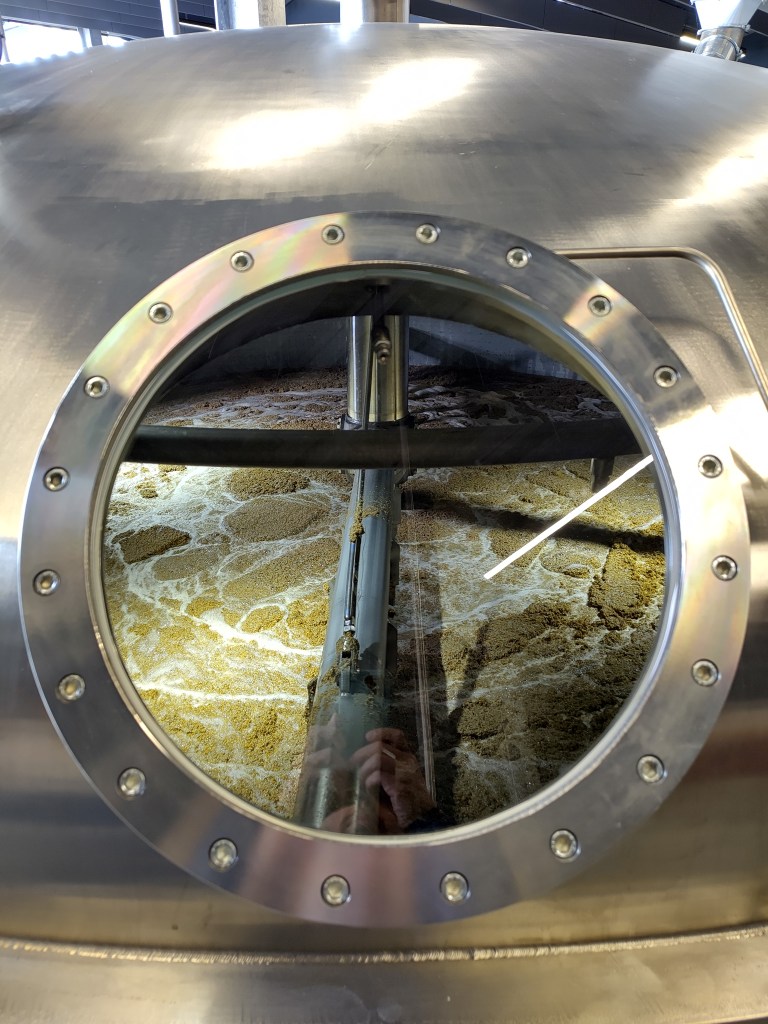
Look what’s mashing!

At the moment, they do 11 mashes per week, mainly with Concerto barley but really with โ€œwhatever comes inโ€, and they have no silent season (except for maintenance, when required). They do mashes of different sizes, one of 5.5 tons for the experimental stills, and one of 7.5 tons for the regular stills (more on that later). With less water runs per mash, this is one of the steps where they save on water, which is common to many Diageo distilleries nowadays. The process is like sparging when brewing beer, in our understanding, with only one water gradually heated up. The wort is then moved to one of the six Oregon pine washbacks, each one with a capacity of 52,000 litres, but they never reach these levels. Fermentation lasts between 92 to 130 hours, quite a long one. Allan allowed us to nose the wash, and if we wanted taste it, but none of our party did.
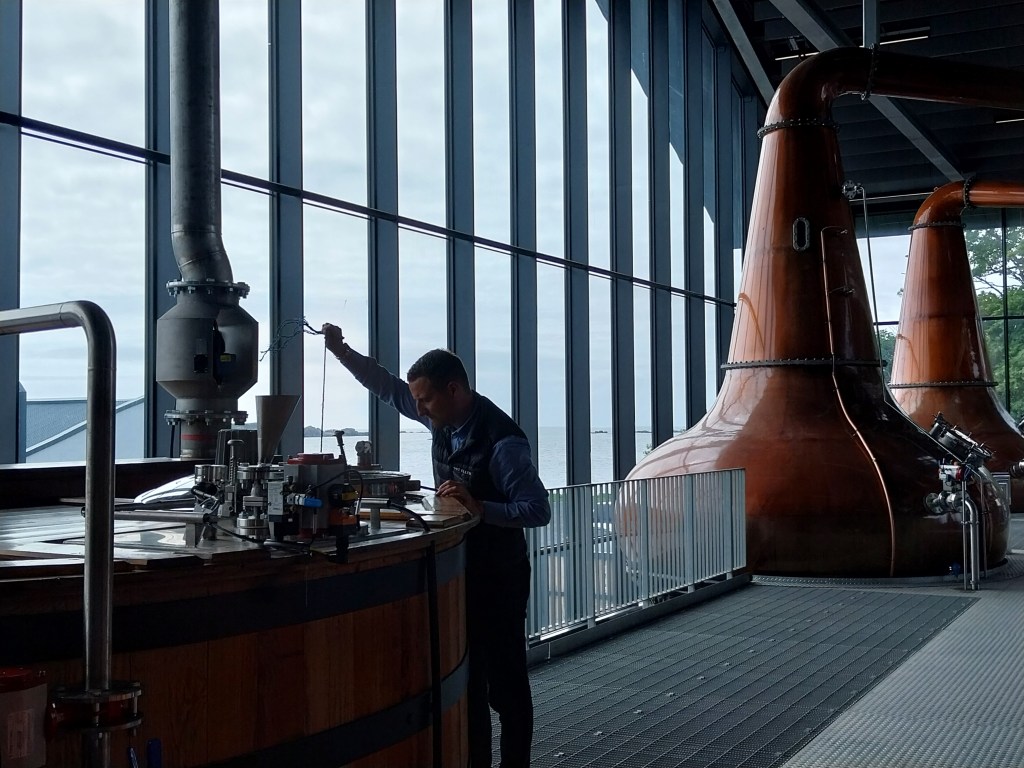
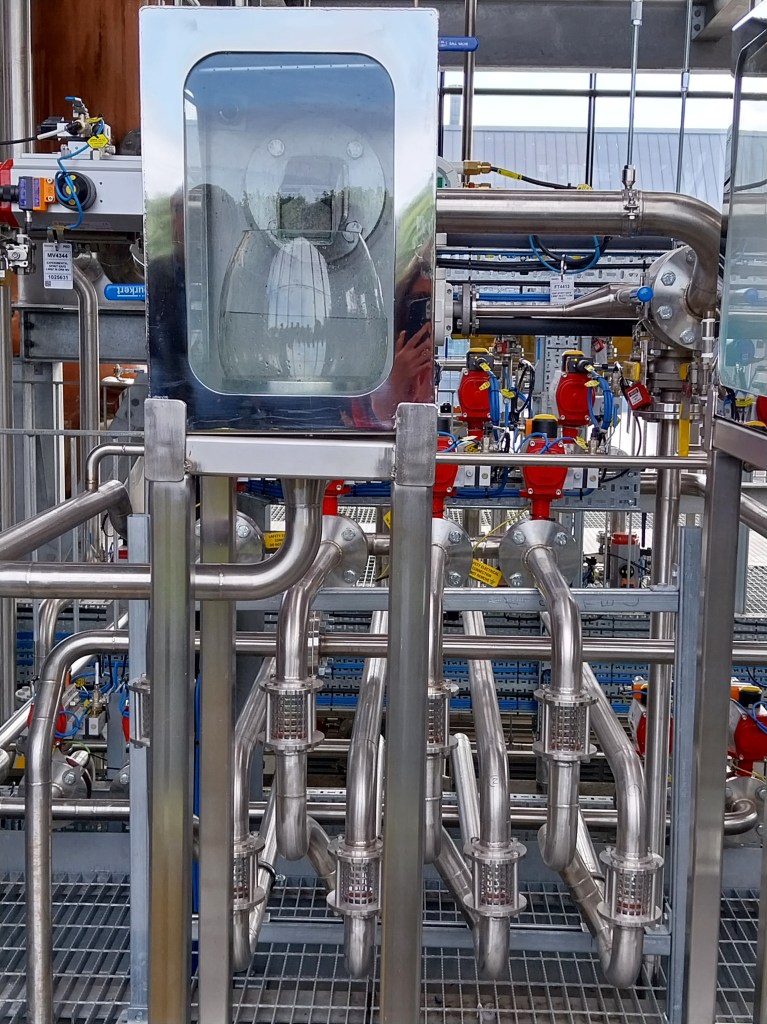
Here is the interesting bit: the old stills that were in the distillery at the times of closing down in the 80s disappeared: they were sent to India and from there they lost track. So, the engineers at Diageoโ€™s Abercrombie had to rely on drawings and sketches to recreate the new ones with the exact same shape. With these stills, the process is the usual: they run a double distillation, with the second cut taken after 25-30 minutes of foreshots, from 72-73% down to 60% (a large one!). The spirit is filled in both tankers and casks on site, usually diluted at 63.5%. However, they also have a second pair of stills, similar but smaller, that they use to experiment. The most interesting part is that instead of having the usual 3-part second distillation (foreshots or head, middle cut or heart, and low wines or tail; the first and last discarded and usually redistilled), the safe can separate out up to 10 different cuts, other than the discarded parts. These donโ€™t get mixed together, and they are used to study and experiment how different cuts provide different flavours to the whisky, and in particular how this relates to the whisky peatiness and smokiness. We got to nose samples, and (maybe the power of suggestion) the difference was definitely there, in particular when comparing the first sample to the last.
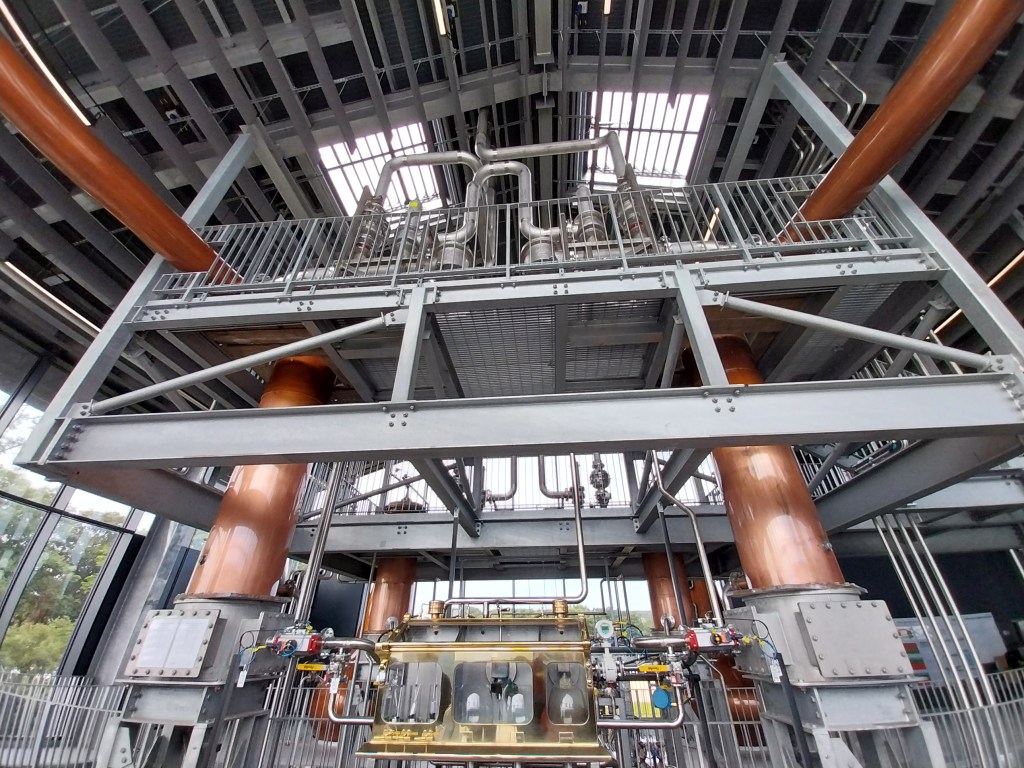
…and experimental spirit safe on the other side.

After this, the tour ended. In general, the distillery manager giving the tour, and in particular the last bit, made the visit really worth it, even if we didnโ€™t manage to try any sample (which we kind of expected). Overall, it was great to see this very beautiful new old distilleryโ€ฆWeโ€™d say weโ€™re looking forward to the whisky in the coming years, but we know weโ€™ll hardly be able to get it, if things stay the way they are now in terms of prices.

Stay tuned for more whisky action, and a little spoiler: we had to take another ferry! Until then, slainte!


Port Ellen Open Day

Price: free (open day, July 2024)

Duration: 1hr

Tasting: nope

Distillery exclusive: none

Target: locals and whisky nerds

Value for money: well, it’s freeee…

Highlights: the beautiful new architecture and the experimental stills

Recommended: yes if it’s the open day

Link: https://www.malts.com/en-row/distilleries/port-ellen

#45.2 Stepping over the (Highland) line!

Back in the Lowlands


TL; DR: After Glengoyne distillery, we headed down back to the Lowlands. First Dumbarton, then Auchentoshan. We had a very in-depth tour, which was great, and we could appreciate every bit of their unique triple distillation process. Worth the money, just a shame the drams were basic. 

(missed Part 1?)

As we came out Glengoyne distillery, we definitely needed some food. Fortunately, we had a couple of sandwiches we got earlier at the Turnip the Beat cafe, quite delicious ones, which we devoured in the Glengoyne visitors parking lot (thus, already in the Lowlands). We soon left though, heading first towards Loch Lomond, and then south. We had a few hours to spare, so we went to Dumbarton, which weโ€™d never visited before.

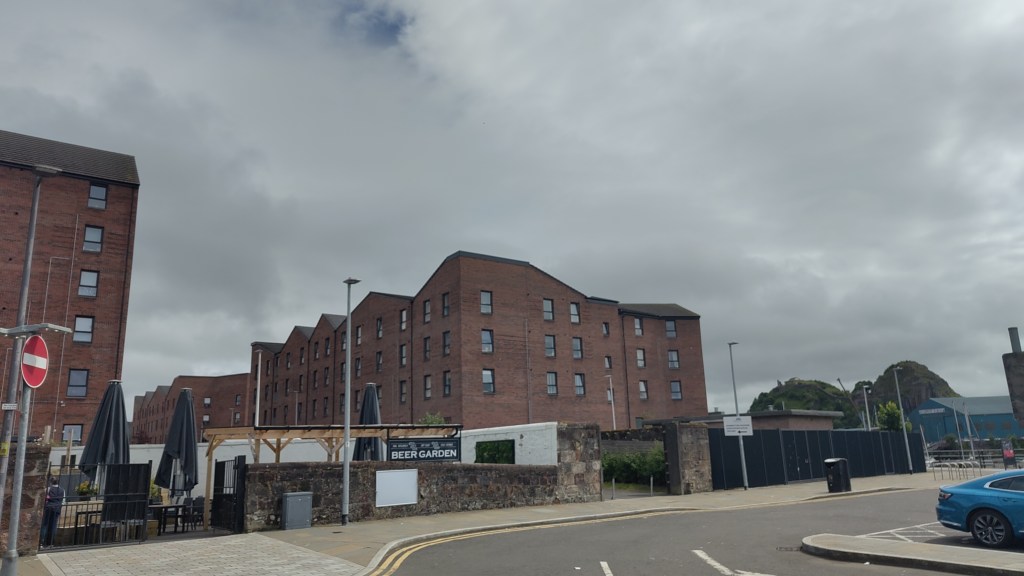
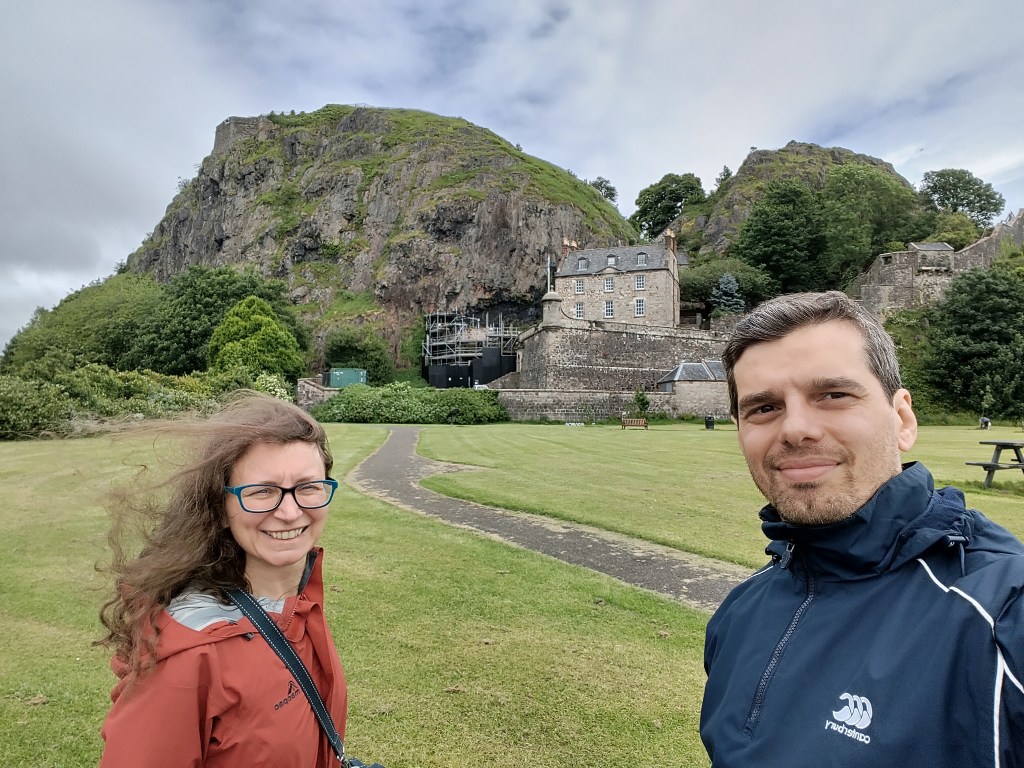
Dumbarton used to be home to the namesake grain distillery, and (on the same site) the Inverleven single malt distillery. Both distilleries started producing in 1938, Inverleven was then closed in 1991 and Dumbarton in 2002. Today there is a housing development on the site, which kept some of the red brick buildings. Other than that, the only remaining signs of this town whisky history are the massive warehouses on the road to Glasgow. We parked at the bottom of the Dumbarton Rock, a huge volcanic plug with a castle on top of it (you guessed it, the Dumbarton Castle). Unfortunately, the castle was closed due to illness (!!!), so we only took a short stroll in the garden below the rock, near the estuary of the river Leven, and then got a coffee and a light bite in town.

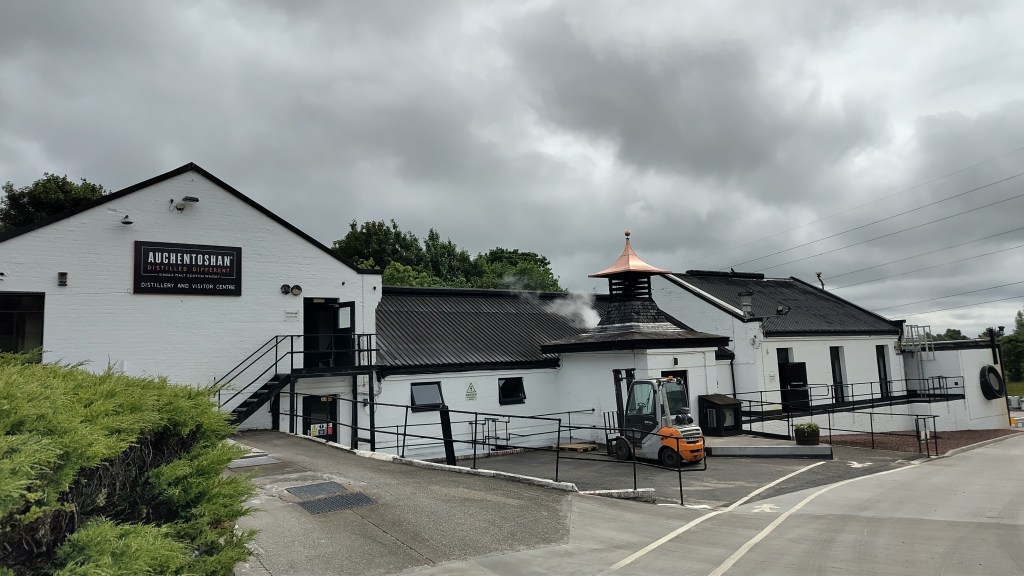
The coffee break was longer than we thought, so we had to sprint to Auchentoshan distillery right away. We got there at the exact minute the tour was starting (although weโ€™d called them to warn we could be late). Our guide was Anya, who started the tour with some history: the distillery was founded in 1817 (licensed in 1823), and the name means the โ€œcorner of the fieldโ€, referring to where the barley was initially harvested. As a matter of fact, there used to be a farm on site since the 1500s.

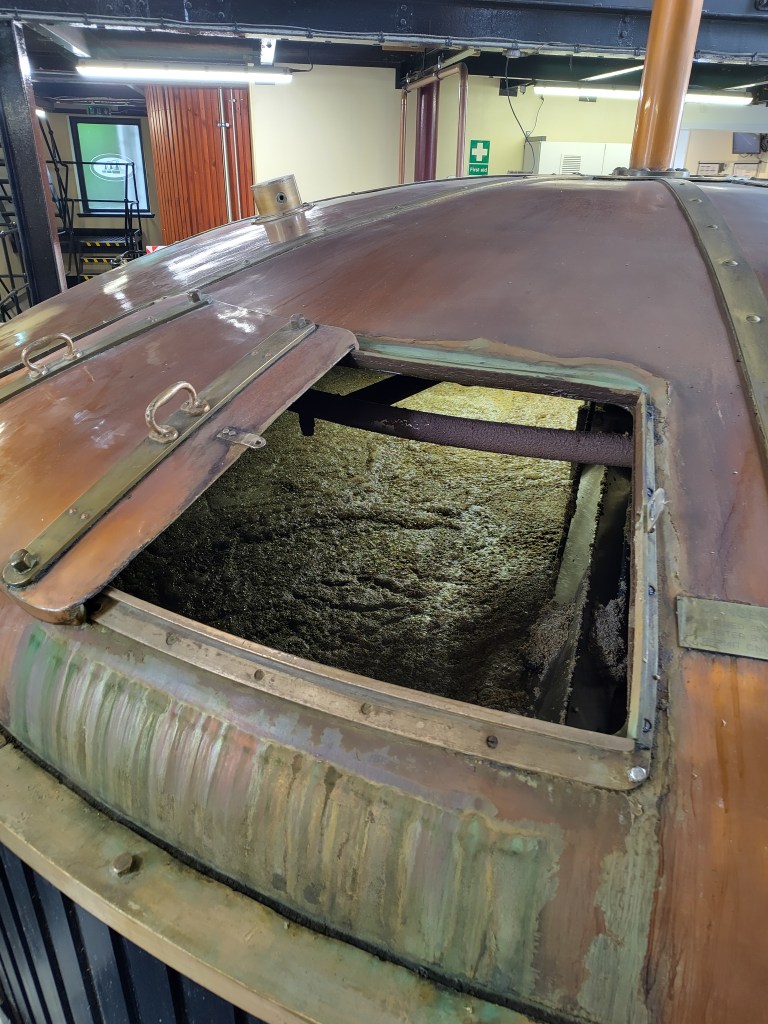
Moving to production, for the mashing they use 7 tons of barley sourced from the big maltsters (Baird, Simpson and Crisp), which goes into a semi-Lauter mashtun with the usual three waters at increasing temperature. Anya told us theyโ€™d just replaced a manual scale with an electronic one, but apparently the new scale needs recalibrating so often that the time savings are not substantial: not all trials go well, we guess. After mashing, the sugary wort is moved to one of the nine washbacks (four made of Oregon pine, five of stainless steel), for a 70h fermentation.

Semi-Lauter mashtun at work.

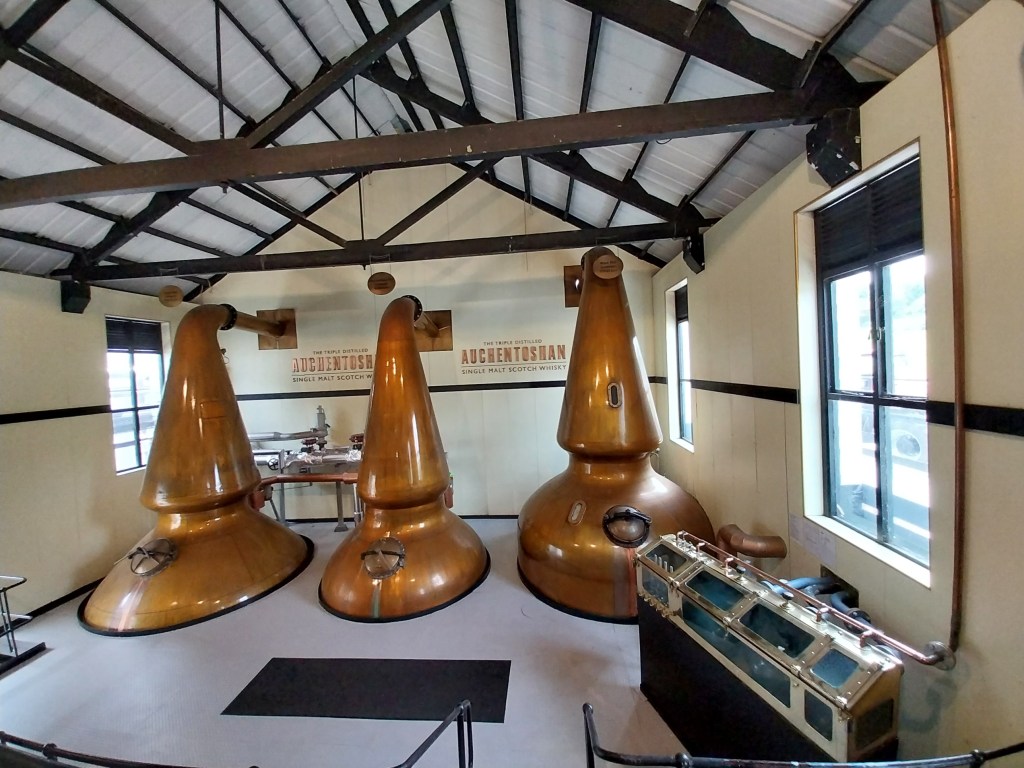
One of the peculiarities of Auchentoshan is their triple distillation, a practice that was once common in the Lowlands distilleries, but gradually disappeared. Now other distilleries we visited do some triple distilled runs at times (Benriach, Benromach, Sprinbgank/Hazelburn, Glengyle), but Auchentoshan remained the only one doing it regularly, before the very recent reopening of Rosebank distillery, in Falkirk. The wash still can hold 17,500 litres, the intermediate 8,200 litres and the spirit still 11,500 litres. Anya described the process well, but it was also good to have, right in front of the stills, a scheme describing everything in detail โ€“ it made it more intuitive. Being triple distilled, the spirit has a higher abv than usual: they take a cut between 82.6% and 80%, average 81%.

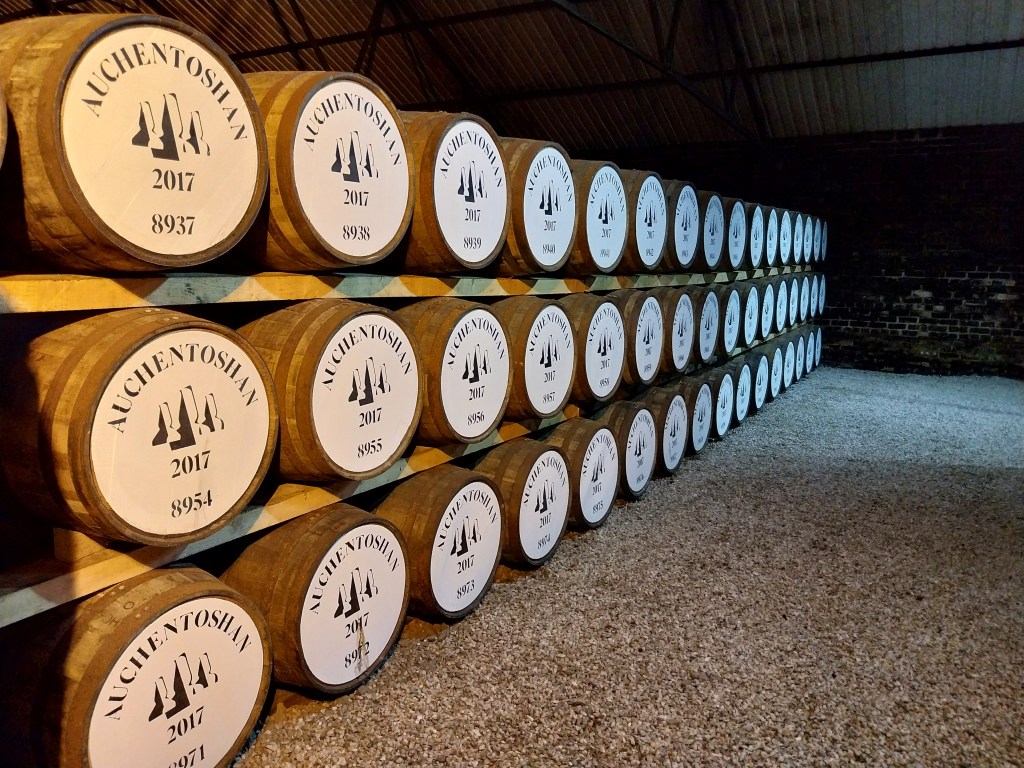
After the still room, Anya walked us into the warehouse, where she explained the maturation process while letting us look at different cask types. Casking and blending donโ€™t happen on site, but in Springburn, where the other Suntory facilities are located.

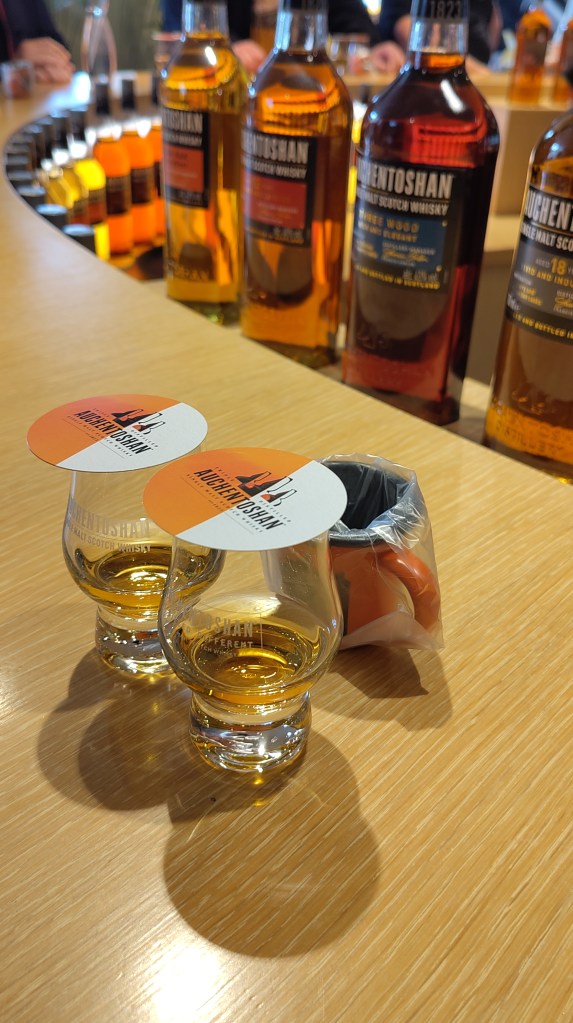
Finally, we went back to the distillery for the tasting, in the same tasting room/bar where we had our tasting back in 2021, above the visitor centre entrance and shop. This time the tasting was not so good – we got a dram of the American Oak (40%, non-age statement, apparently mostly 6y, with some 5y, whisky) and of the 12y (40%), that is, the two most basic expressions. The wee mug they gave us to take home, instead of the usual gleincarn, was a very nice touch, though. We get that this was the entry level tour, but it wouldnโ€™t have costed them much to replace the American Oak with another more โ€˜advancedโ€™ expression: in the shop they have both Bartenderโ€™s Malt limited editions, batch 01 (47%) and 2 (50%), the Sauvignon Blanc cask finish (47%), the travel retail range and a couple of distillery exclusive bottlings (see below), so plenty of options (in theory). Fortunately, at the shop they gave us a wee taste of one of the distillery exclusives, a delicious 9y sherry matured whisky, from an Oloroso cask (59.7%).

Two drams and a wee mug.

At first, we were not sure whether it was a good idea to do the basic tour, but in the end Anya was a great host: very clear and precise when describing the production process of this very unique distillery, she really made our day, so we were happy that we’d decided to go for it. As we said, the dram selection could have been better (yes, in this respect we could have opted for a different โ€˜experienceโ€™), but this has nothing to do with the guide.

Stay tuned for more whisky action, some smoky stuff coming soonโ€ฆUntil then, slainte!


Auchentoshan Origin Tour

Price: ยฃ18.00 pp (June 2024)

Duration: 1hr

Tasting: 2 drams, Auchentoshan American Oak (40%) and 12y (40%), plus a complimentary mini-mug

Distillery Exclusives: Auchentoshan hand-bottled  distillery 9y Oloroso cask (59.7%, distilled 22/10/14, bottled 1/6/24, ยฃ90/30 for 70/20cl) and 22y Oloroso cask (56.2%, distilled 15/10/02, ยฃ250 for 70cl)

Target: tourists and casual drinkers

Value for money: good

Highlights: the triple distillation process showcase

Recommended: yes

Link: https://www.auchentoshan.com/


#45.1 Stepping over the (Highland) line!

An old acquaintance, Glengoyne


TL; DR: We took advantage of a free weekend to get on the van and go for a night away in the (not so wild) wilderness. The next morning, we visited Glengoyne distillery: a very nice tour, although very basic, which ended in a lovely tasting room with some very tasty drams! 

In recent months we had been quite busy, for various reasons: friends visiting, visiting friends, unfortunately work as wellโ€ฆ so, except for the Spirit of Speyside weekend, weโ€™ve not enjoyed much our van. In early June though, we had a weekend with no commitments, so wedecided to spend a night out, not too far away, in the area between Stirling, Glasgow and the Trossachs. This area sits across the Highland Line (roughly, very roughly following the Highland Boundary Fault), which historically was used to separate the taxing regime of whisky producers in the Lowlands and Highlands: we basically spent the weekend crossing it back and forth!

Weโ€™re not new to the area: back in February, we’d spent a lovely evening in Fintry, together with our friend Justine, having a meal at the Fintry Inn, followed by a few nice drams from the Uncharted Whisky Co independent bottler, which has strong ties with the pub (in our understanding, itโ€™s also their tasting room). This time, we aimed for another pub that welcomes campervans, the Pirn Inn in Balfron. The drive was uneventful, but when we got there, we realised they didnโ€™t have a kitchen: dโ€™oh! So, we had to go find food. First, we tried the Old Mill in Killearn, but it was super-busy (in part because of a beer fair they had on for the weekend). Moving on, second time charme: the Clachan Inn in Drymen. We were lucky: it was very busy, which surprised us, before realising it is on the West Highland Way, already swarmed with hikers this time of the year. They found us a table at the bar to be shared temporarily with a couple waiting for their table at the restaurant: we had a nice chat, and as the man was a dairy farmer, Gianluigi asked some questions about farms management and diseasesโ€ฆprofessional bias. After dinner, we quickly drove back to the Pirn Inn, where we had a last pint and a dram (Bunna 12 never disappoints!), before going to sleep.

An ugly glimpse of a much more beautiful spot.

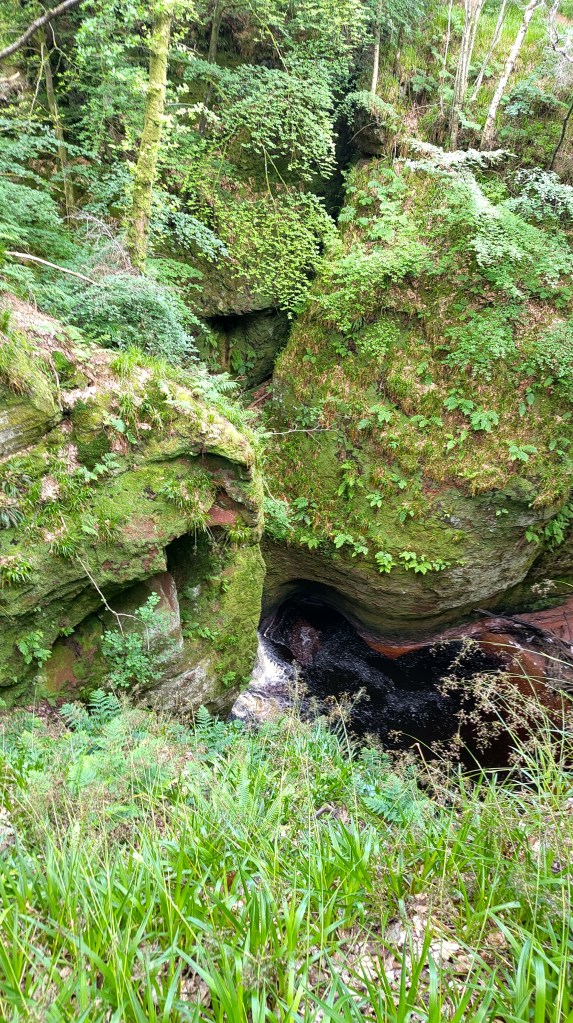
In the morning, the sky was cloudy. We woke up rested, and we somehow managed to avoid midges invading the van, probably thanks to the previous night breeze. We tried to look for an open cafรจ, but we were unluckyโ€ฆ so after a stop for the loo, we drove towards our first destination: the Devilโ€™s Pulpit. The Carnock Burn goes through a very beautiful gorge, all green and brown. Youโ€™d almost expect to find something like this in a tropical jungle, rather than in the Southern Highlands (or Lowlands?). The parking spot can only take three cars (if well parked), so we left Mr Vantastic at a bigger lay-by at the cross of the A809-B834 roads, from where we had to walk no more than 10-15 minutes to find ourselves at the top of the gorge. It was very nice, although we were slightly upset by the amount of garbage found all over the place: from the lay-by, to the side of the road, and in the gorge itself: how can people be so inconsiderate?

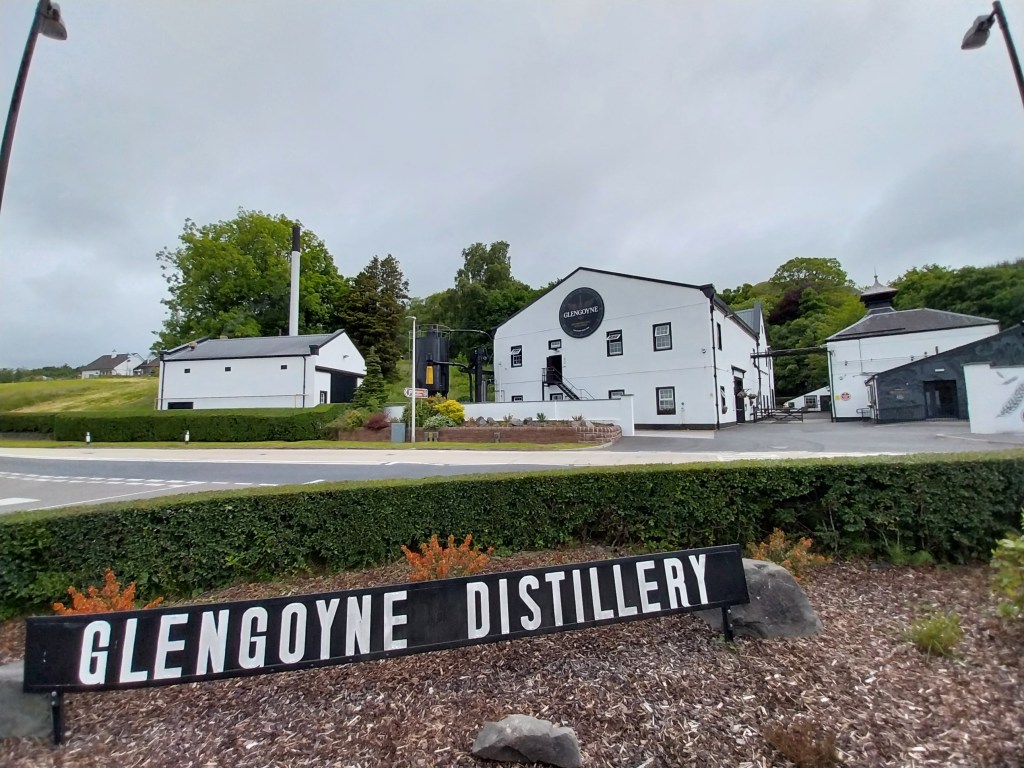
Back to the van, it was time to drive to our next destination: Glengoyne distillery (with a brief stop at the Turnip The Beet for tasty coffee and snacks). Glengoyne is an old acquaintance , as we visited it during the pandemic years (can we say that?) in summer 2021, but at the time we couldnโ€™t tour production because of COVID19 of courseโ€ฆand the waterfall was empty too! Gianluigi had also visited it as part of a networking event after a conference he attended in Glasgow in 2018: too many people, it wasnโ€™t such a memorable experience.

We parked on the south side of the road, which together with their warehouses, is in the Lowlands: the road is the boundary, apparently. Thus, as you can guess, the distillery is in the Highlands. It is owned by Ian McLeodโ€™s Distillers, together with Tamdhu, the newly rebuilt Rosebank, and a the soon to-be-built Laggan Bay, on Islay (in our understanding they also have acquired a single malt distillery in India). As we came out the parking, a hostess pointed us to the check-in for the tour, which started a few minutes earlier in the courtyard. Our tour guide was Diane, โ€œfae Glasgowโ€, and the other two people on the tour were a father-and-son couple from Canada.

In a small exposition room, Diane explained us that the distillery has always been Scottish owned since its foundation and licensing in 1833. It must be one of the few among the old ones, we reckon. Glengoyne means โ€œthe valley of the geeseโ€, and it is located in Dumgoyne (โ€œthe hill of the geeseโ€), hence why you can find this bird on the label.

We quickly moved to production, which is fairly standard. First, Diane showed us a destoner dating back to 1912 and the mill, which we couldnโ€™t take a picture of. The barley varieties they use are mainly Sassy and Lauriet, although one week a year they use Golden Promise, all coming from the East of Scotland.

A shiny mashtun.

The mashtun has a copper lid, and it takes 16,000 litres of water at 63.5ยฐC for the first water, followed by the usual two waters at higher temperatures to maximise the sugar absorption during mashing. Fermentation takes place in one of the six Douglas Fir wood washbacks and lasts about 56 hours, a rather short one. The newmake spirit is obtained after a usual double-distillation process, first in a wash still (16,000 litres), to get to ~20% abv (from their 8-9% wash) and then in one of the two spirit stills (5,000 litres each). Their cut points for the spirit run (what it is going into casks) are generally from 75% to 65%, and the cut is taken only after 3-5 minutes of foreshots.

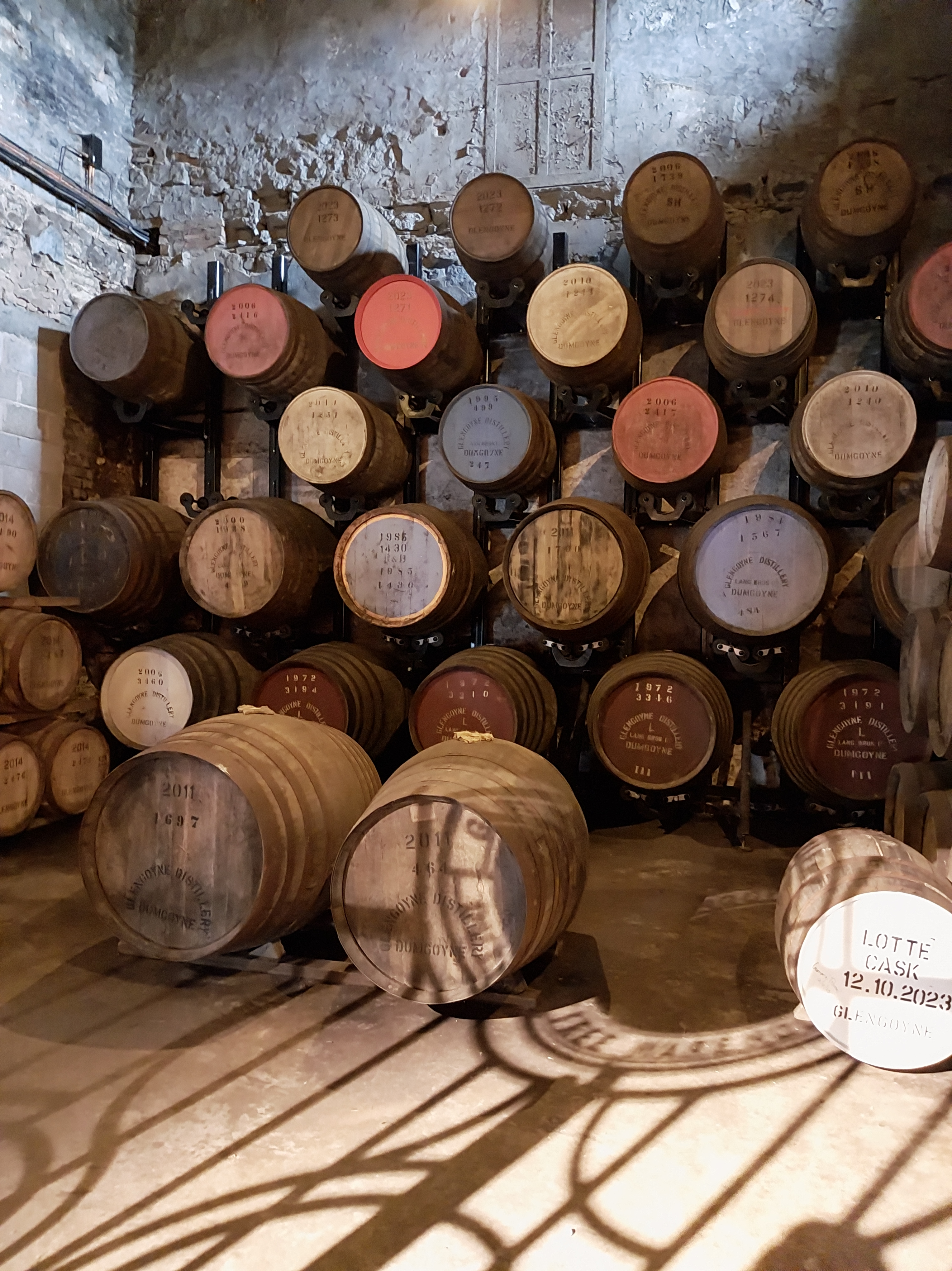
After production, we visited Warehouse 1, next to the production building (not on the other side of the road): quite small, they mostly made a maturation exhibition out of it, where transparent bottles containing spirit and whisky at different stages of maturation are showed, together with the different types of casks and wood. A very interesting bit for more inexperienced visitors. Diane soon after walked us to the Managerโ€™s Cottage, where there is a very nice and relaxing tasting space, with sofas, comfy chairs and fireplaces (they were off while we were there, otherwise we could have easily taken a nap).

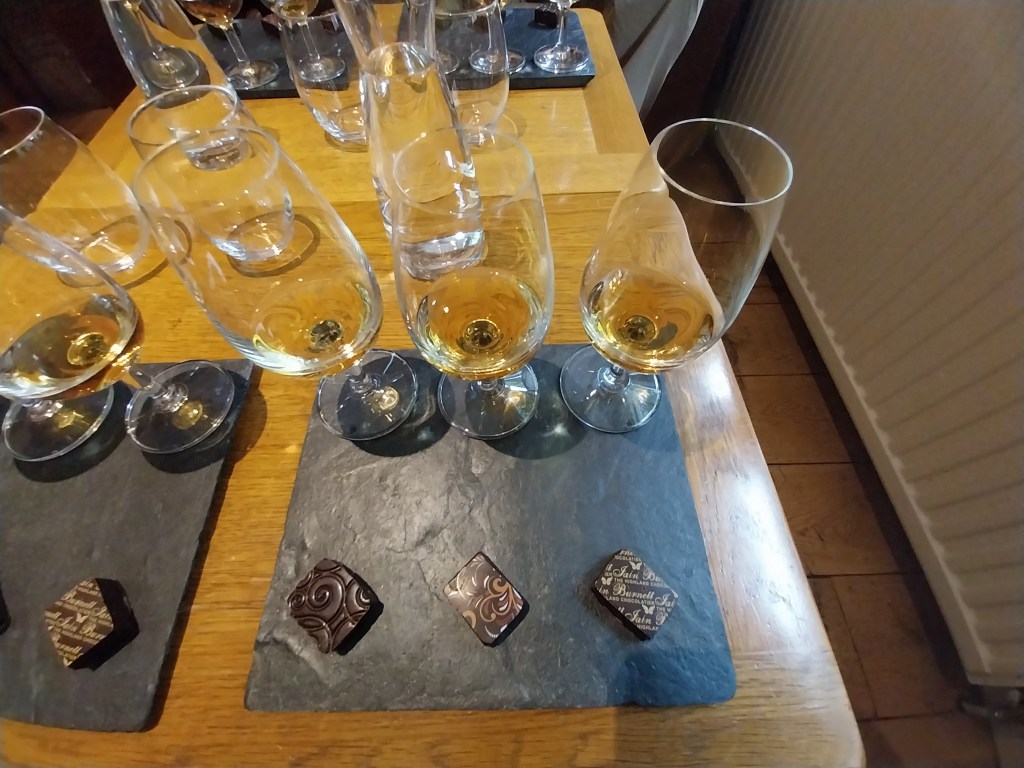
The tasting was ready for us: 3 drams from the core range paired with one chocolate each, from the Highland Chocolatier. First off, the 12y, bottled at 43% and matured in a combination of first-fill European oak (ex-sherry we thinkโ€ฆ20% of the total), first fill American oak ex-bourbon (20%), and not better specified refill casks (60%). Quite nice and bright. The second dram was the 18y, again bottled at 43%, but with a different composition: less refill (50%) and ex-bourbon (15%) casks, and more first-fill European oak casks (35%). This brought definitely more dark-fruity notes and richness, although not as rich and decadent as the last dram. This was a 21y, fully matured in first-fill European oak casks.

Overall the visit was nice, geared towards less whisky knowledgeable visitors though. The best part was the tasting – while we were a bit sceptical because of the low abv, these were delicious and not watery at all. A shame their prices are a bit higher than expected (in particular in the shop, and even taking into account the discount for visitors doing a tour or a tasting), which is probably the main reason we havenโ€™t connected so much with this distillery so far. However, the velvety and soothing quality of these drams was not lost on us, and we think they are perfect to share with family and friends less used to higher strength drams than us. So who knows, maybe one coming in the future?

Stay tuned for the rest of our trip, this time definitely below the Highland line! Until then, slainte!


Glengoyne Collection Tour and Tasting

Price: ยฃ35.00 pp (June 2024, plus ยฃ3.50 booking fee per transaction)

Duration: 1hr 30min

Tasting:3 drams, Glengoyne 12 (43%), Glengoyne 18 (43%) and Glengoyne 21 (43%)

Highlights: the tasting room

Distillery exclusive: Glengoyne Distillery Cask, ex-Port, 14y (56%, distilled 14/04/2010, ยฃ200…!)

Target: the whisky curious

Value for money: good

Recommended: yes

Link: https://www.glengoyne.com/